- Matter and Its States
- Definition of Matter
- Description:
- Matter is anything that occupies space, has mass, and can be perceived by the senses.
- Comprises materials like stones, clouds, food, stars, plants, and water droplets, all characterized by mass, volume, physical resistance, and inertia.
- Historical Perspective:
- Early Indian philosophers classified matter into five basic elements, termed ‘Pancha Tatva’: air, earth, fire, sky, and water.
- They believed all living and non-living entities are composed of these elements.
- Characteristics of Matter
- Particle Nature:
- Matter consists of extremely small particles, beyond human visualization.
- Intermolecular Space:
- Particles have spaces between them, known as intermolecular space.
- Kinetic Energy:
- Particles are in constant motion, possessing kinetic energy.
- As temperature increases, particle speed rises, increasing kinetic energy: \( KE \propto T \).
- Intermolecular Forces:
- Particles attract each other via intermolecular forces, which hold them together.
- The strength of these forces varies across different types of matter.
- Particles of Matter
- Atoms:
- Definition:
- Derived from the Greek word ‘atomos’ (indivisible), an atom is the smallest particle of an element that may or may not exist independently while retaining all chemical properties.
- Participates in chemical reactions.
- Properties:
- Atoms of different elements have distinct masses and chemical properties.
- Molecules:
- Definition:
- A molecule is a group of two or more atoms chemically bonded, capable of independent existence, and exhibiting all properties of the substance.
- Does not participate in chemical reactions.
- Types of Molecules:
- Homomolecules (Molecules of Elements):
- Composed of identical atoms.
- Examples:
- Oxygen (\( O_2 \)), Hydrogen (\( H_2 \)), Nitrogen (\( N_2 \)).
- Atomicity:
- Number of atoms in a molecule, e.g., Phosphorus (\( P_4 \)) has atomicity 4, Sulphur (\( S_8 \)) has atomicity 8.
- Heteromolecules (Molecules of Compounds):
- Composed of atoms from different elements in fixed proportions.
- Examples:
-
| Compound | Combining Elements | Ratio by Mass |
|---|
| Water (\( H_2O \)) | Hydrogen, Oxygen | 1:8 |
| Ammonia (\( NH_3 \)) | Nitrogen, Hydrogen | 14:3 |
| Carbon Dioxide (\( CO_2 \)) | Carbon, Oxygen | 3:8 |
- States of Matter
- Overview:
- Matter exists in three primary states—solid, liquid, and gas—due to variations in intermolecular forces and spaces.
- Solid State:
- Characteristics:
- Definite mass, volume, and shape (e.g., wood, table, pen, book).
- Small intermolecular spaces with strong intermolecular forces.
- Particles (atoms, molecules, or ions) oscillate about fixed positions, making solids incompressible and rigid.
- High density and generally high melting points due to strong intermolecular forces.
- Classification of Solids:
- Crystalline Solids:
- Composed of many crystals with regular particle arrangements.
- Examples:
- Sodium chloride, diamond, quartz, graphite.
- Amorphous Solids:
- Particles have irregular shapes and disordered arrangements.
- Examples:
- Glass, rubber, plastics.
- Also called pseudo solids or supercooled liquids.
- Everyday Science:
- Rubber bands change shape under force but regain shape when force is removed, confirming their solid nature despite flexibility.
- Sponges are compressible solids due to air-filled holes; compression expels air.
- Solids resist hand movement due to strong intermolecular forces, unlike air or water.
- Ice floats on water due to lower density from weaker hydrogen bonding and air-filled spaces: \( \rho_{ice} < \rho_{water} \).
- Liquid State:
- Characteristics:
- No fixed shape but fixed volume; takes the shape of the container (e.g., water, oil, milk).
- Planar upper surface regardless of container shape.
- Less dense than solids, with weaker intermolecular forces allowing particle mobility but not escape, making liquids fluids.
- Gaseous State:
- Characteristics:
- No fixed shape or volume; occupies the container’s shape and size (e.g., air, \( H_2 \), \( O_2 \), \( N_2 \)).
- Very weak intermolecular forces and large intermolecular spaces, making gases highly compressible and fluid.
- Gases expand significantly when heated due to weak forces.
- Gaseous Pressure:
- Results from high-speed, random particle motion causing collisions with each other and container walls.
- Additional States of Matter:
- Plasma:
- Composed of super-energetic, ionized gas particles.
- Found in fluorescent tubes (helium), neon sign bulbs (neon), and stars due to high temperatures.
- Bose-Einstein Condensate (BEC):
- Formed by cooling a low-density gas (about \( 10^{-5} \) of air density) to extremely low temperatures.
- Named after Satyendra Nath Bose and Albert Einstein.
- Nobel Prize awarded in 2001 to Eric A. Cornell, Wolfgang Ketterle, and Carl E. Wieman for achieving BEC.
- Diffusion
- Definition:
- Intermixing of particles of different matter types on their own.
- Example:
- Ink drop spreading evenly in water.
- Factors Affecting Diffusion:
- Heating increases particle speed, reducing intermolecular forces and increasing intermolecular space, thus speeding up diffusion.
- Example:
- Hot food’s smell travels farther than cold food’s due to faster diffusion: \( \text{Rate} \propto T \).
- Diffusion Across States:
- Solids, liquids, and gases can diffuse into liquids; liquids diffuse faster than solids due to greater particle mobility.
- Gases diffuse rapidly into other gases due to high particle speed and large intermolecular spaces.
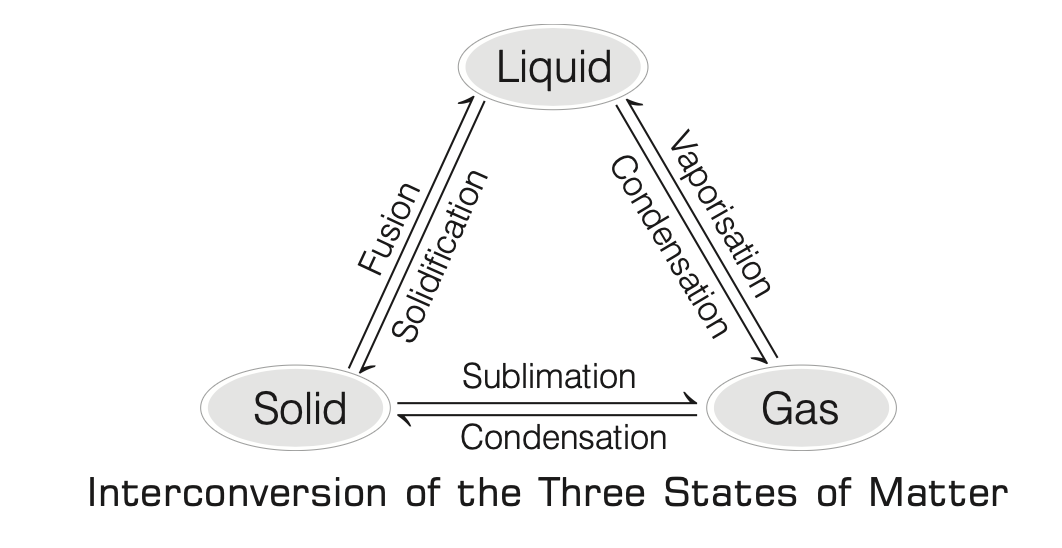
- Interconversion of States of Matter
-
- Overview:
- States are interconvertible by changing temperature or pressure.
- Processes:
- Fusion:
- Solid to liquid (melting).
- Solidification:
- Liquid to solid.
- Vaporisation:
- Liquid to gas.
- Condensation:
- Gas to liquid or liquid to solid.
- Sublimation:
- Solid to gas without liquid phase.
- Key Terms:
- Fusion:
- Conversion of solid to liquid.
- Melting Point:
- Temperature at which a solid melts at atmospheric pressure.
- Indicates strength of intermolecular forces; higher melting point implies stronger forces.
- Example:
- Ice melts at \( 0^\circ C \).
- Sublimation:
- Direct conversion of solid to gas on heating, and back to solid on cooling.
- Examples:
- Naphthalene, camphor, dry ice.
- Vaporisation:
- Liquid to gas on heating; called evaporation if below boiling point.
- Boiling Point:
- Temperature at which a liquid boils at atmospheric pressure; a bulk phenomenon.
- Example:
- Water boils at \( 100^\circ C \) at standard pressure.
- Condensation:
- Gas to liquid or liquid to solid.
- Latent Heat:
- Heat absorbed or released during a state change at constant temperature.
- Latent Heat of Fusion:
- Heat required to convert 1 kg of solid to liquid at its melting point.
- Example:
- Water at \( 0^\circ C \) has more energy than ice at \( 0^\circ C \) due to latent heat.
- Latent Heat of Vaporisation:
- Heat required to convert 1 kg of liquid to gas at its boiling point.
- Temperature remains constant during boiling due to latent heat.
- Effect of Temperature:
- Heating increases kinetic energy, causing particles to vibrate faster, overcome intermolecular forces, and transition from solid to liquid.
- Effect of Pressure:
- Increasing pressure and reducing temperature converts gas to liquid or liquid to solid; decreasing pressure and increasing temperature reverses this.
- Examples:
- Steam at \( 373 \, K (100^\circ C) \) has more energy than water at the same temperature due to latent heat of vaporisation, causing worse burns.
- At high altitudes, low atmospheric pressure lowers water’s boiling point (\( T_b < 100^\circ C \)), increasing cooking time.
- In pressure cookers, high pressure raises the boiling point (\( T_b > 100^\circ C \)), reducing cooking time.
- Impurities increase boiling point and decrease freezing point.
- Dry ice (solid \( CO_2 \)) sublimes to gas at 1 atm without liquifying.
- Chemical Classification of Matter
-
- Overview:
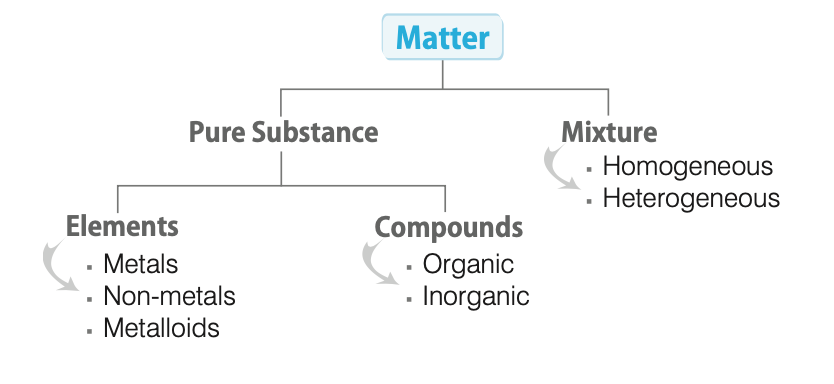
- Matter is classified based on chemical composition into pure substances and mixtures.
- Pure Substances:
- Elements:
- Definition:
- Basic form of matter that cannot be broken down by physical or chemical processes, composed of one type of atom.
- First defined by Robert Boyle (1661) and Antoine Lavoisier (1743–94).
- Types:
- Solids:
- Aluminium (\( Al \)), Iron (\( Fe \)), Gold (\( Au \)), Silver (\( Ag \)).
- Liquids:
- Mercury (\( Hg \)), Bromine (\( Br \)).
- Gases:
- Argon (\( Ar \)), Helium (\( He \)), Oxygen (\( O_2 \)), Hydrogen (\( H_2 \)).
- Total:
- 118 elements, 98 naturally occurring, rest synthetic.
- Symbols:
-
| Element | Symbol | Element | Symbol | Element | Symbol |
|---|
| Aluminium | Al | Copper | Cu | Nitrogen | N |
| Argon | Ar | Fluorine | F | Oxygen | O |
| Barium | Ba | Gold | Au | Potassium | K |
| Boron | B | Hydrogen | H | Silicon | Si |
| Bromine | Br | Iodine | I | Silver | Ag |
| Calcium | Ca | Iron | Fe | Sodium | Na |
| Carbon | C | Lead | Pb | Sulphur | S |
| Chlorine | Cl | Magnesium | Mg | Uranium | U |
| Cobalt | Co | Neon | Ne | Zinc | Zn |
- Naming:
- Symbols derived from Latin, German, or Greek names; first letter capitalized, second lowercase.
- Subcategories:
- Metals, non-metals, metalloids (properties discussed later).
- Compounds:
- Definition:
- Pure substances composed of two or more elements chemically combined in fixed proportions.
- Examples:
- Water (\( H_2O \)), Methane (\( CH_4 \)), Sugar (\( C_{12}H_{22}O_{11} \)), Salt (\( NaCl \)), Baking Soda (\( NaHCO_3 \)).
- Properties:
- Fixed composition, distinct from constituent elements.
- Can be broken down chemically or electrochemically, not physically.
- Categorized as organic (carbon-based) or inorganic (non-carbon-based).
- Mixtures:
- Definition:
- Impure substances with variable proportions of components (e.g., air, seawater, minerals, soil).
- Separable by physical or mechanical processes.
- Types:
- Homogeneous Mixtures:
- Uniform composition throughout.
- Examples:
- Salt in water, sugar in water, methanol in water, vinegar, toothpaste, soap, soft drinks.
- Also called true solutions; solute particle diameter < 1 nm.
- Heterogeneous Mixtures:
- Non-uniform composition with distinct parts.
- Examples:
- Sodium chloride and iron filings, dust in air, salt and sulphur, oil and water, milk (colloid), suspensions.
- Everyday Science:
- Earthen pots cool water in summer due to evaporation through pores, reducing water temperature as energy is absorbed.
- Cotton clothes aid evaporation in summer, cooling the body.
- Water droplets form on cold glass surfaces as water vapor condenses upon losing energy.
- Nail polish remover or spirit cools the skin via evaporation, absorbing heat.
- Sprinkling water on hot roofs cools them due to water’s high latent heat.
- Separating Components of a Mixture
- Heterogeneous Mixtures:
- Separated by physical methods like hand-picking, sieving, filtration.
- Homogeneous Mixtures:
- Require special techniques:
- Evaporation:
- Separates volatile solvents from non-volatile solutes (e.g., salt from seawater).
- Rate increases with temperature, surface area, wind speed, and decreases with humidity.
- Centrifugation:
- Uses centrifugal force to separate denser particles (bottom) from lighter ones (top).
- Applications:
- Blood/urine tests, butter separation from cream, water removal in washing machines.
- Separating Funnel:
- Separates immiscible liquids based on density (e.g., oil and water, slag from molten iron in furnaces).
- Sublimation:
- Separates sublimates (e.g., naphthalene, camphor, dry ice, \( NH_4Cl \), \( HgCl_2 \)) from non-sublimates by heating and cooling vapors.
- Chromatography:
- Separates components with different adsorption capacities (e.g., dyes, pigments, drugs, ink components).
- Invented by Tswett; based on Greek ‘Kroma’ (color).
- Distillation:
- Separates liquids based on boiling point differences (e.g., chloroform and aniline, acetone and water).
- Involves vaporisation and condensation.
- Fractional Distillation:
- Used for miscible liquids with boiling point differences < 25 K (e.g., air gases, petroleum fractions).
- Distillation Under Reduced Pressure:
- For high-boiling-point liquids or those decomposing at boiling points (e.g., glycerol in soap industry).
- Steam Distillation:
- Separates steam-volatile, water-immiscible substances (e.g., aniline, sandalwood oil, turpentine oil).
- Crystallisation:
- Purifies solids by forming crystals from a saturated solution (e.g., salt, alum purification).
- Mass Terms Related to Matter
- Atomic Mass:
- Relative mass compared to carbon-12, expressed in atomic mass units (amu or u).
- \( 1 \, \text{u} = 1.66056 \times 10^{-24} \, \text{g} \), one-twelfth the mass of a carbon-12 atom.
- Average Atomic Mass:
- Weighted average of isotopic masses based on natural abundance.
- Molecular Mass:
- Sum of atomic masses of all atoms in a molecule, in u.
- Example:
- Methane (\( CH_4 \)):
- \( 1 \times 12.011 \, (\text{C}) + 4 \times 1.008 \, (\text{H}) = 16.043 \, \text{u} \).
- Formula Unit Mass:
- Sum of atomic masses in a compound’s formula unit.
- Example:
- Sodium Chloride (\( NaCl \)): \( 1 \times 23 \, (\text{Na}) + 1 \times 35.5 \, (\text{Cl}) = 58.5 \, \text{u} \).
- Equivalent Mass:
- Molecular or formula unit mass divided by valency:
- \( \text{Equivalent Weight} = \frac{\text{Molecular Mass}}{\text{Valency}} \).
- Physical and Chemical Changes
- Physical Change:
- Alters physical properties (shape, size, color, state) without forming new substances; usually reversible.
- Examples:
- Evaporation, melting/freezing of water, cloud formation, stretching a spring.
- Chemical Change:
- Forms new substances by altering molecular composition; irreversible.
- Examples:
- Burning magnesium, coal, wood; photosynthesis (\( CO_2 + H_2O \to C_6H_{12}O_6 \)); rusting; curdling milk.
- Burning a candle involves both physical (wax melting) and chemical (wax burning) changes.
- Bioluminescence:
- Light emission by fireflies via a chemical process in specific organs.
- Laws of Chemical Combinations
- Law of Conservation of Mass:
- Proposed by Antoine Lavoisier (1789).
- Matter is neither created nor destroyed in a chemical reaction:
- \( \text{Total Mass of Reactants} = \text{Total Mass of Products} \).
- Law of Definite Proportions:
- Proposed by Joseph Proust.
- A compound contains elements in a fixed mass ratio.
- Example:
- \( CO_2 \) has carbon and oxygen in a 3:8 mass ratio.
- Law of Multiple Proportions:
- Proposed by Dalton (1803).
- When two elements form multiple compounds, the masses of one element combining with a fixed mass of the other are in a simple ratio.
- Example:
- Water and hydrogen peroxide:
- Water:
- \( 2 \, \text{g H} + 16 \, \text{g O} \to 18 \, \text{g} \, H_2O \).
- Hydrogen Peroxide:
- \( 2 \, \text{g H} + 32 \, \text{g O} \to 34 \, \text{g} \, H_2O_2 \).
- Oxygen masses (16 g, 32 g) with 2 g hydrogen are in a 1:2 ratio.
- Gay-Lussac’s Law of Combining Volumes:
- Proposed by Gay-Lussac (1808).
- Gases combine or are produced in simple volume ratios at constant temperature and pressure.
- Example:
- Hydrogen and oxygen forming water:
- \( 100 \, \text{mL H}_2 + 50 \, \text{mL O}_2 \to 100 \, \text{mL H}_2O \), ratio 2:1.
- Mole Concept
- Definition:
- The mole (mol) is the SI unit for the amount of a chemical species, introduced by Wilhelm Ostwald (1896).
- 1 mole is:
- The amount weighing equal to its formula weight in grams.
- The amount containing \( 6.022 \times 10^{23} \) entities (Avogadro’s number, \( N_A \)).
- For gases, the amount occupying 22.4 L at STP.
- Calculations:
- Number of moles:
- \( n = \frac{\text{Mass of substance (g)}}{\text{Molecular/Atomic weight (g)}} \).
- Number of particles:
- \( N = \frac{\text{Volume of gas at STP (L)}}{22.4} \times N_A \).
- Example:
- 1 mole of \( CH_4 \) = 16.043 g, contains \( 6.022 \times 10^{23} \) molecules, occupies 22.4 L at STP.
- Atomic Structure
- Introduction to Atomic Structure
- Historical Context:
- Until the 19th century, atoms were considered the smallest indivisible particles.
- Experiments revealed atoms are divisible into sub-atomic particles with a definite internal structure.
- Dalton’s Atomic Theory
- Proposed by John Dalton in 1808 in ‘A New System of Chemical Philosophy’:
- Matter consists of minute, indivisible, indestructible particles called atoms.
- All atoms of a given element have identical properties, including mass; atoms of different elements differ in mass and properties.
- Compounds form when atoms of different elements combine in a fixed ratio.
- Chemical reactions involve reorganization of atoms; atoms are neither created nor destroyed.
- Explains laws of chemical combination (e.g., conservation of mass, definite proportions).
- Drawbacks:
- Fails to explain why atoms combine to form molecules.
- Does not account for differences in mass, size, or valency of atoms.
- Lacks explanation for the binding forces responsible for the existence of solids, liquids, and gases.
- Cannot explain the law of gaseous volumes.
- Sub-atomic Particles and Their Properties
- Overview:
- Dalton’s theory was disproved by experiments showing atoms consist of smaller particles called sub-atomic particles (e.g., electron, proton, neutron, positron, neutrino, meson).
- Fundamental particles: Electrons, protons, neutrons.
- Non-fundamental particles appear briefly during particle exchange mechanisms.
- Fundamental Particles:
- Electrons (\( e^- \)):
- Discovery:
- Discovered by J.J. Thomson (1897) in cathode ray experiments.
- At \( 10^{-6} \, \text{atm} \), a high-potential discharge tube produces negatively charged particles (electrons) from the cathode, called cathode rays.
- Characteristics:
- Cathode rays are invisible but detectable with fluorescent or phosphorescent materials (e.g., used in television picture tubes).
- Behave like negatively charged particles in electric or magnetic fields.
- Charge:
- \( -1.602 \times 10^{-19} \, \text{C} \) (determined by Millikan’s oil drop experiment).
- Mass:
- \( 9.11 \times 10^{-31} \, \text{kg} \) (lightest fundamental particle).
- Specific charge (\( e/m \)): \( 1.76 \times 10^8 \, \text{C/g} \) (independent of gas or electrode used).
- Considered to have negligible mass and a charge of \(-1\).
- Protons (\( ^1_1H \)):
- Discovery:
- Discovered by E. Goldstein (1886) as canal rays (positively charged radiations) in gas discharge experiments.
- Named “proton” by Rutherford (1919).
- Characteristics:
- Charge:
- \( +1.6 \times 10^{-19} \, \text{C} \) (equal in magnitude, opposite in sign to electron).
- Mass:
- \( 1.67 \times 10^{-27} \, \text{kg} \).
- Mass taken as 1 unit, charge as \( +1 \).
- Hydrogen (protium) is the only atom without neutrons.
- Neutrons (\( ^0_1n \)):
- Discovery:
- Discovered by Chadwick (1932) by bombarding beryllium with alpha particles.
- Characteristics:
- Electrically neutral (no charge).
- Mass:
- \( 1.67 \times 10^{-27} \, \text{kg} \) (slightly greater than proton).
- Non-Fundamental Particles:
- Positron (\( e^+ \)):
- Discovered by Anderson (1932).
- Antiparticle of electron with positive charge and equal mass.
- Antiproton (\( \bar{p} \)):
- Discovered in 1955.
- Antiparticle of proton with negative charge and equal mass.
- Neutrino and Antineutrino (\( \nu, \bar{\nu} \)):
- Predicted by Pauli (1930), observed in 1956.
- Zero rest mass and charge, possess energy and momentum.
- Mutually antiparticles.
- Pi-mesons (\( \pi^+, \pi^-, \pi^0 \)):
- Predicted by Yukawa (1935), discovered in cosmic rays (1947).
- Types:
- Positive (\( \pi^+ \)), negative (\( \pi^- \)), neutral (\( \pi^0 \)).
- Masses:
- \( \pi^+ \): 274 times electron mass; \( \pi^0 \): 264 times electron mass.
- Explain nuclear forces via exchange between nucleons.
- Quarks and Bosons:
- Quarks:
- Elementary particles forming protons and neutrons, with fractional charges; each proton/neutron contains 3 quarks.
- Bosons:
- Particles with whole-number spin (e.g., mesons, photons).
- Example:
- \( \text{Boson} \to \text{Meson} + \text{Photon} \).
- Notes:
- Every fundamental particle has an antiparticle with opposite properties (e.g., electron and positron differ in charge).
- Non-fundamental particles are categorized by mass, not as antiparticles of fundamental particles.
- Atoms observable only via scanning tunneling microscope.
- All atoms are reactive except noble gases.
- Atom sizes:
- Helium (\( 32 \times 10^{-12} \, \text{m} \)), Cesium (\( 225 \times 10^{-12} \, \text{m} \)).
- Atom existence proposed by Indian and Greek philosophers (400 BC).
- Earlier Atomic Models
- Thomson Model:
- Proposed by J.J. Thomson:
- Atom as a positively charged sphere with embedded electrons, like a Christmas pudding.
- Equal positive and negative charges ensure electrical neutrality.
- Drawback:
- Cannot explain results of alpha-particle scattering experiments.
- Rutherford Model:
- Proposed by Rutherford (1911) based on alpha-particle scattering experiments with gold foil:
- Atom has a positively charged nucleus containing most mass (protons and neutrons, collectively nucleons).
- Electrons revolve in orbits around the nucleus, leaving most of the atom as empty space.
- Nucleus size is very small compared to the atom.
- Drawbacks:
- Electrons in circular orbits should radiate energy due to centripetal acceleration, spiral inward, and collapse into the nucleus, per classical electrodynamics.
- Contradicts observed atomic stability.
- Bohr’s Model:
-
- Proposed by Niels Bohr (1913) using Planck’s quantum theory to address Rutherford’s model flaws:
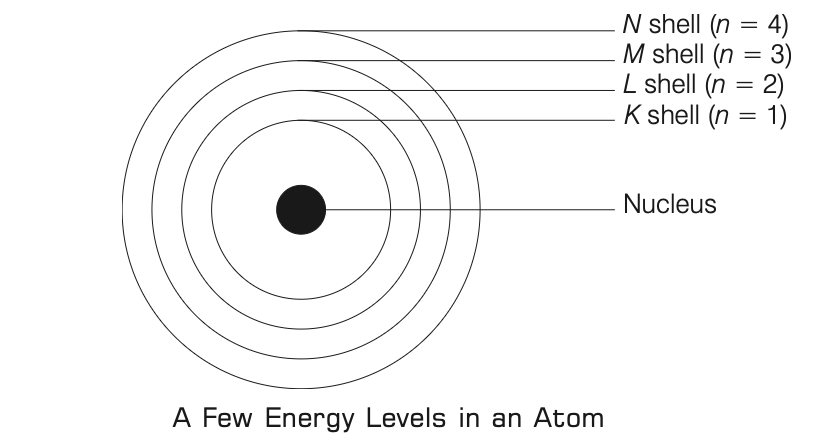
- Electrons revolve in orbits without energy loss, each associated with a definite energy level (shells: K, L, M, N or \( n = 1, 2, 3, 4, \ldots \)).
- Electrostatic Coulomb force balances centripetal force for electron orbits.
- Angular momentum is quantized: \( mvr = \frac{nh}{2\pi} \), where \( n = 1, 2, 3, \ldots \), \( h \) is Planck’s constant.
- Energy emission/absorption occurs only when electrons transition between levels: \( \Delta E = E_2 - E_1 = \frac{hc}{\lambda} \).
- Higher orbital radius corresponds to higher energy.
- Drawbacks:
- Fails to explain spectra of atoms with multiple electrons (e.g., helium).
- Cannot account for spectral line splitting in magnetic (Zeeman effect) or electric (Stark effect) fields.
- Does not explain chemical bond formation.
- Characteristics of an Atom
- Atomic Number (\( Z \)):
- Number of protons in the nucleus, equal to the number of electrons in a neutral atom.
- Example:
- Oxygen has 8 protons and 8 electrons, so \( Z = 8 \).
- \( Z = \text{Number of protons} = \text{Number of electrons} \).
- Moseley’s Law:
- Properties of elements depend more on atomic number than mass, shown by comparing elemental properties with atomic number and mass.
- Mass Number (\( A \)):
- Total number of nucleons (protons + neutrons) in the nucleus.
- Example:
- Oxygen with 8 protons and 8 neutrons has \( A = 16 \).
- \( A = \text{Number of protons} + \text{Number of neutrons} \).
- Number of neutrons:
- \( N = A - Z \).
- Atomic notation: \( ^A_ZX \).
- Ions:
- Anion:
- Atom with more electrons than protons (negative charge).
- Cation:
- Atom with more protons than electrons (positive charge).
- Different Atomic Species
- Isotopes:
- Atoms of the same element with the same atomic number (\( Z \)) but different mass numbers (\( A \)) due to varying neutron counts.
- Examples:
- Hydrogen isotopes: \( ^1_1H \) (protium), \( ^2_1H \) (deuterium), \( ^3_1H \) (tritium, radioactive); Carbon isotopes: \( ^12_6C, ^13_6C, ^14_6C \).
- Same chemical properties, different physical properties.
- Occupy the same periodic table position.
- Hydrogen isotopes uniquely named; polonium has the most isotopes.
- Isobars:
- Atoms of different elements with the same mass number (\( A \)) but different atomic numbers (\( Z \)).
- Examples:
- \( ^40_{14}S, ^40_{17}Cl, ^40_{18}Ar, ^40_{19}K, ^40_{20}Ca \).
- Similar physical properties due to same mass number; placed separately in the periodic table.
- Artificial isobars formed by beta-particle emission from radioactive elements.
- Isotones:
- Atoms of different elements with the same number of neutrons but different \( A \) and \( Z \).
- Examples:
- \( ^23_{11}Na \) and \( ^24_{12}Mg \) (both have 12 neutrons: \( 23-11 = 12 \), \( 24-12 = 12 \)); \( ^31_{15}P \) and \( ^30_{14}Si \) (both have 16 neutrons).
- Isodiaphers:
- Atoms of different elements with the same difference between proton and neutron numbers.
- Example:
- \( ^239_{94}Pu \) and \( ^235_{92}U \).
- Structural Features of an Atom
- Shells and Subshells:
- Shells:
- Orbits of definite energies where electrons revolve; energy increases from innermost (K, \( n=1 \)) to outermost.
- Subshells:
- Within each shell, denoted by \( s, p, d, f \), with specific electron capacities.
- Table of Shells and Subshells:
-
| Shell | Principal Quantum Number (\( n \)) | Subshells | Orbitals | Total Electrons |
|---|
| K | 1 | s | 1 | 2 |
| L | 2 | s, p | 1 + 3 = 4 | 8 |
| M | 3 | s, p, d | 1 + 3 + 5 = 9 | 18 |
| N | 4 | s, p, d, f | 1 + 3 + 5 + 7 = 16 | 32 |
| O | 5 | s, p, d, f, g | 1 + 3 + 5 + 7 + 9 = 25 | 50 |
| P | 6 | s, p, d, f, g, h | 1 + 3 + 5 + 7 + 9 + 11 = 36 | 72 |
| Q | 7 | s, p, d, f, g, h, i | 1 + 3 + 5 + 7 + 9 + 11 + 13 = 49 | 98 |
- Orbitals:
- Three-dimensional regions around the nucleus with maximum electron probability.
- Electron capacities:
- \( s \): 2, \( p \): 6, \( d \): 10, \( f \): 14.
- Shapes:
- \( s \)-orbitals:
- Spherical, with \( n-1 \) spherical nodes (zero electron probability).
- \( p \)-orbitals:
- Three, dumbbell-shaped with two lobes separated by a nodal plane.
- \( d \)-orbitals:
- Five, four double dumbbell-shaped, one dumbbell with a high-density collar.
- Electronic Configuration
- Definition:
- Arrangement of electrons in shells, subshells, and orbitals.
- Bohr-Burry Scheme:
- Proposed by Bohr and Burry (1921):
- Maximum electrons in a shell: \( 2n^2 \) (\( n = 1, 2, 3, \ldots \)).
- Outermost shell:
- Maximum 8 electrons.
- Penultimate shell:
- Maximum 8 electrons unless outermost has 2 electrons.
- To exceed 2 electrons in the outermost shell, penultimate must have 18, outermost 2.
- For 18 electrons in a shell, inner shells must be complete, with outermost and penultimate having 2 and 8 electrons, respectively.
- Electrons fill from inner to outer shells.
- Electron Distribution Example:
-
| Element | Symbol | Atomic Number | Distribution of Electrons |
|---|
| Hydrogen | H | 1 | 1 |
| Helium | He | 2 | 2 |
| Beryllium | Be | 4 | 2, 2 |
| Neon | Ne | 10 | 2, 8 |
| Sodium | Na | 11 | 2, 8, 1 |
| Argon | Ar | 18 | 2, 8, 8 |
| Potassium | K | 19 | 2, 8, 8, 1 |
- nlx Notation:
- Written as \( nl^x \), where \( n \) is the principal quantum number, \( l \) is the subshell (\( s, p, d, f \)), and \( x \) is the number of electrons.
- Examples:
- \( ^11Na: 1s^2 2s^2 2p^6 3s^1 \); \( ^7N: 1s^2 2s^2 2p^3 \); \( ^8O: 1s^2 2s^2 2p^4 \).
- Rules for Filling Electrons:
- Aufbau Principle:
-
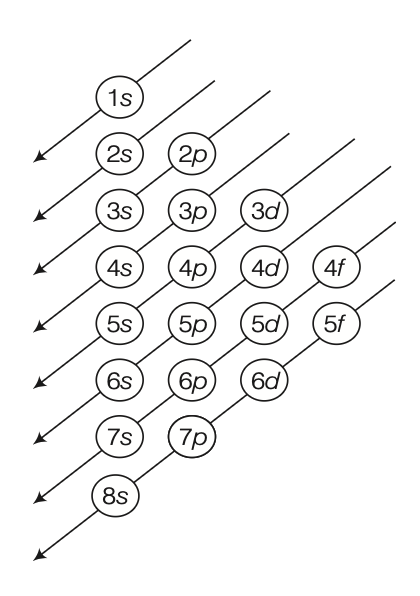
- Electrons fill orbitals in order of increasing energy:
- \( 1s < 2s < 2p < 3s < 3p < 4s < 3d < 4p < 5s < 4d < 5p < 6s < 4f < 5d < 6p < 7s < 5f < 6d < 7p < 8s \).
- Higher-energy orbitals (e.g., \( 5g, 6g, 6h \)) possible but not filled under normal conditions.
- Hund’s Rule of Maximum Multiplicity:
- Electrons singly occupy orbitals in a subshell before pairing to maximize spin multiplicity and stability.
- Pauli Exclusion Principle:
- Proposed by Wolfgang Pauli (1926).
- No two electrons in an atom can have the same set of four quantum numbers.
- If \( n, l, m \) are identical, spin quantum number (\( s \)) must differ (\( +\frac{1}{2} \) or \( -\frac{1}{2} \)).
- Maximum electrons in a shell:
- \( 2n^2 \).
- Valence and Core Electrons:
- Valence Electrons:
- In the outermost shell, determine chemical properties.
- Core Electrons:
- In inner shells.
- Example:
- Magnesium (\( Z=12 \)): \( 2, 8, 2 \) (core: 2, 8; valence: 2).
- Valency Calculation:
- If valence electrons = 1, 2, 3: Valency = Number of valence electrons.
- If valence electrons ≥ 4: Valency = \( 8 - \text{Number of valence electrons} \).
- Valence electrons have higher energy than core electrons.
- Quantum Numbers
- Overview:
- Four quantum numbers describe an electron’s position, energy, subshell, orientation, and spin.
- Principal Quantum Number (\( n \)):
- Positive integer (\( n = 1, 2, 3, \ldots \)).
- Identifies the shell, size, and energy of the orbital.
- Higher \( n \): Higher energy; \( n=1 \) is the ground state.
- Azimuthal Quantum Number (\( l \)):
- Defines subshell and orbital shape: \( l = 0 (s), 1 (p), 2 (d), 3 (f), \ldots \).
- Values:
- \( 0 \) to \( n-1 \).
- Example:
- For \( n=3 \), \( l = 0, 1, 2 \) (\( s, p, d \)).
- Magnetic Quantum Number (\( m \)):
- Determines orbital orientation in a magnetic field.
- Values:
- \( -l \) to \( +l \), including 0.
- Total values:
- \( 2l + 1 \), equal to the number of orbitals in a subshell.
- Examples:
- For \( l=0 \), \( m=0 \) (1 \( s \)-orbital); for \( l=1 \), \( m=-1, 0, +1 \) (3 \( p \)-orbitals); for \( l=2 \), \( m=-2, -1, 0, +1, +2 \) (5 \( d \)-orbitals).
- Spin Quantum Number (\( s \)):
- Represents electron spin (clockwise or anticlockwise): \( s = +\frac{1}{2} \) or \( -\frac{1}{2} \).
- Spin angular momentum is quantized; each orbital holds up to two electrons with opposite spins.
- Bonding and Chemical Reactions
- Chemical Bond
- Definition:
- The attractive force holding atoms, ions, or other constituents together in chemical species, maintaining a specific geometrical shape and mutual atomic order.
- Formation is exothermic, releasing energy and decreasing the system’s free energy.
- Valency
- Definition:
- The combining capacity of an element, determined by the number of valence electrons.
- Noble Gases:
- Include Helium (\( He \)), Neon (\( Ne \)), Argon (\( Ar \)), Krypton (\( Kr \)), Xenon (\( Xe \)), Radon (\( Rn \)).
- Valency is zero due to stable outermost shells (octet: 8 electrons, except \( He \): 2 electrons).
- Exist as monoatomic gases, not participating in bonding due to no tendency to lose, gain, or share electrons.
- Valency Rules:
- For 1, 2, 3, or 4 valence electrons: Valency = Number of valence electrons.
- For 5, 6, 7, or 8 valence electrons: Valency = \( 8 - \text{Number of valence electrons} \).
- Example:
- Sodium (\( Na \): 2, 8, 1) has 1 valence electron, loses it to form \( Na^+ \) (2, 8), valency = 1.
- Notes:
- Term ‘valence’ from Latin ‘valentia’ (strength, capacity).
- Valence electrons:
- Electrons in the outermost shell (valence shell).
- Electronic Theory of Chemical Bonding (Octet Rule)
- Proposed by Kossel and Lewis (1916):
- Atoms combine by transferring or sharing valence electrons to achieve a stable octet (8 electrons) or duplet (\( He \)) in their valence shells, mimicking noble gases.
- Example:
- Sodium chloride (\( NaCl \)): \( Na \) (2, 8, 1) loses an electron to form \( Na^+ \) (2, 8); \( Cl \) (2, 8, 7) gains an electron to form \( Cl^- \) (2, 8, 8).
- Ions
- Definition:
- Electrically charged atoms or groups of atoms.
- Cations:
- Positively charged, formed by electron loss (e.g., \( Na^+, Mg^{2+}, Ca^{2+}, Al^{3+} \)).
- Anions:
- Negatively charged, formed by electron gain (e.g., \( F^-, Cl^-, O^{2-}, CO_3^{2-} \)).
- Characteristics:
- Metallic elements (electropositive) form cations.
- Non-metallic elements (electronegative) form anions.
- Exceptions:
- Non-metal-based cations like \( H^+ \), \( NH_4^+ \).
- Types of Bonding
- Overview:
- Divided into chemical bonding (ionic, covalent, coordinate) and physical bonding (hydrogen, van der Waals’).
- Ionic or Electrovalent Bond:
- Definition:
- Formed by electrostatic attraction between positive and negative ions after electron transfer from a metal to a non-metal, achieving octet or duplet.
- Example: Sodium Chloride (\( NaCl \)):
- \( Na (2, 8, 1) \to Na^+ (2, 8) + e^- \).
- \( Cl (2, 8, 7) + e^- \to Cl^- (2, 8, 8) \).
- \( Na^+ + Cl^- \to NaCl \), held by electrostatic forces.
- Other Examples:
- \( MgCl_2, CaO, NH_4Cl, NaOH \).
- Electrovalency:
- Number of unit charges on the ion (e.g., \( Na \), \( Cl \): 1).
- Characteristics:
- Crystalline solids, hard and brittle due to long-range order.
- High melting and boiling points due to strong electrostatic forces.
- Non-volatile, high density.
- Soluble in polar solvents (e.g., water) due to high dielectric constant; insoluble in non-polar solvents (e.g., benzene, acetone).
- Conduct electricity in aqueous or molten states due to mobile ions; non-conductive in solid state.
- Undergo fast reactions in solution.
- Covalent Bond:
- Definition:
- Formed by sharing electrons between atoms with similar electronegativity to achieve noble gas configuration.
- Example:
- Chlorine (\( Cl_2 \)):
- Each \( Cl \) (2, 8, 7) shares one electron to form a shared pair, achieving octet (2, 8, 8).
- Types:
- Single Covalent Bond:
- One shared electron pair (e.g., \( H-H \) in \( H_2 \)).
- Double Covalent Bond:
- Two shared electron pairs (e.g., \( O=C=O \) in \( CO_2 \)).
- Triple Covalent Bond:
- Three shared electron pairs (e.g., \( N\equiv N \) in \( N_2 \)).
- Covalency:
- Number of electrons an atom contributes for sharing.
- Examples:
- \( H_2 \): H covalency = 1; \( N_2 \): N covalency = 3; \( CH_4 \): C covalency = 4, H covalency = 1.
- Characteristics:
- Exist as gases, liquids, or soft solids (exceptions: diamond, \( SiO_2 \), \( SiC \)).
- Low melting and boiling points due to weak intermolecular forces.
- Insoluble in water, soluble in non-polar solvents (e.g., benzene, \( CCl_4 \)); exceptions like sugar, alcohol due to hydrogen bonding.
- Poor electrical conductors (exception: graphite due to free electrons).
- Rigid, directional bonds, leading to specific molecular shapes.
- Slow, complex reactions.
- Types Based on Polarity:
- Non-polar Covalent Bond:
- Formed between identical atoms; shared electrons equally attracted (e.g., \( H_2, O_2, Cl_2, N_2, F_2 \)).
- Polar Covalent Bond:
- Formed between atoms with different electronegativities; electrons displaced toward more electronegative atom (e.g., \( H^{\delta+}-F^{\delta-}, H^{\delta+}-Cl^{\delta-}, F^{\delta-}-Be^{\delta+}-F^{\delta-} \)).
- Note:
- \( HCl \) is covalent but conducts electricity in aqueous solution due to ion separation.
- Shapes and Bond Angles:
-
| Molecule Shape | Bond Angle | Examples |
|---|
| Linear | 180° | \( BeCl_2, C_2H_2, CO_2, ZnCl_2, H_2 \) |
| Trigonal Planar | 120° | \( BF_3, BCl_3, BH_3, AlCl_3, C_2H_4 \) |
| Tetrahedral | 109.5° | \( CH_4, NH_4^+, CCl_4, SiCl_4 \) |
| Trigonal Bipyramidal | 90°, 120° | \( PCl_5, PF_5 \) |
| Octahedral | 90° | \( SF_6 \) |
| Bent | < 120° | \( SO_2, O_3 \) |
| Pyramidal | < 109°28' | \( NH_3, PH_3, PCl_3 \) |
| V-shape/Angular | < 109°28' | \( H_2O, H_2S \) |
| See-saw | < 109°28' | \( SF_4, SCl_4 \) |
| T-shape | 90° | \( ClF_3 \) |
| Square Pyramidal | < 90° | \( ICl_5 \) |
| Square Planar | 90° | \( XeF_4, [Cu(NH_3)_4]^{2+} \) |
- Coordinate (Dative) Bond:
- Definition:
- A covalent bond where both shared electrons are donated by one atom (donor) to another (acceptor).
- Represented by an arrow (\( \to \)) pointing to the acceptor.
- Example: Hydronium Ion (\( H_3O^+ \)):
- \( H_2O + H^+ \to H_3O^+ \), where oxygen in \( H_2O \) donates a lone pair to \( H^+ \).
- Characteristics:
- Exist in solid, liquid, or gas states.
- Melting/boiling points higher than covalent but lower than ionic compounds.
- Poor electrical conductors.
- Sparingly soluble in water, readily soluble in organic solvents.
- Slow reactions, like covalent compounds.
- Hydrogen Bond:
- Definition:
- Attractive force between a hydrogen atom (covalently bonded to \( N, O, F \)) and an electronegative atom (\( N, O, F \)) in another molecule.
- Example:
- \( H^{\delta+}-F^{\delta-} \cdots H^{\delta+}-F^{\delta-} \), where hydrogen bonds form between \( HF \) molecules.
- Present in water, DNA, and other inorganic/organic molecules.
- Note:
- Lone pair electrons are non-bonding electrons (e.g., in \( NH_3 \), nitrogen has a lone pair).
- Van der Waals’ Forces:
- Definition:
- Weak attractive or repulsive interactions between molecules, excluding covalent or ionic bonds.
- Types:
- Keesom Forces:
- Between permanent dipoles.
- Debye Forces:
- Between a permanent dipole and an induced dipole.
- London (Dispersion) Forces:
- Between instantaneously induced dipoles, dominant in non-polar molecules.
- Example:
- Gecko adhesion to surfaces due to van der Waals’ forces between footpad setae and surfaces.
- Mixed Bonding:
- Some compounds have both ionic and covalent bonds (e.g., \( NaOH, KOH, H_2SO_4, Na_2CO_3 \)).
- Chemical Formula
- Definition:
- Symbolic representation of a compound’s composition, using element symbols and valencies.
- Writing Rules:
- Write constituent elements and their valencies.
- Examples:
- Hydrogen Chloride:
- \( H (1^+), Cl (1^-) \to HCl \).
- Ammonium Sulphate:
- \( NH_4 (1^+), SO_4 (2^-) \to (NH_4)_2SO_4 \).
- Polyatomic ions are enclosed in brackets if more than one (e.g., \( (NH_4)_2SO_4 \)); no brackets if single (e.g., \( NaOH \)).
- Types:
- Empirical Formula:
- Simplest whole-number ratio of atoms (e.g., ethane \( C_2H_6 \): \( CH_3 \)).
- Molecular Formula:
- Exact number of atoms in a molecule.
- Calculated from mass percent: \( \text{Mass \%} = \frac{\text{Mass of element}}{\text{Molar mass of compound}} \times 100 \).
- \( \text{Molecular formula} = (\text{Empirical formula})_n \), where \( n = \frac{\text{Molar mass}}{\text{Empirical formula mass}} \).
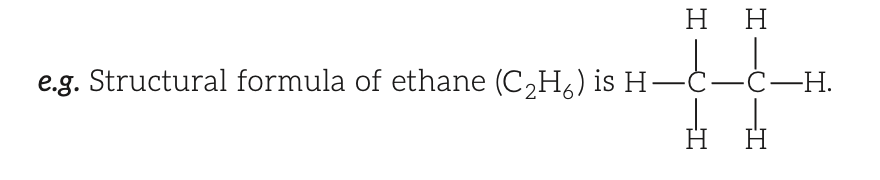
- Structural Formula:
- Shows atomic arrangement (e.g., ethane \( C_2H_6 \): \( H_3C-CH_3 \)).
-
- Chemical Reaction
- Definition:
- Process where reactants form products by breaking old bonds and forming new ones.
- Exothermic if bond energies of reactants > products; endothermic if vice versa.
- Characteristics:
- Observed via:
- Change in state.
- Change in color.
- Gas evolution.
- Temperature change.
- Precipitate formation.
- Chemical Equation
- Definition:
- Symbolic representation of a chemical reaction.
- Reactants (LHS, separated by \( + \)) yield products (RHS, separated by \( + \)) via an arrow (\( \to \)).
- Example:
- \( Zn(s) + H_2SO_4(aq) \to ZnSO_4(aq) + H_2(g) \).
- Rules for Balanced Equations:
- Number of atoms of reactants equals products (law of conservation of mass).
- Example:
- Unbalanced: \( Fe + H_2O \to Fe_3O_4 + H_2 \).
- Balanced: \( 3Fe(s) + 4H_2O(g) \to Fe_3O_4(s) + 4H_2(g) \).
- Include physical states (e.g., \( s, l, g, aq \)).
- Types:
- Thermochemical Equation:
- Includes enthalpy change (e.g., \( N_2(g) + 3H_2(g) \to 2NH_3(g) + 22.5 \, \text{kcal} \)).
- Ionic Equation:
- Uses ions to represent reactants/products (e.g., \( Zn(s) + Cu^{2+}(aq) \to Zn^{2+}(aq) + Cu(s) \)).
- Types of Chemical Reactions
- Combination Reaction:
- Single product from multiple reactants.
- Example:
- \( CaO(s) + H_2O(l) \to Ca(OH)_2(aq) \) (quick lime to slaked lime).
- Others:
- \( C(s) + O_2(g) \to CO_2(g) \); \( 2H_2(g) + O_2(g) \to 2H_2O(l) \).
- Everyday Science:
- Slaked lime (\( Ca(OH)_2 \)) reacts with \( CO_2 \) in air to form \( CaCO_3 \), giving walls a shiny finish.
- Magnesium ignited in dry ice produces bright light.
- Decomposition Reaction:
- Single reactant breaks into simpler products, requiring energy (heat, light, electricity).
- Types:
- Thermal Decomposition:
- By heating (e.g., \( CaCO_3(s) \xrightarrow{\text{Heat}} CaO(s) + CO_2(g) \)).
- Another example:
- \( 2Pb(NO_3)_2(s) \xrightarrow{\text{Heat}} 2PbO(s) + 4NO_2(g) + O_2(g) \).
- Photolysis:
- By sunlight (e.g., \( 2AgCl(s) \xrightarrow{\text{Sunlight}} 2Ag(s) + Cl_2(g) \)), used in black-and-white photography.
- Electrolysis:
- By electricity (e.g., \( 2H_2O(l) \xrightarrow{\text{Electric current}} 2H_2(g) + O_2(g) \)).
- Notes:
- Decomposition is the reverse of combination.
- \( CaCO_3 \) decomposition used in cement manufacturing.
- Metal salts emit colored light when heated.
- Displacement Reaction:
- More reactive element displaces less reactive one from a compound in solution.
- Example:
- \( Fe(s) + CuSO_4(aq) \to FeSO_4(aq) + Cu(s) \).
- Observation:
- Iron nail in \( CuSO_4 \) turns brownish, solution fades as iron displaces copper.
- Other reactive elements:
- Zinc, lead displace copper.
- Double Displacement Reaction:
- Ion exchange between reactants forms new substances.
- Example:
- \( Na_2SO_4(aq) + BaCl_2(aq) \to BaSO_4(s) \downarrow + 2NaCl(aq) \).
- Often forms precipitates (precipitation reaction).
- Neutralisation Reaction:
- Acid and base react to form salt and water, releasing 57.1 kJ if both are strong.
- Example:
- \( HCl(aq) + NaOH(aq) \to NaCl(aq) + H_2O(l) \).
- Isomerisation (Rearrangement) Reaction:
- Atoms in a molecule rearrange, common in organic compounds.
- Example:
- \( NH_4CNO \xrightarrow{\Delta} NH_2CONH_2 \) (ammonium cyanate to urea).
- Reversible and Irreversible Reactions:
- Reversible:
- Proceeds in both directions (e.g., \( N_2(g) + 3H_2(g) \xrightarrow{\text{Fe, Mo}} 2NH_3(g) \)).
- Irreversible:
- Proceeds in one direction (e.g., \( 2NaOH(aq) + H_2SO_4(aq) \to Na_2SO_4(aq) + 2H_2O(l) \)).
- Hydrolysis Reaction:
- Reaction of salts of weak acids/bases with water due to water’s high dielectric constant.
- Example:
- \( CH_3COONa(aq) + H_2O(l) \to CH_3COOH(aq) + NaOH(aq) \).
- Photochemical Reaction:
- Occurs in sunlight; rate depends on light intensity.
- Example:
- Photosynthesis:
- \( 6CO_2(g) + 12H_2O(l) \xrightarrow{\text{Sunlight}} C_6H_{12}O_6(aq) + 6H_2O(l) + 6O_2(g) \).
- Note:
- Chlorophyll acts as a photosensitizer, unchanged during the reaction.
- Exothermic and Endothermic Reactions:
- Exothermic:
- Energy released (e.g., respiration, decomposition, burning natural gas: \( A + B \to C + \Delta E \)).
- Endothermic:
- Energy absorbed (e.g., digestion: \( A + B \to C - \Delta E \)).
- Oxidation and Reduction:
- Oxidation:
- Gain of oxygen/electronegative element, loss of hydrogen/electrons, or increase in oxidation number.
- Memory Trick for oxidation:
- LEO
- Loss of Electons is Oxidation
- Examples:
- \( 2Cu(s) + O_2(g) \xrightarrow{\text{Heat}} 2CuO(s) \); \( CuO(s) + H_2(g) \to Cu(s) + H_2O(l) \) (H oxidized).
- Reduction:
- Gain of hydrogen/electropositive element/electrons, loss of oxygen/electronegative element, or decrease in oxidation number.
- Example:
- \( CuO(s) + H_2(g) \to Cu(s) + H_2O(l) \) (Cu reduced).
- Oxidising and Reducing Agents:
- Oxidising Agent:
- Accepts electrons, gets reduced (e.g., \( O_2, O_3, H_2O_2, KMnO_4, K_2Cr_2O_7 \)).
- Reducing Agent:
- Donates electrons, gets oxidized (e.g., \( H_2, SO_2, CO, H_2S, C \)).
- Example:
- \( Zn(s) + 2HCl(aq) \to ZnCl_2(aq) + H_2(g) \).
- \( Zn \): Oxidation number 0 to +2 (oxidized, reducing agent).
- \( H \): Oxidation number +1 to 0 (reduced, oxidizing agent).
- Note:
- \( HNO_2, SO_2, H_2SO_3 \) act as both oxidizing and reducing agents due to intermediate oxidation states (\( N: +3 \), \( S: +4 \)).
- In \( CO_2 \), \( C \) at +4 (maximum), cannot be oxidized further.
- Oxidation State (Oxidation Number)
- Definition:
- Real or imaginary charge on an atom in its combined state, often equivalent to valency.
- Rules:
- Elemental state:
- 0 (e.g., \( H_2, S_8, P_4 \)).
- Fluorine:
- -1 in all compounds.
- Oxygen:
- -2 (except peroxides: -1, superoxides: \( -\frac{1}{2} \), oxygen fluorides: +2 or +1).
- Hydrogen:
- -1 in metallic hydrides, +1 in others.
- Ion:
- Equals its charge.
- Complex ion:
- Sum of oxidation numbers equals net charge.
- Molecule:
- Sum of oxidation numbers is zero.
- Example:
- \( OF_2 \): \( x + 2(-1) = 0 \to x = +2 \) (O); \( H_2O \): \( 2(+1) + x = 0 \to x = -2 \) (O).
- Range:
- From \( \text{group number} - 8 \) to \( +\text{group number} \) (e.g., \( N \): -3 to +5).
- Effects of Chemical Reactions in Daily Life
- Examples:
- Fermentation, digestion, respiration, burning fuel, corrosion, rancidity.
- Corrosion:
- Oxidative deterioration of metal surfaces by environmental substances, forming oxides or salts.
- Example:
- Rusting: \( 2Fe(s) + \frac{3}{2}O_2(g) + xH_2O(l) \to Fe_2O_3 \cdot xH_2O(s) \).
- Other Examples:
- Silver tarnishing (\( 2Ag(s) + H_2S(g) \to Ag_2S(s) + H_2(g) \)); copper green coating (\( 2Cu(s) + CO_2(g) + O_2(g) + H_2O(l) \to CuCO_3 \cdot Cu(OH)_2(s) \)).
- Electrochemical process, accelerated by impurities, \( H^+ \), electrolytes (\( NaCl \)), gases (\( CO_2, SO_2, NO, NO_2 \)).
- Prevention:
- Electroplating.
- Surface coating (oil, grease, paint, varnish).
- Alloying.
- Galvanisation (zinc coating on iron).
- Anodising (aluminum oxide layer formation).
- Notes:
- Food cans use tin, not zinc, as zinc forms toxic substances.
- Aluminum oxide layer prevents further corrosion.
- Noble metals (\( Pt, Au, Ag \)) resist corrosion.
- Everyday Science:
- Corrosion damages car bodies, bridges, railings, ships.
- Significant costs to replace corroded iron.
- Fermentation:
- Discovered by Louis Pasteur (1857).
- Decomposition of complex organic compounds into simpler ones by microorganisms (yeast, bacteria), exothermic, producing \( CO_2, H_2, CH_4 \).
- Examples:
- Milk to curd via lactobacilli.
- Sugarcane juice to wine, vinegar, or ethanol via yeast.
- Baking industry for bread, pastries, cakes.
- Rancidity:
- Oxidation of oils/fats in food exposed to air, causing staleness, color/smell changes.
- Prevention:
- Add antioxidants (e.g., BHT, \( N_2 \)).
- Store in airtight containers or refrigerators.
- Everyday Science:
- Sliced apples brown due to iron oxidation.
- Chips bags flushed with \( N_2 \) to prevent oxidation.
- Acids, Bases, and Salts
- Introduction
- Compounds are classified as acids, bases, or salts based on chemical properties.
- Acids contribute sour taste, bases contribute bitter taste in foods.
- Acids
- Definition:
- From Latin ‘acidus’ (sour); substances with sour taste, replaceable hydrogen atoms, turn blue litmus and methyl orange red (e.g., \( HCl, HNO_3, H_2SO_4 \)).
- Types:
- Inorganic/Mineral Acids:
- From earth’s crust minerals (e.g., \( HCl, H_2SO_4, HNO_3 \)).
- Organic/Edible Acids:
- From plants/animals (e.g., lactic acid).
- Hydra Acids:
- Contain hydrogen, no oxygen (e.g., \( HCl, HBr, HCN \)).
- Oxy Acids:
- Contain hydrogen and oxygen (e.g., \( H_2SO_4, H_3PO_4, HNO_3 \)).
- Strong Acids:
- Completely dissociate in water (e.g., \( H_2SO_4, HCl, HNO_3, H_3PO_4 \)).
- Weak Acids:
- Partially dissociate in water (e.g., \( CH_3COOH, \) oxalic acid, \( H_2CO_3 \)).
- Dilute Acids:
- Low acid concentration in aqueous solution.
- Concentrated Acids:
- High acid concentration in aqueous solution.
- Properties:
- React with metals to liberate \( H_2 \) gas:
- \( \text{Acid} + \text{Metal} \to \text{Salt} + H_2 \).
- React with metal carbonates/hydrogen carbonates to form salt, water, \( CO_2 \):
- \( \text{Metal carbonate/hydrogen carbonate} + \text{Acid} \to \text{Salt} + CO_2 + H_2O \).
- Neutralisation with bases to form salt and water:
- \( \text{Acid} + \text{Base} \to \text{Salt} + H_2O \).
- Example:
- \( HCl(aq) + NaOH(aq) \to NaCl(aq) + H_2O(l) \).
- React with metallic oxides to form salt and water:
- \( \text{Metal oxide} + \text{Acid} \to \text{Salt} + H_2O \).
- Indicates metallic oxides are basic.
- Release \( NO_2 \) from nitrites, \( H_2S \) from sulphides, \( SO_2 \) from sulphites.
- Produce \( H^+ \) or \( H_3O^+ \) in water:
- \( HCl + H_2O \to H_3O^+ + Cl^- \); \( H^+ \) exists as \( H_3O^+ \).
- Example:
- \( H^+ + H_2O \to H_3O^+ \).
- Strong acids (\( HCl, HNO_3, H_2SO_4 \)) conduct electricity in aqueous solutions.
- Esterification:
- Carboxylic acids react with alcohols to form esters (sweet-smelling) and water: \( \text{Carboxylic acid} + \text{Alcohol} \xrightarrow{\Delta} \text{Ester} + H_2O \).
- Naturally Occurring Acids:
-
| Natural Source | Acid |
|---|
| Vinegar | Acetic acid |
| Amla, citrus fruits (orange, lemon) | Citric acid, Vitamin C (ascorbic acid) |
| Tamarind, grapes, unripe mangoes | Tartaric acid |
| Tomato, sarel tree, spinach | Oxalic acid |
| Sour milk (curd) | Lactic acid |
| Ant sting, nettle sting | Methanoic acid (formic acid) |
| Grass, leaves, urine | Benzoic acid |
| Wheat | Glutamic acid |
| Tea | Maleic acid |
- Uses of Acids:
- \( HNO_3 \):
- Fertilizers, dyes, plastics, medicines, explosives (TNT), aqua-regia, photography, lab reagent.
- \( H_2SO_4 \):
- Fertilizers, plastics, paints, explosives, dyes, detergents, batteries, petroleum exploration.
- \( HCl \):
- Plastics (PVC), medicines, cosmetics, dyes, textiles, aqua-regia, leather industry, lab reagent.
- Benzoic acid, formic acid:
- Food preservatives, insecticides, rubber/leather processing.
- Citric acid:
- Food processing/preserving, metal washing, cloth industries.
- Oxalic acid:
- Photography, cloth coloration/printing, leather bleaching, ink/rust removal.
- Acetic acid:
- Vinegar, acetone production, food processing.
- Everyday Science:
- Phosphoric acid (\( H_3PO_4 \)) in soft drinks (e.g., Coca-Cola) gives sour flavor, inhibits mold/bacteria.
- Lemon juice + baking soda causes \( CO_2 \) effervescence.
- Nettle stings (methanoic acid) neutralized by dock plant leaves (basic).
- Aqua-regia (3:1 \( HCl:HNO_3 \)):
- Dissolves gold/silver.
- Venus atmosphere:
- Thick sulfuric acid clouds.
- \( H_2SO_4 \):
- “Oil of vitriol,” used in car batteries; does not react with dilute silver.
- Lactic acid:
- From milk fermentation to curd.
- Soft drink “fizz”:
- \( H_2CO_3 \to CO_2 \).
- Pickles in glass jars to avoid acid-metal reactions.
- Bases
- Definition:
- Turn red litmus blue, methyl orange yellow, have bitter taste, soapy feel (e.g., \( KOH, Mg(OH)_2, NaOH \)).
- Metallic compounds/radicals that neutralize acids, typically metal oxides/hydroxides.
- Types:
- Strong Bases:
- Completely dissociate in water (e.g., \( Ca(OH)_2, NaOH, KOH \)); oxides/hydroxides of alkali/alkaline earth metals.
- Weak Bases:
- Partially dissociate (e.g., \( Fe(OH)_2, NH_4OH, Mg(OH)_2 \)).
- Properties:
- React with metals (selectively) to form salt and \( H_2 \):
- Example:
- \( 2NaOH + Zn \to Na_2ZnO_2 + H_2 \).
- Neutralisation with acids:
- \( \text{Base} + \text{Acid} \to \text{Salt} + H_2O \).
- React with non-metallic oxides to form salt and water: \( \text{Base} + \text{Non-metal oxide} \to \text{Salt} + H_2O \).
- Indicates non-metallic oxides are acidic.
- Produce \( OH^- \) in water:
- Examples:
- \( KOH(s) \to K^+(aq) + OH^-(aq) \); \( Mg(OH)_2(s) \to Mg^{2+}(aq) + 2OH^-(aq) \).
- Alkalies:
- Water-soluble bases (e.g., \( NaOH, KOH, Ca(OH)_2, NH_4OH \)); all alkalies are bases, not vice versa.
- Amphoteric substances:
- Oxides/hydroxides of \( Zn, Al, Sn \) dissolve in acids and hot concentrated \( NaOH/KOH \) (e.g., \( ZnO, Al_2O_3 \)).
- Strong bases (\( NaOH, KOH \)) conduct electricity in aqueous/molten states due to mobile ions.
- Uses:
- \( Ca(OH)_2 \):
- Bleaching powder, concrete, plaster, whitewashing, water softening, acidic soil treatment, leather hair removal.
- \( Mg(OH)_2 \):
- Antacid, sugar industries.
- \( NaOH \):
- Drugs, hard soaps, paper/textile industries, petroleum refining, metal degreasing, cleaning.
- \( KOH \):
- Lab reagent, soft soaps, shampoos, shaving creams, absorbs \( CO_2, SO_2 \).
- \( CaO \):
- Drying agent, bleaching powder, mortar constituent.
- \( MgO \):
- Refractory material, drugs, rubber supplement.
- Modern Concepts of Acids and Bases
- Arrhenius Concept:
- Acids:
- Produce \( H^+ \) in water (e.g., \( HCl(aq) \to H^+(aq) + Cl^-(aq) \)).
- Bases:
- Produce \( OH^- \) in water (e.g., \( NaOH(aq) \to Na^+(aq) + OH^-(aq) \)).
- Bronsted-Lowry Concept:
- Acids:
- Proton (\( H^+ \)) donors.
- Bases:
- Proton acceptors.
- Example:
- \( NH_3(aq) + H_2O(l) \to NH_4^+(aq) + OH^-(aq) \) (\( NH_3 \): base, \( H_2O \): acid).
- Lewis Concept:
- Acids:
- Electron pair acceptors (e.g., \( BF_3 \), cations).
- Bases:
- Electron pair donors (e.g., \( NH_3 \), anions).
- Example:
- \( BF_3 + NH_3 \to F_3B:NH_3 \).
- Dissolution of Acids/Bases in Water
- Highly exothermic; acid must be added slowly to water with stirring to avoid splashing/burns.
- Dilution reduces \( H_3O^+/OH^- \) concentration per unit volume.
- Salts
- Definition:
- Formed by neutralisation of acids and bases; cation from base, anion from acid.
- Example:
- \( NaOH + HCl \to NaCl + H_2O \).
- Types:
- Simple/Normal Salts:
- Complete hydrogen replacement (e.g., \( KCl, NaCl, FeSO_4, K_2SO_4, Ca_3(PO_4)_2, Na_3BO_3 \)).
- Alkaline salts (from weak acid, strong base):
- Basic in solution, pH > 7 (e.g., \( Na_2CO_3, CH_3COONa, Na_2B_4O_7 \cdot 10H_2O \)).
- Neutral salts (from strong acid, strong base):
- pH = 7 (e.g., \( NaCl, KCl, K_2SO_4, NaNO_3, KClO_3 \)).
- Acidic salts (from strong acid, weak base):
- Acidic in solution, pH < 7 (e.g., \( FeCl_3, ZnCl_2, HgSO_4 \)).
- Acidic Salts:
- Partial hydrogen replacement, retain replaceable hydrogen (e.g., \( NaHSO_4, NaHCO_3, NaH_2PO_4 \)).
- Basic Salts:
- Incomplete base neutralisation, retain \( OH^- \) groups (e.g., \( Mg(OH)Cl, Zn(OH)Cl \)).
- Double Salts:
- Mixture of two salts, exist only in solid state (e.g., potash alum \( K_2SO_4 \cdot Al_2(SO_4)_3 \cdot 24H_2O \), Mohr’s salt \( FeSO_4 \cdot (NH_4)_2SO_4 \cdot 6H_2O \)).
- Show tests for all constituent ions.
- Complex Salts:
- Contain complex ions, exist in solution (e.g., \( K_4[Fe(CN)_6] \) with \( [Fe(CN)_6]^{4-} \), \( [Cu(NH_3)_4]SO_4 \) with \( [Cu(NH_3)_4]^{2+} \)).
- Mixed Salts:
- Yield multiple cations/anions in water (e.g., bleaching powder, sodium potassium sulphate, Rochelle’s salt).
- Uses of Common Salts:
- \( NaCl \):
- Common/rock salt, brown due to impurities; used in \( NaOH \), baking soda, washing soda, bleaching powder, food preservation; symbol in Gandhi’s Dandi March.
- \( NaHCO_3 \):
- Baking powder, antacid, soda-acid fire extinguishers.
- \( MgSO_4 \cdot 7H_2O \):
- Epsom salts, medicinal uses.
- \( Hg_2Cl_2 \):
- Calomel, medicinal uses.
- \( CaSO_4 \cdot 2H_2O \):
- Gypsum, forms Plaster of Paris (\( CaSO_4 \cdot \frac{1}{2}H_2O \)) for fractures, toys, decorations, smooth surfaces.
- \( Na_2CO_3 \cdot 10H_2O \):
- Washing soda, removes water hardness, used in glass, soap, paper, dry cleaning, borax production.
- \( KNO_3 \):
- Gunpowder, firecrackers, glass industry, fertilizers.
- \( CuSO_4 \cdot 5H_2O \):
- Insecticide, electroplating, coloration/printing, copper purification.
- Potash alum:
- Water purification, drugs, color bonding.
- pH Scale
- Definition:
- Measures acidity/basicity via hydrogen ion concentration: \( \text{pH} = -\log[H^+] = \log \frac{1}{[H^+]} = \log \frac{1}{[H_3O^+]} \).
- Ranges from 0 (very acidic) to 14 (very alkaline); neutral at pH 7.
- Higher \( [H_3O^+] \), lower pH.
- Measurement:
- Universal indicator paper changes color with pH; pH meter also used.
- pH of Common Substances:
-
| pH Range | Nature | Substances |
|---|
| 0-1 | Acidic | Battery acid |
| 1.2-2 | Acidic | Stomach acid |
| 2.2-3.4 | Acidic | Lemon juice, vinegar |
| 3.2-3.9 | Acidic | Orange juice, soda, some dental rinses, wine |
| 4.0-4.4 | Acidic | Tomato juice, beer |
| 4.5-5.5 | Acidic | Black coffee |
| 6.4-6.6 | Acidic | Saliva, cow’s milk |
| 7 | Neutral | Pure water |
| 7.3-7.5 | Basic | Human urine, human blood |
| 8 | Basic | Sea water, pH-neutralizing dental rinses |
| 9.2 | Basic | Baking soda, drinking soda |
| 10 | Basic | Antacids |
| 11 | Basic | Antacids, dental treatment rinses |
| 12.5 | Basic | Soapy water |
| 14 | Basic | Sodium hydroxide |
- Notes:
- Acidic:
- pH < 7; Basic: pH > 7; Neutral: pH = 7.
- Strong acids produce more \( H^+ \), weak acids produce less; strong bases produce more \( OH^- \), weak bases produce less.
- Groundwater pH decreases in air due to \( CO_2 \) forming \( H_2CO_3 \), increasing \( H^+ \).
- Adding base to acidic solution increases pH; adding acid to basic solution decreases pH.
- Strong acid + strong base (equal equivalents) yields neutral solution (pH = 7).
- Diluting acid with water decreases pH (remains acidic) due to increased ionisation.
- Importance of pH in Everyday Life
- Biological Sensitivity:
- Organisms function in narrow pH range (e.g., human body: 7.0-7.8); aquatic life struggles below pH 5.6 (acid rain).
- Agriculture:
- Excess fertilizers acidify soil; neutralized with \( CaO \) or \( Ca(OH)_2 \); basic soil treated with organic matter.
- Water Pollution:
- Factory acidic runoff neutralized with bases.
- Digestion:
- Stomach \( HCl \) aids digestion; excess causes pain, neutralized by antacids (\( Mg(OH)_2 \)).
- Tooth Decay:
- pH < 5.5 from bacterial acid (sugar/food degradation); basic toothpaste neutralizes.
- Stings/Bites:
- Bee/ant stings (formic acid) neutralized by baking soda (\( NaHCO_3 \)) or calamine (\( ZnCO_3 \)).
- Milk Storage:
- Banana leaves (basic) prevent yeast in milk jars.
- Indicators
- Definition:
- Substances showing color changes with pH, identifying acidic, basic, or neutral solutions.
- Examples:
- Litmus, turmeric, China rose petals, Hydrangea/Petunia/Geranium petals, pH paper, universal indicator, pH meter.
- Acid-Base Indicators:
- Weak organic acids (e.g., phenolphthalein) or bases (e.g., methyl orange).
- Phenolphthalein unsuitable for weak bases; methyl orange unsuitable for weak acids.
- Color Changes:
-
| Indicator | pH Range | Acidic Medium | Basic Medium |
|---|
| Methyl orange | 3.1-4.5 | Red | Yellow |
| Methyl red | 4.2-6.3 | Red | Yellow |
| Phenolphthalein | 8.0-9.8 | Colourless | Pink |
| Litmus | 5.5-7.5 | Red | Blue |
- Buffer Solutions
- Definition:
- Resist pH changes upon dilution or addition of small amounts of acid/alkali.
- Types:
- Acidic Buffer:
- Weak acid + its salt with strong base (e.g., \( CH_3COOH + CH_3COONa \), pH ~4.75; boric acid + borax).
- Basic Buffer:
- Weak base + its salt with strong acid (e.g., \( NH_4OH + NH_4Cl \), pH ~9.25).
- Example:
- Blood pH maintained by \( H_2CO_3/HCO_3^- \) buffer despite acidic foods.
- Hydrolysis of Salts
- Definition:
- Salts from strong acid + strong base ionize completely in water, no hydrolysis.
- Salts from strong base + weak acid or weak base + strong acid react with water to regenerate original acid/base (hydrolysis).
- Example:
- \( Na_2CO_3 + 2H_2O \to 2NaOH + H_2CO_3 \) or \( 2Na^+ + CO_3^{2-} + 2H_2O \to 2Na^+ + 2OH^- + H_2CO_3 \).
- Solution is basic due to strong base (\( NaOH \)).
- Types Based on Hydrolysis:
- Salts of Weak Acids and Strong Bases:
- Basic solution, pH > 7 (e.g., \( CH_3COONa + H_2O \to CH_3COOH + NaOH \)).
- Salts of Strong Acids and Weak Bases:
- Acidic solution, pH < 7 (e.g., \( NH_4Cl \)).
- Salts of Weak Acids and Weak Bases:
- Neutral, acidic, or basic solution (e.g., ammonium acetate).
- Salts of Strong Acids and Strong Bases:
- No hydrolysis, neutral solution, pH = 7 (e.g., \( NaCl, K_2SO_4, NaNO_3 \)).
- Solutions and Colloids
- Introduction
- Most substances in daily life are mixtures, not pure substances, often called solutions.
- Mixtures classified based on particle size: true solutions, suspensions, colloids.
- Properties are uniform throughout, and utility depends on composition.
- Solution (True Solution)
- Definition:
- Homogeneous mixture of two or more substances with variable composition up to a limit at constant temperature.
- Examples:
- Lemonade, soda water.
- Components of a Binary Solution:
- Solvent:
- Component in largest quantity, determines solution’s phase.
- High dielectric constant enhances solvent ability (e.g., water: high dielectric constant, universal solvent).
- Uses:
- Perfumes, drugs, food processing, beverages, dry cleaning.
- Solute:
- Component(s) other than solvent, usually in smaller amounts, also called dissolved substance.
- Examples:
- Iodine (solute) in alcohol (solvent) forms tincture of iodine; \( CO_2 \) (solute) in water (solvent) in soda water.
- Properties:
- Homogeneous mixture with uniform composition.
- Particle size < 1 nm (\( 10^{-9} \, \text{m} \)), invisible to the naked eye.
- Do not scatter light (no Tyndall effect).
- Solute and solvent diffuse indistinguishably.
- Solute particles cannot be filtered due to small size, stable, permanent, transparent.
- Types of Solutions:
- Based on Solute Amount:
- Unsaturated Solution:
- Can dissolve more solute at given temperature.
- Saturated Solution:
- Cannot dissolve more solute at given temperature.
- Supersaturated Solution:
- Contains excess solute beyond capacity at given temperature, achieved by heating saturated solution; excess crystallizes if a solute crystal is added.
- Based on States of Solute and Solvent:
-
| Type | Solute | Solvent | Examples |
|---|
| Gaseous Solutions | Gas | Gas | Air, mixture of gases |
| Liquid | Gas | Chloroform in nitrogen gas, fog, humidity |
| Solid | Gas | Camphor in nitrogen gas, smog |
| Liquid Solutions | Gas | Liquid | \( O_2 \) or \( CO_2 \) in water, aerated drinks |
| Liquid | Liquid | Ethanol in water, bromine in \( CS_2 \), \( H_2SO_4 \) in water |
| Solid | Liquid | Glucose in water, \( I_2 \) in \( CCl_4 \), lead in mercury |
| Solid Solutions | Gas | Solid | Hydrogen in palladium |
| Liquid | Solid | Mercury in sodium (amalgam) |
| Solid | Solid | Alloys (e.g., bronze) |
- Aqueous vs. Non-aqueous Solutions:
- Aqueous:
- Solute dissolved in water (e.g., ethanol in water, \( NaCl \) in water).
- Non-aqueous:
- Solute dissolved in non-water solvent (e.g., iodine in alcohol).
- Acidic, Basic, Neutral Solutions:
- Acidic:
- More \( H^+ \) than \( OH^- \) ions.
- Basic:
- More \( OH^- \) than \( H^+ \) ions.
- Neutral:
- Equal \( H^+ \) and \( OH^- \) concentrations.
- Concentration of a Solution:
- Definition:
- Amount of solute in a given amount of solution or solvent (mass/volume).
- Dilute:
- Low concentration; Concentrated: High concentration.
- Expressions:
- Mass Percentage:
- \( \frac{\text{Mass of component}}{\text{Total mass of solution}} \times 100 \).
- Volume Percentage:
- \( \frac{\text{Volume of component}}{\text{Total volume of solution}} \times 100 \).
- Mole Fraction:
- \( \frac{\text{Number of moles of component}}{\text{Total moles of all components}} \).
- Parts per Million (ppm):
- \( \frac{\text{Number of parts of component}}{\text{Total parts of all components}} \times 10^6 \).
- Molarity (M):
- \( \frac{\text{Moles of solute}}{\text{Volume of solution (L)}} \).
- Molality (m):
- \( \frac{\text{Moles of solute}}{\text{Mass of solvent (kg)}} \).
- Normality (N):
- \( \frac{\text{Number of gram equivalents of solute}}{\text{Volume of solution (L)}} \).
- Solubility:
- Definition:
- Maximum solute dissolvable in a given solvent amount (typically 100 g) at specific temperature and pressure.
- Formula:
- \( \text{Solubility} = \frac{w (\text{solute mass})}{W (\text{solvent mass})} \times 100 \).
- Factors Affecting Solubility:
- Nature of Solute and Solvent:
- “Like dissolves like” (polar solutes like \( NaCl \) in polar solvents like water; non-polar solutes like cholesterol in non-polar solvents like benzene, \( CCl_4 \)).
- Temperature:
- Endothermic dissolution:
- Solubility increases with temperature (most solutes).
- Exothermic dissolution:
- Solubility decreases with temperature (e.g., \( Ca(NO_3)_2, CaO, Na_2SO_4, Ca(OH)_2, \) calcium citrate).
- Gas solubility in liquids decreases with increasing temperature.
- Pressure:
- No effect on solid solubility in liquids; gas solubility in liquids increases with pressure.
- Size of Substance:
- Solubility decreases with increasing molecular mass.
- Everyday Science:
- High-pressure sealing increases \( CO_2 \) solubility in soft drinks/soda water.
- Deep-sea divers use oxygen diluted with helium (less soluble) to minimize decompression pain (bends).
- Colloidal Solution
- Definition:
- Heterogeneous system with dispersed phase (solute) and dispersion medium (solvent).
- Particle size:
- 1–100 nm (\( 10^{-9} \, \text{m} \) to \( 10^{-7} \, \text{m} \) or 1000 Å).
- Examples:
- Milk, face creams, sponge, rubber, pumice, blood, gems.
- Components:
- Dispersed Phase:
- Colloidal particles (solute).
- Dispersion Medium:
- Medium in which particles are scattered (solvent).
- Classification:
- Based on Physical State:
-
| Dispersed Phase | Dispersion Medium | Type | Examples |
|---|
| Solid | Solid | Solid Sol | Gemstones, colored glasses |
| Solid | Liquid | Sol | Milk of magnesia, mud, paints, cell fluids |
| Solid | Gas | Aerosol | Smoke, automobile exhaust |
| Liquid | Solid | Gel | Jelly, cheese, butter |
| Liquid | Liquid | Emulsion | Milk, face cream, hair cream |
| Liquid | Gas | Aerosol | Fog, clouds, mist, insecticide sprays |
| Gas | Solid | Solid Sol | Foam, rubber, sponge, pumice |
| Gas | Liquid | Foam | Shaving cream, froth, whipped cream |
- Based on Interaction:
- Lyophilic Colloids:
- Liquid-loving, formed by mixing substances like gum, gelatin, starch, rubber with liquid.
- Stable, not easily coagulated, reversible (e.g., starch sol).
- Lyophobic Colloids:
- Liquid-hating, require special preparation methods.
- Unstable, easily coagulated by heating, irreversible (e.g., gold sol).
- Note:
- When water is the dispersion medium, called hydrophilic (lyophilic) or hydrophobic (lyophobic).
- Gold Number:
- Minimum lyophilic colloid (mg) preventing coagulation of 10 mL gold sol with 1 mL 10% \( NaCl \).
- Based on Particle Type:
- Multimolecular Colloids:
- Aggregates of many atoms/molecules (e.g., gold sol, sulphur sol).
- Macromolecular Colloids:
- Large molecules in colloidal size range, stable, resemble true solutions (e.g., starch, cellulose, proteins, enzymes, polythene, nylon, polystyrene, synthetic rubber).
- Associated Colloids (Micelles):
- Form above Kraft temperature (\( T_k \)) and Critical Micelle Concentration (CMC); behave as electrolytes at low concentrations (e.g., soap solution).
- Note:
- Soap/detergent cleansing via emulsification and micelle formation.
- Properties:
- Heterogeneous, permanent, cannot be filtered by ordinary paper.
- Particles invisible to naked eye but visible under ultramicroscope.
- Tyndall Effect:
- Scatter light, making beam path visible (e.g., sunlight through forest canopy, blue sky/sea, comet tails, twinkling stars, red sunset, blue smoke tinge).
- Brownian Movement:
- Continuous zig-zag motion of particles, independent of colloid nature, depends on particle size and solution viscosity; smaller particles, lower viscosity increase motion; stabilizes sols.
- Electric Charge:
- Colloidal particles carry charge (e.g., haemoglobin: positive; starch, gum, gelatin, clay, charcoal: negative).
- Color:
- Due to light scattering, depends on wavelength scattered.
- Coagulation:
- Precipitation by adding electrolyte, neutralizing particle charge (e.g., alum/ferric chloride coagulates blood to stop bleeding).
- Emulsions
- Definition:
- Liquid-liquid colloidal systems from immiscible/partially miscible liquids, stabilized by emulsifiers (e.g., protein, gum, soap, alcohol).
- Types:
- Oil-in-Water (O/W):
- Oil dispersed in water (e.g., milk, vanishing cream).
- Water-in-Oil (W/O):
- Water dispersed in oil (e.g., butter, cream).
- Properties:
- Finely divided droplets dispersed in another liquid.
- Exhibit Brownian movement and Tyndall effect.
- Can be broken into constituent liquids by heating, freezing, centrifuging.
- Everyday Science:
- Electrical Precipitation of Smoke:
- Smoke (colloidal solid particles in air) passed through Cottrell precipitator; charged particles lose charge, precipitate.
- Water Purification:
- Alum coagulates suspended impurities in water.
- Colloidal Medicines:
- Effective due to large surface area, easy assimilation (e.g., silver sol: eye lotion; colloidal antimony: Kala-azar; colloidal gold: injections; milk of magnesia: stomach disorders).
- Industries:
- Rubber from latex coagulation; leather tanning (positively charged hide + negatively charged tannin); paints, inks, plastics, rubber, graphite lubricants, cement are colloidal.
- Photography:
- Emulsion of light-sensitive \( AgBr \) in gelatin on plates/films.
- Artificial Rain:
- Silver iodide seeds clouds.
- Ice-cream:
- Gelatin stabilizes colloid, prevents crystallization.
- Suspension
- Definition:
- Heterogeneous mixture where solute particles remain suspended, do not dissolve.
- Examples:
- Chalk water, polluted river water, smoke in air, muddy water, soil.
- Properties:
- Heterogeneous mixture.
- Particle size > \( 10^{-5} \, \text{cm} \), visible to naked eye.
- Scatter light, making beam path visible.
- Unstable; particles settle when undisturbed, separable by filtration.
- Settled suspension stops scattering light.
- Gaseous State
- Introduction
- Matter exists in three states: solid, liquid, gas; Bose-Einstein condensate is a recently discovered state.
- Gases have unique properties compared to solids and liquids:
- Easily compressible.
- No definite volume or shape, occupy entire container volume.
- Gas Laws
- Measurable properties (mass \( m \), volume \( V \), pressure \( p \), temperature \( T \)) are interdependent.
- Gas laws describe relationships between these properties.
- Boyle’s Law (Pressure-Volume Relationship):
- At constant temperature (\( T \)) and moles (\( n \)), pressure (\( p \)) is inversely proportional to volume (\( V \)): \( p \propto \frac{1}{V} \), or \( pV = k \) (constant), or \( p_1V_1 = p_2V_2 \).
- Pressure is directly proportional to density (\( d \)) for fixed mass: \( p \propto d \), where \( d = \frac{\text{mass}}{V} \).
- Note:
- Molar mass = \( 2 \times \text{vapour density} \).
- Charles’ Law (Temperature-Volume Relationship):
- At constant pressure (\( p \)) and mass, volume (\( V \)) is directly proportional to absolute temperature (\( T \)): \( V \propto T \), or \( \frac{V}{T} = \text{constant} \), or \( \frac{V_1}{T_1} = \frac{V_2}{T_2} \).
- Volume decreases with decreasing temperature.
- Absolute zero:
- Hypothetical temperature where gas volume theoretically becomes zero.
- Gay Lussac’s Law (Pressure-Temperature Relationship):
- At constant volume (\( V \)), pressure (\( p \)) is directly proportional to temperature (\( T \)): \( p \propto T \), or \( \frac{p}{T} = \text{constant} \), or \( \frac{p_1}{T_1} = \frac{p_2}{T_2} \).
- Avogadro’s Law (Volume-Amount Relationship):
- At constant temperature and pressure, volume (\( V \)) is directly proportional to moles (\( n \)): \( V \propto n \), or \( \frac{V}{n} = \text{constant} \).
- Equal volumes of gases at same \( T \) and \( p \) contain equal numbers of molecules.
- At STP (Standard Temperature and Pressure), 1 mole of gas occupies 22.4 L.
- Avogadro’s constant: \( 6.022 \times 10^{23} \) molecules per mole.
- Combined Gas Law:
- Combines Boyle’s, Charles’, and Avogadro’s laws: \( \frac{pV}{nT} = \text{constant} \), or \( \frac{p_1V_1}{T_1} = \frac{p_2V_2}{T_2} \).
- Dalton’s Law of Partial Pressures:
- Total pressure of a non-reacting gas mixture equals the sum of partial pressures: \( p_{\text{total}} = p_1 + p_2 + p_3 + \dots + p_n \) (at constant \( T, V \)).
- Graham’s Law of Diffusion:
- At constant \( T \) and \( p \), rate of diffusion (\( r \)) is inversely proportional to the square root of density (\( d \)): \( r \propto \frac{1}{\sqrt{d}} \), or \( \frac{r_1}{r_2} = \sqrt{\frac{d_2}{d_1}} \).
- Since molar mass (\( M \)) = \( 2 \times d \), then \( \frac{r_1}{r_2} = \sqrt{\frac{M_2}{M_1}} \).
- Diffusion:
- Spontaneous mixing of gases; rate of diffusion is volume diffused per unit time.
- Applications:
- Production of marsh gas (\( CH_4 \)).
- Separation of gaseous mixtures.
- Determination of vapour density.
- Separation of isotopes.
- Everyday Science:
- Gases compressed at high pressure for transportation.
- \( CO_2 \) and \( O_2 \) in air diffuse into water for aquatic respiration.
- Lighter gases diffuse faster than heavier ones.
- Charles’ Law applications: Hydrogen balloon bursting, chapati making.
- Diffusion examples: Smell of cooking food, LPG leak detection via ethyl mercaptan.
- Perfect (Ideal) Gas
- Definition:
- Hypothetical gas with point-mass molecules (no volume) and no intermolecular attractions.
- Examples:
- Permanent gases (\( H_2, O_2, He \)) that resist liquefaction.
- Properties:
- Strictly obeys Boyle’s, Charles’, and Gay Lussac’s laws under all conditions.
- Pressure and volume coefficients are equal.
- Cannot be liquefied or solidified due to lack of intermolecular attractions.
- Ideal Gas Equation
- Combines Boyle’s, Charles’, and Avogadro’s laws: \( V \propto \frac{nT}{p} \), or \( pV = nRT \).
- \( R \):
- Universal gas constant, \( 8.314 \, \text{J mol}^{-1} \text{K}^{-1} \) or \( 0.0821 \, \text{L atm mol}^{-1} \text{K}^{-1} \).
- Also called equation of state, describes gas state with four variables (\( p, V, n, T \)).
- Real Gases
- Follow gas laws only at high temperature and low pressure.
- Have definite volume and intermolecular forces.
- No real gas is truly ideal.
- Kinetic Theory of Gases
- Developed by J. Bernoulli (1738), R. Clausius, and J. C. Maxwell to explain gas laws and behavior via molecular motion.
- Assumptions:
- Gas consists of small, identical molecules dispersed in the container.
- Molecular volume is negligible compared to total gas volume.
- Molecules in constant random motion, moving in straight lines, changing direction on collision with other molecules or container walls.
- Intermolecular forces are negligible, allowing free movement.
- Collisions are perfectly elastic, conserving kinetic energy but redistributing it.
- Gravity’s effect on molecular motion is negligible compared to collisions.
- Pressure results from molecular collisions with container walls, proportional to rate of momentum change (Newton’s second law).
- Average kinetic energy proportional to absolute temperature: \( \text{Kinetic energy} \propto T \).
- Pressure of an Ideal Gas:
- Derived from kinetic theory: \( pV = \frac{1}{3} mN v^2 \). Where: \( m \):
- mass of one molecule, \( N \): number of molecules, \( v \): root mean square velocity, \( V \): volume.
- Different Speeds of Gaseous Molecules
- Average Speed (\( v \)):
- Mean speed of all molecules.
- Most Probable Speed (\( \alpha \)):
- Speed possessed by the maximum fraction of molecules at a given temperature.
- Root Mean Square (RMS) Speed (\( u \)):
- Square root of the mean of squared speeds: \( u \propto \sqrt{T} \), \( u \propto \frac{1}{\sqrt{M}} \).
- Speed Relationship:
- \( \alpha : v : u = 1.414 : 1.595 : 1.732 \).
- Degree of Freedom
- Definition:
- Number of independent directions or coordinates a system can move freely, denoted \( N \).
- Formula:
- \( N = 3A - R \). Where:
- \( A \): number of particles, \( R \): number of independent relations.
- Gas Molecule Energies:
- Translational kinetic energy.
- Rotational kinetic energy.
- Vibrational energy (potential + kinetic).
- Degrees of Freedom for Gas Molecules:
- Monoatomic (\( He \)):
- 3 (translational only).
- Diatomic (\( O_2, CO_2, H_2 \)):
- 5 (3 translational, 2 rotational).
- Triatomic (\( NH_3 \)):
- 6 (3 translational, 3 rotational/vibrational).
- Examples:
- Block in straight line:
- 1 degree (translational).
- Projectile in plane:
- 2 degrees (translational).
- Sphere:
- 2 degrees (1 rotational, 1 translational).
- Chemical Kinetics and Equilibrium
- Chemical Kinetics
- Definition:
- From Greek ‘kinesis’ (movement); studies reaction rates, factors affecting rates, and reaction mechanisms.
- Focuses on reaction rates, variable effects, atom rearrangement, and intermediate formation.
- Slow and Fast Reactions:
- Fast Reactions:
- Occur instantaneously (e.g., ionic reactions like precipitation of \( AgCl \)): \( AgNO_3 + NaCl \to AgCl \downarrow + NaNO_3 \).
- Slow Reactions:
- Take days, months, or years (e.g., rusting of iron in air and moisture).
- Moderate Speed Reactions:
- Studied in chemical kinetics (e.g., inversion of cane sugar, hydrolysis of starch).
- Important Terms:
- Bond Energy:
- Energy to break one mole of a specific bond in gaseous state, expressed in \( \text{kJ mol}^{-1} \).
- Higher bond dissociation energy indicates stronger bonds.
- Bond breaking:
- Endothermic; bond formation: Exothermic.
- Heat of Reaction:
- Heat evolved or absorbed in a reaction.
- Example:
- \( H_2(g) + Br_2(l) \to 2HBr(g) + 72.8 \, \text{kJ mol}^{-1} \).
- Heat of Formation:
- Energy change for forming one mole of a compound from elements.
- Example:
- \( C(s) + 2H_2(g) \to CH_4(g) + 74.81 \, \text{kJ mol}^{-1} \).
- Heat of Combustion:
- Heat evolved from combusting one mole in excess oxygen.
- Example:
- \( C_6H_{12}O_6(s) + 6O_2(g) \to 6CO_2(g) + 6H_2O(l) + 2802.0 \, \text{kJ mol}^{-1} \).
- Rate of a Reaction:
- Definition:
- Change in concentration of reactant or product per unit time.
- Rate = \( \frac{\text{Decrease in reactant concentration}}{\text{Time}} \) or \( \frac{\text{Increase in product concentration}}{\text{Time}} \).
- Unit:
- \( \text{mol L}^{-1} \text{s}^{-1} \) (concentration in \( \text{mol L}^{-1} \), time in seconds); for gases, \( \text{atm s}^{-1} \) if using partial pressures.
- Factors Influencing Rate:
- Concentration:
- Rate increases with higher reactant concentration due to increased molecular collisions.
- Temperature:
- Rate generally increases with temperature due to higher kinetic energy and molecular velocity.
- Nature of Reactants:
- Varies by reactant (e.g., \( Na, K \) react vigorously with water; \( Fe \) reacts only with steam).
- Surface Area:
- Larger surface area increases rate (e.g., zinc dust reacts faster with \( H_2SO_4 \) than zinc pieces).
- Light:
- Increases rate in photochemical reactions (e.g., chloroform oxidation: \( 2CHCl_3 + O_2 \xrightarrow{\text{light}} 2COCl_2 + 2HCl \)).
- Note:
- Chloroform stored in dark bottles to prevent oxidation.
- Catalyst:
- Increases rate by providing a lower activation energy path; specific to reaction.
- Activation Energy:
- Additional energy reactant molecules need to form an unstable activated complex, which decomposes to products.
- Lower activation energy results in faster reaction.
- Catalysis:
-
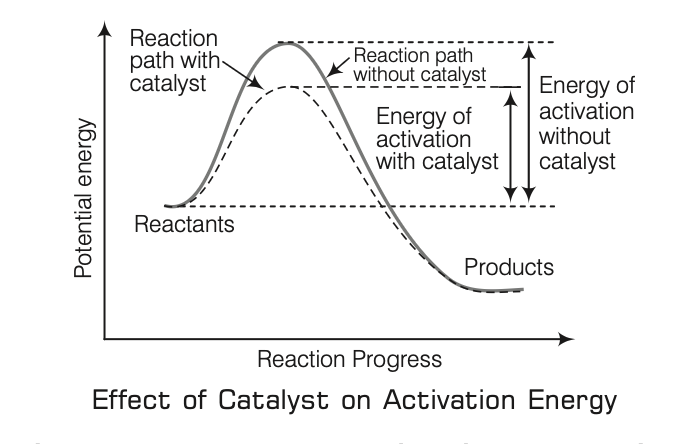
- Definition:
- Substances (catalysts) alter reaction rate without being consumed chemically or quantitatively (Berzelius, 1835).
- Mechanism:
- Provides alternative path with lower activation energy.
- Properties:
- Catalyzes spontaneous reactions, not non-spontaneous ones.
- Does not change equilibrium constant, but accelerates equilibrium attainment by catalyzing forward and backward reactions equally.
- Promoters and Poisons:
- Promoters:
- Enhance catalyst activity (e.g., molybdenum for iron in Haber’s process).
- Poisons:
- Decrease catalyst activity (e.g., carbon for silica-alumina in petroleum cracking).
- Types of Catalysis:
- Homogeneous:
- Reactants and catalyst in same phase (e.g., \( 2SO_2(g) + O_2(g) \xrightarrow{\text{NO}(g)} 2SO_3(g) \)).
- Heterogeneous:
- Reactants and catalyst in different phases (e.g., \( 2SO_2(g) + O_2(g) \xrightarrow{\text{Pt}(s)} 2SO_3(g) \)).
- Types of Catalysts:
- Positive:
- Lowers activation energy, increases rate.
- Negative:
- Increases activation energy, decreases rate.
- Induced:
- Product of one reaction catalyzes another.
- Auto:
- Product catalyzes its own reaction.
- Uses of Catalysts:
-
| Catalyst | Uses |
|---|
| Platinised asbestos | Nitric acid production (Ostwald’s process) |
| Raney nickel | Hydrogenation of functional groups |
| Vanadium pentoxide (\( V_2O_5 \)) | Sulphuric acid production (Contact process) |
| Finely divided iron | Ammonia production (Haber’s process) |
| Iron | Hydrocarbon production (Fischer-Tropsch process) |
| Pt-Rh gauze | \( HNO_3 \) production from ammonia oxidation |
| Oxides of nitrogen | Sulphuric acid production (Lead Chamber process) |
| Hot alumina | Ether production from alcohol |
| Cupric chloride | Chlorine production (Deacon’s process) |
- Order of a Reaction:
- Sum of powers of concentration terms of reactants determining the rate experimentally.
- Can be 0, 1, 2, 3, or fractional; zero order means rate is independent of reactant concentration.
- Molecularity of a Reaction:
- Number of reacting species (atoms, ions, molecules) colliding simultaneously in an elementary reaction.
- Examples:
- Unimolecular:
- \( NH_4NO_2 \to N_2 + 2H_2O \) (1 species).
- Bimolecular:
- \( 2HI \to H_2 + I_2 \) (2 species).
- Trimolecular:
- \( 2NO + O_2 \to 2NO_2 \) (3 species, \( 2+1=3 \)).
- Notes:
- Overall rate controlled by slowest step (rate-determining step).
- Order can be zero or fractional; molecularity cannot.
- Molecularity of slowest step equals overall reaction order.
- Pseudo first-order reactions (e.g., inversion of cane sugar, ester hydrolysis) have multiple reactants but rate depends on one reactant’s concentration.
- Chemical Equilibrium
-
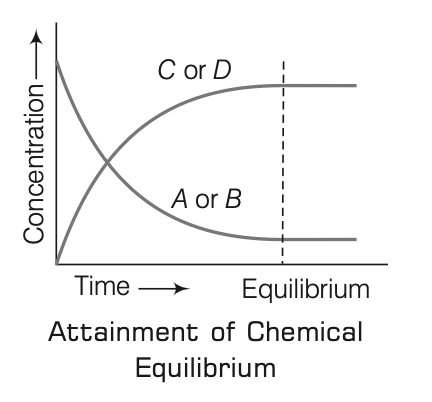
- Definition:
- For a reversible reaction \( A + B \leftrightarrow C + D \), equilibrium occurs when forward and reverse reaction rates are equal, and concentrations of reactants and products are constant.
- Dynamic equilibrium:
- Reactions continue at equal rates.
- Attainment:
- Forward reaction rate decreases, reverse rate increases until equal.
- Law of Chemical Equilibrium and Equilibrium Constant:
- Proposed by CM Guldberg and Peter Waage (1864, law of mass action).
- Rate of reaction proportional to active mass (concentration) of reactants.
- For reaction \( aA + bB \leftrightarrow cC + dD \):
- Forward rate:
- \( r_f = k_f [A]^a [B]^b \).
- Backward rate:
- \( r_b = k_b [C]^c [D]^d \).
- At equilibrium:
- \( r_f = r_b \), so \( k_f [A]^a [B]^b = k_b [C]^c [D]^d \).
- Equilibrium constant:
- \( K_c = \frac{k_f}{k_b} = \frac{[C]^c [D]^d}{[A]^a [B]^b} \).
- \( K_c \):
- Constant at fixed temperature, changes with temperature.
- Types of Equilibria:
- Homogeneous:
- All reactants and products in same phase.
- Examples:
- \( CH_3COOC_2H_5(aq) + H_2O(l) \leftrightarrow CH_3COOH(aq) + C_2H_5OH(aq) \).
- \( N_2(g) + 3H_2(g) \leftrightarrow 2NH_3(g) \).
- Heterogeneous:
- Reactants and products in different phases.
- Examples:
- \( H_2O(l) \leftrightarrow H_2O(g) \).
- \( CaCO_3(s) \xrightarrow{\Delta} CaO(s) + CO_2(g) \).
- Le-Chatelier’s Principle:
- System adjusts to counteract changes in equilibrium conditions.
- Effects:
- Increasing reactant concentration or removing product shifts equilibrium forward.
- Adding product or removing reactant shifts equilibrium backward.
- Temperature increase favors endothermic direction (forward for heat-absorbing, backward for heat-releasing).
- Pressure increase favors direction with lower pressure (fewer gas moles).
- Electrochemistry
- Definition
- Study of electricity production from spontaneous chemical reactions and use of electrical energy for non-spontaneous chemical transformations.
- Used to produce metals, sodium hydroxide, chlorine, fluorine, and other chemicals.
- Electrolysis
- Definition
- From ‘electro’ (electrical energy) and ‘lysis’ (dissociation); decomposition of a molten or aqueous substance by electric current.
- Non-spontaneous chemical reaction driven by electrical energy.
- Example:
- William Nicholson demonstrated electrolysis of water.
- Components Required
- Electrolyte
- Compound conducting electricity in molten or aqueous state (e.g., acids, bases, salts).
- Types:
- Strong Electrolytes:
- Completely dissociate (e.g., \( NaCl, KCl, CaCl_2, MgSO_4 \)).
- Weak Electrolytes:
- Partially dissociate (e.g., \( CH_3COOH \)).
- Non-electrolytes:
- Poor conductors, do not dissociate (e.g., urea, glucose, sugar).
- Electric Current
- Flow of electrons in a conductor, facilitating ion transfer to respective terminals.
- Electrode
- Solid conductor for electric current entry/exit in electrolyte, part of the circuit.
- Arrhenius Theory of Electrolytic Dissociation (1894)
- Postulates:
- Electrolytes dissociate into cations (positive) and anions (negative) in water (ionisation).
- Weak electrolytes partially dissociate, forming an ionic equilibrium with unionised molecules (e.g., \( CH_3COOH \leftrightarrow CH_3COO^- + H^+ \)).
- Degree of Dissociation: \( \frac{\text{Number of ionised molecules}}{\text{Total number of molecules}} \).
- Electrolysis occurs only at electrodes.
- Conductivity depends on the number of ions in solution.
- Faraday’s Laws of Electrolysis (1833-34)
- First Law
- Amount of chemical reaction at an electrode is proportional to the quantity of electricity passed: \( m = ZQ = Zit \). Where:
- \( m \): mass deposited (g), \( Z \): electrochemical equivalent, \( Q \): charge (Coulombs), \( i \): current (A), \( t \): time (s).
- Electrochemical Equivalent (\( Z \)): Mass deposited when 1 A is passed for 1 s (1 Coulomb).
- Second Law
- Masses of substances liberated by the same electricity quantity are proportional to their chemical equivalent weights (\( \text{Atomic mass} \div \text{Number of electrons to reduce cation} \)): \( \frac{W_1}{E_1} = \frac{W_2}{E_2} = \frac{W_3}{E_3} \), or \( Z \propto E \). Where:
- \( W \): mass deposited, \( E \): chemical equivalent weight.
- Faraday’s Constant
- 1 Faraday = charge to deposit one equivalent weight, approximately \( 96487 \, \text{C mol}^{-1} \) (often rounded to \( 96500 \, \text{C mol}^{-1} \)).
- Charge on 1 mole of electrons.
- Products of Electrolysis
- Depend on:
- Material electrolysed.
- Electrode type.
- Oxidising/reducing species and their standard electrode potentials.
- Examples:
- Molten \( NaCl \):
- Sodium metal and \( Cl_2 \) gas.
- Aqueous \( NaCl \):
- \( NaOH, Cl_2, H_2 \).
- Aqueous \( CuSO_4 \) with copper electrodes:
- Copper at cathode.
- Electrode Potential
- Potential difference between electrode and electrolyte.
- Standard Electrode Potential:
- At unit concentration of all species in a half-cell.
- Applications of Electrolysis
- Electrorefining of Metals
- Produces pure metals (e.g., 99.9% pure copper) using impure metal as anode, pure metal strip as cathode, and metal salt solution as electrolyte.
- Electroplating
- Deposits desired metal on another material for appearance, corrosion resistance, or scratch protection (e.g., chromium on car parts, gold on silver/copper/nickel jewellery, tin on iron for cans).
- Electrotyping
- Used in printing for blocks/graphics; copper coated on printing paper for high-quality prints.
- Electrometallurgy
- Extracts metals like calcium, aluminium, magnesium from their compounds.
- Manufacturing of Compounds
- Produces chloroform, ethane, acetylene, drugs via electrolysis.
- Evaluation of Equivalent Weight
- Calculated using \( w \propto E \).
- Electrolytic Capacitor
- Aluminium electrodes with boric acid, glycerine, and aqueous ammonia electrolyte; aluminium hydroxide layer on anode acts as dielectric.
- Electrolytic Cell
-
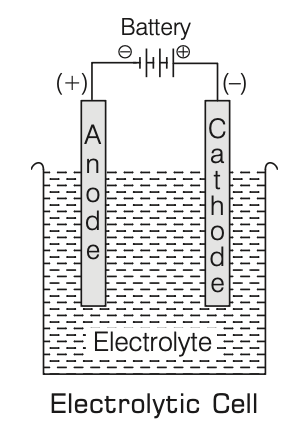
- Container for electrolysis with two electrodes:
- Anode:
- Connected to positive terminal, where oxidation (electron loss) occurs.
- Cathode:
- Connected to negative terminal, where reduction (electron gain) occurs.
- Electrodes dipped in electrolytic solution.
- Galvanic (Voltaic) Cell
- Definition
- Converts chemical energy from spontaneous redox reactions into electrical energy.
- Example:
- Daniell cell.
- Daniell Cell
- Anode:
- Zinc rod in \( ZnSO_4 \) solution.
- Cathode:
- Copper rod in \( CuSO_4 \) solution.
- Operation:
- Zinc loses mass (oxidises), copper gains mass (reduces) when connected by wire, producing current.
- Electrochemical Series
- Definition
- Arrangement of elements by increasing or decreasing electrode potentials, with hydrogen at zero.
- Series:
- \( Li, K, Ba, Ca, Na, Mg, Al, Zn, Cr, Fe, Co, Cd, Ni, Sn, H_2, Cu, I_2, Hg, Ag, Pd, Br_2, Cl_2, Au, F_2 \).
- Characteristics
- Lower reduction potential indicates greater reducing power.
- Metals above hydrogen displace metals below from salt solutions (higher metals more active).
- Metals above hydrogen displace \( H_2 \) from \( H^+ \)-containing solutions.
- Higher negative electrode potential increases tendency to form ions.
- Allows comparison of oxidising/reducing behaviour.
- Batteries
- Definition
- Galvanic cells (single or multiple in series) converting chemical energy to electrical energy via redox reactions.
- Stored chemical energy transforms slowly into electrical energy in a circuit.
- Types
- Primary Batteries
- Non-rechargeable, reaction occurs once, battery becomes dead.
- Examples:
- Dry Cell (Leclanche Cell)
- Used in transistors, clocks.
- Anode:
- Zinc container.
- Cathode:
- Carbon (graphite) rod with \( MnO_2 \) and carbon powder.
- Electrolyte:
- Moist paste of \( NH_4Cl \) and \( ZnCl_2 \).
- Reactions:
- Anode:
- \( Zn(s) \to Zn^{2+} + 2e^- \).
- Cathode:
- \( MnO_2 + NH_4^+ + e^- \to MnO(OH) + NH_3 \).
- \( NH_3 \) forms complex with \( Zn^{2+} \); \( MnO_2 \) acts as depolariser.
- Potential:
- ~1.5 V.
- Mercury Cell
- Used in low-current devices (e.g., hearing aids, watches).
- Anode:
- Zinc-mercury amalgam.
- Cathode:
- \( HgO \) and carbon paste.
- Electrolyte:
- \( KOH \) and \( ZnO \) paste.
- Reactions:
- Anode:
- \( Zn(Hg) + 2OH^- \to ZnO(s) + H_2O + 2e^- \).
- Cathode:
- \( HgO + H_2O + 2e^- \to Hg(l) + 2OH^- \).
- Overall:
- \( Zn(Hg) + HgO(s) \to ZnO(s) + Hg(l) \).
- Potential:
- 1.35 V, constant during life.
- Secondary Batteries
- Rechargeable by passing current in opposite direction.
- Examples:
- Lead Storage Battery
- Used in automobiles, inverters.
- Anode:
- Lead.
- Cathode:
- Lead grid with \( PbO_2 \).
- Electrolyte:
- 38% \( H_2SO_4 \).
- Reactions:
- Anode:
- \( Pb(s) + SO_4^{2-}(aq) \to PbSO_4(s) + 2e^- \).
- Cathode:
- \( PbO_2(s) + SO_4^{2-}(aq) + 4H^+(aq) + 2e^- \to PbSO_4(s) + 2H_2O(l) \).
- Overall (discharge):
- \( Pb(s) + PbO_2(s) + 2H_2SO_4(aq) \to 2PbSO_4(s) + 2H_2O(l) \).
- Recharge:
- Reverses reaction, regenerating \( Pb \) and \( PbO_2 \).
- Six cells, ~2 V each, total ~12 V.
- Capacity in ampere-hours; emf: 2.2 V (charged), 1.8 V (discharged).
- Sulphating:
- Discharged state with \( PbSO_4 \) accumulation.
- Ni-Cd Cell
- Anode:
- Cadmium.
- Cathode:
- Metal grid with \( NiO_2 \).
- Electrolyte:
- \( KOH \).
- Longer life than lead storage, but more expensive.
- Used in torchlights, electric shavers.
- Ni-MH Battery
- 25% longer rechargeable life, less hazardous than Ni-Cd.
- Notes:
- Batteries self-discharge faster at higher temperatures, requiring frequent charging in summer.
- Lithium-Ion Battery (LIB)
- Operation:
- Lithium ions move from negative to positive electrode during discharge, reverse during charging.
- Electrodes:
- Intercalated lithium compounds (e.g., Lithium Manganese Oxide, Lithium Cobalt Oxide).
- Applications:
- Portable Devices:
- Mobile phones, laptops, tablets, cameras, e-cigarettes, game consoles, torches.
- Power Tools:
- Cordless drills, sanders, saws, garden equipment.
- Electric Vehicles:
- Cars, pedelecs, hybrids, wheelchairs, radio-controlled models, Mars Curiosity rover.
- Telecommunications:
- Backup power for network equipment.
- Hydrogen-Oxygen Fuel Cell
- Runs continuously with fuel supply, ~70% efficiency (vs. 40% for thermal plants).
- Pollution-free, used in Apollo space programme.
- Cell Efficiency
- Definition:
- Ratio of beneficial work to total work done.
- Formula:
- \( \eta = \frac{V}{E} \). Where:
- \( E \): emf of cell, \( V \): potential difference at terminals in a closed circuit.
- Classification of Elements
- Introduction
- Elements classified based on similar properties.
- 118 known elements:
- 98 naturally occurring, others artificially synthesized.
- Classification aims to make study of elements convenient, systematic, organized.
- Periodic Classification
- Definition
- Arrangement where elements with similar properties reappear at regular intervals.
- Historical Contributions
- Dobereiner’s Triads:
- Grouped elements in threes; middle element’s atomic weight and properties are averages of the other two.
- Newlands’ Law of Octaves:
- Elements arranged by increasing atomic weight; every eighth element resembles the first, like musical notes.
- Limitations:
- Unable to arrange all known elements effectively.
- Mendeleev’s Periodic Table
- Basis
- Mendeleev studied hydrides and oxides, leading to Mendeleev’s Periodic Law: Properties of elements are a periodic function of their atomic masses.
- Elements arranged by increasing atomic weight, with similar properties recurring at intervals.
- Structure
- 8 groups (vertical columns), 7 periods (horizontal rows).
- Elements with similar properties grouped by atomic weight.
- Characteristics
- Reversed order of some pairs (e.g., cobalt (58.9) before nickel (58.7)) for chemical property alignment.
- Left gaps for undiscovered elements (e.g., Eka-boron, Eka-aluminium, Eka-silicon), later matched to scandium, gallium, germanium.
- Advantages
- Simplified element study.
- Predicted properties of new elements.
- Predicted valency.
- Calculated actual atomic weights.
- Limitations
- No fixed position for hydrogen.
- Isotopes challenged periodic law.
- Irregular atomic mass increase made predicting new elements difficult.
- Misplaced elements: Similar properties in different groups (e.g., \( Cu, Hg \); \( Ag, Tl \); \( Au, Pt \)), dissimilar properties in same group (e.g., group 8 triads, group 1 alkali metals with \( Cu, Ag, Au \)).
- Note: Only 63 elements known during Mendeleev’s time; inert gases undiscovered.
- No separate placement for metals and non-metals.
- Modern Periodic Table
- Basis
- Proposed by Moseley (1913) based on atomic number as the fundamental property.
- Modern Periodic Law: Physical and chemical properties are periodic functions of atomic numbers.
- Removed most drawbacks of Mendeleev’s table.
- Long Form of Periodic Table
- Based on electronic configuration, widely used.
- Characteristics
- 7 periods (horizontal rows), 18 groups (vertical columns).
- Elements with similar outer electronic configurations in groups, sharing similar chemical properties.
- Period number corresponds to highest principal quantum number (\( n \)) of valence shell.
- Period element counts: 1st (2), 2nd-3rd (8 each), 4th-5th (18 each), 6th (32), 7th (incomplete).
- Lanthanoids and actinoids (14 elements each) placed in separate panels at bottom.
- Modern Periodic Table Structure
-
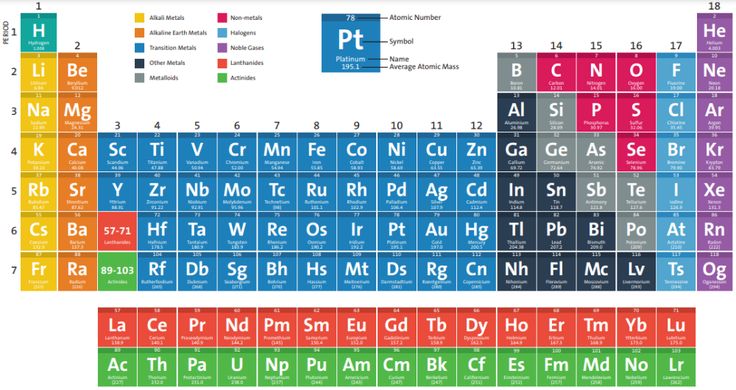
- Characteristics of Periods
- Valence electrons increase from 1 to 8 across a period (left to right).
- Elements have consecutive atomic numbers.
- Valency (w.r.t. hydrogen) increases from 1 to 4, then decreases to 0.
- Properties decreasing left to right:
- Atomic size, electropositive nature, metallic nature, reducing nature, basic nature of oxides.
- Properties increasing left to right:
- Electronegative nature, non-metallic nature, acidic nature of oxides, ionisation potential, electron affinity.
- Characteristics of Groups
- Same number of valence electrons, leading to similar chemical properties.
- Properties increasing top to bottom:
- Atomic size, electropositive nature, metallic nature, reducing nature, basic nature of oxides.
- Properties decreasing top to bottom:
- Electronegative nature, ionisation potential, electron affinity, non-metallic nature, acidic nature of oxides.
- Reactivity:
- Metals increase, non-metals decrease down a group.
- Prediction of Group and Period
- Period:
- Determined by number of electron shells.
- Group:
- s-block:
- Group number = valence shell electrons.
- p-block:
- Group number = valence shell electrons + 10.
- d-block:
- Group number = electrons in \( ns \)-shell + \( (n-1)d \)-shell.
- Types of Elements
- s-Block Elements
- Valence electron(s) in s-orbital.
- Groups 1 (IA, alkali metals) and 2 (IIA, alkaline earth metals).
- Electronic configuration:
- \( [\text{noble gas}] ns^1 \) (alkali metals), \( [\text{noble gas}] ns^2 \) (alkaline earth metals).
- Soft metals, electropositive, form basic oxides.
- p-Block Elements
- Valence electron(s) in p-orbital.
- Electronic configuration:
- \( ns^2 np^{1-6} \).
- Groups 13–18 (IIIA–VIIIA).
- Includes metals, non-metals, metalloids.
- Inert pair effect:
- Heavier elements (e.g., \( Pb \): +2 more stable than +4; \( Tl \): +1 more stable than +3).
- Ununseptium (element 117, group 17, below halogens):
- Synthesized in Dubna (Russia, 2010) and GSI (Germany, 2014); temporary name.
- d-Block Elements
- Valence electron(s) in d-orbital.
- Electronic configuration:
- \( (n-1)d^{1-10} ns^{1-2} \).
- Groups 3–12; transition elements (except \( Zn, Cd, Hg \)).
- Series:
- 3d (\( Sc \) to \( Zn \)), 4d (\( Y \) to \( Cd \)), 5d (\( La \) to \( Hg \), excluding \( Ce \) to \( Lu \)).
- f-Block Elements
- Lanthanoids (14 elements after \( La \)) and actinoids (14 elements after \( Ac \)).
- Lanthanoid configuration:
- \( 6s^2 5d^{0-2} 4f^{1-14} \).
- Actinoid configurations irregular.
- Inner-transition elements.
- Transuranic elements (beyond \( U \), atomic number 92):
- Synthetic, radioactive (e.g., \( Np, Pu, Am, Cm, Bk, Cf, Es, Md \)).
- Notes
- s- and p-block:
- Representative elements.
- \( Hg, Zn, Cd \):
- d-block, not transition elements.
- All s-, d-, f-block elements are metals except hydrogen.
- Highest and Lowest Properties of Elements
-
| Property | Element |
|---|
| Lightest element | Hydrogen |
| Lightest non-metal | Helium |
| Heaviest element | Osmium |
| Lightest metal | Lithium |
| Liquid metal | Mercury |
| Liquid non-metal | Bromine |
| Best conductor (metal) | Silver |
| Second best conductor | Copper |
| Best non-metallic conductor | Graphite |
| Highest ionisation potential | Helium |
| Least ionisation potential | Caesium |
| Highest melting point (metal) | Tungsten |
| Highest electron affinity | Chlorine |
| Most electronegative | Fluorine |
| Strongest oxidant | Fluorine |
| Strongest reductant | Lithium |
| Monoatomic gases | Inert/noble gases (group 0) |
| Most ductile/malleable metal | Gold |
| Group of gaseous elements | Inert/noble gases |
| Element stored in kerosene | Sodium |
| Element in bones/teeth | Calcium |
| Most reactive metal | Caesium |
| Most reactive non-metal | Fluorine |
| Most poisonous metal | Plutonium |
- Trends in Modern Periodic Table (Periodic Properties)
- Definition
- Properties repeating at regular intervals.
- Valency
- Increases from 1 to 7 w.r.t. hydrogen across a period, but w.r.t. oxygen, increases from 1 to 4, then decreases to 0.
- Examples:
- Alkali metals (\( Na, K \)): 1; alkaline earth metals (\( Mg, Ca \)): 2; aluminium: 3; nitrogen: -3 to +5.
- Atomic Size
- Increases down a group (new shells added).
- Decreases across a period (increased nuclear charge pulls electrons closer).
- Alkali metals largest, halogens smallest in a period; noble gases larger than halogens.
- Ionisation Energy
- Energy to remove an electron from a gaseous atom.
- Increases across a period due to higher nuclear charge.
- Exceptions:
- Group 2 (\( Be, Mg, Ca, Sr \), \( ns^2 \)) > Group 3 (\( B, Al, Ga, In \), \( ns^2 np^1 \)); Group 15 (\( N, P, As \), \( ns^2 np^3 \)) > Group 16 (\( O, S, Se \), \( ns^2 np^4 \)) due to stable configurations.
- Decreases down a group (larger atomic size).
- Electron Gain Enthalpy (\( \Delta_e H_g \))
- Enthalpy change when an electron is added to form an anion; energy released is electron affinity (EA).
- EA increases across a period; zero or positive for groups 2, 15, 0.
- Decreases down a group; highest for chlorine.
- Electronegativity
- Tendency to attract shared electrons in a molecule.
- Increases across a period, decreases down a group; highest for fluorine.
- Metallic Character
- Tendency to lose electrons, forming cations.
- Decreases across a period, increases down a group; metals on left side of table.
- Non-Metallic Character
- Tendency to gain electrons, forming anions.
- Increases across a period, decreases down a group.
- Density
- Mass per unit volume.
- Increases down a group and across a period; exception: gold > mercury > steel.
- Hydrogen and Its Compounds
- Hydrogen
- Introduction
- Symbol:
- \( H \), atomic number: 1, mass number: 1.
- Discovered by Henry Cavendish (1766), named by Antoine Lavoisier.
- Simplest atomic structure:
- 1 proton, 1 electron, no neutron in atomic form.
- Exists as diatomic \( H_2 \) (dihydrogen) in elemental form.
- Forms more compounds than any other element.
- Position in Periodic Table
- First element, electronic configuration: \( 1s^1 \).
- Resembles alkali metals and halogens in some properties, placed separately.
- Occurrence
- Most abundant element in universe (70% of total mass).
- Principal element in solar atmosphere, Jupiter, Saturn, and stars.
- Less abundant in Earth’s atmosphere due to light nature.
- Ninth most abundant element in Earth’s crust.
- Isotopes
- Protium (\( ^1_1H \)):
- No neutrons, predominant form.
- Deuterium (\( ^2_1H \) or \( D \)):
- 1 neutron, prepared by Urey, Brickwedde, Murphy (1931), used in organic reaction mechanisms and nuclear reactions.
- Tritium (\( ^3_1H \) or \( T \)):
- 2 neutrons, radioactive (half-life: 12.4 years), beta emitter.
- Special Forms
- Nascent Hydrogen:
- Generated in-situ, highly reactive, strong reducing agent.
- Atomic Hydrogen:
- Produced at high temperature by decomposing molecular hydrogen, stronger reducing agent than nascent hydrogen.
- Ordinary Hydrogen:
- Mixture of ortho (same nuclear spin direction) and para (opposite nuclear spin direction) forms.
- Adsorbed Hydrogen:
- \( H_2 \) adsorbed on \( Pt, Pd, Ni \), released at higher temperatures, process called occlusion.
- Preparation
- Laboratory:
- Granulated zinc with dilute \( HCl \).
- Commercial:
- Electrolysis of acidified water using platinum electrodes.
- Steam on hydrocarbons or coke at high temperature with catalyst.
- Other Methods:
- Water vapours over red-hot iron, treating hydrolith or sodium with water.
- Pure \( H_2 \):
- From \( Mg \) with dilute \( H_2SO_4 \) or \( NaH \) with water.
- Production Sources:
- Petrochemicals (77%), coal (18%), electrolysis (4%), other (1%).
- Properties
- Physical
- Colourless, odourless, tasteless, combustible gas.
- Lighter than air, insoluble in water.
- Melting point:
- 13.96 K, boiling point: 20.39 K.
- Density:
- \( 0.09 \, \text{g L}^{-1} \).
- Chemical
- Inert at room temperature due to high \( H-H \) bond energy.
- With halogens:
- \( H_2(g) + X_2(g) \xrightarrow{\text{high temp}} 2HX(g) \) (\( X = F, Cl, Br, I \)).
- With oxygen:
- \( 2H_2(g) + O_2(g) \xrightarrow{\text{catalyst/heating}} 2H_2O(l) + \text{Heat} \) (exothermic).
- With nitrogen (Haber’s process):
- \( 3H_2(g) + N_2(g) \xrightarrow{\text{Fe, Mo, 673 K, 200 atm}} 2NH_3(g) + \text{Heat} \).
- With metals:
- \( H_2(g) + 2M(g) \to 2MH(s) \) (\( M = \text{alkali metal} \)).
- With organic compounds:
- Hydrogenation with catalysts yields useful products.
- Hydration:
- Water chemically combines with elements/minerals.
- Commercial Importance of Hydrogenation
- Vegetable oils (unsaturated fats) with nickel catalyst form edible fats (vanaspati ghee, saturated fats).
- Hydroformylation of olefins yields aldehydes, reduced to alcohols.
- Uses
- Ammonia synthesis (Haber’s process) for nitric acid and nitrogenous fertilizers.
- Hydrogenation of vegetable oils (e.g., soybean, cottonseed) for vanaspati fat.
- Manufacturing methanol and bulk organic chemicals.
- Producing metal hydrides, hydrogen chloride.
- Reducing heavy metal oxides to metals in metallurgy.
- Atomic and oxyhydrogen torches for cutting/welding.
- Rocket fuel in space research.
- Fuel cells for electricity generation (fuel of the future).
- Balloon filling (85% \( He \), 15% \( H_2 \)), now prohibited due to flammability.
- Notes
- \( H_2, He, Li \):
- Formed in Big Bang.
- Solar energy from \( H_2 \) to \( He \) conversion.
- Anti-hydrogen:
- Anti-matter, reacts explosively with \( O, Cl, F \).
- \( H_2 \):
- Too light for Earth’s gravity, no free hydrogen on Earth.
- Only element without neutrons (protium).
- Water (\( H_2O \))
- Introduction
- Major component of living organisms (human body: ~65%, some plants: ~95%).
- 97% of Earth’s water in oceans, rest in pure form; rainwater purest.
- Properties
- Colourless, tasteless liquid; neutral (\( pH = 7 \)).
- Poor conductor, conductivity increased by adding strong electrolytes.
- Maximum density, minimum volume at 4°C.
- Solidifies to ice at 0°C.
- High freezing point, boiling point, heat of vaporization, heat of fusion due to H-bonding, compared to \( H_2S, H_2Se \).
- High specific heat, thermal conductivity, surface tension, dipole moment, dielectric constant; used as coolant in engines.
- Excellent solvent due to high dielectric constant, transports ions/molecules for metabolism.
- Dissolves covalent compounds (e.g., alcohols, carbohydrates) via H-bonding.
- Structure
- Gas phase:
- Bent molecule, bond angle 104.5°, \( O-H \) bond length 95.7 pm.
- Ice:
- Oxygen tetrahedrally surrounded by four oxygen atoms via H-bonding, open structure with holes, lower density than liquid water.
- Hard Water
- Contains calcium, magnesium, iron salts (hydrogen carbonates, chlorides, sulphates).
- Does not lather with soap, forms scum/precipitate.
- Unsuitable for laundry, harmful for boilers due to scale deposition.
- Notes:
- Boiled water containers develop white carbonate layer (\( Ca, Mg \)).
- Detergents unaffected by hard/soft water.
- Degree of hardness:
- Parts of \( CaCO_3 \) or equivalent per \( 10^6 \) parts water by mass.
- Softening:
- Removal of \( Ca, Mg, Fe \) salts.
- Gamma-emitting isotopes in drinking water detected by scintillation counter.
- Soft Water
- Free from soluble \( Ca, Mg \) salts, lathers with soap.
- Example:
- Rainwater (nearly pure).
- Temporary Hardness
- Caused by magnesium and calcium hydrogen carbonates.
- Removal:
- Boiling:
- Converts soluble \( Mg(HCO_3)_2 \) to insoluble \( Mg(OH)_2 \), \( Ca(HCO_3)_2 \) to \( CaCO_3 \), filtered out.
- Clark’s Method:
- Lime addition precipitates \( CaCO_3, Mg(OH)_2 \), filtered off.
- Permanent Hardness
- Caused by soluble \( Ca, Mg \) chlorides and sulphates.
- Removal:
- Washing Soda (\( Na_2CO_3 \)):
- Forms insoluble carbonates with \( Ca, Mg \) salts.
- Calgon’s Method:
- Sodium hexametaphosphate (\( Na_6P_6O_{18} \)) forms complex anions, keeping \( Ca^{2+}, Mg^{2+} \) in solution.
- Ion Exchange (Zeolite/Permutit):
- Hydrated sodium aluminium silicate exchanges ions to soften water.
- Synthetic Resins:
- More efficient cation exchangers than zeolite.
- Blue Ice
- Purest, virus-free ice, ~2500 years old, found in Greenland, used in whisky production.
- Poly Water
- Prepared in hair-shaped capillaries, chemically similar to ordinary water.
- Freezing point: -40°C, boiling point: 150°C.
- Considered highly dangerous.
- Water Purification
- Potassium permanganate, bleaching powder (\( Cl_2 \)), potash alum used for sterilization.
- Heavy Water (\( D_2O \))
- Discovered by Urey and Washburn (1932), oxide of deuterium.
- Prepared by exhaustive electrolysis of water or as fertilizer industry by-product.
- Occurs 1 part per 5000 parts ordinary water.
- Uses:
- Moderator in nuclear reactors, exchange reactions for reaction mechanisms, preparation of deuterium compounds (e.g., \( CD_4, D_2SO_4 \)).
- Higher density than ordinary water.
- Hydrogen Peroxide (\( H_2O_2 \))
- Discovered by Thenard (1818).
- Properties:
- Nearly colourless (pale blue), odourless liquid, miscible with water, exists as liquid due to extensive H-bonding.
- Preparation:
- Acidifying barium peroxide with \( H_2SO_4 \), or UV exposure on oxygen with water vapour.
- Acts as oxidizing and reducing agent.
- Uses
- Hair bleach, mild disinfectant (oxidizing property).
- Antiseptic (sold as perhydrol).
- Manufacture of sodium perborate, percarbonate for high-quality detergents.
- Bleaching agent for textiles, paper pulp, leather, oils, fats.
- Examination of milk, wine.
- Restoring original colour in old oil paintings.
- Synthesis of hydroquinone, tartaric acid, pharmaceuticals (e.g., cephalosporin).
- Environmental chemistry: Pollution control, cyanide oxidation, restoring aerobic conditions in sewage.
- Fuel in rockets, submarines due to oxygen release.
- Metals and Their Compounds
- Introduction
- Metals:
- Elements that lose electrons to form cations, occupying most of the periodic table (s-, d-, f-blocks, except right corner).
- Known metals:
- Initially \( Cu, Ag, Au \); now 90 metals.
- Physical Properties of Metals
- Solid at room temperature (except \( Hg \)).
- Metallic lustre due to free electrons, polishable.
- Generally hard (except \( Na, K, Ca \), which are soft).
- Malleable:
- Can be hammered into thin sheets (\( Au, Ag \) most malleable).
- Ductile:
- Can be drawn into wires (\( Au \): 1 mg forms 200 m wire).
- Good conductors of heat (\( Ag, Cu \) best; \( Pb, Hg \) poor).
- Good conductors of electricity.
- Sonorous.
- High density (except \( Na, K \)).
- High melting points (except \( Ga, Cs \)).
- Chemical Properties of Metals
- Electropositive, form cations by losing electrons, react with non-metals (\( O_2, H_2, Cl_2, SO_4^{2-} \)).
- Reaction with Oxygen
- Form metal oxides:
- \( \text{Metal} + O_2 \to \text{Metal oxide} \).
- Example:
- \( 2Cu + O_2 \to 2CuO \) (black); \( 4Al + 3O_2 \to 2Al_2O_3 \).
- Most oxides basic; \( Al_2O_3, ZnO \) amphoteric (acidic and basic).
- Soluble oxides form alkalis.
- Reaction with Water
- Highly reactive (\( Na, K, Ca, Mg \)):
- Form hydroxides, release \( H_2 \).
- Moderately reactive (\( Al, Fe, Zn \)):
- React with steam to form oxides, \( H_2 \).
- Least reactive (\( Pb, Cu, Ag, Au \)):
- No reaction.
- Reaction with Acids
- Form salts, \( H_2 \) with dilute acids.
- Dilute \( HNO_3 \):
- No \( H_2 \) (oxidized to \( H_2O \), \( HNO_3 \) reduced to \( N_2O, NO, NO_2 \)).
- Exception:
- \( Mg, Mn \) with dilute \( HNO_3 \) produce \( H_2 \).
- Reaction with Metal Salts
- More reactive metals displace less reactive ones:
- \( Fe + CuSO_4(aq) \to FeSO_4(aq) + Cu \).
- Notes
- \( Li \):
- Lightest metal, strong reducing agent.
- \( Na, K \):
- React vigorously with \( O_2 \), stored in kerosene.
- \( Mg, Al, Zn, Pb \):
- Oxide layer prevents further oxidation.
- \( Fe \):
- Filings burn in flame, not bulk.
- \( Ag, Au \):
- No reaction with \( O_2 \).
- \( Be, Mg \):
- High ionisation energy, no flame colour.
- Reactivity Series
- \( K > Na > Ca > Mg > Al > Zn > Fe > Pb > H > Cu > Hg > Ag > Au \).
- Flame Colouration
- Alkali and alkaline earth metals (except \( Be, Mg \)) impart colours to flames, used in fireworks.
-
| Metal | Colour |
|---|
| Sodium | Golden yellow |
| Potassium | Violet |
| Rubidium | Violet |
| Lithium | Crimson red |
| Calcium | Red or brick red |
| Strontium | Crimson red |
| Barium | Apple green or green |
- Sodium and Its Compounds
- Sodium (\( Na \))
- Atomic number:
- 11, mass: 23, group 1, 3rd period, s-block.
- Electronic configuration:
- \( 1s^2 2s^2 2p^6 3s^1 \).
- Earth’s crust:
- 2.27% by weight, always in combined form.
- Ores:
- Chile saltpetre (\( NaNO_3 \)), Glauber’s salt (\( Na_2SO_4 \cdot 10H_2O \)), borax (\( Na_2B_4O_7 \cdot 10H_2O \)), brine (\( NaCl \)).
- Extraction:
- Electrolysis of molten \( NaOH \) (Castner’s process) or \( NaCl \) (Down’s process).
- Properties
- Light, soft, silvery white, cuttable with knife.
- Highly reactive:
- Forms \( Na_2O \) with air, \( NaOH + H_2 \) with water, stored in kerosene.
- Soluble in benzene.
- Forms sodamide with \( NH_3 \), sodium alkoxide with alcohol, salts with acids, releases \( H_2 \).
- Uses
- Reducing agent, alloying metal, anti-scaling agent.
- Coolant in nuclear reactors (liquid form).
- Making tetraethyl lead (\( TEL \)) from \( Na-Pb \) alloy.
- Compounds
- Sodium Chloride (\( NaCl \))
- Common/table salt, used in food, anti-icing, preserving pickles, meat, fish.
- Raw material for \( NaOH \), washing soda, bleaching powder.
- Notes:
- Not hygroscopic unless impure (\( MgCl_2, CaCl_2 \)); 500 mg/day needed for blood pressure, pH regulation; depletion during dehydration.
- Sodium Hydroxide (\( NaOH \))
- Caustic soda, used in soaps, detergents, salts, pH regulation, petroleum purification, sodium extraction.
- Note:
- Absorbs \( CO_2 \) to form \( Na_2CO_3 \), becomes liquid, then white powder.
- Sodium Carbonate (\( Na_2CO_3 \))
- Washing soda (\( Na_2CO_3 \cdot 10H_2O \)), soda ash (anhydrous), alkaline solution.
- Uses:
- Detergent, removes permanent water hardness, cleans grease/oil/wine stains, used in borax, soap, caustic soda, paper, paints, water glass, petroleum, textiles.
- Note:
- Effloresces to white powder.
- Sodium Bicarbonate (\( NaHCO_3 \))
- Baking soda, used in soda-acid fire extinguishers, baking (with tartaric acid as baking powder, releases \( CO_2 \)).
- Glauber’s Salt (\( Na_2SO_4 \cdot 10H_2O \))
- Used in pulp-paper, detergents, drugs, water glass, drying agent, purgative, sodium sulphide production.
- Sodium Thiosulphate (\( Na_2S_2O_3 \cdot 5H_2O \))
- Hypo, prepared from \( Na_2SO_4 + S + NaOH \).
- Uses:
- Photography (fixes AgBr), cyanide antidote, removes chlorine from tap water.
- Microcosmic Salt (\( Na(NH_4)HPO_4 \cdot 4H_2O \))
- Sodium ammonium hydrogen phosphate, found in urine.
- Forms sodium metaphosphate, \( NH_3 \) on heating.
- Used in salt analysis (microcosmic bead test).
- Magnesium and Its Compounds
- Magnesium (\( Mg \))
- Atomic number:
- 12, mass: 24, group 2, 3rd period, s-block.
- Electronic configuration:
- \( 1s^2 2s^2 2p^6 3s^2 \).
- High reactivity, occurs as chlorides, carbonates, sulphates (e.g., magnesite \( MgCO_3 \), dolomite \( MgCO_3 \cdot CaCO_3 \), epsomite \( MgSO_4 \cdot 7H_2O \), carnallite \( MgCl_2 \cdot KCl \cdot 6H_2O \)).
- Extraction:
- Electrolytic reduction of magnesia or anhydrous \( MgCl_2 \).
- Found in chlorophyll (green colour in plants).
- Properties
- White, glazed, malleable, ductile.
- Melting point:
- 650°C, boiling point: 110°C (likely a typo in source, should be ~1100°C).
- Evolves \( H_2 \) with dilute acids, not bases.
- Forms Grignard’s reagent (\( RMgX \)) with alkyl halides in dry ether.
- Stored in nitrogen atmosphere.
- Uses
- Flashlight ribbons, firecrackers, photography.
- Alloys (e.g., electron: 95% \( Mg \), 4.5% \( Zn \), 0.5% \( Cu \)) for aircraft, vehicle frames.
- Compounds
- Magnesium Hydroxide (\( Mg(OH)_2 \))
- Slightly soluble, alkaline, milk of magnesia (suspension).
- Uses:
- Antacid, laxative, neutralizes acidic wastewater, scalp dandruff treatment.
- Magnesium Sulphate (\( MgSO_4 \))
- Epsomite (\( MgSO_4 \cdot 7H_2O \)), deliquescent, efflorescent.
- Uses:
- Fireproof fabrics, ceramics, cement, matchboxes, mordant in dyeing/tanning, purgative.
- Magnesium Carbonate (\( MgCO_3 \))
- Occurs as magnesite, dolomite, soluble in water.
- Uses:
- Antacid, magnesium alva (drug).
- Magnesium Alba (\( 2MgCO_3 \cdot Mg(OH)_2 \cdot 3H_2O \))
- Uses:
- Antacid, dental abrasive (toothpaste), cosmetics.
- Sorel Cement (\( MgCl_2 \cdot 5MgO \cdot nH_2O \))
- Uses:
- Dental fillings, cementing glass/porcelain.
- Calcium and Its Compounds
- Calcium (\( Ca \))
- Atomic number:
- 20, mass: 40, group 2, 4th period, s-block.
- Discovered by Humphry Davy (1808), third most abundant in Earth’s crust.
- Electronic configuration:
- \( 1s^2 2s^2 2p^6 3s^2 3p^6 4s^2 \).
- Ores:
- Marble, chalk, lime (\( CaCO_3 \)), gypsum (\( CaSO_4 \cdot 2H_2O \)), dolomite (\( CaCO_3 \cdot MgCO_3 \)), fluorspar (\( CaF_2 \)), phosphorite (\( Ca_3(PO_4)_2 \)).
- Extraction:
- Electrolysis of fused 85% \( CaCl_2 \), 15% \( CaF_2 \) (lowers melting point).
- Properties
- Soft (harder than \( Pb \)), silvery white.
- Melting point:
- 1115 K, boiling point: 1757 K, density: 1.55.
- Releases \( H_2 \) with acids, water; no reaction with bases.
- Uses
- Dehydrating agent for absolute alcohol.
- Removes air for high vacuum.
- Oxidizer for cast iron, steel, copper.
- Reducing agent for \( Cr, Th \).
- Compounds
- Calcium Oxide (\( CaO \))
- Quick lime, white porous solid, forms \( Ca(OH)_2 \) with water (hissing sound).
- Uses:
- Cement, mortar, bleaching powder, glass, sugar purification, dyes, chemicals.
- Calcium Hydroxide (\( Ca(OH)_2 \))
- Slaked lime, slightly soluble, lime water (solution), milk of lime (suspension).
- Uses:
- Mortar, glass, bleaching powder, whitewash.
- Note:
- Slaking of lime forms \( Ca(OH)_2 \); with soda, forms soda lime.
- Calcium Carbonate (\( CaCO_3 \))
- Limestone, chalk, marble, pearl, insoluble, decomposes at 1200 K to \( CO_2 \).
- Uses:
- Building material (marble), cosmetic filler, high-quality paper.
- Calcium Chloride (\( CaCl_2 \))
- Hygroscopic, deliquescent, soluble in water, alcohol.
- Uses:
- Dehydrating agent (not for alcohol, ammonia due to addition products).
- Bleaching Powder (\( Ca(OCl)Cl \))
- Calcium chlorooxychlorite, chlorine smell.
- Uses:
- Disinfectant, water purifier, germicide, insecticide, bleaching in textiles, paper, jute.
- Gypsum (\( CaSO_4 \cdot 2H_2O \))
- Uses:
- Plaster of Paris, ammonium sulphate fertilizer.
- Plaster of Paris (\( CaSO_4 \cdot \frac{1}{2}H_2O \))
- Calcium sulphate hemihydrate, forms gypsum on hydration (exothermic, sets hard).
- Reaction:
- \( CaSO_4 \cdot \frac{1}{2}H_2O + 1\frac{1}{2}H_2O \to CaSO_4 \cdot 2H_2O \).
- Uses:
- Plastering bones, dentistry, statues, toys, ornamental work.
- Super Phosphate of Lime (\( CaH_4(PO_4)_2 + CaSO_4 \cdot 2H_2O \))
- From phosphorite, bone ash, water-soluble, plant-assimilable.
- Uses:
- Fertilizer to increase crop production.
- Notes
- Nitrolim (\( CaCN_2 \)):
- From \( CaC_2 + N_2 \) at 2000°C.
- Hydrolith (\( CaH_2 \)):
- Supplies \( H_2 \) with water.
- Calcium phosphate (\( Ca_3(PO_4)_2 \)):
- Toothpaste.
- Aluminium and Its Compounds
- Aluminium (\( Al \))
- Atomic number:
- 13, mass: 27, group 13, 3rd period, p-block.
- Electronic configuration:
- \( 1s^2 2s^2 2p^6 3s^2 3p^1 \).
- Third most abundant in Earth’s crust, occurs as bauxite (\( Al_2O_3 \cdot 2H_2O \)), corundum (\( Al_2O_3 \)), feldspar (\( K_2O \cdot Al_2O_3 \cdot 6SiO_2 \)), cryolite (\( Na_3AlF_6 \)).
- Extraction:
- Bauxite concentrated by Baeyer’s/Hall’s process (\( Fe_2O_3 \) impurity) or Serpek’s process (\( SiO_2 \)), electrolysed with cryolite, fluorspar; purified by Hoope’s process.
- Properties
- Silvery white, soft, ductile, melting point: 659.8°C, boiling point: 2200°C.
- Good conductor of heat, electricity, specific gravity: 2.7.
- Releases \( H_2 \) with conc. \( HCl \), dilute \( H_2SO_4 \); \( SO_2 \) with conc. \( H_2SO_4 \).
- Forms aluminate, \( H_2 \) with \( NaOH, KOH \); aluminium nitride with \( N_2 \).
- Uses
- Reducing agent in metallurgy.
- Thin foil for sweets, cigarette packing.
- Silvery paints (\( Al \) powder + linseed oil).
- Alloys for aeroplanes.
- Alloys
-
| Alloy | Composition | Uses |
|---|
| Aluminium bronze | Al (10%), Cu (90%) | Coins, utensils |
| Duralumin | Al (95%), Mg (0.5%), Cu (4%), Mn (0.5%) | Pressure cookers, aircraft |
| Nickel alloy | Al (90%), Ni (6%), Cu (4%) | Aerospace |
| Magnalium | Al (95-96%), CuFe (2-3%), Mg (2%) | Aerospace |
- Compounds
- Aluminium Chloride (\( AlCl_3 \))
- Anhydrous, white, deliquescent, fumes in air.
- Uses:
- Petroleum refining, synthetic polymers/rubbers, catalyst in gasoline production, Friedel-Crafts reaction, hardening agent, antiperspirant.
- Notes
- Aluminium carbide (\( Al_4C_3 \)): Methanide, forms \( CH_4 \) with water.
- Aluminium acetate:
- Red liquor, mordant in dyeing, calico printing.
- Manganese and Its Compounds
- Manganese (\( Mn \))
- Atomic number: 25, mass:
- 55, group 7, 4th period, d-block.
- Electronic configuration:
- \( [Ar] 3d^5 4s^2 \).
- Ultra-pure:
- Silvery white; commercial: Pink tinge.
- Extraction:
- Pyrolusite (\( MnO_2 \)) by carbon or alumino thermic process; pure via electrolysis of \( MnSO_4 \).
- Alloys
- Spiegeleisen (\( Mn, Fe, C \)):
- Steel manufacture.
- Ferromanganese (70-80% \( Mn \)):
- Steel production.
- Compound:
- Potassium Permanganate (\( KMnO_4 \))
- From \( MnO_2 + KOH \), electrolytic oxidation.
- Dark violet, rhombic prismatic crystals, moderately soluble in water (solubility increases with temperature), reddish aqueous solution.
- Isomorphous with \( KClO_4 \), releases \( O_2 \) at 200°C.
- Uses:
- Oxidizing agent, disinfectant (red medicine), \( Fe^{2+}, C_2O_4^{2-} \) estimation, redox titrations, \( Cl_2 \) preparation, oil decolouration, bleaching wool/silk/cotton.
- Iron and Its Compounds
- Iron (\( Fe \))
- Atomic number:
- 26, mass: 56, group 8, 4th period, d-block.
- Electronic configuration:
- \( 1s^2 2s^2 2p^6 3s^2 3p^6 3d^6 4s^2 \).
- Discovered before 5000 BC, fourth most abundant in Earth’s crust, in vegetables, haemoglobin.
- Ores:
- Red haematite (\( Fe_2O_3 \)), brown haematite (\( 2Fe_2O_3 \cdot 3H_2O \)), magnetite (\( Fe_3O_4 \)).
- Extraction:
- Haematite via carbon reduction in blast furnace.
- Properties
- Ferromagnetic, lustrous, greyish tinge.
- Melting point:
- 1533°C, boiling point: 2450°C.
- No reaction with dry air, water; forms \( H_2 \) with steam.
- With cold dilute \( HNO_3 \):
- Ferrous nitrate, ammonium nitrate.
- With hot conc. \( H_2SO_4 \):
- Ferrous/ferric sulphate, \( SO_2 \).
- With cold conc. \( HNO_3 \):
- Ferric nitrate, \( NO_2 \).
- Forms halides, sulphides with halogens, sulphur.
- Passivity
- Conc. \( HNO_3 \) forms \( Fe_3O_4 \) layer, making iron unreactive; activated by heating in \( H_2 \).
- Notes
- Deficiency causes anaemia; excess causes siderosis (common in African tribes due to iron utensil use).
- Varieties
- Pig Iron:
- 4% \( C \), impurities (\( S, P, Si, Mn \)).
- Cast Iron:
- 3% \( C \), hard, brittle, used for railings, pipes, utensils.
- Wrought Iron:
- 0.12-0.25% \( C \), purest, tough, malleable, ductile, high magnetic permeability, used for chains, hooks, nails.
- Steel:
- 0.25-1.5% \( C \), from cast iron via Bessemer, LD, or Open Hearth processes.
- Steel Alloys
-
| Alloy | Component | Properties | Uses |
|---|
| Nickel steel | Ni (3.5%) | Hard, flexible, rust-resistant | Cables, armour plates, auto parts |
| Stainless steel | Cr (12-18%) | Hard, strong, rust-resistant | Utensils, surgical instruments, blades |
| Chrome vanadium steel | Cr (1-10%), V (0.15-0.51%) | High tensile strength | Axles, springs, wheels, bearings |
| Manganese steel | Mn (12-15%) | Extremely hard, high melting point, rust-free | Rock cutters, safes, railway tracks |
| Invar | Ni (36%) | No expansion | Clock pendulums, scales |
| Tungsten steel | W (14-20%) | Very hard, strong | Springs, cutting tools |
| Chrome steel | Cr (5%) | High tensile strength, heat-resistant | Cutting tools, cutlery |
- Heat Treatment
- Annealing:
- Heat to bright red, cool slowly (soft, ductile).
- Quenching:
- Heat to bright red, cool suddenly in water/oil (hard, brittle).
- Tempering:
- Heat quenched steel below red, cool slowly (balanced hardness).
- Surface Treatment
- Case Hardening:
- Heat with charcoal, plunge in oil (wear-resistant).
- Nitriding:
- Heat in dry ammonia at 500-600°C for 3-4 days (iron nitride coating).
- Compounds
- Ferrous Sulphate (\( FeSO_4 \))
- Green vitriol (\( FeSO_4 \cdot 7H_2O \)), green crystals, water-soluble.
- Uses:
- Iron drugs, blue/black inks, Mohr’s salt, mordant, insecticide.
- Iron Oxides
- Ferrous oxide (\( FeO \)), ferric oxide (\( Fe_2O_3 \), jeweller’s rouge).
- Mohr’s Salt (\( FeSO_4 \cdot (NH_4)_2SO_4 \cdot 6H_2O \))
- Ferrous ammonium sulphate, green crystals, water-soluble, insoluble in alcohol.
- Uses:
- Reducing agent, textile colouration, blue ink, insecticides, leather colouration.
- Copper and Its Compounds
- Copper (\( Cu \))
- Atomic number: 29, mass: 64, group 11, 4th period, d-block.
- Electronic configuration:
- \( [Ar] 3d^{10} 4s^1 \).
- Coinage metal, discovered ~9000 BC (Cyprus).
- Ores:
- Copper pyrite (\( CuFeS_2 \)), copper glance (\( Cu_2S \)), extracted by auto-reduction.
- Properties
- Reddish orange, malleable, ductile, good conductor.
- Melting point:
- 1083°C, boiling point: 2310°C, specific gravity: 8.95.
- Forms basic copper carbonate (green) in moist air.
- No reaction with dilute/cold \( HCl, H_2SO_4 \).
- With hot conc. \( H_2SO_4 \): \( SO_2 \); dilute \( HNO_3 \): \( N_2O \); 50% \( HNO_3 \): \( NO \); conc. \( HNO_3 \): \( NO_2 \); \( HNO_3 \) vapours: \( N_2 \).
- Uses
- Electroplating, electrotyping, wires, appliances, calorimeters, utensils, coins, alloys.
- In cytochrome C oxidase (respiratory enzyme).
- Alloys
-
| Alloy | Composition | Uses |
|---|
| Brass | Cu (70%), Zn (30%) | Utensils, idols |
| Bronze | Cu (90%), Sn (10%) | Utensils, bells, coins |
| Gun metal | Cu (88%), Sn (10%), Zn (2%) | Machine equipment, guns |
| Constantan | Cu (60%), Ni (40%) | Electrical tools |
| Bell metal | Cu (80%), Sn (20%) | Bells, idols |
| German silver | Cu (50%), Zn (35%), Ni (15%) | Utensils, idols |
| Rolled gold | Cu (90%), Al (10%) | Cheap ornaments |
| Delta metal | Cu (60%), Zn (38%), Fe (2%) | Ship propellers |
| Muntz metal | Cu (60%), Zn (40%) | Coins, tubes, castings |
| Monel metal | Cu (70%), Ni (30%) | Alkali-resistant containers |
| Dutch metal | Cu (80%), Zn (20%) | Cheap ornaments |
- Compounds
- Copper (II) Sulphate (\( CuSO_4 \))
- Pale green/grey-white powder; blue vitriol (\( CuSO_4 \cdot 5H_2O \)), poisonous.
- Uses:
- Aquarium fish treatment, fungicide (Bordeaux mixture), seedling protection, chestnut compound, electroplating, copper refining, green dyes.
- Fehling’s Solution
- Mixture of \( CuSO_4 \) (A) and sodium potassium tartrate (B).
- Forms red \( Cu_2O \) precipitate with aldehydes/monosaccharides, tests their presence.
- Silver and Its Compounds
- Silver (\( Ag \))
- Atomic number: 47, mass: 108, group 11, 5th period, d-block.
- Electronic configuration:
- \( [Kr] 4d^{10} 5s^1 \).
- Soft, white, lustrous, occurs as argentite (\( Ag_2S \)), horn silver (\( AgCl \)), ruby silver (\( 3Ag_2S \cdot Sb_2S_3 \)).
- Extraction:
- Mac Arthur cyanide process (argentite); by-product of gold extraction.
- Properties
- Shining white, highly ductile, malleable.
- Melting point:
- 960°C, boiling point: 1955°C, density: 10.47.
- Best conductor of heat, electricity.
- Inert in dry air, forms \( Ag_2S \) (black) with \( H_2S \).
- Inert to acids/bases, dissolves in \( NaCN + O_2 \) (sodium argento cyanide).
- With dilute \( H_2SO_4 \): Inert; conc. \( H_2SO_4 \): \( SO_2 \); dilute \( HNO_3 \): \( NO \); conc. \( HNO_3 \): \( NO_2 \).
- Uses
- Coins, utensils, ornaments, tooth fillings (alloyed), silver plating.
- Note:
- Eggs form \( Ag_2S \) with silver spoons, damaging them.
- Compounds
- Silver Halides (\( AgCl, AgBr, AgI \))
- \( AgBr \): Photography; \( AgCl \): Photochromatic glasses; \( AgI \): Artificial rain.
- Silver Nitrate (\( AgNO_3 \))
- Lunar caustic, white crystalline, melting point: 214°C, water-soluble.
- Stored in coloured bottles (decomposes in sunlight).
- Uses:
- Voter marker, washerman ink, electroplating, hair dyes, lab reagent.
- Gold and Its Compounds
- Gold (\( Au \))
- Atomic number: 79, mass: 197, group 11, 6th period, d-block.
- Electronic configuration:
- \( [Xe] 4f^{14} 5d^{10} 6s^1 \).
- Soft, bright yellow, lustrous, occurs as native, calaverite (\( AuTe_2 \)), sylvanite (\( AgAuTe_2 \)), auriferous sand.
- Extraction:
- Amalgamation (with \( Hg \)) or from auriferous sand.
- Properties
- Heavy, melting point: 1064°C, boiling point: 2610°C, specific gravity: 19.7.
- Inert to most reagents, dissolves in aqua regia (\( 3HCl:1HNO_3 \)).
- Forms aurocyanide ion with \( KCN/NaCN \) in air.
- Soft, alloyed with \( Cu \) for ornaments.
- Note:
- Purity in carats (24 = pure, 23/22 = 1/2 parts \( Cu \)).
- Uses
- Ornaments, coins, electroplating, sugar/pharmaceutical industries.
- Compound: Purple of Cassius (\( Au^+ \cdot Sn(OH)_4 \))
- Colloidal gold, purple, immiscible with water.
- Uses:
- Ruby glass, purple colouration in expensive potteries.
- Zinc and Its Compounds
- Zinc (\( Zn \))
- Atomic number: 30, mass: 65, group 12, 4th period, d-block.
- Electronic configuration:
- \( 1s^2 2s^2 2p^6 3s^2 3p^6 3d^{10} 4s^2 \).
- Discovered before 1000 BC, occurs as zinc blende (\( ZnS \)), zincite (\( ZnO \)), calamine (\( ZnCO_3 \)).
- Extraction:
- Carbon reduction of zinc blende.
- Properties
- Bluish white, hard, brittle, non-malleable, non-ductile.
- Melting point: 419°C, boiling point: 920°C, specific gravity: 7.1.
- Good conductor.
- Forms \( H_2, SO_2, NO_2 \) with dilute \( HCl, H_2SO_4, HNO_3 \); \( H_2 \), sodium zincate with \( NaOH/KOH \).
- Displaces \( Cu \) from \( CuSO_4 \).
- Uses
- Galvanizing iron, alloy production, household items, smoke screens, \( H_2 \) production, gold extraction.
- Compounds
- Zinc Sulphate (\( ZnSO_4 \))
- White vitriol (\( ZnSO_4 \cdot 7H_2O \)), colourless, water-soluble.
- Forms double sulphates (e.g., \( K_2SO_4 \cdot ZnSO_4 \cdot 6H_2O \)).
- Uses:
- Dyes, printing, zinc plating, mordant in dyeing/calico printing.
- Lithopone (\( BaSO_4 + ZnS \))
- From \( ZnSO_4 + BaS \), white pigment, \( H_2S \)-resistant, grey in sunlight, white in dark.
- Uses:
- White paint, enamels.
- Mercury and Its Compounds
- Mercury (\( Hg \))
- Atomic number: 80, mass: 200, group 12, 6th period, d-block.
- Electronic configuration: \( [Xe] 4f^{14} 5d^{10} 6s^2 \).
- Quick silver, liquid at room temperature, from cinnabar (\( HgS \)) via carbon reduction.
- Properties
- Silvery white, superconductor at 4.12 K.
- Forms brown powder with fats/sugar (deadening).
- Loses meniscus with ozone due to oxidation.
- Forms amalgams with most metals except \( Fe, Pt \), transported in iron containers.
- No reaction with water, steam, alkalis, dilute \( HCl, H_2SO_4 \).
- With cold dilute \( HNO_3 \): Mercurous nitrate, \( NO \); conc. \( HNO_3 \): Mercuric nitrate, \( NO, NO_2 \); aqua regia: \( HgCl_2 \).
- Uses
- Thermometers, barometers, amalgams, mascara, mercury-vapour lamps, fluorescent lamps, tube lights (\( Hg \) vapour + \( Ar \)), electrical contacts, silver/gold extraction, vermillion.
- Note:
- Barometer changes indicate weather (rise: clear; fall: cyclone).
- Compounds
- Mercuric Sulphide (\( HgS \))
- Red, crystalline, vermillion, insoluble in water/acid, dissolves in aqua regia to \( HgCl_2 \).
- Uses:
- Medicines, watercolours.
- Mercurous Chloride (\( Hg_2Cl_2 \))
- Calomel, white, water-insoluble.
- Uses:
- Drugs, medicines.
- Mercuric Chloride (\( HgCl_2 \))
- Corrosive sublimate, colourless, poisonous, soluble in hot water.
- Uses:
- Nessler’s reagent (\( K_2HgI_4 + NaOH \)) for \( NH_4^+/NH_3 \), surgical equipment washing, herbicide, dry cells, wood preservative.
- Lead and Its Compounds
- Lead (\( Pb \))
- Atomic number: 82, mass: 207, group 14, 6th period, p-block.
- Electronic configuration:
- \( [Xe] 4f^{14} 5d^{10} 6s^2 6p^2 \).
- Soft, bluish-white, dull grey in air, most stable element.
- Extraction:
- Self-reduction or carbon/CO reduction, purified by Betts electrolytic process.
- Properties
- Amphoteric, melting point: 327°C, boiling point: 1620°C, density: 11.34.
- Malleable, not ductile.
- Inert in dry air, reacts in moist air; forms oxides with \( O_2 \), \( PbCl_2 \) with \( Cl_2 \), \( PbS \) with \( S \), \( PbSO_4 \) with \( H_2SO_4 \), plumbate (\( Na_2PbO_2 \)), \( H_2 \) with \( NaOH \).
- With dilute \( HNO_3 \): \( NO \); conc. \( HNO_3 \): \( NO_2 \) (brown smoke).
- Uses
- Lead chambers, batteries, cable covering, bullets, pipes, alloys, soldering, radiation protection.
- Note:
- Lead pipes banned for drinking water due to toxicity.
- Alloys
-
| Alloy | Composition |
|---|
| Pewter | Sn (75%), Pb (25%) |
| Solder | Sn (50-70%), Pb (30-50%) |
| Type metal | Pb (75%), Sb (20%), Sn (6%) |
- Compounds
- Lead Oxide (\( PbO \))
- Litharge, yellow, amphoteric, volatile.
- Uses:
- Batteries, flint glasses.
- Red Lead (\( Pb_3O_4 \))
- Minium/sindhoor, red, insoluble, from litharge at 470°C.
- Uses:
- Red pigment, glass, matches, protective paint for iron/steel.
- Tetraethyl Lead (\( Pb(C_2H_5)_4 \))
- Colourless liquid, anti-knocking agent in leaded/ethyl petrol (red).
- Lead Carbonate (\( PbCO_3 \))
- Water-insoluble, dissolves in \( HCl, HNO_3 \).
- Uses:
- White pigments.
- Lead Acetate (\( Pb(CH_3COO)_2 \))
- Sugar of lead, white, sweet, water-soluble.
- Uses:
- \( H_2S \) detection, mordant.
- Uranium and Its Compounds
- Uranium (\( U \))
- Atomic number: 92, mass: 238, group 3, 7th period, f-block.
- Electronic configuration:
- \( [Rn] 5f^3 6d^1 7s^2 \).
- Silvery white, from pitchblende, discovered by M.H. Klaproth.
- Six radioactive isotopes: \( ^{232}U, ^{233}U, ^{234}U, ^{235}U, ^{236}U, ^{238}U \) (\( ^{238}U \): 99.28%, \( ^{235}U \): 0.71%, \( ^{234}U \): 0.006%).
- \( ^{235}U \): Fissionable, used in reactors.
- Properties
- Paramagnetic, specific gravity: 19.05, melting point: 1850°C, boiling point: 3500°C.
- Brittle when impure, called metal of hope.
- Uses
- Nuclear fuel, electricity, army, \( NH_3 \) catalyst (Haber’s process), alloys, drugs, nitrates, acetates, photography (uranium acetate/nitrate), gas discharge tube electrodes.
- Note:
- Uranium oxide (yellow cake) used in illegal nuclear explosives.
- Thorium and Platinum
- Thorium (\( Th \))
- Atomic number: 90, mass: 232, group 3, 7th period, f-block.
- Electronic configuration:
- \( [Rn] 6d^2 7s^2 \).
- Radioactive, from monazite, occurs near seashores, octahedral crystals.
- Brown, melting point: 145°C (likely typo, ~1750°C), boiling point: 2800°C, density: 11.23.
- Uses:
- Mag-Thor alloy (aircraft, rockets), nuclear energy, gas mantles, tungsten filament/arc lamps.
- Platinum (\( Pt \))
- Atomic number: 78, mass: 195, group 10, 6th period, d-block.
- Electronic configuration: \( [Xe] 4f^{14} 5d^9 6s^1 \).
- White gold, Adam’s catalyst, inert to air/acids.
- Uses:
- Alloys, pen nozzles, lab devices, ornaments, catalyst in Ostwald’s process.
- Plutonium
- Plutonium (\( Pu \))
- Atomic number: 94, mass: 244, f-block.
- Electronic configuration: \( [Rn] 5f^6 6d^0 7s^2 \).
- Synthetic, radioactive, used in nuclear fission bombs (\( Pu-239 \): Nagasaki), research reactors.
- Other Important Metals
- Tungsten (\( W \)):
- Melting point 3500°C, from Degana mines (Rajasthan), used in bulb filaments (evacuated to prevent burning).
- Titanium (\( Ti \)):
- Strategic metal, strong, light, corrosion-resistant, used in boats, defence.
- Zirconium:
- Burns in \( O_2, N_2 \), neutron-absorbing, used in reactors.
- Chromium:
- Used in magnetic recording (audio cassettes, VHS tapes).
- Beryllium:
- Ore beryl, used in circuit boards, hard disks, motherboards.
- Francium:
- Radioactive liquid metal.
- Tin (\( SnS_2 \)):
- Mosaic gold, used in paints.
- Fuse wire:
- \( Pb, Sn \) alloy.
- Palladium:
- Aircraft manufacturing.
- Gallium:
- Liquid at room temperature.
- Cesium:
- Photoelectric cells.
- Iron:
- In cytochrome.
- Barium Sulphate:
- Barium meal for stomach X-rays.
- Potassium Bromide (\( KBr \)):
- Photography.
- Potassium Nitrate:
- Gunpowder.
- Monopotassium Tartrate:
- Bakery.
- Potassium Carbonate (\( K_2CO_3 \)):
- Pearl ash.
- Nichrome (\( Ni, Cr, Fe \)):
- Electric heater coils.
- Radioactive elements:
- Transform to stable lead.
- Cadmium:
- Banned in EU electronics (2004), used in soldering semiconductors, chip resistors.
- Osmium (\( Os \)):
- Heaviest metal.
- Britannia:
- \( Sb, Cu, Sn \).
- Babbitt:
- \( Sn (89%), Sb (9%), Cu (2%) \).
- Extraction of Metals
- Definition
- Attainment of pure metal from its compound.
- Some metals found free in Earth’s crust, others in compounds.
- Involves chemical principles for extraction and isolation from ores.
- Metallurgy
- Definition
- Scientific and technological process for extracting and isolating metals from ores.
- Types
- Hydrometallurgy
- Extraction by dissolving in aqueous solution.
- Pyrometallurgy
- Extraction by heating with reducing agent.
- Electrometallurgy
- Extraction using electricity.
- Terms Used in Metallurgy
- Minerals
- Naturally occurring chemical substances in Earth’s crust, obtainable by mining (e.g., bauxite, kaolinite).
- Note:
- Oxygen most abundant non-metal, aluminium most abundant metal in Earth’s crust.
- Ore
- Minerals from which metals can be extracted conveniently and profitably.
- All ores are minerals, but not vice versa.
- Example:
- Iron pyrite (\( FeS_2 \)) is a mineral but not ore due to costly extraction.
- Gangue
- Earthen impurities (soil, sand) in ores, also called matrix.
- Ores of Some Important Metals
-
| Element | Composition |
|---|
| Sodium (\( Na \)) | Chile saltpetre (\( NaNO_3 \)), brine (\( NaCl \)), sodium carbonate (\( Na_2CO_3 \cdot 10H_2O \)) |
| Aluminium (\( Al \)) | Bauxite (\( Al_2O_3 \cdot 2H_2O \)), cryolite (\( Na_3AlF_6 \)), feldspar (\( KAlSi_3O_8 \)), corundum (\( Al_2O_3 \)), diaspore (\( Al_2O_3 \cdot 2H_2O \)) |
| Potassium (\( K \)) | Nitre (\( KNO_3 \)), potassium chloride (\( KCl \)), carnallite (\( KCl \cdot MgCl_2 \cdot 6H_2O \)), potassium carbonate (\( K_2CO_3 \)) |
| Magnesium (\( Mg \)) | Magnesite (\( MgCO_3 \)), dolomite (\( MgCO_3 \cdot CaCO_3 \)), epsomite (\( MgSO_4 \cdot 7H_2O \)) |
| Calcium (\( Ca \)) | Calcite (\( CaCO_3 \)), fluorspar (\( CaF_2 \)) |
| Copper (\( Cu \)) | Cuprite (\( Cu_2O \)), copper glance (\( Cu_2S \)), copper pyrite (\( CuFeS_2 \)), malachite (\( Cu(OH)_2 \cdot CuCO_3 \)), azurite (\( 2Cu(OH)_2 \cdot CuCO_3 \)) |
| Silver (\( Ag \)) | Ruby silver (\( 3Ag_2S \cdot Sb_2S_3 \)), horn silver (\( AgCl \)), argentite (\( Ag_2S \)) |
| Zinc (\( Zn \)) | Zinc blende (\( ZnS \)), calamine (\( ZnCO_3 \)), zincite (\( ZnO \)), willemite (\( Zn_2SiO_4 \)) |
| Mercury (\( Hg \)) | Cinnabar (\( HgS \)) |
| Gold (\( Au \)) | Calaverite (\( AuTe_2 \)), auric chloride (\( AuCl_3 \)) |
| Lead (\( Pb \)) | Galena (\( PbS \)), cerussite (\( PbCO_3 \)) |
| Iron (\( Fe \)) | Haematite (\( Fe_2O_3 \)), magnetite (\( Fe_3O_4 \)), siderite (\( FeCO_3 \)), limonite (\( 2Fe_2O_3 \cdot 3H_2O \)), iron pyrite (\( FeS_2 \)) |
| Uranium (\( U \)) | Pitchblende (\( U_3O_8 \)) |
| Thorium (\( Th \)) | Monazite |
- Steps Involved in Metallurgy
-
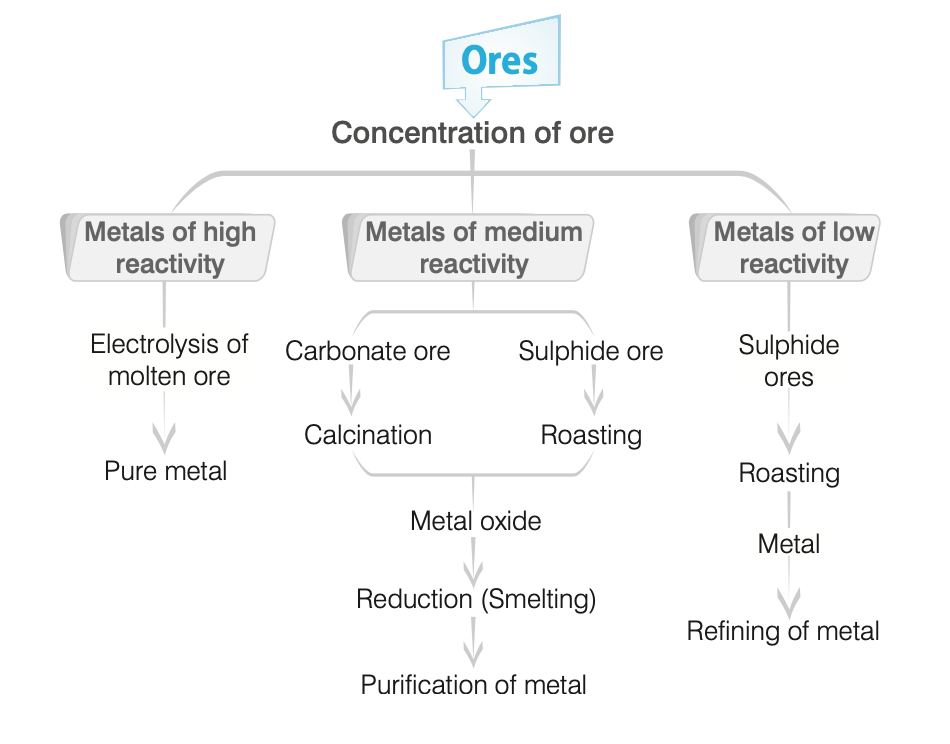
- Sequence:
- Ores → Concentration → Conversion to oxide → Reduction to metal → Purification/refining.
-
| Step | Process |
|---|
| Concentration of Ore | Removal of gangue/impurities. |
| Conversion to Oxide | Calcination/Roasting. |
| Reduction | Smelting/Aluminothermic/Auto-reduction/Electrolysis. |
| Purification | Refining. |
- Concentration of Ores
- Definition
- Removal of unwanted materials (gangue/impurities), also called dressing or benefaction.
- Methods
- Hand Picking:
- Manual separation.
- Hydraulic Washing
- Based on gravity difference.
- Upward water stream washes powdered ore; lighter gangue removed, heavier ore remains.
- Example:
- Iron ores (\( Fe_2O_3, Fe_3O_4 \)).
- Magnetic Separation
- Based on magnetic properties.
- Example:
- Tungsten ores from cassiterite (\( SnO_2 \)), \( Fe_2O_3, Cr_2O_3 \).
- Froth Flotation
- For sulphide ores.
- Powdered ore suspended in water with collectors (pine oils), froth stabilizers (cresols); ore wetted by oils, floats with froth, skimmed off.
- Leaching
- Ore soluble in solvent, impurities insoluble.
- Examples:
- Bauxite with conc. \( NaOH \), silver/gold with dilute \( NaCN/KCN \).
- Extraction of Crude Metals from Concentrated Ores
- Steps
- Conversion to Oxide
- Calcination
- Heating ore with/without air; volatile matter escapes, leaving metal oxide.
- For carbonate, hydroxide, oxide ores; decomposes to oxides, small molecules evolve.
- Roasting
- For sulphide ores; heated below melting point in air, forms oxide.
- Oxidizes impurities (\( S, As \)) to volatiles.
- Example:
- \( 2CuFeS_2 + 3O_2 \to CuO + FeO + 2SO_2 \).
- Reduction of Oxide to Metal
- Smelting
- Reduction with carbon/CO, for medium reactivity metals.
- Ore heated above melting point with coke, flux added.
- Flux converts infusible impurities to fusible slag.
- Example:
- \( PbO + CO \to Pb + CO_2 \) (high temperature).
- Flux:
- Acidic (\( SiO_2 \)) for basic impurities, basic (\( CaO, FeO \)) for acidic.
- Slag:
- Lighter, floats on molten metal.
- Example:
- \( SiO_2 + CaO \to CaSiO_3 \).
- Aluminothermic Process
- For \( Cr, Mn \) oxides, using aluminium.
- Example:
- \( Cr_2O_3 + 2Al \to Al_2O_3 + 2Cr \).
- Auto-Reduction
- For low reactivity metals (\( Cu, Hg, Pb \)); oxides reduced by heating.
- Electrolytic Method
- For high reactivity metals (\( Na, Al, Ca \)).
- Example:
- Sodium from \( NaCl \) electrolysis.
- Note:
- Alkali/alkaline earth metals from chlorides, oxides, hydroxides.
- Refining
- Definition
- Purification of crude metal from impurities, depends on metal and impurities.
- Methods
- Distillation
- For low boiling metals (\( Zn, Cd, Hg \)).
- Liquation
- For low melting metals (\( Sn, Hg, Pb \)).
- Electrolytic Refining
- Impure metal as anode, pure metal as cathode, metal salt as electrolyte (e.g., \( Cu, Ag, Au, Al, Pb \)).
- Zone Refining
- For high purity semiconductors (\( Ge, Si, B, Ga, In \)); impurities more soluble in molten metal.
- Vapour Phase Refining
- Metal to volatile compound, then decomposition to pure metal.
- Mond’s Process (Ni)
- \( Ni + 4CO \to Ni(CO)_4 \xrightarrow{\Delta} Ni + 4CO \).
- Van Arkel Process (\( Zr, Ti \))
- \( Ti + 2I_2 \to TiI_4 \xrightarrow{1600^\circ C} Ti + 2I_2 \).
- Chromatographic Method
- Based on differential adsorption.
- Notes
- Borax or \( KNO_3 \):
- Flux for silver refining.
- Hall-Heroult:
- \( Al_2O_3 \) mixed with \( Na_3AlF_6 \) or \( CaF_2 \) for lower melting point, higher conductivity.
- Wrought iron:
- Purest commercial iron.
- Cast iron:
- Used for wrought iron, steel.
- Thermite (\( Fe_2O_3 + Al \), 3:1):
- Welds railway lines.
- Non-metals and Their Compounds
- Definition
- Elements that accept electrons to form anions.
- 22 non-metals, located on the right side of the periodic table.
- Physical Properties of Non-metals
- States:
- Solids or gases (except \( Br \), liquid); 10 solid, 11 gaseous.
- Variety of colours.
- Poor conductors of heat/electricity (except graphite).
- Not lustrous (except \( I \)), non-sonorous, non-malleable.
- Low melting/boiling points and density (except diamond, graphite).
- Chemical Properties of Non-metals
- Electronegative, form anions by gaining electrons.
- Form oxides with \( O_2 \): e.g., \( S + O_2 \to SO_2 \).
- \( SO_2 + H_2O \to H_2SO_3 \) (sulphurous acid, turns blue litmus red).
- Oxides:
- Acidic (\( CO_2, SO_2, SO_3, NO_2, P_2O_5 \)); neutral (\( CO, NO, N_2O, H_2O \)).
- Generally no reaction with water, but reactive in air (e.g., \( P \), stored in water, catches fire in air).
- Complex reactions with bases.
- Carbon (\( C \))
- Atomic number: 6, mass: 12, group 14, 2nd period, p-block.
- Electronic configuration:
- \( 1s^2 2s^2 2p^2 \).
- 17th most abundant element in Earth’s crust.
- Occurrence
- Free:
- Coal, graphite, diamond.
- Combined:
- Metal carbonates, proteins, carbohydrates, hydrocarbons, \( CO_2 \) (0.03% in air).
- Isotopes:
- \( ^{12}C, ^{13}C, ^{14}C \) (\( ^{14}C \): radioactive, half-life 5770 years, emits β-rays).
- Note:
- \( ^{12}C \) is the international standard for atomic mass (amu); \( ^{15}C, ^{16}C \) also radioactive.
- Forms >5 lakh compounds due to tetravalency and catenation (vs. 50,000 for other elements).
- Properties
- Tetravalent, unaffected by water.
- Forms multiple bonds: \( C=C, C≡C, C=O, C=S, C≡N \).
- Catenation:
- Forms chains/rings via covalent bonds.
- Exhibits allotropy.
- Allotropes of Carbon
- Crystalline:
- Diamond, graphite, fullerene.
- Amorphous:
- Carbon black, coke, wood charcoal, coal.
- Allotropy:
- Same element/compound in multiple forms with similar chemical but different physical properties.
- Diamond
- Occurs in kimberlite stone; purity in carats (1 carat = 200 mg).
- Examples:
- Cullinan (3032 carat), Hope (445 carat), Kohinoor (186 carat), Pitt (136.2 carat).
- Structure:
- Each \( C \) bonded to 4 others in tetrahedral, rigid 3D lattice with covalent bonds.
- Hardest substance due to extended covalent bonding.
- Properties
- Colourless, transparent (impurities add colours, e.g., carbonado/black diamond).
- Density: 3.67, refractive index: 2.44.
- Inert, highly poisonous.
- Bad conductor of electricity (no free electrons), conducts heat.
- Pure:
- Transparent to X-rays; impure: Not (used to distinguish artificial diamonds).
- With \( K_2Cr_2O_7 + \text{conc.} H_2SO_4 \) at 200°C or heated in air (700-900°C): Forms \( CO_2 \).
- Uses
- Coloured:
- Abrasive for sharpening (rock drilling, glass cutting, gem cutters).
- Making dyes, tungsten filaments for bulbs, jewellery (sparkles due to total internal reflection).
- Note:
- First artificial diamond by Moissan (1893).
- Graphite
- Structure:
- Each \( C \) bonded to 3 others in planar hexagonal arrays; 4th electron free, moves in lattice.
- Good conductor of electricity due to free electrons.
- Properties
- Soft, smooth, slippery (layered structure); marks paper (lead pencil, aka black lead).
- Inert to acids, alkalis, dilute \( HNO_3 \); forms \( CO_2 \) when heated alone or with \( K_2Cr_2O_7 + \text{conc.} H_2SO_4 \).
- Converts to diamond at high pressure with catalyst; reverse not possible.
- Thermodynamically most stable allotrope.
- Uses
- Electrodes (conducts electricity).
- Dry lubricant (prevents rusting, viscous friction at high temperatures).
- Refractory crucibles, lead pencils, nuclear reactor moderator.
- Graphite fibres in composites: Tennis rackets, fishing rods, aircraft.
- Note:
- Lead pencils contain 0% lead.
-
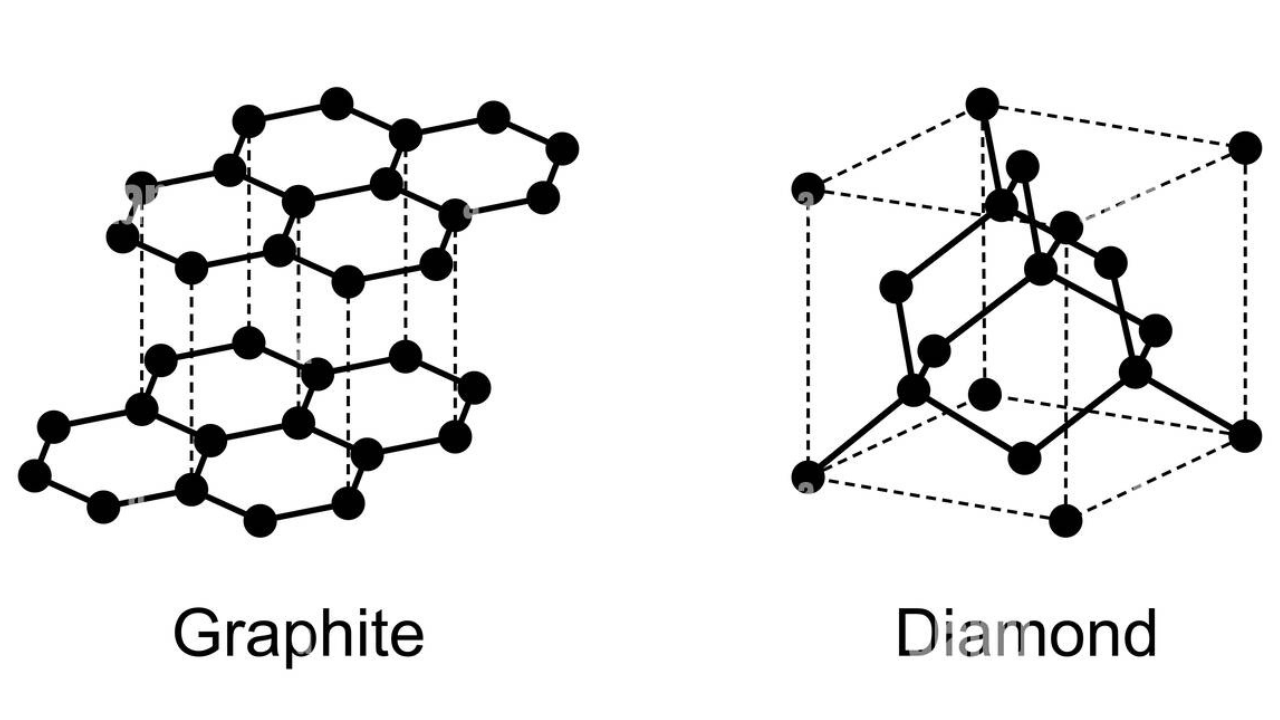
- Graphene
- One-atom-thick planar sheets of \( C \) in honeycomb lattice.
- Discovered by Hanns-Peter Boehm (1962); named from graphite + -ene.
- Strong, conductive, used in touchscreens, LCDs, LEDs.
- Fullerene
- Purest carbon form, cage-like molecules (e.g., \( C_{60} \), Buckminsterfullerene, soccer ball shape).
- Made by heating graphite in electric arc with inert gases (\( He, Ar \)).
- Discovered by HW Kroto, E Smalley, RF Curl.
- Uses:
- Microscopic ball bearings, lightweight batteries, new lubricants, plastics, drugs.
- Lamp Black
- 95% carbon, from burning hydrocarbons in limited air.
- Uses:
- Black pigment (ink, shoe polish), filler in tyres, eye soot.
- Charcoal
- Impure, porous, high surface area, absorbs gases.
- Types
- Wood Charcoal:
- From wood heated without air; used in gas masks, water filters, air conditioning (odour control), explosives; has germicidal properties.
- Bone Charcoal:
- From destructive distillation of bone; used to bleach organic substances.
- Sugar/Blood Charcoal:
- From destructive distillation of sugar/blood.
- Coke
- 80-85% carbon, from coal heated without air (removes volatiles).
- Uses:
- Fuel, reducing agent in metallurgy.
- Coal
- 90% found in northern hemisphere, from carbonation of vegetable matter.
- Unlimited energy source.
- Uses:
- Fuel, coal gas, synthetic petrol.
- Types
-
| Type | Carbon Content | Notes |
|---|
| Peat | 50-60% | Low quality |
| Lignite | 60-70% | Brown coal |
| Bituminous | 78-86% | Soft, domestic use |
| Anthracite | 94-98% | High quality |
- Note:
- Coconut charcoal used to separate inert gases; artificial graphite via Acheson process.
- Oxides of Carbon
- Carbon Monoxide (\( CO \))
- Preparation:
- \( 2C(s) + O_2(g) \to 2CO(g) \) (limited \( O_2 \)).
- Found in vehicle smoke (city pollutant).
- Properties
- In water gas (\( CO + H_2 \)), producer gas (\( CO + N_2 \)); industrial fuels.
- Colourless, odourless, tasteless, nearly insoluble in water.
- Burns with blue flame, forms phosgene (\( COCl_2 \)) with \( Cl_2 \) in sunlight.
- Weight equal to air, highly poisonous.
- Binds haemoglobin 200x stronger than \( O_2 \), reduces oxygen transport, can cause death.
- Uses
- Reducing agent in metallurgy, Mond process (\( Ni \)), preparation of phosgene, methyl alcohol, sodium formate.
- Carbon Dioxide (\( CO_2 \))
- Preparation:
- Complete combustion of carbon/fuels, heating limestone, respiration, fermentation.
- Properties
- 0.03% in atmosphere, removed by photosynthesis.
- Colourless, odourless, acidic, non-poisonous, greenhouse gas (excess causes global warming).
- Forms carbonic acid (\( H_2CO_3 \)) in water.
- Turns lime water milky (\( CaCO_3 \)), milkiness disappears with excess (\( Ca(HCO_3)_2 \)).
- Uses
- Solid (\( CO_2 \), dry ice/drikold):
- Refrigerant for ice cream.
- Gas:
- Carbonated drinks (high pressure), fire extinguisher (via \( NaHCO_3 + \text{acid} \)).
- Urea, hard steel production.
- Note:
- Heavier than air, non-flammable, effective fire extinguisher; avoid sleeping under trees at night due to \( CO_2 \) release.
- Carbonic Acid (\( H_2CO_3 \))
- Formed from \( CO_2 + H_2O \), dibasic acid.
- \( H_2CO_3 / HCO_3^- \) buffer maintains blood pH (7.26-7.42).
- Silicon (\( Si \))
- Atomic number: 14, mass: 28, group 14, 3rd period, p-block.
- Electronic configuration:
- \( 1s^2 2s^2 2p^6 3s^2 3p^2 \).
- Properties
- Occurs as silica (sand) and silicates; 26% of Earth’s crust (2nd most abundant after \( O \)).
- Non-metal, exhibits allotropy.
- Uses
- Component of ceramics, glass, cement.
- Ultra-pure:
- Semiconductors, transistors, computer chips.
- Silicones (polymers):
- Sealants, greases, insulators, waterproofing, surgical/cosmetic implants.
- Silica gel:
- Drying agent.
- Silica garden, acid-resistant steel.
- Compounds
- Silicon Carbide (\( SiC \)):
- Carborundum, artificial diamond.
- Silica (\( SiO_2 \)):
- Crystalline quartz, used in glass, cement.
- Silicones:
- Polymers for sealants, insulators, waterproofing.
- Silanes:
- Silicon hydrides.
- Nitrogen (\( N_2 \))
- Atomic number: 7, mass: 14, group 15, 2nd period, p-block.
- Electronic configuration:
- \( 1s^2 2s^2 2p^3 \).
- Discovered by D Rutherford (1772).
- Occurrence
- 78% of atmosphere by volume.
- In crust:
- Chile saltpetre (\( NaNO_3 \)), Indian saltpetre (\( KNO_3 \)).
- In plants/animals:
- Proteins, urea (46% \( N \)).
- Plants absorb as nitrates from soil.
- Isotopes:
- \( ^{14}N, ^{15}N, ^{13}N \).
- Preparation
- Industrial:
- Liquefaction, fractional distillation of air.
- Lab:
- \( NH_4Cl + NaNO_2 \).
- Properties
- Colourless, odourless, tasteless, diatomic, non-polar, non-toxic.
- Inert at room temperature; at high temperature, forms oxides (\( O_2 \)), hydrides (\( H_2 \)), nitrides (\( Mg_3N_2, Li_3N \)).
- Uses
- Ammonia, calcium cyanamide production.
- Inert atmosphere in iron/steel industry.
- Liquid \( N_2 \):
- Refrigerant for biological materials, food, sperm, cryosurgery.
- Electric bulbs, high-temperature thermometers.
- Nitrogen Fixation
- Conversion of \( N_2 \) to nitrates/nitrites (natural: lightning, rhizobium; artificial: fertilizers).
- Denitrification
- Conversion of nitrogenous compounds to \( N_2 \) by denitrifying bacteria.
- Ammonia (\( NH_3 \))
- Discovered by J Priestley (1774), named by Berthelot (1785).
- Preparation:
- Haber’s process (\( N_2 + H_2 \), \( Fe \) catalyst, \( Mo \) promoter; or \( Fe_2O_3 \), \( Al_2O_3 + K_2O \)).
- Lab:
- Heat \( NH_4Cl + CaCO_3 \).
- Properties
- Colourless, pungent, highly water-soluble gas.
- Tetrahedral, pyramidal due to lone pair.
- Note:
- Liquor ammonia (conc. aqueous solution); ammonium carbonate (\( (NH_4)_2CO_3 \)) called smelting salt; \( NH_4Cl + \text{conc. chlorostannic acid} \to \text{pink salt} \).
- Uses
- Nitrogenous fertilizers, nitric acid production.
- Liquid ammonia: Refrigerant.
- Note:
- Bad smell near toilets/horse parking from urea decomposition; cool bottles before opening due to high vapour pressure.
- Oxides of Nitrogen
- Types:
- \( N_2O \), \( NO \), \( N_2O_3 \), \( NO_2 \), \( N_2O_4 \), \( N_2O_5 \).
- Neutral:
- \( N_2O \), \( NO \); others acidic.
- Nitrous oxide (\( N_2O \)):
- Laughing gas, causes laughter, used in anaesthesia (surgery, dental); excess can be fatal.
- Oxoacids of Nitrogen
- Hyponitrous acid, nitrous acid (\( HNO_2 \)), nitric acid (\( HNO_3 \)).
- Nitric Acid (\( HNO_3 \))
- Preparation:
- Ostwald’s process (catalytic oxidation of \( NH_3 \)), Birkeland Eyde, Retort process.
- Properties:
- Colourless liquid, strong acid, strong oxidizer.
- Attacks most metals (except \( Au, Pt \)); \( Fe, Al, Cr \) passive due to oxide film.
- Called aqua fortis (strong water).
- Uses:
- Explosives (\( \text{nitroglycerin, TNT, TNP} \)), organic compounds.
- Nitrous Acid (\( HNO_2 \))
- Unstable, forms nitrites.
- Acts as oxidizing/reducing agent.
- With \( CS_2 + NO \):
- Used in flash photography.
- Ammonium Chloride (\( NH_4Cl \))
- Aka sal ammoniac, nausadar.
- White crystalline powder.
- Uses:
- Dry cells, pre-welding cleaner, lab reagent, drugs, electroplating.
- Phosphorus (\( P \))
- Atomic number: 15, mass: 31, group 15, 3rd period, p-block.
- Electronic configuration:
- \( 1s^2 2s^2 2p^6 3s^2 3p^3 \).
- Very reactive non-metal.
- Occurrence
- As stable phosphates; in bones (58% calcium phosphate), cells, blood, urine, milk, eggs (phospho-proteins).
- Adult human:
- 0.7 kg \( P \).
- Minerals:
- Phosphorite (\( Ca_3(PO_4)_2 \)), chlorophite (\( Ca_3(PO_4)_2 \cdot CaCl_2 \)), Redonda phosphate (\( AlPO_4 \)).
- Extraction:
- Electrothermal process from phosphorite; small amounts from bone ash.
- Isotopes:
- \( ^{31}P, ^{32}P, ^{33}P \).
- Uses
- DNA/RNA synthesis, photosynthesis, leaf colour.
- Aluminium phosphide: Food grain preserver.
- Phosphor bronze (alloy): Special containers.
- Allotropic Forms
- White/Yellow Phosphorus
- Tetrahedral (\( P_4 \)), each \( P \) bonded to 3 others.
- Highly reactive, ignites at 30°C (stored in water, self-ignition).
- Soluble in \( CS_2 \), insoluble in water; translucent, waxy, poisonous, garlic smell.
- Glows in dark (chemiluminescence).
- With boiling \( NaOH \) (inert atmosphere): Forms phosphine (\( PH_3 \)).
- Uses:
- Firecrackers, fire/smoke bombs.
- Note:
- Causes phossy jaw (jaw bone decay).
- Red Phosphorus
- Polymeric, linear \( P_2 \), red crystalline solid.
- Preparation:
- Heat white \( P \) at 573 K (inert atmosphere).
- Vapours at 523 K (\( N_2, CO_2 \)) condense to white \( P \).
- Odourless, non-poisonous, insoluble in water/\( CS_2 \).
- Less reactive, high ignition temperature (260°C), no glow.
- Uses:
- Safety matchsticks (with antimony trisulphide, \( KClO_3 \)).
- Black Phosphorus
- Preparation:
- Heat white \( P \) at 200°C, high pressure.
- Forms:
- α-black (sublimes in air), β-black (no burning up to 673 K, conductive).
- Black, insoluble in \( CS_2 \), inert.
- Scarlet Phosphorus
- From 10% white \( P \) in \( PBr_3 \), heated 10 hours.
- Red crystalline, non-poisonous, insoluble in \( CS_2 \), more reactive than red \( P \).
- Violet Phosphorus (Hittorf’s)
- From white \( P \) at 803 K in closed tube.
- Violet, non-flammable, bad conductor.
- Phosphorescence/Chemiluminescence
- White \( P \) glows (yellowish-green) due to slow combustion in air, emitting light, not heat.
- Phosphine (\( PH_3 \))
- Preparation:
- Hydrolysis of calcium phosphide (\( Ca_3P_2 \)) with water/dilute \( HCl \); or white \( P + \text{conc.} NaOH \) in \( CO_2 \).
- Colourless, volatile, rotten fish smell, highly poisonous.
- Burns with dazzling light, explodes with oxidizers (\( Cl_2 \)).
- Weakly basic.
- Oxides of Phosphorus
- Phosphorus Trioxide (\( P_2O_3 \), dimer \( P_4O_6 \)):
- From white \( P \) in limited air.
- Phosphorus Pentoxide (\( P_2O_5 \), \( P_4O_{10} \))
- Acid anhydride of phosphoric acid, waxy white, sublimes.
- Reacts vigorously with water to form orthophosphoric acid.
- Tetrahedral structure.
- Uses:
- Dehydrating agent (\( H_2SO_4 \to SO_3 \), \( HNO_3 \to N_2O_5 \), cellulose to carbon).
- Oxoacids of Phosphorus
-
| Name | Formula | Oxidation State |
|---|
| Hypophosphorus acid | \( H_3PO_2 \) | +1 |
| Orthophosphorus acid | \( H_3PO_3 \) | +3 |
| Orthophosphoric acid | \( H_3PO_4 \) | +5 |
| Hypophosphoric acid | \( H_4P_2O_6 \) | +4 |
| Pyrophosphoric acid | \( H_4P_2O_7 \) | +5 |
| Polymetaphosphoric acid | \( (HPO_3)_n \) | +5 |
- Notes
- Bone:
- Hydroxyapatite, amorphous calcium phosphate.
- Basicity:
- \( H_3PO_4 \): 3; \( H_3PO_3 \): 2; \( H_3PO_2 \): 1.
- Hypophosphite compounds:
- Strength-promoting drugs.
- Oxygen (\( O_2 \))
- Atomic number: 8, mass: 16, group 16, 2nd period, p-block.
- Discovered by Scheele (1772), named by Lavoisier (1777).
- Electronic configuration:
- \( 1s^2 2s^2 2p^4 \).
- Occurrence
- Most abundant element (46.6% Earth’s crust, 20.946% dry air).
- From photosynthesis.
- Lab:
- Heat \( KClO_3 \) at 375°C with \( MnO_2 \).
- Industrial:
- Fractional distillation of air.
- Isotopes:
- \( ^{16}O, ^{17}O, ^{18}O \).
- Properties
- Colourless, odourless gas; deep blue liquid when cooled.
- Slightly heavier than air, supports combustion, does not burn.
- Slightly soluble in water (supports aquatic life).
- Paramagnetic.
- Reacts with most metals (except \( Au, Pt \)), non-metals, some noble metals.
- Uses
- Oxyacetylene welding, steel production.
- Oxygen cylinders (\( O_2 + He \)):
- Hospitals, high-altitude flying, mountaineering.
- Liquid \( O_2 \):
- Rocket fuel oxidizer.
- Note:
- Vegetation loss would eliminate \( O_2 \), ending life.
- Ozone (\( O_3 \))
- Triatomic allotrope, formed at 20 km altitude via sunlight.
- Protects Earth from UV radiation.
- Destroyed by \( NO \) (jet exhausts), CFCs.
- Properties:
- Oxidizing/reducing agent; forms ozonides with ethene/ethane; brightens silver to silver black.
- Uses:
- Germicide, disinfectant, water sterilization, bleaching oils, ivory, flour, starch, artificial silk.
- Sulphur (\( S \))
- Atomic number: 16, mass: 32, group 16, 3rd period, p-block.
- Electronic configuration:
- \( 1s^2 2s^2 2p^6 3s^2 3p^4 \).
- Isotopes:
- \( ^{32}S, ^{33}S, ^{34}S, ^{35}S, ^{36}S \) (\( ^{35}S \): radioactive).
- Occurrence
- 0.03-0.1% in crust; in eggs, proteins, garlic, onion, mustard, hair, wool.
- Elemental near hot springs, volcanoes (Italy, Sicily, Japan).
- Compounds:
- \( FeS, HgS, PbS, ZnS \).
- Extraction:
- Frasch, Sicilian processes.
- Allotropic Forms
- Crystalline
- Rhombic Sulphur (α-sulphur):
- Most stable at room temperature, yellow, brittle, \( S_8 \) puckered ring, insoluble in water, soluble in \( CS_2 \), bad conductor; forms \( FeS \) with iron filings.
- Monoclinic Sulphur (β-sulphur):
- Stable >369 K, converts to α-sulphur <369 K; 369 K = transition temperature.
- Non-crystalline:
- Plastic, white, milky sulphur.
- Notes
- \( S_2 \):
- Dominant, paramagnetic at high temperature.
- Sublimation:
- Flower of sulphur.
- Boiled, cooled in cold water:
- Plastic sulphur.
- Pungent odour from sulphurous compounds.
- Uses
- Produces \( SO_2, H_2SO_4, CS_2 \), medicines, ointments, bleaching agents.
- Colour/dye industry, germicide, fungicide, rubber vulcanization.
- Organic:
- In biotin, thiamine vitamins.
- Milky sulphur: Medicines.
- Gunpowder:
- \( S + \text{charcoal} + KNO_3 \).
- Oxides of Sulphur
- Sulphur Dioxide (\( SO_2 \))
- From volcanic eruptions, colourless, pungent, toxic, heavier than air.
- Angular structure, forms sulphurous acid (\( H_2SO_3 \)) in water.
- Turns lime water milky (\( CaSO_3 \)), milkiness disappears with excess (\( Ca(HSO_3)_2 \)).
- Uses:
- Refrigerant, antichlor, disinfectant, preservative, bleaching wool/silk (temporary), petroleum/sugar refining, solvent.
- Sulphur Trioxide (\( SO_3 \))
- Acidic, anhydride of \( H_2SO_4 \), forms \( H_2SO_4 \) with water (exothermic).
- Uses:
- \( H_2SO_4 \), oleum production, drying agent.
- Oxoacids of Sulphur
- Sulphurous acid (\( H_2SO_3 \)), sulphuric acid (\( H_2SO_4 \)), peroxodisulphuric acid (\( H_2S_2O_8 \)), pyrosulphuric acid (\( H_2S_2O_7 \)).
- Sulphurous Acid (\( H_2SO_3 \))
- Strong dibasic acid, forms sulphites, bisulphites.
- Oxidizing/reducing agent, temporary bleaching (like \( SO_2 \)).
- Sulphuric Acid (\( H_2SO_4 \))
- Oil of vitriol, king of chemicals.
- Preparation:
- Lead chamber, contact process (\( SO_2 \to SO_3 \), catalysts: \( Pt, V_2O_5, \text{etc.} \)).
- Colourless, dense, oily, exothermic with water.
- Forms normal/acid sulphates; decomposes to Marshall’s acid (\( H_2S_2O_8 \)).
- Uses:
- Oil refining, wastewater processing, mineral extraction, explosives, drugs, disinfectants, paints, fertilizers, detergents, alums, ethers, metal sulphates, storage batteries.
- Note:
- Chars sugar (dehydration, turns black).
- Pyrosulphuric Acid (\( H_2S_2O_7 \))
- Fuming sulphuric acid/oleum, from \( SO_3 + \text{conc.} H_2SO_4 \).
- Hydrolysis forms \( H_2SO_4 \).
- Hydrogen Sulphide (\( H_2S \))
- From volcanic eruptions, colourless, toxic, rotten egg smell.
- Fatal in large doses; antidote: Dilute \( Cl_2 \).
- Halogens
- Group 17 (VII A): \( F, Cl, Br, I, At \).
- Salt producers (Greek: halo = salt, genes = born).
- Highly reactive, exist in combined form, coloured (absorb visible light).
- Electronic configuration:
- \( ns^2 np^5 \).
- Astatine:
- Radioactive.
- Fluorine (\( F \))
- Atomic number: 9, mass: 19, electronic configuration: \( 1s^2 2s^2 2p^5 \).
- Isolated by Moissan (1886).
- Pale yellow gas, most reactive halogen, most electronegative element.
- Oxidizes water to \( O_2 \), forms \( O_2F_2, OF_2 \).
- Reacts with most metals/non-metals (except \( N \)).
- Uses:
- \( O_2F_2, OF_2 \) as fluorinating agents; \( O_2F_2 \) removes \( Pu \) as \( PuF_6 \) from nuclear fuel.
- Chlorine (\( Cl \))
- Atomic number: 17, mass: 35.45, electronic configuration: \( 1s^2 2s^2 2p^6 3s^2 3p^5 \).
- Discovered by Scheele (1774), aka oxymuriatic acid.
- Preparation: Deacon’s process, electrolysis of brine (Nelson cell).
- Greenish-yellow, pungent, suffocating, 2.5x heavier than air, water-soluble.
- Forms chlorides with metals/non-metals; permanent bleaching via nascent oxygen.
- Forms bleaching powder (\( Ca(OCl)Cl \)) with lime.
- Uses:
- Bleaching wood pulp, cotton, textiles; extracting \( Au, Pt \); dyes, drugs, \( CCl_4, CHCl_3, DDT \), refrigerants; water sterilization; poisonous gases (phosgene, tear gas, mustard gas).
- Notes:
- \( ClO_2 \):
- Bleaching paper/textiles, water treatment; \( ClO_2 + Cl_2 \): Euchlorine; \( HClO_4 \): Strongest oxoacid; \( HCl \): For \( Cl_2, NH_4Cl \), glucose, glue, bone black purification, medicines.
- Bromine (\( Br \))
- Atomic number: 35, mass: 79.9, electronic configuration: \( [Ar] 3d^{10} 4s^2 4p^5 \).
- Discovered by Ballard (1826).
- Reddish-brown liquid, 0.068% in seawater.
- Extraction:
- Carnallite ore, brine (Rann of Kutch, India).
- Colours starch paper yellow, oxidizing/bleaching agent (nascent oxygen).
- Uses:
- Bromide, bromate, hypobromide salts; \( AgBr \): Photography; \( KBr \): Sleeping drugs, pain relief; toxic/tear gases.
- Iodine (\( I \))
- Atomic number: 53, mass: 126.9, electronic configuration: \( [Kr] 4d^{10} 5s^2 5p^5 \).
- Discovered by Courtois (1811) from seaweed ash.
- Shining, dark solid, violet vapours.
- In seawater, seaweeds as iodides; in body as thyroxin (thyroid).
- Deficiency causes goitre.
- Uses:
- Lab reagent, disinfectant, antiseptic, analgesic, goitre treatment, egg production, photographic films/plates.
- Notes:
- \( I_2O_5 \):
- Oxidizing agent, \( CO \) estimation; Iodex: Pain relief ointment (contains dichlorophenol, no \( I \)).
- Inert/Noble Gases
- Group 18:
- \( He, Ne, Ar, Kr, Xe, Rn \).
- Chemically inert (some, e.g., \( Xe \), form compounds with \( O, F \)).
- Obtained from air liquefaction/fractional distillation (except \( Rn \), from \( Ra-226 \) decay).
- Monoatomic, form clathrate/cage compounds (gases trapped in crystal lattices).
- Helium (\( He \))
- Atomic number: 2, mass: 4, discovered by Lockyer, Janssen.
- 2nd most abundant in universe, from natural gas, radioactive minerals (\( \text{pitchblende, monazite, cleveite} \)).
- Diffuses through rubber, glass, plastic.
- Uses:
- Balloons (non-flammable, light), aircraft tyres, gas-cooled reactors, cryogenics, deep-sea diving (\( He + O_2 \), less soluble in blood), asthma breathing, NMR/MRI magnets.
- Neon (\( Ne \))
- Atomic number: 10, mass: 20, discovered by Ramsay, Travers.
- From volatile part of liquid argon.
- Uses:
- Discharge tubes, fluorescent bulbs (advertising), greenhouse bulbs, aerodrome indicator lamps (shine in fog).
- Argon (\( Ar \))
- Atomic number: 18, mass: 40, discovered by Rayleigh, Ramsay (1892).
- Uses:
- Inert atmosphere in metallurgy, arc welding, filling electric bulbs.
- Krypton (\( Kr \))
- Atomic number: 36, mass: 84, discovered by Ramsay, Travers (1898).
- Yellow/green spectral lines.
- Uses:
- Airport runway, approach lights.
- Xenon (\( Xe \))
- Atomic number: 54, mass: 131, discovered by Ramsay, Travers.
- First compound (\( XePtF_6 \)) by Neil Bartlett (1962); forms \( F, O \) compounds.
- Uses:
- High-intensity photographic flash tubes (\( Xe-Kr \)).
- Radon (\( Rn \))
- Discovered by Dorn.
- Uses:
- Cancer treatment (radiotherapy).
- Metalloids
- 7 elements:
- \( B, Si, Ge, As, Sb, Te, Po \); between metals and non-metals.
- Boron (\( B \))
- From cosmic ray spallation.
- Uses:
- Nuclear reactor control rods, bulletproof jackets, semiconductors.
- Compounds
- Borax:
- Flux, borax bead test, water softening, antiseptic, glass/pottery.
- Orthoboric acid:
- Antiseptic, eye lotion, food preservative, carrom board powder.
- Boron carbide:
- Norbide, very hard.
- Borazine (\( B_3N_3H_6 \)):
- Inorganic benzene.
- Others
- Silicon:
- In iron/aluminium alloys.
- Germanium, Gallium Arsenide:
- Semiconductors, solar cells, photodiodes, transistors, computer chips.
- Fuels, Combustion, and Flames
- Fuels
- Definition
- Materials used as heat energy sources for domestic/industrial purposes (e.g., wood, charcoal, petrol, kerosene, LPG, coal gas).
- Contain carbon, generates heat on burning in air.
- Characteristics of a Good Fuel
- Readily available, cheap.
- Burns easily at moderate rate.
- High heat output.
- No undesirable residues.
- Low volatile substances.
- Easily storable, transportable.
- High, specific calorific value.
- Types of Fuels
- Solid:
- Coal, coke, wood, cow dung cakes.
- Liquid:
- Petrol, kerosene, diesel, fuel oil.
- Gaseous:
- LPG, CNG, biogas, coal gas, producer gas, hydrogen, oil gas, water gas.
- Notes
- No ideal fuel exists.
- Gaseous fuels preferred over solid/liquid.
- Calorific Value
- Heat from burning 1 g of fuel in excess \( O_2 \), expressed in kJ/g.
-
| Fuel | Calorific Value (kJ/g) |
|---|
| Coke/Coal/Charcoal | 25-32 |
| Kerosene/Gasoline | 48 |
| Petrol | 50 |
| Diesel | 45 |
| Biogas | 35-40 |
| LPG | 50 |
| Wood | 17 |
| Cow Dung | 6-8 |
| Ethanol | 30 |
| Methane | 55 |
| Hydrogen | 150 |
| Natural Gas | 35-50 |
- Notes
- Water gas > producer gas (lowest calorific value).
- Hydrogen:
- Highest calorific value (150 kJ/g), not used due to inflammability, storage issues; used in some advanced vehicles.
- Fats > proteins, carbohydrates in calorific value.
- Fossil Fuels
- From residues of organisms buried for millions of years (non-renewable).
- Examples:
- Coal, petroleum, natural gas.
- Coal
- Formed from vegetation via carbonisation (no air, high temperature/pressure over millions of years).
- Composition:
- 60-90% carbon, small amounts of \( N, S \).
- Types
-
| Type | Carbon Content | Notes |
|---|
| Peat | 50-60% | First phase |
| Lignite | 60-70% | Brown coal |
| Bituminous | 78-86% | Soft, domestic use |
| Anthracite | 94-98% | Best, high heat, no smoke |
- Uses
- Destructive distillation yields coke, coal gas, coaltar.
- Fuel for boilers, engines, furnaces.
- Coaltar
- Black, thick liquid from destructive distillation of coal.
- Mixture of ~200 substances.
- Uses:
- Synthetic dyes, drugs, explosives, paints, naphthalene balls.
- Petroleum
- Dark, oily liquid (black gold, crude oil, rock oil), unpleasant odour.
- Mixture of hydrocarbons, sulphur; high calorific value.
- Formed from sea organisms, transformed over millions of years (no air, high temperature/pressure).
- Fractional Distillation Products
-
| Fraction | Boiling Range (°C) | Uses |
|---|
| Uncondensed gases | Room temp | Fuel gases, refrigerants, carbon black |
| Crude naphtha | 30-150 | |
| Petroleum ether | 30-70 | Motor fuel, dry cleaning, solvent |
| Petrol/Gasoline | 70-120 | Motor fuel, solvent, dry cleaning |
| Benzene derivatives | 120-150 | Solvent |
| Kerosene | 150-250 | Fuel, illuminant, oil gas |
| Gas oil | 250-350 | Fuel, converted to gasoline by cracking |
| Fuel oil | 250-350 | Fuel |
| Diesel oil | 250-350 | Diesel engines |
| Lubricating oil | 350-450 | Lubrication |
| Paraffin wax | >500 | Candles, boot polish, wax paper |
| Vaseline | >500 | Ointments, lubrication |
| Pitches | >500 | Paints, road surfacing |
- Composition and Uses of Fuels
- Coke
- From destructive distillation of coal, 80-85% carbon.
- Uses:
- Metal extraction (reducing agent), fuel in electrodes.
- Coal Gas
- Composition:
- 55% \( H_2 \), 30% \( CH_4 \), 4% \( CO \), 3% unsaturated hydrocarbons, 8% non-volatile impurities.
- Uses:
- Fuel near coal plants, metallurgical reduction, Bunsen burner.
- Notes:
- \( H_2, CO, CH_4 \) provide heat; unsaturated hydrocarbons emit light; used for street lighting (London 1810, New York 1820), now for heat.
- Water Gas
- Composition:
- \( CO + H_2 \), with \( N_2 \), water vapour impurities.
- Preparation:
- Steam over superheated coke.
- Uses:
- Industrial production of \( H_2 \), ammonia, methyl alcohol.
- Producer Gas
- Composition:
- \( N_2 + CO \) (2:1).
- Uses:
- Glass manufacturing, metallurgy.
- Oil Gas
- Composition:
- Saturated/unsaturated hydrocarbons (\( CH_4 \), ethylene, acetylene).
- From fractional distillation of kerosene/petroleum.
- Uses:
- Lab burners.
- Natural Gas
- Composition:
- 83% \( CH_4 \), 16% ethane.
- Found at petroleum exploration sites, highly flammable.
- Uses:
- Artificial chemical fertilizers.
- Liquefied Petroleum Gas (LPG)
- Composition:
- Butane (\( C_4H_{10} \)), iso-butane, some propane (\( C_3H_8 \)).
- Sources:
- Oil wells.
- Added:
- Ethyl mercaptan (\( C_2H_5SH \)) for leak detection (LPG colourless, odourless).
- Uses:
- Domestic cooking (e.g., Bharat Gas, Indane), compressed in cylinders.
- Biogas (Gobar Gas)
- Composition:
- 75% \( CH_4 \), \( H_2 \), \( H_2S \), \( CO_2 \).
- From anaerobic decomposition of biomass (cow dung, sewage, vegetable waste).
- Burns smoothly, no smoke.
- Uses:
- Domestic cooking.
- Note:
- Spent slurry used as manure (rich in \( N, P \)).
- Compressed Natural Gas (CNG)
- Mainly \( CH_4 \), some ethane.
- Uses:
- Vehicle fuel, produces fewer pollutants (\( CO, NO_x \)) than petrol/diesel.
- Petrol
- Uses:
- Fuel for light vehicles (scooters, cars).
- Quality:
- Measured by octane number (percentage of iso-octane in iso-octane + n-heptane mixture with same anti-knock properties).
- Knocking:
- Preignition causes metallic rattle, damages engine.
- Anti-knock additives:
- Tetraethyl lead (TEL, 0.15 mL/L with ethyl bromide), benzene, toluene, xylene (BTX).
- Note:
- High octane = high lead content.
- Diesel
- Uses:
- Heavy vehicles (trucks, tractors, submarines), high power, low cost.
- Quality:
- Measured by cetane number.
- Biodiesel
- From vegetable oils, animal fats, recycled greases via transesterification.
- Safe, biodegradable, less polluting than petroleum diesel, but more expensive.
- Uses:
- Pure (B100) or additive to reduce particulates, \( CO \), hydrocarbons.
- Liquefied Natural Gas (LNG)
- Liquefied natural gas (\( CH_4 \)) at 25 kPa, -162°C.
- Odourless, colourless, non-toxic, non-corrosive.
- Energy density:
- 2.4x CNG, 60% diesel; cost-efficient for transport.
- Uses:
- Transported via cryogenic vessels/tankers, regasified for pipelines, natural gas vehicles (less common than CNG).
- Note:
- High production/storage costs; Dahej (India) first regasification project (BPCL, GAIL, IOCL, ONGC).
- Brent Crude Oil
- Light crude, 0.37% sulphur, specific gravity 0.835.
- Sourced from North-West Europe.
- Uses:
- Petrol, middle distillates.
- Cracking
- Converts high-boiling hydrocarbons to low-boiling ones.
- Example:
- \( C_{12}H_{26} \xrightarrow{\text{Pt/Pd/Ni}, 973K} C_5H_{10} + C_7H_{16} + \text{other products} \).
- Used to meet petrol demand, improve quality.
- Advancements in Fuels
- Microbial ethanol from glycerol, cleans wastewater.
- Solid material (lithium, boron, hydrogen) stores \( H_2 \), releases with minimal byproducts.
- E-20 fuel (20% ethanol + gasoline):
- Reduces hydrocarbons, \( CO \); no drivability/maintenance issues.
- US:
- 90% gasoline + 10% ethanol; Indy 500 uses ~85% ethanol (E-85), reduces pollutants (\( SO_x \) 80%, \( CO \) 40%, particulates 20%, VOCs 15%, \( NO_x \) 10%).
- Combustion
- Definition
- Chemical process where a substance reacts with \( O_2 \), releasing energy (heat/light).
- Example:
- \( Mg \) burning to form \( MgO \).
- Oxidation process.
- Combustible Substances
- Burn in air/\( O_2 \): Wood, paper, kerosene, charcoal, sulphur, magnesium.
- Non-Combustible Substances
- Do not burn in air: Stone, sand, bricks.
- Conditions for Combustion
- Oxygen:
- Supporter of combustion.
- Ignition Temperature:
- Lowest temperature for a substance to catch fire (inflammable substances like LPG, petrol, alcohol have low ignition temperatures).
- Fuel:
- Essential for combustion.
- Note:
- Dry grass catches fire easier than green grass in summer due to lower ignition temperature.
- Types of Combustion
- Rapid Combustion
- Fuels (e.g., hydrocarbons) burn rapidly, produce heat/light (e.g., matchstick, firecracker explosion).
- Slow Combustion
- Slow rate, no light, heat insufficient to raise reaction temperature (e.g., inhalation).
- Spontaneous Combustion
- Occurs at room temperature without heat supply (auto-combustion).
- Examples:
- White phosphorus, coal dust in mines, forest fires (ignition temperature < room temperature).
- Incomplete Combustion
- Occurs with insufficient \( O_2 \), forms monoxides.
- Example:
- \( CH_4 + O_2 \to CO + H_2O \).
- Note:
- Coal fire produces \( CO \), hinders \( O_2 \) supply, can cause death; gasohol (10% petrol + 90% alcohol) reduces \( CO_2, SO_2 \).
- Propellants (Rocket Fuels)
- High calorific value, rapid combustion, release large energy/gases.
- High internal pressure/temperature; gases (\( CO, \text{steam} \)) exit as jet, propelling rocket forward.
- Types
- Solid Propellants
- Fuel + oxidizer together.
- Composite:
- Polyurethane/polybutadiene + ammonium perchlorate.
- Double Base:
- Nitrocellulose + nitroglycerine (gunpowder).
- Liquid Propellants
- Fuel, oxidizer in separate chambers.
- Monoliquid:
- Single compound (e.g., nitromethane, methyl nitrite).
- Biliquid:
- Oxidizer (\( \text{liquid } O_2 \)) + fuel (\( \text{kerosene, liquid } H_2, \text{paraffin, ammonia, alcohol} \)).
- Hybrid Propellants
- Solid fuel + liquid oxidizer (e.g., acrylic rubber + \( N_2O_4 \)).
- Flame
- Produced by substances that vaporize during burning (e.g., kerosene, molten wax).
- Parts
- Innermost:
- Black, unburnt carbon particles, lowest temperature.
- Middle:
- Yellow, luminous, partial combustion.
- Outermost:
- Blue, non-luminous, complete combustion, hottest (used by goldsmiths for melting \( Au, Ag \)).
- Notes
- Water:
- Common fire extinguisher, not for electric/oil fires (conductor, oil floats).
- Electric/oil fires:
- Use \( CO_2 \), foam for petroleum fires.
- Smothering with blanket cuts air supply.
- Fire control:
- Remove fuel/air, lower temperature.
- Charcoal:
- No vapour, no flame.
- Solar Jet
-
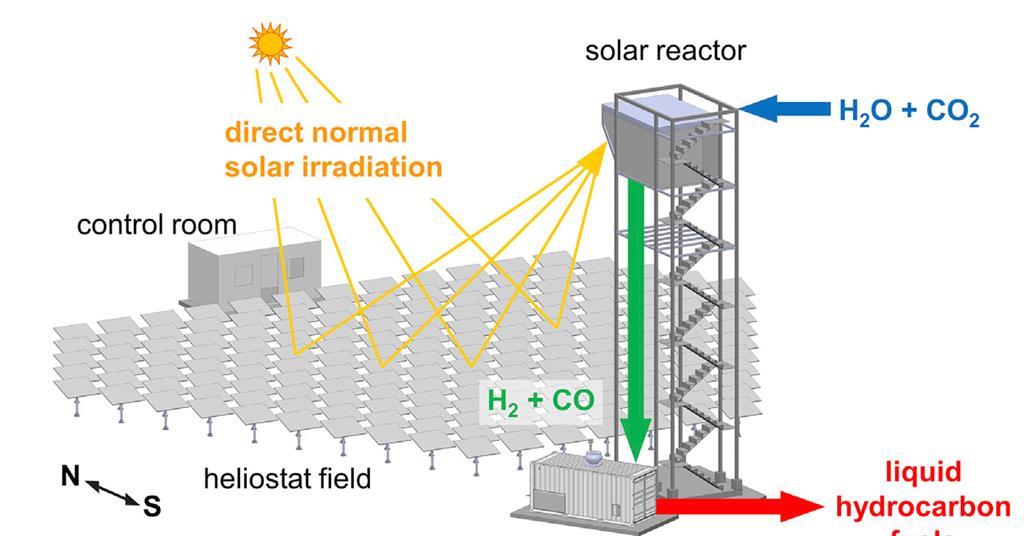
- Solar reactor converts \( CO_2 + H_2O \) to synthesis gas (\( H_2 + CO \)) using concentrated sunlight, then to kerosene via Fischer-Tropsch.
- Launched June 2011, EU-funded (7th Framework Programme, 4 years).
- Advances sustainable fuel production with unlimited feedstocks.
- Organic Compounds
- Definition
- Hydrocarbons and derivatives, excluding \( CO, CO_2 \), carbonates, bicarbonates.
- Term "organic" from 1780 belief:
- Only living organisms could synthesize them (vital force theory, Berzelius).
- Wöhler (1828):
- Synthesized urea from ammonium sulphate + potassium cyanate, disproving vital force theory.
- Kolbe (1844):
- Synthesized acetic acid from elements.
- Berthelot (1856):
- Synthesized methane, confirming lab synthesis of organic compounds.
- Petroleum as a Source
- Mixture of aliphatic (major) and aromatic hydrocarbons, small amounts of \( S, N \) organic compounds.
- Called rock oil (\( \text{petra} = \text{rock}, \text{oleum} = \text{oil} \)), black gold, liquid gold.
- First oil well:
- Pennsylvania, USA, 1859.
- Constituents and Uses
-
| Constituent | Uses |
|---|
| LPG (Petroleum gas) | Fuel for home/industry |
| Petrol | Motor/aviation fuel, dry cleaning solvent |
| Kerosene | Fuel for stoves, lamps, jet aircraft |
| Diesel | Fuel for heavy vehicles, generators |
| Lubricating oil | Lubrication |
| Greases, vaseline, petroleum jelly | Pharmaceutical preparations |
| Paraffin wax | Ointments, candles, waxed paper |
| Asphalt/tar (bitumen) | Paints, road surfacing |
- Notes
- Bitumen replaces coaltar for road metalling.
- Stagnant water damages tar roads.
- Biodiesel:
- From transesterification of oils/fats.
- Petrochemicals
- From petroleum/natural gas:
- Saturated (\( CH_4, C_2H_6, C_3H_8 \)), unsaturated (\( C_2H_4, C_3H_6, C_4H_8 \)), aromatic (\( C_6H_6, C_6H_5CH_3 \)), alcohols, formaldehyde, acetone, acetic acid, vaseline.
- Uses:
- Detergents, fibres, polythene, plastics, fertilizers (urea from \( H_2 \)).
- Classification of Organic Compounds
-
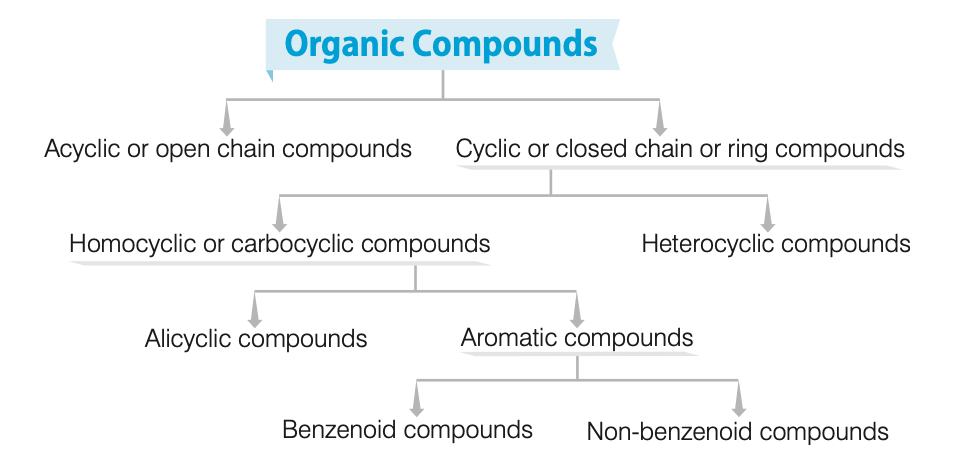
- Acyclic (Open Chain, Aliphatic)
-
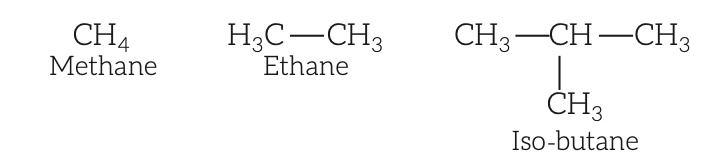
- Straight/branched chains (e.g., \( CH_4 \) (methane), \( C_2H_6 \) (ethane), \( CH_3CH(CH_3)CH_3 \) (isobutane)).
- \( CH_4 \):
- Simplest aliphatic compound.
- Cyclic (Closed Chain)
- Homocyclic (Carbocyclic)
- Alicyclic:
-
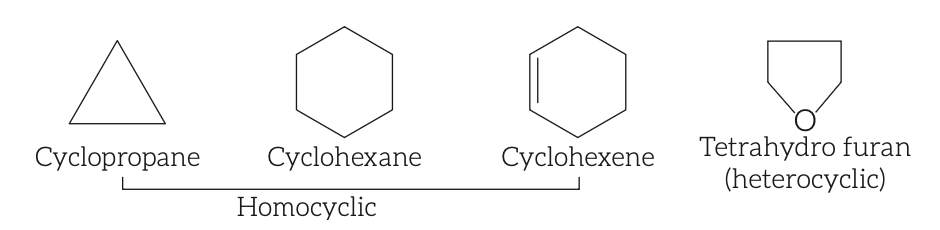
- Carbon ring, resemble acyclic (e.g., cyclopropane (\( C_3H_6 \)), cyclohexane, cyclohexene).
- Aromatic
-
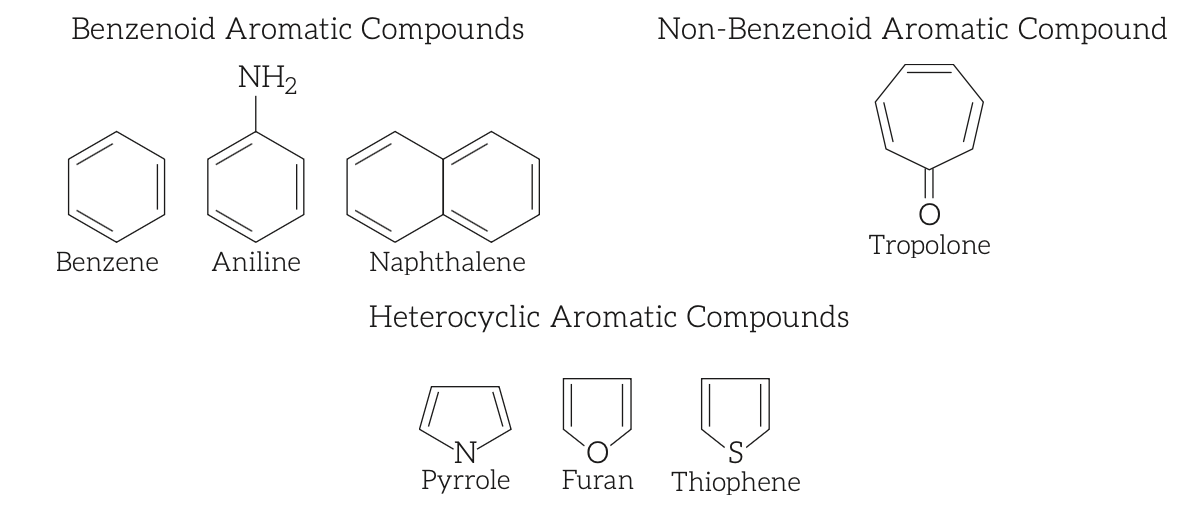
- Benzenoid:
- Contain benzene ring (e.g., benzene (\( C_6H_6 \)), aniline (\( C_6H_5NH_2 \)), naphthalene).
- Non-benzenoid:
- Aromatic without benzene (e.g., tropolone).
- Heterocyclic:
- Non-carbon atoms in ring (e.g., tetrahydrofuran, pyrrole, furan, thiophene).
- Note:
- Benzene (\( C_6H_6 \)) simplest aromatic compound.
- Functional Group
- Atom/group responsible for characteristic chemical properties.
-
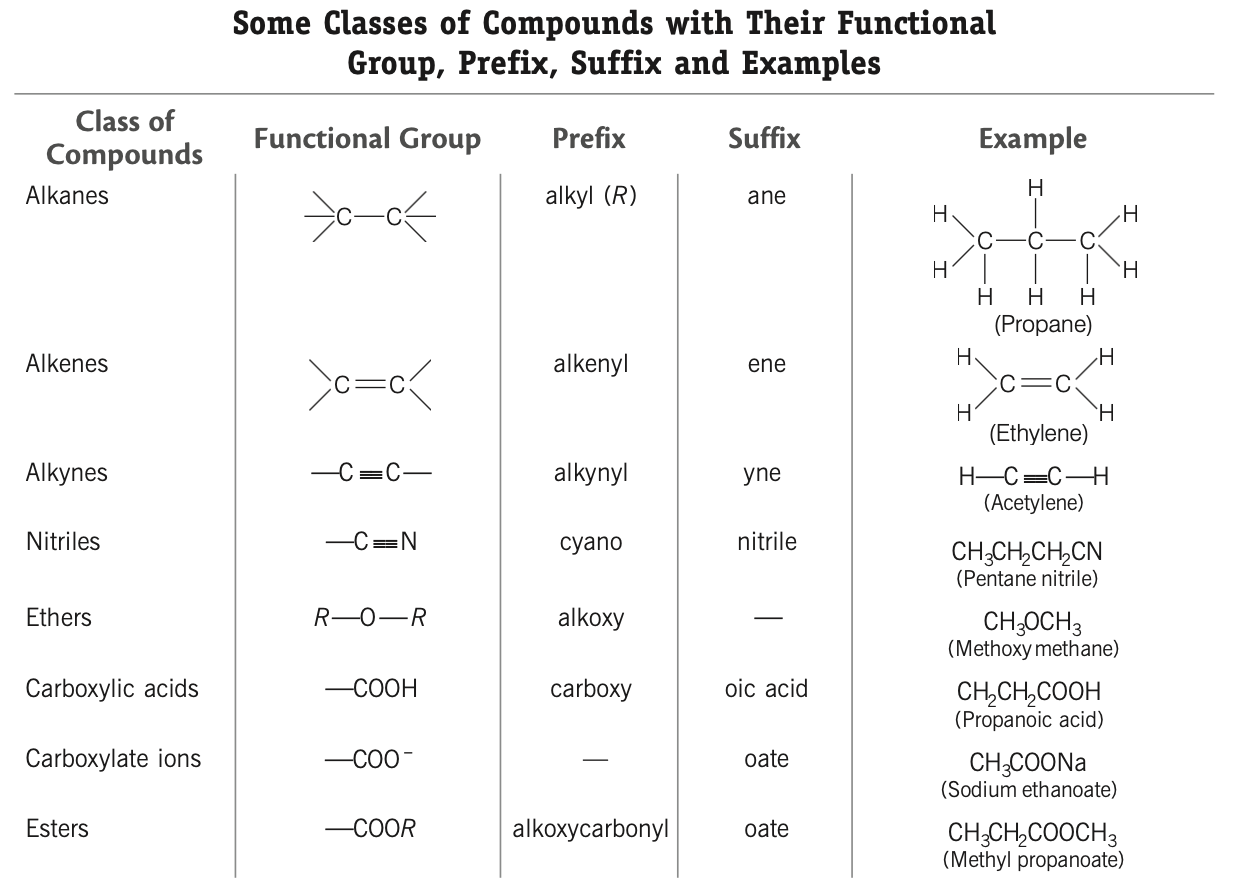
-
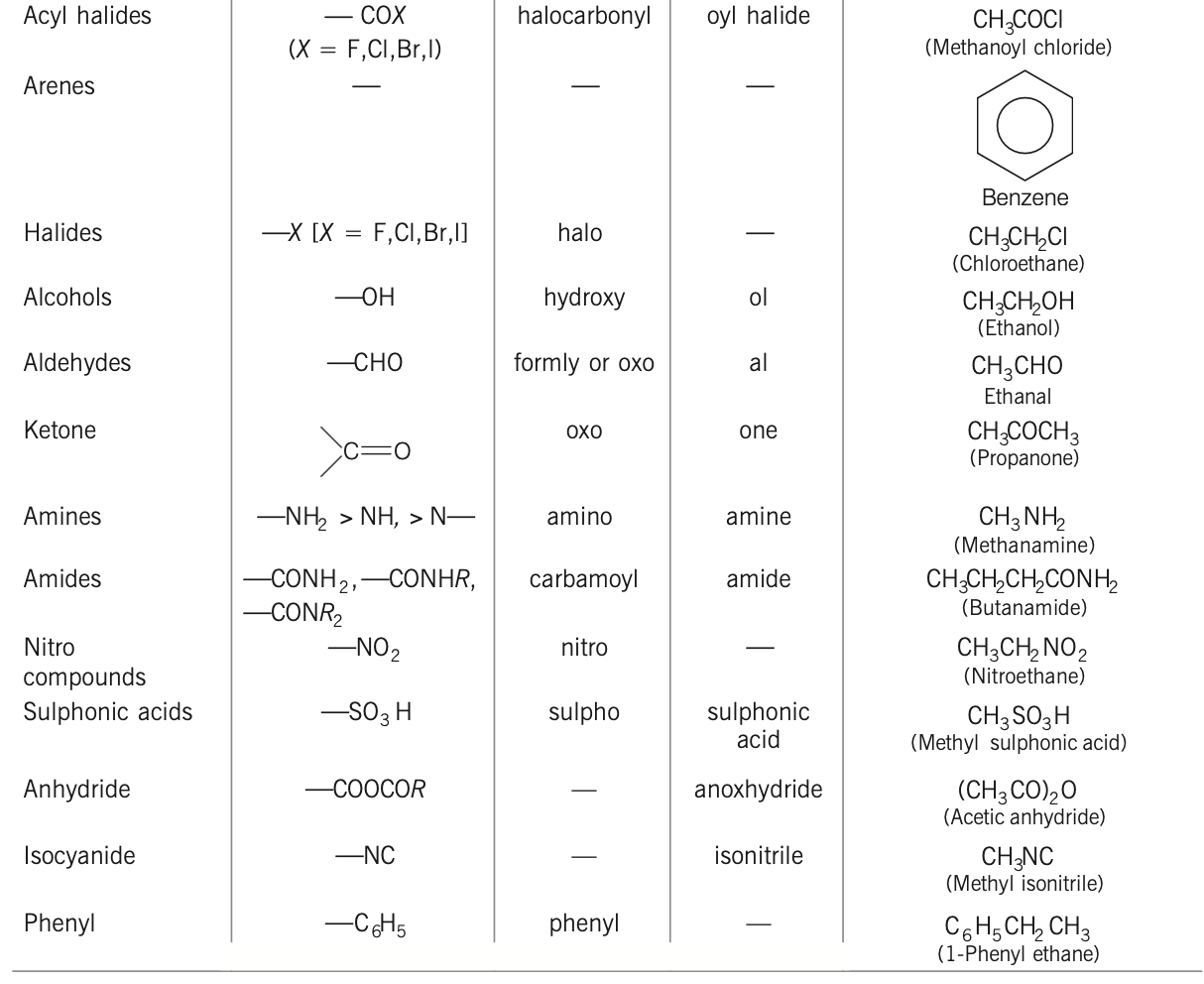
- Homologous Series
- Series with same functional group substituting hydrogen in carbon chain.
- Examples:
- Alkanes (\( CH_4, C_2H_6, C_3H_8, C_4H_{10} \)), alcohols (\( CH_3OH, C_2H_5OH, C_3H_7OH, C_4H_9OH, C_5H_{11}OH \)).
- Characteristics
- Same general formula (e.g., alcohols: \( C_nH_{2n+1}OH \)).
- Successive members differ by \( -CH_2 \) (14 u molecular weight).
- Prepared by same methods.
- Gradation in physical properties (e.g., melting/boiling point, density) with increasing molecular mass.
- Similar chemical properties due to same functional group.
- Isomerism
- Compounds with same molecular formula, different structures/properties.
- Types
- Structural Isomerism:
-
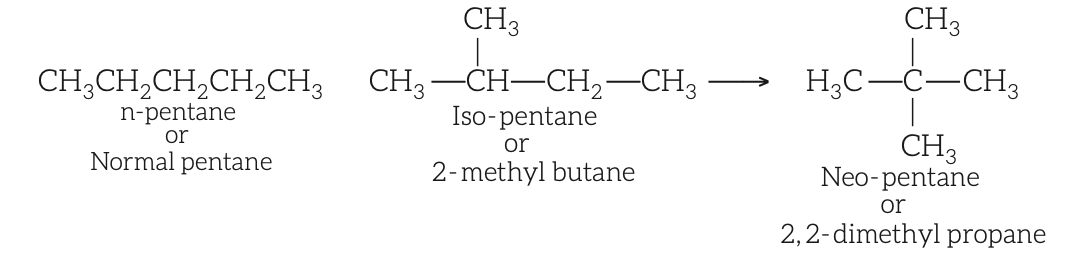
- Different structures (e.g., n-pentane, iso-pentane, neo-pentane (\( C_5H_{12} \))).
- Subtypes:
- Chain, position, functional group, metamerism.
- Stereoisomerism:
- Different spatial arrangement.
- Subtypes:
-Geometrical, optical.
- Hydrocarbons
- Compounds of \( C \) and \( H \), sourced from petroleum.
- Types
- Saturated Hydrocarbons
- Single \( C-C \) and \( C-H \) bonds.
- Alkanes (Paraffins)
- General formula:
- \( C_nH_{2n+2} \).
- Chemically inert (Latin: parum = little, affinis = affinity).
- Examples:
- \( CH_4 \) (methane), \( C_2H_6 \) (ethane), \( C_3H_8 \) (propane), \( C_4H_{10} \) (butane), \( C_5H_{12} \) (pentane), \( C_6H_{14} \) (hexane), \( C_7H_{16} \) (heptane).
- Methane (\( CH_4 \), Marsh Gas)
- From septic tanks, marshy lands, vegetable decomposition.
- Lab:
- Sodium acetate + sodalime.
- Commercial:
- Aluminium carbide + water.
- Properties:
- Tetrahedral (109°28'), black, explosive with air (coal mine explosions).
- Uses:
- Fuel, methyl alcohol, chloroform, carbon black, \( H_2 \), motor tyres.
- Cycloalkanes
- Carbon ring, general formula: \( C_nH_{2n} \).
- Example:
- Cyclopropane (\( C_3H_6 \)).
- Note:
- Single \( C-C \) bond length > double/triple bonds.
- Unsaturated Hydrocarbons
- Contain \( C=C \) or \( C≡C \).
- Alkenes (Olefins)
- At least one \( C=C \), general formula: \( C_nH_{2n} \).
- Ethylene (\( C_2H_4 \))
- Preparation: Ethanol + conc. \( H_2SO_4 \) at 170°C.
- Uses:
- Mustard gas, fruit ripening, oxyethylene flame, fruit preservation, anaesthesia, dry cleaning (trichloroethylene).
- Butene (\( CH_3CH_2CH=CH_2 \)):
- LPG constituent, fuel.
- Alkynes (Acetylenic)
- At least one \( C≡C \), general formula:
- \( C_nH_{2n-2} \).
- Acetylene (\( C_2H_2 \))
- Discovered by Wilson.
- Preparation:
- Calcium carbide + water.
- Properties:
- Acidic (reacts with \( AgNO_3 \)).
- Uses:
- Benzene synthesis, oxy-acetylene welding/cutting (3200°C), plastics, camphor, neoprene, anaesthesia.
- Aromatic Hydrocarbons (Arenes)
- Contain benzene ring, pleasant odour, general formula: \( C_nH_{2n-6} \).
- Examples:
- Benzene (\( C_6H_6 \)), toluene (\( C_6H_5CH_3 \)), naphthalene, anthracene.
- Benzene
- Isolated by Faraday (1825) from whale oil pyrolysis gas.
- Hofmann:
- From coaltar distillation.
- Berthelot:
- Synthesized from acetylene in red-hot tube.
- Uses:
- Organic compounds, explosives, dry cleaning, solvent, fuel (with petrol).
- Toluene
- From tolu balsam.
- Uses:
- TNT, antifreeze, solvent, chloramine-T, saccharin, dye leaving.
- Organic Compounds with \( C, H, O \)
- Alcohols
- \( -OH \) replaces \( H \) in aliphatic hydrocarbon, general formula: \( C_nH_{2n+1}OH \).
- Types:
- Monohydric (methanol, ethanol), dihydric (glycol), trihydric (glycerol), polyhydric.
- Test:
- Esterification (pleasant smell with carboxylic acid).
- Methyl Alcohol (Methanol, \( CH_3OH \))
- From wood distillation (wood spirit), formaldehyde + \( NaOH/KOH \).
- Properties:
- Colourless, poisonous, wine-like odour; causes blindness (affects optic nerve), death in large amounts.
- Uses:
- Solvent (paints, varnishes), artificial colours, formaldehyde, denatured alcohol, fuel (with petrol).
- Ethyl Alcohol (Ethanol, \( C_2H_5OH \))
- Preparation:
- Fermentation of molasses/starch, ethene + steam + \( H_3PO_4 \).
- Properties:
- Colourless, volatile; large intake slows metabolism, impairs judgement, coordination.
- Uses:
- Solvent (varnishes, paints), transparent soaps, perfumes, iodine tincture, polish, wine, fuel (spirit lamps), wound cleaning.
- Notes:
- Apple flavour from ethanol; alcohol test uses \( Na_2Cr_2O_7 \) (orange to green).
- Ethylene Glycol (\( (CH_2OH)_2 \))
- Dihydric, sweet taste.
- Uses:
- Antifreeze in car radiators.
- Glycerol (Glycerine, \( CH_2OHCHOHCH_2OH \))
- Hygroscopic, trihydric.
- Uses:
- Explosives (trinitroglycerine, dynamite), stamp ink, boot polish, medicines, cosmetics, lubricants, antifreeze, wine, soaps, watch cleaning, fruit preservation.
- Found in fats, vegetable oils (esters), fermented sugar, human blood.
- Phenols (\( C_6H_5OH \))
- \( -OH \) on aromatic hydrocarbon.
- Simplest:
- Phenol (carbolic acid, Runge 1834).
- Test:
- Ferric chloride.
- Uses:
- Salol, bakelite, phenolphthalein, aspirin, salicylic acid, phenyl (germicide), explosives (picric acid).
- Ethers
- Alkoxy/aryloxy (\( R-O-R, Ar-O \)) replaces \( H \), general formula: \( C_nH_{2n+2}O \).
- Diethyl Ether (\( C_2H_5OC_2H_5 \))
- Preparation:
- Ethanol + conc. \( H_2SO_4 \) at 140°C, Williamson synthesis.
- Uses:
- Anaesthesia (safer than chloroform).
- Aldehydes
- Contain \( -CHO \), general formula:
- \( C_nH_{2n}O \).
- Tests:
- Tollen’s reagent, Fehling’s solution, Schiff’s reagent.
- Formaldehyde (\( HCHO \))
- Uses:
- Tissue fixative, embalming, disinfectant; 40% solution (formalin) preserves biological specimens.
- Ketones
- Contain \( C=O \), general formula: \( C_nH_{2n}O \).
- Acetone (\( CH_3COCH_3 \))
- Uses:
- Industrial solvent, cosmetics, artificial silk, synthetic rubber, nail polish remover, medicines.
- Note:
- Acetone-free nail polish removers use ethyl/butyl acetate.
- Carboxylic Acids
- Contain \( -COOH \), general formula: \( C_nH_{2n}O_2 \).
- Formic Acid (\( HCOOH \))
- From red ants distillation (Latin: formicus).
- Uses:
- Rubber, leather, textile, dyeing, electroplating, arthritis medicines, insecticide, fruit juice preservative.
- Acetic Acid (\( CH_3COOH \))
- From pyroligneous acid.
- Uses:
- Lab reagent, solvent, vinegar (4-6% solution), photographic film, rayon (cellulose acetate), sauces, jelly.
- Oxalic Acid (\( C_2H_2O_4 \))
- In plants (oxalis, rumex) as potassium-hydrogen salt, human urine (calcium oxalate, kidney stones).
- Uses:
- Metallurgy, cloth colouration/printing, ink spot cleaning (10% solution), leather bleaching, photography (ferrous oxalate).
- Lactic Acid (\( CH_3CH(OH)COOH \))
- Monohydroxy, in milk (sour taste), muscles (causes fatigue).
- Uses:
- Yogurt, detergents, pharmaceuticals, cosmetics.
- Salicylic Acid (\( C_6H_5(OH)COOH \))
- White crystalline, aromatic.
- Uses:
- Painkillers, skin ointments.
- Citric Acid
- Monohydroxy tricarboxylic, in citrus fruits (lemon, orange).
- Esters
- Contain \( -COOR \), fruity smell, general formula: \( C_nH_{2n}O_2 \).
- Examples:
- Methyl formate (\( HCOOCH_3 \)), methyl acetate (\( CH_3COOCH_3 \)), ethyl acetate (\( C_2H_5COOCH_3 \)).
- Uses:
- Artificial perfumes, scented colours, dyes.
- Alcoholic Beverages
- Contain ethanol, from fermentation of grapes, maize, sugarcane.
- Enzyme:
- Zymase (yeast) converts glucose to ethanol.
- Types
- Distilled (40-55% alcohol)
-
| Beverage | Alcohol % | Source |
|---|
| Brandy | 40-50 | Grapes |
| Gin | 35-40 | Maize |
| Rum | 45-55 | Sugarcane |
| Vodka | 30-40 | Corn, wheat |
| Whisky | 40-50 | Molasses |
- Undistilled (3-15% alcohol)
-
| Beverage | Alcohol % | Source |
|---|
| Beer | 4-6 | Barley |
| Cider | 2-6 | Apples |
| Champagne | 10-15 | Grapes |
| Port/Sherry | 15-25 | Grapes |
- Terms
- Denatured Alcohol:
- Ethanol + pyridine, acetone, methanol (poisonous, unfit for drinking).
- Grain Alcohol:
- Ethanol from starch fermentation.
- Absolute Alcohol:
- Pure ethanol, volatile, colourless.
- Power Alcohol:
- Ethanol + benzene + petrol for engines.
- Rectified Spirit:
- 95.6% ethanol, 4.4% \( H_2O \), from repeated distillation.
- Wood Spirit:
- Methanol from wood distillation.
- Other Organic Compounds
- Chloroform (\( CHCl_3 \))
- Discovered by Liebig (1831).
- Properties:
- Oxidizes in air to phosgene (\( COCl_2 \)), stored in dark, filled bottles.
- Uses:
- Anaesthesia (first by Simpson), solvent (fats, alkaloids, iodine, rubber), insecticide, freon R-22 production.
- Iodoform (\( CHI_3 \))
- Yellow, crystalline, specific odour.
- Preparation:
- Iodine + \( NaOH \) + ethanol (haloform reaction).
- Properties:
- Insoluble in water, soluble in alcohol/ether, bactericidal (due to free iodine).
- Uses:
- Antiseptic (historical).
- Chlorofluorocarbons (CFCs, Freons)
- Stable, non-toxic, non-corrosive, easily liquefied.
- Uses:
- Refrigeration, air conditioning, aerosol propellants.
- Note:
- Cause ozone layer depletion.
- Carbon Tetrachloride (\( CCl_4 \))
- Uses:
- Refrigerants, aerosol propellants, dry cleaning, spot remover, fire extinguisher (pyrin, electric fires).
- Aniline (\( C_6H_5NH_2 \))
- From indigo (1826, Unverdorben; coaltar, Runge; alkali + indigo, Fritsche).
- Uses:
- Sulphonilic acid, nitroaniline, explosives, drugs, coloured dyes, zwitter ion, rubber industry.
- Methyl Isocyanate (\( CH_3NC \))
- Uses:
- Rubbers, adhesives, pesticides.
- Note:
- Bhopal gas tragedy (1984, Union Carbide).
- Gammexane (Benzene Hexachloride, BHC, Lindane)
- Uses:
- Insecticide (mosquitoes, lice), pharmaceuticals.
- Formamint
- Uses:
- Throat medicines (chewing tablets).
- Nitrobenzene (\( C_6H_5NO_2 \))
- From Mitscherlich (1834).
- Uses:
- TNB (explosive), soaps, polishes, cheap perfumes.
- Naphthalene (\( C_{10}H_8 \))
- From coaltar.
- Uses:
- Germicide, moth repellent.
- Tear Gas
- Examples:
- Alpha-chloroacetophenone, acrolein, carbonyl chloride, chloropicrin (\( CHCl_3 + HNO_3 \)).
- Uses:
- Crowd control (causes eye burning, tears).
- Lewisite
- Poisonous gas, from acetylene + \( AsCl_3 \) + anhydrous \( AlCl_3 \).
- Used in WW2.
- Paraldehyde
- From anhydrous acetaldehyde + conc. \( H_2SO_4 \).
- Uses:
- Sleeping drug.
- Urotropine (Hexamethylene tetramine)
- From \( HCHO + NH_3 \).
- Uses:
- Urological medicines.
- Mustard Gas
- From sulphur monochloride + ethylene, mustard oil smell.
- Effects:
- Blisters skin, damages lungs, penetrates rubber.
- Used in WW1.
- Chloretone
- From acetone + \( CHCl_3 \) + \( KOH \).
- Uses:
- Drugs for vomiting, headache (mountain/sea expeditions).
- Acetamide (\( CH_3CONH_2 \))
- Uses:
- Moistening pulp/paper, softening leather.
- Chlorobenzene (\( C_6H_5Cl \))
- From benzene + chlorine + Fe catalyst.
- Uses:
- Phenol, aniline production.
- Dichloromethane (\( CH_2Cl_2 \))
- Uses:
- Paint remover, aerosol propellant, metal cleaning.
- DDT (Dichloro Diphenyl Trichloroethane)
- Uses:
- Insecticide (mosquitoes, lice), industrial applications.
- Benzene Sulphonic Acid (\( C_6H_5SO_3H \))
- Uses:
- Sulpha drugs, saccharin.
- Urea (\( NH_2CONH_2 \))
- First lab-synthesized organic compound (1773, from urine).
- Properties:
- Colourless, odourless, water-soluble, 46% \( N \).
- Uses:
- Fertilizer, baronial medicines, formaldehyde-urea, plastics.
- Chloral (\( CCl_3CHO \))
- From chlorine + acetaldehyde.
- Uses:
- DDT production.
- Miscellaneous
- Nicotine:
- Alkaloid in tobacco, causes cancer.
- Tea:
- Stimulates nervous/muscular system, causes indigestion, stomach burns.
- Coffee:
- Aids digestion post-meal.
- Bagasse:
- Residue from sugarcane/sugarbeet juice extraction.
- Henna (Lawsonia inermis):
- Dyes skin, hair, nails, leather, wood due to lawsone (binds proteins/amino acids).
- Food Chemistry
- Overview
- Living systems:
- Composed of complex biomolecules (carbohydrates, proteins, nucleic acids, lipids).
- Carbohydrates, proteins:
- Essential food constituents, interact to form molecular logic of life processes.
- Carbohydrates
- Definition
- Old:
- \( C, H, O \) in 1:2:1 ratio (not always true).
- Modern:
- Optically active polyhydroxy aldehydes/ketones or compounds yielding these on hydrolysis.
- General formula:
- \( C_x(H_2O)_y \) (e.g., glucose (\( C_6H_{12}O_6 \)), fructose, sucrose).
- Produced by plants, major group of organic compounds.
- Sources:
- Cereals (wheat, maize, rice, corn, rye, oat, barley), potato, turnip, beetroot, banana.
- Classification
- Based on Hydrolysis
- Monosaccharides:
- Simplest, non-hydrolysable (e.g., triose (glyceraldehyde), tetrose (erythrose), pentose (ribose), hexose (glucose, fructose)).
- Oligosaccharides:
- Yield 2–10 monosaccharides (e.g., disaccharides: sucrose (glucose + fructose), maltose (2 glucose), lactose (galactose + glucose)).
- Polysaccharides:
- Yield many monosaccharides via glycosidic linkages (e.g., starch, cellulose, gums, glycogen), usually water-insoluble.
- Based on Physical Properties
- Sugars:
- Sweet (e.g., sucrose, lactose (milk sugar)).
- Non-sugars:
- Not sweet (e.g., polysaccharides like starch, cellulose).
- Based on Reducing Properties
- Reducing:
- Reduce Tollen’s reagent (silver mirror), Fehling’s solution (red precipitate); includes all monosaccharides, most disaccharides (except sucrose).
- Non-reducing:
- Do not reduce Tollen’s/Fehling’s (e.g., sucrose, higher saccharides).
- Common Carbohydrates
- Glucose (\( C_6H_{12}O_6 \), Dextrose)
- Sources:
- Sweet fruits, ripe grapes, honey.
- Preparation:
- Starch hydrolysis.
- Properties:
- Main energy sugar, blood concentration 70–115 mg/100 mL, used for silvering mirrors.
- Uses:
- Instant energy source.
- Fructose (\( C_6H_{12}O_6 \), Fruit Sugar, Laevulose)
- Sources:
- Honey, fruits, high fructose corn syrup.
- Properties:
- Sweeter than sucrose.
- Uses:
- Medicinal syrups, toffees.
- Sucrose (\( C_{12}H_{22}O_{11} \), Cane Sugar)
- Source:
- Sugarcane.
- Properties:
- Hydrolysis yields glucose + fructose (invert sugar).
- Uses:
- Preservative in jams, jarred foods.
- Maltose (\( C_{12}H_{22}O_{11} \), Malt Sugar)
- Composition:
- 2 glucose units.
- Uses:
- Alcohol production.
- Lactose (\( C_{12}H_{22}O_{11} \), Milk Sugar)
- Sources:
- Cow’s milk (4–6%), human milk (5–8%).
- Composition:
- Galactose + glucose.
- Starch (\( (C_6H_{10}O_5)_n \))
- Sources:
- Cereals, roots, tubers, vegetables.
- Composition:
- Amylose (water-soluble), amylopectin (water-insoluble), polymer of glucose.
- Properties:
- Gives blue-violet color with \( I_2 \), digested to maltose then glucose.
- Uses:
- Plant food reserve.
- Cellulose (\( (C_6H_{10}O_5)_n \))
- Source:
- Plant cell walls.
- Properties:
- Straight-chain glucose polysaccharide, indigestible by humans (lacks cellulase, present in ruminants/termites).
- Uses:
- Shatterproof glass, cotton wool (from cotton plant).
- Glycogen (Animal Starch)
- Storage:
- Liver, muscles, brain.
- Properties:
- Broken into glucose for energy.
- Notes
- Galactose:
- Rare in nature, forms lactose with glucose.
- Gums:
- Acidic polysaccharides, multiple monosaccharides.
- Importance
- Energy source via oxidation, form nucleic acids.
- Storage:
- Starch (plants), glycogen (animals).
- Structural:
- Cellulose in wood (furniture), cotton fibres (clothes).
- Industrial:
- Raw materials for textiles, lacquers, beverages.
- Proteins
- Definition
- Nitrogenous (\( C, H, O, N \)), polymers of α-amino acids linked by peptide bonds.
- Term:
- From "proteios" (prime importance, Muller 1838).
- Composition:
- ~15% body mass, essential for nourishment.
- Sources:
- Meat, egg (richest).
- 20 amino acids code for protein synthesis in animals.
- Classification
- Based on Composition
- Fibrous:
- Structural, parallel polypeptide chains, hydrogen/disulfide bonds (e.g., keratin, fibroin, collagen, myosin (muscles)).
- Globular:
- Regulate life cycle, coiled spherical molecules (e.g., enzymes, insulin, albumins).
- Based on Components
- Simple:
- Only amino acids (e.g., collagen, albumins, globules).
- Conjugated:
- Protein + non-protein (prosthetic group) (e.g., haemoglobin, casein, nucleoprotein, glycoprotein, phosphoprotein).
- Derived:
- From partial protein breakdown (e.g., peptones, insulin, fibrin).
- Functions
- Enzymes in plants/animals.
- Components of hair, muscle, skin.
- Hormones (e.g., insulin, vasopressin).
- Transport \( O_2 \), fats, metabolic substances.
- Cell/protoplasm synthesis, tissue culturing.
- Emergency energy (when carbohydrates/fats unavailable).
- Genetic/hereditary control.
- Denaturation
- Loss of biological activity due to temperature/pH changes.
- Example:
- Egg coagulation on boiling.
- Notes
- Insulin:
- 51 amino acids, regulates blood sugar.
- Haemoglobin:
- 574 amino acids, carries \( O_2 \).
- Types:
- Transportable (micronutrients), contractile (muscle movement), structural (cells/tissues), defensive (antibodies).
- Fats and Oils
- Definition
- Triglycerides: Esters of glycerol with fatty acids (e.g., palmitic (\( C_{15}H_{31}COOH \)), stearic (\( C_{17}H_{35}COOH \)), oleic (\( C_{17}H_{33}COOH \))).
- Fats:
- Saturated esters, solid at room temp, melting point >20°C.
- Oils:
- Unsaturated esters, liquid, melting point <20°C.
- Composition:
- \( C, H, O \) (less \( O \) than carbohydrates).
- Properties:
- Insoluble in water, soluble in organic solvents (benzene, \( CCl_4 \), petroleum).
- Energy:
- 9 kcal/g (vs. 4.2 kcal/g for carbohydrates).
- Types
- Animal Fats:
- Saturated, solid (e.g., milk, butter, meat, cheese, egg, fish).
- Vegetative Fats:
- Unsaturated (trans), liquid (e.g., nut, coconut, almond, mustard, sunflower).
- Functions
- Stored energy source.
- Resistive layer under skin.
- Shock-resistant layer protecting organs.
- Notes
- Phospholipids:
- Phosphorus-containing fats.
- Iodine value:
- Measures unsaturation.
- Castor oil:
- From castor bean, high protein, pale yellow.
- Waxes
- Definition
- Natural:
- Esters of fatty acids + long-chain alcohols.
- Synthetic:
- Long-chain hydrocarbons from petroleum.
- Properties:
- Insoluble in water, soluble in organic solvents.
- Types
- Animal:
- Beeswax (myricyl palmitate), carnauba wax (myricyl cerotate, palm leaf), spermaceti wax (cetyl palmitate, whale sperm).
- Plant, petroleum-derived, montan waxes.
- Uses:
- Candles, coatings, cosmetics.
- Vitamins
- Definition
- Organic compounds, small amounts needed, regulate metabolism, not energy sources.
- Deficiency:
- Causes specific diseases; excess harmful (consult doctor for pills).
- Types
- Fat-Soluble:
- A, D, E, K (stored in liver, fat tissues).
- Water-Soluble:
- B group, C (excreted in urine, except \( B_{12} \)).
- Fat-Soluble Vitamins
-
| Name | Sources | Functions | Deficiency | Other Info |
|---|
| Vitamin A (Retinol) | Carrot, tomato, papaya, mango, milk, eggs, cod-liver oil | Vision, growth, epithelial tissue differentiation | Night blindness, xerophthalmia, abnormal epithelial growth | Discovered by McCollum (1913), Karrer Nobel Prize (1937) |
| Vitamin D (Calciferol) | Cod liver oil, skin (sunlight) | Calcium absorption, bone deposition | Rickets (children), osteomalacia (adults) | Only vitamin synthesized in body, hormone-like |
| Vitamin E (Tocopherol) | Wheat germ, green leafy vegetables, vegetable fats | Antioxidant, reproduction, muscle/RBC maintenance | Reproductive failure, muscular dystrophy, macrocytic anaemia | Vitamin of reproduction, discovered by Evans/Bishop (1922) |
| Vitamin K (K1, K2, K3) | Leafy vegetables, wheat germ, gut bacteria | Blood clotting, prevents excessive bleeding | Faulty clotting | K1 (Dam), K2 (Doisy) Nobel Prize (1943) |
- Water-Soluble Vitamins
-
| Name | Sources | Functions | Deficiency | Other Info |
|---|
| Vitamin B1 (Thiamine) | Whole grain, wheat germ, legumes, nuts, fish, pulses | Tissue repair/growth, tryptophan to niacin, TPP in TCA cycle | Beri-beri, Wernicke’s/Korsakoff’s syndromes | Alcohol interferes, discovered by Eijkman (1897) |
| Vitamin B2 (Riboflavin) | Milk, cheese, meats, eggs, legumes, mushrooms, greens | RBC production, FMN/FAD in ETC/TCA | Cheilosis, skin cracks, red eyes, tongue cracks | Yellow enzyme |
| Vitamin B3 (Niacin) | Nuts, legumes, yeast, liver, fish, meat, poultry | NAD/NADP in TCA cycle | Pellagra, Hartnup disease | Isolated by Elvehjem (1937) |
| Vitamin B5 (Pantothenic acid) | Yeast, milk, groundnut, tomatoes, liver, meat, honey, egg yolk | Co-enzyme A in TCA, skin/hair health | Dermatitis, hair loss, greying | Identified by Williams (1933) |
| Vitamin B6 (Pyridoxine) | Cereals, peanuts, banana, soyabean, meat, vegetables | Protein metabolism | Dermatitis, anaemia, convulsions, nausea | Discovered by Szent-Györgyi (1934) |
| Vitamin B7 (Biotin) | Egg yolk, milk, nuts, honey, liver, meat, fish | Carbohydrate/protein/fat metabolism | Poor growth, muscle control loss, hair fall | Discovered by Kogl/Tonnis (1936), avidin in egg white blocks absorption |
| Vitamin B9 (Folic acid) | Green leafy vegetables | RBC formation, appetite | Megaloblastic anaemia | Discovered by Lucy Wills (1934) |
| Vitamin B12 (Cyanocobalamin) | Spirulina, liver, meat, fish, eggs, milk | RBC/DNA synthesis, neurological function | Pernicious anaemia | Contains cobalt, Hodgkin Nobel Prize (1964) |
| Vitamin B17 (Laetrile) | Wheat, grass, juice | Anti-cancer | - | - |
| Vitamin C (Ascorbic acid) | Citrus fruits, amla, guava, tomato | RBC/antibody formation, bones/teeth/gums, antioxidant | Scurvy | Discovered by James Lind (1753) |
| Vitamin P (Hesperidin, Citrin) | Citrus fruits, green vegetables | Blood vessel wall maintenance | - | - |
- Notes
- \( B_1, B_5, B_6, B_{12}, C \): Destroyed by heat.
- Vitamin C:
- Absent in animal-derived foods.
- Enzymes
- Definition
- Complex nitrogenous proteins, high molecular mass, produced by plants/animals.
- Biochemical catalysts for life processes.
- Examples and Uses
-
| Enzyme | Uses |
|---|
| Zymase | Ethanol from glucose |
| Diastase | Maltose from starch |
| Mycodrumi aciti | Vinegar from sugar beet |
| Invertase | Glucose + fructose from sugarcane |
| Lacto bacillus | Lactic acid from milk |
| Pepsin | Protein to amino acids (stomach) |
| Erepsin | Protein to amino acids (intestines) |
| Trypsin | Protein to amino acids (pancreas) |
| Ptylin | Starch to glucose (saliva) |
| Carbonic anhydrase | \( H_2CO_3 \) to \( H_2O + CO_2 \) |
| Nucleases | RNA/DNA to nucleotides |
| Amylase | Starch to α-glucose |
| Urease | Urea to \( CO_2 + H_2O \) |
| α-amylase | Sweet syrup from corn starch |
| Rennin | Digestion of mother’s milk in young mammals |
- Characteristics
- Highly efficient, specific (e.g., urease hydrolyzes only urea).
- Optimal temperature:
- 298–310 K; activity decreases outside range.
- Optimal pH:
- 5–7.
- Enhanced by co-enzymes, metal ions (e.g., \( Na^+ \) with amylase).
- Inhibited by poisons/inhibitors.
- Notes
- Most enzymes are proteins (except few).
- Faster than metal-catalyzed reactions.
- Deficiencies:
- Phenyl ketone urea disease (phenylalanine hydroxylase), albinism (tyrosinase).
- Streptokinase:
- Dissolves blood clots, treats heart diseases.
- Food Preservatives
- Prevent microbial spoilage.
- Examples:
- Table salt, sugar, vegetable oils, sodium metabisulphite, sodium benzoate, sorbic acid salts, propanoic acid salts.
- Note:
- Refrigeration slows biochemical reactions, reduces microbial activity.
- Artificial Sweetening Agents
- Used by diabetics to avoid calorie-heavy sucrose.
- Examples
- Saccharin:
- Ortho-sulphobenzimide, 550x sweeter than sugar, inert, excreted unchanged.
- Aspartame:
- 100x sweeter, unstable at cooking temperature, used in cold foods/drinks.
- Alitame:
- 2000x sweeter than sugar.
- Sucrolose:
- Trichloro-sucrose, sugar-like, stable at cooking temperature.
- Food Poisoning
- Caused by microbial toxins in food, leading to illness/death.
- Note:
- Deep-fried foods (hydrocarbon-rich) are carcinogenic.
- Antioxidants
- Prevent oxidation of unsaturated fats/oils, extend shelf life.
- Examples:
- BHA, BHT, gallic acid esters, lecithin.
- Natural Sources
-
| Antioxidant | Sources |
|---|
| Vitamin C | Fruits, vegetables |
| Vitamin E | Vegetable oils |
| Carotenoids | Fruits, vegetables |
| Polyphenolic antioxidants | Tea, coffee, soybean, chocolate |
- Notes
- \( SO_2 \), sulphites:
- Antioxidants for beverages, sugar syrups, peeled fruits.
- Fresh fruits/vegetables:
- Neutralize free radicals, promote health/longevity.
- Chemistry in Everyday Life
- Overview
- Chemistry impacts daily life through materials like clothes, toothpaste, oil, soaps, combs, paints, varnishes, drugs, dyes, glass, cement.
- Soaps and Detergents
- Role:
- Cleansing agents, remove fats binding materials to fabric/skin.
- Soaps
- Definition:
- Sodium/potassium salts of higher fatty acids (e.g., stearic (\( C_{17}H_{35}COOH \)), oleic (\( C_{17}H_{33}COOH \)), palmitic (\( C_{15}H_{31}COOH \))).
- Source:
- Petroleum products, biodegradable.
- Manufacture:
- Saponification (fats + \( NaOH \), heat → soap + glycerol).
- \( NaCl \) added to precipitate soap.
- Only sodium/potassium soaps water-soluble, used for cleansing.
- Types
- Toilet:
- High-grade fats/oils, no excess alkali, added color/perfumes.
- Floating:
- Air bubbles beaten in before hardening.
- Transparent:
- Dissolved in ethanol, excess solvent evaporated.
- Medicated:
- Contains medicinal substances (e.g., Dettol).
- Shaving:
- Glycerol (prevents drying), sodium rosinate (lathering).
- Laundry:
- Fillers (sodium rosinate, silicate, borax, carbonate).
- Soap Powders/Scouring:
- Soap + scouring agent (pumice/sand) + builders (sodium carbonate, trisodium phosphate).
- Soap Granules:
- Dried miniature soap bubbles.
- Characteristics of Good Soap
- No free alkali, ≤10% moisture, soluble in alcohol, no cracking.
- Limitations:
- Ineffective in hard water (forms insoluble Ca/Mg soap scum), hydrolyzed in acidic medium to fatty acids, losing cleansing effect.
- Detergents
- Definition:
- Alkyl sulphate/sulphonate or ammonium salts of long-chain fatty acids (12–18 carbons, e.g., sodium lauryl sulphate, sodium p-dodecylbenzenesulphonate).
- Advantages:
- Work in soft/hard water (soluble Ca/Mg salts), effective in acidic medium, stronger cleansing than soaps.
- Classification
- Anionic:
- Sodium salts of sulphonated alcohols/hydrocarbons (e.g., sodium lauryl sulphate), used in household/toothpastes.
- Cationic:
- Quaternary ammonium salts (e.g., cetyltrimethylammonium bromide), germicidal, used in hair conditioners.
- Non-ionic:
- No ions (e.g., pentaerythritol monostearate), used in liquid dishwashing detergents.
- Additives:
- Sodium sulphate/silicate keep washing powder dry, maintain alkalinity.
- Disadvantage:
- Highly branched detergents non-biodegradable, cause water pollution; biodegradable straight-chain detergents preferred.
- Dyes
- Definition:
- Colored substances for permanent color on fabrics/foodstuffs, chromophores (e.g., nitro, azo) absorb/reflect light.
- Classification
- By Constitution
- Azo:
- Methyl orange, congo red.
- Phthalein:
- Phenolphthalein, mercurochrome.
- Indigoid:
- Indigo, tyrian purple.
- Anthraquinone:
- Alizarin (natural).
- Triphenyl
- Methane: Malachite green.
- By Application
- Acid:
- Sodium salts, dye wool/silk/nylon (e.g., methyl orange, congo red).
- Basic:
- Dye modified nylons/polyesters (e.g., aniline yellow, malachite green).
- Direct:
- Applied from aqueous solutions (e.g., martius yellow, congo red).
- Disperse:
- Applied as dispersion (e.g., celliton fast pink B).
- Fibre
- Reactive: Chemically bond to fibre (e.g., procion cibacron).
- Vat:
- For cotton (e.g., indigo).
- Mordant:
- Require binding agent, color varies (e.g., alizarin: red with Al, blue with Ba).
- Polymers
- Definition:
- Many repeating units (monomers), from Greek "poly" (many), "mer" (part).
- Polymerisation
- Process:
- Monomers form polymers under specific conditions.
- Example:
- \( 3C_2H_2 \rightarrow C_6H_6 \) (acetylene to benzene in hot copper pipe).
- Types
- Addition:
- No loss of small molecules, polymer molecular weight = monomer multiple (e.g., PVC, polythene, polystyrene, rubber), reversible.
- Condensation:
- Eliminates small molecules (e.g., \( H_2O, NH_3 \)), non-multiple molecular weight (e.g., terylene, nylon).
- Plastics
- Definition:
- High molecular mass organic polymers, moldable during preparation.
- Types
- Natural:
- From plant materials (e.g., starch, cellulose, eucalyptus).
- Synthetic
- Thermoplastics:
- Soften on heating, harden on cooling (e.g., polythene, polystyrene, teflon, PVC).
-
| Thermoplastic | Monomer | Uses |
|---|
| Polythene | Ethene (\( CH_2=CH_2 \)) | Toys, bottles, polybags, pipes, dustbins |
| Teflon | Tetrafluoroethene (\( CF_2=CF_2 \)) | Oil seals, gaskets, non-stick utensils |
| Polystyrene | Styrene (\( C_6H_5-CH=CH_2 \)) | Insulator, toys, radio/TV cabinets, combs |
| PVC | Vinyl chloride (\( CH_2=CHCl \)) | Raincoats, dish antennas, handbags, pipes |
| Polypropene | Propene (\( CH_3-CH=CH_2 \)) | Toys, pipes, ropes, fibres |
| Lucite | Methyl methacrylate (\( H_2C=C(CH_3)COOCH_3 \)) | Contact lenses |
- Thermosetting:
- Rigid, cannot soften after molding (e.g., bakelite (phenol + formaldehyde), melamine (fire-resistant, for tiles, kitchenware)).
- Properties:
- Non-reactive, light, strong, durable, poor conductors of heat/electricity.
- Notes
- Linear (PVC, polythene) or cross-linked (bakelite, melamine) arrangements.
- Plasticizers (high boiling esters/haloalkanes) soften plastics.
- Polycarbonates (e.g., polyurethane, kevlar): Bulletproof glass, fridge containers, mixi jars, baby bottles.
- Special plastic cookware for microwaves unaffected by heat.
- Rubber
- Definition:
- Elastic polymer from rubber latex (colloidal rubber in water, from equatorial trees).
- Origin:
- Amazon, Zaire forests (wild rubber), later Malaya, South-East Asia.
- Types
- Natural:
- From rubber tree latex, monomer is isoprene (\( CH_2=C(CH_3)-CH=CH_2 \)).
- Synthetic
- Neoprene:
- From chloroprene, resistant to oils, used in belts, gaskets, hoses, cables.
- Buna-N:
- From 1,3-butadiene + acrylonitrile, for oil seals, tank linings.
- Thiokol:
- From dichloroethane + polysulphide, used in rocket propellants, solvent tanks, oil pipes.
- Vulcanisation:
- Heating rubber with sulphur (5% for tyres, 30% for battery cases) at 373–415 K, improves resistance/elasticity.
- Notes:
- Buna-S (butadiene styrene) used in bubble gums.
- Fibres
- Definition:
- Long, thread-like structures for fabrics.
- Types
- Natural
- Plant:
- Cellulose-based (e.g., cotton, hemp, jute, flax), used in paper/textiles.
- Animal:
- Protein-based (e.g., silkworm silk, spider silk, wool).
- Semisynthetic:
- Chemically treated natural fibres (e.g., rayon from wood pulp cellulose, treated with \( NaOH \), \( CS_2 \), \( H_2SO_4 \)).
- Synthetic:
- From chemicals (e.g., nylon, polyester, carbon fibre, orlon).
-
| Fibre | Monomers | Uses |
|---|
| Nylon | Hexamethylene diamine (\( NH_2(CH_2)_6NH_2 \)) + adipic acid (\( HOOC(CH_2)_4COOH \)) | Toothbrushes, ropes, parachutes, nets, garments |
| Polyester (Dacron/Terylene) | Ethylene glycol (\( HOCH_2CH_2OH \)) + terephthalic acid | Clothes, fire hoses |
| Carbon Fibres | Carbon | Space vehicle parts, sports items |
| Orlon | Acrylonitrile (\( CH_2=CHCN \)) | Wool substitute, blankets |
- Advantages:
- Synthetic fibres dry quickly, durable, cheap, readily available, easy to maintain.
- Disadvantages:
- Melt on heating, catch fire easily, stick to skin (avoid in kitchens/labs).
- Notes
- Cotton:
- Fire-resistant.
- Silk:
- Protein fibre from mulberry silkworm (Bombyx mori).
- Rexin:
- Artificial leather from cellulose or pyroxylene-coated canvas.
- Polycot (polyester + cotton), polywool (polyester + wool), PET (polyester) for jars, bottles, films, wires.
- Kevlar:
- For bulletproof vests.
- Ceramics
- Raw Material:
- Clay (aluminium silicate), china clay (decomposed feldspar + quartz + mica).
- Uses
- Pottery, tableware, tiles, bricks.
- Refractive bricks for furnace linings.
- Abrasive ceramics (silicon/tungsten carbides) for cutting/grinding tools.
- Superconductors for low temperatures.
- Drugs
- Definition:
- Low molecular mass chemicals, medicines cure diseases with minimal toxicity/addiction, drugs may be habit-forming with side effects.
- Classification
- Antipyretics:
- Reduce fever (e.g., aspirin, crocin, ibuprofen, paracetamol, phenacetin, analgin, novalgin).
- Analgesics:
- Reduce pain without impairing consciousness (e.g., aspirin, paracetamol, morphine (narcotic, from opium poppy)).
- Antibiotics:
- Inhibit/destroy microorganisms.
- Bactericidal:
- Penicillin (from fungus, discovered by Fleming 1928), aminoglycosides, ofloxacin.
- Bacteriostatic:
- Erythromycin, tetracycline (from bacterium), chloramphenicol.
- Broad-spectrum:
- Ampicillin, amoxicillin, chloramphenicol, vancomycin, ofloxacin.
- Narrow-spectrum:
- Penicillin-G.
- Antiseptics:
- Prevent/kill microorganisms, safe for human tissues (e.g., furacine, soframycine, dettol, bithionol, tincture iodine, boric acid, 0.2% phenol).
- Disinfectants:
- For inanimate objects (e.g., phenyl, 1% phenol).
- Sulpha Drugs:
- Contain sulphur/nitrogen (e.g., sulphapyridine, sulphadiazine, sulphaguanidine, sulphathiazole, sulphanilamide (1908)).
- Anaesthetics:
- Cease sensation (e.g., diethyl ether (first used 1846 by Morten), chloroform (by Sampson, replaced by safer ethers), cocaine, diazepam, halothane, nitrous oxide, pentothal sodium).
- Antacids:
- Neutralize stomach acidity (e.g., \( Al(OH)_3, Mg(OH)_2 \)); better than \( NaHCO_3 \).
- Others:
- Cimetidine, ranitidine, omeprazole, lansoprazole (acidity relief); tranquillizers (e.g., barbituric acid derivatives, equanil, valium, serotonin); quinine (anti-malarial from cinchona bark); salvarsan (syphilis treatment, Ehrlich Nobel Prize 1908).
- Cosmetics
- Examples:
- Creams, perfumes, talcum powder, deodorants.
- Chemicals
-
| Cosmetic | Chemicals |
|---|
| Moisturising Cream | Cetyl alcohol, hydroquinone |
| Perfumes | Benzaldehyde, benzyl acetate, camphor, ethanol, linalool, terpineol |
| Nail Enamel Remover | Ethyl/butyl acetate (replacing acetone) |
| Shaving Cream | Benzaldehyde, camphor, ethanol |
| Shampoo | Methylene chloride, ethanol |
| Nail Polish | Toluene |
| Cologne | Methylene chloride, acetone, benzaldehyde |
| Aftershave Lotions | Benzyl acetate |
| Vaseline | Petroleum |
- Glass
- Definition:
- Homogeneous silicate mixture of alkaline metals, non-crystalline, transparent/non-transparent.
- Soda Glass Composition:
- \( Na_2O \cdot CaO \cdot 6SiO_2 \), made from sand (silica), sodium carbonate, calcium carbonate + cullet (scrap glass, flux).
- Types
-
| Type | Properties | Uses |
|---|
| Soda Glass | Brittle, cheapest, contains \( Na_2CO_3, CaCO_3, SiO_2 \) | Windows, bottles, dishes, tubelights |
| Potash Glass | High temperature resistant, contains K/Ca carbonates, silica | Test tubes, beakers |
| Photochromatic | Darkens in UV light (silver chloride) | Eye lenses, goggles |
| Pyrex | Borax + silica, withstands temperature changes | Lab equipment |
| Flint | High refractive index, Na/K/Pb silicates | Camera lenses, prisms, microscopes, bulbs |
| Crown | High refractive index, K/Ba/Si oxides | Optical instruments |
| Jena | Soft, strong, acid/alkali-resistant, Zn/Ba borosilicate | Acid/alkali bottles |
| Crook’s | Absorbs UV (cerium oxide + silica) | Eye lenses |
| Lead Crystal | High refractive index, shows total internal reflection | Ornamental items, costly containers |
| Quartz | Allows UV transmission | UV lamp bulbs, lab equipment |
- Annealing:
- Slow, steady cooling; rapid cooling makes glass brittle, very slow cooling makes it opaque.
- Coloured Glass
-
| Substance | Colour |
|---|
| Carbon | Brownish black |
| Cadmium sulphide | Yellow (lemon) |
| Cobalt oxide | Deep blue |
| Cuprous oxide | Glitter red |
| Cupric oxide | Peacock blue |
| Selenium oxide | Orange red |
| Ferric oxide | Brown |
| Nickel/manganese monoxide | Black |
| Manganese dioxide | Pink |
| Ferric salt/sodium uranate | Fluorescent yellow |
| Potassium dichromate | Green/yellow-green |
| Gold chloride/purple of cassius | Ruby red |
| Sodium chromate/ferrous oxide | Green |
- Notes
- Water glass:
- Soluble sodium silicate (\( Na_2SiO_3 \)), from sodium carbonate + silica.
- Safety glass:
- Vinyl acetate resin between glass layers.
- Optical fibre:
- For telecommunication, endoscopy.
- Ground glass:
- Soda glass ground with emery/turpentine.
- Glass wool:
- Fireproof, insulating, stronger than steel, used in fibre glass, glass-reinforced plastic.
- Cement
- Definition:
- Calcium aluminium silicate, grey powder, hardens with water (exothermic).
- Origin:
- Introduced by Joseph Aspdin (1824, England), resembles Portland limestone.
- Raw Materials:
- Limestone (\( CaO \)), clay (silica, alumina, ferric oxide), gypsum (2–3%).
- Composition:
- \( CaO (50–60%), SiO_2 (20–25%), Al_2O_3 (5–10%), MgO (2–3%), Fe_2O_3 (1–2%), SO_3 (1–2%) \).
- Manufacture:
- Limestone + clay heated to form clinker, mixed with gypsum.
- Notes
- Gypsum slows setting, ensures hardening.
- Water sprinkled to cool exothermic setting.
- Excess lime causes cracks; excess alumina speeds solidification.
- Fertilizers
- Definition:
- Supply nutrients (N, P, K) to enhance soil fertility, plant growth.
- Types
- Nitrogenous:
- From ammonia (e.g., ammonium sulphate (\( (NH_4)_2SO_4 \), 25% N), calcium ammonium nitrate (\( Ca(NO_3)_2 \cdot NH_4NO_3 \), 20% N), urea (\( NH_2CONH_2 \), 46% N, pH-neutral)).
- Phosphatic:
- Superphosphate of lime (\( Ca(H_2PO_4)_2 + \) gypsum, 16–20% \( P_2O_5 \)), triple superphosphate, Thomas slag (14–18% \( P_2O_5 \)), potassium chloride/nitrate/sulphate.
- NP:
- Dihydrogen ammoniated phosphate (supplies N, P).
- NPK:
- Mixed fertilizers (supply N, P, K).
- Notes
- Ammonium sulphate:
- Produced at Sindri, Jharkhand; nitrates absorbed by plants.
- Calcium ammonium nitrate:
- Nagal, Punjab; highly soluble, no soil impact.
- Urea:
- From \( CO_2 + NH_3 \) at 125–150°C, 8.5 atm, applied 3–4 days before watering.
- Nitrolim:
- \( Ca(CN)_2 + C \), used before seeding.
- Calcium nitrate:
- Norwegian saltpeter.
- Explosives
- Definition:
- Produce heat, energy, and sound on combustion, consist of fuel + oxidizer or pure compounds.
- Types
- Trinitroglycerine (TNG, Noble’s oil):
- Ester from glycerine + \( H_2SO_4 + HNO_3 \), colorless, oily, used in dynamite (invented 1846).
- Trinitrotoluene (TNT):
- From toluene + nitrating mixture (\( H_2SO_4 + HNO_3 \)), invented 1863, used by UK.
- RDX (Cyclotrimethylene trinitramine):
- Cyclonite/hexogen/T4, invented by Henning (1899), 1510 kcal explosion energy, used in plastic explosives (C-4 with Al powder).
- Trinitrophenol (TNP, Picric acid):
- From phenol + \( H_2SO_4 + HNO_3 \), ultra-explosive.
- Dynamite:
- Invented by Alfred Nobel (1863), 3 parts nitroglycerin + 1 part diatomaceous earth + sodium carbonate, used in mining.
- Notes
- Gunpowder:
- Nitrate + sulphur + charcoal.
- Gelatin dynamite:
- Contains nitrocellulose.
- Modern dynamite:
- Uses sodium/ammonium nitrate + wood pulp.
- Additional insights
- Why measure atomic mass in terms of carbon-12 instead of proton, neutron, etc?
- Convenience: Avoiding tiny numbers and errors
- A proton's mass is approximately \(1.67\times 10^{-27}\) kg.Calculations with such small numbers require constant use of scientific notation and can easily lead to transcription errors.
- The amu scale, where a proton and neutron are both roughly 1 amu, allows for simpler arithmetic and easier conceptual understanding of how the masses of different atoms relate to each other.
- Accuracy: Accounting for binding energy and isotopes
- Defining the atomic mass unit based on the mass of a single proton is inaccurate for a few scientific reasons:
- Protons and neutrons have slightly different masses: The mass of a neutron is slightly greater than a proton, and neither is exactly 1 amu.
- Mass defect and binding energy: When protons and neutrons bind together to form a nucleus, some of their mass is converted into energy (binding energy). This phenomenon, known as "mass defect," means the mass of an atom is always slightly less than the sum of the masses of its individual components. The amount of mass lost varies between elements and isotopes.
- Weighted average of isotopes: The atomic mass on the periodic table is the weighted average of the masses of an element's naturally occurring isotopes. Defining a unit based on a single particle's mass would not account for this natural variation.
- Mole
- Definition:
- A fundamental unit in chemistry representing 6.022 × 10²³ particles (atoms, molecules, or ions). It is used to connect the invisible microscopic world of atoms with measurable amounts in grams.
- Analogy:
- Just like a "dozen" means 12 chocolates, a "mole" means 6.022 × 10²³ particles. This lets chemists count atoms by weighing them.
- Key Rule:
- Moles = (Mass in grams) ÷ (Molar mass in g/mol)
- Examples:
- 1 mole of Carbon (C) = 12 g = 6.022 × 10²³ atoms
- 1 mole of Oxygen gas (O₂) = 32 g = 6.022 × 10²³ molecules
- 1 mole of Water (H₂O) = 18 g = 6.022 × 10²³ molecules
- Artificial rain (cloud seeding) often uses Silver Iodide (AgI) because:
- Its crystal structure is very similar to ice.
- When sprinkled into suitable cold clouds, tiny AgI particles act as nuclei for water vapor to condense and freeze.
- These ice crystals grow larger, combine with supercooled droplets, and eventually become heavy enough to fall as rain (or sometimes snow).
- Octane in Fuel
- What is Octane Number?
- Measures petrol’s ability to resist knocking in an engine.
- Not the actual amount of octane (C₈H₁₈) in fuel.
- Compared to a mix of iso-octane (rated 100, resists knocking) and n-heptane (rated 0, causes knocking).
- Example: 87 octane fuel behaves like a mix of 87% iso-octane and 13% n-heptane.
- What is Knocking?
- In a petrol engine, fuel-air mix should burn smoothly when ignited by the spark plug.
- Knocking is when fuel ignites too early or explosively, causing a metallic sound.
- Effect: Reduces engine efficiency, may cause damage.
- Why Octane Matters?
- Higher octane number = better resistance to knocking.
- High-performance cars (high-compression engines) need high-octane fuel (e.g., 91+).
- Regular cars work fine with 87–91 octane fuel.
- How Octane is Increased?
- Additives like ethanol or MTBE boost octane number.
- Tetraethyl lead (TEL) was used but is now banned due to environmental concerns.
- Analogy
- Think of octane number like a “strength score”, not a recipe:
- A boxer may have “87/100 strength” → doesn’t mean his body is 87% made of muscle and 13% bone 😅.
- Similarly, petrol with octane 87 → performs like 87% iso-octane mixture, but the actual content is very different.
- Why carbon is called the backbone of all biomolecules?
- Valency of 4 (tetravalency):
- Carbon has 4 electrons in its outer shell. It can form 4 strong covalent bonds with other atoms.
- Catenation (self-linking ability):
- Carbon can bond with other carbon atoms strongly, creating long chains, rings, and branched structures. No other element does this so extensively.
- Versatility in bonding:
- It can bond with hydrogen, oxygen, nitrogen, sulfur, phosphorus → making proteins, lipids, carbohydrates, DNA, etc.
- Stable but reactive:
- Carbon-carbon bonds are stable enough to last, but not so strong that they can’t react → perfect balance for life chemistry.
- That’s why life chemistry = Organic chemistry = Carbon chemistry.
- Why oxygen is most abundant in human body despite having 75% mass in water and hydrogen having double the atoms in comparison to oxygen?
- By number of atoms, hydrogen does outnumber oxygen.
- But abundance is usually measured by mass (weight), not atom count
- Oxygen atomic mass ≈ 16
- Hydrogen atomic mass ≈ 1
- In H₂O:
- Total mass = 16 (O) + 1 + 1 (H₂) = 18
- Oxygen contributes 16/18 ≈ 89% of the mass
- Hydrogen contributes only 2/18 ≈ 11% of the mass
- Bones are not made of pure calcium but of calcium phosphate Ca10(PO4)6(OH)2, which in turn contains more oxygen apart from water in the body
- Same is the logic for Earth elements
- Why O2 being a two atom molecule of oxygen stays close to the Earth's surface while O3 having higher mass, stays in stratosphere?
- Why O2 close to surface?
- Oxygen (O₂) is produced mostly by photosynthesis on the surface of Earth (plants, algae, cyanobacteria). Naturally, it accumulates near the biosphere where it is being made.
- O₂ is a very stable molecule. Once formed, it does not easily break apart under normal surface conditions, so it lingers and stays concentrated in the lower atmosphere (troposphere).
- The molecular weight of O₂ (32) is not very different from average air (~29), so it mixes well and does not “float away.”
- Why O3 in stratosphere?
- Ozone is not made by plants directly. It is created when UV radiation from the Sun splits O₂ into free oxygen atoms (O), which then combine with O₂ → O₃. This process requires high-energy UV light, which mostly exists in the stratosphere (above ~10–15 km). That’s why ozone is concentrated there.
- Closer to Earth, ozone is unstable and quickly destroyed by reactions with water vapor, nitrogen oxides, dust, and organic molecules. That’s why it doesn’t survive well in the troposphere (except small amounts as pollution = “bad ozone”).
- Why allotrophes exist? What decides what allotrphic form will be taken instead of random structure formation?
- What decides which allotrope forms?
- Pressure, temperature, and energy input
- Thermodynamic vs kinetic stability
- Example of oxygen
- Oxygen naturally prefers to exist as O₂ because the double bond (O=O) is very stable and strong (bond energy ~498 kJ/mol).
- This form is the lowest-energy state for oxygen atoms under Earth’s surface conditions → so oxygen “chooses” O₂ most of the time.
- That’s why ~21% of our air is O₂.
- Then why ozone?
- Ozone is not the “default” form — it’s formed under special conditions. Ozone is really a product of high-energy radiation, not the natural ground state
- Example of carbon
- Similar to oxygen, graphite is the stable form of carbon, while diamond may look stable, it's metastable, it turns to graphite over millions of years
- Basics of electron shell configuration:
- Shells (K, L, M, N …)
- These are main energy levels around the nucleus, denoted by principal quantum number (n).
- K = n=1, L = n=2, M = n=3, N = n=4 … and so on.
- Maximum electrons in a shell = 2n².
- K (n=1) → 2 electrons
- L (n=2) → 8 electrons
- M (n=3) → 18 electrons
- N (n=4) → 32 electrons
- Subshells (s, p, d, f, g, h …)
- Each shell is divided into subshells.
- Subshell type depends on azimuthal quantum number (l).
- s → l = 0
- p → l = 1
- d → l = 2
- f → l = 3
- g → l = 4
- h → l = 5 (theoretical, very high energy, not needed in normal atoms).
- Orbitals
- Each subshell contains orbitals (specific regions where electrons are found).
- Each orbital holds max 2 electrons (with opposite spins).
- Distribution:
- s → 1 orbital → 2 e⁻
- p → 3 orbitals → 6 e⁻
- d → 5 orbitals → 10 e⁻
- f → 7 orbitals → 14 e⁻
- g → 9 orbitals → 18 e⁻
- h → 11 orbitals → 22 e⁻
- Shell + Subshell Relation
- K (n=1) → 1s → 2 e⁻
- L (n=2) → 2s, 2p → 8 e⁻
- M (n=3) → 3s, 3p, 3d → 18 e⁻
- N (n=4) → 4s, 4p, 4d, 4f → 32 e⁻
- Filling Order (Aufbau Principle)
- Electrons do not always fill strictly by shell, but by increasing energy of orbitals.
- General filling sequence:
1s → 2s → 2p → 3s → 3p → 4s → 3d → 4p → 5s → 4d → 5p → 6s → 4f → 5d → 6p → 7s → 5f → 6d → …
- Key Points
- Shell = major energy level.
- Subshell = division inside a shell.
- Orbital = specific region in a subshell that can hold 2 e⁻.
- Aufbau = filling by lowest energy first.
- Pauli’s Principle = no two electrons in an atom can have all 4 quantum numbers same.
- Hund’s Rule = orbitals of same energy fill singly first, then pairing starts.
- If hydrogen has so much calorific value, then why not use it as renewable fuel?
- Storage and Transport Problems
- Hydrogen is the lightest gas, so even though its energy per gram is very high, its energy per litre (volumetric energy density) is very low.
- At room conditions, 1 litre of hydrogen has very little energy compared to petrol or CNG.
- To make it usable, it must be compressed to very high pressures (350–700 bar) or liquefied at –253 °C, both of which need advanced and costly infrastructure.
- Safety Concerns
- Hydrogen is highly flammable and leaks easily because its molecules are extremely small.
- It forms explosive mixtures with air in a wide concentration range (4–75%), making handling and storage riskier than conventional fuels.
- Production Issues
- Most hydrogen today is produced from natural gas (steam reforming), which itself emits CO₂ — defeating the clean-energy purpose.
- Truly green hydrogen (from electrolysis using renewable electricity) is still very expensive.
- Infrastructure Gap
- Petrol, diesel, and even natural gas have a ready-made distribution system (pipelines, pumps, vehicles).
- Hydrogen fueling stations, pipelines, and tanks require completely new infrastructure — costly and slow to set up.
- Fuel Cell Technology Still Evolving
- Hydrogen works best in fuel cells, which are efficient but expensive (need costly catalysts like platinum).
- Direct burning of hydrogen in engines is possible but inefficient and produces NOx pollutants at high temperature.
- Why petrol used in light vehicles but diesel in heavy vehicles?
- Ignition Type
- Definition:
- How the fuel–air mixture is ignited inside the engine cylinder.
- Petrol engine → Spark ignition:
- A spark from the spark plug ignites the fuel.
- Diesel engine → Compression ignition:
- The fuel ignites automatically due to high temperature from compressing air in the cylinder (no spark plug).
- Compression Ratio
- Definition:
- Ratio of the cylinder volume when the piston is at the bottom vs. top.
- Formula:
Compression ratio = Volume when piston at bottom Volume when piston at top
- Petrol:
- Low (8–12) → avoids knocking with spark ignition.
- Diesel:
- High (14–22) → compresses air enough to ignite fuel without spark.
- Only air is compressed (to very high pressure).
- Diesel fuel is injected directly into hot compressed air.
- Efficiency
- Definition:
- How much of the fuel’s energy is converted into useful work.
- Petrol:
- Moderate (~25–30%) → more fuel energy is lost as heat.
- Diesel:
- High (~35–45%) → more energy converted into work, so fuel-efficient.
- Torque
- Definition:
- Rotational force the engine produces to turn the wheels.
- Petrol:
- Lower torque → less pulling power, better for light vehicles.
- Diesel:
- Higher torque → better for heavy vehicles carrying loads.
- Why Diesel Engines Produce More Torque
- High Compression Ratio
- Diesel engines compress air to a much higher ratio (14–22:1 vs 8–12:1 in petrol).
- This leads to higher cylinder pressure when fuel ignites → stronger downward force on piston → more torque.
- Longer Stroke Design
- Diesel engines often have a longer stroke (distance piston travels).
- Longer lever arm = more twisting force = higher torque.
- Slower RPM, More Force per Stroke
- Diesel engines run at lower speeds (RPM).
- Each combustion stroke is more powerful → delivers greater torque.
- Fuel Properties
- Diesel fuel has higher energy density (more energy per litre).
- When burned under high compression, it releases energy more steadily → stronger push on the piston.
- RPM Range
- Definition:
- Revolutions per minute — how fast the engine can spin.
- Petrol:
- High RPM → can run at high speed, lightweight engines.
- Diesel:
- Low RPM → heavy-duty engines, optimized for strength and efficiency.
- Where is India getting so much ethanol (\(C_{2}H_{5}OH\)) to blend with petrol?
- Main sources
- Molasses-based Ethanol (Traditional, sugar industry by-product)
- When sugarcane is processed → leftover molasses (dark syrup) → fermented → ethanol.
- This has been the main source in India for decades.
- Grain-based Ethanol (Newer, scaling up fast)
- Surplus grains (like maize, damaged rice, wheat, barley) → converted into ethanol in distilleries.
- Helps reduce dependence only on sugarcane.
- Direct Sugarcane Juice / B-Heavy Molasses
- Instead of making only sugar, mills divert some juice directly to ethanol → faster production.
- Especially encouraged when sugar surplus exists.
- Ethanol Blending Programme (EBP)
- Started: 2003, but picked up after 2014.
- Target:
- E20 by 2030 (20% ethanol in petrol) — Govt now trying for E20 by 2025–26.
- Progress:
- ~1–2% blending in 2014 → ~12% blending achieved by 2024.
- Why 2G Ethanol Matters in India
- India burns ~150–170 million tonnes of crop residue each year (causing pollution).
- Instead of burning stubble → convert it into ethanol.
- Helps achieve ethanol blending targets without depending only on sugarcane/water-heavy crops.
- Reduces air pollution (Delhi smog problem).
- Advantages of Blending Ethanol with Petrol
- Economic Benefits
- Reduce oil imports: India imports ~85% of crude oil. Ethanol blending saves billions in foreign exchange.
- Boost to farmers: Extra demand for sugarcane, maize, rice → better income security.
- Rural economy growth: More ethanol plants → jobs in villages.
- Environmental Benefits
- Lower CO₂ emissions: Ethanol is a renewable fuel → reduces lifecycle greenhouse gases by ~30–50%.
- Cleaner burning: Ethanol has oxygen → better combustion, less carbon monoxide, unburnt hydrocarbons, and particulate matter.
- Less stubble burning: 2G ethanol uses crop residue (rice straw, wheat straw) → reduces pollution in North India.
- Energy Security
- Diversifies India’s energy sources → less dependent on crude oil price fluctuations.
- Promotes self-reliance under Atmanirbhar Bharat.
- Engine Performance
- Ethanol has a high octane rating (~108) → improves anti-knock properties of petrol.
- Can make engines more efficient (if designed for high ethanol blends).
- Types of Ethanol
- 1G (First-Generation Ethanol):
- Made from food crops like sugarcane juice, molasses, or grains (rice, maize).
- Easy and cheap, but competes with food supply.
- Example: India’s current sugarcane molasses–based ethanol.
- 2G (Second-Generation Ethanol):
- Made from non-food biomass (crop residues, waste, grasses).
- Uses agricultural waste like rice straw, wheat straw, corn cobs, bagasse, bamboo.
- Advantage: Doesn’t eat into food grains, uses “waste” that would otherwise be burned.
- Needs advanced tech (enzymes, chemical hydrolysis) → more costly right now.
- Are saturated fats bad?
- These are fats in which all carbon atoms are fully saturated with hydrogen; no double bonds. Solid at room temperature (e.g., ghee, butter, coconut oil, palm oil).
- Saturated fats are not inherently bad — moderate amounts from natural sources like ghee, milk, or coconut oil can be part of a healthy diet. It depends on the type, quantity, and overall diet
- Type matters:
- Short- and medium-chain saturated fats (ghee, coconut oil) are metabolized faster and less likely to be stored as fat.
- Long-chain saturated fats (red meat, palm oil) can have more impact on cholesterol.
- Moderate intake is okay; the body uses saturated fats for:
- Energy
- Cell membrane integrity
- Absorption of fat-soluble vitamins (A, D, E, K)
- Chemistry PYQs
- Q1: Which one of the following can be used to confirm whether drinking water contains a gamma emitting isotope or not?
- Options:
- (a) Microscope
- (b) Lead plate
- (c) Scintillation counter
- (d) Spectrophotometer
- Answer:
- (c) Scintillation counter
- Analysis:
- Physical and chemical principles:
- Gamma rays are high-energy photons (\( E = h \nu \), typically >100 keV) from nuclear transitions (e.g., Cs-137: \( \gamma \approx 662 \text{ keV} \)).
- Scintillation counters use scintillators (e.g., NaI(Tl)) to convert gamma energy into light via electron excitation, detected by a photomultiplier tube: \( \gamma + \text{NaI(Tl)} \to e^- \to \text{light} \).
- Quantitative aspect: Detection sensitivity \( \sim 0.1 \text{ Bq/L} \), aligning with WHO guidelines for water safety (\( \sim 1 \text{ Bq/L} \) for Cs-137).
- Why (c) is correct:
- Scintillation counters provide high-resolution energy spectra, identifying specific isotopes by their gamma signatures.
- Why not others:
- (a) Microscopes resolve visible structures (\( \sim 200 \text{ nm} \)), far below gamma wavelengths (\( \sim 10^{-12} \text{ m} \)).
- (b) Lead plates shield gamma rays (\( \mu \approx 0.1 \text{ cm}^{-1} \) at 1 MeV) but cannot detect or confirm isotopes.
- (d) Spectrophotometers measure UV-Vis absorption (\( \sim 200-800 \text{ nm} \)), irrelevant for gamma rays.
- Relevant information:
- Historical context: Scintillation detectors developed in the 1940s, refined post-WWII for nuclear monitoring.
- Example: Post-Fukushima, scintillation counters detected Cs-137 in water at \( \sim 0.5 \text{ Bq/L} \), ensuring safety.
- Applications: Environmental monitoring, nuclear safety, medical diagnostics.
- Experimental context: Calibrated using standard sources (e.g., Co-60) to measure energy resolution and background radiation.
- Q2: Which one of the following pairs of materials serves as electrodes in chargeable batteries commonly used in devices such as torchlights, electric shavers, etc.?
- Options:
- (a) Nickel and cadmium
- (b) Zinc and carbon
- (c) Lead peroxide and lead
- (d) Iron and cadmium
- Answer:
- (a) Nickel and cadmium
- Analysis:
- Chemical principles:
- Nickel-cadmium (NiCd) batteries use nickel oxyhydroxide (\( \text{NiOOH} \)) as the cathode and cadmium (\( \text{Cd} \)) as the anode. Reaction: \( \text{Cd} + \text{NiOOH} + 2\text{H}_2\text{O} \leftrightarrow \text{Cd(OH)}_2 + \text{Ni(OH)}_2 \), \( E^\circ \approx 1.2 \text{ V} \).
- Quantitative aspect: NiCd delivers \( \sim 1000 \) charge cycles, high discharge rates (\( \sim 10\text{C} \)), and energy density \( \sim 40-60 \text{ Wh/kg} \).
- Why (a) is correct:
- NiCd batteries were standard for portable devices due to durability and rechargeability.
- Why not others:
- (b) Zinc-carbon batteries are primary (non-rechargeable), using \( \text{Zn} \to \text{Zn}^{2+} + 2e^- \), unsuitable for recharge.
- (c) Lead peroxide (\( \text{PbO}_2 \)) and lead are used in lead-acid batteries, bulky for cars, not portable devices.
- (d) Iron-cadmium is not a standard battery chemistry; iron is used in niche NiFe batteries.
- Relevant information:
- Historical context: NiCd batteries commercialized in the 1940s, phased out in the EU (2006) due to cadmium’s toxicity (RoHS directive).
- Example: A AA NiCd battery (1.2 V, 600 mAh) powers a torchlight for \( \sim 5 \) hours at 100 mA.
- Applications: Portable electronics, emergency lighting (now largely replaced by NiMH/Li-ion).
- Experimental context: Battery performance tested via cyclic voltammetry and charge-discharge cycles.
- Q3: 'Yellow cake', an item of smuggling across borders, is:
- Options:
- (a) a crude form of heroin
- (b) a crude form of cocaine
- (c) uranium oxide
- (d) unrefined gold
- Answer:
- (c) uranium oxide
- Analysis:
- Chemical and nuclear principles:
- Yellow cake is \( \text{U}_3\text{O}_8 \), a uranium concentrate from ore milling, containing \( \sim 80\% \) uranium, used for nuclear fuel after conversion to \( \text{UF}_6 \) and enrichment (U-235 from \( \sim 0.7\% \) to 3-5%).
- Quantitative aspect: U-235’s thermal neutron fission cross-section (\( \sim 584 \text{ barns} \)) makes yellow cake critical for reactors.
- Why (c) is correct:
- \( \text{U}_3\text{O}_8 \) is a key nuclear material, valued in smuggling for proliferation risks.
- Why not others:
- (a), (b) Heroin and cocaine are organic drugs, unrelated to nuclear chemistry.
- (d) Unrefined gold lacks nuclear significance, though smuggled for economic reasons.
- Relevant information:
- Historical context: Yellow cake production scaled post-WWII for nuclear programs; monitored by IAEA since the 1960s.
- Example: A ton of yellow cake yields \( \sim 7-10 \text{ kg} \) enriched uranium for reactors.
- Applications: Nuclear fuel cycle, energy production.
- Experimental context: Uranium content analyzed via X-ray fluorescence or mass spectrometry.
- Q4: The difference between a nuclear reactor and an atomic bomb is that:
- Options:
- (a) no chain reaction takes place in nuclear reactor while in the atomic bomb there is a chain reaction
- (b) the chain reaction in nuclear reactor is controlled
- (c) the chain reaction in nuclear reactor is not controlled
- (d) no chain reaction takes place in atomic bomb while it takes place in nuclear reactor
- Answer:
- (b) the chain reaction in nuclear reactor is controlled
- Analysis:
- Nuclear physics principles:
- Both systems use fission (\( ^{235}\text{U} + n \to \text{fission products} + 2-3n + \sim 200 \text{ MeV} \)). Reactors maintain criticality (\( k = 1 \)) via control rods (e.g., boron, \( \sigma_{\text{abs}} \approx 760 \text{ barns} \)); bombs achieve supercriticality (\( k > 1 \)) for exponential neutron growth.
- Quantitative aspect: Reactor power \( \sim 1-3 \text{ GW} \) (thermal), controlled to \( k \approx 1 \); bombs release \( \sim 10^{17} \text{ J} \) in microseconds.
- Why (b) is correct:
- Reactors use moderators (e.g., graphite) and control rods to regulate neutron flux, ensuring steady power output.
- Why not others:
- (a), (d) Incorrect: Reactors sustain controlled chain reactions; bombs rely on uncontrolled ones.
- (c) Incorrect: Control is a hallmark of reactor design.
- Relevant information:
- Historical context: First reactor (CP-1, 1942) by Fermi; first bomb (Trinity, 1945).
- Example: A 1 GW reactor requires \( \sim 3 \text{ kg} \) U-235/day; a bomb uses \( \sim 15 \text{ kg} \) for \( \sim 20 \text{ kt} \) yield.
- Applications: Nuclear power, weaponry.
- Experimental context: Criticality tested via neutron multiplication measurements.
- Q5: The alpha particle carries two positive charges. Its mass is very nearly equal to that of:
- Options:
- (a) two protons
- (b) an atom of helium
- (c) sum of masses of two positrons and two neutrons
- (d) two positrons as each positron carries a single positive charge
- Answer:
- (b) an atom of helium
- Analysis:
- Nuclear chemistry principles:
- Alpha particle (\( ^4_2\text{He} \)): 2 protons, 2 neutrons, mass \( \sim 4.0015 \text{ u} \), charge +2e. Helium atom (\( ^4\text{He} \)): mass \( \sim 4.0026 \text{ u} \) (includes 2 electrons, \( \sim 0.0011 \text{ u} \)).
- Quantitative aspect: Proton mass \( \sim 1.0078 \text{ u} \); neutron \( \sim 1.0087 \text{ u} \); positron \( \sim 0.00055 \text{ u} \).
- Why (b) is correct:
- Alpha particle mass is nearly identical to helium-4 atom, differing only by electron mass.
- Why not others:
- (a) Two protons: \( \sim 2.016 \text{ u} \), too light.
- (c) Two positrons (\( \sim 0.0011 \text{ u} \)) + two neutrons (\( \sim 2.017 \text{ u} \)) \( \approx 2.018 \text{ u} \), too light.
- (d) Positrons contribute negligible mass (\( \sim 0.0011 \text{ u} \)).
- Relevant information:
- Historical context: Alpha particles identified by Rutherford (1899) as helium nuclei.
- Example: Am-241 in smoke detectors emits alphas (\( \sim 5.5 \text{ MeV} \)).
- Applications: Radiation therapy, nuclear research.
- Experimental context: Alpha mass measured via mass spectrometry.
- Q6: Match the names of outstanding Indian scientists given in List I with area of their specialized work given in List II and select the correct answer by using the codes given below the lists:
- List-I:
- A. Dr. Raja Ramanna
- B. Dr. M.S. Swaminathan
- C. Prof. U.R. Rao
- D. Prof. Meghnad Saha
- List-II:
- 1. Plant chemistry
- 2. Nuclear physics
- 3. Thermodynamics & astrophysics
- 4. Space research
- 5. Agricultural science
- Options:
- (a) A-3, B-5, C-2, D-1
- (b) A-2, B-1, C-4, D-3
- (c) A-2, B-5, C-4, D-3
- (d) A-3, B-1, C-4, D-2
- Answer:
- (c) A-2, B-5, C-4, D-3
- Analysis:
- Scientific contributions:
- A. Raja Ramanna: Nuclear physics, led India’s 1974 nuclear test (Pokhran-I).
- B. M.S. Swaminathan: Agricultural science, pioneered Green Revolution via high-yield wheat/rice varieties.
- C. U.R. Rao: Space research, developed ISRO’s satellite program (e.g., Aryabhata, 1975).
- D. Meghnad Saha: Thermodynamics & astrophysics, formulated Saha ionization equation (\( \frac{n_{i+1}}{n_i} \propto T^{3/2} e^{-\frac{E_i}{kT}} \)) for stellar atmospheres.
- Why (c) is correct:
- Matches each scientist’s primary field accurately.
- Why not others:
- (a), (b), (d) Mismatch fields (e.g., Ramanna not thermodynamics, Swaminathan not plant chemistry).
- Relevant information:
- Historical context: Saha’s work (1920s) foundational for astrophysics; Ramanna’s contributions shaped India’s nuclear policy.
- Example: Saha’s equation predicts ionization in stars at \( \sim 10^4 \text{ K} \).
- Applications: Nuclear energy, agriculture, space technology, stellar spectroscopy.
- Experimental context: Saha’s equation validated via stellar spectra analysis.
- Q7: Which one of the following elements is essential for the construction of nuclear reactors?
- Options:
- (a) Cobalt
- (b) Nickel
- (c) Zirconium
- (d) Tungsten
- Answer:
- (c) Zirconium
- Analysis:
- Chemical and nuclear principles:
- Zirconium (Zr-90, \( \sim 51\% \) abundance) is used in fuel rod cladding due to low neutron capture cross-section (\( \sim 0.18 \text{ barns} \)) and corrosion resistance in high-temperature water (\( \sim 350^\circ\text{C} \)).
- Quantitative aspect: Zr’s melting point (\( \sim 1855^\circ\text{C} \)) and thermal conductivity (\( \sim 22 \text{ W/m·K} \)) suit reactor conditions.
- Why (c) is correct:
- Zirconium alloys (e.g., Zircaloy) encase UO₂ fuel, minimizing neutron loss and ensuring structural integrity.
- Why not others:
- (a) Cobalt-59 absorbs neutrons (\( \sim 37 \text{ barns} \)), used in control rods, not structural components.
- (b) Nickel is used in alloys but not critical for reactors.
- (d) Tungsten’s high melting point (\( \sim 3422^\circ\text{C} \)) is useful elsewhere, not reactors.
- Relevant information:
- Historical context: Zirconium adopted in reactors post-1950s for its nuclear properties.
- Example: Zircaloy-2 contains \( \sim 1.5\% \text{ Sn} \), enhancing corrosion resistance.
- Applications: Pressurized water reactors (PWRs), boiling water reactors (BWRs).
- Experimental context: Neutron cross-sections measured via reactor irradiation tests.
- Q8: Barium in a suitable form is administered to patients before an X-ray examination of the stomach, because:
- Options:
- (a) barium allows X-rays to pass through the stomach on account of its transparency to X-rays
- (b) barium is a good absorber of γ-rays and this helps the stomach to appear clearly in contrast with the other regions in the picture
- (c) barium is a good absorber of X-rays and this helps the stomach to appear clearly in contrast with the other regions in the picture
- (d) barium salts are white in colour and this helps the stomach to appear clearly in contrast with other regions in the pictures
- Answer:
- (c) barium is a good absorber of X-rays and this helps the stomach to appear clearly in contrast with the other regions in the picture
- Analysis:
- Chemical and imaging principles:
- Barium sulfate (\( \text{BaSO}_4 \)) is used due to barium’s high atomic number (\( Z = 56 \)), enhancing X-ray absorption (\( \mu \propto Z^4/E^3 \), \( E \approx 50-100 \text{ keV} \)).
- Quantitative aspect: \( \text{BaSO}_4 \) mass attenuation coefficient \( \sim 5 \text{ cm}^2/\text{g} \) at 100 keV, providing high contrast.
- Why (c) is correct:
- Barium’s opacity to X-rays highlights the stomach against softer tissues (\( \mu_{\text{tissue}} \approx 0.2 \text{ cm}^2/\text{g} \)).
- Why not others:
- (a) Barium is opaque, not transparent, to X-rays.
- (b) Medical X-rays (\( \sim 50-100 \text{ keV} \)), not gamma rays (\( \sim >100 \text{ keV} \)), are used.
- (d) Color is irrelevant; X-ray imaging depends on absorption.
- Relevant information:
- Historical context: Barium sulfate introduced in radiology in the early 20th century.
- Example: A 500 mL \( \text{BaSO}_4 \) suspension (40% w/v) ensures clear GI tract imaging.
- Applications: Diagnostic radiology, gastroenterology.
- Experimental context: Contrast quality tested via phantom studies in X-ray systems.
- Q9: Cobalt-60 is commonly used in radiation therapy because it emits:
- Options:
- (a) alpha rays
- (b) beta rays
- (c) gamma rays
- (d) X-rays
- Answer:
- (c) gamma rays
- Analysis:
- Nuclear chemistry principles:
- Cobalt-60 (\( ^{60}\text{Co} \)) decays via beta emission to \( ^{60}\text{Ni} \), which emits gamma rays (\( \sim 1.17, 1.33 \text{ MeV} \)): \( ^{60}\text{Co} \to ^{60}\text{Ni} + \beta^- + \gamma \).
- Quantitative aspect: Half-life \( \sim 5.27 \text{ years} \), gamma energy ideal for deep-tissue penetration.
- Why (c) is correct:
- Gamma rays deliver precise radiation doses in teletherapy (e.g., Gamma Knife).
- Why not others:
- (a) Alpha rays (\( \sim 4-9 \text{ MeV} \)) have low penetration (\( \sim \text{mm} \) in tissue).
- (b) Beta rays (\( \sim 0.3 \text{ MeV} \) for Co-60) are less penetrating (\( \sim \text{cm} \)).
- (d) X-rays are produced via electron bombardment, not nuclear decay.
- Relevant information:
- Historical context: Co-60 therapy pioneered in the 1950s for cancer treatment.
- Example: A 1 TBq Co-60 source delivers \( \sim 1 \text{ Gy/min} \) at 1 m.
- Applications: Oncology, sterilization.
- Experimental context: Gamma dosimetry uses ionization chambers for calibration.
- Q10: Assertion (A): Large cold storage plants use ammonia as refrigerant while domestic refrigerators use chlorofluorocarbons.
- Options:
- (a) Both A and R are true and R is the correct explanation of A
- (b) Both A and R are true but R is not a correct explanation of A
- (c) A is true but R is false
- (d) A is false but R is true
- Answer:
- (a) Both A and R are true and R is the correct explanation of A
- Analysis:
- Chemical and thermodynamic principles:
- Assertion: Ammonia (\( \text{NH}_3 \)) is used in industrial refrigeration due to high latent heat of vaporization (\( \sim 1370 \text{ kJ/kg} \)). Domestic refrigerators historically used CFCs (e.g., R-12), now HFCs (e.g., R-134a) due to ozone depletion concerns (Montreal Protocol, 1987).
- Reason: Ammonia liquefies at \( \sim 25^\circ\text{C} \) under \( \sim 8-10 \text{ bar} \), suitable for industrial systems. Critical temperature: 132.4°C.
- Quantitative aspect: Ammonia’s coefficient of performance (COP) \( \sim 4-5 \), higher than HFCs (\( \sim 3-4 \)).
- Why (a) is correct:
- Ammonia’s liquefaction properties enable efficient industrial refrigeration, explaining its use over CFCs/HFCs in large plants.
- Why not others:
- (b) Incorrect: Liquefaction is a valid explanation.
- (c) R is true.
- (d) A is true, though HFCs now dominate domestic use.
- Relevant information:
- Historical context: Ammonia refrigeration dates to the 1850s; CFCs phased out post-1987.
- Example: A 100 kW ammonia system cools \( \sim 50 \text{ tons} \) of storage at -20°C.
- Applications: Cold storage, food processing.
- Experimental context: Refrigerant efficiency tested via vapor-compression cycle analysis.
- Q11: Most of the explosions in mines occur due to the mixing of:
- Options:
- (a) hydrogen with oxygen
- (b) oxygen with acetylene
- (c) methane with air
- (d) carbon dioxide with ethane
- Answer:
- (c) methane with air
- Analysis:
- Combustion chemistry principles:
- Methane (\( \text{CH}_4 \)) in air (5-15% concentration) is explosive: \( \text{CH}_4 + 2\text{O}_2 \to \text{CO}_2 + 2\text{H}_2\text{O} \), \( \Delta H \approx -891 \text{ kJ/mol} \).
- Quantitative aspect: Lower explosive limit (LEL) \( \sim 5\% \), upper \( \sim 15\% \), common in coal mines.
- Why (c) is correct:
- Methane, a byproduct of coal mining, forms explosive mixtures with air.
- Why not others:
- (a) Hydrogen-oxygen mixtures are explosive but less common in mines.
- (b) Acetylene is used in welding, not a mine gas.
- (d) CO₂ is non-flammable; ethane is rare in mines.
- Relevant information:
- Historical context: Mine explosions (e.g., 1906 Courrières disaster) drove methane safety research.
- Example: Methane at 7% in air can ignite with a spark (\( \sim 0.3 \text{ mJ} \)).
- Applications: Mine ventilation, gas sensors.
- Experimental context: Explosive limits tested in combustion chambers.
- Q12: In an atom, the order of filling up of the orbitals is governed by:
- Options:
- (a) Aufbau’s principle
- (b) Heisenberg’s uncertainty principle
- (c) Hund’s rule
- (d) Pauli’s exclusion principle
- Answer:
- (a) Aufbau’s principle
- Analysis:
- Quantum chemistry principles:
- Aufbau’s principle: Electrons fill orbitals in order of increasing energy (\( E \approx -\frac{13.6}{n^2} \text{ eV} \) for H, adjusted by \( Z_{\text{eff}} \) in multi-electron atoms).
- Example: Filling order: 1s → 2s → 2p → 3s → 3p → 4s.
- Quantitative aspect: Energy differences (e.g., 4s vs. 3d) depend on screening effects.
- Why (a) is correct:
- Aufbau governs electron configuration stability (e.g., Ne: \( 1s^2 2s^2 2p^6 \)).
- Why not others:
- (b) Heisenberg’s principle (\( \Delta x \cdot \Delta p \geq \hbar/2 \)) addresses measurement limits.
- (c) Hund’s rule maximizes unpaired electrons in degenerate orbitals.
- (d) Pauli’s exclusion principle limits orbitals to two electrons (\( m_s = \pm 1/2 \)).
- Relevant information:
- Historical context: Aufbau formalized in the 1920s with quantum mechanics.
- Example: Cr ([Ar] 4s¹ 3d⁵) deviates due to half-filled stability.
- Applications: Chemical bonding, spectroscopy.
- Experimental context: Electron configurations verified via atomic emission spectra.
- Q13: A radioactive substance has a half-life of four months. Three-fourths of the substance would decay in:
- Options:
- (a) 3 months
- (b) 4 months
- (c) 8 months
- (d) 12 months
- Answer:
- (c) 8 months
- Analysis:
- Radioactive decay principles:
- Decay follows \( N = N_0 \left( \frac{1}{2} \right)^{t/T} \), where \( T = 4 \text{ months} \). For 3/4 decay, \( N = N_0/4 \):
- \( \frac{1}{4} = \left( \frac{1}{2} \right)^{t/4} \), so \( \left( \frac{1}{2} \right)^2 = \left( \frac{1}{2} \right)^{t/4} \), \( t/4 = 2 \), \( t = 8 \text{ months} \).
- Quantitative aspect: Decay constant \( \lambda = \frac{\ln 2}{T} \approx 0.173 \text{ month}^{-1} \).
- Why (c) is correct:
- Two half-lives (8 months) reduce the substance to 25% (\( N_0/4 \)).
- Why not others:
- (a) 3 months: \( \sim 35\% \) decay (\( N \approx 0.65 N_0 \)).
- (b) 4 months: 50% decay (\( N = N_0/2 \)).
- (d) 12 months: \( \sim 87.5\% \) decay (\( N \approx 0.125 N_0 \)).
- Relevant information:
- Historical context: Radioactive decay laws developed by Rutherford and Soddy (1902).
- Example: C-14 (\( T_{1/2} \approx 5730 \text{ years} \)) uses similar calculations for dating.
- Applications: Radiometric dating, medical isotopes.
- Experimental context: Decay rates measured via Geiger counters or scintillation detectors.
- Q14: Which one of the following is NOT radioactive?
- Options:
- (a) Astatine
- (b) Francium
- (c) Tritium
- (d) Zirconium
- Answer:
- (d) Zirconium
- Analysis:
- Nuclear chemistry principles:
- Zirconium has stable isotopes (e.g., Zr-90, \( \sim 51\% \) abundance), used in reactors due to low neutron absorption (\( \sim 0.18 \text{ barns} \)).
- Quantitative aspect: Astatine (At-211, \( T_{1/2} \approx 7.2 \text{ h} \)), francium (Fr-223, \( T_{1/2} \approx 22 \text{ min} \)), tritium (\( ^3\text{H} \), \( T_{1/2} \approx 12.3 \text{ y} \)) decay via alpha or beta emission.
- Why (d) is correct:
- Zirconium’s stable isotopes lack spontaneous decay.
- Why not others:
- (a) Astatine: All isotopes radioactive, used in targeted alpha therapy.
- (b) Francium: Highly unstable, decays rapidly.
- (c) Tritium: Beta emitter, used in fusion research.
- Relevant information:
- Historical context: Zirconium’s nuclear use identified in the 1950s.
- Example: Zr-90’s stability contrasts with U-238 (\( T_{1/2} \approx 4.5 \times 10^9 \text{ y} \)).
- Applications: Nuclear reactors, medical isotopes.
- Experimental context: Radioactivity tested via gamma spectroscopy.
- Q15: Match List I with List II and select the correct answer using the codes given below the lists:
- List-I (Characteristic):
- A. Zero mass
- B. Fractional charge
- C. Fractional spin
- D. Integral spin
- List-II (Particle):
- 1. Positron
- 2. Neutrino
- 3. Quark
- 4. Photon
- Options:
- (a) A-2, B-3, C-1, D-4
- (b) A-3, B-2, C-4, D-1
- (c) A-2, B-3, C-4, D-1
- (d) A-3, B-2, C-1, D-4
- Answer:
- (a) A-2, B-3, C-1, D-4
- Analysis:
- Particle physics principles:
- A. Zero mass: Neutrino (\( \sim 0.1 \text{ eV} \), nearly massless in Standard Model, though oscillations suggest small mass).
- B. Fractional charge: Quark (\( \pm 1/3, \pm 2/3 e \), e.g., up quark: +2/3 e).
- C. Fractional spin: Positron (spin 1/2, fermion, half-integral spin).
- D. Integral spin: Photon (spin 1, boson).
- Correction note: Original answer (c) is incorrect; (a) correctly matches properties.
- Why (a) is correct:
- Matches particle properties: neutrino (near-zero mass), quark (fractional charge), positron (spin 1/2), photon (spin 1).
- Why not others:
- (b), (c), (d) Mismatch (e.g., photon has integral spin, not fractional).
- Relevant information:
- Historical context: Neutrino proposed by Pauli (1930); quarks by Gell-Mann (1964).
- Example: Quarks form protons (uud, charge +1); positrons in PET scans.
- Applications: Particle accelerators, cosmology.
- Experimental context: Particle properties measured via scattering experiments (e.g., CERN).
- Q16: With reference to ionic compounds, consider the following statements:
- Statements:
- 1. Ionic compounds are insoluble in alcohol.
- 2. Ionic compounds in the solid state are good conductors of electricity.
- Options:
- (a) Only 1
- (b) Only 2
- (c) Both 1 and 2
- (d) Neither 1 nor 2
- Answer:
- (a) Only 1
- Analysis:
- Chemical principles:
- Statement 1: Ionic compounds (e.g., NaCl) are insoluble in low-polarity solvents like ethanol (dielectric constant \( \sim 25 \) vs. water’s \( \sim 80 \)), due to high lattice energy (\( \Delta H_{\text{lattice}} \propto \frac{q_1 q_2}{r} \)).
- Statement 2: Solid ionic compounds have fixed ions, preventing conductivity; molten or aqueous states enable ion mobility (\( \sigma \approx 10 \text{ S/m} \) for NaCl solution).
- Why (a) is correct:
- Statement 1 is true; statement 2 is false.
- Why not others:
- (b), (c) Statement 2 is false.
- (d) Statement 1 is true.
- Relevant information:
- Historical context: Ionic bonding theory developed by Kossel (1916).
- Example: NaCl solubility in ethanol \( \sim 0.01 \text{ g/L} \) vs. \( \sim 360 \text{ g/L} \) in water.
- Applications: Electrolytes, industrial chemistry.
- Experimental context: Conductivity tested via impedance spectroscopy.
- Q17: Regarding the atom of a chemical element, the magnetic quantum number refers to:
- Options:
- (a) orientation
- (b) shape
- (c) size
- (d) spin
- Answer:
- (a) orientation
- Analysis:
- Quantum mechanics principles:
- Magnetic quantum number (\( m_l \)) defines orbital orientation in a magnetic field, ranging from \( -l \) to \( +l \). Example: For p-orbitals (\( l = 1 \)), \( m_l = -1, 0, +1 \) (p_x, p_y, p_z).
- Quantitative aspect: Orbital angular momentum projection: \( L_z = m_l \hbar \).
- Why (a) is correct:
- \( m_l \) specifies spatial orientation of orbitals.
- Why not others:
- (b) Shape: Azimuthal quantum number (\( l \)).
- (c) Size: Principal quantum number (\( n \)).
- (d) Spin: Spin quantum number (\( m_s \)).
- Relevant information:
- Historical context: Quantum numbers formalized in the 1920s (Schrödinger model).
- Example: In C (1s² 2s² 2p²), 2p electrons occupy distinct \( m_l \) orbitals.
- Applications: Spectroscopy, molecular orbital theory.
- Experimental context: Orbital orientation probed via Zeeman effect in magnetic fields.
- Q18: Which one of the following statements is correct?
- Options:
- (a) Liquid sodium is employed as a coolant in nuclear reactors
- (b) Calcium carbonate is an ingredient of toothpaste
- (c) Bordeaux mixture consists of sodium sulphate and lime
- (d) Zinc amalgams are used as a dental filling
- Answer:
- (a) Liquid sodium is employed as a coolant in nuclear reactors
- Analysis:
- Chemical and material principles:
- (a) True: Liquid sodium’s high thermal conductivity (\( \sim 140 \text{ W/m·K} \)) and low melting point (\( \sim 98^\circ\text{C} \)) make it ideal for fast breeder reactors (e.g., FBRs).
- (b) False: Calcium carbonate (\( \text{CaCO}_3 \)) is a minor abrasive; fluoride compounds (e.g., NaF) are primary in toothpaste.
- (c) False: Bordeaux mixture is copper sulfate (\( \text{CuSO}_4 \)) and lime (\( \text{Ca(OH)}_2 \)), used as a fungicide.
- (d) False: Dental amalgams use mercury with silver/tin; zinc is a minor additive.
- Why (a) is correct:
- Sodium efficiently transfers heat in reactors, though reactive with water.
- Why not others:
- (b), (c), (d) Contain factual errors.
- Relevant information:
- Historical context: Sodium cooling used in reactors like EBR-I (1951).
- Example: Sodium-cooled FBRs operate at \( \sim 550^\circ\text{C} \), improving efficiency.
- Applications: Nuclear power, agricultural chemistry, dentistry.
- Experimental context: Sodium’s heat transfer tested in reactor coolant loops.
- Q19: Which one of the following types of glass can cut off ultraviolet rays?
- Options:
- (a) Soda glass
- (b) Pyrex glass
- (c) Jena glass
- (d) Crookes glass
- Answer:
- (d) Crookes glass
- Analysis:
- Chemical and optical principles:
- Crookes glass contains cerium oxide (\( \text{CeO}_2 \)), absorbing UV (<400 nm) via cerium’s f-d electronic transitions (band gap \( \sim 3.2 \text{ eV} \)).
- Quantitative aspect: UV cutoff \( \sim 350 \text{ nm} \), transmission <5% below 400 nm.
- Why (d) is correct:
- Crookes glass is designed for UV protection in optical applications.
- Why not others:
- (a) Soda glass (\( \text{SiO}_2 \)-Na₂O-CaO) transmits UV (\( \sim 300-400 \text{ nm} \)).
- (b) Pyrex (borosilicate) has limited UV absorption (\( \sim >300 \text{ nm} \)).
- (c) Jena glass (similar to Pyrex) lacks strong UV cutoff.
- Relevant information:
- Historical context: Crookes glass developed by Sir William Crookes (1900s) for UV protection.
- Example: Used in sunglasses, UV filters for photography.
- Applications: Optical devices, safety equipment.
- Experimental context: UV absorption measured via UV-Vis spectroscopy.
- Q20: In a dry cell (battery), which of the following are used as electrolytes?
- Options:
- (a) Ammonium chloride and zinc chloride
- (b) Sodium chloride and calcium chloride
- (c) Magnesium chloride and zinc chloride
- (d) Ammonium chloride and calcium chloride
- Answer:
- (a) Ammonium chloride and zinc chloride
- Analysis:
- Electrochemical principles:
- Dry cells use a paste of ammonium chloride (\( \text{NH}_4\text{Cl} \)) and zinc chloride (\( \text{ZnCl}_2 \)) as electrolytes, enabling ion transport: \( \text{Zn} + 2\text{NH}_4^+ \to \text{Zn}^{2+} + 2\text{NH}_3 + \text{H}_2 \).
- Quantitative aspect: Conductivity \( \sim 10-20 \text{ S/m} \) supports \( \sim 1.5 \text{ V} \) output.
- Why (a) is correct:
- \( \text{NH}_4\text{Cl} \) and \( \text{ZnCl}_2 \) stabilize the electrolyte paste in zinc-carbon cells.
- Why not others:
- (b), (c), (d) Sodium, magnesium, or calcium chlorides are not used in standard dry cells.
- Relevant information:
- Historical context: Zinc-carbon cells developed by Leclanché (1866).
- Example: A AA dry cell (\( \sim 1500 \text{ mAh} \)) powers low-drain devices like clocks.
- Applications: Portable electronics, flashlights.
- Experimental context: Electrolyte performance tested via discharge rate analysis.
- Q21: Hydrogen fuel cell vehicles produce one of the following as "exhaust":
- Options:
- (a) NH₃
- (b) CH₄
- (c) H₂O
- (d) H₂O₂
- Answer:
- (c) H₂O
- Analysis:
- Chemical and electrochemical principles:
- Hydrogen fuel cells (e.g., proton-exchange membrane, PEM) generate electricity via the redox reaction: \( 2\text{H}_2 + \text{O}_2 \to 2\text{H}_2\text{O} \), with \( \Delta H^\circ = -286 \text{ kJ/mol} \) per mole of water formed (liquid state).
- Anode: \( \text{H}_2 \to 2\text{H}^+ + 2e^- \), \( E^\circ_{\text{anode}} = 0 \text{ V} \).
- Cathode: \( \text{O}_2 + 4\text{H}^+ + 4e^- \to 2\text{H}_2\text{O} \), \( E^\circ_{\text{cathode}} \approx 1.23 \text{ V} \).
- Overall cell potential: \( E^\circ_{\text{cell}} \approx 1.23 \text{ V} \), though practical voltages are \( \sim 0.7 \text{ V} \) due to losses (ohmic, activation, concentration).
- Quantitative aspect: Efficiency \( \sim 60\% \) (vs. \( \sim 30\% \) for internal combustion engines), with power output \( \sim 50-100 \text{ kW} \) for vehicles like the Toyota Mirai.
- Why (c) is correct:
- Water is the sole exhaust product, produced as liquid or vapor depending on operating temperature (\( \sim 80^\circ\text{C} \) for PEM cells), making fuel cells a clean energy technology.
- Why not others:
- (a) Ammonia (\( \text{NH}_3 \)) requires nitrogen, not present in the reaction.
- (b) Methane (\( \text{CH}_4 \)) is a fuel, not a product.
- (d) Hydrogen peroxide (\( \text{H}_2\text{O}_2 \)) is unstable and not formed; its formation would require specific catalysts and conditions not present in fuel cells.
- Relevant information:
- Historical context: Fuel cells were invented by William Grove (1839); PEM technology advanced in the 1990s for automotive use.
- Example: A fuel cell vehicle with a 5 kg H₂ tank produces \( \sim 40 \text{ kg} \) of water over 500 km, emitting zero CO₂.
- Applications: Electric vehicles (e.g., Honda Clarity), stationary power, aerospace (e.g., Apollo missions used fuel cells).
- Experimental context: Fuel cell performance tested via polarization curves (voltage vs. current density) and impedance spectroscopy to assess efficiency and losses.
- Broader context: Hydrogen fuel cells support decarbonization, though challenges include H₂ production (often via methane reforming, \( \sim 8 \text{ kg CO}_2/\text{kg H}_2 \)) and infrastructure costs.
- Enhanced analysis:
- The original analysis lacks detail on reaction mechanisms, efficiency calculations, and practical challenges. The Gibbs free energy (\( \Delta G^\circ = -237 \text{ kJ/mol} \)) indicates spontaneity, with efficiency given by \( \eta = \frac{\Delta G}{\Delta H} \approx 83\% \) theoretically, reduced by irreversibilities. Catalysts (e.g., Pt) lower activation energy but increase costs.
- Q22: The function of heavy water in a nuclear reactor is to:
- Options:
- (a) slow down the speed of neutrons
- (b) increase the speed of neutrons
- (c) cool down the reactor
- (d) stop the nuclear reaction
- Answer:
- (a) slow down the speed of neutrons
- Analysis:
- Nuclear physics principles:
- Heavy water (\( \text{D}_2\text{O} \)) acts as a neutron moderator, slowing fast neutrons (\( \sim 2 \text{ MeV} \) from U-235 fission) to thermal energies (\( \sim 0.025 \text{ eV} \)) via elastic collisions. Deuterium’s higher mass (2 u vs. 1 u for H) reduces energy loss per collision, with a moderation factor \( \sim 1200 \).
- Thermal neutrons enhance U-235 fission cross-section (\( \sigma_f \approx 584 \text{ barns} \) vs. \( \sim 1 \text{ barn} \) for fast neutrons).
- Quantitative aspect: Moderation requires \( \sim 25-30 \) collisions in \( \text{D}_2\text{O} \), with scattering cross-section \( \sigma_s \approx 7.6 \text{ barns} \) and low absorption (\( \sigma_{\text{abs}} \approx 0.0005 \text{ barns} \)).
- Why (a) is correct:
- Moderation enables sustained chain reactions in reactors like CANDU, using natural uranium (0.7% U-235).
- Why not others:
- (b) Increasing neutron speed reduces fission probability.
- (c) Cooling is handled by separate systems (e.g., light water or sodium); \( \text{D}_2\text{O} \)’s specific heat (\( \sim 4.2 \text{ J/g·°C} \)) is secondary.
- (d) Control rods (e.g., boron, \( \sigma_{\text{abs}} \approx 760 \text{ barns} \)) stop reactions by absorbing neutrons.
- Relevant information:
- Historical context: Heavy water reactors developed in the 1940s (e.g., Canada’s NRX); key to early nuclear research.
- Example: CANDU reactors use \( \sim 50 \text{ tons} \) of \( \text{D}_2\text{O} \), enabling 700 MW power output with unenriched fuel.
- Applications: Nuclear power, neutron scattering experiments.
- Experimental context: Neutron energy spectra measured via time-of-flight techniques or activation analysis.
- Broader context: \( \text{D}_2\text{O} \)’s low absorption allows efficient use of natural uranium, but production is energy-intensive (\( \sim 10 \text{ GJ/kg} \)).
- Enhanced analysis:
- The original analysis omits the physics of moderation and reactor design. The slowing-down power (\( \xi \Sigma_s \)) of \( \text{D}_2\text{O} \) is higher than graphite but lower than \( \text{H}_2\text{O} \), balancing moderation and absorption. Safety concerns include tritium production (\( \text{D} + n \to ^3\text{H} \)).
- Q23: Water can dissolve more substances than any other liquid because:
- Options:
- (a) It is dipolar in nature
- (b) It is a good conductor of heat
- (c) It has high value of specific heat
- (d) It is an oxide of hydrogen
- Answer:
- (a) It is dipolar in nature
- Analysis:
- Chemical and physical principles:
- Water’s dipole moment (\( \mu \approx 1.85 \text{ D} \)) arises from its bent geometry (104.5°) and electronegative oxygen (\( \chi = 3.44 \)). Its high dielectric constant (\( \epsilon_r \approx 80 \)) weakens ionic interactions, enabling dissolution of salts (e.g., NaCl, \( K_{sp} \approx 36 \text{ g/100 mL} \)).
- Hydrogen bonding (strength \( \sim 20 \text{ kJ/mol} \)) solvates polar molecules (e.g., glucose) and ions via ion-dipole interactions.
- Quantitative aspect: Solvation free energy (\( \Delta G_{\text{solv}} = \Delta H - T\Delta S \)) favors dissolution when lattice energy is overcome (e.g., NaCl: \( \Delta H_{\text{lattice}} \approx 787 \text{ kJ/mol} \)).
- Why (a) is correct:
- Dipolarity drives water’s universal solvent properties for ionic and polar substances.
- Why not others:
- (b) Thermal conductivity (\( \sim 0.6 \text{ W/m·K} \)) is unrelated to solubility.
- (c) Specific heat (\( c \approx 4.18 \text{ J/g·°C} \)) affects heat retention, not dissolution.
- (d) “Oxide of hydrogen” describes composition, not solvent ability.
- Relevant information:
- Historical context: Water’s solvent properties studied since alchemy; quantified in the 19th century via solution chemistry.
- Example: Water dissolves \( \sim 360 \text{ g/L} \) NaCl, \( \sim 100 \text{ g/L} \) sucrose, but <0.01 g/L non-polar benzene.
- Applications: Chemical synthesis, biological systems (e.g., cytosol), industrial processes.
- Experimental context: Solubility measured via titration or conductivity; dielectric constant via capacitance.
- Broader context: Water’s polarity enables life processes (e.g., protein folding) but limits non-polar solubility, requiring surfactants in industries.
- Enhanced analysis:
- The original analysis lacks detail on solvation mechanisms and quantitative data. The Born equation (\( \Delta G_{\text{solv}} \propto \frac{z^2}{\epsilon_r r} \)) explains why water’s high \( \epsilon_r \) reduces ion interaction energy, enhancing solubility.
- Q24: Which one of the following is a mixed fertilizer?
- Options:
- (a) Urea
- (b) CAN
- (c) Ammonium sulphate
- (d) NPK
- Answer:
- (d) NPK
- Analysis:
- Agricultural chemistry principles:
- NPK fertilizers combine nitrogen (N, e.g., urea, \( \text{CO(NH}_2\text{)}_2 \)), phosphorus (P, e.g., ammonium phosphate), and potassium (K, e.g., KCl) in ratios like 10-10-10 or 20-20-20 (% by weight).
- Nitrogen promotes leaf growth, phosphorus supports roots, and potassium enhances plant health.
- Quantitative aspect: NPK delivers \( \sim 10-30\% \) of each nutrient; e.g., a 10-10-10 fertilizer provides 100 g N, 100 g P₂O₅, 100 g K₂O per kg.
- Why (d) is correct:
- NPK provides balanced nutrition, unlike single-nutrient fertilizers.
- Why not others:
- (a) Urea (\( \text{CO(NH}_2\text{)}_2 \), 46% N) supplies only nitrogen.
- (b) Calcium ammonium nitrate (CAN, \( \sim 27\% \text{ N} \)) is primarily nitrogen-based.
- (c) Ammonium sulphate (\( (\text{NH}_4\text{)}_2\text{SO}_4 \), 21% N, 24% S) provides nitrogen and sulfur.
- Relevant information:
- Historical context: NPK fertilizers popularized post-WWII, boosting crop yields (Green Revolution).
- Example: A 20-20-20 NPK fertilizer applied at 100 kg/ha delivers \( \sim 20 \text{ kg/ha} \) of each nutrient.
- Applications: Agriculture, horticulture, soil fertility management.
- Experimental context: Nutrient uptake tested via soil analysis and plant tissue assays.
- Broader context: Overuse of NPK can lead to eutrophication; precision agriculture optimizes ratios.
- Enhanced analysis:
- The original analysis omits nutrient roles and environmental impacts. NPK’s stoichiometry (e.g., \( \text{NH}_4\text{H}_2\text{PO}_4 \) for P) ensures targeted delivery, but runoff causes algal blooms (\( \text{NO}_3^- \to \text{N}_2\text{O} \), a greenhouse gas).
- Q25: The chemical used as a 'fixer' in photography is:
- Options:
- (a) Sodium sulphate
- (b) Sodium thiosulphate
- (c) Ammonium persulphate
- (d) Borax
- Answer:
- (b) Sodium thiosulphate
- Analysis:
- Photographic chemistry principles:
- Sodium thiosulphate (\( \text{Na}_2\text{S}_2\text{O}_3 \)) dissolves unexposed silver halides in black-and-white photography: \( \text{AgBr} + 2\text{S}_2\text{O}_3^{2-} \to [\text{Ag(S}_2\text{O}_3)_2]^{3-} + \text{Br}^- \), with formation constant \( K_f \approx 10^{13} \).
- Quantitative aspect: Fixing time \( \sim 1-5 \text{ min} \) for 0.1 M \( \text{Na}_2\text{S}_2\text{O}_3 \) solutions.
- Why (b) is correct:
- Sodium thiosulphate stabilizes images by removing unexposed AgBr, preventing further light-induced reactions.
- Why not others:
- (a) Sodium sulphate (\( \text{Na}_2\text{SO}_4 \)) lacks complexation ability.
- (c) Ammonium persulphate (\( (\text{NH}_4\text{)}_2\text{S}_2\text{O}_8 \)) is an oxidizer, used in bleaching.
- (d) Borax (\( \text{Na}_2\text{B}_4\text{O}_7 \)) adjusts pH in developers, not a fixer.
- Relevant information:
- Historical context: John Herschel discovered hypo’s fixing properties (1819); standard in photography by the 1850s.
- Example: A 10% hypo solution fixes a 4x5-inch film in \( \sim 2 \text{ min} \) at 20°C.
- Applications: Analog photography, archival imaging.
- Experimental context: Fixing efficiency tested via residual AgBr detection (e.g., sulfide toning).
- Broader context: Hypo’s use has declined with digital photography, but it remains critical for archival prints.
- Enhanced analysis:
- The original analysis lacks reaction specifics and historical context. The complexation reaction’s high \( K_f \) ensures rapid and complete removal of AgBr, critical for image permanence.
- Q26: Which one of the following elements is alloyed with iron to produce steel which can resist high temperatures and also have high hardness and abrasion resistance?
- Options:
- (a) Aluminium
- (b) Chromium
- (c) Nickel
- (d) Tungsten
- Answer:
- (b) Chromium
- Analysis:
- Metallurgical principles:
- Chromium (10-20% in stainless steel) forms a passive \( \text{Cr}_2\text{O}_3 \) layer (\( \Delta G_f \approx -1058 \text{ kJ/mol} \)), enhancing corrosion resistance, hardness, and heat resistance.
- Quantitative aspect: Stainless steel (e.g., 304, 18% Cr) has tensile strength \( \sim 500-1000 \text{ MPa} \) and retains strength up to \( \sim 800^\circ\text{C} \).
- Why (b) is correct:
- Chromium’s oxide layer and solid-solution strengthening improve steel’s durability in high-temperature environments (e.g., turbines).
- Why not others:
- (a) Aluminium reduces density (e.g., in Al-Fe alloys) but not hardness or heat resistance.
- (c) Nickel enhances toughness and corrosion resistance (e.g., in Inconel), but less critical for heat resistance than chromium.
- (d) Tungsten forms hard carbides (e.g., in tool steels), but is less common and costly than chromium.
- Relevant information:
- Historical context: Stainless steel developed by Brearley (1913); chromium’s role established in the 1920s.
- Example: 316 stainless steel (16-18% Cr) resists corrosion in marine environments.
- Applications: Turbines, cutlery, chemical reactors.
- Experimental context: Hardness tested via Vickers or Rockwell methods; corrosion resistance via salt spray tests.
- Broader context: Chromium’s toxicity (Cr⁶⁺) requires careful handling in steel production.
- Enhanced analysis:
- The original analysis omits mechanisms like passivation and quantitative properties. The \( \text{Cr}_2\text{O}_3 \) layer’s thickness (\( \sim 2-3 \text{ nm} \)) self-heals, ensuring long-term protection.
- Q27: Which one of the following is not an essential micronutrient for plants?
- Options:
- (a) Boron
- (b) Zinc
- (c) Sodium
- (d) Copper
- Answer:
- (c) Sodium
- Analysis:
- Plant nutrition principles:
- Essential micronutrients (required <100 ppm) include boron (cell wall formation), zinc (enzyme cofactor, e.g., carbonic anhydrase), and copper (photosynthesis, e.g., plastocyanin).
- Sodium is beneficial for some plants (e.g., C4 plants like maize) but not universally essential, as most plants function without it.
- Quantitative aspect: Typical requirements: B (\( \sim 20 \text{ ppm} \)), Zn (\( \sim 20 \text{ ppm} \)), Cu (\( \sim 6 \text{ ppm} \)); Na often <1 ppm.
- Why (c) is correct:
- Sodium’s role is supplementary, not critical for plant metabolism.
- Why not others:
- (a) Boron: Essential for pectin cross-linking in cell walls.
- (b) Zinc: Activates enzymes like alcohol dehydrogenase.
- (d) Copper: Critical for electron transport in photosynthesis.
- Relevant information:
- Historical context: Essential nutrients defined by Arnon and Stout (1939); sodium’s role debated in halophytes.
- Example: Zn deficiency causes leaf chlorosis; B deficiency stunts roots.
- Applications: Fertilizer formulation, hydroponics.
- Experimental context: Nutrient deficiencies studied via controlled growth experiments and tissue analysis.
- Broader context: Sodium’s role in saline soils affects crop tolerance, but excess Na⁺ disrupts K⁺ uptake.
- Enhanced analysis:
- The original analysis lacks quantitative requirements and biochemical roles. Micronutrient deficiencies are diagnosed via spectrometry (e.g., ICP-MS), guiding fertilizer design.
- Q28: The most reactive among the halogens is:
- Options:
- (a) Fluorine
- (b) Chlorine
- (c) Bromine
- (d) Iodine
- Answer:
- (a) Fluorine
- Analysis:
- Chemical reactivity principles:
- Fluorine’s high electronegativity (\( \chi = 4.0 \)) and low bond dissociation energy (\( \text{F}_2 \approx 159 \text{ kJ/mol} \)) drive its reactivity, forming bonds with nearly all elements (e.g., \( \text{XeF}_2 \)).
- Quantitative aspect: Electron affinity (\( \text{EA}_{\text{F}} \approx -328 \text{ kJ/mol} \)) and small atomic radius (\( \sim 72 \text{ pm} \)) enhance electron attraction.
- Why (a) is correct:
- Fluorine reacts spontaneously with most substances, including water (\( 2\text{F}_2 + 2\text{H}_2\text{O} \to 4\text{HF} + \text{O}_2 \)).
- Why not others:
- Reactivity decreases down group 17: Cl (\( \chi = 3.0 \), \( \text{Cl}_2 \approx 243 \text{ kJ/mol} \)), Br (\( \chi = 2.8 \)), I (\( \chi = 2.5 \)).
- Relevant information:
- Historical context: Fluorine isolated by Moissan (1886); its reactivity challenged early chemists.
- Example: Fluorine etches glass (\( \text{SiO}_2 + 2\text{F}_2 \to \text{SiF}_4 + \text{O}_2 \)), requiring PTFE storage.
- Applications: Fluoropolymers (e.g., Teflon), uranium enrichment (\( \text{UF}_6 \)).
- Experimental context: Reactivity studied via controlled gas-phase reactions and calorimetry.
- Broader context: Fluorine’s extreme reactivity limits its natural occurrence, requiring specialized handling.
- Enhanced analysis:
- The original analysis omits quantitative trends and applications. Reactivity scales with \( \frac{\chi}{r} \), explaining fluorine’s dominance due to its small size and high electronegativity.
- Q29: Match List I with List II and select the correct answer using the codes given below the lists:
- List-I:
- A. Blue vitriol
- B. Epsom salt
- C. Baking soda
- D. Caustic soda
- List-II:
- 1. Sodium bicarbonate
- 2. Sodium hydroxide
- 3. Magnesium sulphate
- 4. Copper sulphate
- Options:
- (a) A-3, B-4, C-2, D-1
- (b) A-4, B-3, C-2, D-1
- (c) A-3, B-4, C-1, D-2
- (d) A-4, B-3, C-1, D-2
- Answer:
- (d) A-4, B-3, C-1, D-2
- Analysis:
- Chemical nomenclature principles:
- A. Blue vitriol: \( \text{CuSO}_4 \cdot 5\text{H}_2\text{O} \) (4), a hydrated copper(II) salt, blue due to d-d transitions.
- B. Epsom salt: \( \text{MgSO}_4 \cdot 7\text{H}_2\text{O} \) (3), used medicinally and in agriculture.
- C. Baking soda: \( \text{NaHCO}_3 \) (1), a weak base for leavening (\( \text{NaHCO}_3 \to \text{Na}_2\text{CO}_3 + \text{CO}_2 + \text{H}_2\text{O} \)).
- D. Caustic soda: \( \text{NaOH} \) (2), a strong base for industrial processes.
- Why (d) is correct:
- Correctly matches common names with chemical identities.
- Why not others:
- (a), (b), (c) Mismatch compounds (e.g., blue vitriol is not MgSO₄).
- Relevant information:
- Historical context: Blue vitriol used in medieval alchemy; Epsom salt named after Epsom, England (1600s).
- Example: \( \text{CuSO}_4 \cdot 5\text{H}_2\text{O} \) used as a fungicide (Bordeaux mixture).
- Applications: Fungicides, pharmaceuticals, food processing, chemical manufacturing.
- Experimental context: Hydration states confirmed via thermogravimetric analysis (TGA).
- Broader context: These compounds illustrate the diversity of inorganic salts in practical applications.
- Enhanced analysis:
- The original analysis lacks structural and application details. Hydrated salts like \( \text{CuSO}_4 \cdot 5\text{H}_2\text{O} \) form via water coordination to metal ions, with distinct spectroscopic signatures.
- Q30: Match List-I with List-II and select the correct answer using the codes given below the lists:
- List-I:
- A. Potassium bromide
- B. Potassium nitrate
- C. Potassium sulphate
- D. Monopotassium tartarate
- List-II:
- 1. Fertiliser
- 2. Photography
- 3. Bakery
- 4. Gunpowder
- Options:
- (a) A-2, B-4, C-1, D-3
- (b) A-2, B-3, C-1, D-4
- (c) A-4, B-2, C-3, D-1
- (d) A-4, B-2, C-1, D-3
- Answer:
- (a) A-2, B-4, C-1, D-3
- Analysis:
- Chemical application principles:
- A. Potassium bromide (\( \text{KBr} \)): Used in photography to form light-sensitive AgBr emulsions (2).
- B. Potassium nitrate (\( \text{KNO}_3 \)): Key oxidizer (\( \sim 75\% \)) in gunpowder (\( 2\text{KNO}_3 + \text{S} + 3\text{C} \to \text{K}_2\text{S} + \text{N}_2 + 3\text{CO}_2 \), 4).
- C. Potassium sulphate (\( \text{K}_2\text{SO}_4 \)): Fertilizer, providing potassium (\( \sim 44\% \text{ K}_2\text{O} \), 1).
- D. Monopotassium tartrate (\( \text{KHC}_4\text{H}_4\text{O}_6 \), cream of tartar): Stabilizes egg whites in baking (3).
- Why (a) is correct:
- Matches each compound’s primary application.
- Why not others:
- (b), (c), (d) Mismatch uses (e.g., \( \text{KNO}_3 \) not used in baking).
- Relevant information:
- Historical context: \( \text{KNO}_3 \) used in gunpowder since the Middle Ages; \( \text{KBr} \) critical in 19th-century photography.
- Example: \( \text{K}_2\text{SO}_4 \) supplies \( \sim 180 \text{ kg K/ha} \) in a 400 kg/ha application.
- Applications: Explosives, agriculture, food chemistry, optics (KBr in IR spectroscopy).
- Experimental context: Compound purity tested via titration or spectroscopy.
- Broader context: These compounds highlight potassium’s versatility in redox, ionic, and organic applications.
- Enhanced analysis:
- The original analysis lacks specific reactions and quantitative uses. \( \text{KNO}_3 \)’s oxidizing power (O₂ release) drives its explosive role, while \( \text{KBr} \)’s solubility aids emulsion formation.
- Q31: Coke is one of the materials of the charge added to blast furnace for the production of steel/iron. Its function is to:
- Statements:
- 1. act as the reducing agent
- 2. remove silica associated with the iron ore
- 3. function as fuel; to supply heat
- 4. act as an oxidizing agent
- Options:
- (a) 1 and 2 are correct
- (b) 2 and 4 are correct
- (c) 1 and 3 are correct
- (d) 3 and 4 are correct
- Answer:
- (c) 1 and 3 are correct
- Analysis:
- Metallurgical principles:
- Coke (nearly pure carbon) serves dual roles in blast furnaces:
- 1. Reducing agent: \( \text{Fe}_2\text{O}_3 + 3\text{C} \to 2\text{Fe} + 3\text{CO} \), \( \Delta H \approx -800 \text{ kJ/mol} \), reducing iron oxides to molten iron.
- 3. Fuel: \( \text{C} + \text{O}_2 \to \text{CO}_2 \), \( \Delta H \approx -394 \text{ kJ/mol} \), generates \( \sim 1500^\circ\text{C} \) for smelting.
- Statement 2: Silica (\( \text{SiO}_2 \)) is removed by limestone (\( \text{CaCO}_3 \to \text{CaO} + \text{CO}_2 \)), forming slag (\( \text{CaSiO}_3 \)).
- Statement 4: Coke is a reducing agent; oxygen or air acts as the oxidizer.
- Quantitative aspect: Coke consumption \( \sim 400-600 \text{ kg/ton} \) of pig iron.
- Why (c) is correct:
- Coke’s reduction and heat generation are critical for iron production.
- Why not others:
- (a), (b) Include incorrect statement 2 (silica removal).
- (b), (d) Include incorrect statement 4 (oxidizing agent).
- Relevant information:
- Historical context: Blast furnaces revolutionized iron production in the 18th century; coke replaced charcoal by 1709 (Abraham Darby).
- Example: A modern furnace produces \( \sim 10,000 \text{ tons/day} \), consuming \( \sim 5000 \text{ tons} \) of coke.
- Applications: Steel production, foundry work.
- Experimental context: Coke quality assessed via calorific value (\( \sim 30 \text{ MJ/kg} \)) and ash content.
- Broader context: Coke production emits CO₂ (\( \sim 2 \text{ tons/ton} \) steel), driving research into hydrogen-based reduction.
- Enhanced analysis:
- The original analysis omits slag chemistry and environmental impacts. The Boudouard reaction (\( \text{C} + \text{CO}_2 \leftrightarrow 2\text{CO} \)) enhances reduction efficiency at high temperatures.
- Q32: Which one of the following metals does not form amalgam?
- Options:
- (a) Zinc
- (b) Copper
- (c) Magnesium
- (d) Iron
- Answer:
- (d) Iron
- Analysis:
- Alloy chemistry principles:
- Amalgams are mercury-metal alloys. Iron’s solubility in mercury is extremely low (\( \sim 10^{-5} \text{ g/100 g Hg} \) at 20°C), preventing stable amalgam formation.
- Quantitative aspect: Zinc (\( \sim 1.6 \text{ g/100 g Hg} \)), copper (\( \sim 0.01 \text{ g/100 g Hg} \)), and magnesium form amalgams due to favorable metallic bonding with Hg.
- Why (d) is correct:
- Iron’s negligible solubility in mercury excludes it from forming practical amalgams.
- Why not others:
- (a) Zinc: Forms Zn-Hg amalgams, used in batteries.
- (b) Copper: Forms Cu-Hg amalgams, historically used in dentistry.
- (c) Magnesium: Forms Mg-Hg amalgams, though less common.
- Relevant information:
- Historical context: Amalgams used in gold extraction since antiquity; iron’s resistance noted in the 19th century.
- Example: Zn-Hg amalgam in Clemmensen reduction converts ketones to alkanes.
- Applications: Dentistry, electrochemistry, gold mining.
- Experimental context: Solubility tested via amalgamation reactions and atomic absorption spectroscopy.
- Broader context: Mercury’s toxicity has reduced amalgam use, favoring alternatives like composites.
- Enhanced analysis:
- The original analysis lacks solubility data and applications. Iron’s high cohesive energy (\( \sim 414 \text{ kJ/mol} \)) resists Hg incorporation, unlike zinc’s lower cohesion (\( \sim 131 \text{ kJ/mol} \)).
- Q33: Assertion (A): Sodium metal is stored under kerosene.
- Reason (R): Metallic sodium melts when exposed to air.
- Options:
- (a) Both A and R are true and R is the correct explanation of A
- (b) Both A and R are true but R is not a correct explanation of A
- (c) A is true but R is false
- (d) A is false but R is true
- Answer:
- (c) A is true but R is false
- Analysis:
- Alkali metal chemistry principles:
- Assertion: Sodium reacts with oxygen (\( 4\text{Na} + \text{O}_2 \to 2\text{Na}_2\text{O} \), \( \Delta H \approx -416 \text{ kJ/mol} \)) and water (\( 2\text{Na} + 2\text{H}_2\text{O} \to 2\text{NaOH} + \text{H}_2 \), explosive). Kerosene, an inert hydrocarbon, prevents exposure.
- Reason: False. Sodium’s melting point (\( \sim 97.8^\circ\text{C} \)) is not reached in air at ambient conditions; reactivity, not melting, necessitates storage.
- Quantitative aspect: Sodium’s ionization energy (\( \text{IE} \approx 496 \text{ kJ/mol} \)) drives its high reactivity.
- Why (c) is correct:
- A is true (kerosene storage); R is false (melting not the issue).
- Why not others:
- (a), (b) R is false.
- (d) A is true.
- Relevant information:
- Historical context: Alkali metal reactivity studied by Davy (1807); kerosene storage standard by the 1900s.
- Example: Sodium stored in kerosene prevents fires in labs handling \( \sim \text{kg} \) quantities.
- Applications: Chemical synthesis, nuclear reactor coolants.
- Experimental context: Reactivity tested via controlled exposure to air/water, measuring heat release.
- Broader context: Safer alternatives like mineral oil are explored due to kerosene’s flammability.
- Enhanced analysis:
- The original analysis misattributes the reason. Sodium’s low \( \text{IE} \) and high \( \Delta H_{\text{reaction}} \) explain its pyrophoric nature, not thermal melting.
- Q34: Assertion (A): To dilute sulphuric acid, acid is added to water and not water to acid.
- Reason (R): Specific heat of water is quite large.
- Options:
- (a) Both A and R are true and R is the correct explanation of A
- (b) Both A and R are true but R is not a correct explanation of A
- (c) A is true but R is false
- (d) A is false but R is true
- Answer:
- (a) Both A and R are true and R is the correct explanation of A
- Analysis:
- Acid safety and thermodynamic principles:
- Assertion: Diluting concentrated \( \text{H}_2\text{SO}_4 \) (~98%, 18 M) is highly exothermic (\( \Delta H_{\text{dilution}} \approx -50 \, \text{kJ/mol} \)). Adding water to acid causes localized boiling and splashing; acid-to-water disperses heat safely.
- Reason: Water’s high specific heat (\( c \approx 4.18 \, \text{J/g·°C} \)) and heat of vaporization (~2257 kJ/kg) absorb and dissipate heat, preventing violent reactions.
- Quantitative aspect: Mixing 1 L of 18 M \( \text{H}_2\text{SO}_4 \) with water releases ~900 kJ, raising temperature to >100°C if undiluted properly.
- Why (a) is correct:
- Water’s thermal properties explain why acid-to-water dilution is safer, as heat is absorbed and dispersed.
- Why not others:
- (b) R directly explains A.
- (c) R is true.
- (d) A is true.
- Relevant information:
- Historical context: Acid handling protocols established in the 19th century as industrial chemistry grew.
- Example: Diluting 1 L 98% \( \text{H}_2\text{SO}_4 \) to 1 M requires ~17 L water, added slowly to control temperature.
- Applications: Chemical manufacturing, battery production.
- Experimental context: Heat of dilution measured via calorimetry; safety tested in controlled mixing setups.
- Broader context: Improper dilution causes industrial accidents; guidelines (e.g., OSHA) mandate acid-to-water protocols.
- Enhanced analysis:
- The original analysis oversimplifies the exothermic mechanism. The heat of hydration (\( \text{H}_2\text{SO}_4 + \text{H}_2\text{O} \to \text{H}_3\text{O}^+ + \text{HSO}_4^- \)) drives the risk, mitigated by water’s thermal capacity.
- Q35: Match List-I (Naturally occurring substances) with List-II (Elements) and select the correct answer using the codes given below the lists:
- List-I:
- A. Diamond
- B. Marble
- C. Sand
- D. Ruby
- List-II:
- 1. Calcium
- 2. Silicon
- 3. Aluminium
- 4. Carbon
- Options:
- (a) A-3, B-1, C-2, D-4
- (b) A-4, B-2, C-1, D-3
- (c) A-2, B-1, C-3, D-4
- (d) A-4, B-1, C-2, D-3
- Answer:
- (d) A-4, B-1, C-2, D-3
- Analysis:
- Mineral chemistry principles:
- A. Diamond: Pure carbon (sp³-hybridized, tetrahedral lattice, 4).
- B. Marble: Calcium carbonate (\( \text{CaCO}_3 \), 1), a metamorphic form of limestone.
- C. Sand: Primarily silicon dioxide (\( \text{SiO}_2 \), quartz, 2).
- D. Ruby: Aluminium oxide (\( \text{Al}_2\text{O}_3 \), corundum, 3) with Cr³⁺ impurities for red color.
- Why (d) is correct:
- Correctly matches elemental compositions of these minerals.
- Why not others:
- (a), (b), (c) Mismatch compositions (e.g., diamond is not Al).
- Relevant information:
- Historical context: Diamond’s structure elucidated by Bragg (1913); ruby’s use in lasers since 1960 (Maiman).
- Example: Ruby’s Cr³⁺ doping (~0.05%) causes red fluorescence at 694 nm.
- Applications: Gemstones, abrasives, construction, optics (ruby lasers).
- Experimental context: Mineral composition confirmed via X-ray diffraction (XRD) or electron microprobe analysis.
- Broader context: These materials reflect geological processes (e.g., diamond forms at ~150 km depth, >5 GPa).
- Enhanced analysis:
- The original analysis lacks structural and optical details. Ruby’s color arises from d-d transitions in Cr³⁺, while diamond’s hardness (10 on Mohs scale) stems from strong C–C bonds (~347 kJ/mol).
- Q36: Match List-I with List-II and select the correct answer using the codes given below the lists:
- List-I:
- A. German silver
- B. Solder
- C. Bleaching powder
- D. Hypo
- List-II:
- 1. Tin
- 2. Nickel
- 3. Sodium
- 4. Chlorine
- Options:
- (a) A-1, B-2, C-4, D-3
- (b) A-2, B-1, C-3, D-4
- (c) A-1, B-2, C-3, D-4
- (d) A-2, B-1, C-4, D-3
- Answer:
- (d) A-2, B-1, C-4, D-3
- Analysis:
- Chemical composition principles:
- A. German silver: Cu-Ni-Zn alloy (~20% Ni, 2), nickel provides corrosion resistance.
- B. Solder: Sn-Pb or Sn-based alloys (~60% Sn, 1), low melting point (~183°C for Sn-Pb).
- C. Bleaching powder: Calcium hypochlorite (\( \text{Ca(OCl)Cl} \), 4), releases chlorine for disinfection.
- D. Hypo: Sodium thiosulphate (\( \text{Na}_2\text{S}_2\text{O}_3 \), 3), photographic fixer.
- Why (d) is correct:
- Matches key elemental constituents to their materials.
- Why not others:
- (a), (b), (c) Mismatch elements (e.g., German silver contains Ni, not Sn).
- Relevant information:
- Historical context: German silver used in 19th-century coinage; solder critical in electronics since the 1900s.
- Example: Bleaching powder releases ~30% available Cl₂ by weight.
- Applications: Electronics, sanitation, photography, metallurgy.
- Experimental context: Alloy composition via energy-dispersive X-ray spectroscopy (EDS); chlorine release via iodometric titration.
- Broader context: Lead-free solders (e.g., Sn-Ag-Cu) address environmental concerns.
- Enhanced analysis:
- The original analysis omits specific compositions and applications. German silver’s Ni content enhances durability, while \( \text{Ca(OCl)Cl} \)'s redox chemistry (\( \text{OCl}^- \to \text{Cl}^- + \frac{1}{2}\text{O}_2 \)) drives bleaching.
- Q37: Which one of the following materials is very hard and very ductile?
- Options:
- (a) Carborundum
- (b) Tungsten
- (c) Cast iron
- (d) Nichrome
- Answer:
- (d) Nichrome
- Analysis:
- Material science principles:
- Nichrome (Ni-Cr alloy, ~80% Ni, 20% Cr) combines hardness (Vickers ~200 HV) and ductility (elongation ~20–30%), allowing it to be drawn into wires for heating elements.
- Quantitative aspect: Resistivity ~1.1 × 10⁻⁶ Ω·m, melting point ~1400°C, suitable for high-temperature applications.
- Carborundum (SiC): Very hard (Mohs 9), but brittle (fracture toughness ~3 MPa·m¹/²).
- Tungsten: Hard (Vickers ~400 HV) and high-melting (~3422°C), but less ductile (elongation <5% at room temperature).
- Cast iron: Hard (Vickers ~200–300 HV) but brittle due to high carbon content (~2–4%).
- Why (d) is correct:
- Nichrome’s balance of hardness (from Cr) and ductility (from Ni) suits applications requiring both properties.
- Why not others:
- (a) Carborundum is brittle, not ductile.
- (b) Tungsten’s low ductility limits wire-drawing.
- (c) Cast iron’s brittleness prevents significant deformation.
- Relevant information:
- Historical context: Nichrome patented in 1905; widely used in electrical appliances by the 1920s.
- Example: Nichrome wire (0.5 mm diameter) in toasters operates at ~1000°C with ~1 kW power.
- Applications: Heating elements, resistance wires, aerospace components.
- Experimental context: Hardness tested via Vickers indentation; ductility via tensile testing.
- Broader context: Nichrome’s oxidation resistance (from \( \text{Cr}_2\text{O}_3 \)) enhances longevity in harsh environments.
- Enhanced analysis:
- The original analysis oversimplifies material properties. Nichrome’s face-centered cubic Ni matrix allows plastic deformation, while Cr strengthens via solid-solution effects.
- Q38: Aluminium surfaces are often 'anodized'. This means the deposition of a layer of:
- Options:
- (a) Chromium oxide
- (b) Aluminium oxide
- (c) Nickel oxide
- (d) Zinc oxide
- Answer:
- (b) Aluminium oxide
- Analysis:
- Surface chemistry principles:
- Anodizing forms a thick \( \text{Al}_2\text{O}_3 \) layer via electrolysis in an acid bath (e.g., H₂SO₄): \( 2\text{Al} + 3\text{H}_2\text{O} \to \text{Al}_2\text{O}_3 + 3\text{H}_2 \), driven by applied voltage (~10–100 V).
- Quantitative aspect: Layer thickness ~10–100 µm, hardness ~400–500 HV, corrosion resistance due to \( \Delta G_f \approx -1582 \, \text{kJ/mol} \).
- Why (b) is correct:
- \( \text{Al}_2\text{O}_3 \) enhances durability and corrosion resistance in aluminium products.
- Why not others:
- (a) Chromium oxide forms on stainless steel, not aluminium.
- (c) Nickel oxide is unrelated to anodizing.
- (d) Zinc oxide forms in galvanizing, not anodizing.
- Relevant information:
- Historical context: Anodizing developed in the 1920s for aerospace applications.
- Example: Anodized aluminium (10 µm layer) resists corrosion in seawater for years.
- Applications: Aerospace, architecture, consumer goods (e.g., smartphone casings).
- Experimental context: Oxide thickness measured via scanning electron microscopy (SEM); corrosion tested in salt spray chambers.
- Broader context: Anodizing allows dyeing due to porous oxide structure, enhancing aesthetics.
- Enhanced analysis:
- The original analysis omits electrochemical details. The anodic reaction forms a self-limiting oxide, with pore size (~10–100 nm) enabling sealing or coloring.
- Q39: Consider the following statements: Hard water is not suitable for:
- Statements:
- 1. drinking
- 2. washing clothes with soap
- 3. use in boilers
- 4. irrigating crops
- Options:
- (a) 1 and 3
- (b) 2 and 3
- (c) 1, 2 and 4
- (d) 1, 2, 3 and 4
- Answer:
- (d) 1, 2, 3 and 4
- Analysis:
- Water chemistry principles:
- Hard water contains high Ca²⁺ and Mg²⁺ (e.g., >120 mg/L as CaCO₃).
- 1. Drinking: Excessive hardness (>200 mg/L) may cause kidney stones or cardiovascular issues, though WHO sets no strict limit.
- 2. Washing: Ca²⁺/Mg²⁺ form insoluble stearates with soap (\( \text{Ca}^{2+} + 2\text{RCOO}^- \to (\text{RCOO})_2\text{Ca} \)), reducing lathering.
- 3. Boilers: Scale (\( \text{CaCO}_3 \), \( \text{CaSO}_4 \)) reduces thermal efficiency (\( k \approx 0.2 \, \text{W/m·K} \) vs. steel’s ~50 W/m·K) and causes corrosion.
- 4. Irrigation: High hardness alters soil structure, reducing permeability and affecting crop yield (e.g., Na⁺/Ca²⁺ imbalance).
- Quantitative aspect: Hardness ~120–180 mg/L is “hard”; >180 mg/L is “very hard.”
- Why (d) is correct:
- All four statements reflect hard water’s adverse effects across applications.
- Why not others:
- (a), (b), (c) Exclude valid concerns (e.g., drinking and irrigation issues).
- Relevant information:
- Historical context: Hard water issues noted in industrial revolution; softening methods (ion exchange) developed in the 1900s.
- Example: Boiler scale reduces efficiency by ~10% per mm of deposition.
- Applications: Water treatment, agriculture, industrial processes.
- Experimental context: Hardness measured via EDTA titration; scale effects via thermal conductivity tests.
- Broader context: Hard water treatment (e.g., ion exchange with Na⁺ resins) is critical in regions with limestone geology.
- Enhanced analysis:
- The original analysis lacks quantitative impacts and mechanisms. Scale formation follows (\( \text{Ca(HCO}_3\text{)}_2 \to \text{CaCO}_3 + \text{CO}_2 + \text{H}_2\text{O} \)), driven by heat or pH changes.
- Q40: An aqueous solution of copper sulphate is acidic in nature because the salt undergoes:
- Options:
- (a) Dialysis
- (b) Electrolysis
- (c) Hydrolysis
- (d) Photolysis
- Answer:
- (c) Hydrolysis
- Analysis:
- Solution chemistry principles:
- Copper sulphate (\( \text{CuSO}_4 \)) dissociates: \( \text{CuSO}_4 \to \text{Cu}^{2+} + \text{SO}_4^{2-} \). The \( \text{Cu}^{2+} \) ion hydrolyzes: \( \text{Cu}^{2+} + \text{H}_2\text{O} \leftrightarrow \text{Cu(OH)}^+ + \text{H}^+ \), producing an acidic solution (\( \text{pH} \approx 4–5 \)).
- Hydrolysis constant: \( K_h \approx \frac{K_w}{K_b} \approx 10^{-8} \), where \( K_w = 10^{-14} \).
- Quantitative aspect: For 0.1 M \( \text{CuSO}_4 \), \( [\text{H}^+] \approx 10^{-4} \, \text{M} \), yielding pH ~4.
- Why (c) is correct:
- Hydrolysis of \( \text{Cu}^{2+} \) generates H⁺, lowering pH.
- Why not others:
- (a) Dialysis is physical separation of ions, not pH-related.
- (b) Electrolysis requires an external current, not spontaneous.
- (d) Photolysis involves light-induced reactions, irrelevant here.
- Relevant information:
- Historical context: Hydrolysis effects studied in the 19th century as part of solution chemistry.
- Example: A 0.05 M \( \text{CuSO}_4 \) solution has pH ~4.2, measurable via pH meter.
- Applications: Electroplating, fungicides, chemical analysis.
- Experimental context: pH measured via potentiometry; hydrolysis constants via spectroscopy.
- Broader context: Cation hydrolysis affects industrial processes (e.g., Cu²⁺ in textile dyeing requires pH control).
- Enhanced analysis:
- The original analysis omits equilibrium details. The hydrolysis equilibrium (\( \text{Cu}^{2+} + \text{H}_2\text{O} \leftrightarrow \text{Cu(OH)}^+ + \text{H}^+ \)) shifts with concentration and temperature, impacting solution behavior.
- Q41: Consider the following statements with reference to the periodic table of chemical elements:
- Statements:
- 1. Ionisation potential gradually decreases along a period
- 2. In a group of elements, electron affinity decreases as the atomic weight increases
- 3. In a given period, electronegativity decreases as the atomic number increases
- Options:
- (a) 1 only
- (b) 2 only
- (c) 1 and 3
- (d) 2 and 3
- Answer:
- (b) 2 only
- Analysis:
- Periodic trends and quantum mechanics:
- Statement 1 (False): Ionisation energy (IE, energy to remove the outermost electron) increases across a period due to increasing effective nuclear charge (\( Z_{\text{eff}} = Z - \sigma \), where \( Z \) is the atomic number and \( \sigma \) is the shielding constant). Electrons are added to the same shell, minimally increasing shielding, while \( Z \) rises, reducing atomic radius (\( r \)) and increasing IE. Mathematically: \( IE \propto \frac{Z_{\text{eff}}}{r} \). Example: Period 2, Li (\( IE = 520 \, \text{kJ/mol} \), \( r = 152 \, \text{pm} \)) to Ne (\( IE = 2081 \, \text{kJ/mol} \), \( r = 70 \, \text{pm} \)). Quantum mechanically, higher \( Z_{\text{eff}} \) raises orbital energy, tightening electron binding.
- Statement 2 (True): Electron affinity (EA, energy released when an electron is added) generally decreases down a group as atomic weight and radius increase. Additional electron shells increase \( r \) and \( \sigma \), reducing \( Z_{\text{eff}} \) for the incoming electron. Example: Group 17, F (\( EA = -328 \, \text{kJ/mol} \), \( r = 72 \, \text{pm} \)), Cl (\( EA = -349 \, \text{kJ/mol} \)), Br (\( EA = -325 \, \text{kJ/mol} \)), I (\( EA = -295 \, \text{kJ/mol} \)). Anomaly: Cl > F due to F’s compact 2p orbitals causing electron-electron repulsion (Coulomb energy \( \propto \frac{1}{r_{12}} \)), reducing EA. Down the group, larger orbitals mitigate this effect.
- Statement 3 (False): Electronegativity (EN, tendency to attract bonding electrons) increases across a period due to higher \( Z_{\text{eff}} \) and smaller \( r \), enhancing nuclear pull on shared electrons. Pauling scale: Li (\( EN = 0.98 \)) to F (\( EN = 3.98 \)) in period 2. Mathematically: \( EN \propto Z_{\text{eff}} \). Across a period, \( \sigma \) changes little, so EN rises with \( Z \).
- Why (b) is correct:
- Only statement 2 aligns with periodic trends, accounting for the general decrease in EA down a group, despite anomalies like Cl > F.
- Why not others:
- (a) Statement 1 is false (IE increases across a period).
- (c) Both 1 and 3 are false (EN increases across a period).
- (d) Statement 3 is false, negating the combination.
- Relevant information:
- Historical context: Periodic trends systematized by Mendeleev (1869); Pauling’s EN scale (1932) quantified bonding tendencies. EA measurements refined in the 20th century via photoelectron spectroscopy.
- Example: Group 1 reactivity (low IE, e.g., Cs: \( IE = 376 \, \text{kJ/mol} \)) drives explosive reactions with water; high EN of F explains HF’s strong bond (\( D_0 \approx 570 \, \text{kJ/mol} \)).
- Applications: IE influences ionization in mass spectrometry; EA and EN guide catalyst design (e.g., F’s reactivity in fluorination).
- Experimental context: IE measured via photoionization; EA via electron capture detectors; EN inferred from bond energies or NMR shifts.
- Broader context: Trends underpin chemical reactivity (e.g., alkali metals’ low IE vs. halogens’ high EA) and material properties (e.g., semiconductors). Anomalies (e.g., Cl > F) highlight quantum effects like orbital overlap.
- Enhanced analysis:
- The original analysis lacks quantum mechanical insights and anomalies. The Slater shielding model approximates \( \sigma \), explaining why \( Z_{\text{eff}} \) rises across periods but falls down groups. The Cl > F EA anomaly arises from F’s higher electron density (\( \rho \propto \frac{1}{r^3} \)), increasing repulsion. These trends predict reactivity (e.g., F’s aggressive bonding in PTFE synthesis).
- Q42: Match List-I (Oxidation number) with List II (The element) and select the correct answer using the codes given below the lists:
- List-I:
- A. Oxidation number of Mn in MnO₂
- B. Oxidation number of S in H₂S₂O₇
- C. Oxidation number of Ca in CaO
- D. Oxidation number of Al in NaAlH₄
- List-II:
- 1. 2
- 2. 3
- 3. 4
- 4. 6
- Options:
- (a) A-3, B-4, C-1, D-2
- (b) A-4, B-3, C-1, D-2
- (c) A-3, B-4, C-2, D-1
- (d) A-4, B-3, C-2, D-1
- Answer:
- (a) A-3, B-4, C-1, D-2
- Analysis:
- Oxidation number principles:
- Oxidation numbers assign electron distribution based on electronegativity rules: H (+1, except in hydrides: -1), O (-2), alkali metals (+1), alkaline earths (+2). For neutral compounds, the sum is zero.
- A. Mn in MnO₂: Neutral compound, O = -2. \( x + 2(-2) = 0 \implies x = +4 \). Matches 3.
- B. S in H₂S₂O₇ (disulfuric acid, pyrosulfuric acid): H = +1, O = -2. Structure: H-O-S(=O)₂-O-S(=O)₂-O-H. For two S atoms: \( 2(+1) + 2x + 7(-2) = 0 \implies 2 + 2x - 14 = 0 \implies 2x = 12 \implies x = +6 \). Matches 4. Note: Each S has +6 due to S-O-S linkage symmetry.
- C. Ca in CaO: Ca (Group 2) = +2, O = -2. \( x + (-2) = 0 \implies x = +2 \). Matches 1.
- D. Al in NaAlH₄ (sodium alanate): Na = +1, H (hydride) = -1. \( 1 + x + 4(-1) = 0 \implies 1 + x - 4 = 0 \implies x = +3 \). Matches 2.
- Why (a) is correct:
- Correctly assigns oxidation numbers based on electronegativity and molecular structure.
- Why not others:
- (b, c, d) Mismatch oxidation numbers (e.g., Mn ≠ +6, Ca ≠ +1).
- Relevant information:
- Historical context: Oxidation numbers formalized by Wendell Latimer (1938) for redox chemistry. MnO₂’s role in batteries (e.g., alkaline cells) relies on Mn’s +4 state reducing to +3 or +2.
- Example: H₂S₂O₇, a strong acid, used in organic synthesis; NaAlH₄ in hydrogen storage releases H₂ via decomposition: \( \text{NaAlH}_4 \to \text{NaH} + \text{Al} + \frac{3}{2}\text{H}_2 \).
- Applications: MnO₂ (batteries), H₂S₂O₇ (chemical synthesis), CaO (cement), NaAlH₄ (fuel cells).
- Experimental context: Oxidation states verified via X-ray photoelectron spectroscopy (XPS) or redox titrations (e.g., MnO₂ with Fe²⁺).
- Broader context: Oxidation numbers guide redox reaction balancing and predict compound stability (e.g., MnO₂’s catalytic role in O₂ evolution).
- Enhanced analysis:
- The original analysis lacks structural details for H₂S₂O₇ and applications. The S-O-S linkage in H₂S₂O₇ (similar to peroxodisulfate) results in high oxidation states due to electronegative oxygen bonds. NaAlH₄’s Al-H bonding is covalent, but oxidation rules treat H as -1 in hydrides, reflecting electron transfer to Al.
- Q43: Assertion (A): Synthetic detergents can lather well in hard water.
- Reason (R): Synthetic detergents form soluble calcium and magnesium salts with hard water.
- Options:
- (a) Both A and R are true and R is the correct explanation of A
- (b) Both A and R are true but R is not a correct explanation of A
- (c) A is true but R is false
- (d) A is false but R is true
- Answer:
- (a) Both A and R are true and R is the correct explanation of A
- Analysis:
- Surfactant chemistry:
- Assertion: True. Synthetic detergents (e.g., sodium dodecylbenzene sulfonate, \( \text{C}_{12}\text{H}_{25}\text{C}_6\text{H}_4\text{SO}_3\text{Na} \)) maintain lathering in hard water (Ca²⁺/Mg²⁺ >120 mg/L as CaCO₃), unlike soaps (e.g., sodium stearate, \( \text{C}_{17}\text{H}_{35}\text{COONa} \)).
- Reason: True. Synthetic detergents form soluble Ca²⁺/Mg²⁺ salts (e.g., \( \text{Ca}(\text{C}_{12}\text{H}_{25}\text{SO}_3)_2 \)), which remain dispersed, preserving surfactant activity. Soaps form insoluble precipitates: \( 2\text{C}_{17}\text{H}_{35}\text{COO}^- + \text{Ca}^{2+} \to (\text{C}_{17}\text{H}_{35}\text{COO})_2\text{Ca} \downarrow \), reducing lathering.
- Explanation: R explains A because soluble salt formation prevents loss of surfactant molecules to precipitation, enabling micelles to lower surface tension (\( \gamma \approx 30 \, \text{mN/m} \)).
- Why (a) is correct:
- The solubility of synthetic detergent salts directly enables lathering in hard water.
- Why not others:
- (b) R is the direct explanation, as precipitation prevention is the mechanism.
- (c) R is true (soluble salts form).
- (d) A is true (detergents lather effectively).
- Relevant information:
- Historical context: Synthetic detergents developed in the 1940s (e.g., alkylbenzene sulfonates) to address soap’s limitations in hard water during WWII.
- Example: A 0.01 M detergent solution lathers at Ca²⁺ levels up to 300 mg/L, while soap fails above 100 mg/L.
- Applications: Household cleaning, industrial degreasing, textile processing.
- Experimental context: Lathering tested via foam height measurements (Ross-Miles test); solubility via precipitation studies.
- Broader context: Biodegradable detergents (e.g., linear alkylbenzene sulfonates) reduce environmental impact compared to branched predecessors.
- Enhanced analysis:
- The original analysis omits micelle formation and quantitative hardness effects. Micelles require a critical micelle concentration (CMC, ~1 mM for SDS), unaffected by Ca²⁺ due to soluble salts. Soap scum’s insolubility (\( K_{sp} \approx 10^{-10} \) for Ca-stearate) disrupts micelles, reducing foam stability.
- Q44: Which one of the following statements is NOT correct?
- Options:
- (a) The presence of NaCl increases the rate of setting of plaster of Paris
- (b) Gypsum is added to the cement to slow down its rate of setting
- (c) All alkaline earth metals form hydrated salts
- (d) Barium and strontium are found free in nature
- Answer:
- (d) Barium and strontium are found free in nature
- Analysis:
- Inorganic chemistry principles:
- (a) True: NaCl accelerates plaster of Paris (CaSO₄·½H₂O) setting to gypsum (CaSO₄·2H₂O): \( \text{CaSO}_4 \cdot \frac{1}{2}\text{H}_2\text{O} + \frac{3}{2}\text{H}_2\text{O} \to \text{CaSO}_4 \cdot 2\text{H}_2\text{O} \). Na⁺/Cl⁻ ions enhance ionic interactions, reducing setting time from ~10–20 min to ~5–10 min.
- (b) True: Gypsum (CaSO₄·2H₂O, ~2–5% in cement) slows tricalcium aluminate (C₃A) hydration: \( \text{Ca}_3(\text{AlO}_3)_2 + 3\text{CaSO}_4 \cdot 2\text{H}_2\text{O} \to \text{Ca}_6(\text{AlO}_3)_2(\text{SO}_4)_3 \cdot 32\text{H}_2\text{O} \), forming ettringite, extending workability to ~1–2 hours.
- (c) True: Alkaline earth metals (Be, Mg, Ca, Sr, Ba) form hydrated salts due to high charge density (\( \frac{q}{r} \)). Examples: MgSO₄·7H₂O, CaSO₄·2H₂O, BaCl₂·2H₂O. Hydration energy: \( \Delta H_{\text{hyd}} \propto \frac{z^2}{r} \).
- (d) False: Barium and strontium (Group 2) are highly reactive (\( E^0_{\text{Ba}^{2+}/\text{Ba}} = -2.91 \, \text{V} \), \( E^0_{\text{Sr}^{2+}/\text{Sr}} = -2.89 \, \text{V} \)), forming stable compounds like BaSO₄ (\( K_{sp} \approx 1.1 \times 10^{-10} \)) and SrCO₃, not free metals.
- Why (d) is correct:
- Ba and Sr’s high reactivity precludes their natural occurrence as free metals.
- Why not others:
- (a, b, c) Align with chemical behavior and industrial applications.
- Relevant information:
- Historical context: Plaster and cement chemistry developed in the 19th century; Group 2 reactivity studied by Davy (1808).
- Example: BaSO₄ in X-ray imaging (barium meals) exploits its insolubility; gypsum in cement ensures structural integrity.
- Applications: Construction, medical imaging, chemical synthesis.
- Experimental context: Setting rates measured via Vicat needle tests; hydration via thermogravimetric analysis (TGA).
- Broader context: Ba/Sr compounds’ stability drives their use, while free metal reactivity poses safety risks.
- Enhanced analysis:
- The original analysis lacks mechanistic details. NaCl’s effect on plaster involves ionic strength increasing nucleation rates. Gypsum’s role in cement involves surface adsorption, slowing C₃A’s rapid hydration (\( k \approx 10^3 \, \text{L/mol·s} \)).
- Q45: Assertion (A): In the periodic table of chemical elements, electron affinity is always found to increase from top to bottom in a group.
- Reason (R): In a group, the atomic radii generally increase from top to bottom.
- Options:
- (a) Both A and R are individually true and R is the correct explanation of A
- (b) Both A and R are individually true but R is not the correct explanation of A
- (c) A is true but R is false
- (d) A is false but R is true
- Answer:
- (d) A is false but R is true
- Analysis:
- Periodic trends:
- Assertion: False. Electron affinity (EA) generally decreases down a group due to increasing atomic radius (\( r \)) and shielding (\( \sigma \)), reducing \( Z_{\text{eff}} \). Example: Group 17, F (\( EA = -328 \, \text{kJ/mol} \)), Cl (\( EA = -349 \, \text{kJ/mol} \)), Br (\( EA = -325 \, \text{kJ/mol} \)), I (\( EA = -295 \, \text{kJ/mol} \)). The Cl > F anomaly arises from F’s compact orbitals (electron repulsion energy \( \propto \frac{1}{r} \)). Larger atoms (e.g., I) have lower EA due to weaker nuclear attraction: \( EA \propto \frac{Z_{\text{eff}}}{r} \).
- Reason: True. Atomic radii increase down a group due to additional electron shells (e.g., Li: 152 pm, Cs: 265 pm), increasing \( \sigma \) and reducing \( Z_{\text{eff}} \).
- Explanation: R does not support A; larger radii decrease EA by reducing nuclear pull, contradicting A’s claim.
- Why (d) is correct:
- A is false (EA decreases); R is true (radii increase) but does not explain A.
- Why not others:
- (a, b) A is false.
- (c) R is true.
- Relevant information:
- Historical context: EA trends quantified in the 20th century via electron affinity measurements (e.g., laser photodetachment).
- Example: F’s high EA drives HF’s acidity (\( K_a \approx 10^{-3} \)); I’s low EA reduces HI’s reactivity.
- Applications: EA influences halogenation reactions, semiconductor doping.
- Experimental context: EA measured via anion photoelectron spectroscopy; radii via X-ray crystallography.
- Broader context: EA trends predict halogen reactivity and bond strengths (e.g., F₂’s low dissociation energy: 159 kJ/mol).
- Enhanced analysis:
- The original analysis omits the Cl > F anomaly and quantum effects. The Hartree-Fock model explains F’s lower EA due to higher electron repulsion in 2p orbitals. Radii increase follows quantum shell additions (\( n^2 \)-dependence of orbital size).
- Q46: Assertion (A): Coal-based thermal power stations contribute to acid rain.
- Reason (R): Oxides of carbon are emitted when coal burns.
- Options:
- (a) Both A and R are individually true and R is the correct explanation of A
- (b) Both A and R are individually true but R is not the correct explanation of A
- (c) A is true but R is false
- (d) A is false but R is true
- Answer:
- (b) Both A and R are individually true but R is not the correct explanation of A
- Analysis:
- Environmental chemistry:
- Assertion: True. Coal combustion emits SO₂ (from sulfur impurities) and NOₓ (from N₂ oxidation at high temperatures): \( \text{S} + \text{O}_2 \to \text{SO}_2 \), \( \text{N}_2 + \text{O}_2 \to 2\text{NO} \). These form acids: \( \text{SO}_2 + \frac{1}{2}\text{O}_2 + \text{H}_2\text{O} \to \text{H}_2\text{SO}_4 \), \( 2\text{NO}_2 + \text{H}_2\text{O} \to \text{HNO}_3 + \text{HNO}_2 \). Acid rain (pH < 5.6) damages ecosystems.
- Reason: True. Coal burning produces CO (\( \text{C} + \frac{1}{2}\text{O}_2 \to \text{CO} \)) and CO₂ (\( \text{C} + \text{O}_2 \to \text{CO}_2 \)), with CO₂ dominating (~2.5 tons/ton coal).
- Explanation: R does not explain A. CO₂ forms weak carbonic acid (\( \text{CO}_2 + \text{H}_2\text{O} \leftrightarrow \text{H}_2\text{CO}_3 \), \( K_a \approx 4.3 \times 10^{-7} \)), contributing minimally to acid rain compared to SO₂ and NOₓ.
- Why (b) is correct:
- A and R are true, but acid rain is driven by SO₂/NOₓ, not carbon oxides.
- Why not others:
- (a) R does not explain A (CO₂’s role is minor).
- (c) R is true (carbon oxides are emitted).
- (d) A is true (coal plants cause acid rain).
- Relevant information:
- Historical context: Acid rain recognized in the 1970s; SO₂ scrubbers (CaCO₃-based) mandated in the 1990s.
- Example: A 500 MW coal plant emits ~10,000 tons SO₂/year, lowering local rainfall pH to ~4.
- Applications: Emission controls, flue gas desulfurization, environmental monitoring.
- Experimental context: Acid rain measured via pH meters; SO₂/NOₓ via gas analyzers.
- Broader context: Acid rain reduces soil fertility (cation leaching) and aquatic life (pH < 5 kills fish). Global treaties (e.g., 1999 Gothenburg Protocol) curb emissions.
- Enhanced analysis:
- The original analysis oversimplifies acid formation. SO₂ oxidation involves radical catalysis (OH·): \( \text{SO}_2 + \text{OH}· \to \text{HSO}_3· \), enhancing H₂SO₄ formation. CO₂’s weak acidity (\( \text{pH} \approx 5.6 \)) is negligible in acid rain contexts.
- Q47: Consider the following statements:
- Statements:
- 1. Baking soda is used in fire extinguishers
- 2. Quick lime is used in the manufacture of glass
- 3. Gypsum is used in the manufacture of plaster of Paris
- Options:
- (a) 1 and 2
- (b) 2 and 3
- (c) 1 only
- (d) 1, 2 and 3
- Answer:
- (d) 1, 2 and 3
- Analysis:
- Industrial chemistry:
- 1. True: Baking soda (NaHCO₃) in dry powder extinguishers decomposes: \( 2\text{NaHCO}_3 \xrightarrow{\text{heat}} \text{Na}_2\text{CO}_3 + \text{H}_2\text{O} + \text{CO}_2 \), \( \Delta H \approx 129 \, \text{kJ/mol} \). CO₂ displaces O₂, smothering fires (class B, C fires).
- 2. True: Quick lime (CaO) in glassmaking reacts with SiO₂: \( \text{CaO} + \text{SiO}_2 \to \text{CaSiO}_3 \), lowering melting point (~1700°C to ~1500°C) and removing impurities. Typical soda-lime glass: ~15% CaO, 70% SiO₂, 10% Na₂O.
- 3. True: Gypsum (CaSO₄·2H₂O) is dehydrated at ~150°C: \( \text{CaSO}_4 \cdot 2\text{H}_2\text{O} \to \text{CaSO}_4 \cdot \frac{1}{2}\text{H}_2\text{O} + \frac{3}{2}\text{H}_2\text{O} \), forming plaster of Paris, which rehydrates to set as gypsum.
- Why (d) is correct:
- All statements reflect accurate industrial uses.
- Why not others:
- (a, b, c) Exclude true statements.
- Relevant information:
- Historical context: NaHCO₃ extinguishers developed in the 1900s; glassmaking with CaO since ancient times; plaster used since Egyptian era.
- Example: A 2 kg NaHCO₃ extinguisher releases ~0.5 kg CO₂, sufficient for small fires. Plaster sets in ~10 min with 0.5% additives.
- Applications: Fire safety, construction, glass industries.
- Experimental context: Decomposition of NaHCO₃ via TGA; glass composition via XRF; plaster setting via calorimetry.
- Broader context: These processes highlight chemistry’s role in safety and infrastructure. Plaster’s low energy cost (~1 MJ/kg) supports sustainable construction.
- Enhanced analysis:
- The original analysis lacks reaction thermodynamics and applications. NaHCO₃’s endothermic decomposition absorbs heat, aiding fire suppression. CaO’s role in glass reduces viscosity (\( \eta \propto e^{E_a/RT} \)), improving processability.
- Q48: Salts of which of the following elements provide colours to fireworks?
- Options:
- (a) Zinc and sulphur
- (b) Potassium and mercury
- (c) Strontium and barium
- (d) Chromium and nickel
- Answer:
- (c) Strontium and barium
- Analysis:
- Flame emission spectroscopy:
- Strontium salts (e.g., SrCO₃, SrCl₂) emit red light (~650 nm, 4d→5s transitions); barium salts (e.g., Ba(NO₃)₂, BaCl₂) emit green (~525 nm, 5d→6s). Process: \( \text{Sr}^{2+} \xrightarrow{\text{heat}} \text{Sr}^{2+*} \to \text{Sr}^{2+} + h\nu \), where \( h\nu = \frac{hc}{\lambda} \).
- Quantitative aspect: Emission intensity depends on salt concentration (~1–10% in firework mix) and flame temperature (~2000 K).
- (a) Zinc (white sparks), sulphur (fuel, not colorant).
- (b) Potassium (faint violet, ~404 nm), mercury (toxic, not used).
- (d) Chromium (green, but less common), nickel (faint colors, not standard).
- Why (c) is correct:
- Sr and Ba salts produce vibrant, stable colors essential for fireworks.
- Why not others:
- Other pairs lack the characteristic emissions or practicality.
- Relevant information:
- Historical context: Fireworks originated in China (~9th century); modern colors from metal salts since the 19th century.
- Example: SrCO₃ (5 g) in a firework produces a red burst lasting ~1 s at 2000 K.
- Applications: Pyrotechnics, flame tests in analytical chemistry.
- Experimental context: Emission spectra via spectrometers; flame temperatures via pyrometry.
- Broader context: Environmental concerns (e.g., Ba(NO₃)₂ toxicity) drive research into eco-friendly colorants.
- Enhanced analysis:
- The original analysis omits quantum transitions and safety issues. Sr²⁺/Ba²⁺ emissions arise from d→s transitions, with wavelengths governed by \( E = \frac{hc}{\lambda} \). Heavy metal emissions (e.g., Ba) require careful regulation.
- Q49: Which are the materials generally employed as solder in soldering operations in electronics?
- Options:
- (a) Iron and tin
- (b) Lead and tin
- (c) Aluminium and lead
- (d) Aluminium and iron
- Answer:
- (b) Lead and tin
- Analysis:
- Alloy chemistry:
- Lead-tin solder (e.g., 60/40 Sn-Pb, eutectic at 63/37) melts at ~183°C, ideal for electronics due to low melting point and good wetting on copper. Phase diagram shows eutectic behavior: \( \text{Sn} + \text{Pb} \to \text{liquid at 183°C} \).
- Quantitative aspect: Electrical resistivity ~15 µΩ·cm; tensile strength ~50 MPa.
- (a) Iron: High melting point (~1538°C), unsuitable.
- (c, d) Aluminium: Forms Al₂O₃ oxide layer, hindering soldering.
- Why (b) is correct:
- Sn-Pb’s low melting point and conductivity suit circuit board assembly.
- Why not others:
- Other pairs are impractical due to high melting points or poor soldering properties.
- Relevant information:
- Historical context: Sn-Pb solder standard since the 1900s; lead-free solders (Sn-Ag-Cu) mandated by RoHS (2006).
- Example: A 60/40 solder melts at ~190°C, joining Cu wires in <1 s with flux.
- Applications: Electronics, plumbing (historically), automotive.
- Experimental context: Solder quality tested via shear strength and wetting angle measurements.
- Broader context: Lead’s toxicity (bioaccumulation) drives adoption of SAC305 solder (Sn-3%Ag-0.5%Cu, melting ~217°C).
- Enhanced analysis:
- The original analysis omits phase diagram details. The eutectic point minimizes melting temperature, optimizing energy use (\( Q = mC\Delta T + mL_f \)). Lead-free solders increase reflow temperatures, impacting PCB design.
- Q50: Which one of the following non-metals is not a poor conductor of electricity?
- Options:
- (a) Sulphur
- (b) Selenium
- (c) Bromine
- (d) Phosphorus
- Answer:
- (b) Selenium
- Analysis:
- Semiconductor physics:
- Selenium, a metalloid, has a bandgap (\( E_g \approx 1.8 \, \text{eV} \)), enabling moderate conductivity (~10⁻⁴ S/m) and photoconductivity (conductivity increases under light: \( \sigma = \sigma_0 e^{-E_g/2kT} \)).
- Sulphur (\( E_g \approx 2.6 \, \text{eV} \)), bromine (liquid, molecular), and phosphorus (\( E_g > 2 \, \text{eV} \)) are insulators (>10¹⁰ Ω·m) due to large bandgaps or localized electrons.
- Why (b) is correct:
- Se’s semiconducting properties allow electrical conduction, unlike true non-metals.
- Why not others:
- (a, c, d) Lack delocalized electrons or narrow bandgaps.
- Relevant information:
- Historical context: Selenium’s photoconductivity discovered in 1873; used in early photocells.
- Example: Se in photocells generates ~100 µA/cm² under sunlight.
- Applications: Solar cells, xerography, rectifiers.
- Experimental context: Conductivity measured via four-point probe; photoconductivity via light-dependent resistivity.
- Broader context: Se’s properties bridge non-metals and metals, enabling optoelectronic applications.
- Enhanced analysis:
- The original analysis omits bandgap theory. Se’s p-type semiconductor behavior arises from defect states, enhancing carrier mobility (\( \mu \approx 0.1 \, \text{cm}^2/\text{V·s} \)).
- Q51: Which one among the following is called philosopher’s wool?
- Options:
- (a) Zinc bromide
- (b) Zinc nitrate
- (c) Zinc oxide
- (d) Zinc chloride
- Answer:
- (c) Zinc oxide
- Analysis:
- Inorganic chemistry:
- Zinc oxide (ZnO) forms as a white, fluffy solid when zinc burns: \( 2\text{Zn} + \text{O}_2 \to 2\text{ZnO} \), \( \Delta H \approx -350 \, \text{kJ/mol} \). Its texture earned the name “philosopher’s wool” in alchemical texts.
- Others: ZnBr₂, Zn(NO₃)₂, ZnCl₂ are crystalline salts, not fluffy.
- Why (c) is correct:
- ZnO’s unique appearance matches the historical description.
- Why not others:
- (a, b, d) Lack the wool-like texture.
- Relevant information:
- Historical context: Named in medieval alchemy; ZnO used as a pigment since antiquity.
- Example: ZnO in sunscreens scatters UV light (bandgap ~3.3 eV).
- Applications: Sunscreens, ceramics, piezoelectric devices.
- Experimental context: ZnO formation via combustion; structure via XRD.
- Broader context: ZnO’s amphoteric nature (\( \text{ZnO} + 2\text{HCl} \to \text{ZnCl}_2 + \text{H}_2\text{O} \); \( \text{ZnO} + 2\text{NaOH} \to \text{Na}_2\text{ZnO}_2 + \text{H}_2\text{O} \)) enables versatile uses.
- Enhanced analysis:
- The original analysis omits ZnO’s properties. Its wurtzite crystal structure and high bandgap make it a UV-blocking semiconductor, critical for nanotechnology.
- Q52: Which one of the following does not contain silver?
- Options:
- (a) Horn silver
- (b) German silver
- (c) Ruby silver
- (d) Lunar caustic
- Answer:
- (b) German silver
- Analysis:
- Chemical composition:
- German silver: Cu-Ni-Zn alloy (~60% Cu, 20% Ni, 20% Zn), no silver, named for its silver-like appearance.
- Horn silver: AgCl (cerargyrite), a natural ore.
- Ruby silver: Ag₃SbS₃ (pyrargyrite), red due to sulfide structure.
- Lunar caustic: AgNO₃, used as a cauterizing agent.
- Why (b) is correct:
- German silver contains no Ag, unlike the others.
- Why not others:
- (a, c, d) Contain silver in ionic or mineral form.
- Relevant information:
- Historical context: German silver used in 19th-century coinage; AgNO₃ in photography since 1830s.
- Example: AgCl’s light sensitivity (\( \text{AgCl} \xrightarrow{h\nu} \text{Ag} + \frac{1}{2}\text{Cl}_2 \)) drives photographic applications.
- Applications: Photography, medicine, metallurgy.
- Experimental context: Silver content via gravimetric analysis (AgCl precipitation).
- Broader context: Silver’s antimicrobial properties (Ag⁺) and high conductivity (~6.3 × 10⁷ S/m) underpin its uses.
- Enhanced analysis:
- The original analysis lacks structural details. German silver’s face-centered cubic lattice mimics silver’s luster but lacks its conductivity. AgCl’s ionic lattice (\( E_{\text{lattice}} \approx 900 \, \text{kJ/mol} \)) ensures stability.
- Q53: What are Rubies and Sapphires chemically known as?
- Options:
- (a) Silicon dioxide
- (b) Aluminium oxide
- (c) Lead tetroxide
- (d) Boron nitride
- Answer:
- (b) Aluminium oxide
- Analysis:
- Mineral chemistry:
- Rubies and sapphires are corundum (Al₂O₃, trigonal lattice, Mohs hardness 9). Ruby’s red from Cr³⁺ (~0.05%) d-d transitions (~694 nm); sapphire’s blue from Fe²⁺/Ti⁴⁺ charge transfer (~450 nm).
- (a) SiO₂: Quartz, hardness 7.
- (c) Pb₃O₄: Red lead, used in paints.
- (d) BN: Ceramic, hardness ~10.
- Why (b) is correct:
- Al₂O₃’s structure and impurities define ruby/sapphire properties.
- Why not others:
- Other compounds lack corundum’s composition or properties.
- Relevant information:
- Historical context: Corundum gemstones valued since antiquity; ruby lasers developed in 1960.
- Example: A 1% Cr³⁺-doped ruby emits at 694.3 nm in lasers.
- Applications: Gemstones, abrasives, laser optics.
- Experimental context: Impurity analysis via ICP-MS; crystal structure via XRD.
- Broader context: Synthetic corundum (Verneuil process) dominates industrial uses.
- Enhanced analysis:
- The original analysis omits optical mechanisms. Cr³⁺ substitutes Al³⁺ in Al₂O₃, causing crystal field splitting (\( \Delta_o \approx 2.2 \, \text{eV} \)), producing ruby’s red fluorescence.
- Q54: Which one of the following is also called Stranger Gas?
- Options:
- (a) Argon
- (b) Neon
- (c) Xenon
- (d) Nitrous oxide
- Answer:
- (c) Xenon
- Analysis:
- Noble gas chemistry:
- Xenon (Xe, 0.087 ppm in air) is called “stranger gas” (Greek “xenos” = stranger) due to its rarity and late discovery (1898, Ramsay and Travers). Its high atomic number (54) and polarizable electron cloud enable compounds like XeF₂: \( \text{Xe} + \text{F}_2 \to \text{XeF}_2 \).
- (a) Argon (0.93% in air), (b) Neon (0.0018%), (d) Nitrous oxide (N₂O, not noble) lack this name.
- Why (c) is correct:
- Xe’s rarity and unique chemistry justify the name.
- Why not others:
- Others are more abundant or chemically distinct.
- Relevant information:
- Historical context: Noble gases thought inert until Bartlett’s XePtF₆ (1962).
- Example: XeF₂ used in etching silicon (rate ~1 µm/min).
- Applications: Lighting, anesthesia, semiconductor manufacturing.
- Experimental context: Xe compounds via NMR; abundance via mass spectrometry.
- Broader context: Xe’s chemistry challenges noble gas inertness, enabling fluorination reactions.
- Enhanced analysis:
- The original analysis omits Xe’s reactivity. Its large radius (~131 pm) and low IE (~1170 kJ/mol) allow d-orbital participation, forming Xe-F bonds (\( D_0 \approx 130 \, \text{kJ/mol} \)).
- Q55: Which one of the following pairs of metals constitutes the lightest metal and the heaviest metal, respectively?
- Options:
- (a) Lithium and mercury
- (b) Lithium and osmium
- (c) Aluminium and osmium
- (d) Aluminium and mercury
- Answer:
- (b) Lithium and osmium
- Analysis:
- Physical properties:
- Lithium (Li, density 0.534 g/cm³, bcc lattice) is the lightest metal due to low atomic mass (6.941 u) and open crystal structure. Osmium (Os, 22.59 g/cm³, hcp lattice) is the heaviest due to high atomic mass (190.23 u) and dense packing.
- (a) Mercury: 13.5 g/cm³.
- (c, d) Aluminium: 2.7 g/cm³.
- Why (b) is correct:
- Li and Os represent the density extremes among metals.
- Why not others:
- Other pairs include less extreme density metals.
- Relevant information:
- Historical context: Li isolated by Bunsen (1855); Os’s density measured in the 1900s.
- Example: Li in batteries stores ~700 Wh/kg; Os in alloys for fountain pen nibs.
- Applications: Batteries, aerospace (Li); high-durability alloys (Os).
- Experimental context: Density via pycnometry; crystal structure via XRD.
- Broader context: Li’s low density drives energy storage; Os’s rarity limits use.
- Enhanced analysis:
- The original analysis omits crystal structure effects. Li’s bcc lattice (\( a \approx 351 \, \text{pm} \)) minimizes packing efficiency (~68%); Os’s hcp lattice (\( a \approx 273 \, \text{pm} \)) maximizes it (~74%).
- Q56: Lead, ingested or inhaled, is a health hazard. After the addition of lead to petrol has been banned, what still are the sources of lead poisoning?
- Statements:
- 1. Smelting units
- 2. Pens and pencils
- 3. Paints
- 4. Hair oils and cosmetics
- Options:
- (a) 1, 2 and 3 only
- (b) 1 and 3 only
- (c) 2 and 4 only
- (d) 1, 2, 3 and 4
- Answer:
- (b) 1 and 3 only
- Analysis:
- Toxicology:
- 1. True: Smelting releases Pb particles (~1–10 µg/m³), causing inhalation risks, especially near refineries.
- 3. True: Lead-based paints (e.g., PbCO₃, banned in many countries) in old buildings pose ingestion risks (blood Pb >5 µg/dL toxic).
- 2. False: Pencils use graphite (C), not lead, despite historical misnaming.
- 4. False: Modern cosmetics have low Pb (<0.1 ppm, FDA limit); traditional products (e.g., kohl) may contain Pb but are regulated.
- Why (b) is correct:
- Smelting and paints are significant Pb sources post-petrol ban.
- Why not others:
- (a, d) Include incorrect statements (2, 4).
- (c) Excludes true statements (1, 3).
- Relevant information:
- Historical context: Lead in petrol (tetraethyllead) banned in the 1990s; paint bans followed (e.g., U.S. 1978).
- Example: Old paint chips can contain ~10% Pb, posing risks to children.
- Applications: Environmental monitoring, toxicology studies.
- Experimental context: Blood Pb via atomic absorption spectroscopy; air Pb via particulate sampling.
- Broader context: Pb’s neurotoxicity (inhibits ALAD enzyme) drives global regulations (e.g., WHO limit: 10 µg/dL).
- Enhanced analysis:
- The original analysis omits exposure pathways. Pb²⁺ binds to SH groups in enzymes, disrupting heme synthesis. Smelting emissions follow atmospheric dispersion models (\( C \propto \frac{Q}{u} \), where Q is emission rate, u is wind speed).
- Q57: Photochemical smog is a resultant of the reaction among:
- Options:
- (a) NO₂, O₃ and peroxyacetyl nitrate in the presence of sunlight
- (b) CO, O₃ and peroxyacetyl nitrate in the presence of sunlight
- (c) CO, CO₂ and NO₂ at low temperature
- (d) high concentration of NO₂, O₃ and CO in the evening
- Answer:
- (a) NO₂, O₃ and peroxyacetyl nitrate in the presence of sunlight
- Analysis:
- Atmospheric chemistry:
- Photochemical smog forms via sunlight-driven reactions:
- \( \text{NO}_2 + h\nu (\lambda < 420 \, \text{nm}) \to \text{NO} + \text{O} \)
- \( \text{O} + \text{O}_2 + \text{M} \to \text{O}_3 + \text{M} \) (M = third body)
- O₃ + VOCs (e.g., alkenes) + OH· → peroxyacetyl nitrate (PAN, \( \text{CH}_3\text{COOONO}_2 \)).
- Quantitative aspect: Smog peaks at NO₂ ~0.1 ppm, O₃ ~0.12 ppm, PAN ~0.01 ppm in urban areas.
- (b) CO is a minor contributor, not primary.
- (c) Low temperature inhibits photolysis; CO₂ is inert.
- (d) Evening lacks sunlight, reducing photochemical activity.
- Why (a) is correct:
- NO₂, O₃, and PAN are key smog components, formed via photolysis and radical chains.
- Why not others:
- Other options include incorrect components or conditions.
- Relevant information:
- Historical context: Photochemical smog identified in Los Angeles (1950s); linked to vehicle emissions.
- Example: LA smog events reach O₃ levels of 0.2 ppm, causing respiratory issues.
- Applications: Air quality monitoring, emission controls.
- Experimental context: Smog composition via FTIR spectroscopy; O₃ via UV absorption.
- Broader context: VOC/NOₓ ratios determine smog formation (NOₓ-limited vs. VOC-limited regimes).
- Enhanced analysis:
- The original analysis omits radical mechanisms. The OH· radical (from \( \text{O}_3 + h\nu \to \text{O}(^1\text{D}) + \text{H}_2\text{O} \)) drives PAN formation: \( \text{CH}_3\text{CO}· + \text{O}_2 + \text{NO}_2 \to \text{CH}_3\text{COOONO}_2 \). Photolysis rates (\( J_{\text{NO}_2} \approx 10^{-2} \, \text{s}^{-1} \)) govern smog intensity.
- Q58: Which of the following is/are the example/examples of chemical change?
- Statements:
- 1. Crystallization of sodium chloride
- 2. Melting of ice
- 3. Souring of milk
- Options:
- (a) 1 and 2 only
- (b) 3 only
- (c) 1, 2 and 3
- (d) None
- Answer:
- (b) 3 only
- Analysis:
- Physical vs. chemical changes:
- 1. Crystallization of NaCl: Physical change; NaCl remains NaCl, transitioning from aqueous to solid phase via ionic lattice formation (\( \Delta H_{\text{lattice}} \approx 787 \, \text{kJ/mol} \)).
- 2. Melting of ice: Physical change; H₂O changes phase (solid to liquid, \( \Delta H_f \approx 6.01 \, \text{kJ/mol} \)) without altering composition.
- 3. Souring of milk: Chemical change; lactose ferments via bacteria (e.g., Lactobacillus): \( \text{C}_{12}\text{H}_{22}\text{O}_{11} + \text{H}_2\text{O} \to 4\text{C}_3\text{H}_6\text{O}_3 \) (lactic acid), lowering pH to ~4.5.
- Why (b) is correct:
- Only souring involves new substances via bond breaking/formation.
- Why not others:
- (a, c) Include physical changes (1, 2).
- (d) Excludes true chemical change (3).
- Relevant information:
- Historical context: Fermentation studied by Pasteur (1850s); physical changes formalized in thermodynamics.
- Example: Milk souring produces ~1% lactic acid, detectable by pH drop.
- Applications: Food processing, material science.
- Experimental context: Chemical changes via IR spectroscopy (new bonds); physical via DSC for phase transitions.
- Broader context: Fermentation drives dairy industries (e.g., yogurt); physical changes are key in purification (crystallization).
- Enhanced analysis:
- The original analysis lacks mechanistic details. Lactic acid’s formation involves enzymatic catalysis (lactase, \( k \approx 10^2 \, \text{s}^{-1} \)), altering milk’s molecular structure, unlike phase changes’ reversible nature.
- Q59: Steel slag can be the material for which of the following?
- Statements:
- 1. Construction of base road
- 2. Improvement of agricultural soil
- 3. Production of cement
- Options:
- (a) 1 and 2 only
- (b) 2 and 3 only
- (c) 1 and 3 only
- (d) 1, 2 and 3
- Answer:
- (d) 1, 2 and 3
- Analysis:
- Industrial byproducts:
- Steel slag (CaO ~40%, SiO₂ ~35%, FeO, MgO) is used for:
- 1. Road base: High compressive strength (~100 MPa) as aggregate.
- 2. Agriculture: CaO neutralizes soil acidity: \( \text{CaO} + \text{H}_2\text{O} \to \text{Ca(OH)}_2 \), \( \text{pH} \uparrow \).
- 3. Cement: Substitutes clinker (Ca₃SiO₅), reducing CO₂ emissions (~0.8 tons/ton cement).
- Quantitative aspect: Slag production ~150–200 kg/ton steel.
- Why (d) is correct:
- All three uses leverage slag’s composition and physical properties.
- Why not others:
- (a, b, c) Exclude valid applications.
- Relevant information:
- Historical context: Slag recycling grew post-WWII with steel industry expansion.
- Example: 1 ton of slag in cement saves ~0.5 tons CO₂.
- Applications: Infrastructure, agriculture, green construction.
- Experimental context: Slag composition via XRF; strength via compressive testing.
- Broader context: Slag reuse supports circular economy, reducing landfill waste.
- Enhanced analysis:
- The original analysis omits chemical mechanisms. CaO’s basicity (\( \text{pK}_b \approx 2.4 \)) drives soil neutralization; silicate phases mimic cement clinker’s reactivity.
- Q60: Which one of the following polymers is widely used for making bulletproof material?
- Options:
- (a) Polyvinyl chloride
- (b) Polyamides
- (c) Polyethylene
- (d) Polycarbonates
- Answer:
- (b) Polyamides
- Analysis:
- Polymer chemistry:
- Polyamides (e.g., Kevlar, \( [\text{C}_6\text{H}_4(\text{CONH})_2]_n \)) are aramid fibers with high tensile strength (~3.6 GPa) and modulus (~130 GPa) due to:
- Hydrogen bonding between amide groups (\( -\text{CONH}- \)), forming crystalline domains.
- Aromatic rings (para-phenylene) providing chain rigidity.
- Aligned fibrils dissipating impact energy: \( E_{\text{impact}} \propto \sigma_f \epsilon_f \), where \( \sigma_f \) is strength, \( \epsilon_f \) is strain.
- Quantitative aspect: Kevlar’s specific strength (~2.5 × 10⁵ m) surpasses steel (~5 × 10⁴ m).
- (a) PVC: Low strength (~50 MPa), used in pipes.
- (c) Polyethylene: UHMWPE (e.g., Dyneema) is strong (~2 GPa) but less rigid than Kevlar due to nonpolar chains.
- (d) Polycarbonates: Tough (~70 MPa), used in visors, not vests.
- Why (b) is correct:
- Kevlar’s strength and energy absorption make it ideal for bulletproof vests.
- Why not others:
- Other polymers lack Kevlar’s strength or rigidity.
- Relevant information:
- Historical context: Kevlar invented by DuPont (1965, Kwolek); commercialized in 1970s.
- Example: A Kevlar vest (~2 kg) stops a 9 mm bullet (~400 m/s).
- Applications: Armor, ropes, aerospace composites.
- Experimental context: Tensile strength via ASTM D7269; impact resistance via ballistic testing.
- Broader context: Kevlar’s high cost (~$30/kg) limits use; recycling challenges due to chemical stability.
- Enhanced analysis:
- The original analysis omits molecular details. Kevlar’s strength stems from \( \pi \)-stacking and H-bonding (\( E_{\text{H-bond}} \approx 20 \, \text{kJ/mol} \)), with crystallinity enhanced by liquid crystal spinning. UHMWPE competes but has lower thermal stability (~150°C vs. Kevlar’s ~400°C).
- Q61: The offending substance in the liquor tragedies leading to blindness etc. is:
- Options:
- (a) ethyl alcohol
- (b) amyl alcohol
- (c) benzyl alcohol
- (d) methyl alcohol
- Answer:
- (d) methyl alcohol
- Analysis:
- Toxicology and metabolic pathways:
- Methyl alcohol (CH₃OH, methanol) is highly toxic when ingested, metabolized by alcohol dehydrogenase (ADH) and aldehyde dehydrogenase (ALDH):
- \( \text{CH}_3\text{OH} \xrightarrow{\text{ADH}} \text{HCHO} \xrightarrow{\text{ALDH}} \text{HCOOH} \).
- Formaldehyde (HCHO) damages proteins; formic acid (HCOOH, \( K_a \approx 1.8 \times 10^{-4} \)) causes metabolic acidosis (pH < 7.35) and inhibits cytochrome c oxidase, leading to optic nerve damage and blindness (LD₅₀ ~1 g/kg body weight).
- Quantitative aspect: Blood methanol levels >20 mg/dL cause toxicity; formate levels >2 mM correlate with blindness.
- (a) Ethyl alcohol (C₂H₅OH): Safe in moderation (metabolizes to acetaldehyde, then acetate); used therapeutically to compete with methanol for ADH (\( K_m^{\text{methanol}} \approx 10 \, \text{mM}, K_m^{\text{ethanol}} \approx 1 \, \text{mM} \)).
- (b) Amyl alcohol (C₅H₁₁OH): Less toxic, used in solvents; mild CNS depressant.
- (c) Benzyl alcohol (C₆H₅CH₂OH): Low toxicity, used as a preservative; metabolizes to benzoic acid.
- Why (d) is correct:
- Methanol’s metabolic products directly cause severe symptoms, including optic neuropathy.
- Why not others:
- Other alcohols lack methanol’s toxic metabolites or potency.
- Enhanced analysis:
- The original analysis lacks metabolic and therapeutic details. Methanol’s toxicity stems from formate’s inhibition of mitochondrial respiration (\( \Delta G \approx -30 \, \text{kJ/mol} \)). Treatment involves ethanol or fomepizole (ADH inhibitors) and dialysis to remove formate. Historical context: Methanol poisoning surged during Prohibition (1920s) due to adulterated liquor. Experimental methods: Blood formate via HPLC; retinal damage via electroretinography. Applications: Public health campaigns target illicit liquor (e.g., India, 2019 hooch tragedies: ~150 deaths). Global perspective: WHO estimates 5% of alcohol-related deaths involve methanol. Limitations: The original omits formate’s pH-dependent toxicity (pKa ~3.75) and regional variations in poisoning sources (e.g., homemade brews).
- Q62: The characteristic odour of garlic is due to:
- Options:
- (a) a chloro compound
- (b) a sulphur compound
- (c) a fluorine compound
- (d) acetic acid
- Answer:
- (b) a sulphur compound
- Analysis:
- Organosulfur chemistry:
- Garlic’s odor arises from sulfur compounds, primarily allicin (\( \text{C}_6\text{H}_{10}\text{OS}_2 \)), formed when alliin (\( \text{C}_6\text{H}_{11}\text{NO}_3\text{S} \)) is cleaved by alliinase upon crushing:
- \( 2\text{C}_6\text{H}_{11}\text{NO}_3\text{S} \xrightarrow{\text{alliinase}} \text{C}_6\text{H}_{10}\text{OS}_2 + 2\text{NH}_3 + 2\text{CO}_2 \).
- Allicin decomposes to diallyl disulfide (\( (\text{C}_3\text{H}_5\text{S})_2 \)) and others, with low olfactory thresholds (~0.01 ppb).
- Quantitative aspect: Garlic contains ~1% alliin; allicin yields ~4 mg/g fresh garlic.
- (a) Chloro compounds: Absent in garlic; chlorine lacks biological relevance here.
- (c) Fluorine compounds: Not naturally occurring in plants.
- (d) Acetic acid: Sour smell, unrelated to garlic’s pungent odor.
- Why (b) is correct:
- Sulfur compounds’ volatility and S-S/S-O bonds produce garlic’s distinctive smell.
- Why not others:
- Other options lack chemical relevance to garlic’s biochemistry.
- Enhanced analysis:
- The original omits enzymatic and medicinal details. Allicin’s thioether and sulfoxide groups (\( \text{C-S-C}, \text{S=O} \)) contribute to volatility and reactivity (\( \Delta H_f \approx -150 \, \text{kJ/mol} \)). Historical context: Garlic’s antimicrobial use documented since ancient Egypt (~1500 BCE). Experimental methods: GC-MS identifies sulfur compounds; odor thresholds via olfactometry. Applications: Allicin’s antibacterial action (disrupts thiol enzymes) used in food preservation. Global perspective: Garlic’s sulfur profile varies by cultivar (e.g., Chinese vs. Italian garlic). Limitations: The original ignores allicin’s instability (half-life ~16 hours at 25°C), affecting odor persistence.
- Q63: Which one of the following is an active component of oil of clove?
- Options:
- (a) Menthol
- (b) Eugenol
- (c) Methanol
- (d) Benzaldehyde
- Answer:
- (b) Eugenol
- Analysis:
- Natural products chemistry:
- Eugenol (\( \text{C}_{10}\text{H}_{12}\text{O}_2 \), 4-allyl-2-methoxyphenol, ~85% of clove oil) is a phenolic compound with antiseptic and analgesic properties, acting via membrane disruption and COX inhibition.
- Quantitative aspect: Eugenol’s boiling point (~254°C) and solubility (~2.5 g/L in water) suit topical applications.
- (a) Menthol (\( \text{C}_{10}\text{H}_{20}\text{O} \)): Mint-derived, cooling sensation, not in cloves.
- (c) Methanol (\( \text{CH}_3\text{OH} \)): Toxic, not a natural oil component.
- (d) Benzaldehyde (\( \text{C}_7\text{H}_6\text{O} \)): Almond-like odor, absent in cloves.
- Why (b) is correct:
- Eugenol’s bioactivity and prevalence define clove oil’s utility.
- Why not others:
- Other compounds are unrelated to clove oil’s chemistry or function.
- Enhanced analysis:
- The original lacks structural and pharmacological details. Eugenol’s allyl group and phenolic OH (\( \text{pK}_a \approx 10.2 \)) enhance lipophilicity and hydrogen bonding, aiding membrane penetration (\( \log P \approx 2.5 \)). Historical context: Clove oil used in dentistry since the 19th century. Experimental methods: Eugenol quantified via HPLC; bioactivity via MIC assays (e.g., ~0.1% vs. S. aureus). Applications: Dental cements (zinc oxide-eugenol), flavoring, antiseptics. Global perspective: Clove production (e.g., Indonesia, ~80% of global supply) drives eugenol availability. Limitations: The original omits eugenol’s potential allergenicity (contact dermatitis in ~1% of users).
- Q64: Which one of the following was used as a chemical weapon in the first world war?
- Options:
- (a) Carbon monoxide
- (b) Hydrogen cyanide
- (c) Mustard gas
- (d) Water gas
- Answer:
- (c) Mustard gas
- Analysis:
- Chemical weapons chemistry:
- Mustard gas (\( \text{C}_4\text{H}_8\text{Cl}_2\text{S} \), bis(2-chloroethyl) sulfide) is a vesicant, alkylating DNA/proteins via electrophilic Cl atoms:
- \( \text{R-S-CH}_2\text{CH}_2\text{Cl} + \text{DNA-NH}_2 \to \text{R-S-CH}_2\text{CH}_2\text{-NH-DNA} + \text{HCl} \).
- Causes blisters, blindness, and lung damage (LC₅₀ ~1500 mg·min/m³).
- Quantitative aspect: Effective at ~0.1 ppm in air; persists in soil (~weeks).
- (a) CO: Toxic but not weaponized in WWI (poor delivery).
- (b) HCN: Used later (e.g., WWII), not primary in WWI due to volatility.
- (d) Water gas (CO + H₂): Industrial fuel, not a weapon.
- Why (c) is correct:
- Mustard gas’s devastating effects and WWI use (e.g., Ypres, 1917) are well-documented.
- Why not others:
- Other gases were not significant WWI weapons.
- Enhanced analysis:
- The original omits mechanistic and historical details. Mustard gas’s S atom enhances nucleophilicity, forming cyclic sulfonium intermediates (\( k \approx 10^{-3} \, \text{s}^{-1} \)). Historical context: Caused ~1.3 million casualties; banned by Geneva Protocol (1925). Experimental methods: Toxicity via animal inhalation studies; residue detection via GC-MS. Applications: Modern chemotherapy (e.g., nitrogen mustards) derives from mustard gas research. Global perspective: Chemical weapons stockpiles remain a concern (e.g., OPCW oversight). Limitations: The original ignores mustard gas’s environmental persistence and long-term health effects (e.g., cancer risk).
- Q65: Which one of the following has the highest fuel value?
- Options:
- (a) Hydrogen
- (b) Charcoal
- (c) Natural gas
- (d) Gasoline
- Answer:
- (a) Hydrogen
- Analysis:
- Combustion thermodynamics:
- Fuel value (energy per unit mass, MJ/kg) depends on enthalpy of combustion (\( \Delta H_{\text{comb}} \)) and molecular weight (MW):
- Hydrogen: \( 2\text{H}_2 + \text{O}_2 \to 2\text{H}_2\text{O} \), \( \Delta H_{\text{comb}} = -286 \, \text{kJ/mol} \), MW = 2 g/mol, fuel value = \( 286 / 2 = 143 \, \text{MJ/kg} \).
- Gasoline (C₈H₁₈ avg.): \( \text{C}_8\text{H}_{18} + 12.5\text{O}_2 \to 8\text{CO}_2 + 9\text{H}_2\text{O} \), \( \Delta H_{\text{comb}} \approx -5300 \, \text{kJ/mol} \), MW ≈ 114 g/mol, ~46 MJ/kg.
- Natural gas (CH₄, ~90%): \( \text{CH}_4 + 2\text{O}_2 \to \text{CO}_2 + 2\text{H}_2\text{O} \), \( \Delta H_{\text{comb}} = -891 \, \text{kJ/mol} \), MW = 16 g/mol, ~55 MJ/kg.
- Charcoal (C): \( \text{C} + \text{O}_2 \to \text{CO}_2 \), \( \Delta H_{\text{comb}} = -393 \, \text{kJ/mol} \), MW = 12 g/mol, ~33 MJ/kg (impurities reduce value).
- Quantitative aspect: H₂’s low MW and high bond energy maximize fuel value.
- Why (a) is correct:
- Hydrogen’s superior energy density makes it the highest fuel value.
- Why not others:
- Other fuels have higher MW or lower \( \Delta H_{\text{comb}} \).
- Enhanced analysis:
- The original lacks thermodynamic details. H₂’s high fuel value stems from strong O-H bonds in H₂O (\( D_0 \approx 460 \, \text{kJ/mol} \)). Historical context: H₂ fuel cells developed since the 1960s (e.g., Apollo missions). Experimental methods: Calorimetry measures \( \Delta H_{\text{comb}} \); fuel cells test H₂ efficiency (~60%). Applications: H₂ in clean energy (fuel cells, emissions ~0 g CO₂/kWh). Global perspective: H₂ economy growing (e.g., Japan’s H₂ roadmap). Limitations: The original omits H₂’s storage challenges (low density, ~0.09 kg/m³ at STP) and safety risks (flammability range 4–75%).
- Q66: Which one of the following is used as an anti-freeze for automobile engines?
- Options:
- (a) Propyl alcohol
- (b) Ethanol
- (c) Methanol
- (d) Ethylene glycol
- Answer:
- (d) Ethylene glycol
- Analysis:
- Colligative properties:
- Ethylene glycol (\( \text{C}_2\text{H}_6\text{O}_2 \)) lowers water’s freezing point via colligative effects: \( \Delta T_f = K_f \cdot m \cdot i \), where \( K_f = 1.86 \, \text{°C·kg/mol} \), \( m \) is molality, \( i \approx 1 \) (non-electrolyte). A 50% solution depresses freezing to ~-35°C.
- Quantitative aspect: Boiling point (~197°C) and viscosity (~16 cP at 25°C) suit engine conditions.
- (a) Propyl alcohol: Lower \( K_f \) impact, volatile.
- (b) Ethanol: Freezes at ~-20°C in 50% mix, evaporates easily.
- (c) Methanol: Toxic, lower boiling point (~65°C).
- Why (d) is correct:
- Ethylene glycol’s high boiling point and freezing point depression optimize antifreeze performance.
- Why not others:
- Other alcohols are less effective or unsafe.
- Enhanced analysis:
- The original omits thermodynamic and safety details. Ethylene glycol’s H-bonding (\( \delta_{\text{OH}} \approx 3300 \, \text{cm}^{-1} \)) enhances miscibility with water. Historical context: Used since the 1920s in radiators. Experimental methods: Freezing point via DSC; corrosion tests for engine compatibility. Applications: Automotive, HVAC systems. Global perspective: Propylene glycol gaining use due to lower toxicity (LD₅₀ ~20 g/kg vs. 4 g/kg for ethylene glycol). Limitations: The original ignores corrosion issues (mitigated by additives like silicates).
- Q67: Assertion (A): Phenyl is used as a household germicide.
- Reason (R): Phenyl is phenol derivative and phenol is an effective germicide.
- Options:
- (a) Both A and R are true and R is the correct explanation of A
- (b) Both A and R are true but R is not the correct explanation of A
- (c) A is true but R is false
- (d) A is false but R is true
- Answer:
- (a) Both A and R are true and R is the correct explanation of A
- Analysis:
- Phenol chemistry:
- Assertion: True. Phenyl (emulsified phenol or cresol derivatives, e.g., o-cresol, \( \text{C}_7\text{H}_8\text{O} \)) is a common household germicide, disrupting microbial membranes.
- Reason: True. Phenol (\( \text{C}_6\text{H}_5\text{OH} \), \( \text{pK}_a \approx 10 \)) denatures proteins and lipids via H-bonding and hydrophobicity (\( \log P \approx 1.5 \)).
- Explanation: R explains A, as phenyl’s efficacy derives from phenol’s antimicrobial properties.
- Quantitative aspect: Phenol’s MIC against E. coli ~0.1% w/v.
- Why (a) is correct:
- Phenyl’s germicidal action directly stems from phenol’s chemistry.
- Why not others:
- (b) R is the explanation (mechanism-based).
- (c, d) Both A and R are true.
- Enhanced analysis:
- The original lacks mechanistic and safety details. Phenol’s partial ionization enhances membrane solubility; toxicity (\( \text{LD}_{50} \approx 0.5 \, \text{g/kg} \)) limits modern use. Historical context: Lister introduced phenol as an antiseptic (1860s). Experimental methods: MIC via broth dilution; membrane effects via fluorescence microscopy. Applications: Disinfectants, antiseptics. Global perspective: Phenol derivatives banned in some regions (e.g., EU) for toxicity. Limitations: The original omits safer alternatives (e.g., quaternary ammonium compounds).
- Q68: Consider the following statements about acetylene:
- Statements:
- 1. It is used in welding industry
- 2. It is a raw material for preparing plastics
- 3. It is easily obtained by mixing silicon carbide and water
- Options:
- (a) 1 and 2 are correct
- (b) 1 and 3 are correct
- (c) 2 and 3 are correct
- (d) 1, 2 and 3 are correct
- Answer:
- (a) 1 and 2 are correct
- Analysis:
- Alkyne chemistry:
- 1. True: Acetylene (\( \text{C}_2\text{H}_2 \)) in oxy-acetylene welding produces a ~3500°C flame: \( 2\text{C}_2\text{H}_2 + 5\text{O}_2 \to 4\text{CO}_2 + 2\text{H}_2\text{O} \), \( \Delta H \approx -1300 \, \text{kJ/mol} \).
- 2. True: Acetylene is a precursor for vinyl chloride (PVC): \( \text{C}_2\text{H}_2 + \text{HCl} \xrightarrow{\text{HgCl}_2} \text{C}_2\text{H}_3\text{Cl} \), polymerized to \( [\text{C}_2\text{H}_3\text{Cl}]_n \).
- 3. False: Acetylene is produced from calcium carbide (\( \text{CaC}_2 \)): \( \text{CaC}_2 + 2\text{H}_2\text{O} \to \text{C}_2\text{H}_2 + \text{Ca(OH)}_2 \), not silicon carbide (\( \text{SiC} \), inert).
- Why (a) is correct:
- Statements 1 and 2 reflect acetylene’s industrial roles.
- Why not others:
- (b, c, d) Include false statement 3.
- Enhanced analysis:
- The original omits reaction mechanisms and safety. Acetylene’s triple bond (\( \text{C≡C} \), \( D_0 \approx 837 \, \text{kJ/mol} \)) drives high reactivity. Historical context: Acetylene welding pioneered in the 1900s; PVC production scaled post-WWII. Experimental methods: Acetylene yield via gas chromatography; flame temperature via pyrometry. Applications: Welding, chemical synthesis. Global perspective: Ethylene replacing acetylene in plastics due to safer handling. Limitations: The original ignores acetylene’s instability (\( \Delta G_f \approx +209 \, \text{kJ/mol} \)), requiring acetone storage.
- Q69: Assertion (A): Formic acid is a stronger acid than acetic acid.
- Reason (R): Formic acid is an organic acid.
- Options:
- (a) Both A and R are true and R is the correct explanation of A
- (b) Both A and R are true but R is not the correct explanation of A
- (c) A is true but R is false
- (d) A is false but R is true
- Answer:
- (b) Both A and R are true but R is not the correct explanation of A
- Analysis:
- Acid-base chemistry:
- Assertion: True. Formic acid (\( \text{HCOOH} \), \( K_a = 1.8 \times 10^{-4} \)) is stronger than acetic acid (\( \text{CH}_3\text{COOH} \), \( K_a = 1.8 \times 10^{-5} \)) because HCOOH’s conjugate base (\( \text{HCOO}^- \)) is stabilized by less electron donation than \( \text{CH}_3\text{COO}^- \). Methyl group’s +I effect increases electron density, reducing \( \text{CH}_3\text{COO}^- \) stability.
- Reason: True. Formic acid is organic (contains C-H, COOH).
- Explanation: R does not explain A; acidity depends on electronic effects, not organic classification.
- Quantitative aspect: \( \text{pK}_a^{\text{HCOOH}} \approx 3.75 \), \( \text{pK}_a^{\text{CH}_3\text{COOH}} \approx 4.75 \); \( \Delta G \propto -RT \ln K_a \).
- Why (b) is correct:
- A and R are true, but R is unrelated to acidity differences.
- Why not others:
- (a) R does not explain A.
- (c) R is true.
- (d) A is true.
- Enhanced analysis:
- The original omits electronic and biological details. Formic acid’s lack of alkyl groups minimizes inductive effects (\( \sigma_{\text{CH}_3} \approx +0.1 \)). Historical context: Acidity trends studied by Ostwald (1890s). Experimental methods: \( K_a \) via titration; conjugate base stability via NMR. Applications: Formic acid in leather processing, ant venom. Global perspective: Formic acid’s biodegradable nature suits green chemistry. Limitations: The original ignores resonance stabilization in \( \text{HCOO}^- \) (delocalization energy ~20 kJ/mol higher than \( \text{CH}_3\text{COO}^- \)).
- Q70: Match List-I (Industrial process) with List-II (Industry with which associated) and select the correct answer using the codes given below the lists:
- List-I:
- A. Cracking
- B. Smelting
- C. Hydrogenation
- D. Vulcanization
- List-II:
- 1. Rubber
- 2. Petroleum
- 3. Copper
- 4. Edible fats
- Options:
- (a) A-3, B-2, C-1, D-4
- (b) A-2, B-3, C-4, D-1
- (c) A-2, B-3, C-1, D-4
- (d) A-3, B-2, C-4, D-1
- Answer:
- (b) A-2, B-3, C-4, D-1
- Analysis:
- Industrial chemistry:
- A. Cracking (petroleum, 2): Catalytic breaking of hydrocarbons (e.g., \( \text{C}_{16}\text{H}_{34} \xrightarrow{\text{zeolite}, 500^\circ\text{C}} \text{C}_8\text{H}_{18} + \text{C}_8\text{H}_{16} \)), yielding gasoline. Catalyst lowers \( E_a \approx 100 \, \text{kJ/mol} \).
- B. Smelting (copper, 3): Reduces Cu₂S: \( \text{Cu}_2\text{S} + \text{O}_2 \to 2\text{Cu} + \text{SO}_2 \), \( \Delta H \approx -200 \, \text{kJ/mol} \).
- C. Hydrogenation (edible fats, 4): Converts unsaturated oils to saturated fats: \( \text{RCH=CHR} + \text{H}_2 \xrightarrow{\text{Ni}, 150^\circ\text{C}} \text{RCH}_2\text{CH}_2\text{R} \).
- D. Vulcanization (rubber, 1): Cross-links polyisoprene with sulfur: \( [\text{C}_5\text{H}_8]_n + \text{S} \to \text{cross-linked polymer} \), increasing tensile strength (~20 MPa).
- Why (b) is correct:
- Matches processes to their industries accurately.
- Why not others:
- (a, c, d) Mismatch processes (e.g., cracking not for copper).
- Enhanced analysis:
- The original lacks mechanistic and economic details. Cracking uses zeolite catalysts (Si/Al ratio ~10) for selectivity; smelting involves slag formation (e.g., FeSiO₃). Historical context: Vulcanization by Goodyear (1839); cracking scaled in the 1920s. Experimental methods: Cracking yield via GC; rubber strength via tensile testing. Applications: Fuels, metals, food, tires. Global perspective: Cracking produces ~50% of global gasoline; vulcanization supports $200B tire industry. Limitations: The original omits environmental impacts (e.g., CO₂ from cracking, SO₂ from smelting).
- Q71: Which one of the following is the correct sequence in increasing order of molecular weights of the hydrocarbons?
- Options:
- (a) Methane, ethane, propane and butane
- (b) Propane, butane, ethane and methane
- (c) Butane, ethane, propane and methane
- (d) Butane, propane, ethane and methane
- Answer:
- (a) Methane, ethane, propane and butane
- Analysis:
- Molecular weight calculation:
- Methane (\( \text{CH}_4 \)): \( 12 + 4 \times 1 = 16 \, \text{g/mol} \).
- Ethane (\( \text{C}_2\text{H}_6 \)): \( 2 \times 12 + 6 \times 1 = 30 \, \text{g/mol} \).
- Propane (\( \text{C}_3\text{H}_8 \)): \( 3 \times 12 + 8 \times 1 = 44 \, \text{g/mol} \).
- Butane (\( \text{C}_4\text{H}_{10} \)): \( 4 \times 12 + 10 \times 1 = 58 \, \text{g/mol} \).
- Sequence: \( 16 < 30 < 44 < 58 \).
- Quantitative aspect: Boiling points rise with MW (CH₄: -162°C, C₄H₁₀: -0.5°C) due to increased London dispersion forces (\( \propto \text{MW} \)).
- Why (a) is correct:
- Matches the calculated MW order.
- Why not others:
- (b, c, d) Incorrect sequences.
- Enhanced analysis:
- The original omits physical property correlations. MW drives van der Waals interactions (\( E_{\text{vdW}} \propto \alpha \), polarizability \( \alpha \propto \text{MW} \)). Historical context: Alkanes systematized by Kekulé (1850s). Experimental methods: MW via mass spectrometry; boiling points via distillation. Applications: Fuels, solvents. Global perspective: Methane dominates natural gas (~90% globally). Limitations: The original ignores isomeric variations (e.g., n-butane vs. isobutane, same MW).
- Q72: The purpose of adding sodium sulphate and sodium silicate to the detergent in a washing powder is:
- Statements:
- 1. to keep the washing powder dry
- 2. to maintain the alkalinity of the powder
- Options:
- (a) Only 1
- (b) Only 2
- (c) Both 1 and 2
- (d) Neither 1 nor 2
- Answer:
- (c) Both 1 and 2
- Analysis:
- Detergent formulation:
- 1. True: Sodium sulphate (\( \text{Na}_2\text{SO}_4 \), anhydrous) acts as a desiccant, absorbing moisture (\( \Delta H_{\text{hyd}} \approx -1387 \, \text{kJ/mol} \) for decahydrate), preventing powder caking.
- 2. True: Sodium silicate (\( \text{Na}_2\text{SiO}_3 \)) hydrolyzes: \( \text{SiO}_3^{2-} + \text{H}_2\text{O} \to \text{HSiO}_3^- + \text{OH}^- \), raising pH to ~9–11, aiding stain removal via saponification of fats.
- Quantitative aspect: Detergents contain ~20% Na₂SO₄, ~5% Na₂SiO₃; pH ~10 optimizes cleaning.
- Why (c) is correct:
- Both functions are critical for detergent performance.
- Why not others:
- (a, b) Exclude true statements; (d) incorrect as both are true.
- Enhanced analysis:
- The original omits chemical mechanisms and formulation roles. Na₂SiO₃ also inhibits corrosion (\( \text{SiO}_3^{2-} \) forms protective films). Historical context: Silicates in detergents since the 1950s. Experimental methods: Moisture absorption via gravimetry; pH via titration. Applications: Laundry, industrial cleaning. Global perspective: Na₂SO₄ sourced from salt lakes (e.g., China’s Qinghai). Limitations: The original ignores Na₂SiO₃’s role in stabilizing surfactants (reduces CMC by ~10%).
- Q73: Match List-I (Fuel gases) with List-II (Major constituents) and select the correct answer using the codes given below the lists:
- List-I:
- A. CNG
- B. Coal gas
- C. LPG
- D. Water gas
- List-II:
- 1. Carbon monoxide, Hydrogen
- 2. Butane, Propane
- 3. Methane, Ethane
- 4. Hydrogen, Methane, Carbon monoxide
- Options:
- (a) A-2, B-1, C-3, D-4
- (b) A-3, B-4, C-2, D-1
- (c) A-2, B-4, C-3, D-1
- (d) A-3, B-1, C-2, D-4
- Answer:
- (b) A-3, B-4, C-2, D-1
- Analysis:
- Fuel gas chemistry:
- A. CNG (3): Methane (~90%), ethane (~5%), minor C₃–C₄; fuel value ~50 MJ/kg.
- B. Coal gas (4): H₂ (~50%), CH₄ (~30%), CO (~10%), from coal gasification: \( \text{C} + \text{H}_2\text{O} \to \text{CO} + \text{H}_2 \).
- C. LPG (2): Propane (~60%), butane (~40%), liquefied at ~8 atm; ~46 MJ/kg.
- D. Water gas (1): CO (~50%), H₂ (~50%), from steam reforming: \( \text{C} + \text{H}_2\text{O} \to \text{CO} + \text{H}_2 \), \( \Delta H \approx +131 \, \text{kJ/mol} \).
- Why (b) is correct:
- Accurately matches gas compositions to industries.
- Why not others:
- (a, c, d) Mismatch constituents (e.g., CNG is not propane/butane).
- Enhanced analysis:
- The original omits production and energy details. Coal gas’s variability depends on coal type (e.g., anthracite vs. bituminous). Historical context: Water gas used in 19th-century lighting; CNG since the 1970s for vehicles. Experimental methods: Gas composition via GC-MS; calorific value via bomb calorimetry. Applications: Domestic fuel, industrial synthesis. Global perspective: CNG adoption grows in India (~10M vehicles). Limitations: The original ignores coal gas’s toxic CO content (~10%, LC₅₀ ~0.1%).
- Q74: Consider the following statements:
- Statements:
- 1. Liquefied natural gas (LNG) is liquefied under extremely cold temperatures and high pressure to facilitate storage or transportation in specially designed vessels
- 2. First LNG terminal in India was built in Hassan
- 3. Natural gas liquids (NGL) are separated from LPG and these include ethane, propane, butane and natural gasoline
- Options:
- (a) 1 only
- (b) 1 and 3
- (c) 2 and 3
- (d) 1, 2, and 3
- Answer:
- (b) 1 and 3
- Analysis:
- Natural gas processing:
- 1. True: LNG (mostly CH₄) is liquefied at -162°C, ~1 atm (not high pressure) in cryogenic tanks; reduces volume ~600x.
- 2. False: India’s first LNG terminal was Dahej, Gujarat (2004), not Hassan (no major terminal).
- 3. True: NGLs (C₂H₆, C₃H₈, C₄H₁₀, C₅+ gasoline) are separated via fractional distillation; LPG is specifically C₃H₈/C₄H₁₀.
- Quantitative aspect: LNG density ~0.42 g/cm³; NGL yield ~10% from natural gas.
- Why (b) is correct:
- Statements 1 and 3 are factually accurate.
- Why not others:
- (a) Excludes true statement 3; (c, d) include false statement 2.
- Enhanced analysis:
- The original misstates LNG pressure and omits processing details. LNG liquefaction uses Joule-Thomson cooling (\( \Delta T \propto \mu_{\text{JT}} \Delta P \)). Historical context: LNG trade began in the 1960s; Dahej handles ~17 MMTPA. Experimental methods: NGL composition via GC; LNG storage via calorimetry. Applications: Energy exports, petrochemicals. Global perspective: LNG supplies ~10% of global gas (e.g., Qatar’s 77 MMTPA). Limitations: The original ignores LNG’s energy-intensive liquefaction (~10 kWh/kg).
- Q75: Assertion (A): The main constituent of the liquefied petroleum gas is methane.
- Reason (R): Methane can be used directly for burning in homes and factories where it can be supplied through pipelines.
- Options:
- (a) Both A and R are true and R is the correct explanation of A
- (b) Both A and R are true but R is not the correct explanation of A
- (c) A is true but R is false
- (d) A is false but R is true
- Answer:
- (d) A is false but R is true
- Analysis:
- Fuel chemistry:
- Assertion: False. LPG is primarily propane (\( \text{C}_3\text{H}_8 \), ~60%) and butane (\( \text{C}_4\text{H}_{10} \), ~40%), liquefied at ~8 atm. Methane (\( \text{CH}_4 \)) is the main component of CNG.
- Reason: True. Methane (CNG) is piped for burning (e.g., ~50 MJ/kg), used in homes/industries via pipelines.
- Explanation: R does not explain A, as LPG and CNG are distinct.
- Quantitative aspect: LPG’s boiling point (~-42°C for C₃H₈) allows cylinder storage; CH₄ requires high-pressure tanks (~200 atm).
- Why (d) is correct:
- A is false; R is true but unrelated.
- Why not others:
- (a, b) A is false; (c) R is true.
- Enhanced analysis:
- The original omits physical property differences. LPG’s higher MW increases liquefaction ease (\( T_c^{\text{C}_3\text{H}_8} \approx 97^\circ\text{C} \) vs. \( T_c^{\text{CH}_4} \approx -82^\circ\text{C} \)). Historical context: LPG commercialized in the 1930s; CNG pipelines since the 1970s. Experimental methods: Gas composition via GC; pressure testing for storage. Applications: Cooking, heating, vehicles. Global perspective: LPG consumption ~300 MMTPA globally. Limitations: The original ignores safety risks (LPG’s flammability range 2–10%).
- Q76: Which one of the following chemicals is/are used as dry cleaning chemical?
- Statements:
- 1. Benzene
- 2. Carbon tetrachloride
- 3. Sodium carbonate
- 4. Trichloroethylene
- Options:
- (a) 1 only
- (b) 2 only
- (c) 1, 2 and 4 only
- (d) 1, 2, 3 and 4
- Answer:
- (c) 1, 2 and 4 only
- Analysis:
- Solvent chemistry:
- 1. True: Benzene (\( \text{C}_6\text{H}_6 \)) was used historically; phased out due to carcinogenicity (\( \text{LD}_{50} \approx 3 \, \text{g/kg} \)).
- 2. True: Carbon tetrachloride (\( \text{CCl}_4 \)) was a common solvent; banned for toxicity (hepatotoxin, \( \text{LC}_{50} \approx 5000 \, \text{ppm} \)).
- 4. True: Trichloroethylene (\( \text{C}_2\text{HCl}_3 \)) dissolves grease effectively (\( \log P \approx 2.4 \)).
- 3. False: Sodium carbonate (\( \text{Na}_2\text{CO}_3 \)) is water-soluble, used in wet cleaning.
- Quantitative aspect: Solvents’ solubility parameters (\( \delta \approx 9–10 \, \text{cal}^{1/2}\text{cm}^{-3/2} \)) match oils.
- Why (c) is correct:
- Benzene, CCl₄, and TCE were used for dry cleaning.
- Why not others:
- (a, b) Exclude valid solvents; (d) includes incorrect Na₂CO₃.
- Enhanced analysis:
- The original omits modern solvents and toxicity. Perchloroethylene (\( \text{C}_2\text{Cl}_4 \)) dominates modern dry cleaning (~80% globally). Historical context: Benzene used in the 19th century; TCE in the 1930s. Experimental methods: Solvent efficiency via soil removal tests; toxicity via LD₅₀ studies. Applications: Textile cleaning, degreasing. Global perspective: EU restricts TCE use (REACH regulations). Limitations: The original ignores environmental impacts (e.g., CCl₄’s ozone depletion, GWP ~1400).
- Q77: Which one of the following is another name of RDX?
- Options:
- (a) Cyanohydrin
- (b) Dextran
- (c) Cyclohexane
- (d) Cyclonite
- Answer:
- (d) Cyclonite
- Analysis:
- Explosive chemistry:
- RDX (\( \text{C}_3\text{H}_6\text{N}_6\text{O}_6 \), cyclotrimethylenetrinitramine), also called cyclonite or hexogen, is a nitramine explosive:
- \( \text{C}_3\text{H}_6\text{N}_6\text{O}_6 \to 3\text{N}_2 + 3\text{CO} + 3\text{H}_2\text{O} \), detonation velocity ~8700 m/s.
- (a) Cyanohydrin: Organic compound with CN and OH groups.
- (b) Dextran: Polysaccharide, not explosive.
- (c) Cyclohexane (\( \text{C}_6\text{H}_{12} \)): Stable hydrocarbon.
- Why (d) is correct:
- Cyclonite is a synonym for RDX.
- Why not others:
- Other options are chemically unrelated.
- Enhanced analysis:
- The original omits explosive properties. RDX’s cyclic nitroamine structure (\( \text{N-NO}_2 \)) maximizes energy release (\( \Delta H_{\text{det}} \approx -60 \, \text{kJ/mol} \)). Historical context: Developed during WWII; used in C-4. Experimental methods: Detonation velocity via high-speed imaging; composition via FTIR. Applications: Military, demolitions. Global perspective: RDX production ~10,000 tons/year. Limitations: The original ignores RDX’s sensitivity (impact energy ~7.5 J) and environmental persistence.
- Q78: What is Bisphenol A (BPA)?
- Options:
- (a) A medical test for detecting cancer
- (b) A test for testing the use of drugs to improve performance by athletes
- (c) A chemical used for the development of food packaging materials
- (d) A special type of alloy steel
- Answer:
- (c) A chemical used for the development of food packaging materials
- Analysis:
- Polymer chemistry:
- BPA (\( \text{C}_{15}\text{H}_{16}\text{O}_2 \), 2,2-bis(4-hydroxyphenyl)propane) is used in polycarbonates and epoxy resins for food packaging (e.g., cans, bottles). Its phenolic groups enable strong cross-linking:
- \( n\text{BPA} + n\text{COCl}_2 \to [\text{O-C}_6\text{H}_4\text{-C(CH}_3\text{)}_2\text{-C}_6\text{H}_4\text{-O-CO}]_n \).
- Quantitative aspect: Polycarbonate tensile strength ~70 MPa; BPA leaching ~0.1–10 ppb in food.
- (a, b) Tests: Unrelated to BPA’s chemical role.
- (d) Alloy steel: Metallic, not organic.
- Why (c) is correct:
- BPA’s role in packaging is well-established.
- Why not others:
- Other options are irrelevant to BPA’s use.
- Enhanced analysis:
- The original omits health concerns. BPA’s estrogen-mimicking (\( K_d \approx 10^{-7} \, \text{M} \)) raises endocrine disruption risks. Historical context: BPA commercialized in the 1950s; bans in baby bottles (e.g., EU, 2011). Experimental methods: BPA leaching via LC-MS; polymer strength via tensile testing. Applications: Containers, medical devices. Global perspective: BPA-free alternatives (e.g., BPS) growing (~5% market share). Limitations: The original ignores BPA’s environmental persistence (half-life ~38 days in water).
- Q79: Mixture of which one of the following pairs of gases is the cause of occurrence of most of the explosions in mines?
- Options:
- (a) Hydrogen and Oxygen
- (b) Oxygen and acetylene
- (c) Methane and air
- (d) Carbon dioxide and methane
- Answer:
- (c) Methane and air
- Analysis:
- Combustion chemistry:
- Methane (\( \text{CH}_4 \)) with air (O₂ ~21%) forms explosive mixtures (5–15% CH₄):
- \( \text{CH}_4 + 2\text{O}_2 \to \text{CO}_2 + 2\text{H}_2\text{O} \), \( \Delta H \approx -891 \, \text{kJ/mol} \).
- Quantitative aspect: Lower explosive limit (LEL) ~5% CH₄; ignition energy ~0.3 mJ.
- (a) H₂/O₂: Explosive but rare in mines.
- (b) Acetylene/O₂: Industrial, not mine-related.
- (d) CO₂/CH₄: Non-explosive (CO₂ inert).
- Why (c) is correct:
- Methane’s prevalence in coal mines drives explosion risks.
- Why not others:
- Other pairs are less relevant to mine conditions.
- Enhanced analysis:
- The original omits explosion dynamics. Methane’s low LEL and high release in mines (~1–10% in poorly ventilated areas) amplify risks. Historical context: Mine explosions (e.g., 1906 Courrières, ~1100 deaths) led to safety regulations. Experimental methods: Gas detection via IR sensors; explosion limits via spark testing. Applications: Mine ventilation, methane capture. Global perspective: Coal mine methane emissions ~40 Mt/year globally. Limitations: The original ignores secondary risks (e.g., coal dust explosions).
- Q80: Which one of the following is used as an explosive?
- Options:
- (a) Phosphorus trichloride
- (b) Mercuric oxide
- (c) Graphite
- (d) Nitroglycerine
- Answer:
- (d) Nitroglycerine
- Analysis:
- Explosive chemistry:
- Nitroglycerine (\( \text{C}_3\text{H}_5\text{N}_3\text{O}_9 \)) is a high explosive:
- \( 4\text{C}_3\text{H}_5\text{N}_3\text{O}_9 \to 12\text{CO}_2 + 10\text{H}_2\text{O} + 6\text{N}_2 + \text{O}_2 \), \( \Delta H \approx -6 \, \text{MJ/kg} \), detonation velocity ~7700 m/s.
- Quantitative aspect: Sensitivity ~0.2 J impact energy; stabilized in dynamite.
- (a) PCl₃: Reactive, not explosive.
- (b) HgO: Decomposes to Hg + O₂, not explosive.
- (c) Graphite: Stable carbon allotrope.
- Why (d) is correct:
- Nitroglycerine’s rapid decomposition makes it a key explosive.
- Why not others:
- Other compounds lack explosive properties.
- Enhanced analysis:
- The original omits stability and applications. Nitroglycerine’s nitro groups (\( \text{O-NO}_2 \)) enable rapid gas release (\( \Delta V \approx 10^4 \, \text{L/kg} \)). Historical context: Invented by Nobel (1847); dynamite (1867) improved safety. Experimental methods: Detonation via shock tube; sensitivity via drop-weight tests. Applications: Mining, construction, medical (vasodilator). Global perspective: Nitroglycerine production ~1000 tons/year, tightly regulated. Limitations: The original ignores nitroglycerine’s medical use (e.g., angina treatment, ~0.5 mg/dose).
- Q81: Consider the following statements: Chlorofluorocarbons, known as ozone-depleting substances, are used:
- Statements:
- 1. In the production of plastic foams
- 2. In the production of tubeless tyres
- 3. In cleaning certain electronic components
- 4. As pressurizing agents in aerosol cans
- Options:
- (a) 1, 2 and 3 only
- (b) 4 only
- (c) 1, 3 and 4 only
- (d) 1, 2, 3 and 4
- Answer:
- (c) 1, 3 and 4 only
- Analysis:
- Chemical Context:
- Chlorofluorocarbons (CFCs, e.g., CFCl₃, CF₂Cl₂) are stable halogenated hydrocarbons with C-F and C-Cl bonds (bond energies ~485 kJ/mol and ~327 kJ/mol, respectively). Their ozone depletion occurs via UV photolysis in the stratosphere:
- \( \text{CFCl}_3 + h\nu \rightarrow \text{CFCl}_2 + \text{Cl} \), \( \lambda < 240 \, \text{nm} \).
- Cl radicals catalyze ozone destruction:
- \( \text{Cl} + \text{O}_3 \rightarrow \text{ClO} + \text{O}_2 \)
- \( \text{ClO} + \text{O} \rightarrow \text{Cl} + \text{O}_2 \), net: \( \text{O}_3 + \text{O} \rightarrow 2\text{O}_2 \).
- Ozone depletion potential (ODP) of CFCl₃ ~1.0; ~10⁴ Cl atoms per CFC molecule destroy O₃.
- 1. Correct: CFCs (e.g., CFC-11) were used as blowing agents in polyurethane and polystyrene foams, creating gas bubbles for insulation (density ~30 kg/m³).
- 3. Correct: CFCs (e.g., CFC-113) were solvents for cleaning electronics due to low dielectric constant (~2.4) and non-reactivity.
- 4. Correct: CFCs (e.g., CFC-12) served as aerosol propellants, providing ~2–5 bar pressure.
- 2. Incorrect: Tubeless tyres use vulcanized rubber and nitrogen/air inflation; CFCs are irrelevant.
- Why Not Others?:
- (a, d) Include false statement 2.
- (b) Excludes true statements 1 and 3.
- Enhanced Analysis:
- The original omits mechanistic and regulatory details. CFCs’ stability (tropospheric lifetime ~50–100 years) delays stratospheric impact. Historical context: CFCs commercialized in the 1930s; Molina and Rowland (1974) linked them to ozone depletion. Experimental methods: O₃ monitoring via UV spectroscopy; CFC detection via GC-MS. Applications: Replaced by HFCs (e.g., HFC-134a, ODP = 0, GWP ~1300). Global perspective: Montreal Protocol (1987) reduced CFC use by ~99%; ozone recovery projected by 2050. Limitations: The original ignores HFCs’ high global warming potential and CFC smuggling issues (e.g., ~10,000 tons/year detected in 2018).
- Q82: With reference to the usefulness of the by-products of sugar industry, which of the following statements is/are correct?
- Statements:
- 1. Bagasse can be used as biomass fuel for the generation of energy
- 2. Molasses can be used as one of the feedstocks for the production of synthetic chemical fertilizers
- 3. Molasses can be used for the production of ethanol
- Options:
- (a) 1 only
- (b) 2 and 3 only
- (c) 1 and 3 only
- (d) 1, 2 and 3
- Answer:
- (c) 1 and 3 only
- Analysis:
- Industrial Context:
- Sugar industry by-products: Bagasse (~30% of cane mass), molasses (~5%), press mud.
- 1. Correct: Bagasse (cellulose ~45%, hemicellulose ~25%) is burned in cogeneration plants:
- \( \text{C}_6\text{H}_{10}\text{O}_5 + 6\text{O}_2 \rightarrow 6\text{CO}_2 + 5\text{H}_2\text{O} \), calorific value ~8 MJ/kg (dry).
- Yields ~100 kWh/ton of cane in power generation.
- 3. Correct: Molasses (~50% fermentable sugars) undergoes yeast fermentation:
- \( \text{C}_6\text{H}_{12}\text{O}_6 \xrightarrow{\text{S. cerevisiae}} 2\text{C}_2\text{H}_5\text{OH} + 2\text{CO}_2 \), theoretical yield ~51% w/w.
- Ethanol yield: ~250 L/ton molasses.
- 2. Incorrect: Synthetic fertilizers (e.g., urea, NH₂CONH₂) rely on ammonia (NH₃) via Haber-Bosch:
- \( \text{N}_2 + 3\text{H}_2 \rightarrow 2\text{NH}_3 \), \( \Delta H \approx -92 \, \text{kJ/mol} \).
- Molasses is used in biofertilizers (e.g., microbial cultures), not synthetic fertilizers.
- Why Not Others?:
- (a) Excludes true statement 3.
- (b, d) Include false statement 2.
- Enhanced Analysis:
- The original omits quantitative and sustainability details. Bagasse’s high ash content (~5%) reduces efficiency; molasses fermentation efficiency ~90% of theoretical. Historical context: Bagasse cogeneration scaled in Brazil (1970s); ethanol biofuels since the 1980s. Experimental methods: Calorific value via bomb calorimetry; ethanol yield via HPLC. Applications: Bioenergy, biofuels (e.g., E10 blends). Global perspective: India’s sugar industry (~35 Mt/year) produces ~10 Mt bagasse, ~2 Mt ethanol. Limitations: The original ignores bagasse’s alternative uses (e.g., paper, boards) and molasses’s role in industrial solvents.
- Q83: In the context of the proposals to the use of hydrogen-enriched CNG (H-CNG) as fuel for buses in public transport, consider the following statements:
- Statements:
- 1. The main advantage of the use of H-CNG is the elimination of carbon monoxide emissions
- 2. H-CNG as fuel reduces carbon dioxide and hydrocarbon emissions
- 3. Hydrogen up to one-fifth by volume can be blended with CNG as fuel for buses
- 4. H-CNG makes the fuel less expensive than CNG
- Options:
- (a) 1 only
- (b) 2 and 3 only
- (c) 4 only
- (d) 1, 2, 3 and 4
- Answer:
- (b) 2 and 3 only
- Analysis:
- Fuel Chemistry:
- H-CNG blends CNG (~90% CH₄) with H₂ (up to 20% v/v). H₂’s high flame speed (~2.7 m/s vs. CH₄’s ~0.4 m/s) improves combustion.
- 1. Incorrect: H-CNG reduces CO emissions but does not eliminate them:
- \( 2\text{CH}_4 + 3\text{O}_2 \rightarrow 2\text{CO} + 4\text{H}_2\text{O} \) (incomplete combustion).
- H₂ produces H₂O only: \( 2\text{H}_2 + \text{O}_2 \rightarrow 2\text{H}_2\text{O} \).
- 2. Correct: H₂ lowers carbon content, reducing CO₂ (~10–15% less) and unburnt hydrocarbons (~20% less).
- 3. Correct: 20% H₂ is safe for existing CNG engines (ignition energy ~0.02 mJ for H₂ vs. ~0.3 mJ for CH₄).
- 4. Incorrect: H₂ production (e.g., electrolysis, ~50 kWh/kg) increases H-CNG costs (~20% higher than CNG).
- Why Not Others?:
- (a, d) Include false statement 1.
- (c) Excludes true statements 2 and 3.
- Enhanced Analysis:
- The original omits combustion and cost details. H₂’s higher heating value (~143 MJ/kg vs. CH₄’s ~55 MJ/kg) enhances efficiency. Historical context: H-CNG piloted in India (Delhi, 2018). Experimental methods: Emission testing via FTIR; engine performance via dynamometry. Applications: Urban transport (e.g., BS-VI compliance). Global perspective: H-CNG adoption limited by H₂ infrastructure (e.g., ~500 stations globally). Limitations: The original ignores H₂’s flammability risks (4–75% in air) and storage challenges (700 bar).
- Q84: The term 'West Texas Intermediate', sometimes found in news, refers to a grade of:
- Options:
- (a) Crude oil
- (b) Bullion
- (c) Rare earth elements
- (d) Uranium
- Answer:
- (a) Crude oil
- Analysis:
- Petrochemical Context:
- West Texas Intermediate (WTI) is a light, sweet crude oil (API gravity ~39.6°, sulfur <0.5%) from the Permian Basin, USA. Its low viscosity (~5 cP at 20°C) suits refining into gasoline.
- (b) Bullion: Gold/silver, irrelevant.
- (c) Rare earths: Elements like Ce, Nd; not oils.
- (d) Uranium: Nuclear fuel, not petroleum.
- Why Not Others?:
- Only crude oil matches WTI’s definition.
- Enhanced Analysis:
- The original omits economic and refining details. WTI’s low sulfur reduces SOₓ emissions during refining (\( \text{S} + \text{O}_2 \rightarrow \text{SO}_2 \)). Historical context: WTI became a benchmark in the 1980s (NYMEX). Experimental methods: API gravity via hydrometry; sulfur via XRF. Applications: Gasoline, diesel (~50% yield). Global perspective: WTI price (~$70/barrel, 2025) influences markets; Brent competes (~38° API). Limitations: The original ignores WTI’s regional specificity and pipeline constraints (e.g., Cushing hub bottlenecks).
- Q85: Consider the following:
- Statements:
- 1. Aerosols
- 2. Foam agents
- 3. Fire retardants
- 4. Lubricants
- Options:
- In the making of how many of the above are hydrofluorocarbons used?
- (a) Only one
- (b) Only two
- (c) Only three
- (d) All four
- Answer:
- (b) Only two
- Analysis:
- Chemical Applications:
- Hydrofluorocarbons (HFCs, e.g., HFC-134a: CF₃CH₂F) have no ODP but high GWP (~1300 for HFC-134a).
- 1. Aerosols: HFCs used as propellants (e.g., ~3 bar pressure in cans).
- 2. Foam agents: HFCs (e.g., HFC-245fa) create insulation foams (thermal conductivity ~0.02 W/m·K).
- 3. Fire retardants: Brominated compounds (e.g., HBCD) dominate; HFCs rarely used.
- 4. Lubricants: Mineral oils, silicones used; HFCs unsuitable.
- Why Not Others?:
- (a, c, d) Incorrect, as only aerosols and foams use HFCs.
- Enhanced Analysis:
- The original omits regulatory and property details. HFCs’ C-F bonds (~485 kJ/mol) ensure stability. Historical context: HFCs replaced CFCs post-Montreal Protocol (1987). Experimental methods: GWP via IR spectroscopy; foam density via pycnometry. Applications: Refrigeration, insulation. Global perspective: Kigali Amendment (2016) targets HFC phase-down (~80% by 2050). Limitations: The original ignores HFOs (e.g., HFO-1234yf, GWP <1) as HFC alternatives.
- Q86: Consider the following statements:
- Statements:
- 1. Carbon fibres are used in the manufacture of the components used in automobiles and aircrafts
- 2. Carbon fibres once used cannot be recycled
- Options:
- (a) 1 only
- (b) 2 only
- (c) Both 1 and 2
- (d) Neither 1 nor 2
- Answer:
- (a) 1 only
- Analysis:
- Material Science Context:
- 1. Correct: Carbon fibres (polyacrylonitrile-based, ~95% C) offer high tensile strength (~3–7 GPa) and low density (~1.8 g/cm³), used in aircraft wings, car chassis.
- 2. Incorrect: Recycling via pyrolysis (600–800°C, \( \text{C}_n\text{H}_m \rightarrow \text{C} + \text{volatiles} \)) or chemical depolymerization recovers ~80% fibre strength.
- Why Not Others?:
- (b, c) Include false statement 2.
- (d) Excludes true statement 1.
- Enhanced Analysis:
- The original omits recycling and structural details. Carbon fibres’ sp²-hybridized carbon (C-C bond ~600 kJ/mol) ensures strength. Historical context: Developed in the 1960s for aerospace. Experimental methods: Tensile strength via ASTM D3039; recycling efficiency via SEM. Applications: Composites (~50% weight reduction). Global perspective: Carbon fibre market ~$5B (2025); recycling capacity ~10,000 tons/year. Limitations: The original ignores recycling’s energy cost (~50 MJ/kg) and fibre degradation.
- Q87: The final Agent Orange raid in Vietnam took place in 1970 - areas have begun to bloom again. But 19 years after the war's end, it seems plain that Agent Orange is killing and maiming human beings, something it never intended to do. The offensive substance referred to in this quotation is:
- Options:
- (a) DDT used as insecticide
- (b) A complex mixture of herbicides and weedicides used to increase agricultural output in the South Vietnam under the U.S. aid programme
- (c) A complex mixture of DDT and other insecticides used at aerial sprays for protection against malaria and other tropical diseases
- (d) Dioxin used as defoliants
- Answer:
- (d) Dioxin used as defoliants
- Analysis:
- Historical and Chemical Context:
- Agent Orange, a 1:1 mix of 2,4-D and 2,4,5-T, was used as a defoliant in Vietnam (1961–1970). Its toxicity stems from TCDD (2,3,7,8-tetrachlorodibenzo-p-dioxin), a synthesis contaminant (~0.1 ppm), binding to aryl hydrocarbon receptors (AhR, \( K_d \approx 10^{-9} \, \text{M} \)).
- (a, c) DDT: Insecticide, not a defoliant.
- (b) Incorrect: Agent Orange was for defoliation, not agricultural yield.
- Why Not Others?:
- Only dioxin matches the defoliant and health impact.
- Enhanced Analysis:
- The original omits dioxin’s mechanism and persistence. TCDD’s planarity enhances AhR binding, causing gene expression changes (e.g., CYP1A1 upregulation). Historical context: ~20 million gallons sprayed; health impacts evident by 1980s. Experimental methods: TCDD detection via GC-MS; toxicity via bioassays (LD₅₀ ~1 µg/kg). Applications: None; banned globally. Global perspective: Vietnam’s ~4 million affected; remediation ongoing (e.g., Da Nang cleanup). Limitations: The original ignores TCDD’s soil half-life (~10–20 years) and bioaccumulation (BCF ~10⁴).
- Q88: Which one of the following fuels causes minimum environmental pollution?
- Options:
- (a) Diesel
- (b) Coal
- (c) Hydrogen
- (d) Kerosene
- Answer:
- (c) Hydrogen
- Analysis:
- Environmental Impact:
- Hydrogen: \( 2\text{H}_2 + \text{O}_2 \rightarrow 2\text{H}_2\text{O} \), no CO₂, NOₓ, or particulates (emission ~0 g/kWh for green H₂).
- Diesel: ~2.7 kg CO₂/L, NOₓ ~10 g/kg, PM ~0.1 g/kg.
- Coal: ~2.2 kg CO₂/kg, SO₂ ~10 g/kg, ash ~10%.
- Kerosene: ~2.5 kg CO₂/L, CO ~5 g/kg.
- Why Not Others?:
- Hydrogen has the lowest emissions.
- Enhanced Analysis:
- The original omits lifecycle analysis. Green H₂ (electrolysis, renewable energy) is near-zero emission; grey H₂ (reforming) emits ~10 kg CO₂/kg H₂. Historical context: H₂ fuel cells since Apollo missions (1960s). Experimental methods: Emissions via FTIR; H₂ purity via GC. Applications: Fuel cells, transport. Global perspective: H₂ demand ~90 Mt/year (2025), ~10% green. Limitations: The original ignores H₂ production emissions and infrastructure costs (~$5M/station).
- Q89: Physico-chemical characteristics of water in water sources undergo changes due to:
- Options:
- (a) Aquatic macrophytes
- (b) Aquatic fungi
- (c) Effluents
- (d) Evapotranspiration
- Answer:
- (c) Effluents
- Analysis:
- Water Chemistry:
- Effluents introduce pollutants (e.g., NO₃⁻ ~50 mg/L, PO₄³⁻ ~10 mg/L, heavy metals ~1 mg/L), altering pH (~6–9), DO (~2–8 mg/L), and conductivity (~500–2000 µS/cm).
- (a) Macrophytes: Add O₂ (~5–10 mg/L), minor impact.
- (b) Fungi: Negligible chemical impact.
- (d) Evapotranspiration: Reduces volume, concentrates solutes.
- Why Not Others?:
- Effluents cause the most significant changes.
- Enhanced Analysis:
- The original omits pollutant specifics. Effluents increase BOD (~100 mg/L in untreated sewage) and COD (~200 mg/L). Historical context: Industrial pollution rose post-1950s. Experimental methods: DO via Winkler titration; pollutants via ICP-MS. Applications: Water treatment, monitoring. Global perspective: ~80% of global wastewater untreated. Limitations: The original ignores eutrophication (e.g., algal blooms from N/P).
- Q90: The water pollution in river is measured by the dissolved amount of:
- Options:
- (a) Chlorine
- (b) Ozone
- (c) Nitrogen
- (d) Oxygen
- Answer:
- (d) Oxygen
- Analysis:
- Water Quality:
- Dissolved oxygen (DO, ~5–10 mg/L in healthy rivers) is consumed by organic matter:
- \( \text{C}_6\text{H}_{12}\text{O}_6 + 6\text{O}_2 \rightarrow 6\text{CO}_2 + 6\text{H}_2\text{O} \).
- Low DO (<5 mg/L) indicates pollution.
- (a) Chlorine: Used in disinfection, not a pollution metric.
- (b) Ozone: Transient in treatment, not natural.
- (c) Nitrogen: Causes eutrophication, not primary metric.
- Why Not Others?:
- DO is the standard pollution indicator.
- Enhanced Analysis:
- The original omits complementary metrics. BOD (~20 mg/L in polluted rivers) and COD (~50 mg/L) quantify organic load. Historical context: DO monitoring standardized in the 1970s. Experimental methods: DO via electrochemical sensors; BOD via incubation. Applications: River restoration, fisheries. Global perspective: ~50% of rivers globally have DO <6 mg/L. Limitations: The original ignores seasonal DO variations (e.g., lower in summer, ~10% drop).
- Q91: Which one of the following is produced during the formation of photochemical smog?
- Options:
- (a) Hydrocarbons
- (b) Nitrogen Oxide
- (c) Ozone
- (d) Methane
- Answer:
- (c) Ozone
- Analysis:
- Photochemical Smog Chemistry:
- Smog forms from NO₂ photolysis:
- \( \text{NO}_2 + h\nu \rightarrow \text{NO} + \text{O} \), \( \lambda < 400 \, \text{nm} \).
- \( \text{O} + \text{O}_2 \rightarrow \text{O}_3 \), [O₃] ~0.1–0.5 ppm in smog.
- VOCs and NOₓ are precursors, not products.
- (a, d) Hydrocarbons, methane: Reactants.
- (b) NOₓ: Consumed, not produced.
- Why Not Others?:
- Ozone is the primary smog product.
- Enhanced Analysis:
- The original omits secondary products (e.g., PAN: \( \text{RCOOONO}_2 \)). O₃ formation rate ~10 ppb/h in urban areas. Historical context: Smog studied in LA (1950s). Experimental methods: O₃ via UV photometry; VOCs via GC-MS. Applications: Air quality regulations. Global perspective: Smog impacts ~25% of urban populations (e.g., Delhi, AQI >200). Limitations: The original ignores O₃’s health effects (e.g., respiratory damage at >0.07 ppm).
- Q92: Which of the following substances are found in the beach sands of many parts of Kerala?
- Statements:
- 1. Ilmenite
- 2. Zircon
- 3. Sillimanite
- 4. Tungsten
- Options:
- (a) 1, 2, 3 and 4
- (b) 1, 2 and 3 only
- (c) 3 and 4 only
- (d) 1 and 2 only
- Answer:
- (b) 1, 2 and 3 only
- Analysis:
- Geological Context:
- Kerala’s beach sands (e.g., Chavara) contain:
- 1. Ilmenite (FeTiO₃, ~60% TiO₂): Titanium source.
- 2. Zircon (ZrSiO₄): Ceramics, nuclear reactors.
- 3. Sillimanite (Al₂SiO₅): Refractories (melting point ~1800°C).
- 4. Tungsten (e.g., wolframite): Rare in beach sands; found in granite deposits.
- Why Not Others?:
- (a, c) Include false statement 4.
- (d) Excludes true statement 3.
- Enhanced Analysis:
- The original omits mineral properties. Ilmenite’s density (~4.7 g/cm³) aids separation. Historical context: Chavara mining since the 1920s. Experimental methods: Mineral identification via XRD; Ti content via ICP-MS. Applications: TiO₂ pigments (~5 Mt/year globally). Global perspective: Kerala supplies ~10% of global ilmenite. Limitations: The original ignores environmental impacts (e.g., coastal erosion from mining).
- Q93: Which of the following causes/cause acid rain?
- Statements:
- 1. Oxides of Hydrogen
- 2. Oxides of Nitrogen
- 3. Oxides of Sulphur
- Options:
- (a) 1 and 2 only
- (b) 3 only
- (c) 2 and 3 only
- (d) 1, 2 and 3
- Answer:
- (c) 2 and 3 only
- Analysis:
- Acid Rain Chemistry:
- 2. NOₓ: Forms HNO₃:
- \( 2\text{NO}_2 + \text{H}_2\text{O} \rightarrow \text{HNO}_3 + \text{HNO}_2 \), \( \text{pK}_a^{\text{HNO}_3} \approx -1.3 \).
- 3. SOₓ: Forms H₂SO₄:
- \( \text{SO}_2 + \text{H}_2\text{O} \rightarrow \text{H}_2\text{SO}_3 \), \( \text{SO}_3 + \text{H}_2\text{O} \rightarrow \text{H}_2\text{SO}_4 \), \( \text{pK}_a^{\text{H}_2\text{SO}_4} \approx -3 \).
- 1. Oxides of Hydrogen: H₂O is neutral; H₂O₂ is minor, not a primary cause.
- Why Not Others?:
- (a, d) Include false statement 1.
- (b) Excludes true statement 2.
- Enhanced Analysis:
- The original omits emission sources. SO₂ from coal plants (~70% of global emissions); NOₓ from vehicles (~50%). Historical context: Acid rain recognized in the 1970s; Clean Air Act (1990) reduced emissions. Experimental methods: pH via meters; SOₓ/NOₓ via chemiluminescence. Applications: Emission controls (e.g., scrubbers). Global perspective: Acid rain damages ~10% of global forests. Limitations: The original ignores dry deposition (e.g., SO₂ gas effects).
- Q94: Excessive release of the pollutant carbon monoxide (CO) into the air may produce a condition in which oxygen supply in the human body decreases. What causes this condition?
- Options:
- (a) When inhaled into the human body CO is converted into CO₂
- (b) The inhaled CO has much higher affinity for haemoglobin as compared to oxygen
- (c) The inhaled CO destroys the chemical structure of haemoglobin
- (d) The inhaled CO adversely affects the respiratory centre in the brain
- Answer:
- (b) The inhaled CO has much higher affinity for haemoglobin as compared to oxygen
- Analysis:
- Biochemical Context:
- CO binds haemoglobin ~200 times stronger than O₂:
- \( \text{Hb} + \text{CO} \rightarrow \text HbCO \), \( K_d^{\text{CO}} \approx 10^{-8} \, \text{M} \), \( K_d^{\text{O}_2} \approx 10^{-6} \, \text{M} \).
- HbCO reduces O₂ transport, causing hypoxia (LC₅₀ ~1000 ppm).
- (a) CO to CO₂: Does not occur biologically.
- (c) CO does not destroy haemoglobin.
- (d) Brain effects are secondary to hypoxia.
- Why Not Others?:
- Only (b) explains the mechanism.
- Enhanced Analysis:
- The original omits binding details. CO’s triple bond (\( \text{C≡O} \), ~1070 kJ/mol) enhances Hb affinity via π-backbonding. Historical context: CO poisoning noted in the 19th century. Experimental methods: HbCO via CO-oximetry; exposure via CO monitors. Applications: CO detectors, hyperbaric O₂ therapy. Global perspective: CO causes ~500,000 deaths/year. Limitations: The original ignores chronic exposure effects (e.g., neurological damage at ~50 ppm).
- Q95: Consider the following:
- Statements:
- 1. Carbon dioxide
- 2. Oxides of nitrogen
- 3. Oxides of sulphur
- Which of the above is/are the emission/emissions from coal combustion at thermal power plants?
- Options:
- (a) 1 only
- (b) 2 and 3 only
- (c) 1 and 3 only
- (d) 1, 2 and 3
- Answer:
- (d) 1, 2 and 3
- Analysis:
- Fundamental Principles:
- Coal, a heterogeneous mixture of carbon (~60–80%), sulfur (~0.5–5%), nitrogen (~1–2%), and trace elements (e.g., Hg, As), undergoes combustion in oxygen-rich environments at ~1200–1500°C. Combustion is an exothermic redox process, converting chemical potential energy into heat and gaseous byproducts. The stoichiometry and thermodynamics of these reactions govern emission profiles.
- Statement 1 (CO₂): Carbon in coal (sp²-hybridized in polycyclic aromatic structures) reacts with O₂:
- \( \text{C} + \text{O}_2 \rightarrow \text{CO}_2 \), \( \Delta H = -393.5 \, \text{kJ/mol} \), \( \Delta G = -394.4 \, \text{kJ/mol} \).
- The reaction is thermodynamically favored due to the strong C=O bonds (~803 kJ/mol). For anthracite (~80% C), ~2.2 kg CO₂/kg coal is produced. CO₂, a linear molecule with zero dipole moment, absorbs IR radiation (~15 μm), contributing to greenhouse warming (radiative forcing ~1.7 W/m²).
- Statement 2 (NOₓ): Nitrogen oxides form via two mechanisms:
- Thermal NOₓ: Atmospheric N₂ reacts at high temperatures via the Zeldovich mechanism:
- \( \text{N}_2 + \text{O} \rightarrow \text{NO} + \text{N} \), \( E_a \approx 315 \, \text{kJ/mol} \).
- \( \text{N} + \text{O}_2 \rightarrow \text{NO} + \text{O} \).
- Rate: \( k \approx 1.8 \times 10^8 \, \text{e}^{-38000/T} \, \text{L/mol·s} \), significant above 1300°C.
- Fuel NOₓ: Coal’s organic nitrogen (e.g., pyrrolic, pyridinic groups) oxidizes:
- \( \text{R-N} + \text{O}_2 \rightarrow \text{NO} + \text{products} \).
- NO oxidizes to NO₂: \( 2\text{NO} + \text{O}_2 \rightarrow 2\text{NO}_2 \). Emissions: ~5–10 g NOₓ/kg coal; ~1–2 g/kWh. NO₂, with a bent structure, contributes to acid rain (HNO₃ formation).
- Statement 3 (SOₓ): Sulfur in coal (e.g., pyrite, FeS₂) oxidizes:
- \( \text{S} + \text{O}_2 \rightarrow \text{SO}_2 \), \( \Delta H = -296.8 \, \text{kJ/mol} \).
- Partial oxidation to SO₃: \( 2\text{SO}_2 + \text{O}_2 \rightarrow 2\text{SO}_3 \), catalyzed by ash or V₂O₅ in flue gas.
- SO₂/SO₃ form acids in water: \( \text{SO}_2 + \text{H}_2\text{O} \rightarrow \text{H}_2\text{SO}_3 \), \( \text{SO}_3 + \text{H}_2\text{O} \rightarrow \text{H}_2\text{SO}_4 \). Emissions: ~10–20 g SO₂/kg coal (1% S). SO₂’s polar structure enhances solubility, driving acid rain (pH <5.6).
- Reasoning for Options:
- (a) Incorrect: Excludes NOₓ and SOₓ, which are inevitable due to coal’s N and S content and high-temperature combustion.
- (b) Incorrect: Omits CO₂, the dominant emission (~90% of carbon mass), violating mass balance of carbon oxidation.
- (c) Incorrect: Excludes NOₓ, which forms via thermal and fuel mechanisms, detectable in all coal plants (~1 g/kWh).
- (d) Correct: All three are fundamental products of coal combustion, driven by elemental composition and reaction conditions.
- Enhanced Analysis:
- Thermodynamic Insights: Combustion is entropy-driven (\( \Delta S > 0 \)) due to gas formation; equilibrium constants favor products (e.g., \( K_p^{\text{CO}_2} \approx 10^{40} \) at 1500 K). NOₓ formation is kinetically limited, explaining lower yields.
- Quantum Considerations: C=O, N=O, and S=O bonds involve π-overlaps, stabilizing products. NO₂’s unpaired electron enhances reactivity.
- Historical Context: Coal plants, operational since the 19th century, became major polluters post-1950s industrialization. The 1970 Clean Air Act (USA) and India’s 1981 Air Act targeted NOₓ/SOₓ emissions.
- Experimental Methods: CO₂ via non-dispersive IR spectroscopy; NOₓ via chemiluminescence (NO + O₃ → NO₂* + hν); SOₓ via UV fluorescence. Trace metals (Hg, As) via ICP-MS.
- Applications: Mitigation includes flue gas desulfurization (FGD, ~90% SO₂ removal via CaCO₃) and selective catalytic reduction (SCR, ~80% NOₓ reduction via NH₃). Carbon capture (CCS) traps ~90% CO₂ but is costly (~$50/ton).
- Global Perspective: Coal supplies ~27% of global energy (2025); China (~50%) and India (~10%) dominate CO₂ emissions (~15 Gt/year). SO₂ emissions: ~20 Mt/year (China), ~10 Mt/year (India).
- Limitations: The original omits trace pollutants (e.g., Hg ~0.01–0.1 mg/kg coal, bioaccumulative), CO from incomplete combustion (~0.1 g/kWh), and CCS scalability issues (<1% global adoption). It also ignores regional coal variability (e.g., lignite’s higher S content).
- Q96: What is the role of ultraviolet (UV) radiation in the water purification systems?
- Statements:
- 1. It inactivates/kills the harmful microorganisms in water
- 2. It removes all the undesirable odours from the water
- 3. It quickens the sedimentation of solid particles, removes turbidity and improves the clarity of water
- Options:
- (a) 1 only
- (b) 2 and 3 only
- (c) 1 and 3 only
- (d) 1, 2 and 3
- Answer:
- (a) 1 only
- Analysis:
- Fundamental Principles:
- UV-C radiation (200–280 nm, photon energy ~4.4–6.2 eV) induces photochemical reactions in water purification by exciting molecular orbitals, primarily targeting microbial DNA.
- Statement 1: UV-C photons are absorbed by DNA’s purine/pyrimidine bases (absorption peak ~260 nm, ε ≈ 10⁴ M⁻¹cm⁻¹), forming cyclobutane pyrimidine dimers (e.g., thymine-thymine):
- \( \text{DNA} + h\nu \rightarrow \text{DNA-dimer} \).
- This disrupts replication/transcription, inactivating microbes (e.g., E. coli, 99.9% kill at ~6 mJ/cm²; Cryptosporidium, ~10 mJ/cm²). The process is quantum-driven, with photon energy exceeding DNA bond energies (~4 eV).
- Statement 2: Odours arise from volatile organic compounds (VOCs, e.g., geosmin, C₁₂H₂₂O) or H₂S. UV-C lacks sufficient energy to break C-C (~347 kJ/mol) or C-H (~413 kJ/mol) bonds in VOCs. Activated carbon (adsorption, surface area ~1000 m²/g) or ozonation (O₃, E° = 2.07 V) is required for odour removal.
- Statement 3: Turbidity (colloidal particles, ~0.1–10 μm) scatters light (Rayleigh/Mie scattering) and is removed via coagulation (e.g., Al₂(SO₄)₃ reduces ζ-potential) or filtration. UV-C does not alter particle charge or sedimentation kinetics (Stokes’ law: \( v \propto r^2 \)).
- Reasoning for Options:
- (a) Correct: UV-C’s role is limited to disinfection, driven by photochemical damage to nucleic acids.
- (b) Incorrect: Neither odours (chemical issue) nor turbidity (physical issue) are addressed by UV’s photochemical mechanism.
- (c) Incorrect: Statement 3 is false, as UV does not influence sedimentation or turbidity.
- (d) Incorrect: Includes false statements 2 and 3.
- Enhanced Analysis:
- Thermodynamic Insights: UV disinfection is non-equilibrium, driven by photon absorption; energy transfer efficiency ~10–20% in UV lamps (Hg-vapor, ~254 nm).
- Quantum Considerations: UV-C excites π→π* transitions in DNA, with quantum yield ~0.1 for dimer formation. No equivalent mechanism exists for VOCs or particles.
- Historical Context: UV disinfection emerged in the 1990s as a chemical-free alternative to chlorination, spurred by Cryptosporidium outbreaks (e.g., Milwaukee, 1993).
- Experimental Methods: Microbial inactivation via colony-forming unit (CFU) assays; UV dose via radiometry (\( D = I \cdot t \), ~10–40 mJ/cm²). VOCs via GC-MS; turbidity via nephelometry.
- Applications: UV treats ~10% of global municipal water, effective for wastewater reuse and point-of-use systems.
- Global Perspective: Europe/USA lead UV adoption (~20% of plants); India’s UV systems growing (e.g., Delhi’s 100 MLD plants). Energy use: ~0.01 kWh/m³.
- Limitations: The original omits UV’s ineffectiveness against chemical pollutants (e.g., pesticides, ~1 ppb persistence) and dependence on water clarity (turbidity >5 NTU reduces efficacy). It also ignores lamp maintenance (Hg leakage risks) and energy costs.
- Q97: A team of scientists at Brookhaven National Laboratory including those from India created the heaviest anti-matter (anti-helium nucleus). What is/are the implication/implications of the creation of anti-matter?
- Statements:
- 1. It will make mineral prospecting and oil exploration easier and cheaper
- 2. It will help probe the possibility of the existence of stars and galaxies made of anti-matter
- 3. It will help understand the evolution of the universe
- Options:
- (a) 1 only
- (b) 2 and 3 only
- (c) 3 only
- (d) 1, 2 and 3
- Answer:
- (b) 2 and 3 only
- Analysis:
- Fundamental Principles:
- Anti-matter (e.g., anti-helium, ⁴He̅) consists of antiparticles (antiprotons, antineutrons) with opposite charge but identical mass to matter. At Brookhaven’s RHIC, anti-helium forms via high-energy Au-Au collisions (~200 GeV/nucleon), with low yield (~10⁻¹² per collision). Annihilation with matter releases energy:
- \( \text{p}^+ + \text{p}^- \rightarrow 2\gamma \), \( E = 2m_p c^2 \approx 1.8 \, \text{GeV} \).
- Statement 1: Mineral prospecting uses techniques like seismic surveys or gamma-ray spectroscopy (e.g., ⁴⁰K decay). Anti-matter’s production cost (~$10¹¹/g) and short lifetime (annihilation in ~ns) make it impractical compared to isotopes like ¹⁸F in PET (cost ~$100/MBq). No quantum or thermodynamic basis supports anti-matter’s use here.
- Statement 2: Anti-matter detection in cosmic rays (e.g., via AMS-02 on ISS, sensitive to ~1 anti-helium event/year) could indicate anti-matter stars/galaxies. Quantum chromodynamics predicts anti-nuclei formation in high-energy environments (e.g., early universe, neutron stars), testing grand unified theories.
- Statement 3: Anti-matter studies probe matter-antimatter asymmetry (\( n_b/n_\gamma \approx 10^{-10} \)). CP violation (e.g., kaon decay, \( \epsilon \approx 2 \times 10^{-3} \)) and baryogenesis models explain why matter dominates post-Big Bang, shaping universe evolution.
- Reasoning for Options:
- (a) Incorrect: Anti-matter’s energy-intensive production violates economic and practical feasibility for prospecting.
- (b) Correct: Statements 2 and 3 align with anti-matter’s role in fundamental physics, probing cosmic and evolutionary questions.
- (c) Incorrect: Excludes statement 2, which is valid given anti-matter’s cosmic detection potential.
- (d) Incorrect: Includes false statement 1.
- Enhanced Analysis:
- Thermodynamic Insights: Anti-matter production is entropically unfavorable, requiring ~10¹⁵ eV/g. Annihilation is exothermic, with complete mass-energy conversion.
- Quantum Considerations: Anti-helium’s formation involves quark-gluon plasma (QGP, ~10¹² K), governed by QCD. Detection relies on distinct charge-to-mass ratios (e.g., \( Z/A = -2/4 \)).
- Historical Context: Dirac’s theory (1928) predicted anti-matter; anti-proton discovered 1955; anti-helium at RHIC (2011). India’s STAR experiment contributed to detection.
- Experimental Methods: Anti-nuclei via time-of-flight spectroscopy; annihilation via calorimetry (E > 1 GeV). Cosmic ray analysis via magnetic spectrometers.
- Applications: Limited to fundamental research; no industrial use due to cost and instability.
- Global Perspective: CERN, RHIC lead anti-matter research; AMS-02 data (~2025) constrains anti-matter galaxies to <10⁻⁶ of visible matter.
- Limitations: The original omits anti-matter’s low yield, detection challenges (background noise ~10⁴:1), and theoretical implications (e.g., Sakharov conditions for baryogenesis).
- Q98: Acid rain is caused by the pollution of environment by:
- Options:
- (a) Carbon dioxide and nitrogen
- (b) Carbon monoxide and carbon dioxide
- (c) Ozone and carbon dioxide
- (d) Nitrous oxide and sulphur dioxide
- Answer:
- (d) Nitrous oxide and sulphur dioxide
- Analysis:
- Fundamental Principles:
- Acid rain (pH <5.6) results from strong acids (HNO₃, H₂SO₄) formed by gas-phase reactions of atmospheric pollutants with water. Acid strength depends on dissociation constants (\( \text{pK}_a \)).
- Option (a): CO₂ forms H₂CO₃:
- \( \text{CO}_2 + \text{H}_2\text{O} \leftrightarrow \text{H}_2\text{CO}_3 \), \( \text{pK}_a \approx 6.4 \).
- H₂CO₃ is a weak acid, contributing minimally to rain pH (~5.6). N₂ is inert, not forming acidic oxides under ambient conditions.
- Option (b): CO is non-acidic, forming no stable acid in water. CO₂’s role is negligible, as above.
- Option (c): O₃, a strong oxidant (E° = 2.07 V), does not form acids; it oxidizes NO to NO₂ or SO₂ to SO₃, indirectly aiding acid rain but not as a primary pollutant. CO₂ is weak, as above.
- Option (d): SO₂ forms H₂SO₃ and H₂SO₄:
- \( \text{SO}_2 + \text{H}_2\text{O} \rightarrow \text{H}_2\text{SO}_3 \), \( \text{pK}_a \approx 1.9 \).
- \( \text{SO}_3 + \text{H}_2\text{O} \rightarrow \text{H}_2\text{SO}_4 \), \( \text{pK}_a \approx -3 \).
- NO₂ (from N₂O oxidation, e.g., \( \text{N}_2\text{O} + \text{O}_3 \rightarrow 2\text{NO} \)) forms HNO₃:
- \( 2\text{NO}_2 + \text{H}_2\text{O} \rightarrow \text{HNO}_3 + \text{HNO}_2 \), \( \text{pK}_a^{\text{HNO}_3} \approx -1.3 \).
- These strong acids significantly lower rain pH, matching acid rain’s definition.
- Reasoning for Options:
- (a) Incorrect: CO₂’s weak acidity and N₂’s inertness do not drive acid rain.
- (b) Incorrect: CO and CO₂ lack strong acid-forming capacity.
- (c) Incorrect: O₃ is not a direct acid precursor; CO₂ is insufficient.
- (d) Correct: SO₂ and NO₂ (via N₂O) produce strong acids, aligning with acid rain chemistry.
- Enhanced Analysis:
- Thermodynamic Insights: SO₃ formation is exothermic (\( \Delta H \approx -99 \, \text{kJ/mol} \)), favoring H₂SO₄ production. NO₂’s aqueous reactions are kinetically fast (\( k \approx 10^5 \, \text{M}^{-1}\text{s}^{-1} \)).
- Quantum Considerations: SO₂’s bent structure (C₂v symmetry) enhances solubility; NO₂’s unpaired electron increases reactivity.
- Historical Context: Acid rain emerged as a concern in the 1970s (Scandinavia, USA); reduced by ~50% in Europe via SO₂/NOₓ controls (1990s).
- Experimental Methods: Rain pH via glass electrodes; SO₂/NO₂ via FTIR or chemiluminescence. Deposition via ion chromatography.
- Applications: Emission controls (FGD, SCR reduce ~90% SOₓ/NOₓ); liming neutralizes soil acidity.
- Global Perspective: China (~20 Mt SO₂/year), India (~10 Mt) lead emissions; ~10% of global forests affected by acid rain.
- Limitations: The original misidentifies N₂O as a major precursor (NO₂ dominates, ~70% of NOₓ). It omits dry deposition (~30% of acid input) and soil buffering (e.g., CaCO₃, \( K_{sp} \approx 10^{-8} \)).
- Q99: With reference to 'fly ash' produced by the power plants using coal as fuel, which of the following statements is/are correct?
- Statements:
- 1. Fly ash can be used in the production of bricks for building construction
- 2. Fly ash can be used as a replacement for some of the Portland cement concrete
- 3. Fly ash is made up of silicon dioxide and calcium oxide only, and does not contain any toxic elements
- Options:
- (a) 1 and 2
- (b) 2 only
- (c) 1 and 3
- (d) 3 only
- Answer:
- (a) 1 and 2
- Analysis:
- Fundamental Principles:
- Fly ash, a fine particulate from coal combustion, comprises amorphous aluminosilicates (~60–70% SiO₂, 10–20% Al₂O₃, 5–15% CaO) and trace metals (As, Pb, Hg). Its pozzolanic properties (reactivity with Ca(OH)₂) stem from SiO₂’s amorphous structure.
- Statement 1: Fly ash bricks (~40–60% fly ash, 30% clay) leverage SiO₂’s binding properties, achieving compressive strength (~10 MPa) via:
- \( \text{SiO}_2 + \text{Ca(OH)}_2 \rightarrow \text{C-S-H} \).
- Reduces clay demand (~50%) and firing energy (~20%).
- Statement 2: Fly ash (Class F: low CaO; Class C: high CaO) replaces 15–30% Portland cement, forming calcium silicate hydrate (C-S-H):
- \( \text{SiO}_2 + \text{Ca(OH)}_2 \rightarrow \text{C-S-H} \), enhancing concrete strength (~50 MPa) and durability (reduced permeability, ~10⁻¹² m/s).
- Statement 3: Fly ash contains toxic metals (As ~10 ppm, Pb ~50 ppm, Hg ~0.1 ppm), which can leach under acidic conditions (e.g., pH <4, TCLP limits: As 5 mg/L, Pb 5 mg/L). SiO₂ and CaO are major but not exclusive components.
- Reasoning for Options:
- (a) Correct: Statements 1 and 2 reflect fly ash’s pozzolanic utility, driven by SiO₂ reactivity.
- (b) Incorrect: Excludes statement 1, which is valid due to fly ash’s role in bricks.
- (c) Incorrect: Statement 3 is false, as toxic metals are present, violating compositional claims.
- (d) Incorrect: Statement 3 is false; excludes true statements 1 and 2.
- Enhanced Analysis:
- Thermodynamic Insights: C-S-H formation is exothermic (\( \Delta H \approx -50 \, \text{kJ/mol} \)), stabilizing concrete. Fly ash’s amorphous SiO₂ has higher Gibbs free energy than crystalline forms, enhancing reactivity.
- Quantum Considerations: SiO₂’s disordered structure lacks long-range order, increasing surface reactivity. Trace metals form stable oxides (e.g., As₂O₃).
- Historical Context: Fly ash utilization grew post-1980s (EPA regulations); India’s 1998 Fly Ash Mission promoted use.
- Experimental Methods: Composition via XRF; leaching via TCLP; concrete strength via ASTM C39. Particle size (~10 μm) via laser diffraction.
- Applications: Bricks (~20% of India’s fly ash, ~40 Mt/year); concrete (~15%). Also used in road embankments, mine reclamation.
- Global Perspective: ~800 Mt/year fly ash globally; India utilizes ~60%, China ~70%. Regulations (e.g., India’s 2016 fly ash rules) mandate 100% use.
- Limitations: The original omits trace metal risks (e.g., groundwater contamination, ~1% leaching in acidic soils), variability (Class F vs. C), and disposal challenges (~40% of India’s fly ash landfilled).
- Q100: Brominated flame retardants are used in many household products like mattresses and upholstery. Why is there some concern about their use?
- Statements:
- 1. They are highly resistant to degradation in the environment
- 2. They are able to accumulate in humans and animals
- Options:
- (a) 1 only
- (b) 2 only
- (c) Both 1 and 2
- (d) Neither 1 nor 2
- Answer:
- (c) Both 1 and 2
- Analysis:
- Fundamental Principles:
- Brominated flame retardants (BFRs, e.g., PBDEs: C₁₂H₁₀₋ₓBrₓO) inhibit combustion by releasing Br radicals, quenching free-radical chain reactions:
- \( \text{R-Br} \xrightarrow{\Delta} \text{R} \cdot + \text{Br} \cdot \), \( \text{Br} \cdot + \text{R} \cdot \rightarrow \text{RBr} \).
- Statement 1: C-Br bonds (~290 kJ/mol) are stable, resisting photolysis, hydrolysis, and biodegradation (half-life ~10–100 years in soil). PBDEs’ aromatic structure (sp²-hybridized) enhances persistence.
- Statement 2: PBDEs’ lipophilicity (log P ~5–7) drives bioaccumulation in fatty tissues (BCF ~10⁴–10⁵). They biomagnify through food chains, reaching ~10 ng/g lipid in human blood, disrupting thyroid hormones via aryl hydrocarbon receptor (AhR) binding (\( K_d \approx 10^{-8} \, \text{M} \)).
- Reasoning for Options:
- (a) Incorrect: Excludes statement 2, which is valid due to PBDEs’ bioaccumulation, a key toxicological concern.
- (b) Incorrect: Excludes statement 1, which is true given BFRs’ environmental stability.
- (c) Correct: Both statements reflect BFRs’ chemical stability and biological impacts, rooted in molecular structure and pharmacokinetics.
- (d) Incorrect: Both statements are true.
- Enhanced Analysis:
- Thermodynamic Insights: C-Br bond cleavage requires high energy (~290 kJ/mol), explaining persistence. Bioaccumulation is entropically favored in lipid phases.
- Quantum Considerations: PBDEs’ conjugated π-systems stabilize molecules; Br’s electronegativity (2.96) enhances AhR binding.
- Historical Context: BFRs widely used since the 1970s; restricted under Stockholm Convention (2009) due to toxicity concerns.
- Experimental Methods: PBDE detection via GC-MS (LOD ~1 pg/g); toxicity via bioassays (e.g., TCDD-equivalent factors). Tissue levels via lipid extraction.
- Applications: Fire safety in textiles, electronics (~0.1% BFR by weight). Alternatives: organophosphates, inorganic retardants.
- Global Perspective: ~70 kt/year PBDE production (pre-ban); EU, USA banned penta-/octa-BDEs; India phasing out. ~50% of e-waste contains BFRs.
- Limitations: The original omits health impacts (e.g., neurotoxicity, IQ reduction at ~10 ng/g), incineration risks (dioxin formation, ~0.1 ng/kg), and alternative flame retardants’ challenges (e.g., lower efficacy).
- Q101: With reference to two non-conventional energy sources called 'coalbed methane' and 'shale gas', consider the following statements:
- Statements:
- 1. Coalbed methane is the pure methane gas extracted from coal seams, while shale gas is a mixture of propane and butane only that can be extracted from fine-grained sedimentary rocks
- 2. In India, abundant coalbed methane sources exist, but so far no shale gas sources have been found
- Options:
- (a) 1 only
- (b) 2 only
- (c) Both 1 and 2
- (d) Neither 1 nor 2
- Answer:
- (d) Neither 1 nor 2
- Analysis:
- Fundamental Principles:
- Coalbed methane (CBM) and shale gas are unconventional natural gas sources, primarily methane (CH₄), adsorbed or trapped in geological matrices. Their extraction relies on physical and chemical interactions (adsorption, diffusion).
- Statement 1: CBM is ~95% CH₄, desorbed from coal seams via depressurization (Langmuir isotherm: \( V = V_m b P / (1 + b P) \), where \( b \approx 0.01 \, \text{atm}^{-1} \)). Shale gas is ~70–90% CH₄, 5–10% ethane (C₂H₆), 1–5% propane (C₃H₈), and trace butane (C₄H₁₀), extracted from shale via hydraulic fracturing (fracking). Claiming shale gas is “propane and butane only” violates gas chromatography data showing methane dominance.
- Statement 2: India has CBM reserves (~1.7 Tcm, e.g., Jharia, Raniganj) and shale gas potential (~2.7 Tcm, e.g., Cambay, Krishna-Godavari basins). ONGC’s shale gas pilots (e.g., Cambay, 2014) confirm recoverable resources (~0.1 Tcm extracted by 2025).
- Reasoning for Options:
- (a) Incorrect: Statement 1 mischaracterizes shale gas composition, ignoring its methane content.
- (b) Incorrect: Statement 2 is false, as shale gas reserves exist in India, evidenced by geological surveys.
- (c) Incorrect: Both statements are false.
- (d) Correct: Neither statement holds due to compositional and geological inaccuracies.
- Enhanced Analysis:
- Thermodynamic Insights: CBM desorption is endothermic (\( \Delta H \approx 20 \, \text{kJ/mol} \)); fracking increases entropy by fracturing shale (porosity ~5–10%).
- Quantum Considerations: CH₄’s tetrahedral structure (sp³-hybridized) minimizes intermolecular forces, aiding gas mobility. C₂–C₄ hydrocarbons have higher van der Waals interactions.
- Historical Context: CBM commercialized in the USA (1980s); shale gas boomed post-2000s with fracking advances.
- Experimental Methods: Gas composition via GC-FID; reserves via 3D seismic surveys. Porosity via BET analysis.
- Applications: CBM/shale gas for power (~30% of India’s gas), industrial fuel. Reduces import dependency (~50% of India’s gas imported).
- Global Perspective: USA leads shale gas (~20 Tcm); India’s CBM ~10% of gas production. Global shale gas ~200 Tcm.
- Limitations: The original omits fracking’s environmental risks (e.g., groundwater contamination, ~1% wells leak CH₄), seismic concerns, and low shale gas yields in India due to complex geology.
- Q102: Consider the following pairs:
- Commonly used/consumed materials vs Unwanted or controversial chemicals likely to be found in them:
- 1. Lipstick: Lead
- 2. Soft drinks: Brominated vegetable oils
- 3. Chinese fast food: Monosodium glutamate
- Options:
- (a) 1 only
- (b) 2 and 3 only
- (c) 1 and 3 only
- (d) 1, 2 and 3
- Answer:
- (d) 1, 2 and 3
- Analysis:
- Fundamental Principles:
- Trace contaminants in consumer products arise from raw materials or processing, raising toxicity concerns due to bioaccumulation or physiological effects.
- Pair 1 (Lipstick: Lead): Lead (Pb, ~0.1–10 ppm) in pigments (e.g., PbCrO₄) inhibits enzymes (e.g., ALAD, \( K_i \approx 10^{-6} \, \text{M} \)), causing neurotoxicity (LD₅₀ ~5 mg/kg). Pb’s d¹⁰ configuration enhances protein binding.
- Pair 2 (Soft drinks: BVOs): Brominated vegetable oils (~15 ppm in citrus drinks) stabilize emulsions via high density (~1.3 g/cm³). Br accumulation (half-life ~30 days) disrupts thyroid function (e.g., T3/T4 inhibition).
- Pair 3 (Chinese fast food: MSG): Monosodium glutamate (NaC₅H₈NO₄, ~0.1–1%) enhances umami via glutamate receptors (mGluR, \( K_d \approx 10^{-5} \, \text{M} \)). Alleged “Chinese Restaurant Syndrome” (headaches, ~1% prevalence) is largely debunked (FDA GRAS status).
- Reasoning for Options:
- (a) Incorrect: Excludes valid pairs 2 and 3, which have documented chemical presence.
- (b) Incorrect: Excludes pair 1, where Pb is a known contaminant.
- (c) Incorrect: Excludes pair 2, where BVOs are used in some drinks.
- (d) Correct: All pairs correctly identify chemicals in their respective products, supported by analytical data.
- Enhanced Analysis:
- Thermodynamic Insights: Pb’s low solubility (PbCO₃, \( K_{sp} \approx 10^{-13} \)) enhances persistence; BVOs’ C-Br bonds (~290 kJ/mol) resist metabolism.
- Quantum Considerations: Pb’s heavy-metal electron configuration (6s²6p²) promotes enzyme binding; MSG’s zwitterionic structure enhances solubility.
- Historical Context: Pb in cosmetics regulated since 2000s (FDA: 10 ppm); BVOs banned in EU (2014); MSG safety confirmed by WHO (1987).
- Experimental Methods: Pb via ICP-MS (LOD ~0.01 ppm); BVOs via GC-MS; MSG via HPLC. Toxicity via LD₅₀ assays.
- Applications: Safer alternatives (e.g., TiO₂ pigments, sucrose acetate for BVOs). MSG used in ~2 Mt/year globally.
- Global Perspective: ~50% of lipsticks exceed Pb limits in developing nations; BVOs restricted in EU, Japan; MSG consumption high in Asia (~60% of global use).
- Limitations: The original omits Pb’s chronic effects (e.g., IQ reduction at ~10 μg/dL), BVO alternatives’ efficacy, and MSG’s cultural perception biases.
- Q103: In the context of which one of the following are the terms pyrolysis and plasma gasification mentioned?
- Options:
- (a) Extraction of earth element
- (b) Natural gas extractions technologies
- (c) Hydrogen fuel-based automobiles
- (d) Waste to energy technologies
- Answer:
- (d) Waste to energy technologies
- Analysis:
- Fundamental Principles:
- Pyrolysis and plasma gasification are thermochemical processes converting organic waste into energy-rich products, driven by bond cleavage and radical recombination.
- Option (a): Rare earth extraction uses hydrometallurgy (e.g., leaching with H₂SO₄), not thermal decomposition.
- Option (b): Natural gas extraction involves drilling/fracking, unrelated to pyrolysis or plasma processes.
- Option (c): H₂ fuel vehicles use fuel cells or combustion, not waste-derived syngas.
- Option (d): Pyrolysis (400–800°C, anoxic) decomposes organics:
- \( \text{C}_n\text{H}_m\text{O}_k \rightarrow \text{syngas (CO, H}_2\text{)} + \text{bio-oil} + \text{char} \), ~50% syngas yield (~20 MJ/kg).
- Plasma gasification (~5000°C, ionized gas) converts waste to syngas and vitrified slag, with ~90% volume reduction.
- Reasoning for Options:
- (a) Incorrect: No thermochemical basis for rare earth extraction.
- (b) Incorrect: Gas extraction relies on geological processes, not thermal conversion.
- (c) Incorrect: H₂ vehicles use pure H₂, not waste-derived syngas.
- (d) Correct: Both processes convert waste to energy, aligning with their thermochemical mechanisms.
- Enhanced Analysis:
- Thermodynamic Insights: Pyrolysis is endothermic (\( \Delta H \approx 100 \, \text{kJ/kg} \)); plasma gasification’s high temperature minimizes Gibbs free energy, maximizing syngas yield.
- Quantum Considerations: C-C/C-H bond cleavage in pyrolysis involves homolytic fission; plasma’s ionized state enhances molecular dissociation.
- Historical Context: Pyrolysis scaled in the 1990s for waste management; plasma gasification emerged in the 2000s for high-efficiency conversion.
- Experimental Methods: Syngas via GC-MS (CO ~50%, H₂ ~30%); slag via XRD. Energy output via calorimetry (~1 MW/ton waste).
- Applications: Syngas for power generation; char for soil amendment; slag for construction.
- Global Perspective: ~100 pyrolysis plants globally; ~10 plasma plants due to high costs (~$1M/MW). India explores both for MSW (~150 Mt/year).
- Limitations: The original omits energy intensity (~1 kWh/kg for plasma), dioxin risks in pyrolysis (~0.1 ng/kg), and scalability issues (high CAPEX, ~$10M/plant).
- Q104: In India, the use of carbofuran, methyl parathion, phorate and triazophos is viewed with apprehension. These chemicals are used as:
- Options:
- (a) Pesticides in agriculture
- (b) Preservatives in processed foods
- (c) Fruit-ripening agents
- (d) Moisturising agents in cosmetics
- Answer:
- (a) Pesticides in agriculture
- Analysis:
- Fundamental Principles:
- Carbofuran, methyl parathion, phorate (organophosphates), and triazophos (organophosphorothioate) are neurotoxic pesticides targeting acetylcholinesterase (AChE):
- \( \text{R-OP} + \text{AChE} \rightarrow \text{phosphorylated AChE} \), \( K_i \approx 10^{-9} \, \text{M} \).
- This inhibits acetylcholine hydrolysis, causing neural overstimulation (LD₅₀: carbofuran ~8 mg/kg, phorate ~2 mg/kg).
- Option (a): These chemicals are applied to crops (e.g., rice, cotton) to control pests, leveraging their electrophilic P=O/P=S groups.
- Option (b): Food preservatives (e.g., sodium benzoate, \( \text{pK}_a \approx 4.2 \)) inhibit microbial growth, not neural function.
- Option (c): Fruit ripening uses ethylene (C₂H₄) or calcium carbide, not organophosphates.
- Option (d): Moisturizers use emollients (e.g., glycerin), not neurotoxins.
- Reasoning for Options:
- (a) Correct: Molecular structure and toxicity align with pesticide function.
- (b) Incorrect: Preservatives lack AChE inhibition; chemically distinct.
- (c) Incorrect: Ripening agents promote hormonal responses, not pest control.
- (d) Incorrect: Moisturizers are non-toxic, unlike organophosphates.
- Enhanced Analysis:
- Thermodynamic Insights: Phosphorylation is exothermic (\( \Delta H \approx -50 \, \text{kJ/mol} \)), irreversibly binding AChE. Persistence (half-life ~30–60 days) enhances environmental risk.
- Quantum Considerations: P=O’s polarity (electronegativity: P 2.19, O 3.44) drives nucleophilic attack on AChE’s serine residue.
- Historical Context: Organophosphates surged during the Green Revolution (1960s); bans (e.g., methyl parathion, 2018) reflect toxicity concerns.
- Experimental Methods: Residue via LC-MS (LOD ~0.01 ppm); toxicity via LD₅₀ assays. AChE activity via Ellman assay.
- Applications: Crop protection (~50% yield increase); alternatives include biopesticides (e.g., neem).
- Global Perspective: India uses ~60 kt/year pesticides; ~20% organophosphates. Global bans (e.g., EU) drive safer options.
- Limitations: The original omits ecological impacts (e.g., pollinator decline, ~30%), human exposure (e.g., ~10⁴ poisoning cases/year in India), and biopesticide scalability (~5% of market).
- Q105: With reference to radioisotope thermoelectric generators (RTGS), consider the following statements:
- Statements:
- 1. RTGS are miniature fission reactors
- 2. RTGS are used for powering the onboard systems of spacecrafts
- 3. RTGS can use Plutonium-238, which is a by-product of weapons development
- Options:
- (a) 1 and 2 only
- (b) 2 and 3 only
- (c) 1 and 3 only
- (d) 1, 2 and 3
- Answer:
- (b) 2 and 3 only
- Analysis:
- Fundamental Principles:
- RTGs convert heat from radioactive decay into electricity via the Seebeck effect (thermocouple voltage: \( V = \alpha \Delta T \), \( \alpha \approx 100 \, \mu\text{V/K} \)).
- Statement 1: RTGs use alpha decay of Pu-238 (\( t_{1/2} \approx 87.7 \, \text{years} \), \( E \approx 5.5 \, \text{MeV} \)), producing ~0.5 W/g. Fission reactors split heavy nuclei (e.g., ²³⁵U, \( E \approx 200 \, \text{MeV/fission} \)), requiring critical mass and moderators, unlike RTGs’ subcritical decay.
- Statement 2: RTGs power spacecraft (e.g., Voyager: ~470 W initial; Curiosity: ~110 W) in low-solar environments, leveraging Pu-238’s long half-life and reliability.
- Statement 3: Pu-238 is produced via neutron capture: \( \text{Np-237} + n \rightarrow \text{Pu-238} \), often in reactors linked to weapons programs (e.g., Savannah River, 1960s).
- Reasoning for Options:
- (a) Incorrect: Statement 1 is false, as RTGs use decay, not fission.
- (b) Correct: Statements 2 and 3 align with RTG function and Pu-238’s origin.
- (c) Incorrect: Statement 1 is false.
- (d) Incorrect: Includes false statement 1.
- Enhanced Analysis:
- Thermodynamic Insights: Alpha decay is exothermic (\( \Delta H \approx 5.5 \, \text{MeV/atom} \)); thermocouple efficiency ~5%, limited by Carnot constraints.
- Quantum Considerations: Pu-238’s alpha emission involves quantum tunneling; thermocouples rely on band-gap differences (e.g., Bi₂Te₃).
- Historical Context: RTGs used since 1961 (SNAP-3); Pu-238 production declined post-Cold War.
- Experimental Methods: Power via calorimetry; Pu-238 via gamma spectroscopy (LOD ~1 Bq). Safety via radiation shielding tests.
- Applications: Deep-space missions (e.g., Voyager, 50+ years operation); Mars rovers.
- Global Perspective: USA produces ~1.5 kg Pu-238/year; India explores Am-241 RTGs. Global supply ~35 kg.
- Limitations: The original omits safety risks (e.g., launch failures, Pu release, ~1 Ci/kg), Pu-238 scarcity (~$8M/kg), and alternative isotopes (e.g., Sr-90).
- Q106: Consider the following:
- Statements:
- 1. Battery storage
- 2. Biomass generators
- 3. Fuel cells
- 4. Rooftop solar photovoltaic units
- How many of the above are considered "Distributed Energy Resources"?
- Options:
- (a) Only one
- (b) Only two
- (c) Only three
- (d) All four
- Answer:
- (d) All four
- Analysis:
- Fundamental Principles:
- Distributed Energy Resources (DERs) are small-scale (<10 MW), localized energy systems reducing transmission losses (~5–10%). They leverage electrochemical, thermochemical, or photovoltaic processes.
- Statement 1: Battery storage (e.g., Li-ion, ~200 Wh/kg) uses electrochemical reactions:
- \( \text{LiCoO}_2 + \text{C} \leftrightarrow \text{Li}_{1-x}\text{CoO}_2 + \text{Li}_x\text{C} \), \( E^0 \approx 3.8 \, \text{V} \).
- Enables local energy storage/discharge for grid or off-grid use.
- Statement 2: Biomass generators convert organic matter (~15 MJ/kg) via combustion/gasification:
- \( \text{C}_6\text{H}_{10}\text{O}_5 + 6\text{O}_2 \rightarrow 6\text{CO}_2 + 5\text{H}_2\text{O} \).
- Small-scale units (~1–10 MW) serve rural grids.
- Statement 3: Fuel cells (e.g., H₂-based) generate electricity:
- \( 2\text{H}_2 + \text{O}_2 \rightarrow 2\text{H}_2\text{O} \), \( E^0 \approx 1.23 \, \text{V} \), efficiency ~50%.
- Used in microgrids or standalone systems.
- Statement 4: Rooftop solar PV converts sunlight (~150–200 W/m²) via the photovoltaic effect (p-n junction, Si bandgap ~1.1 eV), producing local power.
- Reasoning for Options:
- (a, b, c) Incorrect: All four systems meet DER criteria, as they generate/store energy locally, reducing grid dependency.
- (d) Correct: Each aligns with DER’s decentralized, small-scale nature.
- Enhanced Analysis:
- Thermodynamic Insights: Batteries store Gibbs free energy (\( \Delta G = -nFE \)); biomass combustion is exothermic (\( \Delta H \approx -15 \, \text{MJ/kg} \)); fuel cells maximize work via electrochemical pathways; PV converts photon energy to electrical work (~20% efficiency).
- Quantum Considerations: PV relies on electron-hole pair generation; fuel cells involve proton conduction across membranes (e.g., Nafion).
- Historical Context: DERs grew post-2000s with renewable policies (e.g., Germany’s Energiewende, 2000). India’s 2015 rooftop solar push targets 40 GW by 2030.
- Experimental Methods: Battery capacity via discharge tests; biomass calorific value via bomb calorimetry; fuel cell efficiency via polarization curves; PV via I-V curves.
- Applications: Microgrids (~99.9% uptime), peak shaving, rural electrification (~20% of India’s villages).
- Global Perspective: DERs ~10% of global capacity (2025); USA leads battery storage (~50 GW); India’s biomass ~10 GW.
- Limitations: The original omits grid integration challenges (e.g., voltage fluctuations, ~5% instability), battery recycling (~5% Li-ion recycled), and biomass emissions (CO₂ ~1 kg/kWh).