- Pillar 2D1: Capital Receipts & Expenditure
- Definition:
- Capital receipts and expenditure in the Union Budget involve funds that affect the government’s assets or liabilities, distinct from revenue receipts/expenditure, which support day-to-day operations. Capital receipts include borrowings and disinvestment proceeds, while capital expenditure creates long-term assets or reduces liabilities.
- Simplification:
-
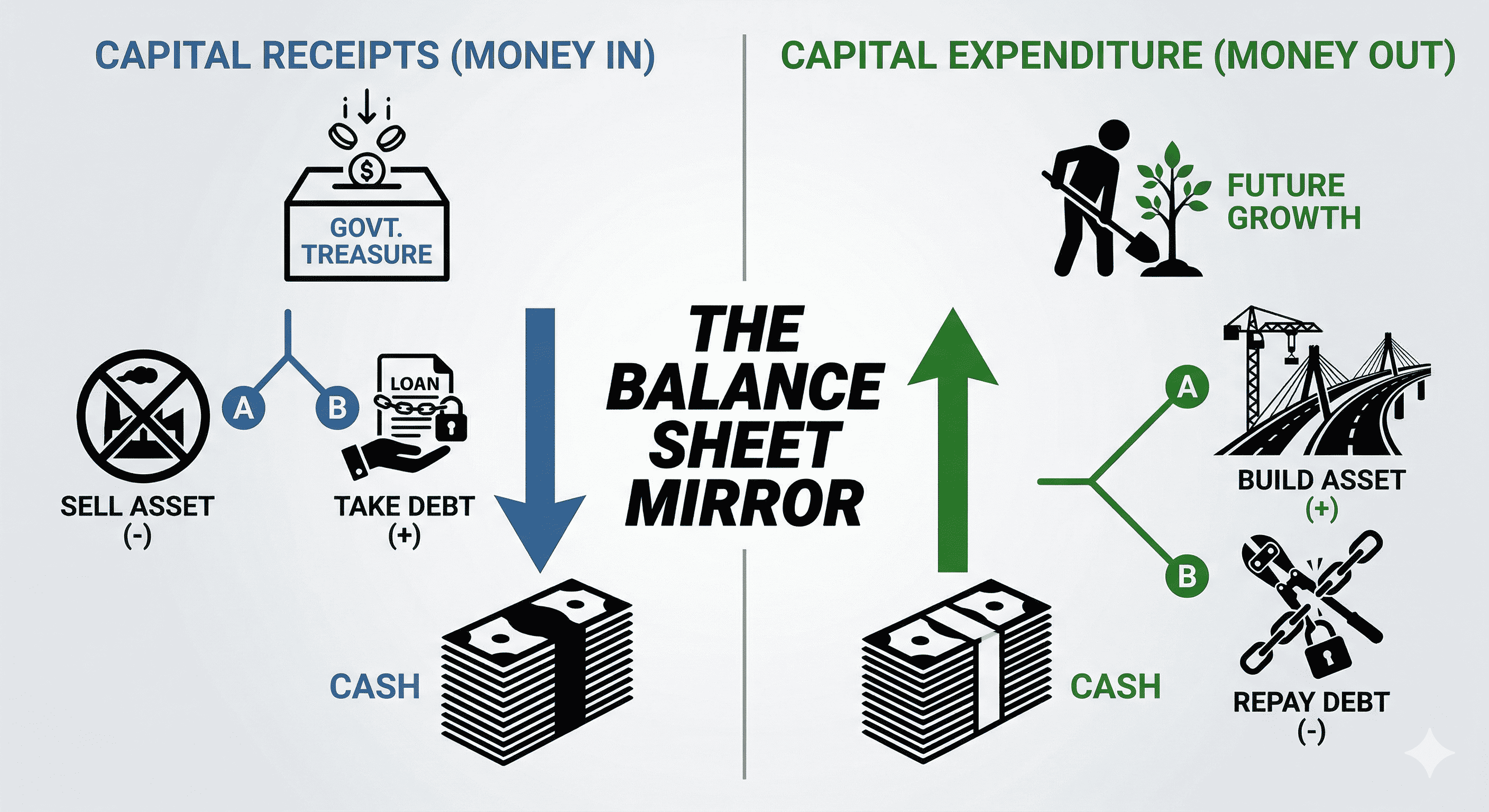
- Capital Receipt
- Money the government receives
- Mainly by raising capital - borrowing, loans, disinvestment
- Capital Expenditure
- Money the government spends
- Mainly for creating capital (assets) - roads, buildings, machines, infrastructure
- Context:
- Capital receipts provide funds for infrastructure, debt repayment, and investments, crucial for economic growth and fiscal stability. Capital expenditure drives development through asset creation (e.g., highways, hospitals) and financial investments, aligning with initiatives like Atmanirbhar Bharat and Gati Shakti.
- Significance for India:
- Effective management of capital receipts and expenditure enhances infrastructure, boosts economic productivity, and reduces fiscal deficits. Strategic disinvestment and monetization policies under Modi’s regime optimize public sector resources, fostering private sector participation and economic efficiency.
- Capital Receipts
- Definition:
- Capital receipts are funds that increase the government’s liabilities (e.g., borrowings) or reduce its assets (e.g., disinvestment). They are categorized into debt and non-debt receipts.
- Types of Capital Receipts:
- Capital Debt Receipts:
- Internal Borrowing:
- Funds raised from domestic sources like RBI, banks, NBFCs, small savings schemes (e.g., Post Office Savings Accounts, Kisan Vikas Patra), and Provident Funds (e.g., EPFO, PPF).
- External Borrowing:
- Loans from foreign countries and institutions like IMF, World Bank, and BRICS Bank, typically in foreign currencies (e.g., USD, Euro).
- Capital Non-Debt Receipts:
- Disinvestment:
- Proceeds from selling government shares in Public Sector Undertakings (PSUs) or Central Public Sector Enterprises (CPSEs).
- Loan Principal Recovered:
- Repayments of principal (not interest) from loans given by the Union to states, foreign countries, or public sector companies.
- Why the loan principal recovered does not come under capital expenditure, as it is an asset for the government?
- Anything that brings cash in = Receipt
- Foreign Borrowing in Foreign Currency
- Introduction:
- In Budget 2019, Finance Minister Nirmala Sitharaman announced that India’s sovereign external debt-to-GDP ratio is low (~5%), allowing the government to raise part of its borrowing from external markets in foreign currencies (e.g., USD, Euro).
- Arguments in Favor:
- Reduces Crowding Out:
- Domestic borrowing reduces funds available for private corporates. External borrowing frees up domestic capital for private sector growth, enabling factory expansion, job creation, and GDP growth.
- Lower Interest Rates:
- Advanced economies (e.g., USA, EU) offer lower interest rates, making foreign loans cheaper than domestic ones.
- Manageable Debt Levels:
- India’s low external debt ratio suggests that moderate foreign borrowing is unlikely to cause significant fiscal strain.
- Arguments Against:
- Exchange Rate Risk:
- A weakening rupee (e.g., $1 = Rs. 60 to Rs. 70) increases the repayment burden in rupees, making loans more expensive than anticipated.
- Risk of Over-Borrowing:
- Future governments may excessively borrow abroad to fund populist schemes, risking a debt crisis if the rupee depreciates significantly.
- Alternative Approach:
- Increasing foreign investment limits in Government Securities (G-Secs) in INR attracts foreign capital without currency risk, preferable to borrowing in foreign currency.
- Conclusion:
- While foreign borrowing can reduce domestic crowding out and leverage low global interest rates, the exchange rate risk and potential for over-borrowing outweigh benefits. Economists like Raghuram Rajan advocate caution, suggesting more deliberation before expanding foreign currency borrowing.
- Foreign/External Borrowing Data
- Economic Survey 2023:
- Most of India’s external debt is in INR, minimizing currency risk.
- Data (in Rs. Crore):
-
| Year |
External Debt |
| 2022–23 |
37,124 |
| 2023–24 |
24,832 |
| 2024–25 |
32,000 |
| 2025–26 |
23,500 |
- Significance:
- India’s external borrowing remains low relative to GDP, reducing fiscal vulnerability. The decline in 2025–26 reflects cautious borrowing strategies.
- Disinvestment
- Definition:
- Disinvestment involves the government selling its shareholding in Public Sector Undertakings (PSUs) or Central Public Sector Enterprises (CPSEs) to raise funds, typically retaining at least 51% ownership to maintain control.
- Types of Government-Owned Entities:
- Departmental Undertakings:
- Directly managed by ministries (e.g., Railways, Postal Services). No separate legal entity, high ministerial interference, audited by CAG.
- Statutory Corporations:
- Created by specific Acts (e.g., RBI, LIC, SBI, EPFO). Some have internal audits, excluding CAG. Moderate operational flexibility.
- Government Companies (CPSEs):
- Registered under the Companies Act with ≥51% government shareholding (e.g., Coal India, NTPC). Audited by CAG-empaneled private auditors, higher operational flexibility.
- Objectives:
- Promote public welfare through affordable services, develop infrastructure, ensure regional balance, and prevent economic concentration in private hands.
- Challenges:
- Political interference, lack of innovation, employee union resistance, and loss-making operations hinder efficiency.
- CPSE vs. PSU vs. PSB
- Public Sector Banks (PSBs):
- Banks with majority government shareholding (e.g., SBI, PNB).
- Central Public Sector Enterprises (CPSEs):
- Government companies under the Companies Act with ≥51% Union shareholding, excluding PSBs, public sector insurance companies, and NBFCs (e.g., ONGC, SAIL).
- Public Sector Undertakings (PSUs):
- Collective term for all government-owned entities, including CPSEs, PSBs, and state/local government companies.
- Ratna Companies
- Definition:
- Ratna status, granted by the Department of Public Enterprises (DPE, shifted to Finance Ministry in 2021), provides operational autonomy to high-performing CPSEs (not PSBs, statutory corporations, or private companies).
- Categories and Conditions:
- Miniratna (Category I & II):
- CPSEs with continuous profits for three years, subdivided based on profit levels (e.g., NHPC, Mazagaon Dock).
- Navratna:
- Miniratna or other CPSEs meeting criteria like manpower cost ratios (e.g., Hindustan Aeronautics, Bharat Electronics).
- Maharatna:
- Navratna CPSEs with ≥Rs. 5,000 crore annual profit for three years, listed on stock exchanges, and significant global presence (e.g., Coal India, NTPC).
- Benefits:
- Autonomy in hiring, acquisitions, and decision-making without government approval for minor decisions.
- Examples (as of 1/1/2020):
- Miniratna:
- National Film Development Corporation, WAPCOS.
- Navratna:
- Oil India, Container Corporation.
- Maharatna:
- Bharat Petroleum, GAIL, ONGC.
- Government Policy Towards Disinvestment (Pre-2021)
- Disinvestment:
- Reducing government shareholding in CPSEs while retaining ≥51% to maintain control.
- Privatization/Strategic Disinvestment:
- Selling ≥50% shareholding with management control transfer, as defined by DIPAM.
- Historical Developments:
- 1951:
- First Constitution Amendment Act allowed nationalization by imposing restrictions on private industries for public interest.
- 1953:
- Air Corporations Act nationalized nine private airlines into Indian Airlines and Air India International.
- 1991:
- Interim Budget introduced disinvestment, with PM Narasimha Rao announcing shareholding reduction in government companies.
- 1998–99 (Vajpayee Era):
- No disinvestment in strategic sectors (e.g., railways, defense, atomic energy).
- Phased disinvestment in non-strategic sectors; established Department of Disinvestment (1999), privatizing Maruti Udyog, VSNL, etc.
- UPA-1 (2004–09):
- No disinvestment due to Leftist coalition pressure; focus on reviving sick government companies.
- UPA-2 (2009–14):
- Allowed disinvestment up to 49%, retaining 51% control. Proceeds went to National Investment Fund (NIF) for bank recapitalization, metro rail, etc.
- Launched CPSE-Exchange Traded Funds (ETFs).
- Arguments for Disinvestment:
- Private investors enhance efficiency, innovation, and autonomy.
- Proceeds fund welfare schemes and reduce fiscal deficits.
- Arguments Against:
- Risks MNC monopolies, worker exploitation, and job losses.
- Disinvestment & Privatization in Modi Raj (2014–)
- Methods of Disinvestment:
- Initial Public Offerings (IPOs):
- Converting private limited CPSEs to public companies (e.g., IRCTC, RVNL).
- Exchange Traded Funds (ETFs):
- CPSE-ETF, Bharat-22-ETF for diversified share sales.
- Institutional Placement Programme (IPP):
- Shares offered to non-retail investors (e.g., institutions).
- Offer for Sale (OFS):
- Shares sold to both retail and non-retail investors.
- Share Buyback:
- CPSEs buy back government-held shares, reducing government shareholding.
- Key Actions:
- Closed loss-making CPSEs (e.g., HMT Watches, Hindustan Photo Film).
- 2016:
- Renamed Department of Disinvestment to Department of Investment and Public Asset Management (DIPAM).
- Privatization Examples:
- Budget 2022:
- Neelanchal Ispat Nigam Limited (NINL) privatized.
- Economic Survey 2023:
- 10 CPSEs privatized, including HPCL, REC, Air India.
- 2024:
- Ferro Scrap Nigam Limited (FSNL) sold to a Japanese company for Rs. 320 crore.
- New Public Sector Enterprise (PSE) Policy (2021)
- Strategic Sectors:
- Atomic energy, space, defense, transport, telecom, power, petroleum, coal, minerals, banking, insurance, financial services.
- Policy:
- Retain at least one government company; others may be merged, privatized, or closed.
- Non-Strategic Sectors:
- All other sectors (e.g., manufacturing, hospitality).
- Policy:
- All government companies to be privatized or closed.
- Terminology:
- NITI Aayog prefers “strategic disinvestment” or “strategic sale” over “privatization” to avoid political backlash.
- Disinvestment Targets (Previous Budgets)
- Data (in Rs. Crore):
-
| Budget Year |
Target |
Achieved |
| 2018–19 |
80,000 |
Yes |
| 2019–24 |
Big targets |
Not achieved |
| 2023–24 |
50,000 |
33,000 |
| 2025–26 |
47,000 |
Pending |
- Analysis:
- Consistent underachievement reflects challenges like market conditions, political opposition, and valuation disputes.
- National Monetisation Pipeline (NMP, 2021)
- Definition:
- A government initiative to monetize assets of CPSEs, National Highways, and Railways by selling, renting, or leasing land, buildings, or machinery to raise Rs. 6 lakh crore by 2025.
- Objectives:
- Mobilize funds for infrastructure development, reduce fiscal burden, and enhance asset efficiency.
- Examples:
- Leasing railway stations, toll roads, or CPSE land to private entities.
- Related Topics:
- National Investment and Infrastructure Fund (NIIF).
- National Infrastructure Pipeline (NIP) and Gati Shakti initiative (refer to Pillar 5).
- National Land Monetization Corporation (NLMC, 2022)
- Definition:
- Established under the Finance Ministry to monetize surplus land and non-core assets of CPSEs and government departments.
- Objectives:
- Optimize land use, generate revenue, and support NMP goals.
- Functions:
- Identify, value, and monetize (sell/lease) surplus land (e.g., unused PSU land for commercial development).
- Note:
- Refer to Pillar 2A1 for details on Finance Ministry departments.
- Minimum Dividend Rule (2024–Nov)
- What is dividend?
- Dividend is a portion of a company’s profit distributed to its shareholders. It's different from capital appreciation of shares.
- It is like the monthly rent you collect from a tenant while you still own the house. You get the cash, and you still own the property and property price appreciates meanwhile
- It is not legally necessary for a company to pay a dividend. Whether to pay a dividend or not is a business decision made by the company's Board of Directors.
- Policy:
- Finance Ministry mandates CPSEs (e.g., ONGC) and government NBFCs (e.g., LIC, Power Finance Corp) to pay ≥30% of profits as dividends to shareholders, including the government.
- Exclusions:
- Public Sector Banks (e.g., SBI, PNB) not explicitly covered, as per available data.
- Significance:
- Ensures steady revenue for the government, supporting fiscal consolidation.
- Note:
- Additional conditions related to net worth apply but are not critical for memorization due to low cost-benefit for UPSC.
- Capital Expenditure
- Definition:
- Capital expenditure involves government spending to create long-term assets or reduce liabilities, such as infrastructure projects, loan repayments, or investments in PSUs.
- Notable Components:
- Capital Assets:
- Expenditure on buildings, vehicles, and equipment for schemes, ministries, and departments.
- Debt/Equity Financing:
- Investments in PSUs, foreign institutions, or loans to state/foreign governments.
- Loan Principal Repayments:
- Repaying principal for internal and external debts (interest payments are revenue expenditure).
- Indian Development and Economic Assistance Scheme (IDEAS):
- Managed by the Department of Economic Affairs (DEA), provides loans to foreign nations for development projects.
- State CAPEX Loans
- Special Assistance to States for Capital Expenditure (CAPEX Scheme):
- Introduced in 2020, provides interest-free, 50-year loans to states for capital projects (e.g., health, rural development, water supply, irrigation, power, transport, education, urban development).
- Budget 2020:
- Allocated ~Rs. 12,000 crore.
- Budget 2025:
- Increased to Rs. 1.5 lakh crore.
- Linked Reforms (Budget 2023):
- Scrapping old government vehicles to reduce emissions.
- Urban planning reforms to improve city infrastructure.
- Strengthening urban local bodies to issue municipal bonds.
- Housing for policemen to enhance security infrastructure.
- Constructing Unity Malls to promote regional products (refer to Pillar 3A).
- Libraries and digital infrastructure for children and adolescents.
- Significance:
- Enhances state-level infrastructure, promotes fiscal federalism, and aligns with national development goals.
- Effective Capital Expenditure
- Definition:
- Effective capital expenditure includes direct Union capital expenditure and grants-in-aid to states for capital projects, reflecting the total capital investment impact.
- Significance:
- Measures the government’s contribution to asset creation and economic growth, critical for infrastructure development and job creation.
- Note:
- Detailed explanation available in referenced video lectures, focusing on budget allocations and economic impact.
- Capital Expenditure for a Company
- Definition:
- Capital expenditure by a company involves investments in income-generating assets, categorized as tangible or intangible.
- Types of Assets based on tangibility:
- Tangible Assets:
- Land, buildings, vehicles, equipment, raw materials, unsold inventory.
- Intangible Assets:
- Patents, copyrights, brand logos, trade secrets (e.g., KFC recipe), licenses (e.g., telecom spectrum), investments in shares/bonds, client databases, accounts receivable, goodwill, website domains.
- Types of Assets based on other parameters:
- Current Assets:
- Short-term assets like cash, inventory.
- Financial Assets:
- Investments in shares, bonds.
- Fixed Assets:
- Long-term assets like buildings, equipment.
- Pillar 2D2: Deficits and Fiscal Policy
- Introduction:
- Deficits occur when government expenditure exceeds its receipts, impacting fiscal stability and economic growth. Understanding types of deficits, their financing, and related policies is crucial for assessing India’s fiscal health and compliance with the Fiscal Responsibility and Budget Management (FRBM) Act, 2003.
- Various types of deficits:
- Budget Deficit
- Definition:
- Excess of total expenditure (revenue and capital) over total receipts (revenue and capital), excluding borrowings.
- Since 1997–98, the Union Budget has ceased reporting budget deficit, focusing instead on fiscal deficit.
- Types of Budget based on deficit
- Surplus Budget:
- Occurs when government receipts (revenue and capital) exceed expenditure, allowing debt repayment or reserve creation.
- Balanced Budget:
- Receipts equal expenditure, ensuring no borrowing is required.
- Deficit Budget:
- Expenditure exceeds receipts, necessitating borrowing to bridge the gap.
- Fiscal Deficit
- Definition:
- Excess of total expenditure over total receipts, excluding borrowings. It represents the amount the government must borrow to meet its financial obligations.
- Formulas:
- Tamilnadu Textbook:
- Fiscal Deficit = Budget Deficit + Borrowings (internal, RBI, external).
- NCERT Textbook:
- Fiscal Deficit = Total Expenditure – (Revenue Receipts + Non-Debt Creating Capital Receipts).
- Alternatively:
- Difference between total expenditure and total receipts, excluding borrowings.
- Note:
- Sukhmoy Chakravarti Committee (1997–98) emphasized fiscal deficit as a key indicator.
- Example Data (Budget 2025):
- Fiscal Deficit Target:
- 4.5% of GDP (as per 15th Finance Commission recommendation).
- Different forms of fiscal deficit:
- Gross Fiscal Deficit (GFD):
- Definition:
- Excess of total government expenditure over total non-debt receipts in a financial year.
- Formula:
- GFD = Total Expenditure - Revenue Receipts - Non-Debt Capital Receipts
- Meaning:
- Total borrowing requirement of the government in that year.
- Includes borrowing from:
- Market loans
- Treasury bills
- External loans
- Small savings, etc.
- Net Fiscal Deficit (NFD):
- Definition:
- Fiscal deficit after subtracting net lending by the government.
- Formula:
- NFD = Gross Fiscal Deficit - Net Lending
- Where:
- Net Lending = Loans given by government − Loan recoveries
- Meaning:
- Actual borrowing need after adjusting for loans given onward by government.
- Note:
- RBI is listed separately in formulas per NCERT, despite being domestic, for clarity in source differentiation.
- Primary Deficit
- Definition:
- Fiscal Deficit minus interest payments on previous loans, indicating borrowing for new programs rather than servicing past debt.
- Formula:
- Primary Deficit = Fiscal Deficit - Interest Payments
- Significance:
- High interest payments from accumulated debt increase borrowing needs, creating a vicious cycle. Primary deficit isolates borrowing for current expenditures.
- Introduced:
- 1993 Budget Speech by Finance Minister Manmohan Singh.
- Example Data (Budget 2025):
- Primary Deficit Target:
- Shifted to 0% by 2022–23, not achieved due to COVID-19.
- Different forms of primary deficit:
- Gross Primary Deficit (GPD)
- Definition:
- Gross Fiscal Deficit minus net interest liabilities.
- Formula:
- Gross Primary Deficit = Gross Fiscal Deficit - Interest Payments
- Net Primary Deficit (NPD):
- Net Fiscal Deficit minus net interest liabilities.
- Formula:
- NPD = Net Fiscal Deficit - Interest Payments
- Revenue Deficit
- Definition:
- Excess of revenue expenditure (e.g., salaries, subsidies, interest payments) over revenue receipts (e.g., taxes, non-tax revenue).
- Formula:
- Revenue Deficit = Revenue Expenditure – Revenue Receipts.
- Significance:
- High revenue deficit forces borrowing for operational expenses, reducing funds for capital expenditure (e.g., schools, hospitals), hindering human development and economic growth.
- Different forms of revenue deficit:
- Effective Revenue Deficit
- Definition:
- Revenue Deficit minus grants-in-aid to states/local bodies used for capital asset creation (e.g., panchayat buildings, disaster management infrastructure).
- Formula:
- Effective Revenue Deficit = Revenue Deficit - Grants for Capital Asset Creation
- Introduced:
- Budget 2011 by Finance Minister P. Chidambaram.
- Significance:
- Adjusts revenue deficit to account for productive expenditure, providing a clearer picture of non-productive borrowing.
- Fiscal Glide
- Definition:
- Gradual reduction in fiscal deficit over time to achieve economic stability without abrupt cuts.
- Example:
- Budget 2018:
- Finance Minister Arun Jaitley aimed for a 3% fiscal deficit by 2020–21, likened to a glider descending smoothly. Temporarily relaxed in 2020 due to structural reforms (FRBM trigger).
- Fiscal Drag
- Automatic increase in tax burden due to inflation and rising incomes, even when tax rates don’t change.
- Fiscal drag is sometimes called a built-in stabilizer, because during inflationary booms it automatically pulls money out of the economy without new policy action.
- Mechanism:
- Income rises -> tax bracket rises -> more tax -> government revenue rises automatically
- Effects on economy
- Acts like a contractionary fiscal force
- Reduces consumption demand
- Increases government revenue without changing tax rates
- Can slow growth if too strong
- Extra-Budgetary Resources (EBR)
- Definition:
- Loans raised by public sector undertakings (PSUs) or government entities, repaid from the Union Budget, often bypassing immediate fiscal deficit calculations.
- Examples:
- Food Corporation of India (FCI) borrowing from National Small Savings Fund (NSSF) for food subsidies (discontinued in Budget 2021).
- Data (in Rs. Crore):
-
| Fiscal Year |
EBR Amount |
| 2020–21 |
148,000 |
| 2021–22 |
121,000 |
| 2022–23 & 2023–24 |
0 |
- Criticism:
- 15th Finance Commission and Economic Survey 2020 criticized EBR for reducing transparency, as they escape media scrutiny, parliamentary debate, and audits.
- Debt Composition
- Amount-Wise (Economic Survey 2022, in Rs. Lakh Crore):
-
| Category |
2019–20 |
2020–21 |
2021–22 |
| Internal Debt |
80 |
99 |
115 |
| External Debt |
5 |
6.15 |
6.59 |
| Public Debt (Internal + External) |
85 |
105 |
121 |
| Other Liabilities (e.g., Small Savings) |
13 |
12 |
12 |
| Extra-Budgetary Resources |
1.12 |
1.39 |
1.39 |
| Total Liability |
99 |
117 |
134 |
- Type-Wise:
- Union vs. State Debt:
- Economic Survey:
- States (70%), Union (30%).
- Kerala Petition (Supreme Court):
- States (40%), Union (60%).
- Union Debt Breakdown:
- Internal (94%), External (6%).
- Repayment Currency:
- Mostly Rupee, minimal foreign currency.
- Interest Type:
- Fixed (95%), Floating (5%, e.g., tied to LIBOR).
- Tenure:
- Mostly long-term.
- Debt-to-GDP Ratio:
- External Debt:
- <3% of GDP.
- Total Public Debt:
- Declined since 2003, stable since 2011, among the lowest in G20, OECD, and BRICS.
- Note:
- Marketable debt
- Government's dated securities (G-Sec) and Treasury Bills, issued through auctions. Investor can easily resell it in secondary market
- Majority of Govts internal debt is marketable debt.
- Non-marketable debt
- Special types of securities/bonds issued by Union Govt to EXIM Bank and other All India Financial Institutions (AIFI), State Govts etc. It's difficult or sometimes not possible to re-sell such securities/bonds in the secondary market.
- External Debt
- Borrowed from other nations and multilateral institutions such as IMF, World Bank, ADB etc.
- At present Govt of India doesn't borrow directly from the International Capital Market.
- Negative Consequences Of Financing the Deficit:
- Methods and Issues:
-
| Method |
Issues |
| Increasing Taxes |
May lead to tax evasion or reduced work motivation (Laffer Curve). |
| Borrowing |
Ricardian Equivalence, crowding out, lower sovereign ratings. |
| Printing Money (Monetization) |
Hyperinflation, reduced purchasing power. |
- Ricardian Equivalence Proposition (REP) theory:
-
-

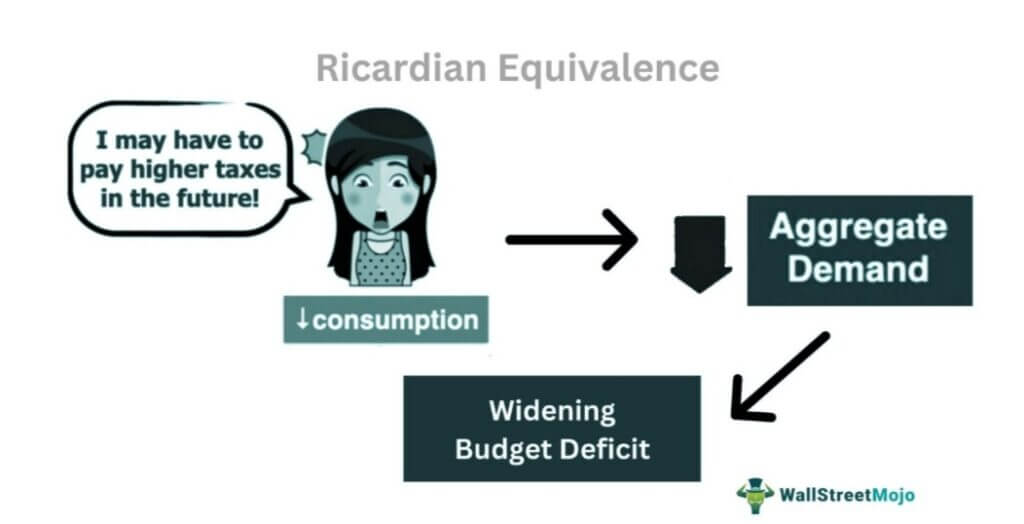
- The Ricardian Equivalence Proposition (REP) is a sophisticated economic theory that suggests that the way a government chooses to finance its spending—whether through immediate taxes or borrowing (deficit)—has no actual effect on the overall economy.
- When the government spends by borrowing instead of taxing, people expect higher taxes in the future and save more now, so total spending in the economy does not increase.
- Theory:
- High fiscal deficit → Government borrows more → At maturity (G-Sec redemption), government must repay principal + interest → This may lead to future tax hikes.
- Anticipating this, rational citizens may increase savings and reduce consumption → Lower demand → Inventory buildup → Slows economic growth.
- Economist David Ricardo proposed this theory.
- Invalid for India (Economic Survey 2021):
- REP assumes people are rational, forward-looking, and understand future liabilities → Not always true in India.
- Reasons for invalidity:
- Citizens are not perfectly rational; decisions often influenced by emotional/personal needs (e.g., weddings, iPhones, foreign trips).
- High prevalence of tax evasion, black money, and a parallel economy → Not all citizens bear the tax burden equally.
- Large informal sector and financial illiteracy weaken the theoretical assumptions of REP in the Indian context.
- Crowding Out Effect:
-
- Concept:
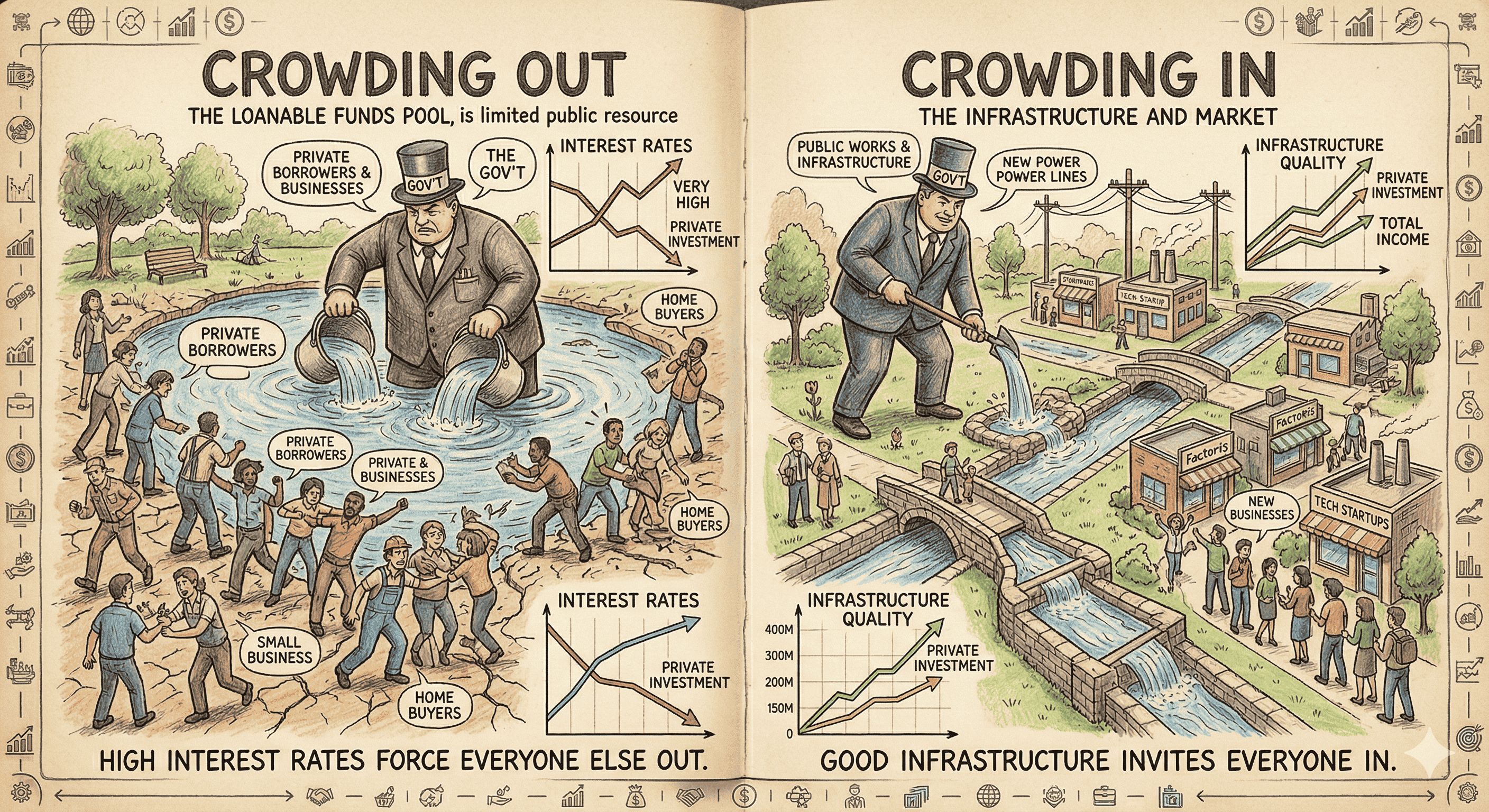
- When the government borrows heavily from households and financial institutions (LIC, EPFO, banks via SLR), less money is left for private corporate borrowers → Crowds out private investment → Slows factory expansion and job creation.
- Economists decided to use word “crowding out” because it sounded nicer than “financial elbowing.” by the government.
- Financial Repression:
- Forcing public institutions (e.g., SBI, LIC, EPFO) to buy G-Secs using depositors’ money → deprives households of optimal returns.
- Example: Govt forced NABARD to buy ₹15,000 crore Swachh Bharat Mission (Gramin) bonds (10-year maturity).
- Govt pressures RBI and others to pay higher dividends → reduces their operational freedom.
- ES21 Observations (1950s–1990s):
- Found some evidence of crowding out due to:
- Very high CRR and SLR → PSBs had limited loanable funds.
- Absence of large private banks.
- Low earnings and savings among public.
- Underdeveloped capital markets.
- ES21 Findings (Post-1990):
- No evidence of crowding out (1990–2019) due to structural changes:
- Economic growth ↑ → household income ↑ → savings ↑ → more money available to both govt and private borrowers.
- Rise in banking habits, NBFCs, mutual funds, and capital market participation.
- Demographic dividend → more working population → improved financial behavior.
- Implication:
- If govt borrowing is for productive infrastructure (health, education, transport, etc.), it raises GDP and incomes → boosts overall savings → the 'size of the dish' increases, so both govt and private sectors get enough funds.
- Thus, "crowding out" is less likely when savings are not fixed but expand with growth.
- Monetization of Deficit:
- When central bank prints more money to pay for government's loans → Monetizing the Deficit.
- It can result in hyperinflation and ↓↓ purchasing power of currency (if supply of goods like onion, tomato is not increased sufficiently). Example: Germany after Treaty of Versailles (1919).
- Therefore, Monetizing the Deficit is also called "inflating away of debt".
- FRBM Act prevents monetization of deficit with following provisions:
- RBI must not subscribe to G-Sec in primary market from 2006-07 onwards.
- Govt shall not borrow from RBI, except for Ways and Means Advances (WMA). [Refer: Pillar#1C]
- Fiscal Deficit ↑↑ = India Sovereign Rating ↓↓
-
| Rating | Description | Examples / Notes |
|---|
| Aaa |
Prime, highest quality |
e.g. US Treasury Bonds |
| Aa1 to Aa3 |
High grade |
Investment-grade upper medium |
| A1 |
Upper medium grade |
Investment-grade |
| Baa1 to Baa3 |
Lower medium grade |
India's rating in June 2020 reduced to Baa3 due to weak fiscal position and rising deficit |
| BA1 and lower |
Non-investment grade (junk) |
Junk status if downgraded further |
- Implications of junk status for India:
- Govt will need to offer higher interest on new G-Sec to attract investors.
- Foreign capital may flee India.
- Foreign investors may fear default by Indian govt → will sell G-Secs → capital flight.
- Capital flight → Dollar strengthens, Rupee weakens. (Refer: Pillar 3)
- However, ES21 said not to worry too much about it.
- Countercyclical Fiscal Policy
- Introduction and Historical Context:
- Historically, governments have used public spending during times of economic distress to provide employment and stimulate growth.
- In ancient economies, rulers invested in infrastructure like roads, canals, and public buildings during famines to create jobs.
- In modern macroeconomics, this principle is institutionalized as countercyclical fiscal policy.
- Definition:
- A countercyclical fiscal policy involves increasing public expenditure and/or reducing taxes during economic slowdowns, and reducing spending and/or increasing taxes during economic booms.
- The objective is to smoothen economic fluctuations, support aggregate demand, and maintain macroeconomic stability.
- How it Works:
- During Economic Slowdown (Recessionary Phase):
- Government increases capital and revenue expenditure.
- Objectives:
- Stimulate demand through infrastructure projects.
- Generate employment and raise household income.
- Boost private sector confidence and investment.
- Leads to Crowding-In effect:
- Increased government investment leads to complementary private sector activity.
- Example:
- Government constructs national highways → private sector builds logistics parks, fuel stations, hotels → more jobs and tax revenue.
- During Economic Boom (Expansionary Phase):
- Government reduces expenditure and increases savings.
- Objectives:
- Control inflationary pressures.
- Accumulate fiscal buffers (surpluses) to deploy during future downturns.
- Avoid overheating of the economy.
- Overheating of an economy refers to a situation where economic growth is unsustainably high, leading to inflationary pressures, resource shortages, and imbalances.
- Strategic Benefits:
- Ensures long-term fiscal sustainability.
- Enhances economic resilience to external shocks (e.g., global financial crises, pandemics).
- Improves sovereign credit ratings and investor confidence.
- Pro-cyclical Fiscal Policy:
- Opposite of countercyclical approach.
- Government increases expenditure during booms and cuts spending during slowdowns.
- Consequences:
- Amplifies economic volatility.
- Worsens inflation during booms and unemployment during recessions.
- Example:
- India’s historical fiscal stance has often been pro-cyclical, as highlighted by Economic Surveys.
- Real-World Examples:
- Chile:
- Uses a structural fiscal rule based on long-term copper prices to avoid pro-cyclicality.
- United States:
- Large fiscal stimulus packages during the 2008 Global Financial Crisis and COVID-19 pandemic.
- India:
- National Infrastructure Pipeline (NIP) and PM Gati Shakti are attempts to institutionalize countercyclical investment.
- Key Terminology:
- Crowding-In:
- When public investment encourages private sector investment.
- Fiscal Multipliers:
-
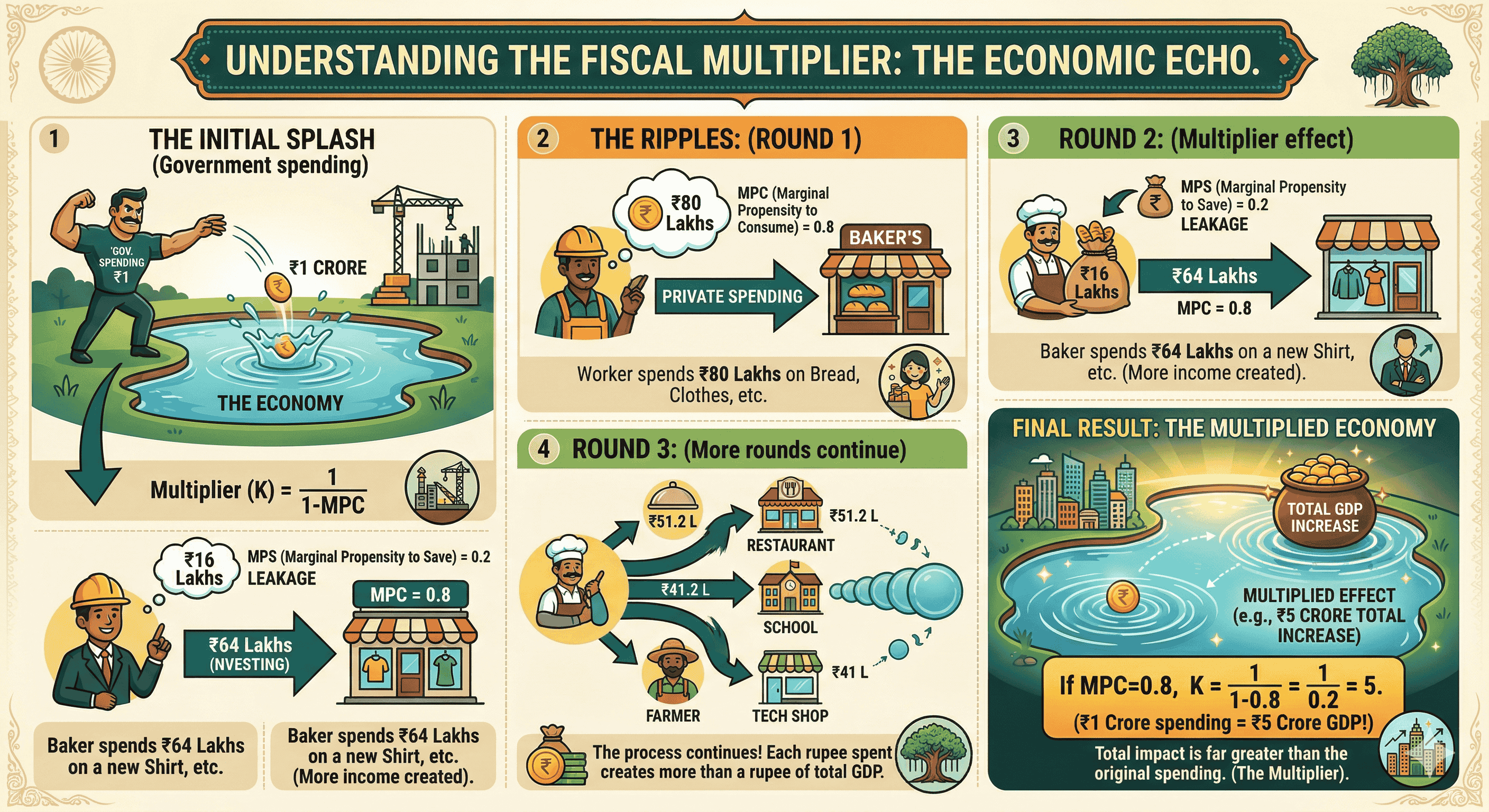
- Ratio of the change in national income to the initial change in government spending or taxation.
- Types
- Government spending multiplier
- Change in GDP due to change in government expenditure
- Tax multiplier
- Change in GDP due to change in taxes
- Usually smaller in absolute value than spending multiplier
- Transfer payment multiplier
- Based on change in government transfers (like subsidies, pensions)
- Interest Rate – Growth Rate Differential (IRGD) and Debt Sustainability
- Concept:
- IRGD measures the difference between the interest rate on government borrowing and the nominal GDP growth rate.
- Indicator of whether public debt is sustainable over the medium to long term.
- Formula:
- IRGD = Interest Rate – GDP Growth Rate
- If IRGD is negative (e.g., 6% – 9% = –3%), it indicates strong debt sustainability.
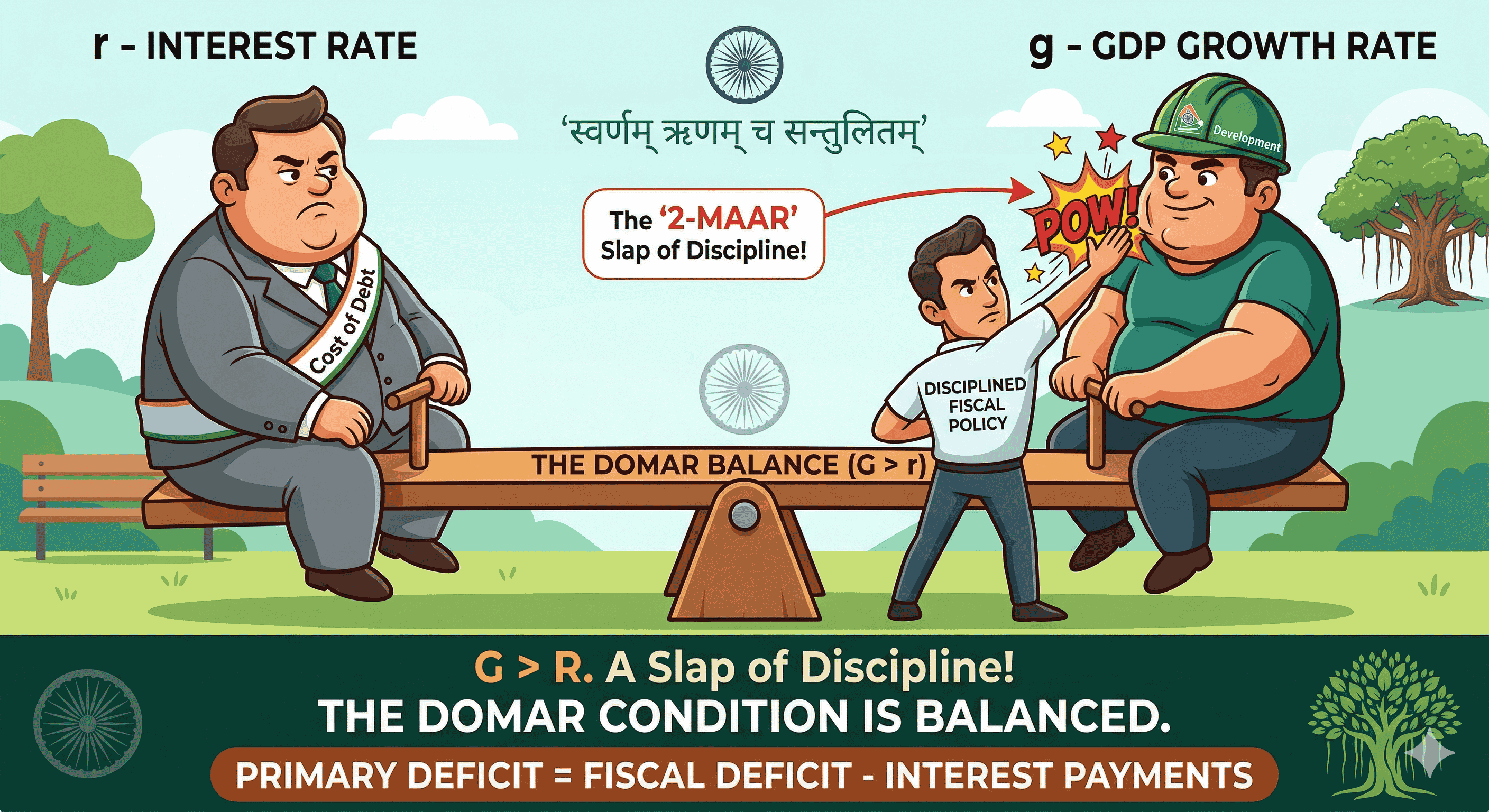
- Domar Condition of Debt Sustainability
-
- Concept Origin:
- Proposed by economist Evsey Domar in 1944.
- Provides a theoretical foundation for assessing long-term debt sustainability.
- Domar's Rule:
- If the growth rate of nominal GDP is higher than the interest rate on public debt, then public debt as a percentage of GDP will decline over time.
- Formula:
- If g > r → debt-to-GDP ratio stabilizes or declines.
- Where g = GDP growth rate, r = interest rate on debt.
- Implications:
- Countries with high GDP growth can afford higher deficits without increasing their debt burden.
- Countries with low growth need to either raise taxes or cut spending to maintain fiscal stability.
- Indian Scenario:
- India’s nominal GDP growth post-COVID recovery has remained higher than the average cost of borrowing.
- Indicates that fiscal expansion (within limits) can be sustainable if accompanied by growth-enhancing reforms.
- Additional concepts
- Automatic Stabilizers
- Definition:
- Mechanisms in the government budget that automatically increase spending or decrease tax liability during economic slowdowns without requiring changes in tax laws or parliamentary approval.
- Examples:
- Income tax, corporation tax, unemployment allowance, food subsidies, and government schemes targeting the poor/lower-middle class.
- Note:
- Countercyclical fiscal policy/fiscal stimulus requires new budgets/laws/parliamentary approval, making them discretionary stabilizers, not automatic.
- Disposable Income & Marginal Propensity to Consume (MPC):
- Disposable Income:
- Personal income minus personal income taxes; available for consumption and saving.
- MPC:
- Fraction of additional disposable income spent on consumption.
- In simple words:
- When your income increases, how much of that extra income you actually spend instead of saving. That share is called Marginal Propensity to Consume (MPC).
- Negative Tax multiplier:
- Increase in taxes reduces disposable income, decreasing consumption and GDP.
- Autonomous Expenditure Multiplier (AEM) & Government Expenditure Multiplier:
- Autonomous Expenditure Multiplier (AEM)
- Measures change in GDP/income/output due to change in autonomous spending (e.g., food, shelter, medicine, regardless of income level)
- Government Expenditure Multiplier
- Measures change in GDP/income/output due to change in government expenditure
- Balanced Budget Multiplier
- Measures change in GDP/income/output due to equal changes in taxes and government expenditure
- Effects of Budget/Fiscal Policy:
- Impacts demand (consumption) and savings through changes in taxes and government spending.
- Three Functions of Government Budget:
- Allocation
- Provides public goods not supplied by markets (e.g., national defense, police, roads, railways)
- Redistribution
- Collects taxes from the rich to fund welfare for the poor
- Stabilisation
- Increases spending during economic slowdowns to stabilize the economy (see counter-cyclical fiscal policy)
- Methods for Repaying Public Debt:
- Redemption (Terminal Annuity):
- Meaning:
- Refers to the repayment of both principal and interest at regular intervals.
- It concludes the debt obligation over time.
- Notes:
- Common in long-term borrowing arrangements.
- Ensures gradual reduction in outstanding liabilities.
- Sinking Fund:
- Meaning:
- A special fund created by the government wherein money is deposited regularly.
- At the time of maturity of Government Securities (G-secs), this fund is used to repay the debt.
- Significance:
- Reduces pressure on budget at the time of redemption.
- Enhances creditworthiness of the government.
- History:
- First introduced in England as a fiscal prudence measure.
- Conversion / Restructuring:
- Meaning:
- Old debt is replaced with new debt having modified terms such as lower interest rate or longer tenure.
- Example:
- Lowering the interest burden by converting old high-interest debt into new low-interest debt.
- Context:
- 2020:
- Zambia became the first African nation to default on Eurobond payments during the COVID-19 pandemic.
- Experts recommended restructuring for debt sustainability.
- Evergreening of Loans:
- Meaning:
- Taking a new loan to repay the old one.
- Risks:
- Creates a debt trap situation if repeated frequently.
- May hide the true fiscal health of the government.
- Repudiation:
- Meaning:
- Government refuses to acknowledge and repay its debt obligations.
- Example:
- After the Russian Revolution (1917), Lenin's regime repudiated the loans taken by the previous Czarist regime from Britain and France.
- Implication:
- Considered a poor strategy in modern economics.
- Leads to loss of investor confidence and denial of future credit.
- Fiscal Consolidation / Prudence
- Definition:
- Fiscal Consolidation refers to policies aimed at reducing government deficits and debt accumulation.
- It is primarily achieved by rationalizing expenditures and improving efficiency in revenue collection.
- Objectives:
- Reduce fiscal deficit.
- Improve macroeconomic stability.
- Control inflation.
- Maintain investor confidence.
- Prevent sovereign credit downgrade.
- Measures for Fiscal Consolidation:
- Reduction in Leakages:
- Targeted delivery of subsidies and welfare schemes via DBT (Direct Benefit Transfer).
- Implementation through the JAM Trinity:
- Jan Dhan Yojana
- Aadhaar
- Mobile connectivity
- Reduces pilferage and corruption in welfare distribution.
- Reduction in Subsidy Burden:
- Deregulation of Fuel Prices:
- Petrol deregulated in 2010.
- Diesel deregulated in 2013.
- Targeting LPG Subsidy:
- Since 2016, LPG-Pahal subsidy blocked for individuals with taxable income above ₹10 lakh.
- Phasing Out Kerosene Subsidy:
- In 2017, Oil Ministry instructed PSU oil companies to increase subsidised kerosene price by ₹0.25 every fortnight to eventually eliminate the subsidy.
- Closure of Loss-Making PSUs:
- Government shut down several consistently loss-making public sector units including:
- Hindustan Photo Films
- HMT Bearings
- HMT Chinar Watches
- Tungabhadra Steel
- Hindustan Cable
- HMT Watches
- Action began around 2014.
- Privatization of Loss-Making PSUs:
- Examples:
- Air India (disinvestment completed in 2022).
- IDBI Bank (stake sale ongoing).
- Expenditure Management Commission (2014–16):
- Headed by Bimal Jalan.
- Mandated to recommend institutional reforms for reducing non-essential expenditure.
- Suggested rationalizing subsidies and restructuring centrally sponsored schemes.
- Austerity Measures:
- Reduce non-essential government expenses to promote fiscal discipline.
- Examples:
- 2018:
- West Bengal Government issued austerity directives:
- Ban on flower bouquets, mementoes in public functions.
- Banned official meetings in private hotels.
- Restricted purchase of new cars, office renovations, air conditioning installations.
- Promoted use of video conferencing over travel.
- 2019:
- PM’s Cabinet Committee on Investment and Growth (CCIG) directed:
- 20% cut in non-essential expenses (travel, food, conferences) for Union ministries.
- 2021:
- Parliament canteen subsidy discontinued:
- Example:
- Masala dosa, earlier sold at ₹6, now sold at full market price.
- Estimated savings of ₹8 crore annually.
- Fiscal Stimulus
- Definition:
- Fiscal Stimulus refers to a government’s use of reduced taxes and/or increased public expenditure to boost economic demand and revive growth, especially during a slowdown or crisis.
- It involves direct intervention by the government to increase disposable income, create employment, and restore investor and consumer confidence.
- Key Mechanisms:
- Tax cuts to increase consumer and business spending.
- Increased government expenditure (capital and revenue).
- Direct cash transfers or subsidies.
- Credit guarantees and support to MSMEs.
- Fiscal Stimulus by Dr. Manmohan Singh (2008)
- Context:
- Triggered by the Global Financial Crisis (2007–08) originating in the US subprime lending market.
- India’s exports and industrial growth were adversely impacted.
- Key Measures:
- Reduction in excise duty and customs duty on exports.
- Tax concessions to industries purchasing new commercial vehicles (to support auto sector).
- Hike in Minimum Support Prices (MSPs) for key crops to boost rural demand.
- Outcome:
- Provided short-term relief to industry and rural sector.
- However, led to widened fiscal deficit in the following years.
- Raised concerns in Economic Surveys regarding sustainability and efficiency of blanket stimulus.
- Atma-Nirbhar Bharat Economic Stimulus Package (2020)
- Context:
- COVID-19 pandemic-induced nationwide lockdown.
- Economic disruption affected all sectors — from corporates to daily wage earners.
- Objective:
- Revive demand and supply chains.
- Provide liquidity and credit access.
- Promote self-reliance and structural reforms.
- Launch:
- Announced in May 2020 by the Prime Minister of India.
- Built on 5 pillars:
- Economy, Infrastructure, System, Demand, Vibrant Demography.
- Components and Allocations:
-
| Date | Component | Original Amount (₹ lakh crore) | As per Economic Survey 2021 (ES21) |
|---|
| 2020-Mar to May |
- RBI’s Monetary Measures (Ref: Pillar 1A2)
|
₹8 lakh crore |
₹13 lakh crore |
| 2020-Mar |
- PM Garib Kalyan Yojana (PMGKY)
- Direct transfers, free rations, LPG etc.
|
₹1.70 – 1.90 lakh crore |
₹17 lakh crore |
| 2020-May |
- Fiscal Measures by Finance Minister
- MSME credit guarantee, reduced TDS, Agri Infrastructure Fund, PM Matsya Sampada Yojana
|
~₹11 lakh crore |
Included above |
| Total Stimulus (as per Govt) |
₹20 lakh crore (~10% of GDP) |
| As per ES21 Methodology |
₹30 lakh crore (~15% of GDP) |
- Criticism and Evaluation:
- Claimed 10–15% of GDP as stimulus, but much of it was in form of credit guarantees and liquidity measures (not direct fiscal spending).
- Questions raised about actual fiscal push vs. accounting overlaps.
- Mixed reviews on how much it revived actual demand or accelerated recovery.
- Risks of Fiscal Stimulus
- Overheating of the Economy:
- Overheating of an economy refers to a situation where economic growth is unsustainably high, leading to inflationary pressures, resource shortages, and imbalances.
- Excess stimulus in low-supply environments can trigger inflationary pressures.
- Rising Fiscal Deficit:
- Short-term revival may come at the cost of long-term fiscal stability.
- Crowding Out:
- High government borrowing can reduce availability of credit to private sector.
- Global Investor Reaction:
- Ratings agencies may view rising deficit negatively, impacting India’s sovereign credit rating.
- Fiscal Responsibility & Budget Management Act, 2003 (FRBM Act)
- Overview:
- Enacted to control Union and State fiscal deficits with specific targets.
- Original Targets (by 2008):
- Fiscal Deficit:
- 3% of GDP (Union) or GSDP (States).
- Revenue Deficit:
- 0% of GDP/GSDP.
- Compliance:
- Some states achieved targets; Union governments struggled, leading to repeated amendments to extend deadlines.
- 2012 Amendment:
- Replaced 0% Revenue Deficit target with 0% Effective Revenue Deficit by 2015; deadlines further extended.
- Trigger Mechanism (Section 4(2)):
- Allows government to exceed deficit targets by up to 0.5% of GDP/GSDP under specific conditions (per NK Singh’s FRBM Review Committee):
- National security/act of war.
- National calamity.
- Collapse in agriculture output/farm incomes.
- Significant fall in real output/GDP growth rate.
- Structural reforms with unanticipated fiscal implications.
- State Application:
- States can exceed targets similarly but must amend their state FRBM Acts.
- Example:
- Budget 2020 cited structural reforms to escape FRBM targets for 2019-20 and 2020-21.
- Deficit Targets and Outcomes:
-
| Year | Fiscal Deficit Target (% of GDP) | Actual/Overcrossed (% of GDP) |
|---|
| 2019-20 | 3.3 | 3.8 |
| 2020-21 | 3.0 | 3.5 |
- Primary Deficit Target (0% for 2020-21):
- Shifted to 2022-23.
- Revenue Deficit/Effective Revenue Deficit:
- Abandoned as targets since 2018 amendment.
- 2020 Corona Crisis:
- Reduced government income and increased expenses led to unprecedented deficits.
- Budget 2021 Amendment:
- Fiscal Deficit:
- 6.8% (2021-22), 4.5% (2025-26, per 15th Finance Commission recommendation).
- Miscellaneous Concepts:
- Fiscal Glide Path:
- 2018:
- FM Jaitley promised gradual reduction of fiscal deficit to 3% by 2020-21.
- Continued by subsequent FMs; temporarily escaped in Budget 2020 via trigger mechanism.
- Fiscal Profligacy:
- Refers to reckless/wasteful public expenditure.
- Fiscal Slippage:
- Exceeding targeted fiscal deficit (e.g., crossing 3.3% of GDP).
- Miscellaneous Bodies
- Expenditure Management Commission (2014):
- Chaired by Dr. Bimal Jalan; suggested ways to reduce fiscal deficit and subsidy bill.
- Public Debt Management Agency (PDMA):
- Proposed but not established; shifted to Mains handout.
- Fiscal Council:
- Proposed but not established; shifted to Mains handout.
- Corona Ex-Gratia Yojana:
- Disaster Management Act, 2005 (Section 12):
- National Disaster Management Authority (chaired by PM) sets relief standards for disaster victims.
- Corona Notified as Disaster:
- PIL in Supreme Court demanded compensation for families of deceased.
- 2021 (Oct):
- SC ordered ₹50,000 per Corona death, straining government fiscal capacity.
- Required Documents:
- FRBM Act mandates Union Government to present with annual budget:
- Macroeconomic Framework Statement:
- Details GDP, growth rate, imports/exports, receipts, expenditure.
- Medium-Term Fiscal Policy Statement:
- Outlines deficit control strategies and potential deviations.
- Fiscal Policy Strategy Statement:
- Explains deficit management (combined with Medium-Term Fiscal Policy Statement in practice).
- Medium-Term Expenditure Framework:
- Not presented from Budget 2021-2025, citing Corona crisis.
- NK Singh FRBM Review Panel
- Background:
- Budget 2016:
- FM Jaitley found FRBM Act targets too rigid, limiting crisis response (e.g., farm loan waivers, unemployment allowances).
- Panel formed under NK Singh to review FRBM Act.
- Note:
- Recommendations outdated post-Corona; not followed, hence omitted.
- UPSC PYQs on NK Singh Report skipped for same reason.
- Fiscal Federalism - Helping the States in Atmanirbhar
- Tax Devolution and Grants:
- Despite reduced tax income during Corona, Union provided tax devolution and grants to states as per Budget and Finance Commission reports.
- States’ Fiscal Deficit Limits:
- Constitution Article 293:
- States require Union permission to borrow.
- Pre-Atmanirbhar:
- Net borrowing ceiling at 3% of Gross State Domestic Product (GSDP).
- Post-Atmanirbhar (2020-21):
- Increased to 5% of GSDP, with additional borrowing tied to reforms:
-
| Sr | Reform | Extra Borrowing (% of GSDP) |
|---|
| 1 | No conditions (un-tied) | 0.50 |
| 2 | One Nation One Ration Card System (Pillar#) | 0.25 |
| 3 | Ease of Doing Business Reform (Pillar#) | 0.25 |
| 4 | Urban Local Body/Utility Reforms | 0.25 |
| 5 | Power Sector Reforms (Pillar#5) | 0.25 |
| 6 | Any 3 of above reforms (2-5) | 0.50 |
- Total Extra Borrowing:
- ₹4.27 lakh crore for states.
- GST Compensation Option #1 (Back-to-Back Loans):
- States opting for this receive unconditional borrowing relaxation (see Pillar#2A: GST Compensation).
- Fiscal Deficit Targets for States:
-
| Year |
Fiscal Deficit (% of GSDP) |
| 2020-21 |
3% (increased to 5% as above) |
| 2021-22 |
4% + 0.5% (conditional, total 4.5%) |
| 2022-23 |
3.5% + 0.5% (power sector reforms, total 4%) |
| 2023-24 |
3% + 0.5% (power sector reforms, total 3.5%) |
- Notes:
- GSDP:
- Gross State Domestic Product.
- Power Sector Reforms:
- Refer to Pillar#5 (Energy Infrastructure).
- 2024-25 Targets:
- Not disclosed in Budget speech.
- Kerala State Deficit Issue:
- Union restricted Kerala from further borrowing due to high deficits; matter under Supreme Court review.
- Temporary payments were made to Kerala (e.g., ₹13,608 crore allowed), but the broader dispute — does the Centre have the power to cap state borrowing under Article 293 — is pending before that larger bench.
- Challenges to Fiscal Federalism and Public Finance:
- 1. Vertical Imbalance:
- Tax powers are concentrated with the Centre, but spending responsibilities are higher at the state level.
- Creates dependence of states on central transfers (Finance Commission, GST compensation, grants).
- Example:
- States have limited access to income tax or customs, but must fund health, education, etc.
- 2. Horizontal Imbalance:
- Fiscal capacity varies widely among states due to differences in resource endowment, development level.
- Richer states like Maharashtra generate more revenue, while poorer states depend more on transfers.
- 3. Delayed and Unpredictable Transfers:
- States face uncertainty in fund flows from Centre (e.g. GST compensation delays).
- Hinders planning and execution of welfare schemes and infrastructure projects.
- 4. GST-related Issues:
- States surrendered significant tax autonomy for GST.
- Delay in GST compensation and disputes on rate-setting dilute cooperative federalism.
- Centre has more control via GST Council decisions, reducing states’ fiscal flexibility.
- 5. Centrally Sponsored Schemes (CSS):
- Majority of CSS are designed and controlled by Centre.
- States bear part of the cost but have limited say in design/implementation.
- Reduces state autonomy and imposes strain on state finances.
- 6. Borrowing Constraints:
- FRBM Act limits fiscal deficit and borrowing of states.
- Centre also controls external borrowing by states.
- States’ ability to raise resources for development is curtailed.
- 7. Non-Devolution of Cesses and Surcharges:
- Cesses and surcharges collected by Centre are not shared with states.
- Their rising share in gross tax revenue reduces the divisible pool for states.
- Erodes the spirit of fiscal federalism.
- 8. Asymmetric Federalism:
- Special category status or special packages for some states leads to perceived inequities.
- Creates friction among states and raises questions on fairness and uniformity.
- 9. Institutional Weaknesses:
- Limited role of Inter-State Council or other cooperative bodies.
- Finance Commission recommendations are only advisory; implementation depends on Centre.
- Need for stronger fiscal federal institutions for dispute resolution and coordination.
- 10. Pandemic & Crisis-Induced Strain:
- COVID-19 exposed limits of states in mobilizing resources independently.
- States sought more borrowing space and timely GST dues.
- Widened Centre-state fiscal gap and trust deficit.
- 11. Climate Financing and New Mandates:
- New responsibilities on states (climate adaptation, SDGs) without matching fiscal support.
- Risk of fiscal stress and unmet development needs.
- 12. Politicization of Fund Allocation:
- Perception of bias in release of funds based on ruling party alignment with Centre.
- Undermines federal neutrality and fiscal accountability.
- Freebies/Revdi Culture
- Definition:
- PM Modi’s term for political parties’ unsustainable freebie promises to win elections.
- Criticism:
- Supreme Court criticized; urged Union to act.
- Note:
- Developing topic; to be revisited in Mains Course.
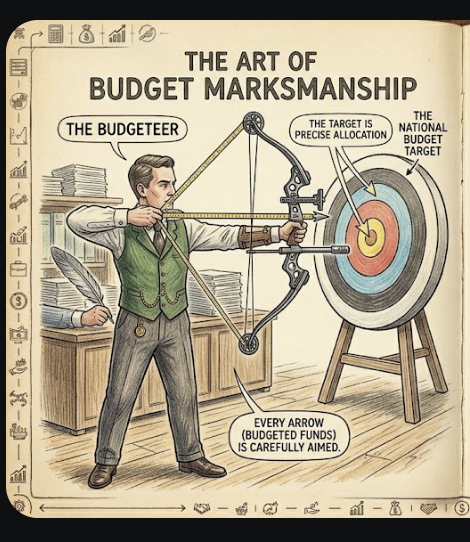
- Budget Marksmanship
-
- Definition:
- Ability to keep income and expenditure within budget targets.
- Performance (2019-20):
-
| Category | Budget Estimate (1/2/2019, ₹ Lakh Cr) | Revised Estimate (1/2/2020, ₹ Lakh Cr) | Actual (Post 31/3/2020, ₹ Lakh Cr) |
|---|
| Receipts (Taxes) | 16 | 15 | 13 |
| Expenditure (Revenue: Subsidies, Loan Interest, etc.) | 24.47 | 23.49 | 23.50 |
- Assessment:
- Poor marksmanship due to overestimated income to present a rosy picture.
- Consequences:
- Tax Terrorism/Litigation:
-
| Year | Direct Tax Dispute Amount (₹ Lakh Cr) |
|---|
| 2012 | <3 |
| 2020 | ~10 |
- Ad-hoc Expenditure Management:
- Excessive reliance on extra-budgetary resources.
- Random cuts in scheme expenditure.
- Delayed contractor payments, leading to substandard construction quality.
- Pillar 2D3: Types of Budget and Schemes
- Types of budgets
- On the basis of revenue and capital
- Revenue Budget:
- Covers short-term (1 year or less), non-asset-creating income and expenditure.
- Includes:
- Taxes, non-tax revenue (e.g., fees, dividends), and revenue expenditure (e.g., salaries, pensions, subsidies, interest payments).
- Capital Budget:
- Covers long-term, asset-creating income and expenditure.
- Includes:
- Borrowings, disinvestment proceeds, and capital expenditure (e.g., infrastructure, machinery, financial assets like bonds).
- On the basis of sectoral and administrative coverage
- Classification
- Railway Budget
- The Railway Budget was a separate annual financial statement showing the estimated receipts and expenditures of Indian Railways for a financial year. It is now merged with the General Budget (since 2017).
- General Budget
- The General Budget is the annual financial statement of the government showing estimated receipts and expenditures of all ministries and departments for a financial year.
- Historical Context:
- 1920–21:
- Acworth Committee recommended a separate Railway Budget due to railways’ significant revenue contribution during British rule.
- 1924:
- Separation Convention formalized this practice.
- Post-independence, the Railway Budget was presented before the General Budget.
- Merger (2017):
- Modi government merged the Railway Budget with the General Budget, based on NITI Aayog’s Bibek Debroy Committee recommendations:
- No constitutional requirement for a separate budget.
- Populist measures (e.g., low fares) during coalition governments eroded railway profitability.
- Railway revenue became a small fraction of the General Budget, not justifying separate presentation.
- Impact:
- Streamlined budgeting, reduced populism, and aligned railway finances with national fiscal goals.
- On the basis of planning
- Classification:
- Plan Expenditure:
- Linked to Five-Year Plans (e.g., development projects).
- Non-Plan Expenditure:
- Routine expenses (e.g., salaries, maintenance).
- Discontinuation (Budget 2017):
- Modi government ended the distinction due to:
- No constitutional mandate.
- Dissolution of the Planning Commission (2014–15).
- End of the 12th Five-Year Plan (2012–17).
- Impact:
- Simplified budget presentation, focusing on revenue and capital classifications.
- Budgeting Methods
-
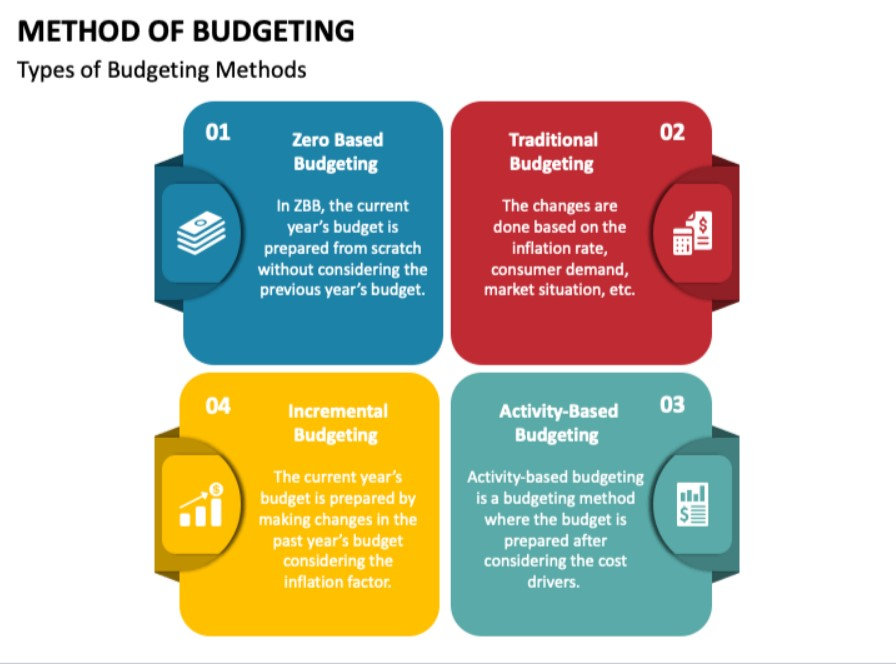
- Traditional/Line-Item Budgeting:
- Focuses on listing income and expenditure without evaluating benefits (e.g., Rs. 10,000 for hospital beds).
- Lacks performance measurement.
- Performance Budgeting:
- Ties expenditure to measurable outcomes (e.g., Rs. 50,000 for computers to achieve 30% faster RTI processing).
- Enhances cost-benefit analysis and efficiency.
- Zero-Based Budgeting (ZBB):
- Requires departments to justify all expenditure from scratch, not incrementally (e.g., reviewing education schemes’ effectiveness before reallocation).
- Prevents automatic budget increases.
- Sunset Budgeting:
- Schemes have predefined deadlines (e.g., a subsidy for two years), ensuring automatic termination unless renewed.
- Gender Budget
- Definition:
- A statement within the General Budget (since 2005) highlighting allocations for women-centric schemes, though not constitutionally mandated.
- Structure (Budget 2025):
- Parts:
- Part A:
- 100% women-focused schemes (e.g., SAMBAL, SAMARTHYA under Women and Child Development Ministry) – >Rs. 1 lakh crore.
- Part B:
- Schemes with at least 30% allocation for women (e.g., school education) – >Rs. 3 lakh crore.
- Part C (since Budget 2024–July):
- Schemes with less than 30% for women (e.g., PM-KISAN, Rs. 6,000 to farmers) – >Rs. 16,000 crore.
- Total:
- >Rs. 4 lakh crore.
- Criticism:
- Three-part system (introduced in 2024) accused of data manipulation to exaggerate women-focused spending.
- Tribal Sub-Plan (TSP) and Scheduled Castes Sub-Plan (SCSP)
- Definition:
- Since the 1970s, ministries must earmark funds for Scheduled Castes (SC) and Scheduled Tribes (ST) within their budgets.
- Monitoring:
- SCSP:
- Social Justice Ministry via e-utthaan.gov.in.
- TSP:
- Tribal Affairs Ministry via stcmis.gov.in.
- Additional Allocations:
- Budget documents also include allocations for children and North Eastern Areas (not constitutionally required).
- Output-Outcome Framework for Schemes
- Introduced:
- Budget 2017.
- Purpose:
- Tracks scheme outlays, outputs (deliverables), and outcomes (impact), monitored by NITI Aayog.
- Example:
-
| Ministry/Scheme |
Outlay |
Output |
Outcome |
| MEITY/PMGDISHA |
Rs. 400 crore |
Computer training for 5 crore rural persons |
Increased digital literacy in rural areas |
- Cash vs. Accrual Budgeting
- Cash budgeting records transactions when cash changes hands; accrual budgeting records when obligations are incurred.
- Lapsable Funds and March Rush
- Definition:
- Appropriation Act allows spending from the Consolidated Fund of India within one financial year (ending March 31). Unspent funds lapse and require fresh parliamentary approval.
- March Rush:
- Departments rush to spend funds in March to avoid lapse, often leading to inefficient or reckless expenditure.
- Mitigation (2017–18):
- Finance Ministry capped fourth-quarter spending at 33% and March spending at 15% of annual budget to curb wasteful spending.
- Non-Lapsable Funds
- Definition:
- Funds that do not lapse on March 31, usable without fresh parliamentary approval (e.g., Nirbhaya Fund for women’s safety).
- Criticism:
- Lax utilization; e.g., Nirbhaya Fund (2013) had ~Rs. 3,000 crore by 2018, with less than 50% utilized.
- 2018:
- Defence Ministry’s request for a non-lapsable modernization fund rejected due to utilization concerns.
- 15th Finance Commission:
- Recommended Modernisation Fund for Defence and Internal Security (MFDIS) of Rs. 2.38 lakh crore (2021–26).
-
| Fund |
Purpose |
Issue |
| Nirbhaya Fund |
Women’s safety |
Underutilization |
| MFDIS |
Defence modernization |
Recommended by 15th FC |
- Types of Schemes
- Classification:
- Centrally Sponsored Schemes (CSS):
- Shared funding between Union and States.
- Central Sector Schemes:
- Fully funded by the Union.
- Union Territory Schemes (without legislature):
- 100% Union-funded.
- Management:
- Disbursed and monitored via Public Financial Management System (PFMS) by Controller General of Accounts (CGA), Department of Expenditure.
- Budget 2022 CSS Rationalization:
- Reduced CSS from 130 to 65 to eliminate duplication and improve efficiency.
- Examples:
- Stopped:
- National Dairy Plan-II, Dairying Through Cooperatives.
- Merged:
- Women and Child Development Ministry:
- 19 schemes merged into Mission Shakti, Mission Vatsalya, Saksham Anganwadi, and POSHAN 2.0.
- Agriculture Ministry:
- 20 CSS merged into Krishionati Yojana, Integrated Scheme on Agricultural Cooperative, Rashtriya Krishi Vikas Yojana.
- Impact:
- Reduced subsidy burden and fiscal deficit through better monitoring.
- Result-Based Financing
- Description:
- Shifts from input-based financing (funding inputs like materials) to result-based financing (funding tied to outcomes, e.g., 15 km road constructed daily or 80% skill trainees employed).
-
| Financing Type |
Description |
Impact |
| Input-Based |
Funds inputs (e.g., materials) |
Lacks outcome focus |
| Result-Based |
Funds tied to outcomes |
Enhances accountability |