- The contemporary period in world history
- Meaning of "Contemporary"
- In general use:
- Modern / present-day / current
- In historical or academic use:
- Events or developments that happened in the recent past or are still ongoing
- As a noun:
- Someone who lived at the same time as someone else.
- Contemporary history refers to the period of history that is closest to the present day, typically covering events from the mid-20th century onward—often from the end of World War II (1945) to the current time.
- History: Meaning, Scope, and Contemporary Relevance
- Meaning and Definition of History
- The word ‘History’ comes from the Latin word Historia, meaning *knowledge through enquiry, research, exploration, and information.
- In German, it is called Geschichte, which refers to an intelligible and significant narrative of past events.
- Droysen’s View:
- History is mankind’s knowledge of itself, its self-awareness.
- Nature and Purpose of History
- History as a Science:
- It is the science of res gestae (human actions in the past).
- Lord Acton’s View:
- History provides a unique opportunity to record the fullness of knowledge useful to the greatest number of people.
- Impact on Human Intelligence:
- Understanding history has contributed to human progress, shaping beliefs, morals, and socio-economic-political structures.
- Writing of History: Approaches and Challenges
- Since Herodotus and Thucydides, history has been written in different ways for different purposes.
- Lynn Thorndike’s Perspective:
- For some, history is literature.
- For others, it is about facts.
- Some see it as an explanation of the present, while others see it as a revelation of the past.
- Will Durant’s Caution:
- Compressing centuries into a few pages is a hazardous task.
- The need arose to narrow down history into a more contemporary framework, shaping modern historiography.
- Croce’s View:
- All history is contemporary history.
- Voltaire’s Contribution:
- He coined the term ‘philosophy of history’.
- Collingwood’s Two Approaches to History:
- A special study of a specific problem.
- A contrast between new historical truths and old doctrines.
- Contemporary History: Definition and Scope
- The goal of writing contemporary history is to analyze historical developments that have shaped the 20th century.
- Earlier, these topics were part of broader subjects like:
- History of Modern Europe
- History of International Relations
- Key Questions in Contemporary History:
- How is contemporary history different from modern history?
- What are its specific features?
- Major Themes in Contemporary History
- Causes of the Disintegration of the ‘Old World’ → Emergence of the ‘New World’
- Covers World History from World War I onwards, including:
- The interwar period.
- Paris Peace Conference & Treaties.
- Rise of Fascism and Nazism.
- Cold War (1945–1991) – Conflicts between Communist and Capitalist blocs.
- Collapse of the Soviet Union & Yugoslavia → Unipolar world order.
- Defining the Boundaries of Contemporary History
- Where does contemporary history begin?
- It starts where modern history ends.
- It records events within the historian’s lived experience.
- Barraclough’s Definition:
- Contemporary history begins when present-day problems first take visible shape.
- How far back can we trace contemporary history?
- French historiography:
- Still finds unresolved issues from the French Revolution (1789) in De Gaulle’s France.
- Historians generally agree that contemporary history starts from World War I due to:
- Rise of nationalist movements (especially in the Third World).
- Decline of Western dominance (Spengler’s ‘Decline of the West’).
- Formation of international organizations (League of Nations, United Nations).
- Growth and collapse of totalitarian ideologies (Fascism, Nazism, Communism).
- Rise of science, technology, and Cold War bipolarity.
- Transition from bipolar to unipolar world post-1991.
- Economic challenges, terrorism, fundamentalism, and global crises.
- Conclusion
- Contemporary history is the study of world events from World War I to the present.
- Historians widely agree that the rise of the modern world must form the essential backdrop for understanding contemporary history.
- Contemporary History: Definition and Scope
- Refers to recent historical events with ongoing effects.
- Covers primarily the 20th century and beyond.
- Unlike earlier periods that become general history, it evolves with the present.
- Meaning and Interpretations
- Fontana Dictionary of Modern Thought (1950s)
- Defines it as the history of the last seventy years.
- In France, it includes events since 1789.
- Oxford English Dictionary (1961)
- Defines “contemporary” as belonging to the same time, age, or period.
- Cambridge International Dictionary of English (1995)
- Describes contemporaries as people living in the same period.
- The Relative Nature of Contemporary History
- Contemporary history is fluid; what is contemporary today may become general history tomorrow.
- A.J.P. Taylor
- Historians must constantly update knowledge as history moves forward.
- Describes contemporary history as “recording events while they are still hot.”
- Geoffrey Barraclough
- The concept emerged post-1918 to explain the failures of World War I.
- Debates on the Validity of Contemporary History
- Some historians question whether contemporary history can be truly objective.
- Concerns exist about the lack of crucial documents for recent events.
- Some argue it is not distinct from modern history due to historical continuity.
- Others claim it should be treated as a separate phase, like medieval and modern history.
- Modern History vs. Contemporary History
- Complexity and Scope
- Contemporary history is more complex than modern history.
- It requires diverse skills and interdisciplinary approaches.
- Modern history is more systematic, with well-documented data and clear interpretations.
- Challenges of Objectivity in Contemporary History
- Historians are influenced by their own time and perspectives.
- Different historians interpret events differently (e.g., collapse of the Soviet Union).
- A contemporary historian is often emotionally or politically involved in the events they study.
- Example: Historians differ in their views on American intervention in Iraq.
- Detachment vs. Involvement
- Modern historians write with detachment, as they are not participants in the events.
- Contemporary historians are often participants, making it hard to remain unbiased.
- Example: Writing about the Gulf War is difficult without taking a stance.
- Hindsight vs. Uncertainty
- Modern historians benefit from hindsight (understanding of an event after it has happened)—they know what happens after an event.
- Contemporary historians do not have this advantage and often struggle to determine the reasons behind events.
- Example: A historian studying the Spanish Civil War knows its long-term consequences, but a contemporary historian lacks such clarity.
- Availability of Source Material
- Modern history has abundant documented sources.
- Contemporary historians rely on limited non-classified materials such as:
- Reports, articles, surveys, statistics, and censuses.
- Oral testimonies, including interviews and verbally transmitted knowledge.
- Reliability of oral sources is a concern.
- Selection of Data in a Globalized World
- Contemporary historians face difficulties selecting relevant data.
- In a globally interconnected world, historical events are more complex.
- Contemporary history raises more questions than it answers, leaving room for further research.
- Overlap Between Modern and Contemporary History
- The transition from modern to contemporary history varies by region:
- World History: Modern history ended around 1945 (end of World War II, decolonization).
- Japan: Modern history begins with the Meiji Restoration (1868).
- China: Starts with the Opium Wars (1839-42).
- Europe: Begins with the French Revolution (1789).
- India: Traced back to the arrival of European trading companies.
- Contemporary history focuses only on recent events.
- The Case for Contemporary History as a Separate Field
- Some historians argue that contemporary history is fundamentally different from modern history.
- Key Question: How far back should contemporary history go?
- Example: The origins of World War I could be traced to 1900, 1890, or even 1870.
- Contemporary history should begin from events that have distinctly shaped the modern world.
- Understanding Contemporary History
- Elasticity and Relativity of Contemporary History
- Contemporary history is flexible and ever-changing.
- What is contemporary today may not be so for future generations.
- For some, it begins after World War II, while others may not consider post-1945 years as history yet.
- Challenges in Defining Contemporary History
- It is often mistaken for a commentary on current affairs.
- Many accounts focus excessively on Cold War events.
- Unlike other periods, it does not just track industrial expansion but highlights contrasts, such as the difference between the 18th-century Industrial Revolution and 20th-century industrial developments.
- Key Structural Changes in the Modern World
- The emergence of the US and Soviet Union as superpowers.
- The collapse of imperialism in Britain, France, and Holland.
- The rise of independent Asian and African nations, reshaping global relations.
- Methodological Differences from Traditional History
- Traditional historians start in the past and move forward.
- Contemporary historians begin in the present and look back for explanations.
- For example, a historian studying 19th-century Europe may link events to the 1815 Vienna Settlement.
- A contemporary historian would instead analyze the global system and its historical roots.
- The Provisional Nature of Contemporary History
- Some argue it is speculative and assumption-based.
- However, it identifies long-term influences on modern life.
- Understanding today’s events requires deep knowledge of historical precedents.
- For example, US foreign policy today can be traced back over a century.
- Post-Modernism as a Feature of Contemporary History
- Post-modernism has shaped contemporary thought since the 1980s.
- It influences art, literature, fashion, technology, and more.
- It emphasizes multiplicity and fluidity in social, political, and economic spheres.
- The rise of religious fundamentalism is sometimes seen as a post-modern reaction to established systems.
- The Role of the Contemporary Historian
- They balance historical facts with present-day values.
- Unlike historians of earlier periods, they can only hypothesize about consequences.
- They have access to vast data, but its quality may vary.
- Their goal is to identify structural changes shaping the modern world.
- The Significance of Contemporary History
- Civilization is a continuous movement, not a fixed destination.
- Contemporary history applies comparative analysis rather than moral judgments.
- It shares methods with traditional history but focuses on present applications.
- Asking the right questions is more important than finding definitive answers.
- Faith in contemporary history reflects faith in the future of society.
- The Dynamic View of Contemporary History
- Phases of Contemporary History
- The dynamic view of contemporary history begins at the end of the 19th century.
- This period saw rising tensions, culminating in World War I (1914–1918).
- Key events included:
- The Russian Revolution (1917)
- The entry of the United States into the war
- The interwar period played a crucial role in shaping the modern world.
- It bridged the decline of the old world order and the emergence of a new one.
- The post-World War II era marked the onset of the bipolar world order.
- It lasted until the Cold War ended in 1991.
- In the 21st century, a new global order is now emerging.
- Limitations in Early Historical Perspectives
- Before 1914, contemporary history lacked a universal theory.
- Dominant Western historians held a Eurocentric view, limiting broader analysis.
- Post-1914 history focused more on current affairs than on international politics.
- Key pre-World War II developments were often analyzed from a local or regional perspective:
- The Bolshevik Revolution
- Fascism in Italy and Nazism in Germany
- Britain’s Policy of Appeasement
- Disarmament debates
- Historians also took a legalistic and moralistic approach to contemporary events.
- Despite these limitations, institutionalized international relations and global law introduced a degree of idealism.
- Until 1939, contemporary history revolved around three key themes:
- International law
- Political reformism
- Diplomatic history
- The Shift in Focus Post-1945
- After World War II, contemporary history broadened its scope to study the real factors shaping international relations.
- Several developments led to this shift:
- End of colonialism
- Advances in science and technology
- Emergence of new nations with new values
- Economic interdependence
- Demographic changes
- Rise of transnational ideologies
- Growing influence of international organizations
- Contemporary history thus became more holistic, incorporating these diverse elements.
- The Industrial Revolution and Contemporary History
- A common belief persists that the late 18th century marked the beginning of the technical and industrial age.
- This was a natural consequence of the Industrial Revolution.
- The 19th century is often viewed as having a contemporary character due to these far-reaching changes.
- Major Events Reshaping Contemporary History
- In the late 20th century, a series of transformative events dramatically altered historical perspectives:
- The fall of the Berlin Wall (1989)
- The reunification of Germany
- The collapse of the Soviet Union (1991)
- These events marked the end of the bipolar world order and reinforced the importance of contemporary history.
- New Challenges and the Changing Nature of Conflicts
- The 20th and 21st centuries have witnessed shifting global conflicts:
- National interest conflicts remain the primary cause of tensions.
- The emergence of new states and threats of external subversion add complexity.
- The nuclear arms race and failed arms-control efforts heighten risks.
- Superpower politics, non-state actors, fundamentalism, and terrorism challenge traditional approaches to history.
- However, the threat of nuclear war discourages direct military conflicts.
- The global balance of power remains uneven, yet international organizations play a critical role in maintaining peace.
- Contemporary history now focuses on how nations navigate these challenges to ensure peaceful coexistence.
- Beginning of the modern age
- Defining the Transition Between Historical Periods
- Historians do not universally agree on a specific date or event that separates medieval from modern history or modern from contemporary history.
- The identification of when modern history began is largely a matter of convenience.
- Generally, modern history is associated with activities and customs that feel more familiar to us today compared to ancient ones.
- Most historians agree that between the 14th and 16th centuries, Europe underwent significant political, social, and economic transformations.
- These changes marked the beginning of what is now considered the modern period.
- The Renaissance: A Rebirth of Civilization
- The term Renaissance literally means rebirth and refers to the surge of intellectual and artistic energy that marked Europe’s transition from the medieval to the modern era.
- However, the Renaissance was not just a cultural movement—it embodied a unique “Renaissance spirit” that transformed political, economic, and religious aspects of life.
- These transformations played a crucial role in shaping the modern world in the following centuries.
- Economic and Commercial Developments
- Growth in trade and commerce, along with urban expansion in Italy, Germany, France, and England, led to the decline of feudalism and the manorial economy.
- Unlike the medieval era, where land was the primary measure of wealth, the Renaissance saw money become the new standard of prosperity.
- Towns and cities around the Mediterranean Sea played a vital role in expanding commerce within and beyond Europe.
- European traders established connections with wealthy nations like India and China.
- Influence of Eastern Civilizations
- Marco Polo was one of the first Europeans to extensively travel across Asia, providing firsthand knowledge of Asian civilizations.
- Interaction with Eastern civilizations reignited European interest in their own Greco-Roman heritage.
- This knowledge, preserved for centuries in the Arabian and Byzantine Empires, gradually made its way back into Europe, fueling the Renaissance movement.
- Meaning and Phases of the Renaissance
- Meaning
- The term Renaissance means rebirth, but it did not signify rediscovering lost knowledge.
- Medieval scholars were familiar with Roman works but lacked access to Greek writings.
- Phases
- Early Phase: Focused on reviving classical learning through traditional methods.
- Later Phase: Marked by innovation, generating new knowledge that shaped modern thought.
- Role of Printing
- Printing helped spread ideas across regions, enabling intellectual debates.
- Renaissance scholars recovered lesser-known classical works alongside famous ones.
- Greek scientific and philosophical treatises became accessible through Latin translations.
- Shift in Thinking
- Scholars used classical texts in new ways to challenge old ideas.
- Rational thinking and scientific inquiry replaced medieval religious perspectives.
- Society became less ecclesiastical (relating to christian church or it's clergy) compared to the Middle Ages.
- Origins and Spread of the Renaissance
- Timeline and Spread
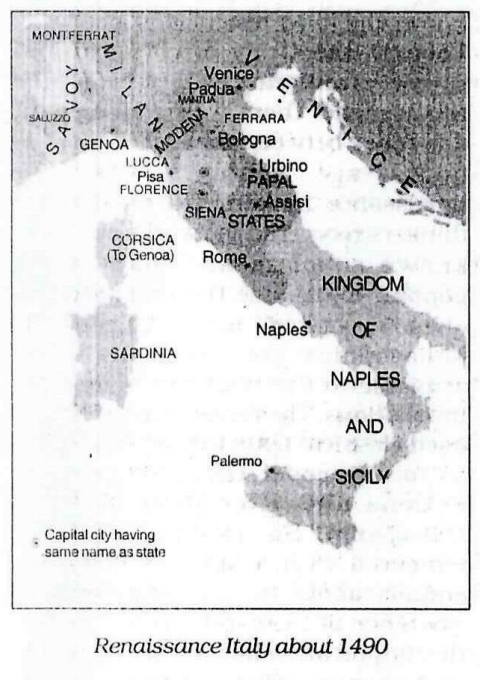
- The Renaissance began in Italy (1300–1550) and spread to Northern Europe (16th century).
-
- Reasons for Italy as the Birthplace
- Geographical Advantage
- Italy was a gateway between East and West, allowing the exchange of ideas.
- Cities like Venice, Genoa, Milan, Pisa, and Florence traded with Asia, fostering economic and cultural vibrancy.
- Political and Economic Structure
- Mercantile cities grew into powerful city-states.
- Unlike northern Europe, Italian aristocrats lived in cities and participated in public affairs.
- The bourgeoisie (merchant class) sought aristocratic status.
- The Medici family of Florence rose from banking to aristocracy.
- Growth of Education
- Merchant families valued education for trade and politics.
- Demand for reading, accountancy, and rhetoric led to skilled educators.
- Scholars produced political, ethical, and literary works.
- Classical Heritage
- Italy had a strong connection to ancient Rome.
- Roman monuments and Latin literature reinforced cultural identity.
- Patronage of Art and Literature
- Wealthy cities competed in building monuments and supporting artists and writers.
- Influential families like Visconti, Sforza, Medici, Este, and Gonzaga were major patrons.
- The Papacy in Rome promoted art and literature, making Rome a cultural center.
- Key Figures of the Early Renaissance
- Dante Alighieri (1265–1321)
- Famous for The Divine Comedy (Hell, Purgatory, Heaven).
- Explored Christian beliefs alongside astronomy, geography, and geology.
- Giotto di Bondone (1266–1336)
- Florentine School painter who established painting as an independent art form.
- Francesco Petrarch (1304–1374)
- Leader of the humanist movement.
- Famous for Petrarchan Sonnets (a poem of 14 lines using formal rhyme schemes), widely imitated in the Renaissance.
- Rise of Humanism
- Meaning of Humanism
- A broad interest in humanity, known as humanism, emerged.
- Humanism had three meanings:
- General interest in human virtues, genius, and sensitivity.
- Specific focus on literature, arts, history, and philosophy.
- Special emphasis on classical knowledge.
- Classical Humanists
- Petrarch is considered the earliest Renaissance humanist.
- Scholars recovered Latin texts and expanded Greek studies.
- Byzantine scholars fleeing Constantinople (1453) helped spread Greek learning.
- Lorenzo Valla (1407–1457)
- Greatest classical scholar of his time.
- Proved the Donation of Constantine (a document justifying Papal power) was a forgery.
- Rewarded by the Pope for his expertise in textual criticism.
- Political and Philosophical Developments
- Neo-Platonism
- Between 1450–1600, scholars blended Plato’s philosophy with Christian thought.
- Niccolò Machiavelli (1469–1527)
- Pioneered modern political thought.
- In The Prince, he described political power as it truly operated, rather than through moral ideals.
- The Renaissance transformed art, science, education, and politics, laying the foundation for modern Europe.
- Achievements of Italian Renaissance Art
- Among the numerous achievements of the Italian Renaissance, the most widely visible are in the realm of art. Of all the great art forms, painting was undoubtedly supreme.
- During this period, schools of painting such as the Florentine and Venetian developed and flourished.
- The Florentine School
- The Florentine School reached its peak with three great masters: Leonardo da Vinci, Raphael, and Michelangelo.
- Leonardo da Vinci (1452–1519)
- Embodied the Renaissance ideal of the universal man.
- Renowned as one of the greatest painters of all time.
- A polymath, excelling in painting, engineering, and biology.
- His inventions anticipated airplanes, submarines, and cars.
- Advocated scientific experimentation and dissected corpses to study anatomy.
- His approach to painting emphasized accurate imitation of nature.
- Famous works:
- Mona Lisa – a masterpiece of realistic portraiture.
- The Last Supper – a three-dimensional fresco in Milan, capturing intense human emotions.
- Raphael (1483–1520)
- Excelled in craftsmanship and Florentine artistic traditions.
- Studied anatomy and classical architecture to enhance his compositions.
- Famous for his tender depiction of Madonna.
- Notable work:
- The School of Athens – a fresco portraying Plato, Aristotle, and ancient philosophers, emphasizing classical wisdom.
- Michelangelo (1475–1564)
- A painter, sculptor, architect, and poet.
- Used the human body in sculpture to express universal ideas and emotions.
- Famous sculptures:
- David – symbolizing human strength and beauty.
- Moses – showcasing dramatic intensity.
- Achieved his pinnacle as a painter with the Sistine Chapel ceiling in Rome:
- One of the largest frescos in the world, containing over 300 heroic figures.
- Each figure is unique yet harmonized into a dramatic unity.
- The Venetian School
- Unlike the Florentine painters, Venetian artists focused on sensory appeal rather than philosophical or psychological themes.
- Titian (1488–1576)
- Most creative and representative figure of the Venetian School.
- Master of color, light, and texture in painting.
- Renaissance Architecture in Italy
- The architecture of the Italian Renaissance was a revival of the Roman style, leading to the term Romanesque.
- St. Peter’s Basilica, Rome
-
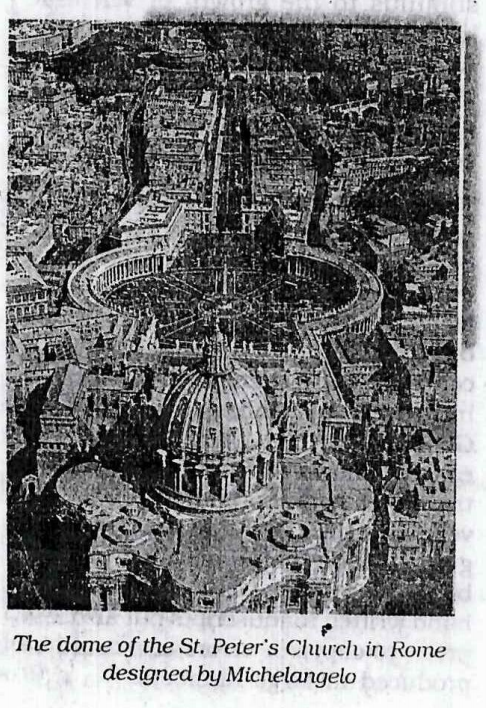
- The most splendid representation of Renaissance architecture.
- Built under the patronage of Pope Julius II and Pope Leo X.
- Originally designed by Donato Bramante.
- The dome was later redesigned by Michelangelo, adding to its grandeur.
- The Renaissance period marked an unparalleled transformation in art and architecture, blending classical inspiration with new techniques that shaped Western artistic traditions for centuries.
- Spread of the Renaissance to Northern Europe
- By the 15th century, the Italian Renaissance had spread to other European countries, leading to the rise of the Northern Renaissance.
- Key Figures of the Northern Renaissance
- Desiderius Erasmus (1466–1536)
- The central figure of the Northern Renaissance.
- A renowned scholar-publicist, known as the “Prince among Humanists.”
- Combined literary and scholarly pursuits with deep religious devotion.
- Notable Work:
- The Praise of Folly – a satirical critique of different social classes, exposing their corruption and immorality while emphasizing the simple teachings of the Gospels.
- Sir Thomas More (1478–1535)
- Close friend of Erasmus, second only to him in humanist distinction.
- Notable Work:
- Utopia – described an ideal society on an imaginary island, highlighting the abuses and injustices of his time.
- Architecture in Northern Europe
- The Gothic style dominated Northern European architecture.
- Characterized by:
- Pointed arches
- External buttresses
- Large windows
- Notable Structures:
- Reims Cathedral, France
- Louvre Museum, France
- Renaissance Music
- Music, along with painting and sculpture, became a brilliant aspect of Renaissance creativity during the 15th and 16th centuries.
- Musical Innovations
- Development of polyphony – a technique that harmonized multiple individual melodies.
- Introduction of new musical instruments, such as:
- Violin
- Double bass
- Lute
- Harpsichord
- Role of Music in Society
- Paid musicians and singers became an integral part of churches and court life.
- Folk songs and music entered mainstream European culture.
- The Northern Renaissance not only embraced humanism and artistic achievements but also made remarkable contributions to architecture and music, shaping European culture for centuries.
- Scientific Inventions of the Renaissance
- The Renaissance not only revolutionized art, literature, and philosophy but also stimulated scientific knowledge, leading to groundbreaking discoveries that transformed the Western world.
- Printing Press
- The most significant invention of the period was the printing technology.
- Origins:
- 12th century – Arabs introduced movable printing techniques from China (developed in the 11th century).
- 14th century – Johannes Gutenberg (Germany) improved the technique.
- First Printed Works:
- Papal letters of indulgence (satisfaction/fulfillment/state of being)
- A version of the Bible
- Impact of Printing:
- Books became cheaper than handwritten manuscripts.
- Reduced copying errors.
- Allowed mass production of books, leading to the spread of knowledge.
- Advances in Medicine
- The invention of printing enabled the wide publication of medical books with anatomical illustrations, advancing medical skills.
- Dissection and Anatomy
- Partial lifting of the 13th-century ban on human dissection led to direct observation of the human body.
- Universities of Padua and Ferrara became renowned for medical studies.
- Key Figures:
- Andreas Vesalius – published On the Structure of the Human Body, based on human dissection.
- Gabriello Fallopio – conducted early studies on the human fetus and described the fallopian tube.
- Pharmacology and Surgery
- Paracelsus (Swiss physician):
- Challenged Galen’s theory that disease was caused by imbalances in bodily fluids.
- Proposed chemical remedies for specific diseases.
- Ambroise Paré (French surgeon):
- Revolutionized surgery by developing stitches to seal blood vessels, replacing the painful hot iron cauterization method.
- Astronomy
- The Renaissance era brought major breakthroughs in the understanding of the cosmos.
- Copernican Revolution
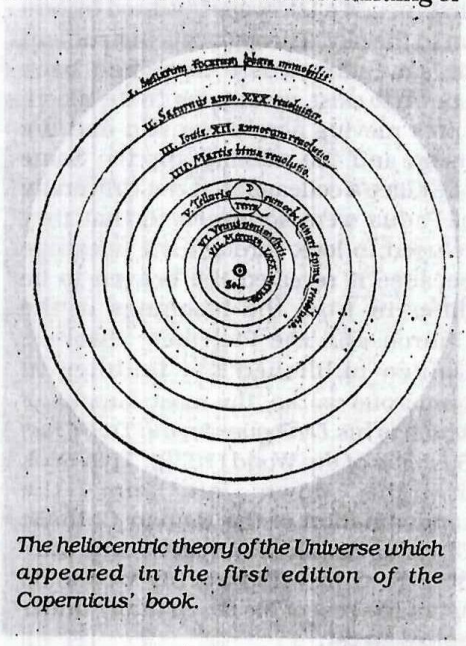
- 1543 – Nicolas Copernicus (Poland) published Six Books Concerning the Revolutions of the Heavenly Spheres.
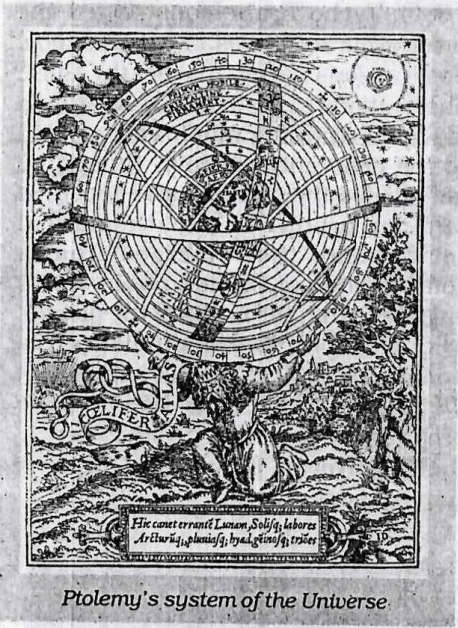
- Challenged the geocentric (Earth-centered) model of the universe proposed by Ptolemy.
- Proposed the heliocentric (Sun-centered) model, stating:
- The Earth revolves around the Sun, rather than the other way around.
- This contradicted Church teachings and the traditional cosmic order.
-
-
- Further Developments in Astronomy
- Tycho Brahe (1546–1601) – Compiled the most accurate astronomical observations.
- Johannes Kepler (1571–1630) – Used Brahe’s data to:
- Support the heliocentric model.
- Prove that planetary orbits are elliptical, not circular (On the Motion of Mars, 1609).
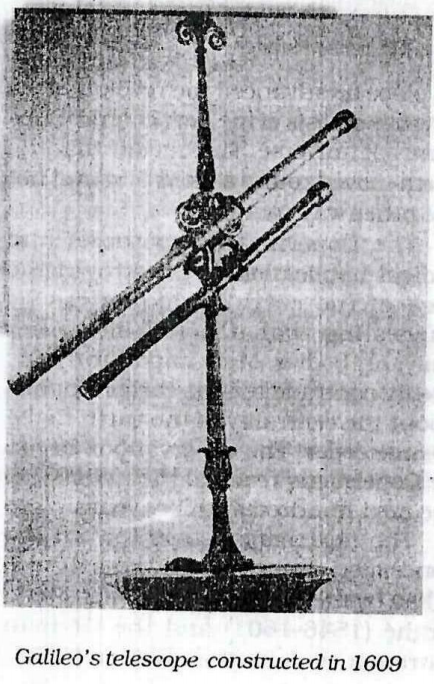
- Galileo Galilei (1564–1642) – Developed the telescope, enabling him to:
- Discover mountains on the Moon and sunspots.
- Observe Jupiter’s moons, proving celestial bodies orbit objects other than Earth.
- His findings contradicted Church teachings, leading to his condemnation and house arrest (Dialogues on the Two Chief Systems of the World, 1632).
-
- Isaac Newton and the Law of Gravitation
- Isaac Newton (1642–1727) expanded on Galileo’s work and solved key planetary motion problems.
- 1687 – Published The Mathematical Principles of Natural Philosophy, introducing:
- The Law of Gravitation – all celestial bodies move due to mutual attraction.
- Combined mathematics and physics in astronomy.
- Similar principles were explored earlier by Varahamihira and Aryabhatta in 5th–6th century India.
- Calendar Reform
- 16th century – Increasing astronomical knowledge led to the reform of the Julian Calendar.
- 1582 – Pope Gregory XIII introduced the Gregorian Calendar:
- Adjusted the solar year by moving the calendar back by 10 days.
- Leap years were revised – only centenary years divisible by 400 were considered leap years.
- This Gregorian Calendar was widely adopted worldwide and is still in use today.
- The Renaissance scientific revolution laid the foundation for modern science through printing innovations, medical discoveries, astronomical breakthroughs, and calendar reforms, marking a new era in human knowledge and progress.
- The Rise of Protestantism
- Awareness of Corruption in the Catholic Church
- The European people, with a renewed spirit of inquiry, recognized the corruption within the Catholic Church.
- The term Protestant was first used for Martin Luther’s followers in 1529 when they protested against restrictions on religious reforms.
- Over time, Protestant came to describe all Christians who rejected Papal supremacy.
- The major branches of Protestantism in the 16th century were Lutheranism, Calvinism, and Anglicanism.
- Martin Luther and the Birth of Lutheranism
- Martin Luther was born in 1485 in Germany to a peasant family.
- His father sent him to study law at the University of Erfurt, but he abandoned it to become a monk in the Order of the Hermits (a person living in religious solitude) of St. Augustine.
- In 1512, he earned his doctorate in theology at Wittenberg.
- Luther’s Criticism of the Church
- A visit to Rome exposed him to the corruption of the Catholic Church.
- He believed that salvation came not from sacraments (religious ceremonies in christian church) or “good works” but through faith in God’s grace (smoothness/elegance).
- He strongly opposed the sale of indulgences, which allowed people to buy forgiveness for sins.
- The Ninety-Five Theses (1517)
- On 31 October 1517, Luther nailed his Ninety-Five Theses to the Church door in Wittenberg.
- He also printed and distributed them, gaining support from common people, merchants, and princes.
- The Elector of Saxony protected him against charges of heresy.
- Key Teachings of Martin Luther
- The civil government is superior to the Church in political matters.
- Priesthood is unnecessary, as every Christian can connect with God directly.
- The Bible should be accessible to all, leading him to translate it into German.
- He officially broke away from the Catholic Church and organized his followers into a new Church, founding Lutheranism.
- Spread of Protestantism
- Zwingli and Calvin in Switzerland
- Ulrich Zwingli and John Calvin led the Protestant movement in Switzerland.
- Calvin’s Swiss cities became a refuge for persecuted Protestants from Western Europe.
- Calvin founded an academy to train Protestant missionaries.
- He wrote The Institutes of the Christian Religion, a concise explanation of Protestant beliefs.
- The Protestant Reformation in England
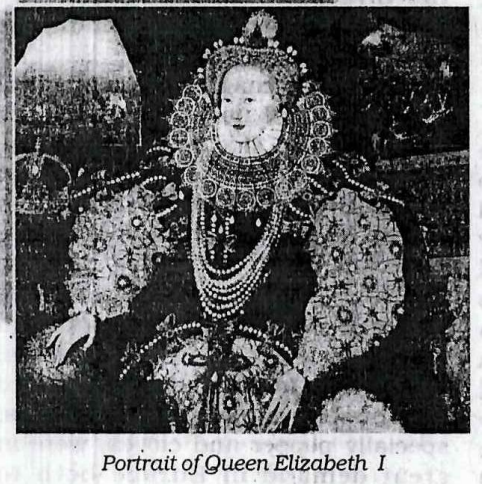
- Led by King Henry VIII and Queen Elizabeth I.
- Unlike Luther and Calvin, their reforms were driven by political interests rather than religious or social ideology.
-
- Henry VIII’s Break with the Catholic Church
- Henry VIII wanted to divorce Catherine of Aragon to marry Anne Boleyn.
- The Pope refused, as Henry had received a Papal dispensation (exemption from a rule / distribution / supply) allowing his first marriage.
- In response, Henry declared himself the head of the Church of England and married Anne Boleyn.
- Their daughter, Elizabeth I, later became Queen of England.
- Formation of the Anglican Church
- In 1529, England’s Parliament passed laws ending Papal authority over the English Church.
- The English Church was renamed the Anglican Church, with the King as its head.
- Side information on history of England's parliamentary system
1. Magna Carta (1215)
- Signed by King John under pressure from barons.
- Limited the powers of the king and laid the groundwork for a council to advise the monarch—an early form of Parliament.
2. Model Parliament (1295)
- King Edward I summoned what is considered the first representative Parliament.
- Included commoners (knights and burgesses) along with clergy and nobles.
3. Development of the Bicameral System (1300s)
- By the 14th century, Parliament had divided into two houses:
- House of Lords (nobles and clergy)
- House of Commons (elected representatives)
4. English Civil War and Execution of Charles I (1642–1649)
- Power struggle between the monarchy and Parliament.
- Resulted in temporary abolition of monarchy and rise of Oliver Cromwell.
5. Glorious Revolution (1688)
- Parliament invited William III and Mary II to rule, forcing them to accept the Bill of Rights (1689).
- This event firmly established Parliament’s supremacy over the monarchy, marking a shift toward constitutional monarchy.
6. Development of the Prime Minister Role (1700s)
- Sir Robert Walpole (1721–1742) is considered the first de facto Prime Minister.
- Gradually, the executive (government) became responsible to Parliament, especially the House of Commons.
Final Transition to Parliamentary Democracy
- By the 19th and 20th centuries, especially after the Reform Acts (1832, 1867, 1884) and full adult suffrage (by 1928), the UK had evolved into a modern parliamentary democracy.
- Conclusion
- The Protestant Reformation was not a single event but a series of movements across Europe.
- Lutheranism, Calvinism, and Anglicanism emerged as the dominant Protestant sects.
- It reshaped the religious and political landscape of Europe, reducing the power of the Catholic Church.
- The Counter-Reformation
- The Protestant Reformation, led by Luther, Zwingli, and Calvin, severely weakened the authority of the Roman Catholic Church.
- To counter the damage, the Catholic Church initiated a series of reforms known as the Counter-Reformation.
- Key Measures of the Counter-Reformation
- The Council of Trent (1545)
- Summoned by Pope Paul III to combat Protestantism.
- Focused on three main objectives:
- Resolving doctrinal disputes between Catholics and Protestants.
- Eliminating corruption and administrative abuses within the Church.
- Launching a new crusade against Muslims.
- The Index of Prohibited Books was created, barring Catholics from reading certain texts.
- The Formation of the Jesuits
- A new order of missionaries, the Jesuits, was founded.
- Led by Ignatius Loyola, a Spanish soldier who experienced a religious transformation.
- The Jesuits were dedicated to spreading the message of Christ worldwide.
- Revival of the Inquisition
- The Inquisition (church court) was revived to suppress heresy (belief or opinion contradictory to orthodox religious).
- What was the Inquisition?
- It was essentially a religious court established in the 13th century.
- Operated under Papal authority.
- It investigated, interrogated, and punished individuals accused of heresy.
- Operated across Europe and the Americas to enforce Catholic orthodoxy.
- Impact of the Counter-Reformation
- The Catholic Church failed to regain full control over Europe.
- However, it successfully checked the spread of Protestantism in many regions.
- While much of Europe remained Protestant, new lands overseas were converted to Catholicism.
- Geographical Explorations and Discoveries
- The Renaissance sparked a spirit of inquiry and adventure, leading to increased interest in geographical explorations.
- European merchants and rulers financed voyages to discover new lands, sea routes, and trade opportunities.
- Factors Facilitating Exploration
- The invention of the mariner’s compass helped in navigation on the high seas.
- The astrolabe allowed sailors to determine latitude.
- Improved maps and guidebooks provided better knowledge of routes.
- European Powers Leading the Explorations
- Spain and Portugal were the first European nations to finance voyages.
- Portugal gained wealth from African trade in gold, ivory, and slaves.
- Interest in gold expanded to the spice trade in India, where pepper and cloves were in high demand.
- Key Voyages and Discoveries
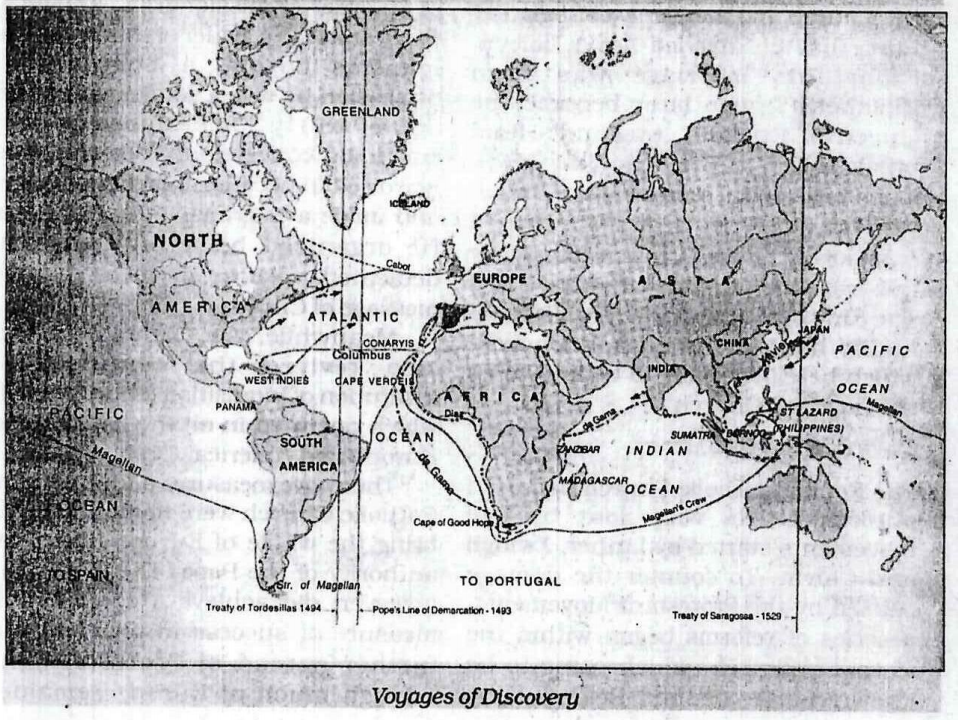
- Bartholomew Diaz (1487)
- Sailed down the west coast of Africa.
- Rounded its southern tip, later named the Cape of Good Hope.
- Vasco da Gama (1498)
- Followed Diaz’s route and landed in Calicut, India.
- Established a direct sea route from Europe to India.
- Christopher Columbus (1492-1504)
- An Italian explorer, funded by Spain, sought a westward route to India.
- Discovered the “New World” but believed he had reached India.
- Named the native people “Indians,” leading to the term “Red Indians” for South Americans.
- Remained unaware that he had discovered a new continent.
- Christopher Columbus never realized during his lifetime that he had discovered a new continent—what we now call the Americas.
- He died in 1506 still believing that he had reached the outskirts of Asia, specifically islands near India or China.
- Ferdinand Magellan (1519-1522)
- A Portuguese explorer, seeking a westward route to the spice islands of Asia.
- Crossed the Pacific Ocean via South America and reached the Philippines.
- Killed in a battle with a local chief, his crew continued the journey under Juan Sebastián Elcano.
- His expedition circumnavigated the earth, proving conclusively that the world is round.
-
- Rise of Colonialism
- European Explorations and the Race for Colonization
- During the 15th and 16th centuries, seafarers from Western European nations crossed vast oceans and discovered new civilizations.
- These discoveries transformed world history, leading to intense competition among European countries to control land and resources in Asia, Africa, and America.
- The colonization of these three continents was closely linked to the commercial revolution in Europe, which was shaped by capitalism and mercantilism.
- Capitalism and Mercantilism
- Capitalism:
- A system where private owners invest accumulated wealth for profit, encouraging commercial expansion from local to global levels.
- Mercantilism:
- A theory that viewed a state’s power as dependent on its wealth, especially in gold and silver. It promoted self-sufficiency, maximizing exports while minimizing imports.
- Mercantilism led to the establishment of overseas colonies, which supplied raw materials and precious metals.
- European governments and entrepreneurs worked together to expand global commerce, particularly in the 17th and 18th centuries. France and England became the most successful mercantilist states in early modern Europe.
- Portugal and Spain: Pioneers of Colonialism
- The first overseas discoveries were financed by Portugal and Spain in the 15th century.
- In 1494, the Treaty of Tordesillas divided the overseas territories between Spain and Portugal. Lands to the east of a designated line went to Portugal, while lands to the west went to Spain.
- Four key principles guided European colonialism:
- The mother country dominated trade, providing manufactured goods while the colonies supplied raw materials.
- Other European nations were excluded from trade with a colony.
- Armed forces were used to control natives and protect trade routes.
- Christianity was spread forcefully or through missionary activities, particularly in the Americas, Africa, and parts of Southeast Asia.
- Colonization of the Americas
- Following the discovery of America, Spain established control over vast territories, including Mexico, Peru, Bolivia, Chile, Guatemala, and the southwestern coast of America.
- The Portuguese controlled Brazil.
- The English colonized North America and the Caribbean, establishing their first permanent colony at Jamestown, Virginia, in 1607.
- By the mid-1600s, English settlers had founded over twenty autonomous settlements in the New World.
- The Dutch colony of New Amsterdam was annexed by the English in 1664 and renamed New York.
- The French established colonies in the St. Lawrence Basin of North America.
- The Swedish and Dutch had minor colonies in America.
- The process of colonization led to the destruction of the Aztec and Inca civilizations. Their kings were killed, and native populations were largely eliminated or replaced by European settlers.
- The remaining indigenous people were forcibly converted to Christianity.
- Colonization of Africa
- Unlike the Americas, Africa was not an unknown land to Europeans.
- North Africa had been part of the Mediterranean trade network since the Roman period, while East Africa was linked to Arab traders.
- In the 15th century, Europeans initially bypassed Africa, considering it poor by their standards.
- Central and southern Africa was inhabited by tribal clans, whose cultures Europeans made little effort to understand.
- The Slave Trade and African Exploitation
- Europeans were mainly interested in the slave trade and commodities like gold, ivory, and tropical goods.
- The Portuguese, Dutch, English, and French set up trading stations along Africa’s coastal belt. The interior remained mostly unexplored, except by slavers and their native accomplices.
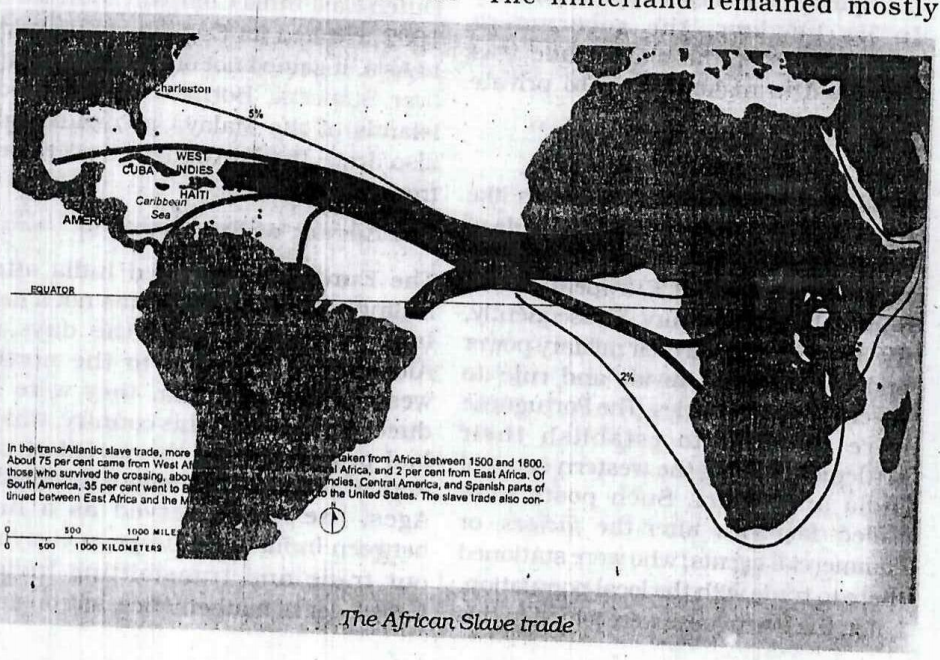
- The cultivation of sugar and tobacco in the Americas depended on African slave labor.
- During the 18th century, an estimated 75,000–90,000 Africans were shipped across the Atlantic every year.
- Over the entire period of the transatlantic slave trade, about nine million Africans were transported, with six million in the 18th century alone.
- 35% of the slaves were sent to English and French plantations in the Caribbean.
- 5% went to North America.
- The rest were taken to Portuguese Brazil and Spanish colonies in South America.
- As the demand for slaves increased, governments abolished state monopolies over the trade, allowing private entrepreneurs to participate.
-
- Colonization of Asia
In Asia, India, China, Japan, and Southeast Asia became major centers of European trade in the 16th century.
- Over time, Europeans used their military strength and divide-and-rule tactics to govern these regions.
- Portuguese, Dutch, British, and French Expansion
- The Portuguese were the first to establish settlements on the west coast of India and in China.
- They were soon joined by the Dutch, British, and French.
- In China, the Portuguese maintained control of Macao, while the Dutch established a post in Taiwan.
- In Japan, European traders initially secured privileges, but strong resistance led Japan to restrict foreign trade.
- The Dutch East India Company (1602) became a dominant force in Asia, controlling Sumatra, Borneo, the Spice Islands, and parts of the Malay Peninsula.
- They also drove out Portuguese traders from many areas.
- The Advent of Europeans in India
- Early European Contact
- Europeans had known about India since Alexander’s invasion in ancient times.
- During the Roman Empire, India was in direct contact with Europe.
- Throughout the Middle Ages, Arab traders linked India and Europe, transmitting Indian knowledge of mathematics, astronomy, medicine, and literature.
- However, Europeans were more interested in commercial trade than cultural exchanges.
- The Struggle for Indian Trade
- The four European powers competing for control over Indian trade were:
- Portuguese
- Dutch
- English
- French
- The Portuguese were the first to establish a trading company in India.
- Their main goals were to defeat Arab traders and spread Christianity.
- They fought the Malabar kings, who protected Arab merchants, leading to conflicts with Egypt, Turkey, and Gujarat.
- Despite resistance, the Portuguese defeated a combined fleet of these powers, securing naval supremacy in the Indian Ocean.
- They conquered Goa from the Sultan of Bijapur, making it a Portuguese colony.
- In the 16th century, the Portuguese were challenged by the Dutch, English, and French.
- Eventually, the British East India Company emerged victorious, laying the foundation for the British Empire in India in the 18th century.
- The Rise of Major European Powers
- During the 17th and 18th centuries, five major states dominated Europe: Great Britain, France, Austria, Prussia, and Russia.
- These states expanded their influence globally through military strength, economic growth, and colonial expansion.
- Their dominance came at the expense of weaker European states.
- Two Models of Political Consolidation
- The English Model
- Developed a limited monarchy with a strong Parliament by the late 17th century.
- Maintained a balance of power between the monarchy and elected representatives.
- Influenced governance in British colonies, especially in North America.
- The French Model
- Followed an absolute monarchy, where the king held unchecked power.
- Relied on a large standing army and high taxation to sustain military expenses.
- Established a bureaucracy to efficiently collect taxes and manage state affairs.
- These two models shaped European politics and influenced global colonial expansion.
- The Glorious Revolution of England
- Turbulence in England (1603-1714)
- England experienced a century of crisis with conflicts between the Puritans, the Stuart Kings, and Parliament.
- Puritanism in 17th-century England included a range of religious groups, from moderate Anglicans to radical sects.
- Despite three foreign rulers and a period without a king (1649-1660), England emerged with a model of limited monarchy, parliamentary government, and religious tolerance.
- James I (1603-1625)
- First foreign king of England as James VI of Scotland.
- Inherited a divided church, royal debt, and tensions with Parliament.
- His attempts to raise revenue independently led to conflict with Parliament.
- Religious tensions increased due to his pro-Spanish foreign policy.
- Best remembered for the translation of the Bible into English (King James Version).
- Charles I (1625-1649)
- Son of James I, continued his father’s conflicts with Parliament.
- Imposed new taxes without consulting Parliament, leading to its dissolution in 1629.
- Recalled Parliament in 1640 due to a war with Scotland.
- Long Parliament (1640-1653) abolished his new taxes and made Parliament dissolution illegal without its consent.
- Charles I saw a division in Parliament and invaded it with soldiers in 1642.
- Parliament, led by Oliver Cromwell, formed the New Model Army to fight against him.
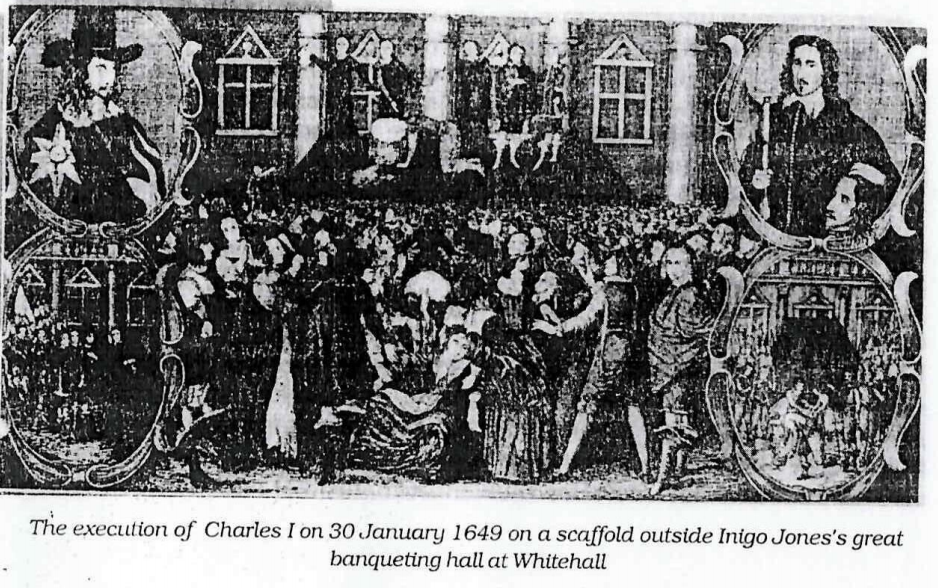
- Executed on 30 January 1649 after a trial, leading to the abolition of monarchy, the House of Lords, and the Anglican Church.
-
- The Puritan Republic (1649-1660)
- England became a Puritan republic under Oliver Cromwell.
- His army conquered Ireland and Scotland, forming Great Britain.
- In 1653, Cromwell dissolved Parliament and ruled as Lord Protector.
- His military dictatorship was unpopular, leading to a desire to restore monarchy.
- The Restoration of Monarchy (1660)
- In 1660, Charles II (1660-1685), son of Charles I, was restored to the throne.
- Marked the return of a hereditary monarchy and the supremacy of the Anglican Church.
- Succeeded by his brother, James II (1685-1688), who dissolved Parliament and promoted Catholicism.
- His Catholic wife gave birth to a son in 1688, ensuring a Catholic heir, which triggered a political crisis.
- The Glorious Revolution (1688)
- Whigs and Tories united against James II and invited William III of Orange and Mary to invade England.
- William III arrived in November 1688 and was welcomed without opposition.
- James II fled to France, and Parliament declared the throne vacant.
- William III and Mary (1689-1702) were crowned as joint monarchs.
- They signed the Bill of Rights (1689), which:
- Limited the monarchy’s power.
- Ensured Parliament’s supremacy.
- Guaranteed civil liberties to the privileged classes.
- Prohibited Catholics from occupying the English throne.
- The Glorious Revolution established constitutional monarchy in England, where monarchs ruled with the consent of Parliament and under the law.
- American War of Independence
- Introduction
- The American War of Independence marked a turning point in European colonialism.
It set the stage for future liberation movements in Africa, Asia, and Latin America.
- The war led to the secession of thirteen American colonies from Britain and became a laboratory for new political ideas and institutions.
- British Colonization in America
- Establishment of Colonies
- Britain established its first colony in Jamestown, Virginia, in 1607.
- Within a century, a series of English colonies were established in North America.
- By the early 18th century, the British Crown directly governed these colonies.
- Administration of Colonies
- The Crown appointed Royal Governors for administration.
- Each colony had an elected legislative assembly, a council, and militias.
- Economic Structure
- The economy was primarily agricultural, based on plantations managed by enslaved people.
- Major crops: tobacco, indigo, rice, and sugar.
- Principal port cities: Boston, Newport, New York, Philadelphia, and Baltimore.
- Growing Resentment (bitterness) Against Britain
- Political Awareness and Influence
- Until the 1760s, American political values were similar to England’s.
- Prominent American political theorists included Benjamin Franklin, Thomas Jefferson, James Wilson, and John Adams.
- Their ideas were influenced by John Locke and Montesquieu, advocating self-government.
- Demand for Self-Government
- Initially, American leaders sought self-governance within the British Empire, not independence.
- British leaders, however, viewed the Empire as indivisible.
- By 1750, few expected independence to happen in the 18th century.
- Causes of the American Revolution
- Economic Strains After the Seven Years’ War
- Britain sought to recover war expenses by taxing American colonies.
- The colonies, having benefited from British victories, were expected to share the financial burden.
- The Stamp Act (1765)
- Imposed taxes on legal documents and newspapers.
- British justified it as legal, but colonists opposed it, asserting “No taxation without representation.”
- Colonial Protests and the Stamp Act Congress
- In 1765, the Stamp Act Congress in America drafted a protest memorandum.
- Groups like the ‘Sons of Liberty’ led widespread resistance.
- Britain repealed the Stamp Act in 1766 but passed the Declaratory Act, affirming British authority over the colonies.
- British Political Writings and American Resistance
- Radical British political writings, ignored in Britain, gained traction in America.
- These texts reinforced ideas of liberty and republican governance.
- Key Events Leading to Independence
- The Tea Act and the Boston Tea Party (1773)
- British Parliament allowed the East India Company to sell tea directly to the colonies.
- Though the Act lowered tea prices, it retained a tax without colonial consent.
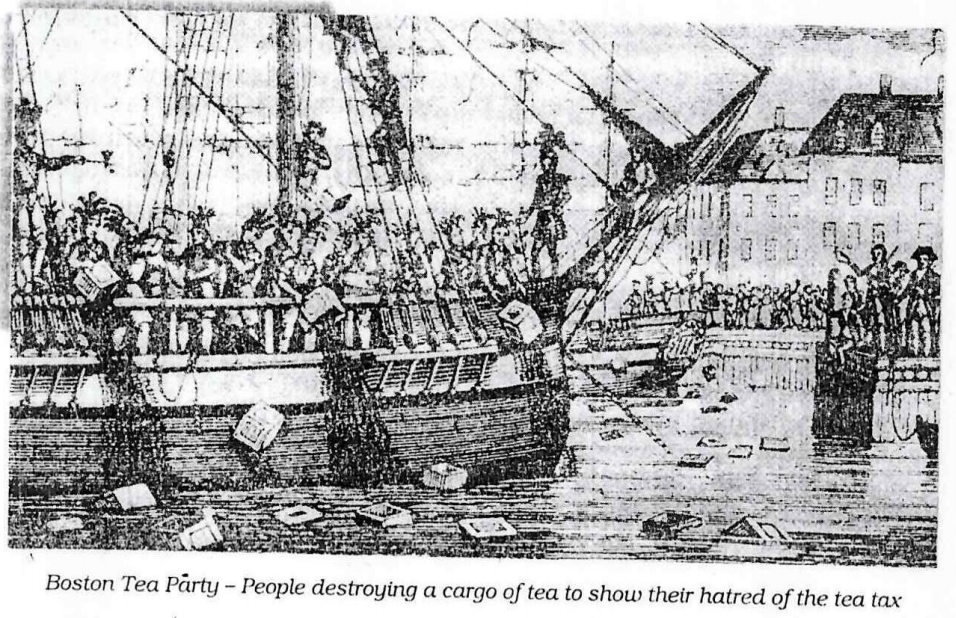
- In response, colonists in Boston threw a shipment of tea into the harbor on 16 December 1773, an event known as the ‘Boston Tea Party.’
-
- The Intolerable Acts (1774)
- British Parliament, under Lord North, passed laws to punish the colonies:
- Closed the port of Boston.
- Reorganized the Massachusetts government.
- Allowed British troops to be housed in private homes.
- The Path to War
- Formation of the First Continental Congress (1774)
- Colonists formed Committees of Correspondence to coordinate resistance.
- The First Continental Congress met in Philadelphia, demanding self-government.
- The Second Continental Congress and Rebellion (1775)
- In May 1775, the Second Continental Congress began governing the colonies.
- King George III declared the colonies in rebellion.
- Thomas Paine’s pamphlet Common Sense (1776) galvanized support for independence.
- Declaration of Independence and the War
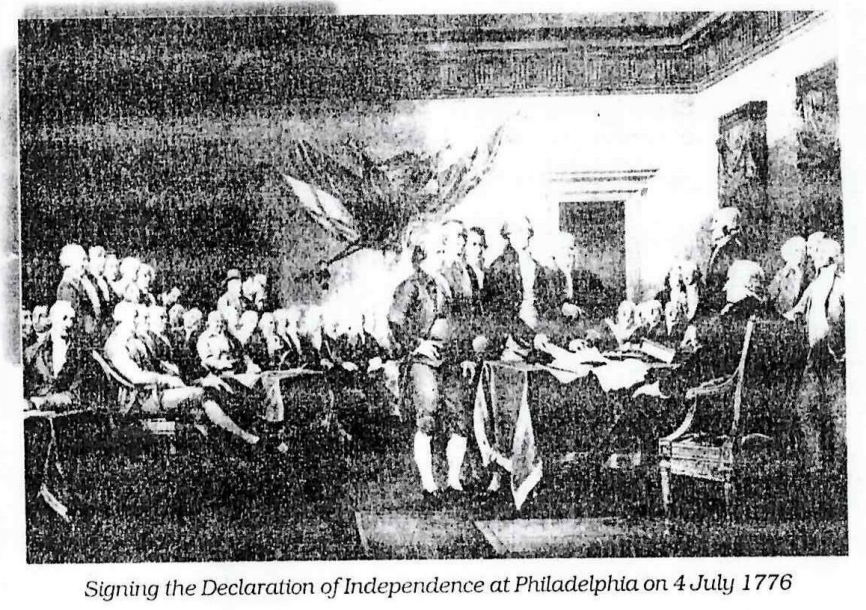
- Declaration of Independence (4 July 1776)
- The Continental Congress formally declared independence from Britain.
- The war continued until 1781.
- Foreign Support and Victory
- Spain and France supported the American colonies against Britain.
- In 1781, George Washington’s forces defeated Lord Cornwallis at Yorktown.
- The Treaty of Paris (1783) officially ended the war, recognizing American independence.
-
- Formation of the United States
- Post-Independence Perspective
- Initially, Americans saw themselves as protecting English liberties from a tyrannical monarchy and Parliament.
- Over time, they developed a new sense of liberty.
- The U.S. Constitution (1787)
- A Constitutional Convention was held in Philadelphia under George Washington’s chairmanship.
- Proposed a federal system, dividing power between central and state governments.
- The American colonies officially united as the United States of America.
- The American colonies gained independence from Britain in just about 12 years after serious tensions began
- The reasons that differentiate why America took only 12 years while India took approx 200 years
- Nature of Colonialism: Settler vs. Exploitative
- British were more oppressive toward Indians (considered inferiors) as compared to American colonies.
- Unity
- American colonies got united very quickly due to homogeneous nature (language, religion, roots) while India was diversified into multiple religions, languages, etc making divide and rule easy
- Indians were fighting amongst themselves and would often support British among their rivalries.
- Geopolitical Distraction
- Britain was already busy with ongoing European rivalries and lacked resources for proper control during that time
- Military Power
- Americans rebels were using same Military knowledge as the British while Indians were using old inferior ways of fighting.
- Leadership and Strategy
- American revolution had coordinated leadership while Indian freedom struggle was fragmented and more on personal benefits of participating individuals.
- Communication and Technology
- India was way behind in technology against European powers.
- Lack of education
- Most of the Indians were uneducated and could not counter the intelligent strategies of British like Divide and conquer, strategic disarmament, etc
- Timing
- Americans were the first to decolonize themselves from the British crown, but during for India, british had learned from the experience and had counter strategies in place.
- The French Revolution
- Causes of the French Revolution
- The French Revolution was one of the most dramatic and complex upheavals (disruption / sudden change) in Western civilization. It not only disrupted France but also had a profound impact on the rest of Europe.
- The Revolution was rooted in:
- The social and political conditions of 18th-century France.
- The ideas of the Enlightenment, which were widespread throughout Europe.
- Historians debate which of these factors played a more significant role:
- Some argue that the abuses of the Ancien Régime (Old Regime) made the revolution inevitable.
- Others believe the Revolution was mainly driven by philosophers influenced by Enlightenment ideas, who exposed the weaknesses of the Ancien Régime.
- The Ancien Régime
- The term Ancien Régime refers to the political, social, and economic structures that existed in France before 1789. It was characterized by:
- Political system:
- Absolute monarchy supported by bureaucracies and armies.
- Economic system:
- Agriculture-based, scarcity of goods, slow transport, weak financial institutions, and competitive overseas trade.
- Social structure:
- Aristocratic elites with inherited privileges, powerful churches, organized labor in guilds, and a heavily taxed peasantry.
- Few people outside the government called for reforms, which were promoted under the Enlightenment Movement.
- Enlightenment thinkers exposed contemporary abuses and argued for political and social change.
- The Role of Enlightenment Thinkers
- By the mid-18th century, Enlightenment philosophers brought their ideas to the public through writings and debates. They:
- Exposed political oppression and religious restrictions.
- Suggested practical reforms to improve society.
- Became highly respected figures, influencing revolutionary thought.
- Key figures included:
- Voltaire
- John Locke
- Montesquieu
- Rousseau
- These thinkers inspired the Revolution by challenging oppressive governance, unfair social structures, and conflicts between the monarchy and the aristocracy.
- Financial Crisis and the Monarchy’s Failure
- The French monarchy failed to manage its finances, leading to a severe economic crisis. Major causes included:
- The costly Seven Years’ War (1756–1762).
- Financial aid to the American War of Independence, deepening debt.
- Inability to tax the wealthy aristocracy and clergy, while the overburdened peasants had no means to pay.
- King Louis XVI and Marie Antoinette
- Louis XVI (ruled 1774–1792) was honest but indecisive, preferring hunting and court politics over governance.
- Marie Antoinette, his Austrian wife, was seen as extravagant (no restraint on spending) and disconnected from common people’s struggles.
-

- The Estates-General and the Rise of the Third Estate
- To address the financial crisis, Louis XVI appointed various ministers (1786–1788) to persuade the nobility and clergy to pay taxes, but all failed.
- In July 1788, under pressure, the king agreed to convene the Estates-General in May 1789 (the first meeting since 1614).
- The Estates-General consisted of three estates:
- Clergy
- Nobility
- Bourgeoisie (middle class), also known as the Third Estate
- The Third Estate demanded:
- All three Estates sit together and vote individually.
- The number of Third Estate representatives be doubled.
- When these demands were ignored, the Third Estate declared itself the National Assembly, taking the Tennis Court Oath (20 June 1789), vowing to draft a new constitution for France.
- Key Events of the Revolution (1789)
- The Fall of the Bastille (14 July 1789)
- Parisian mobs stormed the Bastille, a fortress and political prison, symbolizing the hated Ancien Régime.
- The governor ordered troops to fire on civilians, killing 98 people.
- In response, the crowd stormed and captured the Bastille, marking the Revolution’s violent beginning.
- The Women’s March on Versailles (October 1789)
- A scarcity of bread (due to drought and crop failures) led to protests.
- Rumors spread that Marie Antoinette had dismissively said, “Let them eat cake.”
- Thousands of women marched to Versailles, demanding the King return to Paris, forcing Louis XVI to comply.
- The National Constituent Assembly and the Declaration of Rights
- The Declaration of the Rights of Man and Citizen (27 August 1789)
- Before drafting a new constitution, the Assembly issued this document, declaring:
- All men are born free and equal.
- Natural rights include liberty, property, security, and resistance to oppression.
- Sovereignty rests with the people.
- The Constitution of 1791
- France became a constitutional monarchy with limited powers.
- Voting rights were granted only to those who paid taxes or owned property.
- The National Legislative Assembly was created, with the power to declare war and peace.
- Radicalization and the Execution of Louis XVI
- Rise of Political Factions
- Jacobins (radicals)
- Girondists (moderates)
- Sans-Culottes (working-class revolutionaries)
- The Trial and Execution of Louis XVI (January 1793)
- Louis XVI was tried for treason and executed by guillotine in January 1793.
- His execution marked the official end of the monarchy and radicalized the Revolution.
- The Reign of Terror (1793–1794)
- Led by Robespierre and the Jacobins, aiming to eliminate “enemies of the Revolution.”
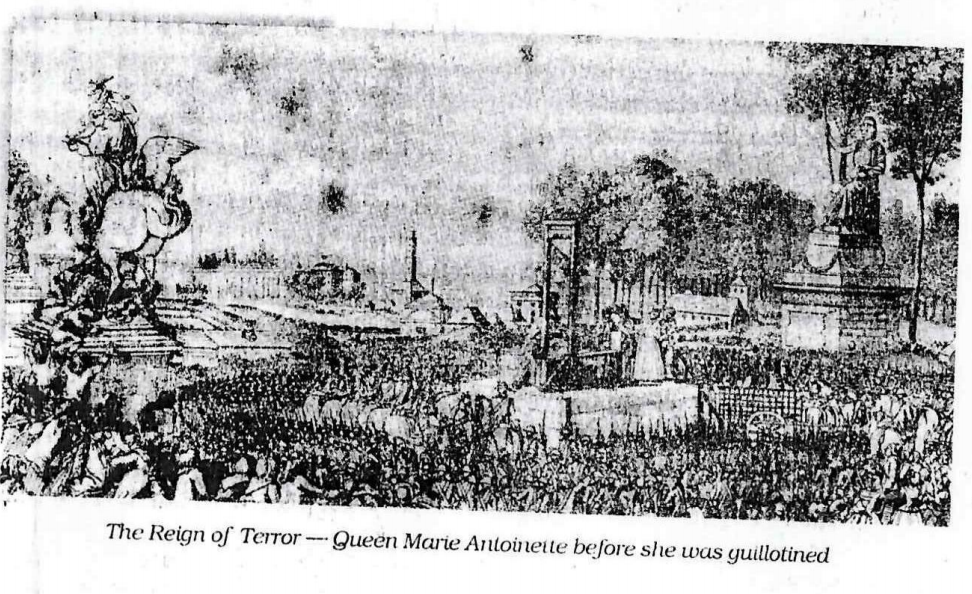
- More than 15,000 people were guillotined, including Queen Marie Antoinette.
-
- By 1794, the Terror ended, and the Jacobins lost power.
- The Directory (1795–1799)
- A new Republican Constitution established the Directory, a five-member executive government.
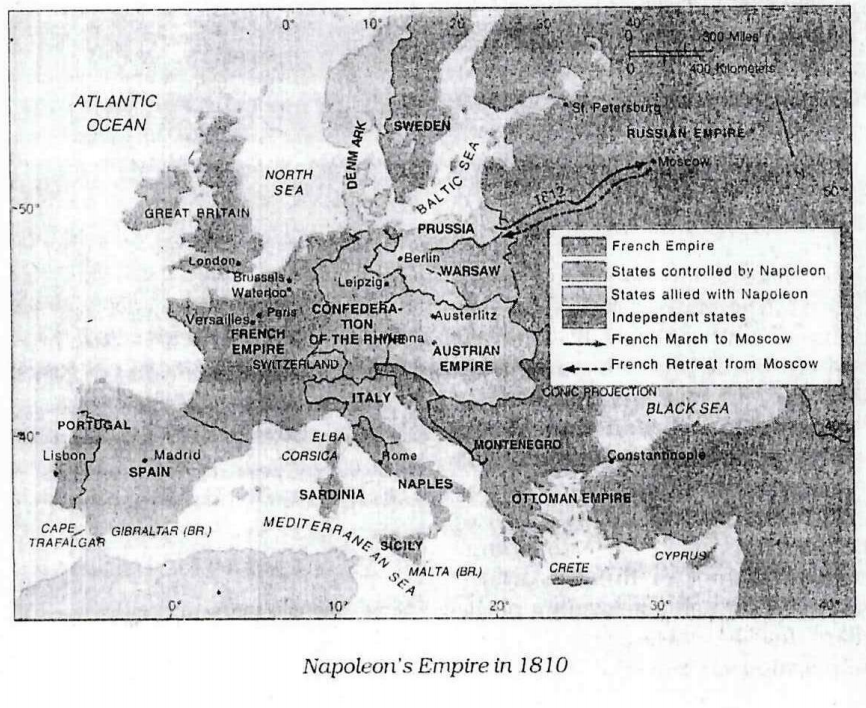
- Napoleon Bonaparte, a rising military leader, gained prominence.
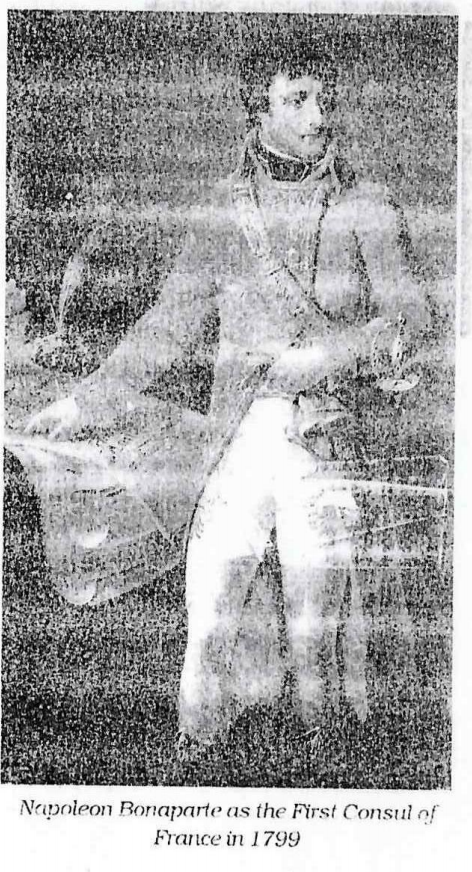
- Napoleon Bonaparte (1799–1815)
-
- Rise to Power
- 1799: Napoleon led a coup against the Directory, becoming First Consul with dictatorial powers.
- A plebiscite (public vote) confirmed his authority, with 99.9% approval.
- Achievements (1799–1804)
- Restored stability after the Revolution.
- Defeated France’s enemies through military campaigns.
- Introduced economic and administrative reforms, including:
- Establishing the Bank of France.
- Reforming the tax system.
-
- Unification of Italy
- The period from 1848 to 1875 witnessed significant political changes in Europe, driven by the ideals of Liberty, Equality, and Fraternity—representing individual political liberty, economic equality, and national unity.
-
- Italy Before Unification
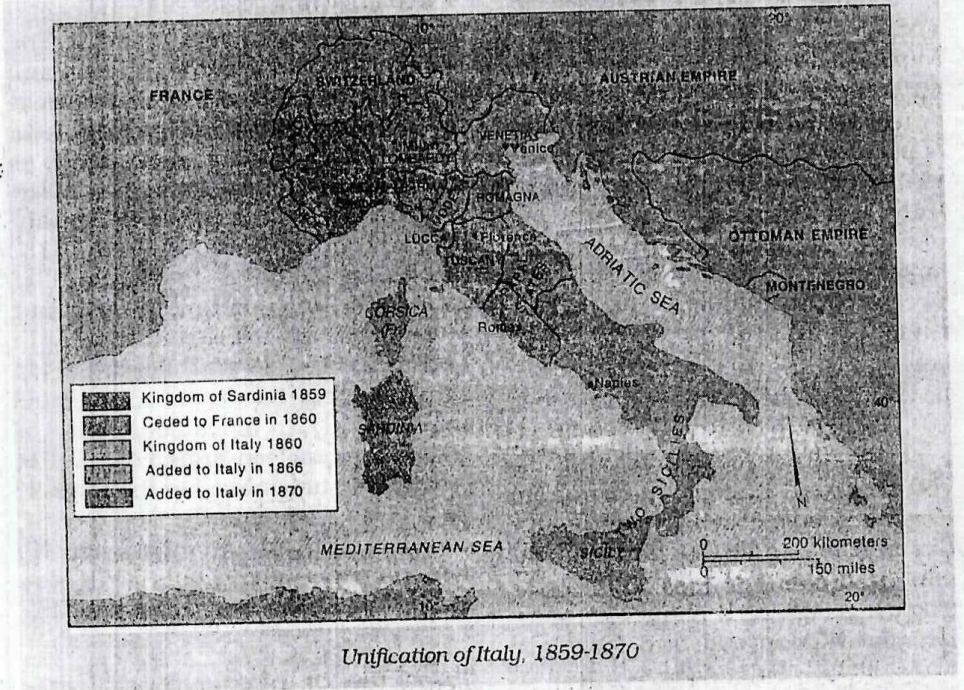
- At this time, Italy was merely a geographical expression, divided into several independent states.
- Italian nationalists aspired to unite these small, absolutist principalities into a single nation, but there was no consensus on the approach:
- Religious-minded patriots supported a federation under the Pope.
- Moderate nationalists favored a constitutional monarchy.
- Leaders of the Unification Movement
- Three key figures emerged as leaders in the Italian unification struggle:
- Count Camillo Benso di Cavour – The royal minister of Piedmont (also known as the Kingdom of Sardinia).
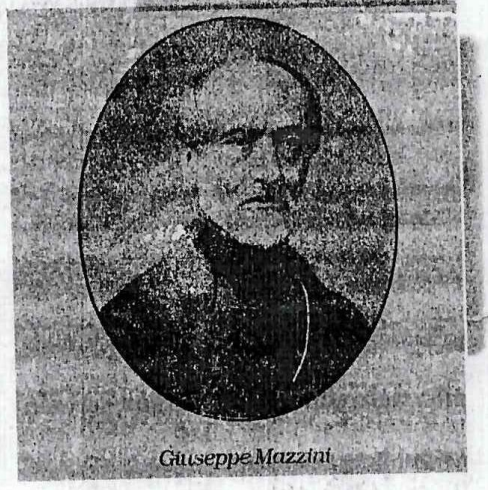
- Giuseppe Mazzini – Advocated for a “free, independent, and republican Italy,” inspiring the youth and setting an example for other European nations.
-
- Giuseppe Garibaldi – A revolutionary military leader who played a crucial role in securing southern Italy.
- Cavour, supported by King Victor Emmanuel II, worked towards unifying Italy as a democratic republic and implemented key reforms in Piedmont to gain international support.
- The Struggle for Unification
- Early Attempts and Failures
- The first attempt at expelling Austria failed in 1848-1849, as Sardinia was defeated.
- Cavour’s Strategy
- In 1852, Victor Emmanuel II appointed Cavour as his minister.
- Cavour aimed to prove that Italians were efficient and economically progressive to gain international recognition.
- He promoted free trade, railway construction, economic expansion, and agricultural development.
- He established the Nationalist Society and a printing press to advocate unification across Italian states.
- Believing that Italy needed French support, he allied with France and Britain in the Crimean War to bring the Italian issue to the global stage.
- The War Against Austria (1859)
- In June 1859, war broke out between Sardinia and Austria.
- Austria was defeated and driven out of most of northern Italy.
- However, France betrayed Cavour by indirectly supporting Austria.
- Despite this, Sardinia gained control of Lombardy, and the regions of Parma, Modena, Tuscany, and Romagna voted to unite with Sardinia.
- Garibaldi’s Campaign in Southern Italy (1860)
- Garibaldi’s republican forces successfully conquered Sicily, Palermo, and Naples.
- Meanwhile, Cavour’s troops seized the Papal States, except for the area around Rome, which remained under Papal control.
- Garibaldi, despite favoring republicanism, reluctantly accepted Sardinia’s leadership.
- The Formation of Unified Italy
- By the late 1860s, the southern Italian states joined the northern union led by Sardinia.
- In March 1861, Victor Emmanuel II was declared the King of Unified Italy.
- The new state adopted the conservative constitution of 1848, originally issued by Charles Albert.
- Challenges After Unification
- Despite unification, Italy faced numerous difficulties:
- It lacked the natural resources of France and Germany.
- It did not have the strong overseas trade network that Britain enjoyed.
- These economic weaknesses continued to affect Italy well into the 20th century.
- Unification of Germany
-
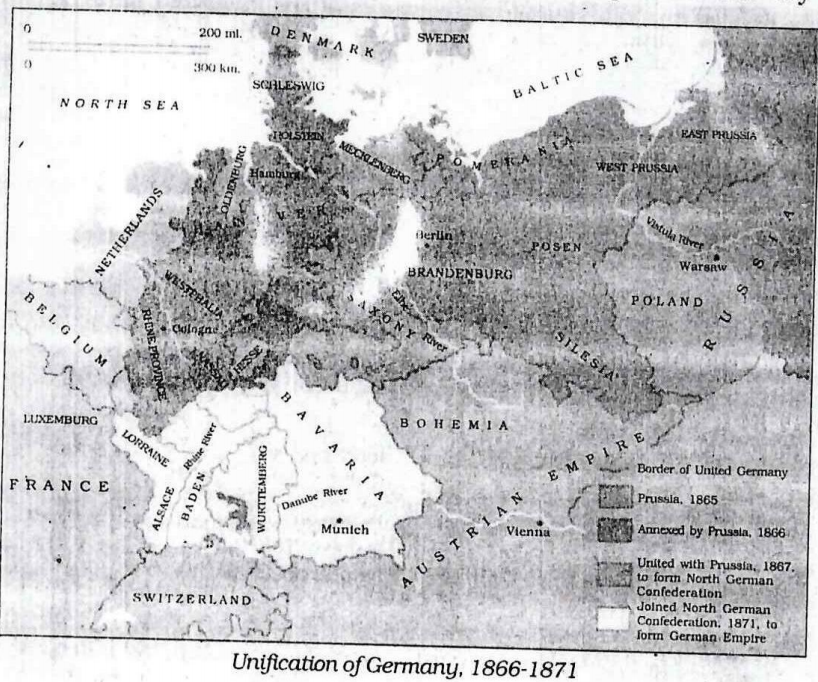
- Before its unification, Germany consisted of thirty-nine independent states, which had replaced the old Holy Roman Empire.
- These states were loosely grouped together in an organization called the German Confederation.
- The success of Italian unification intensified nationalist aspirations in Germany, and its unification process followed a similar pattern.
- Otto von Bismarck: The Architect of German Unification
- The key figure behind Germany’s unification was Otto von Bismarck (1815-1898), who shaped European history for the next thirty years.
- Bismarck began his career as a staunch defender of royal privilege during the turbulent year of 1848.
- As a reward, King Wilhelm I appointed him as Prussia’s representative to the Frankfurt Diet of the German Confederation.
- He later served as Prussia’s ambassador to St. Petersburg and Paris.
- Bismarck’s Rise to Power
- Meanwhile, King Wilhelm I faced opposition from the liberal-dominated Prussian Parliament, which refused to approve military reforms demanded by the army generals.
- On the verge of abdicating, Wilhelm I appointed Bismarck as Chancellor to resolve the crisis.
- Bismarck made it clear that the great questions of the day would be solved not by parliamentary debates but by “blood and iron”.
- His policies were strongly supported by the army and the bureaucracy.
- Wars Leading to Unification
- Bismarck understood that uniting Germany under Prussian leadership required shifting public focus from internal issues to foreign affairs.
- War Against Denmark (1864)
- Bismarck declared war on Denmark over the disputed territories of Schleswig and Holstein.
- Austria supported Prussia in the war, and together they defeated Denmark.
- After victory, Schleswig and Holstein were placed under joint Austro-Prussian administration, but tensions between the two powers grew.
- Austro-Prussian War (1866)
- Bismarck formed strategic alliances with France and Italy to ensure that Austria would be isolated in the event of war.
- In 1866, war broke out between Prussia and Austria over the administration of Schleswig and Holstein.
- Prussia won a decisive victory, and the Treaty of Prague excluded Austria from German affairs.
- Prussia now emerged as the dominant power among the German states.
- Formation of the North German Confederation (1867)
- Prussia incorporated all German states north of the River Main, deposing their ruling dynasties.
- These states, along with Prussia, formed the North German Confederation, with Prussia as the leader.
- The Confederation’s Constitution (later adopted in 1871 for the German Empire) introduced a legislative house (Reichstag) elected by universal male suffrage.
- However, the Reichstag had little real power, as the army always remained loyal to the King and his ministers.
- Franco-Prussian War and the Final Unification (1870-1871)
- Bismarck now sought to incorporate the southern German states into the Confederation.
- The opportunity arose when France opposed the possible succession of a Prussian prince to the Spanish throne.
- Bismarck manipulated a diplomatic dispute (the Ems Dispatch) to make it appear as though King Wilhelm I had insulted the French ambassador.
- Enraged, France declared war on Prussia in July 1870.
- The southern German states sided with Prussia, completing Germany’s national unity.
- The Fall of France
- On September 1, 1870, at the Battle of Sedan, the Germans defeated the French army and captured Napoleon III.
- By late September, Paris was under siege.
- On January 28, 1871, Paris surrendered.
- Ten days earlier, on January 18, 1871, in the Hall of Mirrors at the Palace of Versailles, the unified German Empire was proclaimed.
- Wilhelm I was crowned Emperor (Kaiser) of Germany, while the rulers of southern German states retained their positions within the new Federation.
- Impact of German Unification
- The unification of Germany in the 19th century established a strong, centralized state in the heart of Europe.
- The new German Empire had some liberal characteristics, but real power remained with the monarchy and the military.
- Bismarck’s “blood and iron” policy captured popular imagination, but it also fostered militarism and authoritarianism, shaping Germany’s future trajectory.
- The world from 1900 to 1919
- Political Landscape at the Turn of the 19th Century
- The world did not change significantly from previous decades. Europe remained dominant in world affairs.
- Great Britain maintained naval supremacy.
- It ruled over a vast colonial empire.
- However, it avoided continental commitments.
- Two key reasons for this were:
- Queen Victoria’s accession (1837) severed ties with Hanoverian Germany.
- Britain’s domestic and imperial politics led to its isolation from European issues.
- Meanwhile, Germany was the leading land power. Italy, Japan, and the U.S. had yet to emerge as global forces.
- Major Powers and Their Influence
- Germany, Austria-Hungary, Russia, and Turkey dominated continental Europe (east of the Rhine).
- Britain, Russia, and China held power in Asia.
- Africa was undergoing colonial partition, as in the 19th century.
- Despite minor changes, the European order remained intact.
- This order was preserved more by tradition and sentiment than by practical adjustments.
- The Rise of Imperialism
- The principles of liberalism and nationalism grew more competitive.
- European states expanded their colonial ambitions.
- They eyed distant lands and ancient civilizations.
- This new political obsession brought complex challenges.
- One key driver of this outlook was scientific and technological progress.
- These advances boosted industries.
- They also enhanced military weaponry.
- This period came to be known as the “Era of Armed Peace”.
- The extension of European control and intensified rivalries defined this phase.
- The Changing Balance of Power
- The European order was stable only in appearance.
- The Triple Alliance (Germany, Austria-Hungary, Italy) controlled one side.
- The Dual Alliance (France, Russia) balanced the other.
- A major shift began in 1890. Kaiser Wilhelm II dismissed Otto von Bismarck as Imperial Chancellor.
- This led to:
- A change in German foreign policy.
- Abandonment of Bismarck’s cautious approach.
- Increased German interference in the Near East.
- A German naval build-up, challenging British naval dominance.
- Wilhelm II and his generation sought new triumphs (a greater victory or achievement). No single leader controlled Germany’s foreign policy.
- Instead, it became a compromise between:
- The Kaiser
- The Imperial Chancellor
- The Foreign Office
- The Concert of Europe and Its Failure
- Despite rivalries, major powers acted jointly in the Concert of Europe.
- This alliance (Austria-Hungary, France, Germany, Britain, Russia, Italy) prevented small conflicts from escalating.
- However, its members often manipulated one another. This internal struggle eventually led to its collapse. Its failure paved the way for World War I.
- Developments Leading to World War I
- At the start of the 20th century, Britain and the Dutch clashed over South Africa. This struggle began in October 1899.
- The conflict arose because:
- The Dutch republic of Transvaal refused to grant political rights to Anglo-Saxon immigrants.
- Other Boer republics also denied these rights.
- The Boer republics were independent, self-governing republics formed by Dutch-speaking inhabitants of the Cape Colony and their descendants.
- In Britain, public opinion saw this as a just war. The Boers (Dutch speaking settlers) were denying lawful rights to British citizens.
- However, European and global opinion viewed it as British imperialism.
- The Boer War
- At the start of the 20th century, Britain and the Boers clashed over South Africa.
- The Boers, having previously defeated Britain, were aware of its military weaknesses in the region.
- They believed that before the war ended, some European power would intervene on their behalf.
- British Underestimation
- The British underestimated:
- The tenacity and tactical skill of Boer fighters.
- The advantage of fighting on home ground.
- The Dutch-class irregulars were strong fighters but suffered from:
- Lax discipline
- Excessive caution
- Lack of unified strategy
- Had they overcome these weaknesses, the war could have lasted longer in their favor.
- Course of the War
- Several small battles took place.
- Boer forces used thin, extended defensive lines, making them difficult to penetrate.
- The British gradually gained successes.
- The war spanned thousands of square miles and involved 450,000 British soldiers. It ended on 31 May 1902, after a two-and-a-half-year campaign.
- The British secured victory by:
- Splitting the war zone into smaller resistance areas.
- Using mounted columns to strike at Boer mobility.
- Impact of the War
- Inside Britain:
- The Liberals came to power in 1905.
- The new Secretary of State for War, R.B. Haldane, took key steps:
- Maintained British naval supremacy.
- Reorganized the army, drawing lessons from the Boer War.
- Outside Britain:
- The war showcased British imperial unity.
- Britain’s military reputation suffered due to prolonged Boer resistance.
- However, Britain’s naval power prevented European rivals from aiding the Boers.
- Politics of Alliances
-
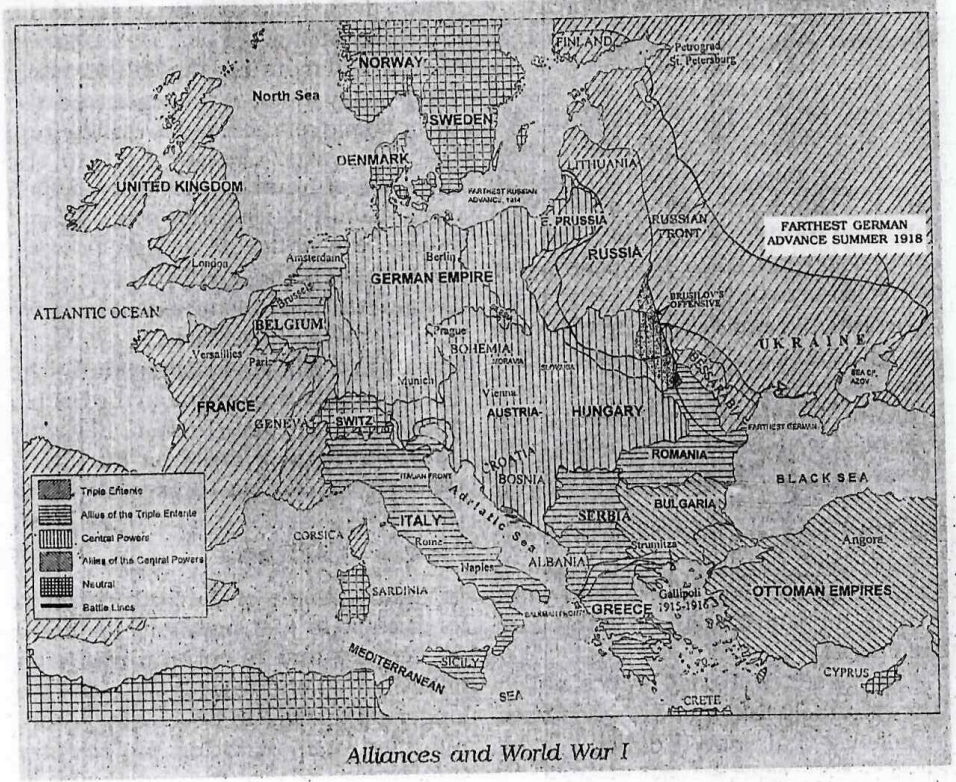
- At the beginning of the 20th century, Britain’s long-standing policy of splendid isolation was becoming impractical.
- Maintaining naval supremacy alone was no longer sufficient, and Britain began seeking an ally on the European mainland.
- Germany as a Potential Ally
- Britain initially considered Germany due to:
- Its military strength, as the most formidable (intimidating) power in Europe.
- Its rising population and tradition of aggressive diplomacy.
- Its potential as a counterweight to Russia, Britain’s key rival in the Middle and Far East.
- Its historical ties with Britain:
- The Kaiser of Germany was Queen Victoria’s grandson.
- Germany had helped Wellington at Waterloo.
- British Efforts to Secure an Alliance
- During the Boer War, British Colonial Secretary Joseph Chamberlain sought closer ties with Germany.
- He proposed a secret agreement over Morocco, where Germany’s influence was growing.
- German Resistance
- Baron von Holstein, a German Foreign Ministry official, advised the Kaiser against an alliance.
- He argued that Britain always used others for its own benefit.
- He encouraged Germany to demand a higher price for its friendship.
- Holstein believed a British-French alliance was unlikely, making Britain dependent on Germany.
- Shift Towards France
- Britain, frustrated by Germany’s reluctance (unwillingness), began reconsidering its alliances.
- Factors Leading to a French Alliance
- The British press urged an understanding with Russia, even at the cost of concessions (compromise) in China and the Persian Gulf.
- Growing concerns over Germany’s expanding naval power pushed Britain to seek alternatives.
- France, though a traditional enemy, became a potential partner.
- Challenges in a British-French Alliance
- Britain was aristocratic, whereas France was the only acknowledged republic in Europe.
- France had suffered British indifference when defeated by Germany thirty years earlier.
- The two nations had nearly gone to war in 1898 over Fashoda (later Kodok) in Sudan.
- France’s internal instability:
- It was seen as divided, with a weak government.
- The appointment of Alexander Millerand, a Socialist, to the French Cabinet in 1899 worried Britain’s Conservative government.
- The Anglo-French Entente (agreement / understanding / arrangement)
- Despite obstacles, Anglo-French relations improved at the start of the 20th century.
- The Role of King Edward VII
- May 1903: King Edward VII visited Paris, breaking the diplomatic deadlock.
- His visit paved the way for negotiations between:
- Lansdowne (British Foreign Minister)
- Delcassé (French Foreign Minister)
- Formation of the Entente (April 1904)
- The negotiations resulted in a series of agreements known as the Anglo-French Entente, the most significant diplomatic event of the early 20th century.
It remained in effect until France fell in World War II.
- Key Agreements
- First Agreement (Egypt & Morocco)
- Britain agreed not to alter Egypt’s political status.
- Egypt remained a semi-independent Turkish province but was under British occupation.
- France would not interfere in British affairs there.
- France agreed not to alter Morocco’s political status.
- Morocco was under French influence.
- Britain would not interfere in French affairs there.
- Additional terms:
- Trade freedom in Egypt and Morocco for 30 years.
- No fortifications on the Moorish coast opposite Gibraltar.
- France would negotiate separately with Spain on Morocco’s status.
- The Egyptian government could manage its finances, provided it paid its debt interest.
- Suez Canal matters were settled as per French wishes.
- Second Agreement (Newfoundland & West Africa)
- France gave up its fishing rights off Newfoundland’s coast.
- In return, France gained uninterrupted access between its territories on:
- The Niger River.
- Lake Chad (West Africa).
- Third Agreement (Southeast Asia & Madagascar)
- Both nations agreed to:
- No military intervention or special privileges in the Menam Basin (Thailand).
- France recognized British influence:
- West of the neutral zone (Siamese territory).
- Gulf of Siam, Malaya Peninsula, and adjacent islands.
- Britain recognized French influence:
- East and southeast of the neutral zone.
- Britain withdrew objections to:
- French tariffs in Madagascar (occupied by France in 1896).
- 1906: Britain and France established a joint rule (condominium) over the New Hebrides islands.
- Impact of the Anglo-French Entente
- The agreement resolved many outstanding disputes between Britain and France.
- It strengthened their diplomatic ties, paving the way for future cooperation.
- However, it also deepened European divisions, leading to the formation of two opposing military blocs.
- Lord Rosebery (British ex-Premier) noted:
- Germany, Europe’s strongest military power, was excluded from the negotiations.
- The neglect of Germany’s interests in Morocco contributed to growing tensions.
- Ultimately, this pushed Britain towards war against Germany.
- The Franco-Russian Alliance
- The Anglo-French Entente influenced Russo-British relations, which had been hostile for most of the 19th century.
- Russia’s Shift in Focus
- After bitter experiences in Bulgaria, the Russian Tsars turned their attention towards the Far East.
- The collapsing Chinese Empire presented new expansion opportunities for Russia.
- To secure Western support, Russia sought an alliance with France.
- Strengthening Franco-Russian Ties
- Since the late 1880s, relations between France and Russia improved due to:
- Financial transactions.
- Military exchanges.
- 1891: A political agreement was reached to coordinate foreign policy.
- 1895: A military convention (a way in which something is usually done) was officially announced.
- The alliance aimed to counter any attack by the Triple Alliance (Germany, Austria-Hungary, Italy).
- Reaction from Other Powers
- The Franco-Russian Alliance was met with suspicion and disapproval in Berlin and London.
- However, the alliance did not mask the military and political weaknesses of both partners.
- Historians note:
- Both France and Russia were weaker than they appeared.
- Over the next ten years, their weaknesses became evident.
- Only when Britain later joined the alliance did it become a true counterbalance to the Triple Alliance.
- The Status of the Triple Alliance
- The Triple Alliance consisted of Germany, Austria-Hungary, and Italy, but internal tensions and conflicting interests weakened its unity.
- Austria-Hungary: A Fragile Partner
- Apart from Germany, the most significant power in the alliance was Austria-Hungary.
- As a multiethnic empire, it faced challenges from rising nationalism.
- Emperor Franz Josef followed a moderate policy:
- He refused to impose military dictatorship in Bohemia.
- However, Germany and Hungary formed an unholy alliance to undermine the empire’s balance.
- For Germany, Austria-Hungary was merely:
- A recruitment ground for its army.
- A buffer state against Russian expansion.
- Austria-Hungary adopted anti-Slav policies to align with German interests, despite many Slavs being loyal subjects.
- This approach also suited Hungary, which had its own record of mistreating minorities.
- Italy: A Reluctant Ally
- Italy joined the Triple Alliance despite its historical enmity with Austria-Hungary.
- Its decision was driven by hostility towards France due to:
- France’s imperialist policies in Africa.
- Mediterranean territorial disputes.
- Italy resented French control over:
- Savoy
- Nice
- Corsica
- Though a formal member, Italy’s commitment to the alliance remained weak, as its national interests often clashed with those of its allies.
- The Status of the Ottoman Empire
- The Ottoman Empire sprawled across the Balkans, the Near East, and North Africa. Despite its declining power, it remained a force capable of maintaining its vast, multiethnic dominions.
- The “Sick Man of Europe”
- Tsar Nicholas I famously referred to the Ottoman Empire as the “Sick Man of Europe”, highlighting its weakening position.
- However, the empire still managed to hold its diverse territories together, despite internal and external challenges.
- Military Strength and Resilience
- In the late 19th century, the Ottomans proved their resilience by:
- Crushing an Armenian revolt.
- Defeating Greece decisively in battle.
- These victories demonstrated that, although in decline, the Ottoman Empire remained a significant military power in the region.
- The Moroccan Question
- The Anglo-French Entente focused on resolving Mediterranean disputes, including control over territories such as Morocco, Bosnia, Herzegovina, Tripoli, and the Balkan Peninsula.
- France’s Blunder and Germany’s Reaction
- The Entente granted France a free hand in Morocco, but French Foreign Minister Delcassé failed to consult Germany on the matter.
- German Chancellor Bernhard von Bülow took advantage of this to assert that Morocco was an international issue, not just a French concern.
- Germany also used the dispute to test the strength of the Anglo-French Entente.
- Kaiser Wilhelm II’s Intervention (March 1895)
- Kaiser Wilhelm II publicly challenged France’s role in Morocco, delivering a speech to the German colony in Tangier:
- He emphasized Morocco’s independence and called for an open-door policy for international trade, opposing monopolies or annexation.
- In April 1895, Bülow escalated tensions by demanding a conference of the Treaty of Madrid (1880) signatories to discuss Morocco.
- The Algeciras Conference (1906)
- Sultan Abdul Aziz IV of Morocco invited the concerned parties to a conference.
- French Foreign Minister Delcassé resisted but eventually conceded under pressure from U.S. President Theodore Roosevelt, marking the first major U.S. intervention in European diplomacy.
- The conference was held in Algeciras (January–April 1906).
- Outcomes of the Conference
- France and Spain jointly gained control over the Moroccan police.
- Germany ensured that the Moroccan issue remained a multilateral concern.
- The conference had broader geopolitical effects:
- Strengthened ties between Britain, France, and Russia.
- Marked the rise of the U.S. as a world power.
- Continued Anglo-French military consultations until 1914, despite changes in the British government.
- The Anglo-Russian Convention (1907)
- The Anglo-Russian Convention, signed on 31 August 1907, marked the end of longstanding rivalries between Britain and Russia, bringing them to an agreement on key territorial and political issues in Persia, Afghanistan, and Tibet.
- Persia: Spheres of Influence
- Persia was divided into three zones:
- A large Russian sphere in the north.
- A small British sphere in the southeast.
- A neutral zone in between, where both powers were placed on equal footing.
- Both countries agreed to maintain the status quo in the Persian Gulf.
- Afghanistan: British Supremacy Recognized
- Britain assured Russia that it would not take any action threatening Russian interests in Afghanistan.
- Russia, in turn, agreed to conduct all political relations with Kabul only through the British Foreign Office.
- Tibet: Non-Interference Policy
- Both nations agreed to respect Tibet’s territorial integrity.
- They also pledged not to interfere in Tibet’s internal administration.
- The Anglo-Russian Convention marked a significant step in the formation of the Triple Entente, aligning Britain, France, and Russia against the Triple Alliance (Germany, Austria-Hungary, and Italy) in the lead-up to World War I.
- The Awakening of the Far East
- At the turn of the 19th century, the Far East gained global significance, with the balance of power shifting in favor of Japan.
- Japan pursued regional supremacy, challenging European interests, particularly in China and Korea.
- The Boxer Rebellion and Its Aftermath (1900-1901)
- The rise of ultra-nationalist Boxers, supported by the Dowager Empress Cixi (1835-1908), threatened foreigners in China.
- European powers, setting aside their rivalries, sent an international force to suppress the rebellion in 1900.
- The Boxer settlement (September 1901) imposed severe penalties on China:
- Emperor Guangxu apologized to Berlin and Tokyo for the murder of German and Japanese diplomats.
- China was forced to pay an indemnity of 450,000,000 Taels.
- Harsh punishments were imposed:
- Two Imperial princes were sentenced to death.
- Three high-ranking officials were ordered to commit suicide.
- Three leading Mandarins were beheaded.
- The Anglo-Japanese Alliance (1902)
- In January 1902, Britain and Japan signed an agreement to safeguard their special interests in China and Korea.
- The treaty allowed Britain to shift its naval focus from the Pacific to the North Sea and Atlantic, where Germany’s growing naval power posed a challenge.
- Japan’s international standing soared, reaching its peak in 1905 when it defeated Russia decisively in the Russo-Japanese War.
- This period marked Japan’s emergence as a dominant power in Asia, while European influence in the Far East began to wane.
- The Russo-Japanese War and the Treaty of Portsmouth (1904-1905)
- By the turn of the 20th century, Russian influence was expanding in northern China. This expansion, particularly in Manchuria and Korea, alarmed Japan and led to rising tensions between the two powers.
- Rising Tensions Between Russia and Japan
- Russian Expansion in Manchuria and Korea
- Russia deployed troops into Manchuria and constructed railways linking Vladivostok and Port Arthur under permission from the Chinese government.
- In winter 1902-03, Russia increased its activities in North Korea, moving troops towards the Yalu River under the pretext of protecting Russian nationals cutting timber under a Chinese concession.
- Failed Diplomatic Negotiations
- Negotiations between Russia and Japan led to an agreement in January 1904:
- Japan agreed to stay out of Manchuria.
- Russia agreed to stay out of Korea.
- However, Russia failed to respond within the stipulated three weeks, leading Japan to sever diplomatic relations.
- The Russo-Japanese War (1904-1905)
- Contrary to European expectations, Japan was well-prepared:
- Its army was expanded, reorganized, and re-equipped.
- Its navy was highly efficient and well-organized.
- Japan had a geographical advantage, whereas Russia struggled to reinforce its Far Eastern troops.
- Economic Backing
- Japan received financial support from London and New York.
- Russia relied on France.
- Major Battles and Japanese Victories
- Land Battles: Japan defeated Russian forces in the battles of Liaoyang, Shaho, and Mukden (20 February – 10 March 1905).
- Naval Battles:
- Admiral Togo led the destruction of Russian sea power in Port Arthur.
- He inflicted a crushing defeat on Russia’s Baltic Fleet in the Battle of Tsushima (27-28 May 1905).
- The Treaty of Portsmouth (5 September 1905)
- By summer 1905, Japan had achieved its war objectives, leading to a peace settlement brokered by the United States.
- The Treaty of Portsmouth (signed 5 September 1905) included:
- Russian Recognition of Japanese Dominance
- Russia recognized Japan’s paramount interests in Korea.
- Russia transferred the Liao-Tung Peninsula lease and the southern Chinese Eastern Railway (Port Arthur to Changchun) to Japan, subject to Chinese approval.
- Russia ceded (give up) the southern half of Sakhalin Island to Japan.
- Withdrawal from Manchuria
- Both sides agreed to withdraw their forces from Manchuria and not use railways there for strategic purposes.
- Consequences of the War
- Impact on Russia
- The defeat led to domestic rebellion, planting the seeds of the Bolshevik Revolution (1917).
- Impact on European Power Balance
- Germany’s military strategists saw war on two fronts (as in 1914) as more feasible after Russia’s defeat.
- Impact on Nationalist Movements
- Japan’s victory over a European power inspired nationalist movements in India, Turkey, Persia, and beyond.
- The Anglo-Japanese Alliance (1905)
- Britain recognized Japan’s dominance in Korea.
- Japan acknowledged Britain’s interests in India’s frontier regions.
- The Russo-Japanese War marked the first time an Asian power decisively defeated a European one, shifting the global balance of power and reinforcing Japan’s role as a dominant force in East Asia.
- The Manchurian Crisis
- Japanese Expansion in Korea
- Agreement with Korea (17 November 1905)
- Japan signed an agreement with Korea.
- Prince Ito was appointed as the Resident-General at Seoul.
- Assassination of Prince Ito (1909)
- Killed by a Korean nationalist.
- Rising hostility due to Japanese overbearing and exploitative conduct.
- Annexation of Korea (22 August 1910)
- Japan formally annexed Korea.
- Tacit approval from Russia and Great Britain.
- Japanese Expansion in Manchuria
- Impact of the Russo-Japanese War
- Japan’s victory over Russia strengthened its position in Manchuria.
- China was forced to accept the terms of the Portsmouth Treaty.
- Sino-Japanese Agreement (22 December 1905)
- China agreed to open sixteen towns in Manchuria to foreign trade and residence.
- Japan was allowed to reconstruct railways connecting Antung (Korean frontier) with Mukden.
- Friction and Delays
- Reconstruction was completed only in 1911 due to tensions.
- China tried to involve Britain and the US by granting railway concessions to British-American companies.
- US Intervention and Its Failure
- US Proposal (1909)
- Suggested an international loan to China to buy foreign-controlled Manchurian railways.
- Aimed at ensuring railway neutralization.
- Rejection by Russia and Japan
- Russia and Japan jointly rejected the US proposal.
- Showed that the US was still far from becoming a world power.
- Growing Japan-US Tensions
- Speculation of Conflict
- Rising tensions over immigration issues between Japan and the US.
- Third Anglo-Japanese Alliance (1911)
- Strengthened Japan’s position in the Far East.
- China’s Political Collapse
- Government Breakdown
- Administrative failure across all provinces.
- Fall of the Manchu Dynasty (1912)
- Yuan Shih-Kai took power.
- Established a new regime, ending imperial rule in China.
- Crisis in the Near East
- The Aftermath of the Treaty of Berlin (1878)
- The Treaty of Berlin settled Near Eastern affairs, with little change except for Egypt coming under British rule.
- The Ottoman Empire, though in decline, failed to capitalize on the internal divisions within the Balkans.
- Britain’s acquisition of Cyprus and dominance over Egypt reduced Ottoman Turkey’s strategic importance.
- Russia, after the Treaty of Portsmouth (1905), shifted focus from the Near East to the Middle East, creating a power vacuum that Germany sought to exploit.
- The Armenian Massacres and German Influence
- During the late 19th century, Kaiser Wilhelm II’s interest in the region became evident, particularly during the Armenian massacres.
- The massacres at Urfa (September 1895) and Constantinople (August 1896) were orchestrated under Sultan Abdul Hamid II, with Turkish soldiers and fanatics carrying out the atrocities.
- The British public reacted strongly, but Salisbury’s Conservative government refrained from intervention to avoid a European war.
- The crisis strengthened German influence in Constantinople while weakening Britain’s position, setting the stage for World War I.
- The Macedonian Crisis (1903-1908)
- Turkish misrule in Macedonia led to tensions, prompting Austria and Russia to agree on the Murzsteg reforms in 1903, dividing Macedonia into administrative zones.
- Austria’s 1908 proposal to build a railway through the Sanjak of Novibazar raised Russian suspicions, ending their cooperation in the Balkans.
- In July 1908, the Young Turk Revolution, led by Enver Pasha, overthrew Sultan Abdul Hamid II and established a parliamentary system.
- The new Parliament’s inclusion of representatives from Bosnia and Herzegovina alarmed Vienna, as Austria-Hungary formally occupied these provinces.
- The Annexation of Bosnia and Herzegovina (1908)
- Serbia, under King Peter I, sought the unification of Southern Slavs, but Austria-Hungary swiftly moved to annex Bosnia and Herzegovina.
- A secret agreement between Austria and Russia allowed the annexation in exchange for Russian access to the Bosphorus and the Dardanelles.
- On 5 October 1908, Bulgaria declared independence, and the next day, Austria-Hungary annexed Bosnia and Herzegovina.
- Serbia, diplomatically isolated, had to accept the annexation in March 1909.
- German Chancellor Bülow hailed (call out to attract attention) this as proof of the Austro-German alliance’s strength in continental politics.
-
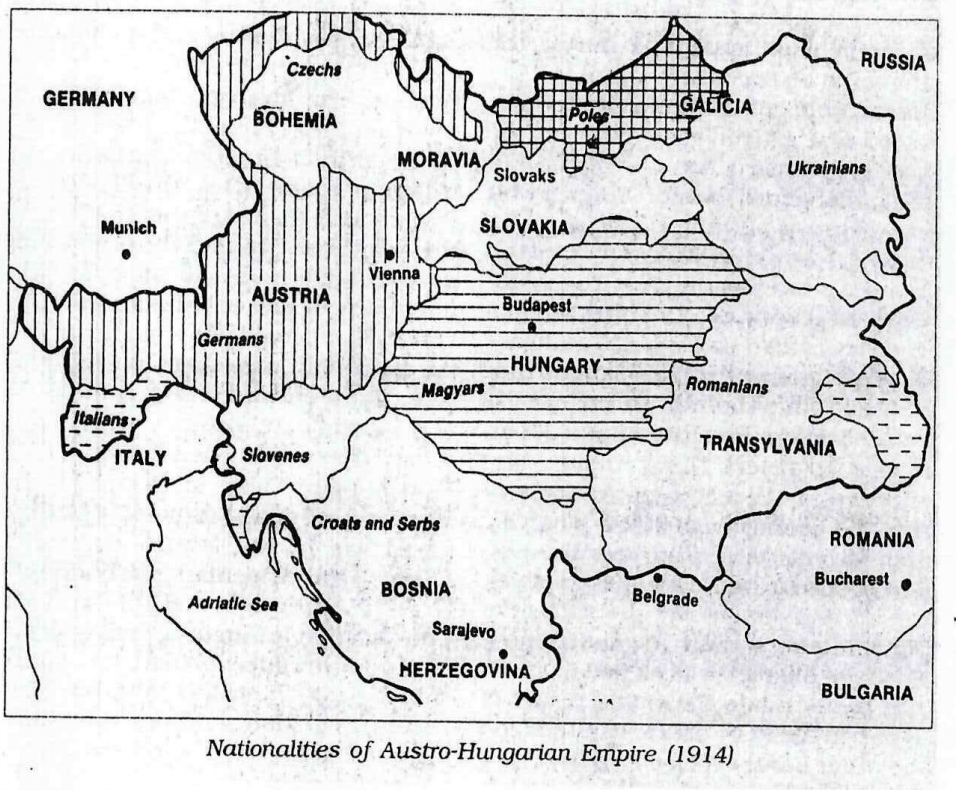
- The Moroccan Crisis (1908-1912)
- In 1908, Sultan Abdul Aziz IV of Morocco was overthrown by his brother Mulai Hafid, but his rule was unstable.
- The Riff tribes rebelled against Spain in 1909, forcing Spain to deploy 50,000 troops.
- In 1911, revolts around Fez led France to intervene, occupying the city while Spain seized Larache.
- Germany, angered by these developments, sent the warship Panther to Agadir, challenging the Treaty of Algeciras.
- Britain reacted sharply, leading to negotiations where Germany backed down.
- In 1912, France established a protectorate over Morocco, ceding parts of the French Congo to Germany in return.
- The crisis left lasting tensions between Britain, France, and Germany.
- The Italo-Turkish War (1911-1912)
- Italy, fearing French expansion in North Africa, declared war on Turkey in September 1911.
- Using Turkish interference in trade as a pretext, Italy seized Tripoli.
- Britain denied Turkey permission to send reinforcements through Egypt, allowing Italy an easy victory.
- The Treaty of Ouchy (October 1912) resulted in Turkey ceding Tripoli to Italy.
- Italy’s shift from the Triple Alliance to the Triple Entente was a crucial development for World War I.
- Formation of the Balkan League (1912)
- Bulgaria’s King Ferdinand and Prime Minister Gueshoff sought cooperation with Serbia to realize Bulgaria’s territorial ambitions.
- With Russian support, Serbia and Bulgaria signed a treaty in March 1912, joined by Greece in May and Montenegro in August.
- A secret annex in the treaty provided for joint military action against Turkey under Russian approval.
- The First Balkan War (1912-1913)
- Turkish promises of reform in Albania dissatisfied Serbia and Bulgaria.
- Montenegro mobilized, and by 3 November 1912, Balkan Christian states were at war with Turkey.
- The Bulgarians advanced toward Constantinople, forcing Turkey to seek European intervention.
- A conference in London led to a peace treaty in December 1912, but Enver Pasha rejected it.
- Fighting resumed, with Adrianople falling to Bulgarian and Serbian forces while Greece captured Jannina.
- The Treaty of May 1913:
- Greece gained Salonika, southern Macedonia, and Crete.
- Serbia secured northern Macedonia.
- Bulgaria received Thrace and the Aegean coast but ceded Silistria to Romania.
- Turkey retained Constantinople and eastern Thrace.
- The Second Balkan War (1913)
- Within a month, Bulgaria attacked Serbian forces in Macedonia and attempted to seize Salonika.
- Serbia and Greece resisted, while Romania invaded Bulgaria.
- Turkey exploited the situation to retake Adrianople.
- The Treaty of Bucharest (August 1913):
- Bulgaria lost access to the Aegean Sea and territory in Macedonia.
- Romania gained land with 340,000 people.
- Turkey retained Adrianople.
- Albania was recognized as independent.
- Prelude to World War I (1913-1914)
- The Balkan Wars proved that Britain and Germany could cooperate to prevent war.
- However, military buildup intensified across Europe, with growing tensions in Germany and France.
- French Ambassador to Vienna noted the rising belief that war was inevitable.
- The Assassination of Archduke Franz Ferdinand (28 June 1914)
- The heir to the Habsburg throne was assassinated in Sarajevo, triggering a chain of events leading to World War I.
- Austria issued an ultimatum to Serbia on 23 July 1914, demanding compliance within 48 hours.
- On 31 July, Germany gave Russia an ultimatum to halt mobilization within 12 hours.
- By 1 August, Germany and Russia were at war, followed by Germany’s declaration of war on France on 3 August.
- Germany’s invasion of Belgium provoked Britain, which declared war on 4-5 August.
- Bismarck’s 1891 prediction that a world war would start in the East proved correct.
- World War I
- Causes of World War I
- The immediate provocation for World War I was the assassination of Archduke Francis Ferdinand.
- However, several underlying causes had been brewing for over a generation, leading to the outbreak of the war:
- Extreme Nationalism
- Inflamed racial pride among people of different nations.
- Increased rivalries between states.
- Led to disputes over colonial possessions in Asia, Africa, and the Balkans.
- Nationalist aspirations in the Balkans turned the region into a volatile "tinderbox" that ultimately ignited the war.
- Formation of Alliances
- Nations grouped into mutually suspicious alliances, increasing tensions.
- Militarism, along with secret treaties, intensified rivalries, setting the stage for war.
- Imperialism and Economic Conflicts
- Competition for markets, raw materials, and investment opportunities.
- Germany’s unfulfilled imperialist ambitions played a major role in the war’s outbreak in 1914.
- Character and Progress of World War I
- When war broke out, it became unprecedented in scale and destruction:
- Nearly all known nation-states participated, and battles were fought worldwide.
- Lethal weaponry, including submarines, Zeppelins, poison gas, tanks, and armored vehicles, led to massive casualties.
- Like many European wars before, it was fought for the "Balance of Power."
- Two opposing sides emerged:
- Central Powers: Germany, Austria-Hungary, Bulgaria, and Turkey.
- Allied Powers: France, England, Japan, and Italy.
- Key Developments:
- For the first three and a half years, Germany held the upper hand.
- In 1917, Russia withdrew from the war after the Bolsheviks overthrew the Tsarist regime, further strengthening Germany.
- Germany's large-scale submarine warfare (U-boat menace) threatened Allied control of the seas.
- The Lusitania, a British ocean liner, was sunk by a German U-boat on May 7, 1915, and over 100 American passengers died.
- This factor along with Germany's unrestricted submarine warfare and it's incitation of Mexico against U.S. led U.S. to enter war and join allied forces.
- Germany surrendered in November 1918 due to combined Allied pressure.
- The Allies quickly defeated Turkey, secured Bulgaria's surrender, and witnessed Austria's collapse.
- End of the War:
- President Woodrow Wilson of the USA proposed the "Fourteen Points" as the basis for a peace settlement.
- A naval mutiny in Germany led to the Kaiser fleeing to Holland.
- A republic was established in Germany, which signed the armistice on 11 November 1918, ending the war.
- The Paris Peace Conference of 1919
- Held in Paris in 1919, attended by the victorious Allied powers.
- The venue selection reflected a spirit of vengeance.
- The conference had to consider various secret treaties made during the war regarding territorial distributions.
- French Prime Minister Clemenceau and British Premier Lloyd George pressured Wilson into compromising on his Fourteen Points.
- Resulted in a series of five treaties concluded in and around Paris.
- The Treaty of Versailles, 1919
- Signed between the Allies and Germany on 28 June 1919, the Treaty of Versailles imposed harsh conditions on Germany:
- Territorial Losses:
- Alsace-Lorraine was returned to France.
- Saar Valley’s coal fields were given to France for 15 years.
- Eupen and Malmedy were ceded to Belgium after a plebiscite.
- Schleswig was returned to Denmark following a plebiscite.
- West Prussia was used to create a Polish corridor to the Baltic.
- Memel was given to Lithuania, and Prussian Poland was annexed to Poland.
- Danzig was internationalized under League of Nations control.
- Colonial and Overseas Losses:
- Germany lost all African colonies and privileges in China, which were placed under the League of Nations.
- Military Restrictions:
- German army reduced to 100,000 men; conscription (compulsory enlistment for state service) abolished (formally put to an end).
- Banned the production and trade of war materials.
- German navy was limited and prohibited from having submarines.
- The Rhineland was demilitarized.
- War Guilt and Reparations:
- Germany accepted full responsibility for the war.
- Had to pay huge financial reparations (compensation).
- Allied forces occupied the left bank of the Rhine until treaty terms were met.
- The Treaty of Versailles was a "dictated peace" as German representatives had no say in its terms.
-
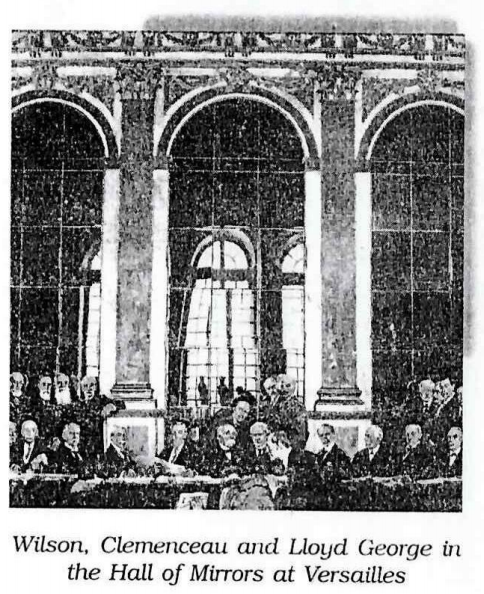
- Other Treaties
- Treaty of St. Germain (1919): Signed with Austria-Hungary, dismembering the empire:
- Bohemia and Moravia formed Czechoslovakia.
- Bosnia and Herzegovina merged with Serbia to form Yugoslavia.
- Italy received South Tyrol, Trentino, and parts of the Adriatic coast.
- Poland received Galicia, and Hungary became independent.
- Treaty of Neuilly (1919): Bulgaria lost:
- Western Thrace to Greece.
- Part of Macedonia to Yugoslavia.
- Dobruja to Romania.
- Treaty of Trianon (1920): Hungary ceded:
- Transylvania to Romania.
- Slovakia to Czechoslovakia.
- Croatia to Yugoslavia, losing all sea access.
- Treaty of Sèvres (1920): Signed with Turkey:
- Lost all rights in Africa and the Middle East.
- Greece occupied Eastern Thrace, Smyrna, and parts of Asia Minor.
- Armenia was to become independent.
- Dardanelles and Bosphorus became neutral zones.
- Turkish nationalist leader Mustafa Kemal rejected the treaty, leading to its replacement by the Treaty of Lausanne.
- Results of the War
- Collapse of four major empires: German, Austro-Hungarian, Ottoman, and Russian.
- Rise of new republics and smaller nation-states.
- Spread of democratic ideals, but also rise of totalitarian (authoritarian) ideologies (Bolshevism, Fascism, and Nazism).
- Formation of the League of Nations to resolve future conflicts.
- Advances in labor rights, women's suffrage, medicine, aviation, and military technology.
-
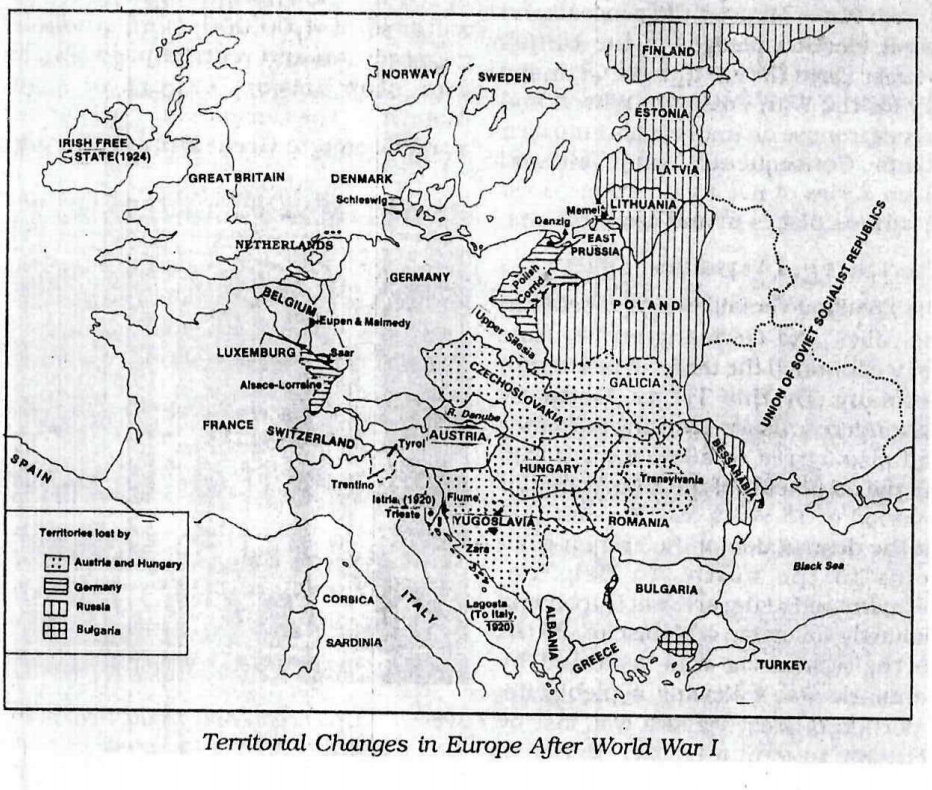
- Impact of World War I on India
- India actively supported Britain:
- 300,000 Indian soldiers fought in West Asia, Africa, and Europe.
- 800,000 more were later recruited.
- Supplied vast amounts of food, materials, and funds.
- Contributed £100 million to Britain’s war costs.
- Britain’s Response:
- Promised self-governance (Montagu Declaration, 20 August 1917).
- Montagu-Chelmsford Reforms (Government of India Act, 1919) introduced dyarchy.
- Failed to satisfy Indian aspirations, especially after oppressive measures:
- Rowlatt Act: Allowed arrests without trial.
- Jallianwala Bagh Massacre (1919): British troops killed peaceful protestors.
- Khilafat Movement: Discontent over British treatment of Turkey.
- Rise of Indian nationalism led by Mahatma Gandhi, ultimately culminating in India's independence on 15 August 1947.
- The Russian Revolution, 1917
- Introduction
- During World War I, two significant events occurred in 1917:
- The entry of the United States into the war, which ultimately influenced its outcome.
- The Russian Revolution, which marked the end of the Tsarist regime and introduced the “dictatorship of the proletariat”.
- The Russian Revolution was the most significant social upheaval (disruption) since the French Revolution.
- Circumstances Leading to the Russian Revolution
- The revolution, epitomized by the Bolshevik seizure of power in Petrograd on 7 November 1917, had long been in the making due to:
- The Russo-Japanese War (1905), which weakened confidence in the Tsarist regime.
- Russian military defeats in World War I, leading to further distrust.
- Widespread discontent with the inefficient and autocratic rule of the Tsar.
- The First Revolution (March 1917)
- Initially, Russia entered the war with enthusiasm and saw some early successes. However, by 1915:
- Military defeats exposed the regime’s weaknesses.
- Munitions (ammunition) and supplies were critically low.
- Tsar Nicholas II was weak and influenced by corrupt ministers.
- Rumors of a separate peace with Germany fueled unrest.
- Rasputin’s influence over the royal family worsened the crisis, leading to his assassination.
- Key Events:
- Riots erupted among peasants and workers.
- Desertions (abandonment) increased within the army.
- Food shortages intensified, particularly a shortage of bread.
- The Petrograd Soviet (workers’ and soldiers’ council) was formed.
- The Duma (parliament) established a Provisional Government, forcing Tsar Nicholas II to abdicate.
- The Provisional (interim, temporary) Government
- The Provisional Government, led by moderate republicans (Kadets), implemented:
- Liberal reforms (freedom of press, speech, and religion).
- Plans for a National Constituent Assembly.
- Commitment to continuing the war, hoping to maintain patriotic support.
- However, the masses prioritized:
- Peace
- Land reforms
- Food security
- Growing Discontent:
- The revolution shifted from a political movement to a socialist one.
- Local Soviets emerged across Russia, mobilizing workers, peasants, and soldiers.
- Workers demanded better wages and working conditions.
- Peasants seized (take hold forcefully) noble lands.
- Soldiers mutinied, and national minorities (Finns, Poles) sought independence.
- The Second Revolution (November 1917)
-
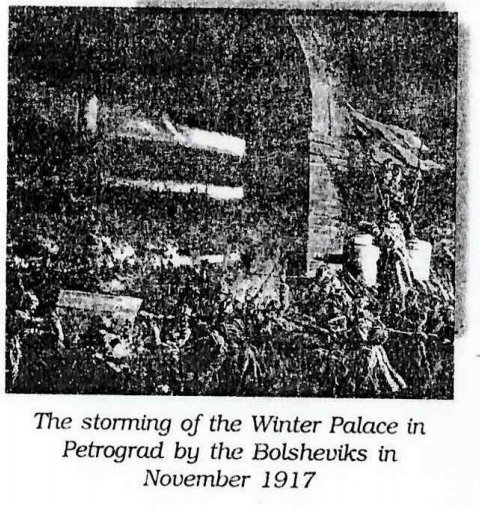
- The Rise of the Bolsheviks:
- The failure of the Provisional Government to end the war led to dissatisfaction.
- Mensheviks, under Alexander Kerensky, came to power but failed to bring peace.
- The Bolsheviks, led by Lenin and Trotsky, opposed the war and advocated immediate socialist reforms.
- The Bolshevik Coup (seizure of power):
- Germans advanced towards Petrograd, creating instability.
- Bolshevik influence grew within the Petrograd Soviet.
- In November 1917, the Bolsheviks overthrew the Provisional Government.
- Kerensky fled, and Bolsheviks seized power.
- Consolidation of Bolshevik Rule
- Immediate (action of making something more solid or stronger) Actions:
- Lenin negotiated the Treaty of Brest-Litovsk (1918), ending Russia’s involvement in World War I.
- Territorial losses were accepted as a necessary price for revolution.
- Key Reforms:
- Abolition of private property.
- Peasants received land to be cultivated for the state.
- Factories were handed over to workers.
- Compulsory labor was introduced.
- Public debts were repudiated (rejected).
- The Orthodox Church was stripped of power.
- Repression (action of subduing someone):
- The Cheka (secret police) executed opposition figures, including Tsar Nicholas II and his family (July 1918).
- The Red Army, led by Trotsky, crushed anti-Bolshevik forces, ensuring Bolshevik rule for over 70 years.
- Causes of the Russian Revolution
- The revolution resulted from long-term dissatisfaction across Russian society:
- Peasants (agricultural worker)
- Suffered economic insecurity and social oppression.
- Small land holdings vs. large aristocratic estates led to resentment (bitterness / anger and disappointment).
- Formed the bulk of the Social Revolutionary Party.
- Workers
- Low wages and harsh working conditions led to discontent.
- Many joined the Workmen’s Social Democratic Party.
- Middle Class (Bourgeoisie)
- Wanted constitutional government to limit autocratic rule.
- Intellectuals
- Advocated radical political and social reform.
- Minority Nationalities (Jews, Poles, Finns, etc.)
- Resisted Tsarist policies of Russification (making russian) and sought independence.
- Influence of Ideologies
- Moderate republicanism and Marxian socialism fueled revolutionary movements.
- These diverse elements ultimately overthrew the Tsarist regime, leading to the establishment of a socialist state under the Bolsheviks.
- The world from 1919 to 1939
- The Inter-War Period (1919–1939): Prelude to World War II
- Aftermath of World War I
- World War I, or the Great War, was called the ‘war to end all wars.’
- It was the most devastating conflict in human history up to that time.
- Over 37 million combatants lost their lives.
- None of the original parties to the war achieved anything substantial.
- Despite the devastation, the war ended with a sense of hope.
- Post-War Optimism
- Many expected that humanity would learn from the horrors of the war.
- It was hoped that future territorial disputes would be resolved through structured dispute-settlement mechanisms.
- There was optimism that democracy would be safeguarded.
- Hopes of equity and progress for all were widespread.
- Reality: Continued Chaos and Disillusionment
- Contrary to expectations, Europe quickly fell into further chaos.
- The United States and Europe remained the political and economic centers of global affairs.
- Instead of peace and stability, disillusionment spread across the world.
- Persistence of Pre-War Institutions
- Colonialism remained intact, keeping over half of the world’s population in subjugation.
- Aristocracy, feudalism, supra-nationalism, and militarism continued to exist.
- Rather than fading away, these forces shaped the political landscape of the post-war world.
- Rise of New Political Forces
- Fascism (authoritarian right wing) and Communism (state ownership / collectivism) emerged as dominant ideologies.
- These forces played a crucial (decisive) role in destabilizing Europe.
- The continent, and consequently the world, moved closer to another catastrophic war.
- The ‘Inter-War’ Period (1919–1939)
- The period between World War I and World War II is known as the ‘inter-war’ period.
- During this time, major world powers and their allies influenced global politics.
- Their actions collectively contributed to the conditions that led to World War II.
- This chapter analyzes their roles in the unfolding global crisis.
- The League of Nations: Mankind’s First Global Peacekeeping Attempt
- Introduction
- Any discussion on the inter-war period must begin with the League of Nations.
- It was humanity’s first attempt at creating a global institution to prevent armed conflict.
- The League aimed to serve as a neutral arbiter in international disputes while preserving national sovereignty.
- Origin and Vision
- The League of Nations was originally the vision of U.S. President Woodrow Wilson (1913–21).
- He proposed its formation in his Fourteen Points on 18 January 1918.
- The victorious powers incorporated the Covenant (agreement / contract) of the League of Nations into the peace treaties that concluded World War I.
- It was designed as a forum where all states, regardless of size, could cooperate to maintain peace and limit military aggression.
- Formation and Structure
- The Covenant of the League of Nations outlined its principles and operational framework.
- An international committee, including leaders like Lord Robert Cecil (Britain), Jan Smuts (South Africa), and Léon Bourgeois (France), drafted the Covenant.
- President Wilson ensured that the Covenant was included in every peace treaty, securing its establishment.
- Headquarters: Geneva, Switzerland.
- Main Organs:
- General Assembly – Included all member states.
- Council – Had four permanent members: Britain, France, Italy, and Japan.
- Permanent Court of International Justice – Based in The Hague, Netherlands.
- Secretariat – Managed administrative affairs.
- Various Committees – Focused on mandates, dispute resolution, and disarmament.
- Peacekeeping Arm – Responsible for conflict resolution.
- International Labour Organisation (ILO) – Created under the League’s mandate.
- Refugee and Health Organisations – Precursors to modern United Nations (UN) agencies.
- Fundamental Weaknesses and Contradictions
- The League was flawed from the beginning.
- It did not include a clear stance against colonialism.
- Instead, it introduced a “mandate” system, where colonies were placed under the control of major powers under the pretext of guiding them toward independence.
- Lack of enforcement mechanisms made this provision (providing / supplying) ineffective.
- To persuade Japan to join, it allowed Japan to take over former German concessions (allowance / something that is provided in exchange) in China.
- To appease France, Germany and Russia were excluded from membership.
- The United States refused to join, further weakening the League.
- The reasons include internal senate opposition between political parties (Democrats vs Republicans), fear of loss of sovereignty, to sentiment to remain isolated from European conflicts.
- As a result, three of the world’s most powerful nations (USA, Germany, and Russia) had no role in the League, significantly diminishing its impact.
- Failures of the League
- The League repeatedly failed to act in major international crises:
- 1920 - Polish Seizure of Vilna:
- France-backed Poland seized the Vilna region from Lithuania, and the League did not intervene.
- 1923 - Corfu Incident:
- Three Italian officials were murdered on Greek territory.
- Italian dictator Benito Mussolini blamed Greece and demanded compensation.
- Greece refused, leading to an Italian bombing campaign on Corfu.
- Instead of League intervention, Britain and France acted as mediators.
- 1931 – Japanese Invasion of Manchuria:
- Japan seized Manchuria from China in violation of international agreements.
- 1936 – Italian Invasion of Ethiopia:
- Italy conquered Ethiopia, and the League did nothing.
- 1930s – Rise of Adolf Hitler:
- By the time Hitler emerged as a European threat, secret treaties and power-balancing tactics had returned, rendering the League obsolete.
- Legacy of the League of Nations
- The League provided a model for the United Nations (UN), which was established after World War II.
- However, during its existence, it failed to prevent major conflicts and proved ineffective in maintaining peace.
- With the League’s decline, global politics reverted to military alliances, secret treaties, and power struggles, setting the stage for World War II.
- Germany
- The Impact of the Treaty of Versailles on Germany
- The Treaty’s Effect on German Pride
- The Treaty of Versailles left a deep scar on German pride.
- Many Germans believed they had been “stabbed in the back” by their own generals and communists at the end of World War I.
- This resentment (bitterness) fueled the desire for revenge, contributing to the conditions leading to World War II.
- A Historical Perspective on Post-War Punishments
- Retaliatory actions after conflicts were not uncommon in European history.
- The Congress of Vienna (1815) had imposed heavy penalties on France for the Napoleonic Wars.
- Germany had treated France harshly in 1871 after the Franco-Prussian War.
- The Treaty of Brest-Litovsk (1918) had imposed severe territorial and economic losses on Russia by Germany.
- Compared to Brest-Litovsk, Versailles was lenient—Germany remained geographically and economically intact and preserved its political unity.
- The Weimar Republic: Struggles and Challenges
- Formation of the Weimar Republic
- Germany’s Chancellor Philip Scheidemann called the Treaty an “imprisonment of the German people” but had no choice but to accept it.
- The Social Democrats and the Catholic Centre Party formed a new government, signing the Treaty under pressure from the victorious Allies.
- The new government, known as the Weimar Republic (1919–1933), was stigmatized (condemned / regarded as unworthy) for accepting Versailles under threat of military occupation.
- The Weimar Constitution
- A liberal document promising civil liberties and universal adult suffrage.
- However, it had structural flaws:
- Proportional representation made it easy for small parties to gain seats, destabilizing governance.
- The President had the power to appoint or remove the Chancellor, who led the cabinet.
- The President could rule by decree (an official order) in national emergencies, enabling dictatorship.
- Political Instability and Extremist Threats
- Left-Wing and Right-Wing Uprisings
- The Republic faced constant threats from both left-wing communists and right-wing conservatives.
- In 1919, the Spartacist uprising, led by Rosa Luxemburg and Karl Liebknecht, attempted a communist revolution but was crushed by the Army. Both leaders were executed.
- In 1920, the right-wing Kapp Putsch tried to restore Prussian aristocratic dominance, causing government officials to flee Berlin temporarily.
- Subsequent strikes and uprisings required military intervention.
- Assassinations of key Republican leaders further destabilized Germany.
- Economic Crises and Their Political Impact
- The Burden of War Reparations
- In 1921, the Allies presented Germany with a war reparations (compensation) bill of over $33 billion, forcing the Weimar government to accept under threat of invasion.
- The French invaded the Ruhr in 1923 to enforce payments, prompting passive resistance—German workers went on strike while the government subsidized them.
- Hyperinflation and Unemployment
- Printing excessive currency led to hyperinflation.
- Unemployment reached 6 million in the mid-1920s.
- Salaries could not keep up with rising prices.
- Those with fixed incomes suffered the most.
- The Great Depression’s Impact (1929)
- Germany’s economic revival had relied on American loans and cheap exports under the Dawes Plan (1924) and the Young Plan (1929).
- The Wall Street Crash (1929) caused an economic collapse, further weakening the Republic.
- Agricultural prices collapsed, angering farmers.
- University students faced disillusionment due to unemployment.
- Weimar Republic’s Brief Stability and Stresemann’s Efforts
- Gustav Stresemann’s Leadership (1923)
- Briefly served as Chancellor before becoming Foreign Minister.
- Stabilized the economy by appointing economist Hjalmar Schacht, who introduced a new currency (Rentenmark).
- Negotiated new reparation payment methods, leading to the withdrawal of French forces from the Ruhr.
- Foreign Policy Achievements
- Pursued reconciliation with Britain and France.
- Germany joined the League of Nations.
- Negotiated the Treaty of Locarno (1925), which secured Germany’s western borders but left eastern borders ambiguous—favoring future territorial revision.
- However, nationalist parties, including Hitler’s Nazi Party, opposed Locarno, seeing it as an extension of Versailles.
- The End of Weimar and the Rise of Totalitarianism
- Despite Stresemann’s efforts, the Great Depression provided an opportunity for radical political forces.
- Economic desperation led to a shift towards totalitarian ideologies.
- Hitler and the Nazi Party exploited public discontent to rise to power in 1933, marking the end of the Weimar Republic.
- The Rise of Nazism
- Adolf Hitler’s Early Life and Entry into Politics
- Adolf Hitler first appeared on the German political scene in 1923. His rise to power was unprecedented (never known or seen before).
- William L. Shirer, the American journalist-historian, described him as an unlikely figure to succeed the legacy of Bismarck, the Hohenzollern emperors, and President Hindenburg.
- Born in 1889 as the son of an Austrian customs official, Hitler had an incomplete education and lived as a vagabond (a person who wanders from place to place without a home or job) in Vienna.
- During World War I, he fought in the German Army with exceptional valor (bravery / courage / fearlessness), earning high military honors.
- After the war, he lived a purposeless life but was deeply affected by Germany’s humiliation, fueling his desire for revenge and driving him into politics.
- Formation of the Nazi Party
- In 1919, as an intelligence agent for the German Army, Hitler attended a meeting of a small nationalist and anti-Semitic group and later joined it out of curiosity.
- By 1920, the group was renamed the National Socialist German Workers Party (Nazi Party).
- The party’s Twenty-Five Points demanded:
- Repudiation (rejection) of the Treaty of Versailles.
- Unification of Austria and Germany.
- Exclusion of Jews from German citizenship.
- Agrarian reforms and nationalization of industries.
- The Nazis conducted their activities with military fanfare, organizing paramilitary groups known as Sturm Abteilung (SA) or Brownshirts.
- The 1923 Beer Hall Putsch and Its Aftermath
- The French occupation of the Ruhr Valley in 1923 helped the Nazis stir nationalist passions.
- On November 9, 1923, Hitler led a failed coup in Munich during a Bavarian legislature meeting at a Beer Hall.
- The coup was crushed, and Hitler was sentenced to five years in prison, but he served less than a year before being paroled (permanent or temporary release of a prisoner before the expiry of sentence on the promise of good behaviour).
- While in jail, he wrote Mein Kampf (My Struggle) and realized that legal means were necessary to capture power.
- The Nazis and the Economic Crisis of 1929
- After Hitler’s release, extreme nationalism lost appeal under the Weimar Republic’s reformist phase.
- The Great Depression of 1929 devastated Germany’s economy, increasing unemployment and political instability.
- The centrist coalition government collapsed in March 1930 over economic disagreements.
- President Paul von Hindenburg ruled by decree and appointed Heinrich Brüning as Chancellor, but the crisis persisted (carried on).
- Nazi Electoral Success and Hitler’s Rise to Power
- In 1932, von Hindenburg replaced Brüning with Franz von Papen, who sought Nazi support.
- The Nazi Party gained 30.1% of votes in 1930, rising from 12 Reichstag seats in 1928 to 107 seats.
- To counter opposition, von Papen lifted the ban on Nazi rallies, leading to further electoral gains.
- In the July 1932 elections, the Nazis won 230 seats (37.2% of the vote).
- Hitler demanded the Chancellorship, but Hindenburg refused.
- After political deadlock and von Papen’s resignation, Kurt von Schleicher was appointed Chancellor but dismissed soon after.
- On January 30, 1933, Hitler was appointed Chancellor of Germany.
- Hitler’s Consolidation of Power
- Eliminating Political Opposition
- Within a month of taking office, Hitler used the Reichstag Fire incident to suppress communists.
- The fire was later revealed to be set by Nazi agents, but they blamed the communists, stirring fears of a Soviet-style revolution.
- Hitler secured emergency powers and jailed or executed communist leaders.
- In March 1933, the Enabling Act was passed, allowing Hitler to rule by decree.
- Establishing a One-Party Dictatorship
- Hitler outlawed all political parties by July 1933, making the Nazi Party the only legal party.
- Provincial governments were reorganized to suit Nazi interests.
- Opposition politicians were imprisoned, sent to concentration camps, or murdered.
- Nazi spies monitored civilians, turning Germany into a police state.
- Germans were forced to swear personal loyalty to Hitler, addressed as Der Führer (The Leader).
- The Suppression of Jews
- May 1933: Jewish intellectuals’ books were burned in public bonfires.
- 1935 Nuremberg Laws: German Jews lost their citizenship and were expelled from jobs.
- November 1938 Kristallnacht (Night of Broken Glass):
- Jewish homes, shops, and synagogues were attacked.
- Thousands of Jews were arrested.
- The Night of the Long Knives (June 30, 1934)
- The SA (Brownshirts), led by Ernst Röhm, had grown to one million members.
- The German Army feared it would become a rival military force.
- To secure the Army’s loyalty, Hitler ordered Röhm’s execution along with key SA leaders.
- Former Chancellor von Schleicher was also killed.
- A month later, President von Hindenburg died, and Hitler merged the offices of President and Chancellor, becoming the supreme dictator.
- Hitler’s Militarization and Foreign Policy
- Hitler rearmed Germany, violating the Treaty of Versailles.
- In 1936, he remilitarized the Rhineland, but France failed to intervene.
- He promoted Lebensraum (“living space”), justifying territorial expansion in Eastern Europe.
- Conclusion: Germany’s Path to War
- Within two decades of World War I, Germany emerged as a threat to European peace.
- The Allied powers, preoccupied with domestic problems, did not resist Hitler’s militarization.
- Hitler instilled (gradually but firmly establish) racist ideologies, portraying Germans as Aryans, superior to Jews and Slavs.
- This ideology set Germany on the path to another global war.
- Meanwhile, a similar authoritarian movement was rising in Italy under Fascism, which we shall now examine.
- Italy and the Rise of Fascism
- Origins and Ideology of Fascism
- Fascism was a political ideology antithetical (directly opposed or contrasted) to democracy
- Fascism opposed:
- Democracy
- Parliamentarism
- Individual liberty
- Freedom of expression
- State control over businesses (though it clashed with communism)
- Derived from the Italian word fasces, meaning the authority of the state over all.
- Fascists believed:
- Democratic politics weakened nations by prioritizing partisan interests over national unity.
- Single-party rule was necessary to maintain order and strength.
- Benito Mussolini:
- First fascist dictator, came to power in 1922.
- Declared in 1931:
- “The Fascist conception of the state is all-embracing, and outside of the state, no human or spiritual values can exist.”
- Fascist governments in Italy, Germany, and Spain were characterized by:
- Single-party rule
- Use of terror
- Regimentation (organized according to a strict system) of society
- Widespread police surveillance
- Mussolini’s Early Life and Political Rise
- Born in 1883, son of a blacksmith.
- Entered politics in 1912 as a socialist.
- In 1914:
- Left socialism.
- Joined the Italian Army (Italy fought on the Allied side in WWI).
- Was wounded in action.
- After WWI (1919):
- Founded Fasci di Combattimento (Band of Combatants) in Milan.
- Nationalist sentiment grew in Italy due to:
- A feeling of betrayal, as the country was denied territorial gains despite being on the victorious side.
- Dysfunctional parliamentary system.
- Widespread internal turmoil, strikes, and unrest.
- Fear of a communist takeover.
- The Rise of the Black Shirts and Seizure of Power
- Mussolini organized the Black Shirts to:
- Terrorize Socialists (the most powerful party at the time).
- Attack strikers and farm workers.
- Gained support from:
- Conservatives
- Industrialists
- 1921:
- Mussolini and 34 of his followers elected to the Chamber of Deputies.
- October 1922:
- Organized the March on Rome (hundreds of thousands of Black Shirts participated).
- King Victor Emmanuel III, alarmed, sent a telegram on 29 October asking Mussolini to become Prime Minister.
- Mussolini’s Establishment of Dictatorship
- Initially, Mussolini’s Fascists were a minority in the Chamber of Deputies.
- He demanded dictatorial powers from the King:
- The King, pressured by big business, agreed on 23 November 1922.
- Given dictatorial powers for one year to ensure good governance.
- Mussolini’s actions to consolidate power:
- Removed elected representatives from lower government levels.
- Replaced them with Fascists.
- 1924:
- Changed election laws:
- The party with the largest popular vote would automatically receive two-thirds of Parliament seats.
- Coalition governments became obsolete.
- 1925 elections:
- Fascists gained complete control over the Chamber of Deputies.
- 1925–1926:
- Passed laws granting Mussolini:
- Power to rule by decree.
- Authority to dissolve all other political parties.
- Mussolini’s Policies and Downfall
- Ruthless against opponents.
- Gained popularity among the masses through:
- Large public projects.
- Social security for workers.
- Subsidized vacations.
- 1929:
- Won over the Catholic Church:
- Gave the Pope sovereignty over the Vatican.
- Made Roman Catholicism the state religion.
- Late 1920s:
- Strengthened Italy’s economy.
- 1930s:
- Great Depression weakened Italy’s economy.
- To maintain power, Mussolini initiated military adventures abroad.
- Italy’s aggressive policies contributed to Europe’s instability, leading to World War II.
- Spain and the Spanish Civil War
- Spain Before the Civil War
- 1 Constitutional Monarchy (1885–1923)
- Spain was a constitutional monarchy under King Alfonso XIII (ruled since 1885).
- 2 Rule of General Primo de Rivera (1923–1930)
- 1923: General Primo de Rivera staged a coup and ruled with the King’s approval.
- Though a dictator, he was:
- Not a fascist.
- Progressive in implementing public works and industrialization.
- Successfully resolved Spain’s problems in Morocco (1925).
- Spain remained stable until the Great Depression affected its economy.
- The economic crisis led to:
- Financial ruin.
- Rising unemployment.
- Loss of Army support for de Rivera.
- 1930: De Rivera resigned, and King Alfonso XIII abdicated (resigned / give up throne).
- A Republic was proclaimed.
- Problems Faced by the New Republic
- Political and Regional Conflicts:
- Catalonia and the Basque provinces demanded separation.
- The Roman Catholic Church opposed the Republic and wanted the King’s return.
- Economic Crisis:
- Wine and olive export markets collapsed.
- Iron and steel production declined.
- Unemployment rose.
- Public discontent against the new government.
- Right-Wing Reforms and Resistance:
- Conservative Right-Wing parties controlled the Cortes (Parliament).
- They were supported by socialists and middle-class radicals.
- Attempted reforms:
- Allowed Catalonia some autonomy.
- Increased workers’ wages.
- Nationalized large estates.
- Separated the Church from the State.
- These reforms caused internal conflicts among the Right-Wing factions.
- Pro-Church CEDA party defended:
- The Church.
- The rich landlords.
- Rise of Fascism and the Road to Civil War
- 1932: Army officers attempted a coup against Prime Minister Manuel Azaña, but it failed.
- Left-Wing (Communist-inspired) parties launched agitations to weaken the Republic.
- 1933 elections:
- Azaña’s government was defeated.
- A Right-Wing government, dominated by the CEDA, was formed.
- The government failed to restore peace.
- Formation of the Fascist Party (Falange, 1933):
- Founded by José Antonio de Rivera, son of the former dictator.
- Supported by the Army.
- 1936: The Army incited rebellion in Spanish Morocco, sparking the Spanish Civil War.
- The Spanish Civil War (1936–1939)
- Brutal conflict with atrocities on both sides.
- Became a proxy war for world powers.
- Key participants:
- Fascists (led by General Francisco Franco):
- Received arms, troops, food, and ammunition from Hitler (Germany) and Mussolini (Italy).
- Republicans:
- Direct support from the Soviet Union (Russia).
- Unofficial support from Britain and France (sent “volunteers” to fight).
- March 1939: Franco captured Madrid and declared himself Dictator.
- Ruled Spain until 1975.
- Significance of the Spanish Civil War
- Though an internal conflict, it is often called a “Little World War” due to international involvement.
- Spain remained neutral in World War II under Franco’s rule.
- Britain and France in the Inter-War Period
- Britain in the Inter-War Years
- 1 Economic Decline Post-World War I
- Britain emerged victorious from World War I but lost its position as the world’s foremost industrial power to the United States.
- The country suffered from economic stagnation, like the rest of Europe.
- To revive the economy, the government implemented:
- Wage reductions to make British goods more competitive.
- This backfired, leading to strikes and industrial unrest.
- Political impact:
- The failure of economic policies ended Conservative supremacy.
- The Labour Party came to power in 1924 and 1929.
- The Great Depression (1929) worsened economic conditions.
- 1931: A National Government was formed with representatives from the Conservative, Liberal, and Labour parties.
- 2 Social and Economic Challenges
- Women’s Suffrage (1918):
- Representation of the People’s Act granted women the right to vote, but:
- The voting age for women was 30, while for men, it was 21.
- Economic Problems:
- 1920: A slump in British overseas trade led to massive unemployment.
- Labour Party demanded:
- Reforming the industrial system along socialist lines.
- Strikes in railways and coal industries shook the country.
- 3 The Irish Problem (1918–1922)
- 1918 elections:
- The old Irish Nationalist Party was defeated.
- Sinn Féin emerged as the dominant party.
- Sinn Féin leaders Michael Collins and Arthur Griffith:
- Advocated Republicanism.
- Set up a Republican government in Ireland.
- Rejected British authority.
- British response:
- Offered to establish two separate governments in Dublin and Belfast.
- Brutally suppressed Irish resistance.
- Led to severe public resentment (bitterness) in both Ireland and Britain.
- 1921: Under pressure from the United States, the David Lloyd George government negotiated a settlement:
- Irish Free State was created with British dominion status.
- Accepted by Griffith and Collins, but rejected by Eamon de Valera.
- 1922: Irish Civil War erupted between:
- Republicans.
- Those who accepted the 1921 treaty.
- 4 Britain’s Industrial and Economic Struggles
- Britain’s economic power, built in the 19th century, declined significantly.
- Before World War I, Britain dominated:
- Textiles, heavy engineering, and manufactured goods.
- Post-war competition:
- United States and Germany captured British markets.
- Asian and African colonies started producing their own goods.
- Tariff barriers in America and Europe made British exports uncompetitive.
- Great Depression impact (1929):
- Britain faced a severe financial crisis.
- The James Ramsay MacDonald government had to:
- Raise taxes (a politically risky move).
- Establish a National Government in 1931, including all major parties.
- Recovery Measures:
- Increased taxes and wage cuts (unpopular but necessary).
- Trade agreements with Canada and Australia boosted exports.
- By 1934, the economy showed signs of recovery.
- France in the Inter-War Years
- 1 Economic Challenges and Political Struggles
- France faced severe economic problems, worsened by:
- The threat of Fascist and Communist movements.
- The Bolshevik takeover in Russia (1917), which deprived France of an anti-German ally.
- French Military Interventions:
- Sent troops to support anti-communist forces in Russia (White Russians).
- 1920: Helped Poland defeat Russia in the Polish-Soviet War.
- Rising international tensions:
- 1935: Britain signed the Anglo-German Naval Agreement, allowing Germany to build submarines (violating the Treaty of Versailles).
- France felt betrayed and was unable to counter Hitler’s remilitarization of the Rhineland.
- 2 Economic Development Amidst Class Struggles
- France’s economic condition improved during the inter-war years.
- However, class conflicts emerged, hindering national progress.
- Governments of Raymond Poincaré (1922–1924) and Édouard Herriot (1924–1926):
- Industries prospered, but at the cost of labor rights.
- Rise of the United States
- The United States as an Economic Power
- By the late 19th century, the U.S. had already become a global economic power.
- After World War I, its vast industrial capacity and large domestic market reinforced its dominance in global trade.
- During World War I, the U.S. loaned the Allies over $12 billion at a 5% interest rate.
- In the 1920s, the U.S. government encouraged American corporations to expand profits in Europe, Canada, and Central and South America.
- The Republican Party (1921–1933) followed an isolationist policy, keeping the U.S. out of European politics.
- The U.S. did not join the League of Nations but could not fully disengage due to its global economic interests.
- The American public demanded repayment of loans given to Britain and France.
- Domestic Policies and Social Inequality
- Successive U.S. Presidents in the inter-war years ignored social reforms.
- Government policies prioritized big businesses over workers’ rights.
- When individual states passed progressive laws, the Supreme Court often struck them down.
- The economic boom benefited private industries but widened the gap between the rich and the poor.
- Labour rights were weak, and wages did not grow in proportion to economic expansion.
- U.S. Intervention in Germany’s Financial Crisis
- The U.S. played a key role in stabilizing Germany’s economy during its financial crisis in 1923.
- Under the Dawes Plan (1924) and Young Plan (1929), ‘German bonds’ were sold to American investors.
- This financial aid helped Germany pay reparations to Britain and France.
- Britain and France, in turn, used that money to repay their debts to the U.S.
- Economic Boom and the Great Depression
- The U.S. economy boomed in the 1920s due to strong industrial growth and financial capacity.
- American consumers created high demand for domestic goods.
- European products struggled to compete due to high tariff barriers protecting U.S. industries.
- By 1927, consumer demand peaked and then started to decline.
- The stock market became overextended, with inflated share prices and risky margin trading.
- In October 1929, the Wall Street Crash triggered a financial collapse.
- The Great Depression began, shrinking the market to one-tenth of its previous value.
- American investments in German bonds stopped, worsening the global financial crisis.
- Banks collapsed, industries shut down, and unemployment soared.
- By 1933, 14 million people were jobless, and wages had drastically fallen.
- Great depression
- The Great Depression: The Worst Economic Crisis
- The Great Depression was the worst economic crisis in history.
- It began in the United States and spread across the industrialized world.
- The primary cause was the extreme inequality in wealth distribution during the 1920s.
- Causes
- Wealth Inequality and Its Impact
- Between 1923 and 1929, the U.S. national income grew from $74.3 billion to $89 billion.
- However, this wealth was not evenly shared.
- The top 0.1% of Americans had the same income as the bottom 42%.
- This elite group controlled 34% of all savings, while 80% of Americans had no savings at all.
- The Wage-Consumption Imbalance
- Industrial productivity increased, but wages did not grow proportionally.
- Business owners made large profits by keeping wages low.
- A healthy economy requires a balance between supply and demand.
- By the late 1920s, an oversupply of goods existed, but consumers lacked purchasing power.
- The Rise of Consumer Credit
- With limited incomes, Americans turned to credit to buy goods.
- The “buy-now-pay-later” trend became widespread.
- By the late 1920s:
- 60% of cars and 80% of radios were bought on installment plans.
- Outstanding installment credit doubled from $1.38 billion in 1925 to over $3 billion in 1929.
- People spent most of their income repaying past loans, reducing their ability to make new purchases.
- The Fragile Economic Foundation
- The U.S. economy depended on luxury spending and investments by the wealthy.
- This worked only as long as the rich had confidence in the economy.
- The economic structure was weak:
- 200 corporations controlled over half of corporate wealth.
- The automobile sector thrived, but agriculture suffered.
- Many industries relied on car and radio production (steel, glass, rubber, petrol, construction).
- Demand for cars and radios was limited, while food was a necessity—but agriculture was in ruins by 1929.
- International Economic Instability
- America’s economic boom in the 1920s contrasted with Europe’s struggles after World War I.
- During the war, the U.S. loaned European allies $7 billion and another $3.3 billion in the 1920s.
- Under the 1924 Dawes Plan, the U.S. lent money to Germany.
- Over 90% of these loans were used to buy American goods.
- However, the U.S. imposed high tariffs on European products, preventing European recovery and repayment of debts.
- The Culture of Stock Market Speculation
- Many Americans turned to stock market investments to pay off debts.
- In the absence of wage growth, people borrowed money to buy shares.
- Brokers allowed investors to buy shares with loans:
- A person could buy a $75 share with just $10 of their own money, borrowing the remaining $65.
- As stock prices surged, investors could sell at a higher price, repay the broker, and keep profits.
- However, the stock boom was not based on real economic growth—many companies with soaring stock prices were financially weak.
- The 1929 Stock Market Crash
- By mid-1929, brokers’ outstanding loans totaled over $7 billion, rising to $8.5 billion in just three months.
- Share prices suddenly began to fall.
- Panic selling followed, and on “Black Tuesday” (October 29, 1929), stock prices collapsed.
- Buyers disappeared, and share values plummeted.
- The Economic Collapse and Global Impact
- The stock market crash destroyed the confidence of wealthy Americans.
- Luxury spending and investments stopped.
- The middle and lower classes could no longer pay off loans or afford new purchases.
- This led to a decline in industrial demand and production.
- Mass layoffs followed, and unemployment skyrocketed.
- The crisis spread to Europe and other nations reliant on U.S. investment.
- Unemployment in the U.S. rose from 5 million in 1930 to 13 million in 1932.
- The country spiraled into economic disaster—this was the Great Depression.
- The Impact of the Depression and Roosevelt’s New Deal
- End of Republican Governance
- The Great Depression ended 11 years of Republican rule.
- Republican Presidents:
- Warren Harding (1921-23)
- Calvin Coolidge (1923-29)
- Herbert Hoover (1929-33)
- Franklin D. Roosevelt (Democrat) introduced the New Deal to revive the economy.
- Franklin D. Roosevelt: A Dynamic Leader
- Suffered from polio, leaving his legs completely paralyzed.
- Displayed great determination but could never walk unaided.
- Excellent communicator, gained popularity through radio addresses.
- First and only US President to serve four terms.
- Later, a law was passed limiting Presidents to two terms.
- Objectives of the New Deal
- Relief – Direct aid to the poor, homeless, and unemployed.
- Recovery – Reduce unemployment and boost economic demand.
- Reform – Prevent another Wall Street crash.
- Key Policies of the New Deal
- Banking & Financial Reforms
- Government temporarily took over banks and financial institutions.
- Securities Exchange Commission (1934) regulated the stock market.
- Investors buying shares on credit had to pay at least 50% upfront.
- Agricultural Support
- Farmer’s Relief Act (1933) paid farmers to reduce production, raising prices.
- By 1937, farmers’ incomes doubled but left many farm laborers jobless.
- Employment & Infrastructure Development
- Civilian Conservation Corps created 2.5 million jobs by 1940.
- Workers earned $30 per month, with $25 sent directly to families.
- Provided free food, clothing, and necessities.
- National Industrial Recovery Act (1933)
- Created Public Works Administration for large infrastructure projects.
- Built dams, roads, bridges, hospitals, schools, and airports.
- Inspired by John Maynard Keynes (Keynesian economics).
- Labour Reforms
- National Recovery Administration
- Abolished child labor.
- Introduced an eight-hour workday.
- Encouraged, but did not force, businesses to comply.
- Wagner Act (1935)
- Recognized labor unions.
- Established National Labour Relations Board for worker grievances.
- Fair Labour Standards Act (1938)
- Maximum 45-hour workweek.
- Minimum wage introduced.
- Social Security Act (1935)
- Old-age pensions.
- Unemployment insurance.
- Impact of the New Deal
- Millions of jobs created.
- Unemployment fell to 8% by 1937.
- Restored public confidence in the government.
- Prevented a communist revolution.
- Tennessee Valley Authority and other projects provided lasting infrastructure.
- First step towards making the US a welfare state.
- Debate: The New Deal vs. World War II
- Historians agree Roosevelt saved democracy from fascism and communism.
- Debate over whether the New Deal or World War II caused lasting economic recovery.
- Arguments Against the New Deal
- Did not fully end the Depression.
- World War II played a bigger role in economic recovery.
- World War II’s Economic Impact
- US supplied tanks, aircraft, and weapons to Europe from 1939 onward.
- Between June 1940 and December 1941, supplied Britain with 23,000 warplanes.
- After Pearl Harbor (December 1941), war production surged.
- By 1942, 100% employment was achieved in the US.
- Between 1939 and 1945, GNP almost doubled.
- World War II solidified US global economic dominance.
- Thus, while the New Deal stabilized the country, World War II ensured long-term economic prosperity.
- Communism, totalitarianism and the road to world war II
- Reassessment of World War II’s Causes
- Traditional View on World War II’s Origins
- Previously, Adolf Hitler’s ambitions were seen as the main cause of the war.
- Governments worldwide discouraged scholars from exploring other factors.
- Post-Cold War Revelations
- Collapse of the USSR led to access to suppressed Soviet documents.
- Confessions (a former statement admitting one is guilty) from former Soviet leaders revealed new perspectives.
- It became clear that communism, like fascism, contributed to World War II.
- Hitler’s Responsibility Remains Undisputed
- These revelations do not diminish Hitler’s role in starting the war.
- His crimes against humanity and warmongering (encouragement or advocacy of aggression towards others) remain undeniable.
- Stalin’s Role in World War II
- Contemporary scholars now view Joseph Stalin as equally responsible for the war.
- Hitler and Stalin share the blame for the conflict’s outbreak.
- The Rise of Communism and Vladimir Ilyich Lenin’s Rule
-
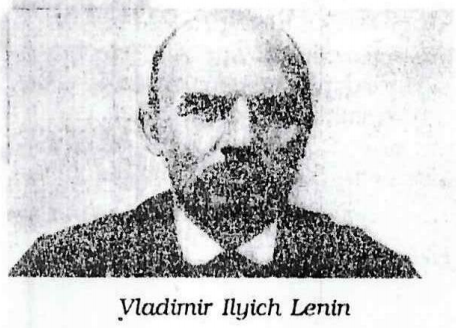
- Socialism vs. Communism in 19th-Century Europe
- Political debates in Europe’s capitals focused on Marxian socialism.
- Differing views:
- Reject socialism,
- Accept it, or
- Blend it with capitalism for a softer state approach.
- Communism and socialism became major global ideologies post-1917.
- Birth of Communism: The Bolshevik Revolution (1917)
- Vladimir Lenin’s Bolsheviks seized power from Kerensky’s Social Democratic government in October-November 1917.
- Led to a brutal civil war between:
- ‘White’ Russians (Tsar supporters) and
- ‘Red’ Bolsheviks (Lenin’s followers).
- Lenin emerged victorious.
- Lenin’s Key Policies
- Abolition of Capitalism
- Marxist ideology saw private capital as a source of inequality and exploitation.
- Lenin’s priority was eliminating capitalism entirely.
- Rapid Industrialization
- The economy was organized like an army, with state-appointed managers controlling all sectors.
- Lenin anticipated future wars to defend communism.
- Western nations (US, Japan, France, Britain) supported White Russians during the civil war.
- August 1918 assassination attempt on Lenin led to the first ‘Red Terror’ purge—thousands of socialist opponents were executed.
- New Economic Policy (NEP) (1921)
- Introduced to revive the economy after the civil war.
- Key features:
- Peasants could keep surplus produce after taxation.
- Limited private trade was permitted.
- Opposition from hardliners (e.g., Kamenev, Zinoviev), who feared the kulaks (rich peasants) as potential threats to communism.
- Lenin saw NEP as temporary, aiming for full state control over agriculture through collective farms.
- Outcome: Economic recovery and improved living conditions.
- Lenin’s Political Repression
- March 1921: Lenin banned ‘factionalism’ within the Communist Party.
- Consequences:
- Expulsion or execution for those who opposed party policies.
- Late 1921: One-third of party members purged via the Cheka (secret police).
- Lenin’s Death and Its Aftermath
- Died in January 1924 at age 53.
- Established the world’s first communist state, but global communist uprisings did not occur.
- USSR remained isolated in world politics.
- Lenin’s early death led to a power struggle and the worst phase of Red Terror was yet to come.
- Joseph Stalin’s Rise and Policies
- Power Struggle After Lenin’s Death
- Leon Trotsky was expected to succeed Lenin, but after a five-year power struggle, Joseph Stalin emerged victorious.
- Stalin’s real name: Joseph Djugashvili; adopted the name Stalin (meaning “man of steel”) after joining the Bolsheviks.
- Challenges Faced by the Soviet Economy
- The Soviet Union faced economic and political problems:
- Weak economy and industrial underdevelopment.
- Fear of foreign invasion.
- Stalin introduced radical measures to address these issues:
- Five-Year Plans for industrial growth.
- Collectivization of agriculture.
- Establishment of a totalitarian regime.
- Industrialization Through Five-Year Plans
- Industrialization was conducted through a planned process:
- First Five-Year Plan (1928-1932): Focused on heavy industries (coal, iron, steel, oil, heavy engineering).
- Second and Third Plans: Continued emphasis on heavy industries but also included consumer goods.
- Achievements by 1940:
- USSR overtook Britain in iron and steel production.
- USSR nearly matched Germany’s coal output.
- Thousands of factories built in remote towns (safe from invasion).
- Key industrial projects:
- Iron and steel works at Magnitogorsk.
- Tractor factories at Kharkov and Gorki.
- Oil refineries in the Caucasus Mountains.
- Harsh Conditions for Workers
- Despite industrial growth, the Soviet Union was not a worker’s paradise:
- Strict discipline enforced on workers.
- Productivity rewards were given, but failure to meet targets led to severe punishment.
- Workers accused of ‘sabotaging the revolution’ were executed or sent to forced labor camps.
- Living conditions:
- Workers lived in primitive housing.
- Party officials enjoyed luxury, with residences in holiday resorts.
- Historian Richard Freeborn:
“The First Five-Year Plan was a declaration of war by the state against workers and peasants, subjecting them to greater exploitation than under capitalism.”
- Brutal Collectivization of Agriculture
- Stalin opposed Lenin’s New Economic Policy (NEP), especially its leniency towards kulaks (wealthy peasants).
- 1929: Stalin launched a policy to merge small farms into large collective farms (kolkhoz).
- Massive opposition from peasants:
- Thousands deported or executed for resisting.
- Millions died from hunger and repression.
- Food security worsened:
- Total grain production in 1934 was lower than in 1928.
- Famine of 1932-33 led to five million peasant deaths.
- Despite famine, USSR exported two million tonnes of grain to claim program success.
- Revelations (surprising and previously unknown facts) after the Soviet collapse (1991):
- Previously suppressed archives exposed the scale of atrocities (act of barbarity / act of brutality).
- The Black Book of Communism (1999) documented:
- Over two million deportations.
- Six million deaths from hunger.
- Hundreds of thousands died due to deportation.
- Some historians claim Stalin welcomed the famine as a way to crush peasant resistance.
- Stalin’s Totalitarian Rule and the Great Purge (cleanse / clear / free someone from)
- Stalin’s Quest for Absolute Power
- Stalin believed that all political activities must be controlled under his totalitarian regime.
- He sought complete, unchallenged power and was intolerant of criticism.
- His first major purge began in December 1934, following the murder of Sergei Kirov, one of his supporters.
- Recent research suggests that Stalin himself ordered Kirov’s murder to justify eliminating his perceived enemies.
- Even Nikita Khrushchev, Stalin’s successor, admitted this more than two decades later.
- By this time, Stalin’s main opponent, Trotsky, had already fled into exile.
- In 1940, Stalin’s agent murdered Trotsky in Mexico.
- The Great Purge (1934-1938)
- Over the next four years, hundreds of Communist Party officials were arrested and put through show trials with pre-determined sentences.
- Key victims included many of the Bolsheviks who had led the 1917 revolution:
- Zinoviev, Kamenev, Bukharin, and Radek.
- Most of the top military officers of the Red Army were also executed.
- Between December 1934 and February 1935:
- More than 6,500 people were executed.
- Thousands more were deported to Siberia or the Central Asian Republics.
- The Great Terror (1936-1938) – Ezhovshchina
- Known as Ezhovshchina, the Great Terror was one of the largest state-sponsored purges in human history.
- The full extent of Stalin’s repression remains uncertain, but Khrushchev publicly admitted the scale of the crimes at the 22nd Party Congress of the CPSU in October 1961.
- Estimated casualties:
- At least 6 million arrested, jailed, or deported.
- 3 million executions.
- 2 million deaths in labor camps.
- Revisionist historians claim the figures are exaggerated, but similar denials exist regarding the Nazi Holocaust.
- Stalin’s 1936 Constitution – A False Democracy
- Stalin introduced a New Constitution in 1936, creating an illusion of democracy:
- Secret ballot voting allowed citizens to choose members of the Supreme Soviet.
- However, the Supreme Soviet met for only two weeks a year and merely rubber-stamped Stalin’s decisions.
- Real power lay with a small Presidium and the Union of Soviet Commissars, where Stalin served as Secretary.
- Stalin’s Control Over Culture and Religion
- Stalin demanded unquestioning loyalty from writers, artists, and musicians:
- Maxim Gorky visited the Solovetsky prison camp (one of the worst Stalinist labor camps) and later wrote a book praising it.
- Dmitri Shostakovich, a composer, was condemned (sentenced to a particular punished, especially death) because his opera “Lady Macbeth of Mtsensk” failed to please Stalin.
- Religious repression:
- Despite harsh measures against the Russian Orthodox Church, including the murder of priests, the people’s faith remained strong.
- In the Central Asian Republics, Stalin suppressed the largely Islamic population:
- Mosques were burned down.
- Centuries-old Islamic heritage was destroyed.
- Yet, the faith of the people did not waver.
- Hitler’s Fascist Regime and the Nazi Atrocities
- Hitler’s Brand of Fascism
- Hitler’s fascism was similar to Mussolini’s in Italy but more extreme in its totalitarianism and brutality.
- Unlike communists, the Nazis did not even pretend to uphold democracy.
- Dissent (holding different opinion from formal ones) was forcibly suppressed, with strict censorship of the press and discouragement of foreign journalists.
- State propaganda was widely used:
- Books deemed ‘subversive’ were burned.
- A secret police force monitored every citizen.
- Anti-Semitism (anti-jewinesh) as State Policy
- Nazism institutionalized anti-Semitism, with Hitler’s SS forces leading the elimination of Jews in occupied territories.
- Jewish persecution (oppression / victimization) had deep historical roots in Europe:
- Christian dogma had long treated Jews as an ‘undesirable race’, believing they had betrayed Jesus Christ.
- The Catholic Church historically supported state-sponsored persecution of Jews.
- Hitler’s own hatred for Jews developed during his struggling years in Vienna, influenced by anti-Semitic propaganda.
- However, the Nazis did not promote Christianity:
- Though Hitler was nominally Catholic, he prohibited the Church from interfering in state matters.
- Thousands of Catholic priests and nuns were imprisoned or killed.
- Yet, Hitler managed to get the Pope to remain silent on the Jewish genocide (systematic killing of humans in large numbers).
- Racial Superiority and the ‘Master Race’ Doctrine
- Hitler promoted the theory of Aryan racial superiority, believing Germans were the ‘master race’ (Aryans) with a divine right to rule over ‘inferior’ people.
- He classified East Europeans and non-white races as inferior but modified this stance to accommodate Japan as an ally during World War II.
- The glorification of war, conquest, and authoritarian rule was not Hitler’s invention:
- The British had used similar racial theories to justify their colonial rule over Asia and Africa.
- The Persecution of Jews – From Discrimination to Genocide
- Hitler’s anti-Jewish policies began early in his rule:
- Jews were banned from employment and business.
- They were forced to wear armbands with the Star of David.
- Public humiliation, exclusion from sports and the arts, and other restrictions reduced them to ‘sub-humans’.
- Kristallnacht (Night of Broken Glass) – 9 November 1938:
- Organized by the Nazi Party, this marked the beginning of systematic savagery against Jews.
- It culminated in the Holocaust, which continued until the end of World War II.
- The Final Solution (1942) and the Holocaust:
- Over 6 million Jews and hundreds of thousands of other ‘sub-human’ races were systematically murdered.
- Mass killings were conducted using advanced technology, making Nazi genocide the most industrialized slaughter in history.
- While more people were killed under communist regimes, the Nazis used science and technology purely for mass extermination.
- The World’s Indifference to Nazi Atrocities
- The true extent of Nazi brutality was not widely known outside Germany before World War II.
- Nations continued trading and maintaining diplomatic ties with Nazi Germany until the war broke out in September 1939.
- Reactions to Nazi anti-Semitism:
- Countries like the USA imposed strictures against Germany due to discrimination against Jews.
- The 1936 Berlin Olympics became a political tool:
- Several nations, including the USA, considered boycotting the event.
- To avoid controversy, Hitler temporarily softened his anti-Jewish stance during the Games but resumed persecution afterward.
- Failure to assist Jewish refugees:
- International Jewish organizations pleaded with Western countries to allow Jewish emigration—most requests were ignored.
- U.S. President Franklin D. Roosevelt ordered American embassies to slow down visa processing for Jewish refugees.
- Even after intelligence confirmed mass killings in concentration camps, the USA refused to conduct commando operations or air raids to disrupt the extermination process.
- Japan’s Aggression and Its Alliance with Nazi Germany
- Japan’s Expansionist Policies in Asia
- Japan pursued a policy of aggression, aiming to expand its influence in Asia.
- Invasion of Manchuria (1931):
- Manchuria, a Chinese province with 30 million people, was invaded by Japan.
- The League of Nations failed to take any action.
- Japan as a Hegemonic Power:
- Since the late 19th century, Japan had built a powerful navy, dominating eastern Asia.
- Impact of the 1929 Great Depression:
- Japan’s exports declined, and the price of raw silk (its chief product) fell to less than a fifth of the 1923 level.
- This led to widespread poverty and resentment (bitterness).
- Conflict with China:
- Japanese traders and businessmen in Manchuria were being pushed out, leading to tensions.
- Fascist groups within the Japanese Army launched the invasion without government approval.
- When Prime Minister Inukai criticized the invasion, he was assassinated.
- After this, the Japanese Army gained dominance over the government.
- Full-scale Invasion of China (1937):
- Encouraged by its success in Manchuria, Japan invaded China, dragging the country into World War II.
- The Germany-Japan Alliance Against Communism
- Fear of Communism as a Unifying Factor:
- Both Germany and Japan feared the spread of communism, particularly through the Comintern (Communist International), which had been founded by Lenin in 1919 to promote global communist revolutions.
- Stalin’s Five-Year Plans were showing success, increasing concerns that the USSR would expand its influence.
- Formation of the Anti-Comintern Pact (25 November 1936):
- Germany and Japan signed the pact, officially presenting it as a propaganda (information of misleading nature) move to exploit global anti-communist sentiments (point of view).
- Context of the Anti-Comintern Pact:
- In 1935, Britain, France, and Italy had formed the Stresa Front to condemn Hitler’s rearmament.
- France also strengthened ties with the USSR, fearing Germany’s resurgence.
- These developments alarmed Hitler, pushing him to portray himself as a global fighter against communism.
- Secret Protocol in the Anti-Comintern Pact:
- If the USSR attacked Germany or Japan, both nations would consult on countermeasures to protect their shared interests.
- They agreed not to assist the USSR in any way.
- Neither country would sign separate treaties with the USSR without mutual consent.
- Appeasement and the Road to World War II
- Duplicity in International Relations
- The inter-war period was marked by political duplicity, where Hitler benefited from the “conspiracy of silence” practiced by the Allied powers.
- The Stresa Front (1935), formed by Britain, France, and Italy to counter German rearmament, collapsed quickly when:
- Britain, without consulting France or Italy, signed the Anglo-German Naval Agreement (June 1935).
- Inspired by the aggressive expansion of Germany and Japan, Mussolini invaded Abyssinia (October 1935).
- Communism as the Greater Threat
- In the 1930s, Western powers viewed communism, not Fascism or Japan, as the greatest threat.
- Hitler exploited this fear, shifting focus onto the USSR’s international communist agenda.
- Conservative politicians in London, Paris, and Washington saw Hitler as a bulwark against Soviet expansion, leading them to adopt a policy of appeasement.
- Britain and France’s Policy of Appeasement
- Neville Chamberlain (British PM, May 1937) took appeasement to new levels.
- Historian Norman Lowe noted that Chamberlain sought to “find out what Hitler wanted” and negotiate rather than use force.
- Consequences of Appeasement:
- German Rearmament: No action was taken to check Hitler’s military buildup.
- Anglo-German Naval Agreement (1935): Signed without consulting France, shaking French confidence in Britain.
- Reoccupation of the Rhineland (1936):
- The French could have easily expelled German forces, but they hesitated.
- When Britain offered no support, France remained passive, despite this being a clear violation of the Versailles Treaty.
- Spanish Civil War (1936-39):
- Nazi Germany backed General Franco, but neither Britain nor France intervened.
- Anschluss (March 1938):
- Hitler annexed Austria, a move many in Britain saw as a “natural union”.
- Munich Agreement (September 1938):
- Chamberlain encouraged Hitler to take Czechoslovakia instead of resisting.
- Czechoslovakia had one of Europe’s strongest armies, and an Anglo-French-Czech alliance could have deterred Hitler.
- Yet, Chamberlain yielded, returning to London declaring “peace for our time”.
- The Final Steps Toward War
- After seizing all of Czechoslovakia (March 1939), Hitler turned to Poland.
- Germany’s grievances with Poland (1919 Treaty of Versailles):
- Poland was granted the port of Danzig, which Germany wanted back.
- Hitler demanded a road-rail corridor linking East Prussia to Germany.
- Poland refused, trusting British support.
- Chamberlain’s Diplomatic Failure:
- Britain needed Russian support to counter Germany in Poland.
- A British delegation was sent to Moscow (11 August 1939), but no agreement was reached.
- The Nazi-Soviet Pact and the Outbreak of War
- On 23 August 1939, the world was stunned when Germany and the USSR signed a Non-Aggression Pact.
- Two ideological enemies—Nazis and Communists—had joined hands.
- The pact guaranteed Soviet neutrality when Germany attacked Poland.
- Secret Clauses (revealed in 1989):
- Germany and the USSR agreed to divide Eastern Europe:
- Western Poland → Germany
- Eastern Poland → USSR
- Lithuania → Germany
- Estonia, Latvia, Finland, Bessarabia, Ukraine, and Belarus → USSR
- The Start of World War II
- 1 September 1939:
- Germany invaded Poland.
- 3 September 1939:
- Britain and France gave Germany two days to withdraw.
- When Hitler refused, they declared war on Germany.
- World War II had begun.
- Developments in Asia, Africa and South Africa
- Reassessing World History Beyond Europe
- Eurocentrism in Historical Perspective
- There is a common tendency to equate European history with world history.
- In the 20th century, many scholars viewed global developments through a Euro-American lens.
- While the 19th and 20th centuries were undeniably shaped by European political and social movements, it would be a mistake to overlook the reverse influence.
- Asia, Africa, and South America not only responded to European influences but also impacted political relations within Europe itself.
- Additionally, local histories in these regions shaped the lives of more than three-fifths of humanity, a perspective often neglected in traditional historiography.
- The Role of Non-European Regions in Global Politics
- During the late 19th and 20th centuries, European and American strategic and colonial interests dictated the fate of many countries in these continents.
- However, the people in these regions were also evolving their own political and social consciousness.
- By the early 20th century, these internal transformations led to significant domestic upheavals, which in turn:
- Influenced European affairs.
- Drew America deeper into global politics.
- Examining Global Interactions
- This chapter will explore the complex relationship between European, American, and non-European historical developments.
- A key example is Japan, an ancient civilization that stood alone against the combined power of Europe and America during World War II.
- Understanding Japan’s role offers crucial insights into the broader interplay of global forces beyond the traditional Eurocentric narrative.
- The Rise of Japan: From Industrial Power to Militarist Expansion
- Japan’s Strength and Early Expansion
- Despite its small size, high population density, and lack of natural resources, Japan emerged as a major power in the late 19th century.
- In 1854, the United States, under Commodore Mathew C. Perry, signed a treaty with Japan, opening trade with America, which accelerated industrial growth.
- This economic expansion fueled imperial ambitions, leading to:
- The Sino-Japanese War (1894-95), where Japan defeated China and gained control over Formosa (Taiwan).
- The Russo-Japanese War (1904-05) over the Sakhalin Islands, where Japan’s victory shattered the myth of European military superiority over Asia.
- The annexation of Korea in 1910, further solidifying Japan’s position as a dominant power in the region.
- Japan in World War I and Its Economic Boom
- Japan had been a British ally since the Anglo-Japanese Alliance of 1902.
- During World War I, Japan supported the Allies, using its industrial base to supply war materials to Britain and America.
- Key benefits from the war included:
- Expanding its commercial influence in Asia, particularly in China.
- Strengthening its Navy by training with the British and American fleets.
- Gaining Germany’s former territories, including Pacific islands and Shandong province in China.
- By 1918, Japan was thriving economically and politically, with growing calls for liberal reforms and democracy.
- Rise of Militarism and the Economic Downturn
- In 1925, Japan granted voting rights to all adult males, signaling a shift towards democracy.
- However, military influence was also rising, fueled by:
- Corruption in the government, which weakened democratic institutions.
- The Wall Street Crash of 1929, which devastated Japan’s economy, particularly silk exports to the U.S.
- Widespread rural poverty, leading many peasants to join the Army, giving military leaders greater influence.
- The Army, backed by conservative politicians, saw expansionism as the solution to Japan’s economic struggles.
- The Manchurian Crisis and Military Takeover
- In 1931, Japan invaded Manchuria, a Chinese province with 30 million people and significant Japanese business interests.
- The invasion, carried out without consulting the Prime Minister, led to:
- The establishment of a puppet government, Manchukuo.
- The assassination of Prime Minister Inukai, allowing the Army to seize control of the government.
- From this point, Japan transitioned into a military dictatorship, mirroring the authoritarian regimes of Germany and Italy.
- Japan’s Aggressive Foreign Policy and World War II
- Under military rule, Japan pursued ultranationalist policies, eliminating all opposition:
- Dissenters (holding different opinions from official) were labeled ‘communists’ and executed.
- Freedom of speech and education were suppressed.
- Japan’s imperialist ambitions led to:
- The invasion of China in 1937, marked by the Nanjing Massacre, one of the most horrific atrocities in history.
- Emperor Hirohito’s passive stance, which, according to historian Richard Storry, allowed the military to act without restraint.
- This unchecked militarism ultimately led Japan into World War II, resulting in its near-total destruction.
- The Path to Japan’s Post-War Revival
- Japan’s self-destructive war policies culminated in its defeat in 1945.
- The country’s post-war recovery and transformation into a peaceful industrial power will be explored in a later chapter.
-
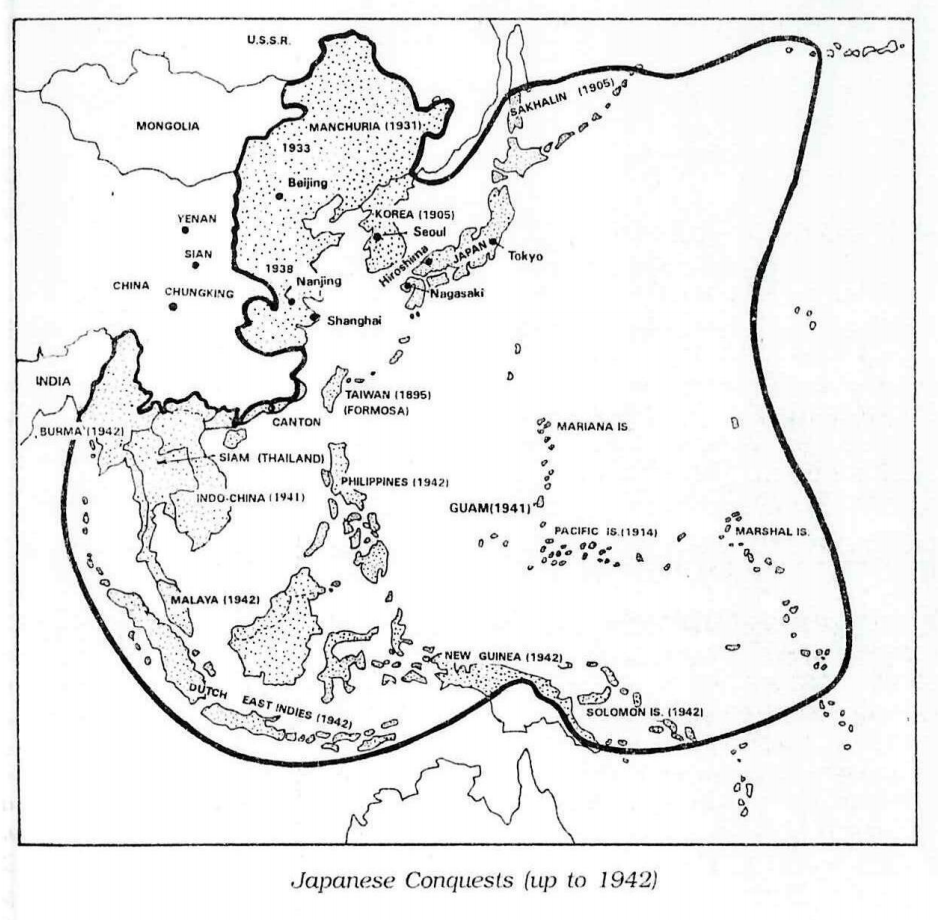
- China’s Transformation: From Feudalism to Revolution
- China’s Decline Under Foreign Domination
- A century ago, China was a poor and feudal society, despite its vast potential and rich history.
- For centuries, it remained unified under the Manchu (Ching) dynasty, but foreign interference led to its decline.
- Key events of foreign exploitation:
- Opium Wars (1839-42): Britain defeated China and took Hong Kong, opening the country to European and American intervention.
- Defeat to Japan (1894-95): China lost Formosa (modern Taiwan), worsening national humiliation.
- The Boxer Uprising (1898-1900): A rebellion against foreign influence, but it was crushed by an international army, forcing China to pay a heavy indemnity.
- The Fall of the Manchu Dynasty and Political Chaos
- The last effective Emperor of the Manchu dynasty died in 1911, leaving the throne to a five-year-old child, Pu Yi.
- General Yuan Shihkai ruled in the child Emperor’s name, but China fell into anarchy (a state of disorder), with provincial (regional / state) warlords seizing control.
- In 1915, Yuan declared himself King, losing military support and forcing his abdication (act of renouncing the throne).
- The Warlord Era (1916-1928) and Fragmentation
- After Yuan’s fall, China descended into chaos, with feudal lords and generals dividing the country among themselves.
- This period, known as the Warlord Era, resembled modern Afghanistan under the Taliban, where central authority was weak, and tyranny prevailed.
- The central government was powerless, failing to restore order.
- The Rise of Nationalism and the May Fourth Movement (1919)
- In 1919, the Treaty of Versailles handed Japan control of former German territories in Shandong, sparking public outrage.
- The May Fourth Movement emerged, led by the Kuomintang (Nationalist Party) under Sun Yat-sen and Chiang Kai-shek, aiming to:
- End warlord rule.
- Resist foreign domination.
- Establish a modern Chinese democracy.
- Sun Yat-sen and the Kuomintang’s Vision
-
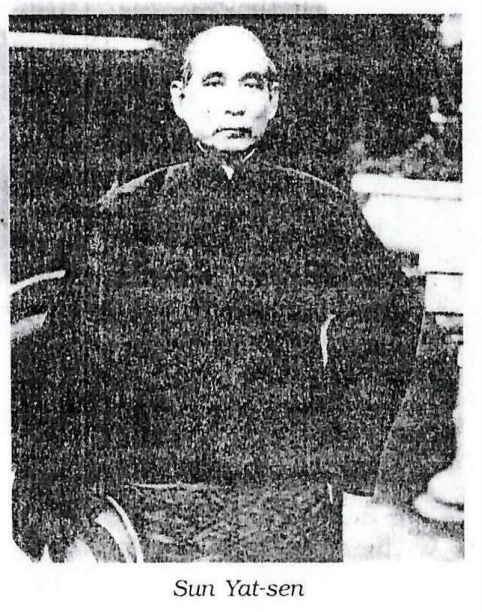
- Sun Yat-sen is regarded alongside Mahatma Gandhi (India) and Mustafa Kemal Atatürk (Turkey) as a reformist leader who sought to modernize his nation.
- A US-trained doctor, he founded the Kuomintang in Canton province with three goals:
- End foreign domination.
- Establish democracy.
- Implement land reforms to free peasants from feudal rule.
- The Chinese Communist Party (CCP), founded in 1921, initially collaborated with the Kuomintang in these efforts.
- The Kuomintang-Communist Rift and the Long March
- After Sun Yat-sen’s death in 1925, Chiang Kai-shek took over the Kuomintang and turned against the Communists, leading to violent persecution.
- This forced Mao Zedong and his Communist followers to embark on the 6,000-mile ‘Long March’, establishing a new power base in northern China.
- This division set the stage for the later Communist-Nationalist struggle that would shape modern China.
- Chiang Kai-shek’s Leadership and Anti-Communist Actions
-
- Soviet Support and Kuomintang’s Strengthening
- After Sun Yat-sen’s death, Chiang Kai-shek took over the Kuomintang (Nationalist Party) and sought help from the Soviet Union.
- The USSR supported Chiang, believing he might embrace communism. They helped build up the Kuomintang army, which Chiang used not only against warlords but also against Chinese communists.
- Anti-Communist Purge and Repression (1927)
- Chiang was deeply suspicious of the communists’ rising influence in China.
- In 1927, he launched a ‘purification’ movement, purging suspected communists from the Kuomintang.
- At least 250,000 people were executed under his orders during this period.
- Failure to Implement Sun Yat-sen’s Vision
- Despite consolidating Kuomintang rule, Chiang failed to realize Sun Yat-sen’s vision of a strong and equitable China.
- Instead of land reforms or democracy, he empowered a new class of landlords, worsening social and economic inequality.
- Mao
- Mao’s Early Life and Rise to Power
- Mao, born in 1893 in Hunan province, is regarded as one of the most charismatic leaders in modern history.
- He worked as a librarian at Beijing University, a hub for communist activities.
- Returning to Hunan, Mao built a strong trade union and peasant movement to fight against warlords.
- The Communist Purge and the Long March
- In 1930, Mao, Chairman of the Central Executive Committee, hid during the Communist purge.
- He built the Red Army, and in 1934, after a crushing defeat by the Kuomintang’s Soviet-backed Army, Mao initiated the Long March.
- 100,000 communists embarked on a 6,000-mile journey, crossing 18 mountain ranges, 24 rivers, and passing through 12 provinces.
- Only 20,000 communists survived to reach the northern provinces of Shensi and Kansu.
- Chiang Kai-shek and the Nationalist Struggle
- Under Chiang Kai-shek, China’s situation worsened. He focused on fighting communists instead of the Japanese.
- In 1937, when Japan invaded, Chiang’s generals pressured him to focus on Japan.
- This led to a temporary alliance with Zhou Enlai, forming a united front against Japan.
- Communist Advantage and the Japanese Occupation
- The alliance benefited the communists, who retained control over Shensi.
- The Kuomintang struggled, while the communists capitalized on their strong base in northern China.
- The communists were seen as the true nationalists, and many Kuomintang soldiers defected to their side.
- By the end of World War II, Mao had over 100 million followers.
- The United States’ Role and the Post-War Situation
- The U.S. sent aid to the Kuomintang, but Chiang was unwilling to fight the Japanese.
- Mao’s army had strong grassroots support, and people saw him as a successor to Sun Yat-sen.
- After Japan’s defeat, the USSR allowed the communists to take over Manchuria.
- This led to confusion over who controlled China, with the Allies recognizing the Kuomintang.
- The Civil War and the Kuomintang’s Retreat
- With U.S. help, the Kuomintang retook eastern cities, but a civil war broke out.
- The war continued until 1949, when Mao’s forces forced Chiang and his followers to flee to Hong Kong.
- Chiang later established a Kuomintang republic on Formosa (Taiwan).
- Turkey
- Turkey’s Transformation: From Empire to Republic
- Turkey’s shift from an empire-building nation to a modern republic serves as an example to the developing world, especially Islamic states.
- After World War I, Turkey, which sided with the Central Powers, faced harsh treatment at Versailles.
- Mustafa Kemal Ataturk (1881-1938), a key figure in Turkey’s transformation, is regarded as one of history’s major nation-builders.
- Mustafa Kemal’s Leadership
- Mustafa Kemal, later honored as ‘Ataturk’ (Father of the Turks), became a national hero.
- He led a small, ill-equipped army to defeat the forces of the Sultan and the Western armies enforcing the Treaty of Versailles.
- In 1922, his forces took over Istanbul, and in 1923, Turkey was proclaimed a Republic.
- The Allies, impressed by the new regime’s popular support, signed the Treaty of Lausanne, allowing Turkey to retain lands reconquered under Mustafa Kemal.
- Territorial Changes and Kemal’s Rule
- The new Turkey included Anatolia, Armenia, and eastern Thrace but excluded Mesopotamia, Arabia, Palestine, and Syria.
- Kemal ruled as a benevolent dictator until his death in 1938, officially as President, though he didn’t allow opposition parties.
- He maintained his regime as ‘temporary’ or ‘transitional,’ believing the people weren’t ready for self-government.
- Western nations tolerated his undemocratic rule because he kept Turkey out of international conflicts.
- Ataturk’s Reforms
- Ataturk’s reforms transformed Turkey into a modern state and captured global attention.
- He established a national public education system and freed women from Islamic shariat laws.
- The Caliphate (the area ruled by Khalifa or Caliph) and its institutions, like religious courts and legal codes, were abolished.
- Madrasas were closed, and modern schools were established. Turkish was changed from Arabic to Roman script, with Ataturk personally teaching people how to use it.
- Women’s Rights and Social Reforms
- Women saw Ataturk as their true liberator.
- He banned the veil, encouraged Western clothing, and opened modern schools for girls.
- Women were granted the right to vote and entered professions previously reserved for men.
- Turkey became the first country to have a female chief of a national supreme court.
- Economic Reforms and Agriculture
- Ataturk’s economic reforms guided other developing countries.
- Despite abundant mineral resources, most of Turkey’s population relied on agriculture.
- Ataturk established agricultural colleges, model farms, and banks to support farmers.
- He promoted land reform, freed peasants from oppressive landlords, and encouraged smallholdings.
- Post-Ataturk Era and Modernization
- After Ataturk’s death in 1938, his successors, Ismet Inonu and Celal Bayar, continued modernizing Turkey.
- Turkey remained neutral during World War II.
- Africa
- Africa’s Transformation (1880-1945)
- Africa underwent significant changes between 1880 and 1945.
- Sub-Saharan Africa, North Africa, and Egypt were connected to Ottoman Empire and European politics.
- Central, eastern, and most parts of the continent were under colonial rule.
- This era was marked by bloodshed, exploitation, and human suffering.
- Colonial Struggles Before 1850
- Before 1850, struggles for colonies occurred mainly in South Africa and Algeria.
- In South Africa, Boers (Dutch settlers) clashed with Bantu tribes.
- Algeria was invaded by France in 1830, leading to conflict between European settlers and native resistance.
- European governments and corporations dreamed of Africa’s untapped resources.
- Christian missionaries sought to convert the local population.
- European desire for markets and competition for power spurred further colonization.
- European Colonial Powers
- The British and French led the colonial expansion into Africa.
- Britain had taken over most of South Africa from the Dutch and established a protectorate (a state that is controlled and protected by other) in Egypt in 1882.
- Britain expanded its holdings into western Africa but preferred indirect involvement.
- The French were more involved, with trading posts in Senegal and West Africa.
- France captured Algeria in 1847, after 17 years of struggle, and took Tunisia and Ivory Coast as protectorates in the 1880s.
- The French annexed Dahomey and established French Equatorial Africa.
-
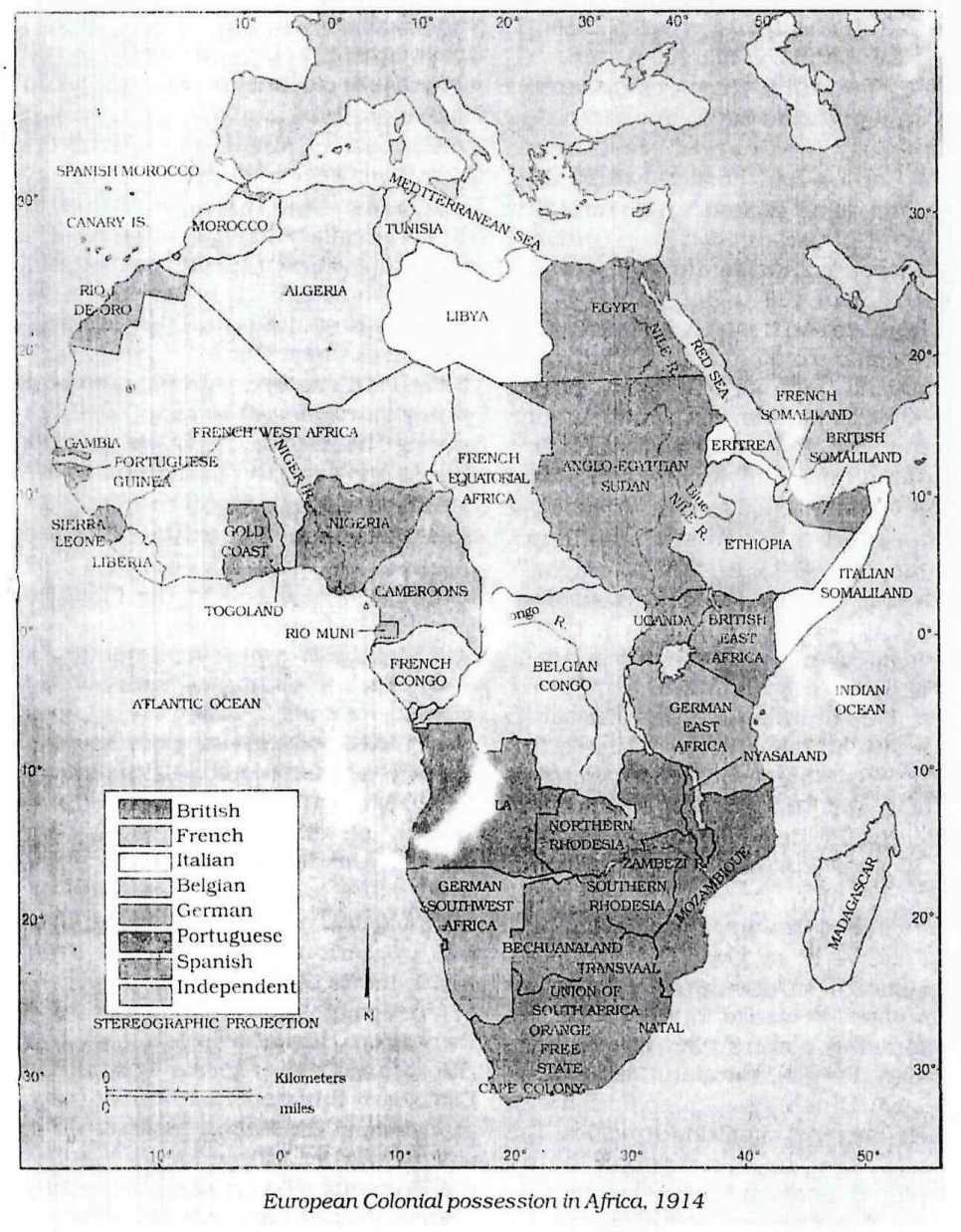
- Other Colonial Powers
- King Leopold II of Belgium and Bismarck of Germany also laid claims in southern, central, and eastern Africa.
- Leopold financed commercial stations in the lower Congo, which became colonies.
- Portugal, with ancient claims in Africa, had its territories recognized by Britain.
- Bismarck authorized the colonization of South-West Africa, Cameroon, and Togo in 1884.
- The Berlin Conference (1884-85)
- The Berlin Conference recognized European claims in Africa:
- Belgium’s claim to the Congo.
- French rights in Equatorial Africa.
- Free trade within the continent.
- The conference laid out that European claims to African territories must be more substantial than informal dominance.
- Bismarck declared a protectorate over the mainland opposite Zanzibar, where German companies had trading rights.
- Britain partitioned Zanzibar in 1886, with modern Kenya given to Britain and mainland Tanzania to Germany.
- Partition of Africa and Resistance
- By the time World War I broke out, European powers had partitioned almost the entire continent, except for Liberia and Ethiopia.
- Liberia and Ethiopia defended themselves with modern weapons.
- Many large and remote areas remained outside European control.
- European colonial rule in Africa is a dark chapter in history, marked by atrocities and racism.
- The white minority exercised disproportionate power over native populations.
- The legacy of apartheid (a system of discrimination based on race) in South Africa persisted (carried on) until 1990.
- The Scramble for Africa
- The last two decades of the 19th century saw rapid European partitioning of Africa.
- Europeans used military might and technology to impose control.
- By the time World War I broke out, small states had been created in Africa.
- These states evolved to specialize in producing for the world market.
- They developed political and social systems to survive as nations by the mid-20th century.
- Resistance to Colonial Rule
- Despite lacking diplomacy, technology, and economic power, native Africans resisted colonial rule.
- In modern Uganda, King Mutesa resisted European takeover in the 1870s.
- Ethiopians successfully repelled an Italian invasion.
- The Hehe people fought a valiant but unsuccessful war against the Germans, who responded with brutal force.
- The British committed genocide in South Africa, killing hundreds of thousands in concentration camps.
- Widespread grievances led to local revolts by stateless people and small chiefdoms, though these lacked the organization to challenge European control.
- Latin AMERICA
- South American Independence and Economic Devastation
- By the mid-1820s, Spanish and Portuguese colonies in South America had gained independence.
- The wars for independence primarily aimed to end colonial trade monopolies and maintain existing social structures.
- However, these wars devastated the continent’s economic infrastructure:
- Mines were flooded.
- Workforce was depleted due to fighting.
- Livestock was lost.
- South American countries, which once relied on Spain for markets and credit, came under the influence of the United States and Britain.
- Unique Characteristics of Latin America
- Latin America’s official languages are primarily European, though many people speak native American languages.
- The predominant religion is Roman Catholicism.
- Nations in the region have adopted constitutional traditions from Europe and the U.S.
- Many elites were educated in Europe and the U.S.
- Despite these similarities, Latin America’s economic and political development has been distinct from Europe’s.
- Challenges in South American Development
- South American countries have faced political instability, characterized by coups (sudden unlawful seizure from government) and declining living standards.
- Political leaders believed that developing export economies based on one or two raw materials or semi-finished goods would suffice (enough).
- This approach made the region vulnerable to:
- Global demand fluctuations.
- External political influence from European and American banking and corporate interests.
- Comparison with Asia and Africa
- In the early 20th century, South America shared more in common with Asia and Africa than with Europe.
- In all three regions, countries specialized in specific products as the global economy integrated.
- Rubber in Asia, cocoa and coffee in South America, and cocoa in Africa, along with mining industries, came under European control.
- Focus on Three Major South American Countries
- With this broad overview in mind, we now focus on the specific experiences of three of South America’s largest countries in the pre-1945 period.
- Argentina
- Independence and Early Struggles (1816-1853)
- Independence: Argentina won its independence from Spain in 1816.
- Internal Struggles: In the early years, Argentina faced a struggle between centrifugal and regional forces, with debates over which region would dominate the country’s polity and economy.
- Bernardino Rivadavia (1821-1827): Tried to create a liberal political state but was bogged down by conflicts between Buenos Aires and the provinces.
- Juan Manuel de Rosas (1827-1852): After Rivadavia’s resignation, Rosas established a period of dictatorship. His style of governance, while centralizing foreign policy and customs in Buenos Aires, caused resentment (bitterness) among the provinces.
- Federal Constitution (1852): Rosas was overthrown by Justo José de Urquiza, who established a Federal Constitution for Argentina. Buenos Aires became a separate federal province in 1880.
- Economic Expansion and Immigration (1853-1916)
- Economic Growth: The period saw significant economic progress, with Argentina’s economy based largely on agriculture, particularly wool, hides, tallow, and beef.
- Refrigeration and Export: In 1876, refrigeration facilities in cargo ships enabled the export of beef to Europe.
- Foreign Investment: Britain invested in railways to connect Argentina’s interior to coastal ports, facilitating the export of wheat.
- Immigration and Industrialization: Large-scale European immigration transformed Argentina into a highly urbanized, industrialized country with a diverse population. It became one of South America’s wealthiest nations, rivaling the United States.
- Democratic Suppression: Despite economic success, democracy was suppressed during this period.
- Political Developments and Struggles for Democracy (1916-1930)
- Rise of the Radical Party (1890s): The Radical Party emerged as a political expression of Argentina’s middle class, which had little influence in governance.
- Saenz Peña Law (1912): The conservative government expanded the franchise and introduced the secret ballot, helping the Radical Party’s cause.
- Hipólito Yrigoyen (1916): The leader of the Radical Party was elected president in 1916. However, his administration exhibited authoritarian tendencies and failed to deliver land and labor reforms, favoring the rich landlords instead.
- Decline of the Radical Party (1920s): The Radical Party degenerated into a corrupt and directionless entity by the 1920s.
- Military Coup (1930): In 1930, the military staged a coup against Yrigoyen, who had returned to power in 1928. Argentina was suffering from the effects of the Great Depression.
- Nacionalismo and World War II Impact (1930-1943)
- US-British Rivalry: The United States began competing with Britain for influence in Argentina, giving rise to the right-wing Nacionalismo movement. This movement opposed both the US and Britain while advocating for social reforms.
- World War II: The war was disastrous for Argentina, as its European markets were closed. The country’s political institutions were ill-equipped to handle the crisis.
- Military Takeover (1943): In 1943, the military once again seized control of the government. Most military officers were first or second-generation immigrants, supportive of Nacionalismo.
- Peronism and Political Stability (1943-1956)
- Juan Perón and Peronism: Led by Colonel Juan Perón, the military’s new leadership combined social discontent and authoritarian politics into a movement known as Peronism. The movement, though dictatorial, was socially progressive and anti-communist.
- Trade Union Support: Perón gained support from trade unions and even attracted communist backing, consolidating power.
- Eva Perón: Perón’s wife, Eva Duarte, was a charismatic figure and played a key role in securing public support for her husband’s movement.
- Political Stability: Peronism brought much-needed political stability to Argentina.
- Perón’s Ouster (1956): Perón was ousted in 1956, leading to prolonged instability, poor governance, and economic decline in the following years.
- Brazil
- Early History and Independence:
- Pedro Alvares Cabral, a Portuguese seafarer, was the first European to reach Brazil in 1500.
- The country was sparsely populated by Amerindian tribes, most of whom were exterminated.
- The Portuguese brought in hundreds of thousands of African slaves; slavery lasted until 1888.
- In 1808, the King of Portugal moved the seat of government to Brazil, and Don Joao VI ruled.
- After Don Joao VI’s return to Portugal, his son, Pedro, proclaimed Brazil’s independence in 1822 and became its first Emperor.
- In 1889, the monarchy was deposed, and a republic was established. A military junta took control in 1930, and Getulio Vargas assumed dictatorial powers until 1945.
- Slavery and Economic Shift:
- Brazil’s economy relied heavily on sugar plantations, which depended on slavery.
- By the 1850s, coffee cultivation began spreading in southern Brazil.
- Coffee producers made significant profits and supported labor reforms.
- The Brazilian government stopped importing slaves by 1850, under British pressure.
- In 1871, the Rio Branco Law was passed, freeing slaves owned by the crown.
- Slavery was finally abolished in 1888 through a law passed by Christina, the Regent.
- This law caused resentment (bitterness) among the Army, planters, and the Church, leading to a coup and the fall of the Empire.
- Economic Dominance of Coffee:
- By the early 20th century, Brazil produced three-fourths of the world’s coffee.
- Surplus production led to government loans from foreign banks to maintain coffee prices.
- Brazil’s neighboring countries became dependent on this coffee economy.
- To repay the loans, the Brazilian government raised taxes from other sectors, harming other industries.
- The Great Depression in 1929 caused coffee prices to crash, leading to an economic collapse.
- In October 1930, a military coup ended the Republican regime.
- Getulio Vargas and Economic Transformation:
- After the coup, Vargas reduced Brazil’s dependence on coffee.
- He set up new industries to diversify Brazil’s economy.
- By the end of the 1930s, Brazil’s manufacturing base was firmly established.
- Vargas introduced a new Constitution that included labor welfare laws and a planned development program.
- By 1945, Brazil had become an industrial power in South America.
- South American States
- Mexico
- Independence and Early Struggles:
- After over a decade of rebellion, Mexico gained independence from Spain and became a republic in 1823.
- For the first 90 years, Mexico was ruled by conservative presidents who failed to address social and economic issues.
- Antonio Lopez de Santa Anna, a dictatorial leader, was the most prominent among them.
- A liberal political movement, La Reforma, emerged in the mid-19th century, seeking democratic governance and foreign investment.
- In 1855, Santa Anna was exiled, and liberals passed reforms to break up large estates and establish small farms.
- The reforms led to a civil war, and Benito Juarez emerged victorious in 1861.
- The Empire of Maximilian:
- Following Juarez’s victory, conservatives sought to install an Emperor to protect their interests and invited Austrian Archduke Maximilian to take the throne.
- Supported by French troops under Napoleon III, Maximilian was installed as emperor in 1864.
- Juarez organized resistance, and in 1867, Maximilian was captured and executed.
- Porfirio Diaz and the Revolution:
- In 1876, Porfirio Diaz led a revolution to install a “true republic.”
- Diaz became president and ruled with weak conservative prime ministers until 1911.
- He allowed landowners to buy public land cheaply, favored the Army, and permitted the Church to operate freely.
- Mexico’s rich became richer, while the majority remained impoverished.
- Labour unrest and strikes erupted, especially in the textile and mining industries, leading Diaz to use brutal repression.
- By 1900, foreign (especially American) investments flowed into the country.
- Madero’s Insurrection and Radical Reforms:
- Diaz rigged (conduct something fraudently to gain advantage) the 1910 elections, where Francisco Madero emerged as his opponent.
- Despite being defeated, Madero launched an insurrection against Diaz, forcing him to flee in May 1911.
- Madero became president but failed to address the needs of the poor.
- Radical leaders such as Pancho Villa, Venustiano Carranza, and Emiliano Zapata emerged, promising land reforms.
- In 1911, Zapata’s program included large-scale land confiscations, dividing Mexican society.
- Madero was overthrown by General Victoriano Huerta in 1913, but Huerta’s government collapsed in 1914.
- Carranza, with American backing, emerged as a leader. U.S. forces occupied Veracruz to support Carranza’s cause.
- Carranza used nationalism to win public support and positioned himself as a national hero.
- Carranza’s Leadership and Constitution:
- Carranza promised reforms to workers and peasants but aligned with landowners and industrialists.
- Growing public discontent led to another civil war between Carranza’s army and Zapata’s forces.
- In 1917, Carranza presented a new Constitution that launched a social revolution and political reforms.
- Post-Revolutionary Mexico:
- After 1917, Mexico entered a period of consolidation (act of making something stronger).
- During the 1920s, military leaders from Carranza’s faction served as presidents.
- These leaders followed the example of California but did not implement land reforms.
- In 1929, Plutarco Elias Calles founded the Institutional Revolutionary Party (PRD), which transformed Mexico’s political system into a single-party system.
- While criticized for limiting democracy, the PRD provided Mexico with the longest period of political stability in South America.
- The era of revolutionary politics ended in 1940 with the election of Manuel Avila Camacho, and Mexico began resolving major issues democratically.
- World war II 1939-1945
- The Stages of War
- Prelude to World War II:
- The war began on 3 September 1939, when England and France declared war on Germany, two days after Hitler’s blitzkrieg (intense military campaign to bring swift victory) attack on Poland.
- Over the next six years, the conflict spread across Europe, the Sahara Desert, West Asia, South East Asia, India, Pacific Islands, and the Arctic.
- Rapid advancements in aviation technology brought the war to the United States, while German U-boats clashed with the Allied Navy off Uruguay.
- The war ended with the devastating use of atomic bombs on Japan, exposing the horrors of atomic power.
- However, the birth of the United Nations, built on the ruins of the League of Nations, symbolized a renewed global commitment to avoid future warfare.
- German Invasion of Poland and the Outbreak of War:
- Germany’s invasion of Poland marked the first use of blitzkrieg ((intense military campaign to bring swift victory)), with German warplanes supporting the Army and the Soviet Army attacking from the east.
- By the end of September 1939, Poland was divided between Germany and the USSR.
- After a five-month pause (the ‘Phoney War’), fighting resumed in April 1940, with Germany invading Norway and Denmark.
- In May, Germany invaded Holland and Belgium, followed by France’s surrender in six weeks.
- Italy joined Germany’s side, and Hitler considered ‘Operation Sea Lion’ to invade Britain.
- Realizing that air superiority was needed, the Luftwaffe launched air strikes against the Royal Air Force (RAF).
- The RAF, bolstered (padded support) by Winston Churchill’s leadership, repelled these attacks in the Battle of Britain (July-September 1940).
- Despite extensive bombings, the British resolve remained unbroken, and the invasion of Britain was abandoned.
-

- North African Campaign:
- The war shifted to North Africa when Mussolini’s Italy invaded Greece and Egypt.
- German forces landed in support of the Italians.
- Rebel armies, known as Partisans and supported by Britain, harassed the German occupation forces in Europe.
- While the United States remained neutral, it provided arms and supplies to Britain.
- Meanwhile, tensions between the United States and Japan escalated as both sought dominance in the Pacific.
- German Invasion of the USSR:
- On 21 June 1941, Germany launched an unprovoked invasion of the USSR.
- The Germans initially achieved significant successes but underestimated the vastness of Russia and the challenge of supplying their advancing troops.
- Hitler’s overconfidence led to disastrous consequences, as German troops were unprepared for the harsh Russian winter.
- Japan’s Expansion and U.S. Entry into the War:
- On 7 December 1941, Japan’s surprise attack on Pearl Harbor led to the United States’ entry into World War II, marking a turning point in the conflict.
- Japan initially scored notable victories, forcing British forces to surrender Singapore, Malaysia, and Burma.
- The fall of Australia and India seemed imminent, and the U.S. was driven out of the Philippines, Guam, and Wake Island.
- Under General Douglas MacArthur, the Allies launched a prolonged counter-offensive using land, sea, and air warfare.
- Aircraft carriers became central to the Pacific War, symbolizing the power of naval warfare in this theater.
- The German Campaign in Russia
- Initial Advance and Stalingrad:
- In 1941, the German armies, despite being slowed by harsh winter conditions, reached Stalingrad (Volgograd) by August 1942.
- The Germans aimed to capture Stalingrad and use it as a springboard to attack Moscow from the southeast.
- However, the Red Army, supported by local populations, mounted a heroic defense.
- The Winter of 1942 and German Defeat at Stalingrad:
- By the end of 1942, the Russian winter helped turn the tide, causing the Germans to lose their supply line.
- With no option to retreat, German General von Paulus surrendered in February 1943, along with 100,000 soldiers.
- This defeat shattered the myth of the invincibility of Hitler’s Army.
- Defensive Successes in the North and Center:
- In the north, the German Army was halted at Leningrad (St. Petersburg).
- In the center, the Red Army revived at the gates of Moscow, bolstered (provided by padded support) by Russian industries that had been relocated deep within the country by Stalin.
- These industries continued to produce essential material for the counter-offensive.
- Allied Support and the Red Army’s Counterattack:
- The British and Americans provided support through Iran in the east.
- In December 1942, the Red Army launched a counter-attack on all fronts, pushing the Germans back to Berlin by April 1945, through Ukraine and Poland.
- Mussolini’s Involvement and the North African Front
- Mussolini’s Ambitions and Initial Setbacks:
- Mussolini, who had long coveted (dezired) Greece and Egypt for Italy, opened a new front in the war by attacking Egypt and Greece in September 1940.
- However, the British quickly drove the inexperienced Italian forces out of Egypt, and the Greeks also repelled the Italian armies.
- German Intervention and the Afrika Korps:
- Seeking help, Mussolini turned to Hitler, who responded by sending the German ‘Afrika Korps’ to Tripoli, the capital of the Italian colony of Libya, in February 1941.
- A joint German-Italian counter-offensive pushed the British out of the region.
- German Success and the Battle of El Alamein:
- Under the leadership of General Erwin Rommel, known as the ‘Desert Fox’ for his strategic brilliance, the German forces overwhelmed (have a strong emotional effect on) the British in Egypt. By July 1942, they were within 80 miles of Alexandria.
- However, the British, Indian, Australian, and New Zealand armies, led by Generals Montgomery and Alexander, launched a successful counter-attack.
- On 23rd October 1942, the Battle of El Alamein resulted in a decisive British victory, shattering Rommel’s forces.
- The Germans were forced to retreat westward, and their hopes of advancing into India through West Asia were crushed.
- The Allied Advance in Italy (Surrender of Italy)
- The Allied Forces’ Push into Europe:
- The British and Indian forces, later joined by the Americans and the French from Tunisia, gradually pushed the Germans and Italians back into Europe.
- The Invasion of Southern Italy and Mussolini’s Fall:
- In July 1943, the Allied forces landed in southern Italy, leading to Mussolini’s dismissal by the King.
- Italy surrendered unconditionally, and Mussolini was imprisoned on an island. However, Hitler’s commandos eventually rescued him.
- The Battle for Cassino:
- The Germans fiercely defended the mountainous area southeast of Rome, particularly around the heights of Cassino.
- Indian soldiers showed exceptional bravery in the battle for Cassino, which ultimately fell to the Allies in June 1944.
- The Battle for the Atlantic
- German U-boats:
- German U-boats caused significant damage to Allied shipping. These submarines would surface suddenly and attack large ships.
- The Allies knew that without establishing superiority in the Atlantic, victory in Europe would remain out of reach.
- Challenges with Neutral Countries:
- The Republic of Ireland remained firmly neutral, limiting the Allies’ ability to launch air strikes on German ships from nearby bases.
- Turning the Tide:
- The tide of the sea-war turned when Portugal allowed the Allies to use the Azores islands in the mid-Atlantic, providing a critical air base for launching strikes against German shipping.
- Allied Bombing Campaign and the Push from the West
- 1943 Bombing Campaign:
- Throughout 1943, British and American planes relentlessly bombed Germany.
- Despite the heavy bombing, German morale remained intact, and production in its military industrial complex was largely unaffected.
- Russian Advances:
- As the Soviet forces advanced towards Germany from the east, defeating German armies, the Allies began planning an invasion from the west.
- Operation Overlord and D-Day
- Operation Overlord:
- Under the leadership of American General Dwight D. Eisenhower, Operation Overlord was launched.
- D-Day (6 June 1944):
- The combined forces of Britain, America, and Canada landed on the northern coast of France.
- This event, known as D-Day, marked the beginning of the liberation of Western Europe.
- After establishing a toehold, the Allies pushed the Germans back, and Paris was liberated by August.
- Belgium was also freed shortly after.
- Arnhem and the German Counter-offensive
- Arnhem and the Defeat:
- A second “D-Day” type operation was launched in Arnhem, aimed at liberating Holland.
- However, adverse weather conditions led to the Allies’ defeat in this operation.
- German Counter-offensive:
- This defeat emboldened (give courage) the Germans, who launched a major counter-offensive in December 1944.
- For two weeks, it appeared the Allies might be routed. However, the Germans struggled to sustain the momentum of their offensive, unable to secure enough fuel for their tanks and vehicles.
- The Final Push
- Restoration of Parity (state of being equal):
- By February 1945, the Allies restored parity.
- Crossing the Rhine:
- In March, the Allies crossed the Rhine River and entered Germany.
- They destroyed the remaining German forces, leading to the eventual collapse of Nazi Germany.
- End of the Third Reich and the Fall of Nazi Germany
- Nazi Dream of a Thousand-Year Reich:
- The Nazis had envisioned their ‘Third Reich’ lasting a thousand years, but it ended in just 12 years.
- The Red Army’s Advance:
- The Red Army crossed the Oder River and fought its way into Berlin.
- Despite fierce resistance from the German armies, there was no hope left for victory.
- Mussolini’s Fate:
- Mussolini, who had been freed by Nazi paratroopers earlier, was captured by anti-Fascist partisans while attempting to escape to neutral Switzerland.
- He was shot dead.
- Hitler’s Suicide:
- Adolf Hitler, wishing to avoid Mussolini’s fate, committed suicide on 29 April 1945 as Soviet troops entered the Reichstag (Parliament).
- Germany’s Surrender and Post-War Division
- German Surrender:
- On 7 April 1945, Germany’s armed forces surrendered, marking the end of World War II in Europe.
- Yalta and Potsdam Agreements:
- According to agreements made at the Yalta Conference in February 1945 and later confirmed at the Potsdam Conference in July 1945, Germany was stripped of all wartime gains.
- The country was divided into four zones of occupation: British, American, Soviet, and French.
- Berlin, located within the Soviet zone, was also split into four sectors.
- Nazi Trials:
- A large number of Nazi leaders were captured and put on trial for their war crimes.
-
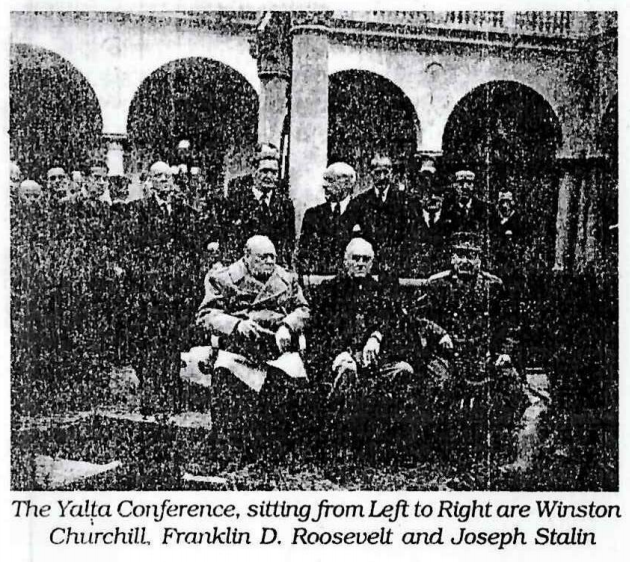
- The Final Phase of the War in the Pacific (Japanese Surrender)
- Allied Advances:
- In June 1945, British and Indian forces successfully regained Burma after a series of fierce battles.
- Earlier, in January 1945, American forces had driven the Japanese out of the Philippines and made significant landings on islands near Japan, such as the Marianas and Okinawa.
- The Dilemma of the Allies:
- Following the death of President Roosevelt in April 1945, President Harry S. Truman took office.
- Truman had overseen the successful test of the first atom bomb and faced a tough decision on how to bring the war with Japan to a swift end.
- His generals advised that Japan would be more difficult to conquer than Germany, especially since Japan was still holding on to territories like Malaysia, Singapore, Korea, Manchuria, and Formosa (Taiwan).
- A prolonged war would be required to ensure Japan’s complete defeat.
- Use of the Atom Bomb:
- To avoid a drawn-out conflict, Truman decided to use the atom bomb.
- On 6 August 1945, the city of Hiroshima was destroyed by the first atomic bomb.
- Three days later, a second bomb was dropped on Nagasaki, causing devastating destruction.
-
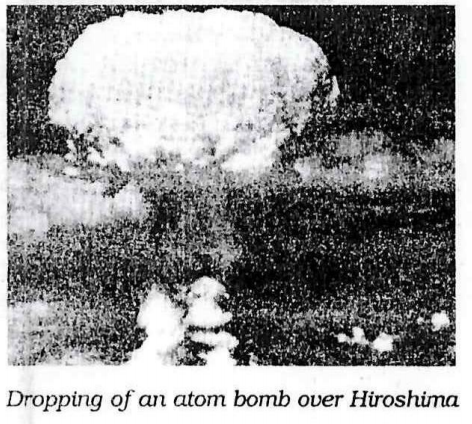
- The Aftermath:
- The bombings killed hundreds of thousands of people, with many others maimed (injured) for life due to radiation exposure.
- Future generations were also affected by the long-term effects of radiation.
- With no other option, Japan surrendered on 14 August 1945, bringing an end to World War II.
- Causes of the US Entry into World War II
- Isolationist Policy:
- During the inter-war period, the United States maintained a policy of isolation.
- For the first 26 months of World War II, President Roosevelt kept the country out of the war, while supporting Britain with supplies of armaments and food. This assistance was formalized through the Lend-Lease Agreement signed in April 1941.
- Under this agreement, the US provided warplanes, ships, and other defense equipment to Britain, with the understanding that Britain would pay for them after the war.
- Churchill’s Push for American Involvement:
- Winston Churchill, the British Prime Minister, urged the US to enter the war. Germany’s defeat required an ally with immense resources and the capacity to endure prolonged warfare.
- America, with its vast resources, could hold the key to success, but President Roosevelt rejected Churchill’s repeated overtures for US involvement.
- Japan’s Expansion in Asia:
- Japan, initially neutral in the war, sought to exploit (derive benefit from) the setbacks suffered by Dutch, French, and British colonies in Asia by capturing their colonial bases.
- Japan was already engaged in a war with China, and the US supported China in this conflict, resulting in a stalemate between Japan and the Kuomintang (Chinese nationalists) and the Communists.
- Japanese Actions in Indochina:
- After France’s fall, the Germans installed a puppet government in Vichy France. Japan used its diplomatic influence over the Vichy Government to acquire French Indochina.
- Japan established military bases in Indochina, particularly in Vietnam, which bordered China. The US became alarmed at the strategic depth Japan was gaining and feared the possibility of Japan opening a new front against China.
- The US demanded Japan’s withdrawal from Indochina, and to enforce this demand, the US Navy imposed a naval blockade in July 1941, preventing oil shipments to Japan.
- US-Japan Negotiations:
- Japan was forced to enter negotiations with the US. During talks, the US demanded that Japan withdraw from both Indochina and China.
- On 16 October 1941, General Tojo became the new Prime Minister of Japan and adopted an aggressive foreign policy. He began preparing for an attack on the US.
- Attack on Pearl Harbor:
- On 7 December 1941, without a formal declaration of war, a large Japanese armada attacked the US naval base at Pearl Harbor.
- 335 Japanese planes launched from aircraft carriers bombed the base for over two hours, resulting in significant damage:
- 350 planes were destroyed, five battleships were sunk, and around 3,700 Americans were killed.
- US Declaration of War:
- Two days later, the US Senate voted in favor of declaring war on Japan.
- The US entry into the war turned the tide in favor of the Allies.
- Adolf Hitler, despite the advice of his close advisors, declared war on the United States.
- Had he not done so, the US-Japanese conflict might have remained confined to the Asia-Pacific region.
- Causes of World War II
- The Versailles Treaty:
- The treaty imposed harsh terms on Germany, taking away its territories and colonies, and forcing it to pay large reparations.
- This created economic hardship and led to the rise of fascism and resentment (bitterness), fueling the idea of “betrayal” and the need for revenge.
- Failure of the League of Nations:
- The League of Nations failed to enforce collective security and did not push colonial powers to grant independence.
- This created competition among European powers and contributed to the rise of fascism.
- Economic Factors:
- The Great Depression of 1929 worsened conditions, fostering the rise of fascist parties in Britain and France.
- Hitler used the economic crisis to rearm Germany and remilitarize the Rhineland in violation of the Versailles Treaty.
- Hitler’s Expansionist Ideology:
- Hitler aimed to create Lebensraum (living space) by conquering Austria, Czechoslovakia, and parts of Poland and Eastern Europe.
- His expansionist policies led to aggression that other powers could not tolerate.
- Chamberlain’s Policy of Appeasement:
- Britain and France failed to take a tough stand at the Munich talks (1938), allowing Hitler to expand unchecked.
- This reinforced Hitler’s belief that the Western powers would tolerate his actions, especially against Poland.
- Hitler’s Misjudgment:
- A.J.P. Taylor argued that Hitler did not initially want a world war, but misjudged the situation and hoped for Britain’s non-interference in Poland.
- Hitler thought the Western powers would accept his claims for the Danzig corridor, but he miscalculated their response.
- Joseph Stalin’s Role:
- Stalin signed the Non-Aggression Pact with Germany, giving Hitler the confidence to invade Poland.
- The pact had secret clauses allowing Stalin to annex Estonia, Latvia, and Lithuania, which betrayed Poland and the entire continent.
- World War II: Devastation and Aftermath
- Loss of Life and Destruction:
- Around 40 million people were killed, including both soldiers and civilians.
- Cities, villages, industries, and communication systems were destroyed.
- Over 21 million people became homeless, with the USSR being the hardest hit, suffering more than half of the casualties.
- Germany and Japan also faced significant destruction, and Poland lost nearly an entire generation.
- Peace Treaties:
- Unlike World War I, there was no comprehensive peace treaty due to growing distrust between the Allies and the USSR.
- Several separate treaties were signed, including:
- Italy had to give up its African colonies and claims to Albania and Ethiopia.
- Trieste was declared a free territory under the United Nations.
- The Treaty of San Francisco forced Japan to renounce all its overseas territories.
- Tension Between the USSR and Allies:
- Stalin sought to maintain Soviet control over Eastern Europe, which had been liberated by the Red Army.
- Territories like parts of Czechoslovakia, Finland, Ukraine, Latvia, Lithuania, and Estonia were annexed by the USSR.
- Puppet communist governments were established in countries such as Czechoslovakia, Hungary, Romania, Bulgaria, and Poland.
- Yugoslavia, led by Marshal Tito, became a communist country but remained independent from Moscow.
- Germany was divided into East Germany (under communist influence) and West Germany (democratic), escalating tensions.
- Social Upheaval:
- Large-scale population movements occurred, with 10 million Germans fleeing to West Germany.
- The Jewish population in Eastern Europe, Holland, Greece, and Germany was decimated, with nearly 6 million Jews killed in Nazi extermination camps.
- In countries like Ukraine and the Baltic states, Jews were shot and buried in mass graves.
- The Soviets, under Stalin, also committed atrocities like the Katyn Massacre, where over 4,000 Polish Army officers were executed.
- After the war, most of Europe’s Jewish population migrated to America or Israel.
- Decline of European Powers:
- Britain failed to achieve its pre-war objectives, including maintaining Naval supremacy and strategic interests in Europe.
- In July 1946, Churchill’s coalition government was defeated, and a Labour government led by Clement Attlee took over.
- Former European powers were in decline, and decolonization began under American pressure, leading to independence for many colonies in Asia and Africa.
- Rise of Superpowers:
- After the war, two superpowers emerged: the USA and the USSR.
- The two countries competed for global influence, leading to the Cold War.
- The Iron Curtain, a term coined by Winston Churchill in 1946, marked the ideological and physical divide between the spheres of influence of the USA and the USSR.
- The Cold War was characterized by an arms race and the constant threat of nuclear war, lasting until the USSR’s collapse in 1991.
- The Birth of the United Nations
- Formation of the United Nations:
- During World War II, the need for a more effective global organization was recognized, to address the failures of the League of Nations.
- In 1944, leaders from the USSR, America, China, and Britain met at Dumbarton Oaks in the United States to discuss forming a new organization: the United Nations (UN).
- The UN Charter was drafted in San Francisco in 1945. The aims outlined in the Charter are:
- Preserve peace and eliminate war.
- Remove the causes of conflict through economic, social, educational, scientific, and cultural progress, particularly in underdeveloped nations.
- Safeguard human rights for all individuals, and the rights of people and nations.
- It officially opposed colonialism and imperialism.
- Gave newly emerging nations an international platform to raise their voices.
- The UN pressured colonial powers like Britain, France, Portugal, Belgium to decolonize peacefully.
- UN’s Role and Achievements:
- Over the next 60 years, the UN gained global support but was unable to resolve all international conflicts.
- Wars continue to break out with or without the UN’s sanction, as seen recently in Iraq.
- However, the UN has prevented numerous wars by setting up dispute settlement bodies, organizing ceasefires, and facilitating negotiations, mediations, and peacekeeping missions.
- The UN also plays a significant role in humanitarian and development work, addressing issues like health, education, sanitation, water, and the environment, especially in poor countries.
- Comparison with the League of Nations:
- The UN has been more successful than its predecessor, the League of Nations.
- The League failed to address the needs of the vast majority of the world’s population living under colonial rule.
- Unlike the League, which was primarily dominated by Anglo-French interests, the UN focuses on global peace and social-economic development in underdeveloped countries.
- The UN spends significant resources on economic and social development through specialized agencies such as UNICEF, WHO, and FAO.
- It is also committed to human rights, something the League largely ignored.
- Challenges and Areas for Improvement:
- Despite its successes, the UN has several contradictions and inconsistencies.
- One major issue is the Security Council, which is still dominated by the original UN founders. India, the world’s largest democracy, has yet to secure a seat on the Council.
- The UN now has 189 members, and there is a growing consensus that these anomalies should be addressed.
- In the post-Cold War era, US actions have undermined the authority of the UN, an issue that needs to be rectified (corrected).
- Decolonisation and the birth of new natinos in the post-war world
- The Impact of World War II
- World War II was undoubtedly the most significant upheaval in human history, shaking mankind to its core.
- As explored in a previous chapter, the war caused massive devastation in terms of human life and economic destruction.
- It also brought about tectonic shifts in the trajectory of nations and civilizations.
- One of the most profound impacts was the end of the colonial order, which had caused centuries of human misery and conflict.
- Decolonization
- The Impact of World War II on European Empires
- Before World War II
- The European empires were characterized by a wide gap between the rulers and the ruled.
- Most colonial populations lived in extreme poverty, with little hope of challenging the entrenched power structures.
- The awe of European power, sustained by military force and foreign-origin laws, prevented many colonized peoples from imagining any significant upheaval.
- World War II’s Role in the Dissolution of Empires
- World War II accelerated the dissolution of these empires, leading to rapid changes after 1945.
- European Empires in 1945
- Britain’s Empire
- The largest empire, consisting of:
- The Indian subcontinent, Burma (Myanmar), Malaya (Malaysia), and Singapore
- Vast regions in Africa, Cyprus, and Hong Kong
- Islands in the Caribbean (West Indies), Pacific (Fiji), and territories like the Falklands and Gibraltar
- France’s Empire
- The second largest empire, comprising:
- Large territories in Africa, Indo-China, and the Caribbean
- Other European Powers
- Holland: Indonesia and Dutch East Indies
- Belgium: Congo and Rwanda
- Portugal: Angola, Mozambique, Guinea, and Goa
- Spain: Morocco, Spanish Guinea, Ifni, and Spanish Sahara
- Italy: Libya, Somalia, and Eritrea
- The Aftermath of World War II
- The Shake-up
- The end of World War II led to a rapid shake-up of the colonial system, continuing for three decades.
- Transfer of Power
- By 1975, most former colonies had gained independence, with new nations emerging from the old empires.
- Reluctance to Relinquish (renounce / give up) Control
- While some colonial powers, like Britain and France, relinquished control, others like the Dutch and French were more reluctant to do so, as seen in Indonesia and Indo-China.
- Causes of the End of the Colonial Empires
- Impact of World War II
- World War II shattered the imperial order, particularly in colonial territories.
- Nationalist movements gained new momentum due to the war, with oppressed peoples receiving fresh inspiration.
- The defeat of European powers by Japan in regions like Malaya, Hong Kong, the Dutch East Indies, and Indo-China shattered the myth of European invincibility.
- After the war, local people in Indo-China and Indonesia continued their resistance instead of meekly (quite, subtle, gentle and submissive manner) accepting their former colonial rulers back.
- Effect on Soldiers and Loyalty
- Many colonies provided recruits for the Allied forces during the war.
- These soldiers returned home after the war with a resolve to address their own countries’ issues, challenging their European rulers’ authority and loyalty.
- Weakening of European Powers
- Loss of Resources and Energy
- The European powers were severely weakened by the war, with many of their best soldiers lost in battle.
- A sense of fatigue (extreme tiredness) replaced the earlier vigor (physical strength and good health) with which they had defended their empires.
- Dependency on the United States
- European powers found themselves increasingly under the shadow of the United States, a country that opposed colonialism.
- During the war, President Roosevelt pressured Allied powers to accept the Atlantic Charter (1941), which outlined two key principles:
- Nations should not expand by taking territory from others.
- All people should have the right to choose their own form of government.
- Roosevelt’s Influence and British Resistance
- Though Churchill attempted to limit the Charter’s application to Nazi Germany, Roosevelt made it clear that its principles applied globally.
- President Harry S. Truman and Clement Atlee pressured Britain to relinquish control over India, although Britain delayed independence for other colonies.
- United States’ Pressure for Decolonization
- Fear of Communism
- The United States feared that communism, supported by Moscow, could inspire colonial liberation struggles.
- Economic Interests
- The U.S. was also motivated by commercial interests, seeking new markets in the newly independent countries.
- United Nations’ Role
- The United Nations, which was heavily influenced by the U.S., periodically issued statements against colonialism.
- National Struggles and Independence Movements
- India’s Independence
- The history of India’s independence serves as an example of how nationalist movements gained energy and ultimately led to the partition of India, creating two nations.
- India’s experience mirrored the struggles faced by other colonies seeking independence after World War II.
- West Indies, Malaya and Cyprus
-
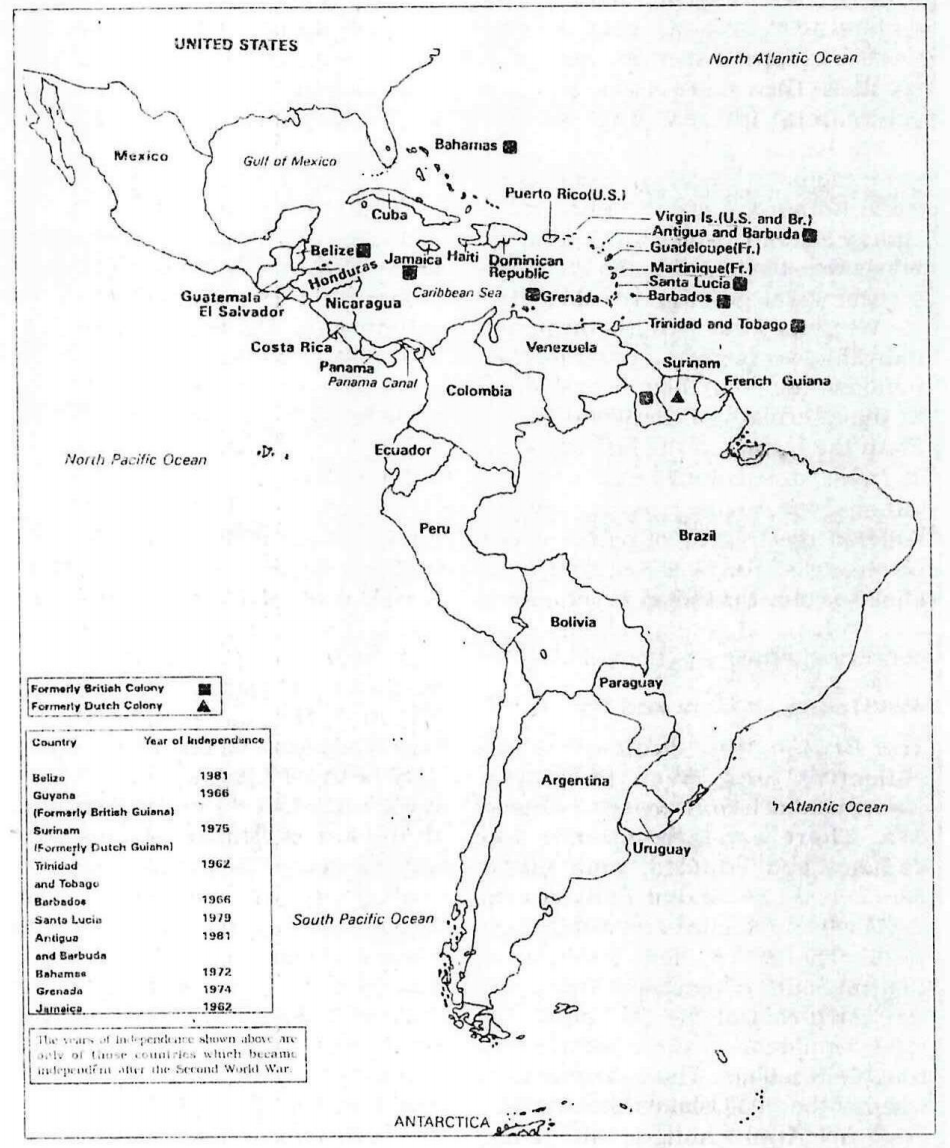
- British West Indies
- Overview of the British West Indies
- The British West Indies comprised various islands in the Caribbean Sea, including large islands like Jamaica and Trinidad, as well as smaller islands like Grenada, St. Vincent, Barbados, Seychelles, Bahamas, and Antigua.
- The British also controlled Honduras in Central America and Guyana in South America, with a total population of roughly 6 million.
- There were doubts about the viability of small islands like Grenada, St. Vincent, and Antigua, each with populations under 100,000.
- Attempts at Federation (a group of states with cetral government but independent in internal affairs / confederation)
- Initially, the British considered a federation of these islands but faced resistance.
- Honduras and Guyana wanted to retain separate identities, while Jamaica and Trinidad were unwilling to join.
- Despite this, the West Indies Federation was established in 1958.
- The federation faced resentment (bitterness) as the islands had few commonalities.
- Jamaica and Trinidad withdrew in 1961, and the British granted independence to each island separately.
- Jamaica and Trinidad-Tobago gained independence first, followed by Guyana in 1966.
- Other islands gained independence gradually, with the Bahamas (renamed Belize) in 1981, and St. Kitts and Nevis in 1983.
- Despite rejecting a federation, the islands soon realized the benefits of regional cooperation.
- In 1968, they formed the Caribbean Free Trade Association, and in 1973, they established the Caribbean Community and Common Market (CARICOM), excluding Guyana and Belize.
- Malaya’s Struggle for Independence
- Ethnic Tensions and Federation
- After Japanese occupation ended in 1945, Malaya faced ethnic rivalry between the Malay population, Chinese, Indians, and Europeans.
- As a step toward independence, the British encouraged the creation of the Federation of Malaya in 1948, uniting nine states, each ruled by a Sultan, along with the territories of Malacca and Penang.
- Each state had its own legislature for local affairs, while a central government maintained overall control.
- Singapore was retained as a colony at this stage.
- Communist Insurgency and Independence
- Communist insurgents, led by Chin Pen, launched a guerrilla war against British rule.
- The British declared a state of emergency in 1948, which lasted until 1960.
- Under Tunku Abdul Rahman, the Malaya population gained political ascendancy (domination) and mobilized support from non-communist Chinese and Indian communities.
- In 1957, Britain transferred power, and in 1963, the Federation of Malaysia was established.
- Brunei’s Sultan did not join and remained independent, while Singapore initially joined the Federation but became independent in 1965.
- The Malaysian federation remains intact today.
- Cyprus’ Struggle for Independence
- Ethnic and Religious Conflict
- Cyprus had a population of 80% Greek Orthodox Christians and 20% Muslims of Turkish origin.
- The Greek Cypriots wanted to unite with Greece, which was opposed by the Turkish Cypriots.
- The British Labour government initially attempted to grant Cyprus independence but faced resistance.
- Winston Churchill’s return to power in 1951 slowed the independence process, causing strong anti-British sentiment, particularly among the Greeks.
- Struggle for Freedom
- A guerilla movement led by Archbishop Makarios and General Grivas (Eoka) waged constant warfare against British troops.
- The British were reluctant to grant independence, instead wanting to retain Cyprus as a military base.
- Over 35,000 British troops were stationed in the country.
- The Turkish Cypriots launched a campaign to divide the country along religious lines.
- Independence and Aftermath
- In 1960, British Prime Minister Harold Macmillan granted full independence to Cyprus to avoid civil war.
- Makarios dropped plans for union with Greece and became the country’s first president.
- However, peace lasted only three years, and civil war erupted again in 1974.
- Turkey intervened, establishing a separate state in the north.
- Cyprus remains divided to this day, with Greek Cypriots controlling the south, and United Nations peacekeepers maintaining peace between the two sides.
- Hong Kong’s Accession (succession) to China
- Early History of Hong Kong
- Before 1842, Hong Kong was a tiny island inhabited by fishermen, with little economic importance.
- The strategic location of the island was first recognized by the British, who needed a naval base in the eastern Indian Ocean.
- British Acquisition (purchase / accession) of Hong Kong
- At the end of the First Opium War in 1842, China ceded Hong Kong to Britain permanently.
- In 1860, China ceded Kowloon, the mainland area opposite Hong Kong, to Britain under the Peking Convention.
- Conversion to Leasehold
- Following the Second Opium War, in 1898, a treaty resulted in the British converting their ownership of Hong Kong into a 99-year lease, with the inclusion of more strategic mainland territory.
- Immigration and Growth of Hong Kong
- Starting in 1900, Hong Kong experienced a steady influx of immigrants fleeing the civil war in mainland China.
- Over the next 90 years, Hong Kong’s service-oriented economy attracted people from around the world, with a significant wave of immigration after mainland China became communist in 1949.
- Hong Kong’s rule under Britain was not democratic, with the island’s Governor being nominated by the British Prime Minister.
- Concerns Over the Lease (rental agreement) Expiry
- In the 1980s, Britain grew concerned about the approaching end of its leasehold over Hong Kong.
- By this time, living standards in Hong Kong were among the highest in Asia.
- There was fear that the spirit of free enterprise that made Hong Kong prosperous would be stifled (suffocate / choke) under communist rule.
- Many of the island’s Chinese-origin citizens began emigrating to Britain, Australia, Canada, and other countries.
- Negotiations for Sovereignty (supreme power or authority) Transfer
- Britain formally requested to renew the leasehold, but Deng Xiaoping, China’s communist chairman, refused and demanded the full return of Hong Kong to China.
- To avoid confrontation, Britain agreed, and in 1984, Prime Minister Margaret Thatcher and Chinese counterpart Zhao Ziyang signed a Joint Declaration to transfer sovereignty of Hong Kong to China on 30 June 1997.
- China’s Commitments
- In return for the sovereignty (supreme power or authority) transfer, China agreed to grant Hong Kong and its people greater freedom and autonomy, allowing the retention of its capitalist system up to 2047.
- Challenges Before Transfer
- The road to the transfer was marked by bickering (argue / quarrel).
- After the Tiananmen Square massacre in 1989, where China’s totalitarian regime suppressed a peaceful democratic demonstration, people in Hong Kong became nervous about their future.
- Thousands of Hong Kong citizens applied for British citizenship.
- To quell these fears, the British introduced democratic reforms, but they were largely meaningless, as China could nullify them after the transfer.
- Post-Transfer Changes
- In July 1997, the last British Governor of Hong Kong, Chris Patten, left.
- The Chinese government installed an interim legislature to replace the colonial chamber.
- The democratic measures introduced by Patten were abolished.
- Hong Kong was declared a Special Administrative Region (SAR) of China, and Tung Chee-hwa, a businessman, was named the Chief Executive.
- Tung was granted a second term in February 2002.
- Independence of British Africa
- The Rise of Nationalism in Africa
- By 1945, nationalism spread across Africa.
- Colonial troops in World War I and educated African youth in Britain imbibed ideas of democracy and nationalism.
- The British Labour government under Clement Attlee was willing to transfer power but aimed to maintain economic control through neo-colonialism.
- The decolonization process was delayed, as Britain tried to hold onto power.
- Types of British Colonies in Africa (1945)
- West Africa: Gold Coast, Nigeria, Sierra Leone, and Gambia. Minimal European presence made independence easier.
- East Africa: Kenya, Uganda, and Tanganyika. Presence of British and Asian settlers complicated the process.
- Central Africa: Nyasaland, Northern Rhodesia, and Southern Rhodesia. Europeans controlled the local economy and land, keeping locals marginalized.
- Decolonization in West Africa
- Sierra Leone became independent in 1961, followed by Gambia in 1965.
- Independence was straightforward due to minimal European settlement.
-
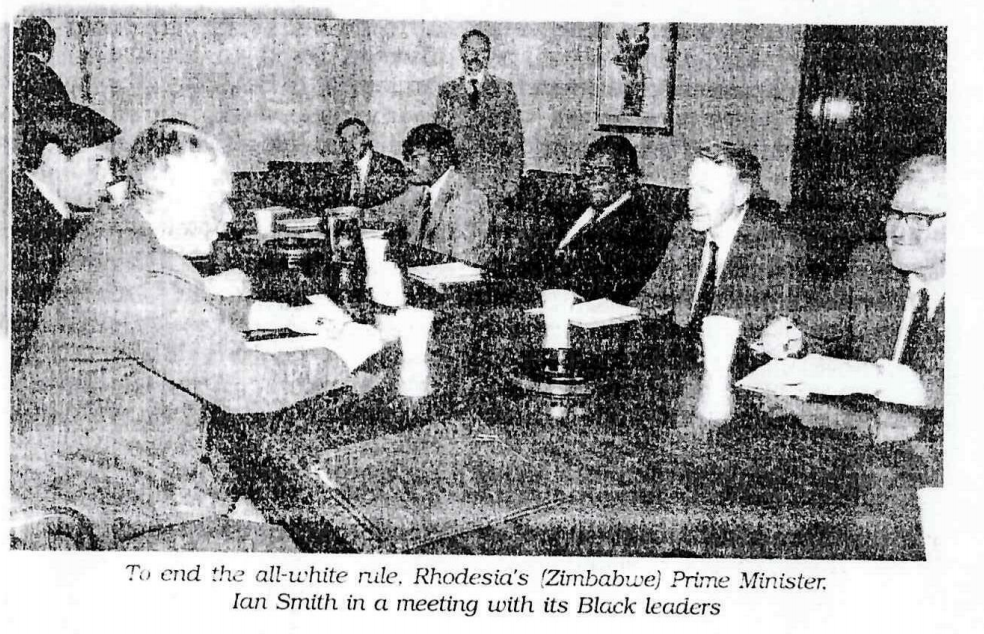
- Challenges in East Africa
- Tanganyika (later Tanzania) gained independence in 1961 under Julius Nyerere.
- Uganda became independent in 1962 but struggled with tribal rivalries.
- Kenya was complicated by white settlers resisting black majority rule.
- Jomo Kenyatta and the Kenya African Unity Party led the independence movement.
- Mau Mau secret society fought white settlers, leading to brutal suppression by the British.
- Kenyatta was jailed for six years but released in 1963. Kenya became a moderate state.
- Central Africa’s Push for Independence
- In Central Africa, white settlers pushed for a Central African Federation to maintain control.
- Leaders like Kenneth Kaunda, Joshua Nkomo, and Hastings Banda campaigned for black majority rule.
- A 1960 commission recommended universal suffrage and ending racial discrimination.
- Nyasaland and Northern Rhodesia became independent in 1963.
- Southern Rhodesia and Struggles for Independence
- In Southern Rhodesia, white settlers clung to power, leading to Ian Smith declaring unilateral independence in 1965.
- The UN condemned the move and imposed sanctions, but neighboring countries and US corporations continued support.
- After Mozambique’s independence in 1975, the situation improved.
- Robert Mugabe’s forces controlled most of Rhodesia by 1979, leading to negotiations.
- Formation of Zimbabwe
- In December 1979, an agreement created Zimbabwe with 80 out of 100 parliamentary seats for Africans.
- Zimbabwe became independent in 1980, with Robert Mugabe as its Prime Minister.
- Comparison with Other Colonizers
- Britain made efforts to exit gracefully (in an attractive elegant way), unlike the French, Dutch, and Portuguese, who clung (hold on tightly) to their colonies.
- After WWII, the French adopted the Brazzaville Declaration, denying autonomy to their colonies, resulting in forced independence later.
- Independence of the French Colonies
- French Indo-China and the War of Independence
- French Indo-China included Vietnam, Laos, and Cambodia.
- During World War II, Japanese occupation drove out the French.
- Ho Chi Minh led the Vietnamese communists in resistance against the Japanese.
- After the war, the French tried to reassert control, but the Vietnamese revolted.
- After eight years of struggle, the Geneva Conference in 1954 granted independence to Vietnam, Laos, and Cambodia.
- Tunisia’s Independence Struggle
- In Tunisia, the New Destour group led by Habib Bourghiba opposed French rule.
- The French sent 70,000 troops, imprisoned Bourghiba, and tried to suppress the nationalist movement.
- Communist infiltration raised concerns in Paris, prompting the French to negotiate.
- Bourghiba was released, and Tunisia gained independence in March 1956 under his leadership.
- Morocco’s Path to Independence
- Morocco faced a similar nationalist movement led by the Istiqlal party and trade unions.
- France realized it couldn’t wage wars in both Indo-China and Africa.
- King Muhammed V was allowed to return from exile, and Morocco gained independence in 1956.
- Algeria’s Complex Struggle
- Algeria posed a bigger challenge due to the presence of over 1 million French settlers.
- Initially peaceful, the independence movement became militant under Ben Bella’s National Liberation Front after World War II.
- A full-scale war broke out, with 700,000 French troops involved in brutal suppression.
- The war caused significant social unrest in France, leading to the fall of the Fourth Republic and the rise of General Charles de Gaulle.
- Charles de Gaulle and Negotiations
- In October 1958, the Fifth Republic was established in France under Charles de Gaulle.
- As the French army faced defeats in Algeria, de Gaulle realized victory was impossible and began negotiating with Ben Bella.
- The OAS (terrorist group) supported by French generals fought against those favoring Algerian independence.
- In July 1962, France withdrew, and Ben Bella became Algeria’s first President.
- Charles de Gaulle’s Reconciliation (restoration of friendly relations) with Colonies
- De Gaulle sought to reconcile with the colonies, moving away from treating them as part of France.
- He proposed a new plan in 1958 for French West Africa and French Equatorial Africa to have self-government, while foreign affairs and taxation remained controlled by France.
- A referendum was held in these countries, and Guinea under Sékou Touré chose outright independence.
- Following Guinea’s example, Togo, Cameroon, and Madagascar also gained independence in 1960.
- Dissolution of Other Empires
- Dutch Empire
- The Dutch exploited Indonesia (East Indies), offering little to alleviate the people’s suffering.
- Ahmed Sukarno was the nationalist leader of Indonesia.
- During World War II, the Japanese allowed Sukarno to administer Indonesia, promising independence after the war.
- After the war, Sukarno declared Indonesia’s independence.
- Holland attempted to regain control by sending its army but was pressured by the United Nations to grant Indonesia independence.
- In 1949, Indonesia became independent, but Holland retained West Irian.
- Sukarno expelled Europeans from West Irian in 1950.
- Surinam, another Dutch possession, gained independence in 1975.
- Belgian Empire
- Belgium had colonies in Africa, including Belgian Congo and Ruanda-Urundi.
- The Belgian colonial rule was brutal, denying locals education and fostering tribal divisions.
- Nationalist movements in Leopoldville (capital of Belgian Congo) began in 1959.
- The Belgian government, after suppression, decided to grant independence.
- Congo gained independence in June 1960 under Patrice Lumumba.
- Ruanda-Urundi became independent in 1962, splitting into Rwanda and Burundi, both ruled by the Tutsi.
- Spanish Empire
- Spain held colonies such as Spanish Sahara, Spanish Morocco, Ifni, and Spanish Guinea.
- General Franco, the Spanish dictator, showed little resistance to nationalist movements and had no interest in colonies.
- Spanish Morocco was relinquished (given up / renounced) to unify with independent Morocco in 1956.
- Ifni joined Morocco in 1969.
- Equatorial Guinea (Spanish Guinea) gained independence in 1968.
- Spanish Sahara was retained by Franco due to its phosphate resources but was abandoned after his death in 1975.
- Portuguese Empire
- Portugal resisted granting independence to its African colonies, including Angola, Mozambique, and Portuguese Guinea, along with the eastern half of Timor.
- Revolts broke out in Angola in 1961, led by the MPLA (People’s Movement for Angolan Liberation), supported by the USSR due to its communist leanings.
- Portugal fought a costly war, leading to widespread public resistance.
- In 1974, a military coup overthrew the Salazar dictatorship, leading to the independence of Portuguese colonies.
- Italian Empire
- Italy was the only colonizing power to accept indigenous independence demands with some grace.
- After World War II, Italy lacked the power to resist independence movements.
- Ethiopia was returned to Emperor Haile Selassie in 1941 after the Italian invasion in 1935.
- Libya gained independence in 1951.
- Eritrea was handed to Ethiopia in 1952 but retained autonomy.
- Italian Somaliland merged with British Somaliland to form Somalia in 1960.
- The British Commonwealth of Nations and Neo-Colonialism
- Neo-colonialism means controlling or influencing a country politically, economically, or culturally even after it has become independent — without direct political rule.
- Formation of the British Commonwealth
- The British Commonwealth began with special relationships between white dominions like Australia, New Zealand, Canada, and South Africa in the early 20th century.
- After World War II, the Labour government decided to grant independence to colonies, but British industrial lobbies pushed for preferential trade ties.
- Neo-colonialism emerged, with Britain maintaining control over former colonies due to their weakened economies.
- The British Commonwealth expanded, and former colonies continued to rely on Britain for trade.
- British companies retained monopolies in key sectors until the 1980s.
- Britain avoided joining the European Economic Community to maintain control over a market of 800 million people.
- Role of the British Commonwealth
- The Commonwealth was not just about exploitation.
- It opposed the racist regime of South Africa in 1961.
- It promoted economic, scientific, and technical cooperation among members.
- The British monarch remains a symbolic head of the forum.
- French Neo-Colonialism
- France was more forceful in implementing neo-colonialism.
- It initially resisted granting independence but later gave up political control.
- However, French economic interests were maintained, particularly in Tunisia and Morocco.
- Charles de Gaulle pushed for indirect control over former colonies’ economies.
- Many African republics still felt the influence of French economic and foreign policies.
- American Involvement in Neo-Colonialism
- The United States also took part in neo-colonialism, leveraging its influence over former European powers.
- Newly independent nations became dependent on American investments and markets, falling into debt traps.
- African nations were the worst hit, struggling with internal conflicts.
- Countries like Nigeria and the former Belgian Congo faced civil wars due to tribal divisions.
- Attempts at socialist reforms were branded as “communist”, resulting in the cut-off of Western aid, worsening political and economic crises.
- World War II and Global Change
- World War II sparked independence movements worldwide.
- It changed the geographical contours of nations, with new countries emerging.
- The process of decolonization is ongoing, affecting global politics.
- The next chapter discusses how the birth of Israel continues to impact West Asia.
- West Asian conflicts
- The Middle East Crisis
- Overview of West Asia
- West Asia, or the Middle East from the Western perspective, has been one of the most troubled regions since 1945.
- The region has witnessed frequent violence, escalating into wars and terrorism sponsored by fanatical forces on both sides.
- The Genesis (origin) of the Crisis
- After World War II, Zionist movements (Jewish homeland activists) intensified their efforts to create a Jewish state.
- As part of the Zionist movement, Jewish settlers began migrating to Palestine, then part of the Ottoman Empire and later under British rule after World War I.
- The Holocaust in Germany, where six million Jews were systematically murdered, was the key catalyst.
- The Balfour Declaration (1917) by Britain supported the establishment of a "national home for the Jewish people" in Palestine.
- Jews, feeling vulnerable as refugees (people who are forced to leave their country) in foreign lands, believed that only a Jewish homeland could ensure their safety and prevent further persecution.
- Biblical accounts of their expulsion (removal) from Israel reinforced their determination to restore the Jewish state.
- Conflict with Arab Muslims
- This led to a direct conflict with Muslim Arabs who had lived in Palestine for over a millennium.
- The arrival of Jewish settlers, backed by American support after World War II, led to the formation of Israel in 1948, this left the Arabs feeling like refugees in their own land.
- Why backed by America
- Religious and Cultural Sympathy
- Many Americans (especially Christians) historically felt a religious connection to the idea of a "Jewish homeland" because of the Bible.
- Impact of the Holocaust (World War II)
- Geopolitical Interests (Cold War)
- After WWII, the Cold War started between the USA and the Soviet Union.
- The Middle East became strategically important because of oil and geographical location.
- Supporting Israel gave the USA a strong, loyal ally in a critical region.
- Jewish American Influence
- The USA had (and still has) a large and influential Jewish community.
- They lobbied for American political support to establish and later to protect Israel.
- Democracy and Shared Values
- Many Americans felt that supporting Israel was like supporting democracy and "Western values" in the Middle East.
- This marked the beginning of the Middle East Crisis, a conflict that remains unresolved.
- Origins of the Arab-Israeli Conflicts
-
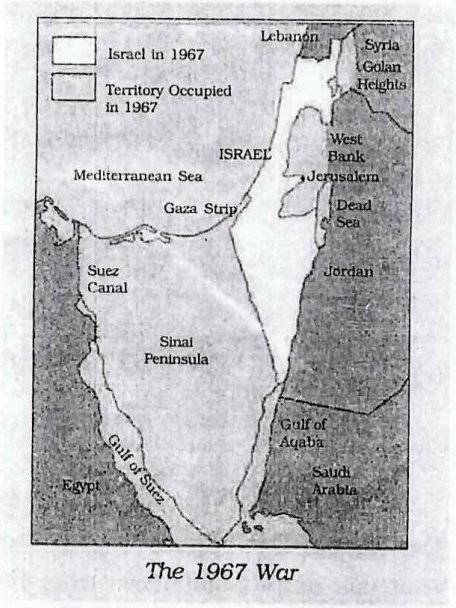
-
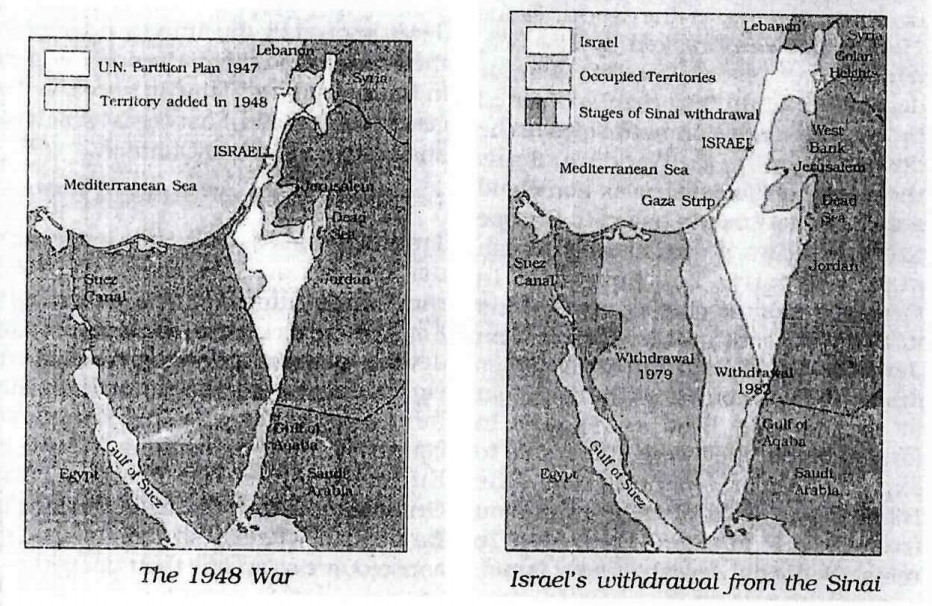
- Historical Background
- Jews were driven out of Palestine almost 2,000 years ago and faced persecution and violence across Europe for centuries.
- The persecution culminated in mass murders such as pogroms (organized massacre of particular ethnic group) in many European countries.
- The Zionist Movement
- In 1897, wealthy European Jews founded the World Zionist Organisation in Basle, Switzerland, advocating for the return of Jews to their homeland.
- They began to push their cause with European powers, especially Britain, which controlled Palestine at the time.
- British Support for a Jewish Homeland
- In 1917, British Foreign Minister Arthur Balfour announced support for a Jewish national home in Palestine.
- Palestine became a British mandate (official approval) in 1919, and Jews started returning to the region, which caused dismay among the Arabs.
- To calm Arab concerns, the British assured that not all of Palestine would be given to the Jews, aiming to create peaceful coexistence between Jews and Arabs.
- Tensions After World War II
- Post-WWII, Jews rejected the second-class citizen status in Europe and Britain faced pressure from the United States to allow 100,000 Jews into Palestine.
- Reluctant to anger Arab sentiment, Britain initially refused to allow the influx, leading Jews to start a terrorist campaign targeting both the British and the Arabs.
- Major Terrorist Incidents:
- King David Hotel Bombing (July 1946)
- Target: British administrative offices in Jerusalem (inside King David Hotel).
- Executed by: Irgun.
- Casualties: 91 people killed (British officials, Arabs, and Jews).
- Goal: Attack British authority and push them to leave Palestine.
- Assassination of Lord Moyne (1944)
- Target: British Minister of State in the Middle East.
- Executed by: Lehi (Stern Gang).
- Goal: Protest British anti-immigration policies.
- Attacks on British Soldiers and Police
- Ambushes, bombings, and kidnappings became common.
- They also attacked Arab villages when they saw them as a threat.
- Illegal Immigration ("Aliyah Bet") and Ship Battles
- Jews tried to smuggle Holocaust survivors into Palestine.
- Armed confrontations happened between Jewish militias and British naval forces.
- The Exodus (mass departure) ship, filled with European Jews, including Holocaust survivors, made a notable attempt to enter Palestine during this period.
- UN Intervention and Partition
- The British sought the United Nations intervention (involvement), and in November 1947, the UN voted in favor of partitioning Palestine.
- Half of the territory was allocated to the Jews, establishing the new state of Israel.
- The British withdrew from Palestine, and immediately afterward, the new state of Israel was attacked by a coalition of Egypt, Syria, Jordan, Iraq, and Lebanon.
- Outcome of the First Arab-Israeli War
- The First Arab-Israeli War (1948-1949), also known as the War of Independence by Israelis or the Nakba ("catastrophe") by Palestinians.
- Initial Expectations
- The world expected Israel to be easily defeated in the first Arab-Israeli war as it faced attacks from four sides.
- However, Israel’s fight became a matter of survival, marking the Israeli style of warfare with fierce (ferocious / savage) defense and desperation (hopelessness).
- Israel’s Success
- Contrary to expectations, the Israelis not only fended (look after onself without outside help) off the attackers but also captured three-fourths of Palestine and the Egyptian port of Eilat on the Red Sea.
- Reasons for Israel dominance
- Strong national identity and leadership
- Arab lack of coordination and underestimation of Israeli strength
- Highly organized superious military, experience from participating in world war and strong defence
- International aid and arms support
- Psychological factors and the holocaust legacy
- Nearly one million Arab Palestinians fled to Egypt, Lebanon, Jordan, and Syria, where they were placed in refugee camps.
- Aftermath and Arab Response
- Jordan occupied part of Jerusalem, while the US, Britain, and France guaranteed Israel’s frontiers.
- Despite this, the Arab nations refused to recognize Israel’s legal status, viewing the conflict as just the first step in a larger struggle to liberate Palestine and destroy Israel.
- From this point onward, Israel has remained in a state of war-preparedness.
- The Suez Crisis, 1956
- Nasser’s Arab Unity Efforts
- President Gamal Abdel Nasser of Egypt focused on building Arab unity, realizing that Israel would thrive if Arab states remained divided.
- He formed secret fidayeen (suicide) squads, which carried out explosions deep inside Israel.
- Nasser also targeted Western support for Israel and adopted aggressive policies against Britain and France.
- Nationalization of the Suez Canal
- The 1936 treaty allowing Britain to maintain troops on the Suez Canal expired in 1956. Nasser demanded British withdrawal.
- He also incited (encouraged or stir up) other Arab states against Western powers.
- Tensions escalated after Nasser signed an arms deal with the USSR in September 1955, which concerned the US.
- In retaliation for the US freezing aid for the Aswan Dam, Nasser nationalized the Suez Canal.
- Escalating Tensions and Western Response
- Western powers feared a communist conspiracy to block their main oil source and began media propaganda likening Nasser to Hitler.
- British politicians recalled the pre-WWII appeasement policy, which had proven ineffective. Plans were made to wage war against Egypt.
- Israeli Attack and International Reaction
- On 29 October 1956, Israeli forces attacked Egypt and captured the entire Sinai Peninsula within a week.
- Britain and France bombed Egyptian airfields.
- Approx. 100 aircrafts destroyed in action.
- However, global opinion turned against the three countries. The US initially supported the plan but reversed its stance (posture / pose) and joined the USSR in calling for a cease-fire at the UN Security Council.
- As a result, the Israelis withdrew, and UN peacekeepers were deployed to patrol the Israel-Egypt border.
- Aftermath and Long-Term Consequences
- The Suez Crisis marked the greatest humiliation for Britain and France in the 20th century. Britain’s status as a world power was severely diminished.
- The US took control of much of Britain’s foreign policy.
- Nasser emerged as a hero of Arab nationalism, and he strengthened ties with the USSR, creating a powerful Arab alliance.
- These developments ultimately set the stage for the 1967 war.
- The Six-Day War, 1967
- Background Factors
- Iraq’s Ba’ath Party, in power since 1963, supported Arab independence and unity, with pro-Communist leanings and a willingness to cooperate with Egypt.
- Syria’s Ba’ath Party came to power in 1966, backing fidayeen operations inside Israel.
- With Soviet cooperation, Nasser had developed Egypt into a modern state and felt confident about launching another strike against Israel by 1967.
- The Military Build-Up
- By June 1967, Arab armies from Egypt, Syria, Jordan, Lebanon, Iraq, Saudi Arabia, and Algeria were all arrayed against Israel, putting Israel in a seemingly hopeless position.
- However, Israel decided that offense was the best defense. On 5 June 1967, the Israeli air force launched a surprise attack and destroyed the entire Egyptian air force on the ground.
- The blow to Egypt's air force was devastating, and it left the Egyptian military unable to effectively engage in further combat operations from the air.
- The Egyptian army on the ground was also underprepared for the fast-moving Israeli offensive.
- Simultaneously, Israeli ground forces captured the Gaza Strip and Sinai Peninsula from Egypt, the West Bank from Jordan, and the Golan Heights from Syria.
- International Response and Aftermath
- The United Nations passed a resolution calling for an immediate cease-fire, which the Arabs accepted on 10 June 1967.
- The Israelis halted their advance but refused to return the captured territories, realizing they could use them as buffer zones between themselves and the Arabs in the future.
- Consequences for Nasser and Arab Forces
- For Nasser, the war was a major setback. Despite having large, well-armed armies, the Arab forces were ineffective in combat.
- The Soviets, who had promised support, stayed out during the conflict.
- After the war, the Soviets renewed efforts to supply the Arab states with weapons, and the Arab resolve (settle) was revived (bring back to life), leading to future attacks on Israel.
- The Yom Kippur War, 1973
- Rise of Terrorism (1967-1973)
- Between 1967 and 1973, terrorism became a potent force in the region.
- The Palestinian Liberation Organization (PLO), led by Yasser Arafat, pressured Arab states to attack Israel, but they were less enthusiastic after their 1967 defeat.
- The Popular Front for the Liberation of Palestine (a faction of the PLO) carried out airline hijackings, which embarrassed King Hussein of Jordan, leading to the expulsion of PLO leaders from Jordan.
- In September 1970, members of the PFLP hijacked four international flights bound for the United States and Israel. These hijackings were coordinated and involved planes being diverted to a remote desert airstrip in Jordan.
- The hijackings were seen as a direct challenge to the stability of the Jordanian monarchy, and the kingdom was under increasing pressure from both internal and external actors to resolve the situation.
- Terrorism escalated, with Israeli athletes attacked at the Munich Olympic Games in 1972.
- 11 Israeli athletes and coaches hostage in the Israeli team’s quarters. The group demanded the release of over 200 Palestinians held in Israeli prisons, as well as the departure of Israeli forces from Palestinian territories.
- When negotiations failed, and the Israeli athletes were killed.
- The attack shocked the world and brought terrorism into sharp focus on the global stage.
- Leadership Transition in Egypt
- Nasser died in 1970, and his successor, Anwar Sadat, was less inclined to war.
- Sadat favored a peace settlement with Israel to resolve the Palestinian issue and sent diplomatic missions to the US.
- When the Nixon administration refused to mediate, Sadat, along with Syria, planned an attack on Israel, hoping to prompt American intervention.
- The War Breaks Out
- On 6 October 1973, during Yom Kippur, the Egyptians and Syrians attacked Israel.
- Despite initial Arab successes, the Israelis counterattacked, retaining their territories and even crossing the Suez Canal into Egypt.
- The Soviets refused to intervene on behalf of the Arabs, but Americans, as Sadat hoped, played a key role in enforcing a ceasefire.
- Aftermath and Global Consequences
- The Geneva talks led to Israel agreeing to withdraw troops from the Suez Canal.
- The Arab states, angered by Western support for Israel, decided to restrict oil supplies to the West.
- The Organisation of Petroleum Exporting Countries (OPEC) raised oil prices, leading to global inflation and an energy crisis.
- The Egypt-Israel Peace
-
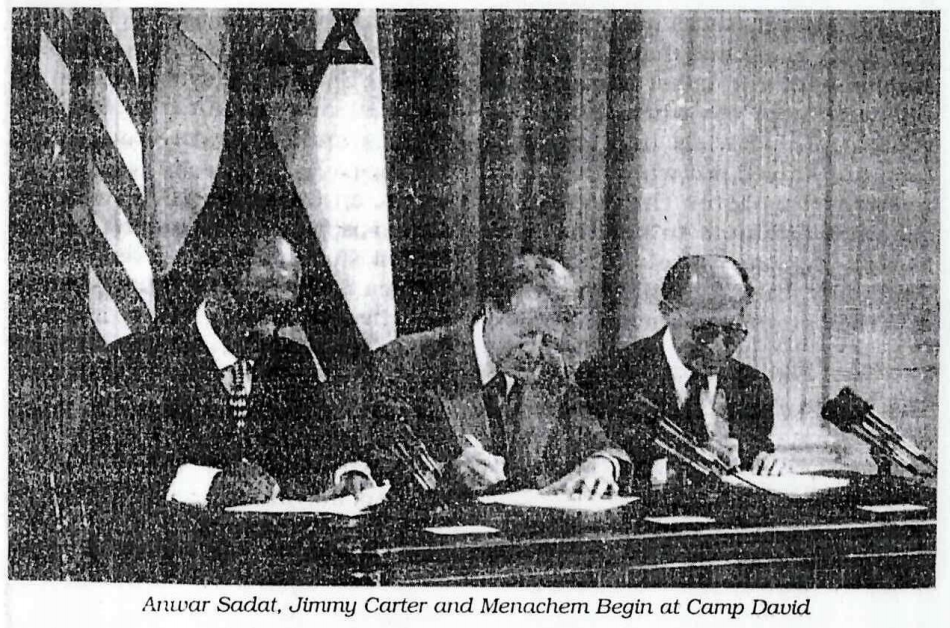
- Sadat’s Realization and Decision
- President Sadat recognized that Israel could not be defeated outright in war.
- However, engaging in dialogue with Israel meant acknowledging its existence, which could isolate Egypt from the Arab world.
- Despite this, Sadat took the historic step of visiting Israel in November 1977, a decision that would change the course of relations.
- Initial Steps Towards Peace
- Menachem Begin, the Israeli Prime Minister, reciprocated (do the same) by visiting Egypt in December 1977.
- At this time, Israel was facing economic challenges, and Begin realized that indefinite war-readiness was unsustainable.
- President Jimmy Carter of the US recognized the emerging desire for peace and mediated peace talks, which began in September 1978 at Camp David near Washington D.C.
- The Peace Treaty
- In March 1979, the Camp David Accords resulted in a peace treaty, ending the state of war between Israel and Egypt, which had existed since 1948.
- Israel agreed to withdraw its troops from Sinai.
- In return, Egypt promised not to attack Israel again and ensured oil supplies from Southern Sinai.
- Israel gained the right to use the Suez Canal.
- Reactions and Aftermath
- Both Sadat and Begin received international recognition for achieving the peace treaty.
- However, the PLO and most of the Arab world (except Morocco and Sudan) condemned Egypt for the agreement.
- Following the treaty, Israel became more assertive (confident), declaring it would never return the Golan Heights to Syria, even if a separate peace agreement was made.
- Israel also stated that it would not give up the West Bank to Arab Palestinians, justifying these positions on the grounds of security.
- BEGINNING OF THE MIDDLE EAST PEACE PROCESS
- Sadat’s Assassination and Mubarak’s Stance
- Sadat was assassinated in October 1981 by extremists in his own army, angry over his peace efforts.
- His successor, Hosni Mubarak, upheld the Camp David Agreement, ensuring that Egypt would continue its peace with Israel.
- Israeli Actions and Palestinian Response
- Begin intensified settlement of Jewish people on the West Bank.
- From 1987, Israeli suppression of Palestinian protests attracted global condemnation.
- Shift Towards Negotiation
- In 1992, Prime Minister Yitzhak Rabin and Foreign Minister Shimon Peres responded to international calls to negotiate with the PLO.
- By 1994, the Oslo Accords were signed, with Israel formally recognizing the PLO and vice versa.
- The agreement set the framework for “land for peace”, including Palestinian self-rule in the West Bank and Gaza Strip.
- Terms of the Oslo Accords
- Key issues for future negotiation included:
- Palestinian statehood
- Status of Jerusalem
- Jewish settlements in occupied territories
- Return of Palestinian refugees
- Arafat promised to end violence, and Israel was to withdraw based on UN resolutions.
- Resistance and Domestic Challenges
- Extremist groups opposed the Oslo deal, with the Popular Front demanding full independence.
- Israeli settlers resisted leaving the West Bank.
- In September 1995, Israel agreed to withdraw from most of the West Bank, and Palestinians were given voting rights for a Palestinian parliament.
- Prime Minister Rabin was assassinated by a Jewish fundamentalist in November 1995, dampening the peace process.
- Continued Violence and US Involvement
- Terrorist attacks by groups like Hamas and Hezbollah hindered progress.
- In 2000, Camp David II talks almost resulted in a final settlement but broke down over the status of Jerusalem.
- Israel claimed Jerusalem as its eternal capital, while Palestinians wanted East Jerusalem as their capital.
- Renewed Violence and Israeli Response
- Ariel Sharon’s visit to Haram al-Sharif in 2000 led to widespread violence.
- By 2001, over 1,000 people had been killed, mainly Palestinians.
- In March 2002, Israel launched Operation Defensive Shield, aimed at dismantling Palestinian terrorist infrastructure, and confined (restricted) Arafat to his headquarters (head office).
- Suicide bombings in June 2002 led to further Israeli occupation of Palestinian towns.
- The US Peace Plan
- In June 2002, US President George W. Bush outlined a vision for a post-Oslo solution, focusing on a two-state resolution.
- A Quartet (US, EU, Russia, and UN) proposed a “Road Map”, supporting Palestinian self-determination and Israeli security.
- However, this plan was criticized by Israel for lacking a commitment from Palestinians to renounce (give up) violence.
- OIL AND GEOPOLITICS
- Discovery of Oil and Its Impact
- West Asia contains the world’s largest petroleum reserves.
- In the 1930s, the discovery of oil in eastern Arabia significantly shifted global politics.
- The British and Americans rushed to Saudi Arabia, securing deals with King Abdul-Aziz ibn Saud, who ruled from 1906-1953 and united Hejaz and Najd to form the Kingdom of Saudi Arabia.
- King Abdul-Aziz granted concessions to the Arabian-American Oil Company (Aramco), a joint venture between Texaco and Standard Oil Company of California (USA).
- Royalties from Aramco helped fund Saudi Arabia’s rapid development.
- Saudi Arabia’s Political System
- Saudi Arabia follows an 18th-century absolute monarchy model, with power concentrated in the King and a few princes.
- Women are excluded from public offices and must seek permission from their male guardians to travel abroad, despite being educated.
- Society is strictly Islamic, and Sharia law is absolute, with public beheadings for criminals and stoning of women deemed (regarded as) immoral.
- Despite lacking political freedoms, the people benefit from extensive social security, unparalleled in many parts of the world.
- Oil’s Influence on Saudi Arabia’s Power
- Saudi Arabia’s wealth from oil grants it significant control over the Islamic world and serves as both an economic and political weapon.
- The country’s foreign policy is anti-Israel, but during the Cold War, the United States supported Saudi Arabia due to its fiercely anti-communist stance.
- ORGANISATION OF PETROLEUM EXPORTING COUNTRIES (OPEC)
- Emergence of Regionalism
- After World War II, regional arrangements and organizations grew in importance, as they proved more effective in organizational action compared to global ones.
- Regionalism refers to the concept of mobilizing states and areas on a geopolitical basis.
- Distribution of Oil Reserves and Production
- Oil reserves and production are unevenly distributed across the world.
- 66% of global oil reserves are located around the Persian Gulf.
- Kuwait, Saudi Arabia, Iran, Iraq, and the UAE are the main producers, accounting for 75% of global oil exports.
- Formation of OPEC
- In 1962, conflicts with international oil companies and their decision to reduce the price of Middle Eastern crude oil led to the Baghdad Declaration.
- The declaration called for the formation of OPEC (Organisation of Petroleum Exporting Countries).
- Iraq, Kuwait, Saudi Arabia, Iran, and Venezuela were the founding members, accounting for 80% of the global oil trade.
- Since then, the membership of OPEC has expanded.
- OPEC played a key role in countering the manipulation of oil prices and other selfish practices by international companies.
- Saudi Arabia and OPEC’s Influence
- The formation of OPEC is considered a landmark in efforts toward a more equitable global economic order, despite Ecuador and Iran withdrawing from the organization in 1992.
- Saudi Arabia played a significant role in forming OPEC.
- In 1973-74, angry with Western attitudes towards Israel, King Faisal of Saudi Arabia imposed an oil embargo (official ban), advised by his oil minister, Sheikh Ahmed Zaki Yamani.
- The embargo sent shockwaves through the global oil market, as the U.S. relied on Saudi Arabia for 20% of its oil imports.
- Saudi Arabia invested its oil royalties in U.S. banks, stocks, and bonds.
- Iran’s Oil and Political History
- Iran, Saudi Arabia’s eastern neighbor, also possesses vast oil reserves.
- British interests in Iran’s oil were driven by the collapse of the Russian Empire.
- Lord Curzon, the British foreign secretary, secured political and military control over Persia (Iran) to serve as a buffer state between India and Bolshevik Russia.
- The Anglo-Persian Oil Company held lucrative oil exploration concessions until 1932, when Reza Khan (later Shah of Iran) canceled them.
- The British were forced to accept profit-sharing with the Iranian government.
- During World War II, Iran was occupied by Britain, Russia, and the U.S..
- Conflict over Nationalisation of Oil
- In 1951, Iranian parliament authorized the nationalization of its petroleum industry to improve its economy.
- This move angered the U.S. and Britain, who opposed economic independence in a semi-colonial state.
- The U.S. government cut off aid, and the British enforced an oil embargo, preventing tankers from reaching Iran’s markets.
- As a result, Iran faced economic collapse, with refineries shutting down.
- In 1953, the CIA sponsored a coup to restore the Shah to power.
- The Shah, Reza Pahlavi, was reduced to a puppet leader, and under a treaty, Iran’s oil industry was handed over to five American companies, with the U.S. controlling 40% of the industry.
- ORGANISATION OF ISLAMIC COUNTRIES
- Formation and Early Deliberations (long and careful consideration or discussion)
- In September 1969, a summit of Muslim Heads of State was held at Rabat.
- This was followed by Islamic Foreign Ministers’ Conferences in March at Jeddah and in December 1970 at Karachi.
- These deliberations led to the formation of the Organisation of Islamic States (OIS), initially with 45 members.
- Structure and Functioning
- The Conference of Heads of State is the supreme body of the OIS.
- It is meant to meet once every three years.
- The priorities of the OIS include:
- Cooperation for mutual and collective development
- Elimination of racism
- Safety of holy places
- Promotion of world peace and Islamic solidarity
- Headquarters
- The headquarters of the Organisation of Islamic States is located in Saudi Arabia.
- THE ISLAMIC REVOLUTION IN IRAN, 1978
- Reign of Muhammad Reza Pahlavi
- Reign lasted four decades, making Iran wealthy.
- The Shah ruled with repression (subduing by force), using secret police.
- Terror and torture were used to maintain loyalty.
- Westernisation caused resentment (bitterness) among Shia population.
- Uprising and Revolution
- Economic slump (flop) in the late 1970s led to protests.
- Shah used violence to suppress the revolt but failed.
- Ayatollah Khomeini, exiled in 1964, led the revolution from Paris.
- Shah vacated the throne on 16 January 1979.
- Impact on the Islamic World
- Inspired Muslim clergy (the body of all people ordained for religios duties) to reject Western-style development.
- Khomeini imposed Shariat law and an anti-American, anti-Israeli policy.
- ‘Shaitan-e-Buzurg’ (great Satan) became a rallying cry against the U.S.
- The Hostage Crisis
- Shah admitted to the U.S. for treatment, angering Khomeini.
- 52 American diplomats taken hostage in November 1979.
- Hostage crisis ended in January 1981 after negotiations.
- The Shah moved to Panama, then Egypt, where he died in July 1980.
- THE IRAN-IRAQ WAR
- Background and Causes
- Shatt al Arab Waterway: Disputes over ownership between Iran and Iraq.
- Important for oil exports and forms part of their border.
- Iraq controlled it until Shah of Iran forced shared control.
- Saddam Hussein’s Decision:
- Saw Iran’s Islamic revolution as an opportunity to strike.
- Assumed the revolution would keep Iran’s army busy.
- Launched attack in September 1980.
- Early War Dynamics
- Saddam’s Strategy:
- Poor strategist, underestimated Iranian resistance.
- Tensions had been brewing over Iraq’s secular leadership fearing Khomeini’s influence.
- Both regimes supported rebel movements against each other.
- Diplomatic Relations Severed:
- In June 1980, Iraq and Iran severed ties.
- Border clashes broke out.
- Global Involvement and Strategic Concerns
- Global Impact:
- Both sides engaged in a prolonged war, weakening both countries.
- U.S. interests: Wanted a drawn-out, inconclusive war to weaken both sides, maintaining stability in the region.
- Support for Iran:
- Syria, Libya, China, North Korea, and Israel supported Iran.
- Israel: Despite anti-Zionist Ayatollah Khomeini, Israel supported Iran due to Saddam’s ambitions.
- Support for Iraq:
- Saudi Arabia, Kuwait, Jordan, Egypt, the U.S., France, and the USSR backed Iraq.
- U.S.: Supplied Iraq with advanced weapons.
- France and USSR: Both sided with Iraq.
- Shifting War Dynamics
- Iraq’s Early Success:
- Seized southern Iran and besieged refinery towns.
- Turning Point:
- Mid-1981: Iran broke out of Abadan and recaptured Khorramshahr.
- By June 1982, Iraq was driven out of Iran, and Iraq fought defensively.
- Iran’s Stubbornness:
- Ayatollah rejected peace offers from Saddam.
- War continued for six more years with neither side gaining a clear victory.
- American Involvement and Arms Deals
- American Policy:
- U.S. didn’t want either side to win.
- Supplied arms to both Iran and Iraq.
- Arms deal with Iran was clandestine (secret) due to U.S. arms embargo (official ban).
- Embarrassing Revelation: The arms deal to Iran became politically sensitive when exposed (unprotected / visible).
- Conclusion and Aftermath
- End of the War:
- By 1988, both sides were exhausted.
- UN brokered (middleman) a ceasefire, with Iran accepting first.
- No victory claimed by either side, and the border dispute remained unresolved.
- Human Cost:
- One million deaths, including civilians, and two million wounded.
- Financial cost: Over $200 billion for both sides.
- Diplomatic Relations:
- Resumed two years later after Iraq withdrew troops and focused on invading Kuwait.
- Agreement over the Shatt al Arab and exchanged prisoners.
- EFFECTS OF THE WAR
- Long-term Impact
- Iran:
- Continued spreading instability across West Asia.
- Supported Shiite terrorists, threatening Gulf monarchies, especially Saudi Arabia.
- Used Lebanon as a base for attacks on Israel and Western nations backing Israel.
- Iraq:
- Saddam Hussein remained dictator until March 2003.
- Briefly invaded Kuwait in 1990, but was driven out by a U.S.-led international coalition.
- From 1991 to 2003, Iraq faced UN sanctions which severely impacted Saddam’s regime.
- Global Consequences
- The world, especially the United States, continued to deal with Iraq’s ambitions to dominate West Asia, leading to further international intervention.
- RISE OF SADDAM HUSSEIN
- Early Life and Political Ideology
- Born: 1937, Tikrit district of Iraq, into a humble rural family.
- Childhood: A lonely child, often carrying an iron bar.
- Political Ideas:
- Influenced by Pan-Arab nationalism of President Nasser of Egypt.
- Associated with American intelligence services during his youth.
- Joined the Ba’ath Party, which had a presence across the Arab world, and became a socialist.
- Rise to Power
- 1968: Ba’ath Party came to power in Iraq; Saddam became vice-chairman.
- Popularity:
- Implemented a mass literacy program, making failure to send a child to school punishable by three years in prison.
- Received an award from UNESCO for this initiative.
- Transformed Iraq with improved education, roads, public housing, and health systems.
- Political Shifts and Aggression
- Islamic Revolution in Iran (1979): Changed Saddam’s outlook.
- Concerned about Islamic fundamentalism spreading into Iraq, a secular state.
- Became externally aggressive to prevent this, receiving support from Western powers keen to protect regional oil reserves from fundamentalists.
- Dictatorship and Brutality
- Brutal Leadership:
- Known for using biological and chemical weapons against Iraq’s Kurdish population.
- Employed torture and murder to suppress dissent.
- Family Influence: His two sons were equally feared figures.
- Admiration for Stalin: Saddam openly acknowledged Stalin as his role model.
- Western Support and Demonization
- Initially supported and backed by Western powers.
- Over time, these same powers turned against him, demonizing him for defying their geopolitical interests.
- INVASION OF KUWAIT AND THE FIRST GULF WAR
- Motivations for Invasion
- Saddam’s Economic Struggles: After the Iran-Iraq war, Saddam needed funds to revive Iraq’s economy.
- Kuwait’s Oil Reserves: Viewed Kuwait’s oil wealth as a potential solution.
- International Miscalculation: Saddam believed no world power would intervene if Iraq took over Kuwait, as the US, USSR, Britain, and France had supported him during the Iran conflict.
- Claim for Justification: Saddam claimed Kuwait had once been part of Iraq, though it had been a British protectorate since 1899.
- Events Leading to Invasion
- Oil Overproduction: In May 1990, Kuwait and the UAE started overproducing oil, which caused a drop in Iraqi oil prices.
- Saddam termed this an ‘act of economic warfare’ against Iraq.
- Oil Theft Accusations: In July, Saddam accused Kuwait of stealing oil from the Rumaila oil fields on the Iraq-Kuwait border.
- Military Buildup: By the end of July 1990, Iraq began amassing troops on the Kuwaiti border.
- Invasion: On 2nd August 1990, Iraqi troops crossed into Kuwait and seized its oil fields. The Emir of Kuwait fled to Saudi Arabia.
- International Response and Escalation
- Saudi Plea for Help: Iraq threatened Saudi Arabia by positioning troops on its border, prompting Saudi Arabia to urgently request US military assistance.
- US and UN Action:
- UN Sanctions: Imposed a trade embargo on Iraq on 6th August 1990.
- Saddam’s Reaction: Saddam declared a jihad against the US and Israel, and renamed Kuwait City al-Khadima.
- International Coalition:
- Britain and France pledged military support for action.
- Several countries from Europe, Asia, Africa, and South America joined the coalition.
- The USSR remained neutral but attempted to mediate.
- UN Deadline: On 17th December 1990, the UN set a deadline for Iraqi withdrawal from Kuwait by 15th January 1991. Saddam rejected all UN resolutions.
- Operation Desert Storm
- Military Action Begins: After diplomatic efforts failed, Operation Desert Storm commenced on 17th January 1991.
- Over the course of four months, US planes bombed strategic targets in Iraq.
- Saddam’s response was weaker than expected.
- Saddam’s Actions:
- Ordered Iraqi air force pilots to fly planes to Iran for safekeeping.
- Instead of attacking Saudi coalition bases, he launched Scud (moving fast in straight line) missiles at Israel.
- Ordered Iraqi troops to destroy Kuwait’s oil installations and create an environmental disaster by dumping crude oil into the Persian Gulf.
- Liberation of Kuwait
- Ground Operations: On 24th February 1991, coalition forces began ground operations to liberate Kuwait.
- Weak Iraqi Resistance: Iraqi soldiers offered little resistance and quickly retreated.
- Kuwait’s Freedom: By 27th February, Kuwait was liberated.
- Cease-fire: On 3rd March 1991, Iraq officially accepted a cease-fire.
- AFTERMATH OF THE WAR
- Lack of Iraqi Revolt
- The Gulf War raised hopes for an Iraqi revolt, especially among Kurds and Shia Muslims, but these uprisings were crushed when the Allies did not intervene.
- Kurds: Suppressed by Saddam, with neighboring countries staying passive due to their own Kurdish populations.
- Shia Revolt: The US did not support the Shia uprising, fearing that it would strengthen Iran.
- US and UN Response
- The US pushed for a safe haven for Kurds north of 32°N latitude and imposed a no-fly zone south of 32°S latitude to limit Saddam’s power.
- Preparation for Future Conflict
- The groundwork for another conflict was laid over the 12 years following the 1991 ceasefire.
- Bill Clinton focused on other global issues, but Saddam remained a concern.
- Continued Hostility During Clinton’s Presidency
- 1993 Attack: The US struck Iraq’s military intelligence headquarters in retaliation for the attempted assassination of former President Bush.
- Weapons of Mass Destruction: The US continued to suspect Iraq of developing chemical and biological weapons, leading to further sanctions.
- UN Sanctions and Their Impact
- Resolution 687 (1991): The UN imposed strict sanctions on Iraq, demanding the destruction of weapons of mass destruction.
- Impact: Iraq’s economy was devastated, and Iraq was barred from selling oil until it complied with the UN’s disarmament requirements.
- The Oil-for-Food Program
- Resolution 986 (1995): The UN allowed Iraq to sell oil, but the funds went to a UN-managed account for buying essential supplies.
- Impact: The program provided only 32 cents per day per person, insufficient to meet basic needs. The allocation was later doubled in 1997.
- Humanitarian Consequences
- Child Mortality:
- 1990: 56 children per 1,000 died.
- 1999: 131 per 1,000.
- The trend would have dropped to 25 per 1,000 by 2000 if it had continued as in the 1980s.
- THE RUN-UP TO ANOTHER WAR
- Saddam’s Continued Defiance
- Saddam Hussein defied UN resolutions and strengthened his power base.
- In 1995, he held a referendum that granted him the right to rule for another seven years. A similar exercise occurred in 2002, with 99.9% support claimed for his continued rule.
- UNSCOM and the Weapons Inspections
- The UN Weapons Inspection team (UNSCOM) continued to check Iraq’s civilian and military sites for disarmament compliance.
- The US government claimed Iraq was uncooperative.
- In October 1998, Iraq announced it would no longer accept UNSCOM inspections.
- In retaliation, the US and Britain launched Operation Desert Fox to destroy Iraq’s weapons programs.
- Continued Defiance and New Inspection Body
- Saddam remained defiant, rejecting a December 1999 UN resolution that created the UNMOVIC (UN Monitoring, Verification, and Inspection Commission).
- In February 2001, US and British planes conducted another bombing operation to destroy Iraq’s air defense system, without international approval.
- September 11 Attacks and the War on Terror
- September 11, 2001: Terrorists hijacked four planes and attacked the World Trade Center in New York, killing over 4,000 people.
- In response, President George W. Bush declared a “war against terrorism” and attacked Afghanistan, targeting the Taliban regime that hosted Osama bin Laden.
- Shift Towards Iraq
- After defeating the Taliban, Bush turned attention to Saddam Hussein.
- Bush advocated for “regime change”, accusing Saddam of evading weapons inspections and being a regional threat.
- The US and Britain were united in supporting this stance, with the US acting unilaterally as the sole global superpower post-USSR dissolution.
- Iraq’s Response
- Saddam realized the seriousness of the situation and allowed UNMOVIC inspectors to return, claiming cooperation.
- Hans Blix, the Chairman of UNMOVIC, acknowledged Iraq’s increased cooperation, stating more time was needed for inspections.
- Despite no evidence of concealed weapons of mass destruction, the US and Britain continued to demand Saddam’s removal.
- US Ultimatum and the Invasion
- On 17 March 2003, the US gave Saddam and his sons 48 hours to leave Iraq or face war.
- 20 March 2003: US and British forces began bombing Iraq.
- Ground operations followed immediately, and by 9 April 2003, US forces entered Baghdad.
- Kurdish forces, under US-British control, seized Kirkuk and Mosul.
- Saddam and his sons, however, managed to escape before Baghdad fell.
- LONG TERM EFFECTS OF THE SECOND GULF WAR
- Operation Iraq Freedom’s Outcome
- “Operation Iraq Freedom” ended quicker than expected, showcasing the full force of America’s military might.
- Thanks to television, people worldwide witnessed the conflict unfold in real-time.
- Saddam Hussein and the Iraqi People
- While Saddam was no saint, many Iraqis viewed the US troops as liberators due to the oppression they faced under Saddam’s dictatorship.
- However, the US applied different standards in its global approach, offering full support to Pervez Musharraf’s regime in Pakistan, despite its undemocratic actions and sponsorship of terrorism.
- Expectations and Reality Post-Gulf War
- After the Gulf War, there were hopes for a “chain reaction” of reforms across West Asia, where many believed that the undemocratic regimes would evolve after 1991.
- Instead, many countries, including Saudi Arabia, UAE, and Kuwait, became more conservative, with women’s rights remaining severely restricted.
- These countries continued to secretly sponsor Islamic fundamentalism and terrorism, raising concerns about the future of the region.
- The Enduring Fundamentals of West Asia
- In conclusion, the fundamentals of West Asia have changed little since 1945.
- Western interests in oil continue to dominate regional politics.
- The dream of Jewish-Palestinian good neighborliness remains as elusive (difficult to find or catch) as it was in the 1940s.
- Despite unprecedented material prosperity, the region’s socio-economic structure remains largely backward.
- West Asia, much like the desert it rests upon, remains resistant to significant change.
- The cold war years
- TWO YEARS OF MISTRUST
- The Cold War’s Threat
- For 45 years after WWII, the world feared a catastrophic war between the US and the Soviet Union.
- Weapons of mass destruction were stockpiled, ready to be deployed within minutes.
- The conflict was ideological: free enterprise vs. communism, democracy vs. totalitarianism.
- The End of the Cold War
- Surprisingly, World War III did not happen.
- Bernard Baruch coined the term “Cold War” in 1946 after tensions in Berlin.
- Rise of Superpowers
- The US and USSR became the world’s two superpowers.
- Britain and France became secondary powers.
- The USSR replaced Nazi governments in Eastern Europe with communist regimes.
- Polarization of the World
- The world split into two blocs: the Western Bloc (led by the US) and the Eastern Bloc (led by the USSR).
- Western Europe joined the US fearing communism.
- A Tense Stand-off
- The Cold War remained “cold” with no direct conflict.
- Both sides feared accidental war, which could destroy humanity.
- Spies and pacts were common, but direct war was avoided.
- ORIGINS OF THE COLD WAR
- Strained Relations Before WWII
- Allied powers and the USSR had tense relations until Hitler’s invasion of Russia in 1941.
- The US sent significant war material and humanitarian supplies to the USSR under the Lend-Lease system, with repayment expected later.
- President Roosevelt of the US had a good relationship with Stalin, but Harry S. Truman (Roosevelt’s successor) was highly suspicious of Stalin’s intentions.
- Stalin’s Concerns
- Stalin feared that once Nazi Germany was defeated, the US and Britain would turn their war machinery against the USSR.
- The Yalta Conference
- In February 1945, Roosevelt, Stalin, and Winston Churchill met at Yalta to plan the post-WWII world.
- Germany was to be divided into three zones: British, American, and Soviet. The French zone was added later.
- Berlin, in the middle of Germany, was also divided into three zones (later four).
- The creation of the United Nations was agreed to replace the League of Nations.
- Democracies would be established in the countries freed from Nazi rule, allowing the people to elect their governments.
- The USSR would join the war against Japan, with the condition of receiving the Sakhalin Islands and some territory in Manchuria.
- The Potsdam Conference
- In July 1945, a follow-up conference was held at Potsdam between Churchill, Stalin, and Truman (Roosevelt had died in April 1945).
- The meeting revealed tensions between the three powers, and no decision could be reached on the long-term future of Germany.
- The biggest issue was Poland. Stalin had broken his promise by occupying a large part of Eastern Germany.
- A pro-communist regime was established in Poland, leading to atrocities and mass evictions of German people.
- Communist Satellite States
- Stalin’s Puppet Governments
- Stalin exacerbated the crisis by establishing puppet communist governments in Poland, Hungary, Bulgaria, Albania, and Romania.
- Political opponents were systematically eliminated in most of these countries.
- In Hungary, where Soviets allowed elections, the communists won less than 20% of the vote, but Stalin ordered mass murder and terrorized non-communists.
- By the end of 1947, every Eastern European country, except Czechoslovakia, had a Stalinist government.
- Yugoslavia’s Resistance
- Yugoslavia was an exception. Marshal Tito, who had led a heroic partisan struggle against the Nazis, became the President in 1945.
-
- Since the Soviets did not have an army stationed there, Stalin could not take action against Tito.
- Stalin’s Speech on Communism
- In February 1946, Stalin stated that communism and capitalism could never coexist peacefully.
- He declared that future wars were inevitable until the final victory of world communism.
- The Coup in Czechoslovakia
- In February 1948, Czechoslovakia—the last free Eastern European country—suffered a Moscow-backed coup and a complete communist takeover.
- The country had previously had a coalition government of communists and other left-wing parties after the 1946 elections, but the coup shocked the world.
- The Truman Doctrine
- In March 1947, President Truman announced the Truman Doctrine, stating that America would support free people resisting subjugation by armed minorities or outside pressures.
- The doctrine was spurred by the civil war in Greece, where communists began fighting post-war.
- It also committed the US to a policy of containing communism not only in Europe but globally.
- Marshall Plan and Cominform
- Post-War Economic Recovery
- World War II devastated the economies of Western Europe under US influence.
- In June 1947, George C. Marshall announced the European Recovery Programme, offering financial aid to rebuild Europe.
- The goal was to revive economies and open up markets, addressing poverty, which could breed communism.
- Exclusion of Eastern Europe
- The Marshall Plan was offered to Eastern Europe, but Soviet regimes (government) couldn’t decide independently.
- The Soviets called it ‘dollar imperialism’ and blocked funds from reaching Eastern Europe.
- Stalin’s Response: Cominform
- In September 1947, Stalin set up Cominform to:
- Assert the supremacy of Soviet-style communism.
- Support industrialization of the East Bloc.
- Announce exclusive trade among East Bloc nations.
- Yugoslavia’s Expulsion
- Yugoslavia, opposing Stalin’s policy, was expelled from Cominform.
- Comecon and Molotov Plan
- Comecon coordinated the Eastern Bloc’s economic development.
- The Molotov Plan was the Soviet alternative to the Marshall Plan to finance Comecon.
- Berlin Blockade
- Crisis Overview
- The Berlin Blockade (seize), starting in 1948, was the biggest crisis of the early Cold War.
- Stalin not only prevented the implementation of the Marshall Plan in Soviet-controlled Germany but also exploited the region.
- German civilians suffered from starvation and oppression under Soviet control.
- Meanwhile, the British, American, and French zones merged into a single economic unit and quickly began recovering.
- As a result, thousands of refugees fled westward.
- Soviet Actions
- The Soviets sealed all roads, rails, and canal links between West and East Berlin, cutting off western aid to the people in East Berlin.
- East Berliners faced starvation due to the blockade.
- Western Response
- The United States launched an airlift, flying in food and essential supplies, even at the risk of intruding into Soviet airspace.
- This airlift continued for 10 months without interruption.
-
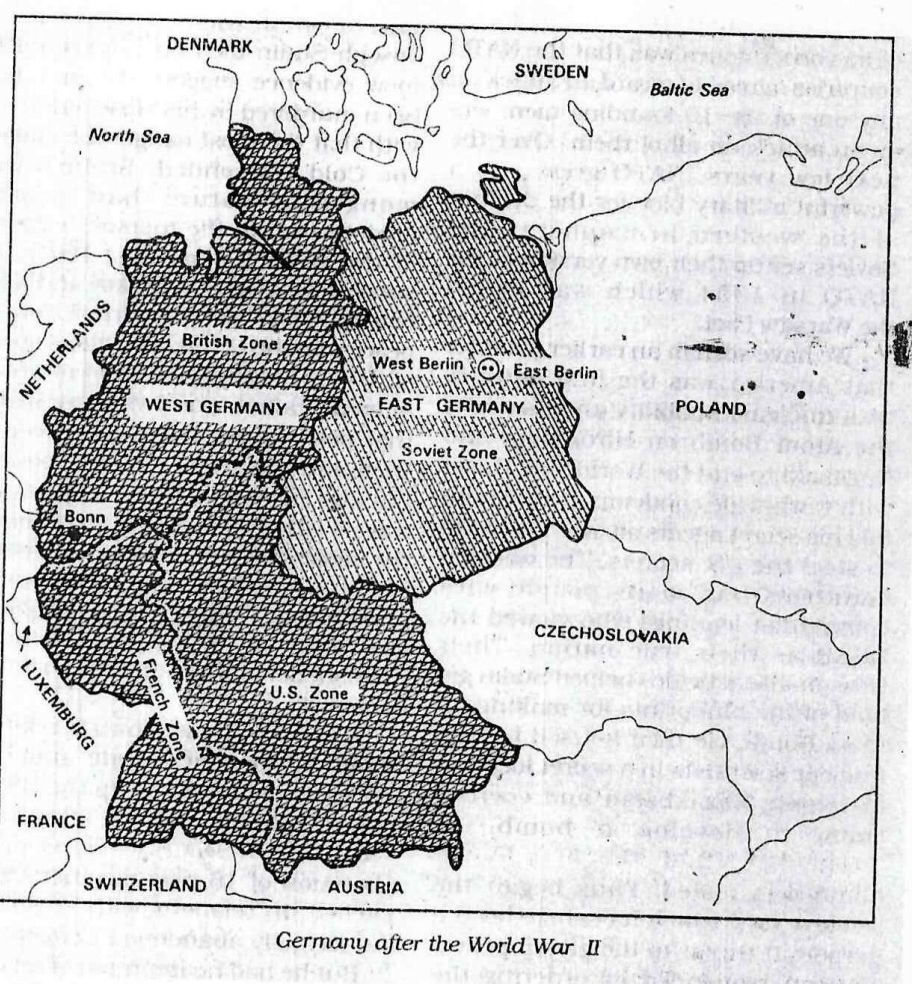
- Conclusion
- The Soviets ultimately lifted the blockade in 1949, unable to prevent the ongoing supply effort.
- Formation of NATO
- Creation of NATO
- After their success, the western powers sought to create a strategic (long terma aims and means to achieving them) alliance (union / association) to prevent a communist invasion of Western Europe backed by the USSR.
- The North Atlantic Treaty Organisation (NATO) was established in April 1949.
- A key principle of NATO was that an attack on any one of the 10 founding members would be regarded as an attack on all.
- Expansion and Response
- Over time, NATO grew into a formidable (intimidating) military bloc focused on defending the Western Hemisphere.
- In 1954, the Soviets created their own version of NATO, called the Warsaw Pact.
- Nuclear Arms Race
- After the United States became the first country with nuclear capability, their use of the atomic bomb on Hiroshima and Nagasaki in World War II was met with global condemnation.
- Stalin directed his secret agents worldwide to steal U.S. nuclear secrets, with the help of communist sympathizers (well-wishers / supporters).
- These efforts enabled the Soviets to obtain the blueprints for the atomic bomb, leading to a successful test in September 1949.
- This triggered the start of the nuclear arms race, a continual global threat to peace.
- U.S. Response and Global Arms Race
- In response, President Truman ordered the development and testing of a hydrogen bomb, much more powerful than an atomic bomb.
- This led to an ongoing arms race involving many nations, diverting resources away from development to military production.
- End of Stalin Era and the Rise of Khrushchev
- Death of Stalin and Leadership Transition
- Joseph Stalin died on 5 March 1953. New evidence suggests he may have been murdered by his close aides (assistant).
- His war-mongering (encouragement or advocacy towards violence towards other nations) nature had created anxiety even among the top ranks of the Soviet Communist Party.
- After his death, Georgi Malenkov and Nikita Khrushchev took over, showing inclination toward peace with the United States.
- In 1956, Khrushchev fundamentally altered Stalin’s worldview by advocating peaceful co-existence between the West and East, stating:
- “There are only two ways—either peaceful co-existence or the most destructive war in history. There is no third way.”
- Though Khrushchev remained committed to world communism, he did not believe in war as a means to achieve it.
- The ‘Thaw’ in Cold War Tensions
- The thaw (soften) in relations between the USSR and the West began under Khrushchev.
- He made key concessions (compromises), including:
- Withdrawing USSR’s military bases from Finland.
- Lifting the Soviet veto in the UN Security Council, allowing 16 new member states to join.
- Patching up relations with Yugoslavia.
- Formally abandoning Cominform.
- Soviet Control Over Satellite States (states that are formally independent but are under heavy influence of anouther state or country)
- Despite the thaw, Khrushchev had no intention of loosening control over Soviet satellite states.
- In 1956, a popular uprising (resistance / rebellion) erupted (become active / explode) in Budapest, Hungary.
- Khrushchev responded by sending troops to brutally crush the rebellion, proving that the thaw was only superficial.
- To further solidify Soviet influence, he formed the Warsaw Pact (1955), a military alliance including:
- Albania, Bulgaria, Czechoslovakia, East Germany, Hungary, Poland, Romania, and the USSR.
- A unified military command was established in Moscow.
- The Arms Race and Space Race
- Khrushchev aggressively armed the USSR with advanced weapons.
- The Soviet Hydrogen Bomb was developed using espionage (spying) networks and communist sympathizers in the West.
- The USSR also developed:
- A long-range bomber plane capable of reaching the United States.
- The Intercontinental Ballistic Missile (ICBM), capable of striking U.S. cities with nuclear warheads.
- The U.S. responded by developing their own ICBM, the Atlas, escalating the arms race.
- The rivalry extended into space:
- The USSR launched Sputnik I (1958), the world’s first artificial satellite.
- The U.S. countered with Explorer 1.
- The Berlin Crisis and the Cold War’s Continuation
- By 1958, Khrushchev had gained a strategic edge in the arms race and used it to challenge the West.
- He declared that the USSR no longer recognized Western rights in West Berlin.
- The U.S. responded with a firm (solid) stance (pose), warning against any Soviet aggression.
- In 1961, the Berlin Wall was built to stop East Germans from escaping to the West.
- The Berlin Wall stood for 29 years, symbolizing the division of Germany.
- Many people made daring escape attempts, but most were shot down by communist forces.
-
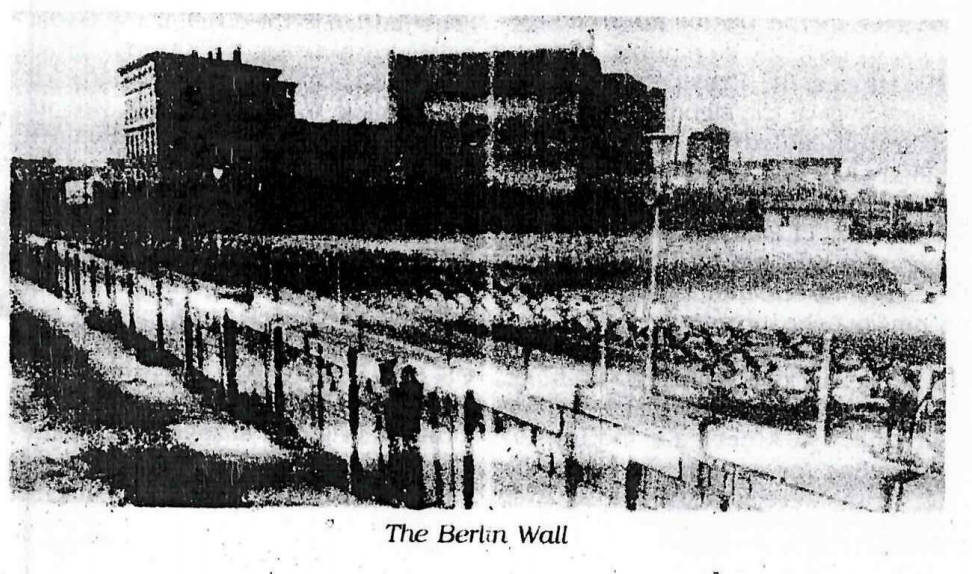
- The Cuban Missile Crisis (1962)
- Communist Takeover of Cuba
- In January 1959, Cuba came under communist rule when Fidel Castro’s guerrilla army overthrew the corrupt Batista regime.
- The United States had significant (notable / worthy of attention) business interests in Cuba.
- Castro retaliated (fight back) by nationalizing U.S. plantations and industries, causing thousands of Cubans to flee to the U.S. by boat.
- U.S. Response and the Bay of Pigs Invasion (1961)
- President Dwight D. Eisenhower adopted an aggressive stance toward Cuba.
- The CIA began training Cuban refugees in the U.S. to launch an attack and overthrow Castro’s communist government.
- President John F. Kennedy, Eisenhower’s successor, authorized the invasion.
- In April 1961, 1,400 men landed at the Bay of Pigs from the U.S. military base in Guantanamo Bay.
- The operation was poorly planned, and Castro’s forces easily crushed the invaders.
- Soviet Involvement and Missile Deployment
- The USSR provided economic assistance to Cuba to counter the impact of the U.S. blockade.
- In 1962, U.S. intelligence discovered that the Soviets had established (having taken root) missile bases inside Cuba.
- Satellite and aerial photographs confirmed the presence of nuclear missiles.
- This directly threatened the U.S., as Soviet missiles could strike American cities in the event of war.
- The USSR resumed atmospheric nuclear testing on 1 September 1961, while the U.S. responded with underground nuclear tests.
- The Crisis and Resolution
- The UN Secretary-General, U Thant, appealed for restraint (restriction / constraint) from both sides.
- The crisis lasted for several tense days.
- Ultimately, Khrushchev agreed to remove Soviet missiles from Cuba in exchange for a U.S. pledge not to attack Cuba.
- President Kennedy also agreed to dismantle American missiles in Turkey as part of the deal.
- To prevent future misunderstandings, a direct telephone link, known as the ‘hotline’, was established between the U.S. and Soviet leaders for swift communication in times of crisis.
- Regional Military Alliances During the Cold War
- During the Cold War, nations formed military alliances to protect themselves against perceived threats from the superpowers—the United States and the Soviet Union.
- These alliances were primarily politico-military pacts, with the North Atlantic Treaty Organization (NATO) being the largest and most influential (powerful).
- U.S.-Led Military Alliances
- NATO (North Atlantic Treaty Organization) – The most significant military alliance, formed to counter the Soviet threat in Europe.
- US-Japan Mutual Security Treaty – A defense pact ensuring U.S. military protection for Japan.
- US-Korea Mutual Security Treaty – A similar agreement for South Korea’s security.
- ANZUS (Australia, New Zealand, and the U.S.) – A defense alliance among these three Pacific nations.
- SEATO (Southeast Asia Treaty Organization, 1954) – Modeled after NATO, this alliance included most of the Southeast Asian countries to counter communist expansion.
- CENTO (Central Treaty Organization, 1955) – A defense alliance involving Arab states, designed to block Soviet influence in the Middle East.
- Limitations of These Alliances
- Despite their strategic intent, these alliances often proved impractical in execution.
- Many member states had conflicting interests, limiting their effectiveness in addressing regional security challenges.
- The Bandung Conference and the Non-Aligned Movement (NAM)
- Growing Concerns of the 1950s
- By the mid-1950s, the world was increasingly militarized and divided into two opposing camps.
- A devastating war seemed imminent.
- Poverty, inequality, and colonialism were being ignored.
- Leaders of Indonesia, Ceylon (Sri Lanka), and the Philippines initiated a conference to address these concerns.
- The Bandung Conference (1955)
- Held in Bandung, Indonesia, with representatives from 29 African and Asian nations.
- Aimed to promote cultural and economic cooperation and resist colonialism.
- Prominent leaders:
- Jawaharlal Nehru (India)
- Gamal Abdel Nasser (Egypt)
- Zhou Enlai (China)
- Ho Chi Minh (Vietnam)
- Kwame Nkrumah (Gold Coast, later Ghana)
- Excluded countries: South Africa, Israel, Taiwan, South Korea, and North Korea.
- Led to the formation of the Non-Aligned Movement (NAM) in 1961.
- The Non-Aligned Movement (NAM)
- Started with the goal of staying neutral during the Cold War.
- Played a moral role against the arms race and military expansion of superpowers.
- Passed resolutions condemning superpower actions.
- Actively opposed apartheid in South Africa.
- Challenges Faced by NAM
- Lacked a permanent secretariat (permanent administrative office).
- Was largely inactive between summit meetings.
- Failed to prevent conflicts among its own member states, such as the Iran-Iraq War.
- Could not act when the USSR invaded Afghanistan in 1979.
- Many member states depended on superpowers for economic support.
- NAM After the Cold War
- After the Cold War ended, many questioned its relevance.
- SEATO and CENTO had already dissolved, but some members wanted to retain NAM.
- New concern: Unipolarism (US dominance as the world’s only superpower).
- Despite reaffirming its goals, NAM failed to take action during the 2003 Iraq crisis.
- Nuclear Arms Control and Disarmament
- The Nuclear Test Ban Treaty (1963)
- Signed by the US, USSR, and Britain.
- Marked the beginning of détente (easing of tensions).
- Banned nuclear tests in the atmosphere, underwater, and outer space.
- Shift Towards Arms Control
- By the 1960s, both superpowers realized that the arms race was endless.
- Research and development ensured that one power would always catch up with the other.
- They began signing treaties to limit research, testing, and deployment of nuclear weapons.
- The Outer Space Treaty (1967)
- Signed by the US, USSR, and 60 other countries.
- Declared outer space a zone of peace.
- The Nuclear Non-Proliferation Treaty (NPT) (1970)
- Signed by the US, USSR, and 58 other nations.
- Aimed to prevent the spread of nuclear weapons.
- Key provisions:
- US and USSR agreed not to supply nuclear weapons or technology to other countries.
- Banned nuclear testing by countries not capable of building nuclear weapons.
- India opposed the NPT, calling it discriminatory and insisting (stand firm) on universal disarmament.
- Strategic Arms Limitation Treaty (SALT-I) (1972)
- Signed on 26 May 1972.
- Restricted the development of:
- Anti-Ballistic Missiles (ABMs)
- Intercontinental Ballistic Missiles (ICBMs)
- Submarine-Launched Ballistic Missiles (SLBMs)
- Introduced the Mutually Assured Destruction (MAD) doctrine, ensuring that neither power had an advantage.
- SALT-II Talks (1979)
- Initiated by US President Jimmy Carter and Soviet leader Leonid Brezhnev.
- Aimed to further limit long-range nuclear missiles.
- Talks collapsed after the USSR invaded Afghanistan in 1979.
- NATO escalated tensions by announcing Dual Track deployment in Europe to counter Warsaw Pact missiles.
- The Strategic Arms Reduction Treaty (START) (1982-1983)
- Proposed by US President Ronald Reagan.
- Introduced the Zero Option, aiming to eliminate an entire class of nuclear missiles.
- Suggested reducing ICBMs and signing a verifiable arms control agreement.
- Talks broke down in 1983 due to Reagan’s insistence on the Strategic Defense Initiative (SDI), or “Star Wars”.
- SDI aimed to intercept enemy missiles from space, leading to fears of a new arms race in outer space.
- Breakthrough with Mikhail Gorbachev (1985-1991)
- Gorbachev revived START negotiations with new proposals.
- At the Geneva Summit (1985), Reagan and Gorbachev agreed to reduce nuclear arms by 50%.
- Nuclear Risk Reduction Centre Agreement (1987) improved communication and trust.
- Treaty of Conventional Armed Forces in Europe (1990) reduced land army strength.
- START Treaty signed on 31 July 1991, just five months before the USSR dissolved.
- Post-Cold War Nuclear Disarmament
- The Cold War ended, but the START Treaty remains in effect.
- Russia inherited the USSR’s international obligations.
- Both Russia and the US continue to uphold the treaty’s nuclear disarmament commitments.
- Socio-Economic Impact of the Cold War
- Global Economic Growth Amidst Uncertainty
- The Cold War era saw rapid industrialization and global economic expansion.
- However, constant regional conflicts created uncertainty, with fears of a potential World War III.
- Economic Revival in the Western World
- Superpowers used financial resources to gain the loyalty of allies.
- This accelerated economic recovery in Western Europe.
- After centuries of war, Western European nations realized the need for economic and social cooperation.
- Early Steps Toward European Economic Unity
- Winston Churchill (1943) proposed a Council of Europe and a “United States of Europe”.
- 1948: The Organisation of European Economic Cooperation (OEEC) was established, doubling trade volumes within its first six years.
- The International Trade Organisation and GATT (General Agreement on Trade and Tariffs) were formed to reduce import duties and promote free global trade.
- Formation of the European Economic Community (EEC) (1957)
- The most significant Cold War economic bloc.
- Established by France, West Germany, Italy, Netherlands, Belgium, and Luxembourg under the Treaty of Rome.
- Inspired by the European Coal and Steel Community (1951-56), which boosted European steel production by 50%.
- EEC’s goals:
- Remove customs duties and trade quotas.
- Encourage free competition among member states.
- Success of the EEC (by 1961):
- Reflected in economic growth statistics.
- Led Britain to join in 1973, despite initially staying away.
- Struggles of the Communist Bloc
- While Western Europe prospered, the Eastern Bloc economies struggled.
- Khrushchev’s attempt to unify Eastern Bloc economies under COMECON failed due to internal resistance.
- Though economic institutions remained weak, the Communist bloc had a strong record in social services.
- Asia in ferment (state of unrest or agitation)
- Asia’s Transformation in the 20th Century
- The 21st century is often anticipated (expected) as the ‘Asian Century’, potentially bringing extraordinary progress for one-third of humanity.
- However, in the 20th century, Asia started at a major disadvantage compared to Europe and the Americas.
- The second half of the 20th century saw widespread turmoil (state of great distrubance) across Asia:
- Violent revolutions
- Mass movements
- Social upheavals
- Economic struggles followed by recovery in some cases
- To understand this transformation, we must begin with the Chinese Communist Revolution, which serves as the starting point of Asia’s dramatic evolution.
- China
- The Chinese Communist Revolution and Mao’s Reforms
- Establishment of Communist Rule (1949)
- The Chinese Communist Party (CCP), led by Mao Zedong, gained control over mainland China in 1949 after a long and violent civil war.
- At the time, China was devastated due to:
- Years of civil war
- Japanese occupation
- Severe food shortages
- Underdeveloped agricultural infrastructure
- Minimal industrial base
- Despite extreme poverty, the people placed their faith in Mao and the Communists.
- Mao adopted Marxist ideology, blending it with Chinese traditions, tailoring reforms to China’s unique challenges.
- A Peasant-Led Revolution
- The Chinese Communist Revolution was the world’s first large-scale peasant revolution, unlike the Russian Revolution, which was led by industrial workers.
- Mao’s strategy was to build a coalition of:
- Peasants
- Workers
- Petty bourgeoisie
- National bourgeoisie (small business owners and industrialists)
- Mao initially allowed businessmen to retain their properties if they supported the revolution, but by 1956, the state took over all private lands and businesses.
- Industrialisation and Economic Growth
- Industrialisation was given high priority:
- Oil production made China one of the world’s largest producers by 1977.
- China ranked third in coal production and led in various minerals.
- Biogas plants were set up to produce methane gas and fertiliser from waste.
- By 1960, China’s steel production rivaled France, and power generation increased tenfold.
- Irrigated land doubled (1949–1960).
- Large-scale afforestation projects were launched.
- The railway network was expanded, enabling industrial dispersal beyond Manchuria and the East.
- Small-scale industries thrived, aided by Soviet assistance in:
- Precision tools
- Electronics
- Daily-use goods (scissors, pens, toys, surgical instruments, switches, etc.)
- ‘Made in China’ products gained credibility in international markets due to their high quality and low cost.
- Land Reforms and Collectivisation
- Land reforms began by confiscating (seize) large landholdings from landlords.
- Cooperative farming was introduced, where multiple villages pooled resources.
- By 1957, more than 90% of agricultural land was collectivised.
- In the next phase, state-controlled collective farms replaced cooperatives, ensuring direct Communist Party oversight.
- The ‘Great Leap Forward’ (1959) and Its Failure
- Mao launched the ‘Great Leap Forward’ to accelerate industrialisation and agricultural production.
- Key measures:
- Rural cooperatives were merged into large communes, symbolizing state ownership over local control.
- A mobile labor force was created to support industrial projects.
- Results:
- The plan failed catastrophically (extremely unsuccessful) due to incompetent Communist Party officials managing it.
- Food shortages worsened, and industrial production collapsed.
- In 1962, the strategy was revised:
- Agriculture was prioritized.
- Communes were downsized.
- Farmers were allowed to cultivate small private plots.
- The Great Chinese Famine
- The Promise vs. Reality
- Mao’s ‘Great Leap Forward’ was launched with the slogan:
- “Three years of hard work and suffering, and a thousand years of prosperity.”
- However, instead of prosperity, China faced an unprecedented (never seen before) famine.
- Initially, everything appeared successful as:
- Communist Party units reported exaggerated (overstated) agricultural output.
- Encouraged by false reports, the government set even higher production targets.
- Technical Failures and Agricultural Mismanagement
- The primary reasons for failure were flawed agricultural techniques:
- Seeds were sown at ten times the normal density, suffocating young plants.
- Wheat and maize were grown on the same fields, which proved ineffective.
- Mass extermination (killing) of sparrows (to prevent seed loss) led to uncontrolled pest infestations (the presence of an unusually large number of insects).
- Poorly planned irrigation projects caused massive soil erosion.
- Focus on a few select crops resulted in neglect of essential food crops and vegetables.
- Official Denial and Propaganda
- Chinese leaders believed in false production figures, leading to severe miscalculations.
- Despite famine, the Party continued propaganda, creating misleading slogans:
- In 1959, when people were starving and boiling grass for food, they were advised to:
- “Live frugally (costing little) in a year of plenty.”
- The state-run radio glorified starvation, urging citizens to:
- “Take naps” since they were too weak to work.
- Doctors were instructed to convince people that Chinese physiology required neither proteins nor fats.
- Human Cost and Economic Collapse
- The 1960 harvest was 26% lower than 1957 levels.
- By 1960, food production had fallen to 1950 levels, but China’s population had increased by over 100 million.
- Consequences:
- Rice prices skyrocketed—rising 30 times in some provinces.
- Coal shortages disrupted emergency rail transport of food.
- Miners abandoned work to search for food, worsening coal production.
- Mortality rate surged (sudden upward movement) from 15% to 68% in 1960.
- Birth rate plummeted (fall or drop down at high rate) from 30% to 11%.
- The famine remained largely unknown to the outside world as China tightly controlled information.
- The Great Chinese Famine stands as one of the deadliest man-made disasters in history, caused by a combination of faulty policies, misinformation, and rigid state control.
- The Cultural Revolution
- Background and Mao’s Motivation
- The failure of the ‘Great Leap Forward’ weakened Mao’s influence.
- To reassert his control, he launched the Cultural Revolution, one of the darkest periods in Chinese communism.
- Mao, a hardline communist, feared that:
- Party officials were becoming complacent (self-satisfied).
- Communist ideology was losing ground.
- Resentment (bitterness) was growing due to the failures of the ‘Great Leap Forward’.
- Right-wing party leaders like Deng Xiaoping and Liu Shaoqi suggested reforms:
- Higher wages for quality labor.
- Allowing larger private holdings.
- Guiding the revolution with expert managerial oversight rather than party cadres (small group).
- Mao rejected these ideas, considering them a betrayal (disloyalty) of Marxist-Leninist principles.
- The Launch of the Cultural Revolution
- In 1966, Mao announced the ‘Proletarian (working class / common) Cultural Revolution’, aiming to mobilize the youth to “save” the revolution.
- The Red Guards, composed mostly of students, became his strongest supporters.
- They traveled across China, carrying Mao’s ‘Little Red Book’, and:
- Led massive propaganda campaigns to reinforce communist ideology.
- Denounced (criticize) and physically attacked ‘counter-revolutionaries’.
- Targeted teachers, intellectuals, professionals, and local party officials.
- However, the movement soon spiraled out of control, leading to widespread chaos and violence.
- Anarchic (lawless) Totalitarianism (1966-1976)
- The Death Toll and Lingering Famine Effects
- Unlike the Great Leap Forward, where millions died from famine, the Cultural Revolution resulted in:
- 400,000 to 1 million deaths, according to general estimates.
- Some scholars, like Domenach, estimate 1 million to 3 million deaths.
- The effects of the Great Leap Forward famine were still being felt, making it difficult to determine which policy caused more devastation.
- The Red Guards’ Reign of Terror
- By 1967, daily executions were widespread.
- Mao encouraged the youth to embark on their own “Long March”, claiming they would “learn revolution by making revolution”.
- Schools shut down as students joined the Red Guards, often to save themselves from persecution.
- The Red Guards turned against their own families and communities:
- Teenagers denounced their parents, teachers, and relatives.
- Ancient monuments were destroyed, private homes raided, and random killings became common.
- The movement developed its own armed investigators, parallel police forces, and judiciary, complete with judges and prisons.
- Chaos and Civil War Threat
- The Cultural Revolution soon spiraled into anarchy, pushing China to the brink of civil war.
- Strikes and protests erupted against the Cultural Revolution.
- China became isolated internationally, with even the communist bloc distancing itself.
- Mao reversed his stance and called upon the People’s Liberation Army (PLA) to suppress the Red Guards.
- Lin Biao, a key architect of the Cultural Revolution, was removed from power and died in a mysterious air crash in 1971.
- The Second Phase of the Cultural Revolution
- The Red Guards turned against each other.
- Students attacked workers.
- Workers targeted day laborers.
- Industrial production collapsed, and civil society disappeared, replaced by violence, slogans, and political campaigns.
- Mao continued purging his close allies, even ordering the mysterious execution of Lin Biao, whom he had once named as his successor.
- Disillusionment (feeling of disappointment knowing something is not as good as expected) grew, and when Mao died in 1976, the nation heaved a sigh of relief.
- The ‘Gang of Four’, led by Mao’s wife Jiang Qing, was jailed, reflecting the public’s deep resentment (bitterness) toward Mao’s rule.
- The US-China Rapprochement (incresed understanding) (1972)
- Nixon’s Historic Visit to China
- In February 1972, the world was shocked to learn that US President Richard Nixon would visit Beijing.
- This was unprecedented (unparalleled / unmatched), as US-China relations had been severed since the Korean War.
- ‘Ping Pong’ Diplomacy: The Secret US-China Talks
- ‘Ping Pong’ diplomacy was the term for clandestine (secret) meetings between US and Chinese officials from the late 1960s to early 1970s.
- Since the US had not formally recognized Communist China, it could not engage with its officials openly.
- Meanwhile, China’s relations with the USSR had deteriorated due to:
- Ideological differences.
- Leadership disputes over the world communist movement.
- Border conflicts between China and the USSR.
- The US sought to exploit this Sino-Soviet rift to counter Soviet influence.
- Pakistan, an ally of both the US and China, acted as a facilitator in these secret negotiations.
- Outcomes of Nixon’s Visit
- The visit led to the US officially recognizing the People’s Republic of China (PRC) as the legitimate (legal) government of China.
- Taiwan was sidelined:
- It lost its seat in the UN Security Council to Communist China.
- However, it continued to receive American aid.
- The visit paved the way for formal US-China diplomatic relations, reshaping global geopolitics.
- Deng Xiaoping’s Rise and Reforms
- After Mao’s death, a power struggle followed.
- Deng Xiaoping emerged victorious in 1979.
- He had been removed during the Cultural Revolution for being “too liberal.”
- Once in power, he reversed many policies of that era.
- Political and Social Reforms
- Revolutionary committees were replaced with democratically elected groups.
- Confiscated (seized) property was returned to survivors of original owners.
- Religious freedom was restored.
- Intellectuals were given more freedom of expression.
- Economic Reforms and Modernization
- Deng and Hu Yaobang sought Western investment.
- China joined the World Bank and IMF in 1980.
- State farms gained more control over administration and planning.
- Profit-sharing and bonuses were encouraged.
- Tax reductions boosted agricultural output.
- Grain production increased, improving nutrition levels.
- Impact
- Deng’s message: “To get rich is not a crime.”
- The Party reduced its role in the economy.
- By the late 20th century, per capita income rose to $1,200.
- China transformed into a modern industrial state.
- Democracy Wall Movement and Deng’s Response
- November 1978: People in Beijing and other cities began protesting for more reforms.
- The government banned marches, leading people to create “democracy walls.”
- Anonymous posters and graffiti (writings or drawings scribbled) demanded human rights and criticized Mao.
- Deng’s Reaction
- Deng, a party loyalist, opposed uncontrolled dissent.
- He believed China would fall into chaos without the Party.
- Democracy walls were banned, and leaders of the movement were arrested and sentenced.
- However, Mao-era terror did not return under Deng.
- Tiananmen Square Protests and Government Crackdown
- Party Hardliners vs. Reformists:
- Deng faced pressure from hardliners like Li Peng, who wanted his reforms to fail.
- He promoted liberal leaders like Zhao Ziyang and Hu Yaobang but kept criticism within limits.
- Economic Issues (1988-89):
- Inflation rose, and wages lagged behind prices.
- Students in Beijing began peaceful protests in Tiananmen Square (May 1989).
- They demanded political reforms, democracy, and an end to corruption.
- The Protest and Government Response:
- Zhao assured them their demands would be addressed.
- The demonstrations were festive, with music, flags, and a ‘Democracy’ statue.
- The world press covered the events.
- The Crackdown (June 3-4, 1989):
- The government saw it as a threat to Communist rule.
- Deng turned hardliner, replaced Zhao with Li Peng, and sent in the Army.
- Tanks rolled in, and 1,500–3,000 people were killed.
- The world was outraged (extremely strong reaction of anger), but China refused to repent (feel remorse or guilt).
- Deng justified the massacre, claiming one-party control was necessary for a ‘socialist market economy.’
- Tibet and Sino-Indian Relations
- Tibet’s Strategic Importance:
- Tibet, a high-altitude region, was strategically important for British India.
- China had ruled Tibet since the 18th century, while the British secretly mapped the region.
- In 1911, China granted Tibet independence.
- The Dalai Lama became both spiritual and political head.
- China’s Takeover of Tibet (1951):
- After British India’s exit, diplomatic ties between New Delhi and Lhasa continued.
- In 1951, China sponsored a communist uprising and seized Tibet.
- The Dalai Lama retained nominal control, but Buddhism was suppressed, causing tension.
- Tibetan Revolt and Dalai Lama’s Exile (expulsion) (1956-1959):
- Ethnic Tibetans in China revolted in 1956 against the persecution of religious leaders.
- The movement spread to Tibet, and in 1959, China crushed it with brute force.
- Hundreds were massacred, and sacred monuments were destroyed.
- Facing persecution, Dalai Lama fled to India with 100,000 followers.
- Nehru granted them refuge in Dalhousie, Himachal Pradesh.
- Sino-Indian Conflict (1962):
- China refused to recognise British-drawn borders.
- Though Nehru and Zhou Enlai agreed on Panchsheel (Five Principles), China’s People’s Liberation Army (PLA) frequently intruded into Indian territory.
- In November 1962, China launched a full-scale invasion.
- The ill-equipped Indian Army struggled, and China occupied large territories.
- Global condemnation followed, and the US provided military aid to India.
- China withdrew partially but retained over 50,000 sq. km of Indian land.
- In 1963, Pakistan illegally transferred part of Kashmir to China.
- Diplomatic Standoff and Normalization (1962-1988):
- India downgraded diplomatic ties with China from 1962 to 1979.
- In 1979, Atal Bihari Vajpayee visited Beijing, initiating dialogue (conversation).
- In 1988, PM Rajiv Gandhi visited China, restarting the normalization process.
- A Joint Working Group was formed to resolve the border dispute, but no progress was made.
- Present-Day Sino-Indian Relations:
- Trade relations have grown significantly.
- However, China is still seen as supporting Pakistan’s hostile (aggressive) actions.
- China refuses to acknowledge Sikkim as part of India.
- Vietnam’s Struggles and Wars (Post-World War II)
- War Against French Colonial Rule (1946-1954)
- Vietnam, the largest country in former French Indo-China, went through three major wars after World War II.
- After Japan’s surrender (1945), the French attempted to reclaim Vietnam.
- Ho Chi Minh’s Viet Minh (League for the Independence of Vietnam) had gained military experience fighting the Japanese.
- With the Japanese gone, Ho established the Democratic Republic of Vietnam.
- However, non-communist nationalists and religious leaders opposed his rule.
- In 1946, the French launched an attack to reclaim Vietnam, installing a puppet regime in 1948.
- Battle of Dien Bien Phu (1954):
- The French were completely defeated.
- Geneva Conference (1954): Vietnam was divided into communist North Vietnam and non-communist South Vietnam.
- The Vietnam War (1955-1975)
-
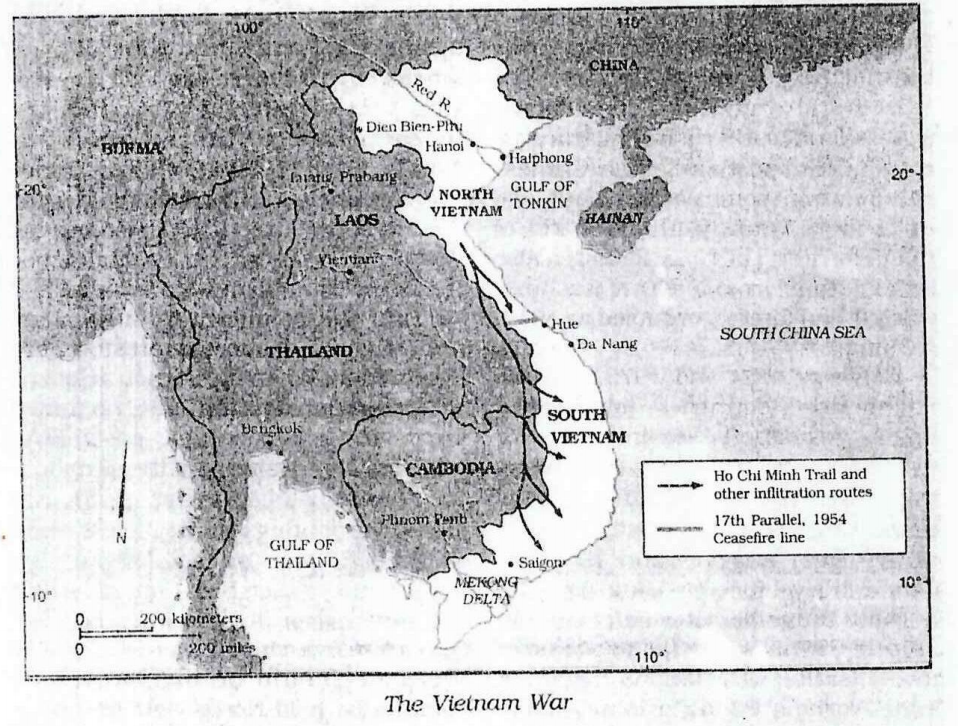
- Initially, the US urged France to negotiate with Ho Chi Minh and nationalist leader Diem Ngo Dinh.
- But the rise of Communist China and the Korean War changed US policy.
- President Eisenhower backed France to prevent Ho’s communist rule in Vietnam.
- After the French withdrew, the US supported the Diem regime in South Vietnam.
- Escalation of Conflict
- From 1959, tensions between North and South Vietnam escalated.
- Diem’s Unpopularity:
- He persecuted (oppress / abused) his political rivals, leading some to resort to guerrilla warfare.
- Another perspective suggests that North Vietnam sponsored the insurgency (active revolt or uprising).
- A full-scale war erupted:
- North Vietnam was backed by USSR and China.
- US openly supported South Vietnam.
- US Involvement and Defeat
- Initially, the US sent military advisers to assist South Vietnam.
- By 1963, US troops landed in Vietnam, and by 1969, over 500,000 American soldiers were involved.
- Guerrilla Warfare Challenges:
- Despite technological superiority, the US could not match North Vietnam’s fighting skills.
- The Vietnamese used jungle warfare, drawing Americans into unfamiliar terrain.
- War Crimes and Public Backlash:
- US troops committed massacres, making the war unpopular.
- Example: My Lai Massacre (1967) – innocent civilians were slaughtered.
- American public opinion turned against the war.
- End of the Vietnam War
- President Nixon (1971) decided the US could not achieve victory.
- The US had lost over 50,000 soldiers, and public opposition was strong.
- Paris Peace Talks led to a ceasefire agreement (January 1973).
- US troops withdrew by March 1973, but North-South fighting continued.
- In 1975, South Vietnam was defeated, and Vietnam was reunified.
- Post-War Conflicts (1975-1989)
- War with Cambodia (1978-1989)
- Cambodia was ruled by the Khmer Rouge (Communist regime) after a bloody civil war (1975).
- Khmer Rouge massacred over 1 million Cambodians in forced labor camps.
- Border clashes with Vietnam led to a Vietnamese invasion (1978).
- The Vietnamese Army occupied much of Cambodia, forcing Khmer Rouge into the jungles near Thailand.
- Conflict with China (1979)
- China supported Khmer Rouge leader Pol Pot.
- In 1979, China invaded Vietnam, but Vietnamese troops repelled the attack.
- China retreated but continued supporting Pol Pot.
- Vietnam’s Withdrawal from Cambodia (1989)
- Under UN intervention, Vietnam withdrew from Cambodia in 1989.
- Cambodia transitioned to democracy, and Vietnam focused on economic rebuilding.
- The Partition and War in Korea
-
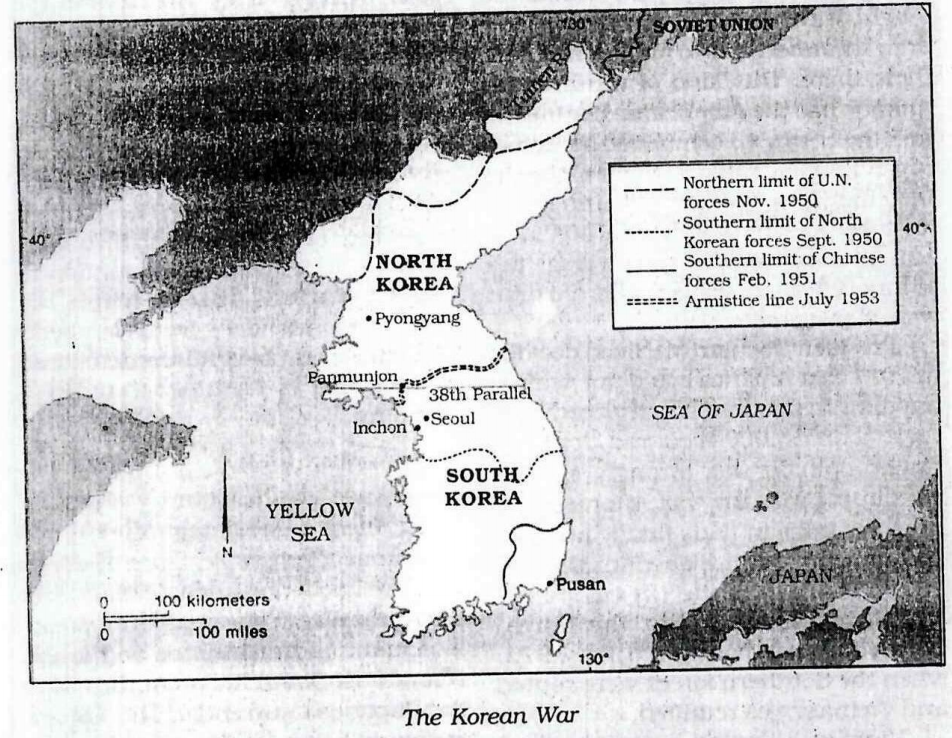
- Partition of Korea (Post-World War II)
- Korea was under Japanese rule from 1910 to 1945.
- After World War II, the country was partitioned into communist North Korea and non-communist South Korea.
- At the time of Japan’s surrender,
- The US occupied the South (below the 38th Parallel).
- The Soviet Army controlled the North.
- The US backed an anti-communist government under Syngman Rhee in South Korea.
- The Soviets supported a communist regime under Kim Il Sung in North Korea.
- Rising Tensions and the Outbreak of War (1950-1953)
- 1948: The Soviets withdrew from North Korea.
- 1949: The Americans left South Korea.
- However, hostility remained, with:
- Large-scale refugee crossings.
- Armed incursions from both sides.
- 25 June 1950: North Korea invaded South Korea, sparking a three-year war.
- The Cold War Context and US Involvement
- The Cold War between the US and the USSR had begun in Europe.
- February 1950: The Sino-Soviet Alliance was signed.
- It remains uncertain whether North Korea was encouraged by China or the USSR to start the war.
- The US saw the conflict as part of a broader communist expansion.
- America intervened, fearing that Soviet and Chinese influence would spread across Asia.
- US troops, backed by the UN, were sent from Japan to Korea.
- Major Phases of the Korean War
- The war saw multiple shifts in control:
- UN Commander General Douglas MacArthur led an amphibious landing at Inchon, pushing North Korean forces beyond the 38th Parallel.
- UN forces crossed the Yalu River, nearing China’s border.
- China retaliated, sending troops to aid North Korea, pushing UN forces back.
- Three years of stalemate followed.
- 27 July 1953: An armistice was signed, but no peace treaty was ever concluded.
- Post-War Korea: A Divided Nation
- The Korean border remains closed.
- Relations between North and South Korea remain tense even after six decades.
- The issue of Korean unification remains unresolved.
- Post-War Reconstruction and Economic Growth in South Korea
- Challenges After the Korean War
- South Korea faced major obstacles in rebuilding its society and economy after the war.
- While two-thirds of the peninsula’s population resided in the South, most industrial infrastructure was located in the North.
- With almost no industrial base, South Korea had to start from scratch, focusing on:
- Power plants
- Agriculture
- Basic industries
- US economic assistance in the 1950s was crucial in helping South Korea feed its population and rebuild its economy.
- Economic Development and the Role of the State
- South Korea embraced private ownership and capitalism.
- Since the 1960s, a government-business partnership coordinated a successful growth strategy based on:
- Foreign investment
- Export-driven industries
- Sustained economic planning
- Per capita income rose dramatically from around $100 in the late 1950s to nearly $2,000.
- The rapid economic transformation was not a mere “miracle”, but the result of:
- Effective government planning
- Strategic use of foreign capital
- A disciplined and highly educated workforce
- Strong collaboration between political leaders and private entrepreneurs
- Social and Economic Inequality
- Despite economic growth, income distribution remained uneven.
- Workers’ wages did not keep pace with the economy’s rapid expansion.
- The government restricted labor unions and strikes, limiting workers’ ability to demand better conditions.
- Many believed that only certain social groups benefited from the economic boom.
- Even the new urban middle class, which gained from economic success, began demanding greater political freedoms.
- Shifting Priorities: Social and Political Changes
- As South Korea moved beyond rapid industrialization, new challenges emerged:
- Equity and income distribution
- Increased social spending
- Economic liberalization (reducing government controls and fostering free markets)
- Democratic reforms to create a more open political system
- The government had to shift from a “growth at all costs” mindset to a more balanced approach, addressing both economic and social concerns.
- Cambodia’s (Kampuchea) Path to Turmoil: From Independence to Civil War
- Independence and Neutrality (1953–1969)
- Cambodia gained independence from French Indo-China along with Vietnam in 1953.
- Under King Norodom Sihanouk, Cambodia maintained neutrality during regional conflicts in the 1950s.
- The rise of communism in Cambodia was seen as a threat by the US, which was stationed in neighboring South Vietnam.
- Tensions with the US increased when South Vietnamese forces pursued Vietnamese communist guerrillas into Cambodian territory.
- In response, Cambodia severed ties with the US.
- However, when evidence emerged that Ho Chi Minh was secretly supporting Cambodian communists, Sihanouk restored relations with the US in 1969.
- Political Upheaval and Civil War (1970–1975)
- In 1970, pro-American Premier Lon Nol overthrew King Sihanouk and abolished the monarchy.
- Lon Nol demanded that North Vietnam withdraw its 40,000 soldiers who had established bases in Cambodia.
- Sihanouk fled to China, where he later aligned with the communist Khmer Rouge.
- A civil war broke out between:
- The Vietnam-backed Khmer Rouge (communist insurgents)
- The US-backed government of Lon Nol
- Khmer Rouge Rule and Mass Atrocities (1975–1979)
- In April 1975, the Khmer Rouge captured Phnom Penh, Cambodia’s capital.
- Pol Pot, the group’s leader, enforced a radical vision of agrarian communism, believing cities and their inhabitants were undesirable.
- Hundreds of thousands of city dwellers were forcibly relocated to rural areas for:
- Agriculture
- Forest clearing
- Hard labor
- The country’s name was changed to Kampuchea.
- Mass atrocities followed, leading to an estimated two million deaths over the next four years due to:
- Execution
- Forced labor
- Starvation and disease
- The Khmer Rouge turned the entire country into a minefield to prevent refugees from escaping into camps set up in Thailand.
- Vietnamese Invasion and Continued Conflict (1978–1980s)
- In 1978, border conflicts with Vietnam escalated into a full-scale invasion in January 1979.
- The Vietnamese installed a Hanoi-backed government in Kampuchea.
- However, fearing that one communist regime had simply replaced another, thousands of Cambodians fled to Thailand.
- Starvation and hardship were widespread across the country.
- The Khmer Rouge retreated into the western jungles, using guerrilla warfare to continue their resistance.
- Post-war shakeup in Africa and Asia
- Post-Independence Challenges in Asia and Africa
- Independence and Its Challenges
- As discussed in a previous chapter, many countries in Asia and Africa gained independence after World War II.
- However, independence was just the beginning; the real challenge lay in:
- Fulfilling the needs and aspirations of the people
- Building a stable civil society
- Ensuring peace and long-term stability
- Africa’s Struggles After Liberation
- The leaders of newly independent African nations faced overwhelming (have a strong emotional effect on) problems post-liberation.
- Political, economic, and social challenges made nation-building a difficult task.
- This chapter will explore the early struggles of some African countries that have remained in the news in recent decades.
- The Emerging Republics of Central Asia
- After the collapse of the Soviet Union, several new republics emerged in Central Asia.
- These nations face immense challenges in governance, economy, and security.
- Their strategic location near India makes their stability crucial for the broader region.
- The developments in Central Asia hold significant implications (the conclusion that can be drawn from something although it's not explicitly stated) for global security.
- African scenerio
- Challenges Faced by Newly Independent African Nations
- Struggles of Newly Freed African Nations
- Most newly independent African nations faced severe handicaps from the start.
- These countries were ethnically diverse, composed of multiple tribes that had been forcibly united under colonial rule.
- During their freedom struggles, a fragile sense of unity existed, but once the colonial powers left, deep divisions resurfaced.
- Many people struggled with dual loyalties—whether to their tribe or the nation.
- In several nations like Nigeria, Congo (Zaire), Burundi, and Rwanda, tribal rivalries escalated into full-scale civil wars.
- Artificial Boundaries and Economic Struggles
- Most modern African nations were not natural entities; rather, they were created due to the colonial partition of the continent.
- After independence, many of these countries found their economies heavily reliant on a single export product, making them vulnerable to global market fluctuations.
- Nigeria depended almost entirely on oil exports.
- Ghana relied on cocoa.
- Kenya’s economy was centered around tea exports.
- The lack of economic diversity and an educated workforce left many nations struggling to build self-sufficient economies.
- The Impact of Neo-Colonialism
- Even after independence, former imperial powers continued to exert influence over these nations, leading to a form of neo-colonialism.
- Many African governments remained economically and politically dependent on their former rulers.
- Sovereignty was often compromised, as foreign nations intervened or withheld support based on their approval or disapproval of African governments.
- Political and Economic Transitions in Ghana
- The Nkrumah Era (1957–1966)
- Ghana, formerly the Gold Coast, became independent in 1957 with Kwame Nkrumah as its first President.
- Under his socialist government, Ghana’s population enjoyed better living conditions than many other African nations.
- He expanded the cocoa industry, Ghana’s principal export crop, and sought to diversify the economy by investing in:
- Forestry
- Fishing
- Cattle-breeding
- Gold and bauxite mining
- Nkrumah was a strong advocate of Pan-Africanism and worked towards African economic unions with Guinea and Mali.
- He also played a key role in the formation of the Organisation of African Unity (OAU) in 1963.
- Shift to Authoritarianism and Military Coup (1964–1966)
- Nkrumah’s administration became increasingly authoritarian due to over-centralisation of power.
- He abandoned the Parliamentary system and established one-party rule, leading to:
- Suppression of political opponents
- Harsh laws, including a 1959 order that allowed opponents to be expelled or jailed for up to five years without trial
- A personality cult built around himself
- These moves angered the military, and while Nkrumah was on a tour of China in 1966, the military staged a coup.
- The new military rulers promised democratic reforms and drafted a new Constitution by 1969.
- Kofi Busia, leader of the Progressive Party, was elected Prime Minister.
- Economic Decline and Military Interventions (1969–1981)
- Busia, an Oxford scholar, struggled to reassert civilian control over the military-dominated system.
- Under his leadership:
- The economy deteriorated due to a debt crisis, forcing currency devaluation.
- Tribal tensions resurfaced, further weakening national stability.
- In 1972, the military staged another coup, replacing him with Colonel Ignatius Acheampong.
- However, Acheampong’s government was corrupt and ineffective, failing to address the economic crisis.
- In July 1978, the military removed Acheampong on corruption charges and installed General Fred Akuffo.
- A year later, in June 1979, Air Force officer Jerry Rawlings led a coup, promising to eliminate corruption and restore democracy.
- In July 1979, elections were held, and Hilla Limann became President.
- The Rawlings Era and Path to Democracy (1981–1991)
- Economic hardships continued, with unemployment and industrial strikes destabilizing the country.
- In 1981, Rawlings staged another coup, removing Limann and establishing the Provisional National Defence Council (PNDC).
- Unlike previous military rulers, Rawlings did not seek complete military control but wanted the army to have influence in national decision-making.
- He appointed a civilian government under the PNDC, consisting of renowned leaders and academics.
- A comprehensive economic recovery program was launched, leading to growth and stability.
- Over time, Ghana transitioned towards full democracy, culminating in the 1991 elections, marking the end of military rule.
- Nigeria: Political Instability and the ‘Coup Culture’
- Oil Wealth and Political Instability
- Nigeria possesses huge oil reserves, giving it a significant economic advantage over its African neighbors.
- However, the country has been plagued (sickness) by political instability, marked by a persistent ‘Coup Culture’, where military factions (small organized dessenting group) repeatedly overthrow democratic governments.
- The military leaders who seize power often become victims of new conspiracies, leading to a cycle of instability.
- Early Years and the 1966 Coup
- From 1960 to 1966, Nigeria remained stable under Prime Minister Abubakar Tafawa Balewa.
- However, in 1966, a military coup overthrew Balewa’s government, leading to a civil war caused by tribal conflicts:
- In the north, Muslims competed for power with the Hausa and Fulani tribes.
- In the west, the Yorubas held grievances (unjustice).
- In the east, the Ibos felt marginalized (treated as insignificant) by the dominant northern region, from which Balewa hailed (call out to attract attention).
- Ibo officers in the Army staged a coup, assassinating Balewa and several politicians, which triggered ethnic violence.
- General Ironsi, the new leader, was soon killed by northern soldiers, who then installed Colonel Yakubu Gowon as the head of state.
- This led to the mass migration of Ibos to the east, where in 1967, under Colonel Ojukwu, they declared independence and formed the Republic of Biafra.
- The Nigerian Civil War (1967–1970)
- A brutal civil war erupted between Lagos (the federal government) and Biafra.
- The war lasted for three years, causing mass starvation and heavy casualties, especially in the east.
- Neither the UN nor the Commonwealth could mediate peace until the final Biafran resistance collapsed (crumbled).
- After the war, Gowon restructured Nigeria by introducing a federal system with 12 states (later expanded to 19) to give better representation to all tribes.
- In the mid-1970s, the oil boom temporarily improved Nigeria’s economy, though political instability persisted (carried on).
- Military Coups and Civilian Rule (1975–1983)
- In 1975, the Army overthrew Gowon, unhappy with his slow return to civilian rule.
- Under international pressure, elections were held in 1979, bringing President Shagari to power under a civilian government.
- However, Nigeria’s economy remained heavily dependent on oil, and when global oil prices collapsed in the 1980s, the country faced an economic crisis.
- Military Takeovers and Economic Collapse (1983–1993)
- In August 1983, Shagari was overthrown in a coup led by Major General Muhammadu Buhari, who became President.
- However, Buhari himself was ousted by Major General Ibrahim Babangida, who attempted economic diversification but struggled against falling oil prices.
- In 1986, Nigeria was forced to accept a World Bank loan for the first time to sustain its economy.
- Babangida initiated steps toward democratic governance, but in 1993, another military coup derailed progress.
- The Sani Abacha Regime and International Isolation (1993–1998)
- In 1993, General Sani Abacha staged a bloodless coup and established a highly authoritarian rule.
- Under his regime:
- Political opponents and intellectuals were imprisoned or executed.
- Ken Saro-Wiwa, a famous novelist and activist, was hanged on flimsy charges, drawing global condemnation.
- International sanctions were imposed, isolating Nigeria and blocking oil exports.
- Sharia law was enforced in the north, leading to widespread human rights violations.
- Once a nation with the potential to rival South Africa as an economic power, Nigeria declined into an international pariah (outcast) state.
- Angola: Civil War and Struggle for Power
- Independence and Internal Conflict (1975)
- Angola gained independence from Portuguese rule in 1975, but a bitter civil war erupted immediately.
- The conflict arose because there were three separate liberation movements, each fighting for control of the country after the Portuguese withdrew.
- Key Factions in the Civil War
- Popular Movement for the Liberation of Angola (MPLA):
- A left-wing movement that took control under Agostinho Neto.
- Had a communist ideology (the set of beliefs / system of ideas), which alarmed Western nations.
- National Union for the Total Independence of Angola (UNITA):
- Led by Jonas Savimbi and supported by the Ovimbundu tribe in the south.
- Backed by the United States and Mobutu’s Zaire with arms and ammunition.
- National Front for the Liberation of Angola (FNLA):
- Weaker than MPLA and UNITA, but had some support, particularly from the Bakongo tribe in the northwest.
- Foreign Involvement and Escalation
- Western concerns over the communist nature of the MPLA led to foreign interventions:
- United States and Zaire supported UNITA.
- Cuba backed MPLA with military aid.
- South Africa, opposing MPLA’s support for Namibia’s SWAPO, invaded from the south.
- Zairean forces attacked from the northeast, further complicating the war.
- Decade-Long Civil War and UN Intervention
- The civil war lasted over a decade, with heavy casualties and widespread destruction.
- In December 1988, the UN brokered a peace agreement:
- South Africa agreed to grant Namibia independence.
- Cuban troops withdrew from Angola.
- In 1990, under Sam Nujoma, Namibia became a democratic republic.
- Elections in 1992, held under UN supervision, resulted in a victory for Nujoma’s MPLA.
- UNITA’s Final Resistance and Resolution (1992–1993)
- By 1992, global communism was collapsing, and Soviet support to MPLA ended.
- This encouraged UNITA to make another attempt to seize power.
- Jonas Savimbi rejected the election results, leading to six months of renewed fighting.
- In 1993, under international pressure, including US recognition of the MPLA government, UNITA was forced back to negotiations.
- UNITA accepted the election results and agreed to join a coalition government with MPLA, bringing an end to the conflict.
- Burundi: Ethnic Conflict and Political Turmoil
- Historical Tensions and Ethnic Divide (1962–1988)
- Burundi and Rwanda, both former Belgian colonies, experienced ethnic tensions from the moment they gained independence in 1962.
- The Tutsi minority controlled power in Burundi, which was deeply resented by the Hutu majority.
- In 1988, tensions escalated when Hutu soldiers in the Burundi Army revolted, massacring thousands of Tutsis.
- Democratic Elections and Renewed Violence (1993–1996)
- In 1993, Burundi held its first democratic elections, in which the Hutus won.
- The Tutsis, unwilling to accept Hutu rule, assassinated the newly elected President, triggering a cycle of killings and reprisal attacks.
- The country plunged into complete chaos, with fighting continuing until 1996.
- International Peace Efforts and Military Takeover (1996)
- Alarmed by the endless bloodshed, the Organisation of African Unity (OAU) deployed a peacekeeping force in 1996.
- A power-sharing government was established:
- The Prime Minister was a Tutsi.
- The President was a Hutu.
- However, even the peacekeeping forces failed to restore stability.
- Ultimately, the Burundi Army dismissed the government and seized power under Major Pierre Buyoya, a Tutsi.
- Rwanda: The Tutsi-Hutu Conflict and Genocide
- Ethnic Rivalry and Civil War (1990–1993)
- Rwanda, like Burundi, was plagued by intense Tutsi-Hutu rivalry, leading to frequent genocidal conflicts.
- In 1990, war erupted between the Tutsi-dominated Rwandese Patriotic Front (RPF) and the Hutu-controlled Rwandan Army.
- The UN deployed a peacekeeping force while international mediation worked to end the civil war.
- A temporary peace was achieved in October 1993.
- Assassination of Leaders and Massacre (1994)
- In early 1994, an unusual assassination occurred:
- The Presidents of Rwanda and Burundi (both Hutus) attended a meeting in Tanzania.
- While returning to Kigali, their aircraft was hit by a missile, killing all on board.
- This triggered one of the worst genocides in African history:
- Thousands of Tutsi men, women, and children were massacred.
- Though a UN peacekeeping force was present, it failed to stop the killings.
- The Aftermath: Mass Killings and Refugee Crisis
- Over half a million Tutsis were murdered in just a few months.
- More than a million refugees fled to Zaire and Tanzania.
- The endless cycle of violence continued despite repeated UN peace missions and efforts by moderate Hutus.
- The Turbulent History of the Democratic Republic of Congo (Zaire)
- Independence and the Katanga Secession (withdrawal) (1960–1962)
- In 1960, Belgium granted independence to Congo, leaving power in the hands of a coalition government.
- However, conflicts erupted:
- The Army, still controlled by Belgian officers, rebelled.
- The rich copper province of Katanga, backed by the Belgian mining company Union Minière, attempted to secede (withdraw from) under Moise Tshombe.
- The UN intervened, but its Secretary-General, Dag Hammarskjöld, was suspected of favoring Katanga’s independence, yielding to Belgian pressure.
- President Patrice Lumumba sought UN support, but when the UN failed to stop Katanga’s separatism, he turned to Moscow for help, drawing American opposition.
- With US backing, President Joseph Kasavubu had Lumumba imprisoned and executed.
- After Hammarskjöld’s death, his successor, U Thant, reversed UN policy. In September 1962, UN forces ended Katanga’s secession and reunified the country.
- Military Rule and Economic Decline (1965–1990)
- Tribal conflicts continued to destabilize the nation.
- In 1965, General Joseph Mobutu seized power using foreign mercenaries (private individual serving in armed conflict for personal gains) and established an authoritarian regime, bringing stability.
- Congo was renamed Zaire.
- In the late 1970s, Zaire faced:
- An invasion by Angolan troops, seizing Katanga (renamed Shaba).
- International intervention repelled the invasion.
- Economic troubles due to the declining world copper prices, making food imports expensive.
- Mobutu’s rule became increasingly repressive, and under international pressure, he lifted the ban on multiparty politics in 1990.
- The Rwandan Refugee Crisis and the Fall of Mobutu (1994–1997)
- In 1994, after the ethnic massacres in Rwanda, hundreds of thousands of Tutsi refugees crossed into eastern Zaire.
- The Zairean Army intervened, forcing refugees back into Rwanda, where they faced Hutu reprisals.
- Meanwhile, Mobutu’s health deteriorated, and he spent long periods in European hospitals.
- In 1996, General Laurent Kabila, backed by Rwanda, led a rebellion from eastern Zaire.
- With weak resistance from the Zairean Army, Kabila advanced westward.
- In May 1997, Kabila’s forces entered Kinshasa, forcing Mobutu into exile.
- The country was renamed the Democratic Republic of Congo (DRC).
- Continued Instability and the Rise of Joseph Kabila (1998–2001)
- Kabila failed to restore stability.
- In August 1998, rebels backed by Uganda and Rwanda launched an uprising, raiding Kinshasa.
- Kabila received military aid from Angola, Namibia, and Zimbabwe, pushing back the rebels.
- A ceasefire was declared in August 1999.
- In 2001, Kabila was assassinated by his own bodyguard and succeeded by his son, Joseph Kabila.
- The Republic of Congo (Congo-Brazzaville)
- Another country, the Republic of Congo (Congo-Brazzaville), lies in western Africa.
- It gained independence from France in 1960.
- Tanzania: A Model of Stability and Visionary Leadership
- A Nation United by Swahili
- Despite being one of Africa’s poorest countries, Tanzania did not suffer from tribalism.
- The Swahili language served as a common bond, fostering national unity.
- Nyerere’s Visionary Leadership (1960s–1985)
- Julius Kambarage Nyerere, Tanzania’s first President, promoted socialist principles through his famous ‘Arusha Declaration’.
- Key aspects of the Arusha Declaration:
- The state should control all means of production.
- It aimed to prevent the exploitation of the poor by the rich.
- Emphasis on strengthening agriculture as the country’s economic backbone.
- Despite single-party rule, genuine democracy existed under his leadership.
- He offered an alternative model of growth and governance for developing nations, unlike other African countries that followed Western models, which led to:
- Civil wars
- Ethnic conflicts
- Massive inequality between the rich and poor
- Role in African Politics
- Nyerere was an outspoken (forthright) critic (person with unfavourable opinion) of the global economic system, which he argued trapped nations in poverty.
- He played a crucial role in:
- Overthrowing General Idi Amin’s regime in Uganda.
- Strengthening the Organisation of African Unity (OAU).
- He retired in 1986 but remained an influential voice in African affairs.
- Transition to Multi-Party Democracy
- In 1992, the Constitution was amended to allow:
- A multi-party system.
- Gradual privatization of the economy.
- Nyerere passed away in 1999, leaving behind a legacy of stability, unity, and self-reliance.
- South Africa: A History of Apartheid and Resistance
- A Nation of Wealth and Controversy
- South Africa, one of Africa’s richest and most industrialized nations, was also infamous for its racist policies.
- Until the 1990s, the country was synonymous with apartheid, a system of racial discrimination comparable to Nazi Germany and Stalinist USSR.
- The White Minority’s Domination
- Demographics:
- 70% of the population were Blacks.
- 12% were other non-Whites, including ethnic Indians and Asians.
- 18% were Whites, who held absolute political and social control.
- Apartheid Laws:
- Blacks were confined to reserved areas, which comprised only 7% of the land.
- Entry into White areas required passes, reinforcing a system of segregation.
- Institutionalizing Apartheid (1948–1978)
- Daniel Malan (1948–1954):
- Introduced a stricter form of apartheid, fearing that White dominance would end following India’s independence and global pressure for racial equality.
- Spread Nazi-style propaganda about White supremacy.
- Received support from the Afrikaner Nationalist Party and the Dutch Reformed Church.
- His Successors:
- Strijdom (1954–1958) and Vorster (1966–1978) continued apartheid policies, despite global condemnation.
- South Africa became a pariah nation due to its racist laws.
- The Horrors of Apartheid
- Living Conditions:
- Non-Whites were forced into overcrowded, unsanitary townships.
- Their homes could be demolished at any time if Whites felt they were “too close for comfort.”
- Strict Segregation:
- Separate buses, trains, public toilets, and even park benches for non-Whites.
- Inferior schools for Black children.
- Every person had to carry a racial identity card and prove their legitimacy in White areas.
- No political rights, with the Parliament being exclusively White-dominated.
- Suppression of Dissent:
- The Suppression of Communism Act branded all opposition as communists.
- Protesters (opposers) could be indefinitely detained without trial.
- The African National Congress (ANC) and Resistance
- The ANC led the fight against apartheid, inspired by Mahatma Gandhi’s Satyagraha.
- Albert Luthuli (1952) launched:
- A protest movement, including work stoppages and civil disobedience.
- Non-Whites entered White-only shops in defiance (open resistance) of segregation laws.
- Brutal Crackdown:
- Over 8,000 people were flogged (beaten with whip) in public.
- Luthuli was jailed, and the ANC was suppressed.
- The Freedom Charter (1955):
- The ANC, along with other non-White groups, proclaimed that “South Africa belongs to all who live in it, Black and White.”
- Demands included:
- Equality before the law.
- Freedom of speech, religion, and the press.
- Voting rights and fair wages.
- Free medical care and education.
- The Sharpville Massacre (1960) and Armed Resistance
- In Sharpville, near Johannesburg, a peaceful protest against the Pass Law turned into a bloodbath.
- Police fired on demonstrators, killing 67 and wounding hundreds.
- Shift from Non-Violence to Armed Struggle:
- Many Black leaders concluded that non-violence was ineffective.
- The ANC turned to sabotage and bomb attacks.
- Repression intensified:
- The ANC was banned.
- Nelson Mandela was arrested and sentenced to life imprisonment.
- Luthuli died in 1967, widely suspected to be murdered.
- South Africa’s long and painful struggle against apartheid continued, ultimately leading to its demise in the 1990s.
- Apartheid and International Response
- Apartheid: A 20th Century Anachronism (attributing something to a period to which it don't belong)
- By the mid-20th century, apartheid was seen as an outdated and inhumane system.
- South Africa faced expulsion from the Commonwealth, but Prime Minister Hendrik Verwoerd avoided this by withdrawing voluntarily and declaring the country a Republic.
- Global Condemnation and Economic Sanctions
- The United Nations voted for an economic boycott against South Africa.
- However, the sanctions were largely ineffective because major Western powers, including:
- The United States
- Britain
- France
- West Germany
- Italy
- Publicly condemned apartheid but continued trade with South Africa.
- During the Cold War, Western nations even supplied arms to South Africa, viewing it as a strategic ally against communism in Africa.
- Continued Black Resistance and Government Repression (the act of subduing)
- Protests persisted (carried on) despite harsh government crackdowns.
- The Soweto Uprising (1976):
- A massive protest erupted in Soweto, a Black township near Johannesburg.
- The police responded with brutal force, killing 200 people.
- Steve Biko’s Death (1977):
- Steve Biko, a charismatic young leader of the Black Consciousness Movement, was arrested and beaten to death by the police.
- Despite relentless (persistent) oppression, the resistance movement grew stronger, eventually leading to the fall of apartheid in the early 1990s.
- The Road to the End of Apartheid
- Reforms Under P.W. Botha (1979-1989)
- In 1979, Prime Minister P.W. Botha initiated reforms to ease apartheid laws due to:
- Economic problems caused by trade restrictions from hostile neighboring countries.
- Demographic shifts, with the White population declining to 16% due to emigration (moving abroad), while the Black population increased.
- Earlier, the government had promoted independent tribal ‘homeland’ states, but the plan failed due to:
- Corruption among rulers co-opted by the racist regime.
- Widespread poverty among their people.
- Botha acknowledged apartheid’s dangers, stating:
“A revolution in South Africa is no longer a remote possibility. Either we adapt or we perish. White domination and legally enforced apartheid are a recipe for permanent conflict.”
- Partial Reforms and Black Resistance
- Botha introduced some reforms:
- Allowed Blacks to form trade unions and elect local councils in townships.
- Established two new Houses of Parliament for Coloureds and Asians—but Blacks were still excluded from national elections.
- Legalized interracial marriages (1985) and abolished the Pass Law (1986).
- However, these reforms failed to appease Black South Africans, as full equality was still denied.
- Blacks who participated in elections were accused of collaborating with the racist regime.
- A state of civil war developed.
- In Port Elizabeth (1985), police fired on a peaceful funeral procession, killing 40 people, on the 25th anniversary of the Sharpeville massacre.
- International Pressure Intensifies
- South Africa faced growing global condemnation:
- Banned from international sporting events.
- In 1986, the US Congress imposed strict sanctions, halting trade and investments.
- President Reagan vetoed the decision, but public pressure ensured its enforcement.
- Margaret Thatcher opposed sanctions, arguing they would harm Blacks, but Rajiv Gandhi led a global campaign for stricter sanctions that crippled South Africa’s economy.
- Archbishop Desmond Tutu won the 1984 Nobel Peace Prize, mobilizing both local and international opposition against apartheid.
- Moderate White politicians began advocating power-sharing with Blacks.
- The Presidency of F.W. de Klerk (1989-1994)
- In 1989, F.W. de Klerk was elected President. Though cautious at first, he was:
- Opposed to apartheid and recognized the need for Black political inclusion.
- Despite resistance from White supremacists, he initiated major reforms:
- Released Nelson Mandela (1990) after 27 years in prison.
- Granted Namibia independence.
- Abolished all apartheid laws.
- Started negotiations with the ANC to draft a new democratic Constitution.
- By 1993, negotiations succeeded, leading to:
- Merging of ‘homeland’ territories with the rest of South Africa.
- Establishment of a fully democratic system.
- The Rise of Nelson Mandela and the End of Apartheid
- In April 1994, South Africa held its first-ever open elections.
- The ANC emerged victorious, and Nelson Mandela became the country’s first Black President.
- Mandela’s Leadership (1994-1999):
- Chose reconciliation (restoration of friendly relations) over revenge, refusing to punish those who had persecuted him.
- Established the Truth and Reconciliation Commission, allowing victims to confront perpetrators (person who carries out harmful, illegal, immoral act) without legal repercussions (consequences / unintended consequences), ensuring that apartheid’s atrocities were recorded but not repeated.
- In 1999, Mandela retired from politics, handing over the Presidency to Thabo Mbeki.
-
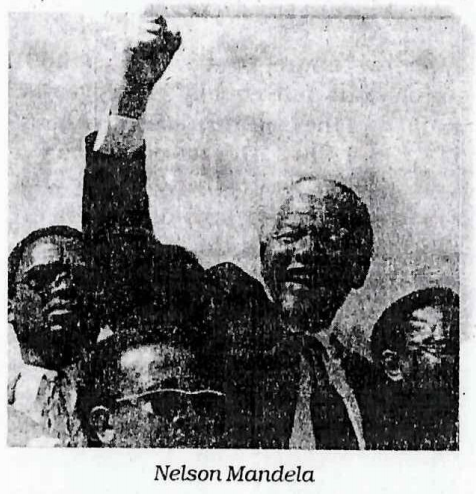
- Mandela’s Legacy
- Despite spending 27 years in prison, Mandela became a global symbol of courage, perseverance (persistence), and forgiveness.
- Today, he remains one of the most revered figures worldwide, representing justice, peace, and the triumph (great victory) of humanity over oppression.
- The Asian scenerio after the dissolution of the USSR in 1991
- Kazakhstan: History, Demographics, and Leadership
- Geographic and Demographic Overview
- Kazakhstan is almost as large as India but has a population smaller than the city of Chennai.
- Unlike many nations, Kazakhstan never existed as an independent entity before the fall of the Soviet Union.
- Historical Background and Soviet Influence
- The partition of Central Asia mirrored Africa’s, where new nations were created to serve colonial interests in the 19th century.
- In the early 20th century, Central Asia was a vast but sparsely populated region occupied by various tribes such as:
- Kazakhs, Turkmen, Uzbeks, Mongols, and others.
- Stalin’s Forced Relocations (1930s–1950s):
- Stalin pursued (chased / go after) a policy of populating Central Asia with forcibly displaced people from Europe.
- Hundreds of thousands of Poles, Ukrainians, Latvians, Lithuanians, and Germans were sent eastward.
- Families were often separated permanently.
- Kazakhstan’s Strategic and Economic Importance
- The country housed most of the USSR’s nuclear facilities.
- Rich in natural gas, but unable to capitalize on it due to its geographical isolation from key Asian markets.
- Post-Soviet Leadership
- In 1991, after independence, Nursultan Nazarbayev, the former communist chief, became President of Kazakhstan.
- Like other ex-Soviet leaders, he swiftly adopted democratic rhetoric but governed with an authoritarian approach.
- In 1999, he was re-elected for another seven-year term, as his main opponent was disqualified from the elections.
- Uzbekistan: Historical Ties, Economic Potential, and Geopolitical Shifts
- Historical and Cultural Ties with India
- Uzbekistan shares deep civilizational links with India.
- The Mughals originated from this region, establishing strong historical connections.
- Economic and Industrial Landscape
- Although Uzbekistan lacks significant natural gas reserves, it is highly industrialized.
- It holds potential as a trading partner for India.
- Security Challenges and Terrorism
- The country has been a victim of international Islamic terrorism, particularly in the Ferghana Valley, which is shared with Tajikistan.
- Geopolitical Shift: US Military Presence in Central Asia (2001)
- In 2001, during the US-led war in Afghanistan, President Islam Karimov allowed the United States to establish military bases in Uzbekistan.
- This move disrupted the existing balance of power, as Central Asian states were historically aligned with Russia under a common security pact.
- Russia viewed this as a direct challenge to its regional dominance.
- Tajikistan: Post-Independence Turmoil and the Fight Against Terrorism
- Political Instability After Independence (1991-1993)
- After gaining independence in 1991, Tajikistan experienced severe (very bad / serious) political instability.
- President Rakhmon Nabiyev, a conservative former communist, was forced to resign within months of taking office.
- In September 1992, a coalition government of Islamic, nationalist, and Western-oriented parties was formed.
- However, this coalition was unstable, leading to a pro-Communist takeover in 1993 and the introduction of a new Presidential system.
- Tajikistan as a ‘Frontline State’ Against Terrorism
- Tajikistan is considered a key player in the global fight against international Islamic terrorism.
- The country has been one of the worst affected by terrorism in the region.
- The Rise of Militant Islam and Civil War (1992-1997)
- Under communist rule, Islam in Central Asia had adopted a more liberal outlook:
- Women did not wear veils.
- They had equal access to education and employment.
- After independence, economic struggles allowed militant Islam, allegedly supported by Pakistan and extremist Islamic states, to gain influence.
- This led to a civil war in Tajikistan, which resulted in the deaths of at least 55,000 people by 1997.
- Turkmenistan: Energy Wealth and Authoritarian Rule
- Vast Oil and Gas Reserves
- Turkmenistan possesses the largest oil and natural gas deposits in the Central Asian region.
- Due to its landlocked geography, the country exports gas via pipelines through Iran.
- Authoritarian Rule and Personality Cult (sect / religious group)
- President Saparmurad Niazov, known as “Turkmenbashi” (Leader of the Turkmen), established a strong personality cult.
- His statues are widespread, adorning (decorating) almost every street in the country.
- Mongolia and Kyrgyzstan: Challenges of Geography and Politics
- Mongolia: Isolation and Political Landscape
- Due to its remoteness and extreme climate, Mongolia remains economically backward with limited natural resources.
- The political scene is still dominated by former Communists, despite the country’s transition from socialism.
- Kyrgyzstan: Similar Struggles with Added Security Concerns
- Kyrgyzstan faces similar economic challenges but also grapples (wrestle) with Islamic fundamentalism.
- In 2001, during the U.S. war against the Taliban, President Askar Akayev allowed the American Air Force to establish military bases in the country.
- Afghanistan: A Crucial Link in India’s Security and a Battlefield of Power Struggles
- Strategic Importance and Historical Connection
- Afghanistan, situated at the junction of South and Central Asia, is crucial to India’s security.
- Historically, it was part of Greater India and a gateway for numerous invaders since ancient times.
- India has a de jure border with Afghanistan, but Pakistan’s illegal occupation of parts of Jammu and Kashmir has severed their traditional connection.
- A Nation Devastated by War
- Afghanistan has endured years of civil war and oppressive regimes, both communist and fundamentalist Islamic.
- Presently, it is struggling to rebuild under international supervision, with efforts to establish a liberal democratic government.
- The Communist Takeover and Soviet Invasion (1973-1979)
- In 1973, King Mohammed Zahir Shah was overthrown in a military coup led by Daoud Khan, who was backed by the USSR.
- The People’s Democratic Republic of Afghanistan was created as a Moscow-aligned state with a new constitution.
- However, Daoud’s suppression of Islamic clergy (body of all people ordained for religious duties) angered tribal factions.
- In 1978, Nur Mohammed Taraki, a communist leader with clergy connections, staged a bloody coup, killing Daoud and declaring Afghanistan’s independence from Moscow.
- Taraki’s social reforms conflicted with Islamic values, leading to widespread revolts across Afghanistan.
- His rival, Hafizullah Amin, seized control of most of the countryside.
- Fearing Pakistan’s involvement, Soviet President Leonid Brezhnev ordered the invasion of Afghanistan in December 1979.
- Amin was assassinated, and Babrak Karmal, a pro-Moscow leader, was installed as President.
- The Cold War Battleground (1980s): U.S., Pakistan, and the Mujahideen
- Afghanistan became a key Cold War battleground between the USSR and the US.
- The United States, under President Jimmy Carter, used Pakistan as a frontline state against the Soviet Union.
- Pakistan’s Zia-ul-Haque regime armed and trained Mujahideen fighters using U.S.-supplied weapons, including Stinger missiles.
- The Mujahideen waged a fierce guerrilla war, making it impossible for the Soviets to gain full control.
- Afghanistan’s rugged terrain further complicated Moscow’s efforts.
- The war was marked by brutal atrocities, with villages burned and civilians massacred.
- Despite immense Soviet firepower, the Mujahideen resisted for eight years, leading to an estimated 300,000 deaths.
- Soviet Withdrawal and Continued Instability (1988-Onwards)
- Under Mikhail Gorbachev, the USSR acknowledged the war’s futility (pointlessness).
- In 1988, a peace treaty was signed in Geneva, and the Soviets withdrew.
- However, Moscow-installed President Najibullah continued ruling, sparking civil war as the Mujahideen refused to accept his leadership.
- The US lost interest in Afghanistan after the Soviets’ departure, abandoning (renounce) the region.
- Both superpowers left behind a massive stockpile of arms, ensuring that conflict persisted (carried on) long after their withdrawal.
- Afghanistan: From Civil War to Global Terrorism and the Fall of the Taliban
- The Aftermath of the Cold War and Pakistan’s Proxy War
- As civil war raged in Afghanistan, the USSR collapsed, marking the end of the Cold War.
- Despite continued human suffering and massacres, global interest in Afghanistan declined.
- Pakistan became home to armed Mujahideen, many of whom were sent to wage a proxy war in Jammu and Kashmir during Benazir Bhutto’s regime, leading to a sustained campaign of terror in India.
- The Rise of the Mujahideen and Internal Power Struggles (1992-1996)
- In 1992, President Najibullah fell, and the Mujahideen captured Kabul.
- They installed Burhanuddin Rabbani, an ethnic Tajik, as the new leader, but this move angered the powerful Pashtun tribes of southern Afghanistan.
- Meanwhile, Pakistan cultivated a new fundamentalist force—the Taliban, whose fighters were mostly madrasa students (talib).
- The Taliban began a brutal military campaign, killing both combatants (fighting man) and civilians as they marched toward Kabul.
- Pakistan backed the Taliban to gain ‘strategic depth’ in a future war against India, as Afghanistan’s previous rulers had denied such support during the Indo-Pak wars of 1965 and 1971.
- The Taliban’s Rule and Extreme Fundamentalism (1996-2001)
- In 1996, the Taliban captured Kabul and established one of the most extremist regimes in the world.
- Women, who had been among the most educated and progressive in the Islamic world, faced severe repression:
- Banned from working or receiving education.
- Forced to wear the burqa at all times.
- Subjected to brutal punishments for disobedience.
- The Taliban imposed harsh Islamic restrictions on daily life and enforced extreme punishments.
- Only three countries—Pakistan, Saudi Arabia, and the UAE—recognized the Taliban government.
- Al-Qaeda’s Rise and Global Terrorism
- Former Mujahideen leader Ahmed Shah Masood regrouped anti-Taliban forces in the Panjsher Valley and launched resistance attacks.
- The Taliban gained global notoriety (bad reputation) for harboring Al-Qaeda, the world’s most feared terrorist group.
- Under Taliban protection, Osama bin Laden orchestrated multiple terrorist attacks:
- 1993 World Trade Center bombing in New York, killing 6 and injuring over 1,000.
- 1998 US embassy bombings in Nairobi (Kenya) and Dar es Salaam (Tanzania), killing 263 people.
- Global Pressure and Taliban Defiance (open resistance)
- Despite international pressure, the Taliban refused to hand over Osama bin Laden.
- The Taliban and Al-Qaeda thrived on drug trafficking, moving narcotics through Central Asia to Russia, Europe, and America to fund terrorism.
- In 1998, the US launched missile strikes on bin Laden’s camp, but he escaped.
- India, Russia, China, and Central Asian republics convinced the UN to impose sanctions on Afghanistan in December 1999.
- Further sanctions in January 2001 failed to break the Taliban’s resolve.
- In a final act of defiance, the Taliban destroyed the giant Bamiyan Buddhas, shocking the world.
- The 9/11 Attacks and the Fall of the Taliban
- On September 11, 2001, Al-Qaeda launched the deadliest terrorist attack on the World Trade Center in New York.
- The attack brought global attention to Afghanistan’s suffering and its role as a terrorist hub.
- President George W. Bush declared a ‘War on Terror’, making Afghanistan the first battleground.
- The Taliban resisted briefly (short time) but were soon overthrown by US-led coalition forces.
- Hamid Karzai, a former Mujahideen, was installed as interim President until elections could be held.
- Pakistan’s Policy Shift and the Aftermath
- Pakistan’s Pervez Musharraf regime had been backing the Taliban, but under US pressure, it withdrew support.
- Pakistan even allowed US military bases on its soil for the war against the Taliban.
- This policy shift brought diplomatic and financial benefits to Pakistan but also exposed it as a global hub of terrorism.
- The fall of the Taliban was a major blow to Pakistan, forcing it to abandon its ambition of gaining ‘strategic depth’ against India.
- Climax and fall of communism in the USSR and easter Europe
- The Rise and Fall of Soviet Communism
- Collapse of the Communist Empire
- Stalin’s empire stretched from East Germany to Mongolia.
- Collapsed suddenly in 1991 after 74 years.
- Left a lasting impact despite its short existence.
- Achievements and Failures
- Major achievements: Space conquest and industrial growth.
- Totalitarian rule: No free speech or enterprise.
- Economic decline: Couldn’t compete with the US.
- Eastern Bloc resistance: Moscow’s control clashed with national pride.
- Understanding the Fall
- The chapter explores why Soviet communism collapsed.
- Earlier discussions:
- Russian Revolution: Bloodshed and economic shifts.
- Stalin’s rule: Expansion and suppression.
- Turning point: Stalin’s death on 5 March 1953.
- Power Struggle After Stalin’s Death
- Suspected Poisoning
- Research suggests Stalin was poisoned by close aides.
- They feared his aggressive policies could start another World War.
- Power Struggle in the Kremlin
- Stalin’s death led to a bloody power struggle.
- Soviet citizens were shocked as they had known no other leader.
- Key contenders:
- Lavrenti Beria – KGB chief, oversaw mass executions.
- Georgi Malenkov – Soviet premier.
- Nikita Khrushchev – Senior party leader, responsible for purges in Ukraine.
- Khrushchev Takes Control
- Khrushchev emerged as the leader within months.
- Beria was executed, marking the end of his brutal reign.
- Khrushchev’s Reforms and De-Stalinization
- Condemning Stalin (1956)
- At the 20th Communist Party Congress, Khrushchev openly criticized Stalin.
- Accused him of:
- Promoting a personality cult.
- Deviating from party principles.
- Ordering massacres in the 1930s.
- Mismanaging World War II.
- Emphasized that socialism should succeed without Stalin’s methods.
- Advocated better relations with the US to avoid nuclear war.
- Economic Reforms
- De-Stalinization process aimed at improving Soviet living standards.
- Continued Five-Year Plans but shifted focus from:
- Heavy industries → Agriculture & Consumer goods.
- Replaced Stalin’s centralized system with Regional Economic Councils.
- Allowed managers to focus on profits instead of quotas.
- Economy became more stable but lagged behind the US and Western nations.
- Agricultural Reforms
- Launched the Virgin Lands Scheme to cultivate Siberia & Kazakhstan.
- Allowed peasants to sell surplus crops from private plots.
- Increased procurement (action of obtaining) rates to encourage production.
- 1953-1958: Collective farm output rose by 56%.
- 1962: Grain production reached 147 million tonnes.
- 1963: Fell to 110 million tonnes, leading to dependence on food imports.
- Political Changes
- Reduced Stalinist oppression:
- No personality cult.
- Less KGB surveillance on ordinary citizens.
- Dissidents (person opposing official policy) faced dismissal, not execution.
- However, repression continued in cases like Hungary (1956).
- Gulags (prison camps) remained, but mass terror was less frequent.
- Eastern European Uprisings (1956)
- The Hungarian Uprising
- Led by Prime Minister Imre Nagy, a nationalist communist.
- Hungarians demanded freedom from Soviet control.
- Nagy:
- Planned a broad-based government with non-communist parties.
- Cut ties with Moscow, alarming Soviet leadership.
- 24 October 1956:
- Soviet tanks invaded Hungary.
- Weeks of violent clashes followed.
- After suppression:
- 100,000+ arrested, many interned.
- 25,000 jailed, 229 executed.
- Nagy & his followers sentenced to death, body buried in secrecy.
- Janos Kadar, a Soviet loyalist, installed as leader.
- The Polish Uprising
- June 1956: Polish workers revolted, demanding better wages & living standards.
- Warsaw’s communist regime attempted to suppress the unrest.
- October 1956:
- Khrushchev deployed tanks but ordered no shooting.
- A compromise was reached.
- Władysław Gomułka, imprisoned by Stalin, was freed & made leader.
- Outcome:
- Poland allowed to follow its own version of communism.
- Permitted to trade with non-communist nations.
- Khrushchev’s Downfall (1964)
- Main Reason: Failure of his agricultural policy.
- October 1964: The Central Committee forced him into retirement.
- Age & Health: Though 70 years old, he was in perfect health.
- Other Factors:
- Sino-Soviet Rift: Relations between the USSR & China had deteriorated.
- Controversial Foreign Policy:
- Grew too close to Egypt.
- Awarded the Order of Lenin to President Nasser, despite Nasser suppressing communism.
- Retirement & Death:
- Lived in his dacha (country home) until his death in 1971.
- Succeeded by Leonid Brezhnev.
- The Sino-Soviet Rift
- Early Friendship (Post-1949)
- The USSR and China were close allies after the Chinese Communist Party came to power.
- Soviet military aid helped Mao Zedong seize power.
- Despite an unresolved border dispute, they signed the Treaty of Mutual Assistance and Friendship (1950).
- Ideological Differences (Post-Stalin Era)
- After Stalin’s death, ideological differences emerged.
- Mao opposed Khrushchev’s reforms, defending Stalin’s use of terror.
- China accused Khrushchev of “revisionism”—straying from Marxist-Leninist principles.
- Territorial Dispute
- Russia had seized large areas of Chinese land (19th century).
- Mao demanded their return, but Khrushchev refused.
- Cold War Conflicts
- Vietnam War:
- The USSR backed the Vietcong under Ho Chi Minh.
- China & Vietnam disagreed over Pol Pot’s brutal regime in Cambodia (1975-79).
- In 1979, China attacked Vietnam, worsening Sino-Soviet relations.
- China-US Rapprochement (1972):
- China reconciled with the US, sparking a Cold War with the USSR.
- The USSR sought to isolate China diplomatically.
- Afghanistan Invasion (1979):
- The Soviet Army invaded Afghanistan, installing a puppet communist regime.
- China supported the Mujahideen in their resistance.
- Reconciliation (1989-Present)
- Gorbachev’s Visit (1989):
- Marked the beginning of improved Sino-Soviet ties.
- Post-Soviet Era:
- After the Soviet collapse, Russia mended (repaired) ties with China.
- Boris Yeltsin (First Russian President) actively promoted defense & trade relations with China.
- Economic cooperation has steadily grown since then.
- The Prague Spring and Soviet Suppression (1968)
- Brezhnev’s Hardline Approach
- Leonid Brezhnev, who succeeded Khrushchev, followed a Stalinist approach.
- Unlike Khrushchev, who allowed Eastern Bloc nations some autonomy, Brezhnev saw this as a threat to Soviet control.
- By 1968, he was increasingly anxious about developments in Czechoslovakia.
- Growing Czech Discontent
- Czechoslovakia, the most industrially and culturally advanced nation in the Eastern Bloc, resented Soviet domination.
- Antonin Novotny, a pro-Soviet hardliner, was widely hated for his authoritarian rule.
- The Soviets forced Czechoslovakia to accept lower-quality goods, such as inferior steel from Siberia, over better imports from Sweden.
- Suppression of free speech and violent crackdowns on demonstrations fueled unrest.
- Rise of Alexander Dubcek & the Prague Spring (January-August 1968)
- In January 1968, after mass protests, Novotny resigned.
- Alexander Dubcek, the widely respected First Secretary of the Czech Communist Party, took office.
- He initiated progressive reforms, which he called “socialism with a human face”:
- Ending Communist Party interference in daily life.
- Decentralizing industries, giving them freedom from party control.
- Reforming agriculture, replacing collective farms with independent cooperatives.
- Empowering trade unions with greater autonomy.
- Introducing civil liberties, including freedom of speech, press, and foreign travel.
- Czechoslovakia remained in the Warsaw Pact, but Moscow feared these changes would inspire similar movements across the Eastern Bloc.
- Soviet Invasion & Brutal Crackdown (August 1968)
- In August 1968, fearing the spread of reforms, Moscow launched a massive invasion under “Operation Danube”.
- Warsaw Pact forces, including Soviet, Polish, East German, Bulgarian, and Hungarian troops, invaded Czechoslovakia.
- The invasion force was larger than Nazi Germany’s in 1938.
- Dubcek called for passive resistance, but brutal repression followed:
- 90 civilians were killed.
- Mass arrests of liberal leaders, some deported to Siberia.
- Self-immolation protests by Czechs, drawing global condemnation.
- Soviet Control & the Brezhnev Doctrine (belief or set of belief)
- Facing international pressure, the Soviets released some arrested leaders but intensified their repression.
- Gustav Husak was installed as a puppet leader under strict Soviet control.
- Censorship was reimposed, and the Czech Communist Party was purged of reformists.
- 40,000 people fled the country.
- Brezhnev justified the invasion through the Brezhnev Doctrine, declaring that:
- The USSR had the right to intervene in any communist country if its regime was threatened by reform movements.
- The Prague Spring was crushed, reinforcing Soviet domination over the Eastern Bloc, but it remained a symbol of resistance against authoritarianism.
- The Spread of the Prague Spring’s Spirit
- International Exposure of Soviet Repression
- Unlike previous Soviet crackdowns in East Germany (1953), Hungary (1956), and Poland (1956)—which occurred behind the Iron Curtain—the Prague Spring (1968) unfolded under global media scrutiny (careful examination).
- When the Warsaw Pact Army invaded Czechoslovakia, international journalists were already present in Prague, ensuring that the world witnessed Soviet aggression firsthand.
- Growing Unrest in the Eastern Bloc
- Despite Soviet suppression, the spirit of resistance spread across the Eastern Bloc.
- By 1970, riots erupted in Poland, marking the beginning of a decade-long struggle against Soviet rule.
- This unrest culminated (reach a climax or point of highest development) in 1979 with the emergence of Solidarity (unity), an independent trade union movement, which became a major force in Poland’s push for freedom.
- Widespread Dissidence (disagreement) and Defections (desertion of one's country or cuase in favour of an opposing one)
- Across Eastern Europe, people began privately discussing communism’s failures.
- In East Germany, the population longed for reunification with West Germany, which led to heightened surveillance and repression by the Stasi (secret police).
- Dissidence spread rapidly, with many attempting to defect to the West.
- Many failed escape attempts resulted in imprisonment or execution.
- The Road to 1989
- The growing stirrings for freedom would continue building momentum, eventually reaching their climax in 1989, as discussed later in the chapter.
- The Decline of the Soviet Communist Party and the Rise of Gorbachev
- The Aging Leadership and Economic Crisis
- By the 1980s, the Soviet Communist Party was dominated by elderly leaders, unable to cope with mounting (going up) crises.
- Leonid Brezhnev, in his final years, was a shadow of his former self, struggling as the Soviet economy deteriorated (worsened).
- The Ronald Reagan administration in the U.S. took an aggressive stance against communism, especially after Brezhnev ordered the invasion of Afghanistan.
- Brezhnev died in October 1982, followed by two short-lived leaders:
- Yuri Andropov (1982–1984) attempted some liberal reforms by replacing aging officials with younger ones.
- Konstantin Chernenko (1984–1985) was a Stalinist revivalist who ignored economic hardship and persecuted intellectuals, including nuclear physicist Andrei Sakharov, jailed in Siberia since 1980.
- The Rise of Mikhail Gorbachev
- After Chernenko’s death, Mikhail Gorbachev was elected General Secretary in 1985 at the age of 54.
- He was widely regarded as the most dynamic and intellectually evolved communist leader.
- His leadership was based on two major policies:
- Glasnost (Openness)
- Perestroika (Restructuring)
-
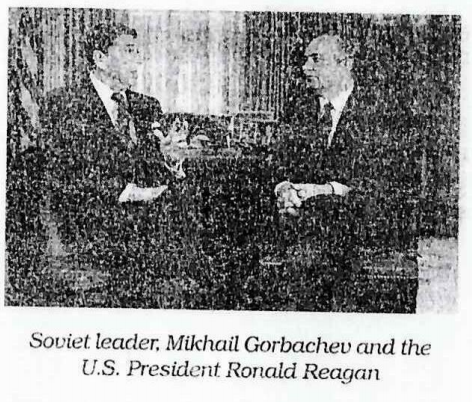
- Glasnost: A New Era of Openness
- Gorbachev encouraged political criticism within the Communist Party.
- Key reforms under Glasnost:
- Release of political dissidents, including Sakharov.
- Revocation of laws that sent critics to mental institutions.
- Restrictions on the KGB’s power were eased.
- Historical transparency: He acknowledged and apologized for the 1940 Katyn massacre, in which over 4,000 Polish officers were executed.
- Media freedom: Coverage of government meetings was allowed for the first time.
- Arts and literature revival: Banned books and films were reintroduced.
- Religious freedom: The communist suppression of religion was lifted.
- Chernobyl disaster (1986): The Soviet media reported on government failures, a first in communist history.
- Perestroika: Economic Restructuring
- Gorbachev inherited a severely mismanaged economy, plagued by shortages of basic goods.
- Key economic reforms under Perestroika:
- Introduction of fiscal (tex / revenue) discipline to curb reckless currency printing.
- Small-scale private enterprises were encouraged.
- Quality control measures introduced in industries.
- Automation and computerization allowed for efficiency.
- Decentralization: Factories and businesses were given market-based autonomy.
- State planning system dismantled, shifting focus to consumer demands.
- The Failure of Reforms and Growing Discontent
- Despite Gorbachev’s efforts, economic problems persisted (carried on):
- 1988–1989: Economic growth remained stagnant.
- 1990: National income fell by 15%.
- Workers focused on producing high-value goods, neglecting basic necessities.
- 25% of the population lived in extreme poverty.
- By 1989, the working class lost patience:
- Nationwide coal miners’ strike, the first since 1917, erupted over economic hardships.
- Essential goods like soap, toothbrushes, and food were in short supply.
- Gorbachev did not suppress the strikes, instead allowing independent trade unions.
- Rising Opposition to Gorbachev
- Gorbachev found himself caught between two factions:
- Radicals, who criticized him for not reforming fast enough.
- Hardliners, who resented his departure from strict communist principles (truth / concept / idea).
- Although Gorbachev had pledged to preserve communism, his openness and reforms weakened the system.
- Boris Yeltsin, the President of Russia, emerged as a major critic, openly challenging Gorbachev’s policies (plans / strategy).
- Conclusion
- Gorbachev’s reforms triggered political and economic upheavals that he struggled to control.
- By the early 1990s, the Soviet Union was on the verge of collapse, as resentment (bitterness), economic decline, and political opposition intensified.
- The Disintegration of the East Bloc
- The winds of change set in motion by the Prague Spring continued to sweep across Eastern Europe throughout the 1970s.
- By the 1980s, the circulation of free ideas and nationalist ideologies intensified, further fueling the demand for change.
- The Fall of Communism in Poland
- The Solidarity Movement and Initial Suppression
- Led by Lech Walesa, the Solidarity movement gained momentum in Poland.
- Brezhnev, nearing the end of his rule, had approved military pressure against Poland but was unable to act effectively.
- The ongoing Afghan War weakened Soviet military strength and public support for foreign interventions.
- Instead of direct Soviet intervention, Polish leader General Jaruzelski declared martial law to suppress Solidarity (unity / here solidarity means a union from poland).
- Solidarity (here solidarity means a union from poland) was banned, and thousands of activists were arrested and suppressed.
- Martial law was lifted in 1983, and Solidarity (here solidarity means a union from poland) leaders were released.
- Economic Crisis and the Return of Solidarity
- Poland’s economic problems persisted (carried on), and in 1988, General Wojciech Jaruzelski cut government subsidies, leading to mass job losses and rising food prices.
- Despite being banned, Solidarity (here solidarity means a union from poland) organized new demonstrations across the country.
- Unlike before, Jaruzelski did not suppress the protests, as Gorbachev in Moscow had adopted a policy of non-interference in Eastern Europe.
- Facing an economic crisis, Jaruzelski was forced to negotiate with Solidarity (here solidarity means a union from poland), leading to a major constitutional overhaul (repair / maintain) in April 1989.
- The 1989 Constitution and Free Elections
- Poland introduced a new Constitution, creating a bicameral Parliament:
- Lower House (Sejm): 65% of seats reserved for Communists.
- Senate: Open for free elections, without Communist control.
- The two Houses would elect a President, who in turn would appoint a Prime Minister.
- Solidarity was officially recognized as a political party for the first time.
- June 1989 elections:
- Solidarity won 92 out of 100 Senate seats and 160 out of 161 open seats in the Lower House.
- Jaruzelski retained the Presidency due to the reserved Communist seats.
- However, under public pressure, he appointed Tadeusz Mazowiecki, the first non-Communist Prime Minister in Eastern Europe.
- Final Collapse of Communism in Poland
- In December 1990, the 1989 Constitution was amended to remove Communist guarantees.
- By this time, Communism had collapsed across Eastern Europe, leaving Jaruzelski with no justification to stay in power.
- Lech Walesa was elected President, and Poland became fully independent for the first time since 1939.
- The Fall of Communism in Hungary
- Economic Crisis and Internal Party Struggles
- Janos Kadar, Hungary’s leader under Soviet influence, faced a crisis within the Communist Party in 1986.
- Hungary was in a deep economic crisis, and Kadar struggled to find solutions.
- The country’s industries were burdened with outdated Soviet-imposed machinery.
- The Communist Party split into two factions:
- Reformists urged decentralization, leading Kadar to establish company councils with the right to elect managers.
- Hardliners, expecting Soviet support, insisted on maintaining the Stalinist system.
- However, they miscalculated, as Gorbachev was not Stalin and did not intervene to suppress reforms.
- Political Shakeup and Rise of the Opposition
- In May 1988, a major shakeup within the Communist Party led to Kadar and eight of his supporters being voted out of the Politburo.
- This shift allowed progressive communists to take control.
- Meanwhile, two major opposition parties emerged:
- Liberal Alliance of Free Democrats
- Democratic Forum
- The reformist Communists negotiated with the opposition and agreed to hold free elections.
- In an attempt to reinvent itself, the Communist Party rebranded as the Hungarian Socialist Party.
- The 1990 Elections and the End of Communism
- Despite its rebranding, public sentiment had turned against the communists.
- In Hungary’s first free elections, the Democratic Forum, led by Jozsef Antall, secured victory.
- With this, Hungary permanently ended communist rule.
- The Reunification of Germany
- Division of Germany
- Yalta Conference (1945) led to two Germanies.
- West Germany (1949): Free, democratic, led by Adenauer.
- East Germany (1949): Communist, controlled by Stasi.
- Economy: Strongest in East Bloc but weaker than West Germany.
- Rising Discontent
- 1985: Honecker resisted reforms.
- Gorbachev’s policies fueled protests.
- Gorbachev’s Role
- June 1989: Sought Western aid.
- Kohl pushed for reunification.
- Gorbachev agreed in exchange for aid.
- East Germans fled via Poland, Hungary, Czechoslovakia.
- Fall of the Berlin Wall
- Honecker’s crackdown failed.
- Communists ousted him.
- Krenz opened the Wall (Nov 1989).
- West German parties pushed for unity.
- Reunification
- 3 Oct 1990: Germany reunified.
- Cold War neared its end.
- The Velvet Revolution in Czechoslovakia
- Persistent Resistance
- 1970s: Brutal suppression failed to silence protests.
- Despite political unrest, the economy remained the strongest in the region.
- Economic Decline & Leadership Crisis
- 1980s: USSR’s control harmed the economy.
- Gustav Husak (since 1969) failed to resolve issues, resigned in 1987.
- Milos Jakes took over but proved equally ineffective.
- Rise of Vaclav Havel & Charter 77
- Havel, a playwright, led Czech Charter 77.
- Velvet Revolution began, drawing massive public support.
- Fall of Communism
- November 1989: Alexander Dubcek re-emerged in politics.
- Strikes & protests escalated.
- Moscow did not intervene.
- Jakes resigned.
- Democratic Transition
- 29 December 1989: Havel elected President.
- End of Extreme Communist Tyranny in Romania
- Nicolae Ceausescu’s Brutal Regime
- Ruled since 1965, considered more brutal than East Germany’s Honecker.
- Controlled Romania with Securitate, a secret police as oppressive as the Stasi.
- The 1989 Uprising
- Until November 1989, the regime seemed unshaken.
- 17 December: Army fired on peaceful protestors in Timisoara, killing many.
- Nationwide outrage erupted, branding Ceausescu and his wife as murderers.
- 25 December (Christmas 1989): Crowds stormed the palace, captured them, and executed them after a short trial.
- Struggle for Democracy
- Romania lacked organized opposition like Solidarity (Poland) or Charter 77 (Czechoslovakia).
- National Salvation Front, led by Ion Iliescu (a former minister under Ceausescu), took power.
- 1996: Christian Democrat Emil Constantinescu won elections, leading the first non-communist government.
- Bulgaria’s Easy Transition
- Todor Zhivkov, in power since 1954, was a hardliner who refused reforms despite a collapsing economy.
- Mikhail Gorbachev repeatedly urged him to implement changes, but he resisted.
- By 1989, fearing the fate of their counterparts in neighboring countries, his own party turned against him.
- December 1989: The Politburo voted him out and renamed the party as the Bulgarian Socialist Party.
- End of Communism in Albania
- Albania became communist in 1945 through an internal uprising, without Soviet intervention.
- Enver Hoxha, the dictator for 40 years, admired Stalin’s system and kept the country isolated and backward.
- His successor, Ramiz Alia, failed to address Albania’s worsening situation.
- Unlike other East Bloc countries, Albanians had little experience in mass uprisings.
- 1991: Thousands of young Albanians fled to Italy, drawing international criticism.
- 1992: Free elections were held, and Sali Berisha became Albania’s first non-communist leader.
- Reasons for the Collapse of Communism in Eastern Europe (1945–1989)
- Communism Was Imposed, Not Accepted Naturally
- The East Bloc countries were independent, culturally advanced, and historically accustomed to freedom.
- After World War II, the Soviet Army liberated them from the Nazis but did not restore their sovereignty.
- Instead of following the Allied example of democracy, Stalin brutally imposed communism on them.
- Suffering Under Communist Tyranny
- Moderate socialists and democrats were executed to eliminate opposition.
- Hungary (1949): Leaders Laszlo Rajk and Janos Kadar were hanged for defying Stalin.
- Bulgaria (1949): Prime Minister Traicho Kostov was arrested and executed.
- Czechoslovakia (1952): Stalin ordered the execution of Rudolf Slansky and 10 other ministers.
- Over time, people realized their leaders were mere puppets of Moscow.
- Economic Decline and Youth Unemployment
- The economies of the East Bloc were tied to the USSR, using outdated technology that made them uncompetitive.
- While Western Europe prospered, East Germans, Poles, Czechs, and Hungarians saw their own economies collapse.
- By the 1970s and 1980s, unemployment surged, especially among the youth.
- Revolutions often stem from economic despair, and with nothing to lose, young people led the uprisings of 1989.
- Gorbachev’s Leadership and Soviet Weakness
- When Mikhail Gorbachev took power, he inherited the burden of the Afghan War.
- Thousands of Soviet soldiers died, creating resentment (bitterness) at home.
- Unlike previous leaders, Gorbachev did not suppress revolts in Eastern Europe.
- Hardliners in Moscow opposed him and began plotting his downfall.
- Religious Revival and Resistance to Communism
- Communism suppressed religion, but the people of the East Bloc never accepted atheism.
- 1970s: People reopened churches that had been shut since Stalin’s rule.
- 1980s: Many young Catholics became priests, and spiritual movements like ISKCON and Ananda Marga gained popularity.
- The rediscovery of religion gave people strength to resist communism.
- Reagan’s Economic War and Western Support
- Ronald Reagan, US President (1981–1989), was determined to defeat communism.
- He launched an economic war against the USSR and the East Bloc, making communist goods uncompetitive.
- Western Europe fully supported the US, further weakening Eastern economies.
- Pope John Paul II, a Polish leader of the Catholic Church, encouraged religious revival, strengthening the resistance.
- Conclusion
- Communism in Eastern Europe collapsed because it was imposed, economically unsustainable, and ideologically rejected.
- The youth, religious revival, economic failures, and external pressures combined to bring down 44 years of communist rule in a remarkably short time.
- The Fall of the USSR
-
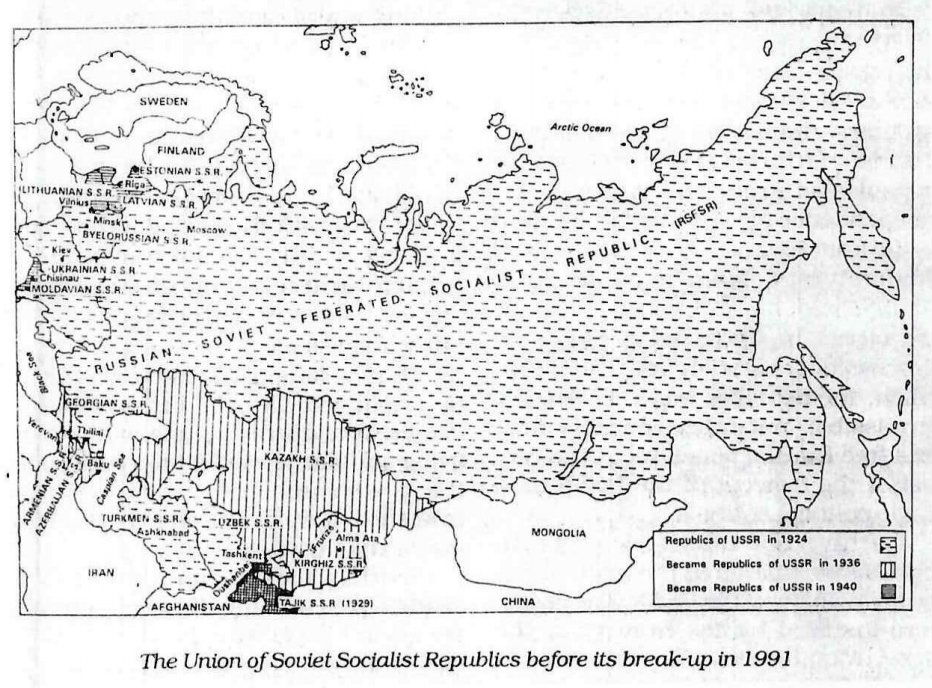
- The Collapse of Communism in the USSR
- Communism collapsed at an astonishing speed in the world’s first communist country, the USSR, with minimal bloodshed. Freedom-loving people across the world witnessed this historic event unfold.
- Political Reasons for the Fall of the USSR
- Gorbachev’s Reforms and the Weakening of the Communist Party
- Gorbachev introduced far-reaching reforms that reduced the Soviet Communist Party’s dominance.
- In January 1987, he initiated steps toward democracy within the party.
- By 1988, the old 1,450-member Supreme Soviet was replaced by a 2,250-member Congress of People’s Deputies. This body elected a new 450-member Supreme Soviet, whose chairman would serve as the Head of State.
- In December 1989, the guarantees of the Communist Party were abolished (put to an end).
- The Youth and Boris Yeltsin’s Radicalism
- Soviet youth demanded faster reforms.
- Boris Yeltsin, a popular leader, advocated (publicly supported or recommended) for a Western-style, market-oriented democracy.
- Though Gorbachev was open to reform, he sought a gradual transition, advised by Yegor Ligachev.
- This created a dangerous split within the Communist Party.
- Radical Discontent and Street Protests
- In the May 1989 elections, radicals (far reaching or thorough) failed to win enough seats in the Congress of People’s Deputies.
- Yeltsin himself was unable to get elected.
- Frustrated, he turned to mass demonstrations, using Gorbachev’s policy of glasnost against him.
- Rising Nationalism in Soviet Republics
- Republics such as Georgia, Lithuania, and Uzbekistan sought independence.
- Many had strong underground pro-independence movements for decades.
- Inspired by the fall of the East Bloc, nationalist movements gained momentum.
- Yeltsin championed Russian independence, undermining (sabotaging / weakening) the USSR’s unity.
- Soviet Defeat in Afghanistan
- The USSR’s military defeat in Afghanistan shattered its image of invincibility.
- The Afghan Mujahideen’s resistance inspired Soviet citizens to challenge their own system.
- The Soviet people’s conviction (declaration of someone guilty) that communism could collapse was reinforced by the events in Eastern Europe in 1989.
- Economic Reasons for the Fall of the USSR
- Economic Decline and Recession
- Gorbachev’s economic reforms failed to boost growth.
- By 1990, the national income plummeted, worsening into 1991.
- Some economists compare the USSR’s economic crisis in 1990 to the Great Depression in the US during the 1930s.
- The Law on State Enterprises Backfires
- Gorbachev’s law made wages directly proportional to output, but it had unintended consequences.
- Workers prioritized luxury goods over essentials, leading to scarcity (shortage).
- Basic necessities became difficult to find, resulting in long queues outside stores.
- Widespread Strikes and Public Discontent (dissatisfaction)
- Mass strikes erupted across the USSR.
- Citizens openly questioned when their living standards would improve—an unprecedented event in a communist state.
- It became evident (clearly seen or understood) that the Communist Party was losing control.
- Burden of the Arms Race with the USA
- The USSR struggled to keep pace with the US in military advancements.
- Obsolete (out of date) Soviet weaponry required massive funding for upgrades.
- Essential funds were drained into defense, worsening economic hardship.
- Loss of Economic Support from Eastern Europe
- The USSR’s preferential (privileged) trade agreements with Eastern European countries ended after 1989.
- This deprived the USSR of crucial economic advantages.
- Additionally, countries like India, which once provided lucrative trade opportunities (such as rupee-based tea purchases resold for dollars), began their own economic reforms in the early 1990s, further weakening Soviet financial stability.
- The Final Collapse of the USSR
- Gorbachev Caught Between Radicals and Conservatives
- Gorbachev found himself trapped between two opposing factions:
- Radicals, led by Boris Yeltsin, who demanded rapid reforms.
- Conservatives, led by Yegor Ligachev, who resisted change.
- By July 1990, many Soviet republics began demanding independence.
- Massive demonstrations erupted in Latvia and Lithuania, while Georgia unilaterally declared independence.
- Gorbachev opposed using military force to suppress these uprisings.
- He proposed a voluntary union granting the republics greater autonomy.
- The leaders of the 15 Soviet republics agreed to sign a treaty on 20 August 1991.
- The August 1991 Coup Attempt
- Vice-President Gennady Yanayev and other hardliners planned a coup to prevent the treaty from being signed.
- On 18 August, while Gorbachev was on holiday in Crimea, coup plotters held him at gunpoint and demanded his resignation.
- When Gorbachev refused, they placed him under house arrest and sent tanks and soldiers into Moscow.
- The public was falsely informed that Gorbachev was ill and a new committee was in charge.
- They declared a state of emergency, banned demonstrations, and attempted to suppress opposition through military intimidation.
- Yeltsin Leads the Resistance
- The coup leaders underestimated the power of the people and failed to arrest Yeltsin.
- Seizing the opportunity, Yeltsin rushed to the Russian Parliament (White House) and gathered a massive crowd.
- In a historic moment, he climbed onto a tank in open defiance of the coup leaders.
- The soldiers refused to fire on him or the protesters.
- Yeltsin emerged as the symbol of resistance, and public support for the coup crumbled (fall apart).
- The Coup Collapses
- Confusion and chaos spread across the USSR for two days.
- Hardline communists initially celebrated, removing Gorbachev’s portraits and destroying books on glasnost and perestroika.
- Lenin and Stalin’s images reappeared in government buildings.
- An Indian newspaper editorial described the situation as the “Dance of Fossils.”
- On 21 August, overwhelmed (have a strong emotional effect on) by peaceful resistance, the coup leaders surrendered to Yeltsin.
- Four top coup leaders were later sentenced to death, though the USSR collapsed before their sentences were carried out.
- Gorbachev returned to Moscow, but his authority was irreparably weakened.
- The Final Collapse of the USSR
- The coup was the final blow to the Soviet Communist Party, which was now discredited (lost respect).
- Gorbachev resigned as General Secretary of the party, and Yeltsin banned it in Russia.
- Relations between Gorbachev and Yeltsin soured further.
- Yeltsin declared Russia’s independence and encouraged other republics to do the same.
- On 1 December 1991, Ukraine declared its independence, sealing the fate of the USSR.
- Finally, on 25 December 1991, Gorbachev resigned, marking the official end of the Soviet Union.
- With political unrest, economic decline, and growing nationalist movements, the USSR disintegrated, marking the end of communist rule in the Soviet Union.
- Polity and economy in the contemporary world
- The 20th Century: A Paradox of Progress and Struggle
- Economic Disparity
- The century witnessed unprecedented prosperity for a few but widespread poverty for the majority.
- Despite economic slumps and depressions, the rich grew richer, while the poor suffered more.
- Fall of European Imperial Powers
- At the start of the century, European empires dominated global politics.
- Within 50 years, these empires collapsed, replaced by a world divided between two superpowers.
- Rise of the Superpowers
- Unlike colonial empires, the new superpowers exerted (apply) influence through nuclear strength and economic leverage.
- The USA emerged as the largest economic power after World War I.
- USA’s Global Dominance
- After World War II, the USA became the strongest political and economic power in the West.
- Following the Cold War, it remained the world’s sole superpower, influencing global decision-making.
- The Rise of Globalization and America’s Economic Dominance
- Early Globalization (Late 19th Century)
- Globalization flourished as industrialized nations like the USA, Britain, Germany, and France produced most of the world’s manufactured goods.
- Meanwhile, Asia, Africa, and Latin America supplied raw materials, reinforcing economic dependence.
- Colonial Economic Control
- Imperial powers carved the world into zones of influence:
- USA dominated Latin America.
- Britain and France controlled Asia and Africa.
- Colonizers dictated agricultural production, ensuring cash crops like cotton were grown in regions like Uganda, Sudan, and Mozambique to serve their industries.
- Native producers had no control over pricing, which favored buyers from industrialized nations.
- America’s Economic Supremacy
- By 1900, the USA surpassed Britain, producing twice the amount of coal, iron, and steel.
- By World War II, US income levels were:
- Twice that of Britain
- Seven times that of the USSR
- After the war, America left all European economies far behind, cementing its global economic dominance.
- America’s Rise to Economic Dominance
- World War I and America’s Economic Advantage
- The war disrupted global trade, forcing countries to turn to America for essential supplies.
- German submarine threats halted merchant shipping, cutting off Europe’s exports.
- After the war, a capital crunch in Britain and France and Germany’s devastation solidified America’s role as the leading global supplier.
- The biggest economic winner of World War I was the United States.
- War Loans and the Great Depression
- European powers borrowed heavily from the US to fund their war efforts.
- High-interest payments slowed Europe’s economic recovery.
- The US reinvested in Germany’s post-war recovery, linking European and American economies.
- When the Great Depression struck, it devastated economies worldwide, leaving:
- 25 million unemployed in America
- Over 50 million jobless across Europe, Africa, and Asia
- World War II and America’s Economic Boom
- Initially, American companies profited by selling food, essentials, and arms to Britain.
- When America entered the war, its economy expanded massively.
- Post-war, Europe’s economy was shattered, while America had a cash surplus.
- The Marshall Plan was introduced to:
- Rebuild Europe as a key market for US goods.
- Prevent Western Europe from falling under communist influence.
- Steps Toward European Economic Unity
- American support encouraged Western Europe to pursue economic integration.
- Under the Marshall Plan, the Organisation of European Economic Cooperation (OEEC) was established.
- This promoted economic planning and cooperation, discouraging protectionism.
- Simultaneously, NATO gave Europe a new perspective on peace and collaboration.
- These efforts laid the foundation for European economic unity.
- Evolution of European Economic Unity
- Robert Schuman and the Idea of Economic Cooperation
- French Foreign Minister Robert Schuman (1886-1963) proposed sectoral economic unity.
- He convinced European nations to integrate steel and coal production.
- In 1951, France, West Germany, Italy, and the Benelux countries (Belgium, Netherlands, Luxembourg) formed the European Coal and Steel Community (ECSC).
- The ECSC led to remarkable growth:
- Coal production increased by 23% (1955).
- Iron and steel production rose by nearly 150%.
- Its success encouraged economic integration in other sectors.
- Formation of the European Economic Community (EEC)
- In 1957, the Treaty of Rome established the European Economic Community (EEC), also called the Common Market.
- Objectives:
- Free movement of capital and labor.
- Elimination of customs duties on member states’ goods.
- Balance between wages and social benefits.
- Governance:
- Council of Foreign Ministers.
- High Commission of technocrats.
- Expansion and Britain’s Entry
- By 1968, all tariff barriers among the six founding nations were removed.
- Trade and labor migration increased, inspiring other nations.
- European Free Trade Area (EFTA) was formed by Britain, Denmark, Norway, Sweden, Switzerland, Austria, and Portugal.
- Britain initially rejected joining the EEC but reconsidered in 1961.
- Despite French opposition, in 1973, Britain, Ireland, and Denmark joined the EEC.
- Towards a Common European Currency
- The EEC began discussing monetary integration, but:
- Britain, Norway, and Sweden feared it would weaken their economies.
- In 1988, members agreed to create a European Free Trade Zone by 1992.
- The 1991 Treaty of Maastricht laid the groundwork for:
- A strong central bank.
- A unified European currency.
- After seven years of parliamentary ratifications, in 2000, the Euro became the common currency (except Britain, which retained the Pound).
- Impact of the European Union (EU)
- The EEC evolved into the European Union (EU)—the world’s first successful trade bloc (alliance).
- Achievements:
- Removed trade barriers among member states.
- Strengthened collective economic resources.
- Inspired regional trade alliances:
- NAFTA (North America).
- Gulf Cooperation Council (GCC).
- ASEAN (Southeast Asia).
- The SAARC Dilemma in South Asia
- Despite similar aspirations, SAARC (South Asian Association for Regional Cooperation) has failed to integrate South Asia into a common market.
- Member nations: India, Pakistan, Bangladesh, Sri Lanka, Nepal, Bhutan, Maldives.
- Key obstacle: Pakistan’s hostility toward India remains the biggest roadblock.
- The World Trade Organisation (WTO)
- Origins: The General Agreement on Trade and Tariffs (GATT)
- After World War II, major economic powers negotiated trade rules to reduce trade barriers and settle disputes.
- These rules were established as the General Agreement on Trade and Tariffs (GATT), headquartered in Geneva, Switzerland.
- Several rounds of multilateral trade negotiations were held under GATT.
- The Uruguay Round (1986-1993)
- The eighth round of GATT, known as the Uruguay Round, started in 1986 in Punta del Este, Uruguay, involving 117 countries.
- It lasted till 15 December 1993 and led to the most comprehensive trade liberalization agreement.
- The negotiations exposed tensions between:
- The North (developed nations) and the South (developing nations).
- The world’s biggest trading nations and newly freed economies.
- Key Issues Debated in the Uruguay Round
- Subsidies
- Governments subsidizing industries make their products cheaper, creating unfair competition.
- Example: European agriculture was heavily subsidized, leading to objections from the U.S.
- After intense debate, poor countries were allowed limited subsidies, but hidden subsidies still persist.
- Patents
- Developed countries demanded patent protection, preventing national companies from copying manufacturing processes.
- Issue: Many developing countries produce and sell cheap generic medicines based on patented drugs.
- Concern: If multinational corporations monopolize patents, life-saving drugs would become unaffordable for developing nations.
- Quotas
- Many poor nations rely on quotas (especially in textiles) to secure foreign exchange earnings.
- Multi-Fibre Agreement (MFA) ensured minimum import quotas for poor countries.
- However, rich nations opposed quotas, arguing they hindered free trade.
- The agreement was extended but scheduled to end by 2005.
- Dispute Settlement
- Earlier, trade disputes led to expensive, time-consuming legal battles.
- The Uruguay Round established a transparent dispute settlement mechanism under the WTO for fast resolution of trade conflicts.
- Non-Tariff Barriers
- Labour Wages:
- Developed countries argued that low wages in the South resulted in lower production costs, making their own industries uncompetitive.
- They demanded uniform labour standards, but developing nations resisted, citing economic constraints.
- Environmental Concerns:
- Developed countries claimed that manufacturing in the South caused environmental degradation.
- They proposed banning goods made through environmentally unsafe processes.
- Developing nations argued this was a protectionist move by rich countries.
- The Uruguay Round ignored environmental concerns, but the debate continues.
- Most Favoured Nation (MFN) Status
- WTO members agreed to treat each other as Most Favoured Nations (MFN), ensuring non-discrimination in trade policies.
- However, many countries were already part of regional trade blocs (e.g., EEC, NAFTA, GCC, ASEAN), granting preferential trade rights to their neighbours.
- This conflict between WTO rules and regional agreements remains unresolved.
- Formation of the WTO (1995)
- GATT was rebranded as the World Trade Organisation (WTO) and officially started on 1 January 1995.
- Responsibilities of the WTO:
- Administers trade agreements and treaties.
- Monitors trade policies and statistics.
- Settles trade disputes among member nations.
- The Third World and the North-South Divide
- Origin of the Term ‘Third World’
- During the 1950s, the term ‘Third World’ was widely used to describe countries that were:
- Neither part of the highly industrialized West (First World)
- Nor part of the rapidly industrializing Communist Bloc (Second World)
- These were mostly newly independent nations, previously isolated from global economic activity.
- By 1970, the Third World included most of Africa, Asia, and Latin America.
- Economic Disparities
- Despite housing over 70% of the world’s population, the Third World consumes less than 30% of global food production.
- In contrast, the United States, with less than 10% of the world’s population, consumes 40% of global agricultural production.
- Recognizing these disparities, world leaders began addressing the issue in the 1970s.
- The Brandt Report and the North-South Divide
- In 1980, former West German Chancellor Willi Brandt and former British Prime Minister Edward Heath published the Brandt Report.
- The report rejected the First-Second-Third World classification and instead divided the world into:
- The North – Developed industrial nations (North America, Europe, former USSR, Japan, Australia, New Zealand).
- The South – The underdeveloped and developing nations (Third World).
- The report confirmed that the North was getting richer while the South was becoming poorer.
- By 1989-90, the Gross National Product (GNP) of the North was 24 times greater than that of the South.
- Neo-Colonialism and Economic Exploitation
- Many Southern countries remain economically dependent on their former colonial rulers, a phenomenon known as neo-colonialism.
- African nations are particularly affected, still relying on one-product economies set up by imperial powers:
- Ghana depends on cocoa.
- Zambia depends on copper.
- A decline in the world price of these commodities causes severe economic crises in these countries.
- Perpetual (never ending or changing) Indebtedness of the South
- While commodity prices fluctuate (vary), the cost of manufactured goods from the North keeps rising, worsening the South’s trade imbalance.
- As a result, Southern nations frequently borrow from the North to afford these imports, increasing their debt burden.
- The World Bank estimates that the total loan burden of the South has reached $900 billion.
- Some nations are even forced to borrow money just to pay interest on their previous loans, trapping them in a cycle of debt dependency.
- Challenges and Industrial Growth in the South
- Particular Problems of the South
- The Southern world faces multiple challenges, the most pressing being:
- Rapid Population Growth:
- The population in the South is increasing at a much faster rate than in the North, leading to more mouths to feed each year.
- In contrast, the North experiences negligible or even negative population growth.
- Conflicts and Instability:
- Many Southern nations are plagued by ongoing conflicts, which hinder economic development.
- Resources that could be used for human development are instead spent on military expenditures.
- Some of the worst conflicts have occurred in Ethiopia, Eritrea, Nicaragua, Guatemala, Lebanon, Congo, Sudan, and Liberia.
- Environmental Vulnerability:
- Many countries in the South are highly susceptible (likely or liable to be influenced or harmed by something) to natural disasters such as droughts and floods.
- These disasters frequently devastate their economies, worsening poverty and instability.
- Industrialisation in the South
- The industrial landscape of the South is diverse, with some countries experiencing significant economic progress:
- Oil-Rich Nations:
- Some countries in the South possess vast oil reserves, which have led to substantial economic growth.
- The income from oil sales has notably improved their per capita Gross National Product (GNP).
- Rapidly Industrialising Nations:
- Countries like South Korea, Taiwan, Malaysia, Indonesia, and Singapore underwent rapid industrialisation during the 1960s and 1970s.
- This led to a significant rise in living standards for their populations.
- Economic Strength of the ‘Tiger’ Economies:
- The Southeast Asian ‘Tiger’ economies now have GNP levels comparable to many European nations.
- They have attracted substantial foreign investments from the North.
- Some Northern companies have even relocated entire production facilities to these countries due to lower costs and business-friendly policies.
- Impact of Industrialisation on the Environment
- Environmental Degradation
- Industrialisation prioritises wealth over the environment.
- Leads to overuse of resources, pollution, and ecosystem damage.
- Fossil fuels (coal, oil, gas) are being rapidly depleted.
- Experts predict oil shortages by the mid-21st century.
- Resource Depletion
- Metals like tin, lead, copper, zinc, mercury are running out.
- Southern economies suffer due to dependence on resource exports.
- Northern consumption patterns influence global demand.
- Sustainable Development
- Earth Summit 1992 introduced Sustainable Development.
- Focus on fair wealth distribution and resource management.
- Self-discipline and sustainable consumption are key.
- Sustainable Consumption
- Simple living reduces environmental harm.
- “Think global, live local” discourages unnecessary transportation.
- Vegetarianism and eco-friendly products are gaining support.
- Alternative Energy
- Ethanol from sugar is used in vehicles.
- Nuclear power, if safe, is a good alternative to coal.
- Deforestation and Biodiversity Loss
- Half of the world’s forests were lost by 1987.
- 80,000 sq. km of forests vanish annually.
- Many species are extinct due to habitat destruction.
- Climate Change & Pollution
- CFCs from fridges/ACs damage the ozone layer.
- Global warming melts polar ice caps, causing flood risks.
- Agriculture crisis due to land shortage and toxic fertilizers.
- Water Scarcity & Future Conflicts
- Freshwater sources are drying up.
- Deforestation affects the natural water cycle.
- Interstate & international water disputes are rising.
- Solutions & Challenges
- Industries need subsidies to adopt green technology.
- Farmers require aid for organic farming.
- Wastewater recycling is essential but costly.
- Polluting industries must be closed with compensation.
- People must shift from greed to need for true sustainability.
- Political Currents in the Post-Cold War World
- Rise of Democracy
- The French Revolution (1789) introduced democracy, equality, and fraternity.
- By the 21st century, democracy became the preferred form of government.
- Dictatorships, military regimes, and one-party rule are being replaced.
- The Atlantic Charter (1942) envisioned a world dominated by democracy.
- Expansion of Suffrage
- Initially, voting rights were limited to wealthy men.
- Over time, all adult males gained suffrage, but women were excluded.
- Now, except for a few Arab nations, women have equal voting rights.
- Global Democratisation
- Most UN member states are now democracies.
- Pakistan and China remain exceptions.
- Afghanistan (2001) chose democracy after the fall of the Taliban.
- Iraq embraced democracy after Saddam Hussein was overthrown.
- Economic Impact of Democratisation
- Governments have shifted from control to facilitation of economies.
- The private sector now plays a leading role.
- Cold War and Dictatorships
- Superpowers supported dictators in strategic countries.
- US-backed coups led to brutal interventions.
- Chile (1973): US supported a coup against Salvador Allende.
- Pakistan: US supported General Pervez Musharraf.
- Growing Spirit of Freedom
- Today, leaders and world powers are openly criticised for wrongdoings.
- A global spirit of freedom and accountability is emerging.
- Terrorism – The 21st Century’s Biggest Scourge
- 9/11 – A Defining Moment
- On 11 September 2001, terrorists hijacked two passenger planes and crashed them into the World Trade Centre in New York.
- Hundreds of innocent people from various nations were killed.
- The attack highlighted that wars in the 21st century would not be fought on battlefields but through surprise terrorist attacks.
- Terrorism as a Tool of Struggle
- Often seen as an expression of frustration by oppressed groups.
- Lacking the power for conventional war, some organisations engage in covert (secret) warfare.
- The phrase “one man’s terrorist is another man’s freedom fighter” reflects this perspective.
- Example: The British labeled Indian revolutionaries like Bhagat Singh, Chandrashekhar Azad, Surya Sen, and Bagha Jatin as terrorists.
- The Distinction Between Revolutionaries and Terrorists
- Indian revolutionaries targeted only the military-civil establishment, not innocent civilians.
- Modern terrorism, starting post-World War II, often targets innocent people.
- Example: 1972 Munich Olympics attack, where Palestinian gunmen killed Israeli athletes.
- Attacks on civilians, hijackings, and bombings qualify as terrorism, not a freedom struggle.
- United Nations and the Fight Against Terrorism
- The Challenge of Defining Terrorism
- A precise definition of terrorism remains elusive.
- Some wrongly blame fundamentalist (one who believes in strict, literal interpretation of religious scripture) Islam for the rise in terrorism.
- Islamic fundamentalism grew in reaction to:
- Neo-colonial powers imposing foreign lifestyles on Muslim countries.
- U.S. support for Israel, leading to widespread animosity (strong hostility / enmity) in the Islamic world.
- Radical groups spreading a cult of hate under slogans like “Islam is in danger.”
- Terrorist groups like Al-Qaeda and Intifada attract unemployed, semi-literate youth to the gun culture.
- United Nations’ Efforts Against Terrorism
- Since the 1972 Munich Olympics attack, the UN has been working to combat terrorism.
- It has passed 12 international conventions to address terrorism-related issues:
- Convention on Offenses Committed on Aircraft (1963)
- Convention for the Suppression of Unlawful Seizure of Aircraft (1970)
- Convention for the Suppression of Acts Against Civil Aviation Safety (1971)
- Convention on the Prevention and Punishment of Crimes Against Internationally Protected Persons (1973)
- Convention Against the Taking of Hostages (1979)
- Convention on the Physical Protection of Nuclear Material (1980)
- Protocol on Violence at Airports (1988)
- Convention for the Suppression of Unlawful Acts Against Maritime Navigation (1988)
- Protocol on the Safety of Fixed Platforms on the Continental Shelf (1988)
- Convention on the Detection of Plastic Explosives (1991)
- International Convention for the Suppression of Terrorist Bombing (1997)
- International Convention for the Suppression of Terrorism Financing (1999)
- The Need for a Comprehensive Convention
- Despite these efforts, no single UN convention defines terrorism universally.
- In 1995, India proposed a Comprehensive Convention on International Terrorism.
- The treaty aimed to unify global efforts against terrorism, but progress has stalled (stopped).
- Opposition comes from:
- Human rights groups, fearing misuse against political opponents.
- Some West Asian countries, arguing over the distinction (contrast) between legitimate movements and terrorism.
- India’s Battle Against International Terrorism
- India has been a major victim of cross-border terrorism.
- Over one million Indian civilians, mostly from poor communities, have suffered.
- Terrorism in India is often linked to external support for secessionist (formwal withdrawal from federation or body) movements, including:
- Nagaland (North-East India)
- Punjab
- Jammu & Kashmir (North-West India)
- Oppressed People’s Movements
-
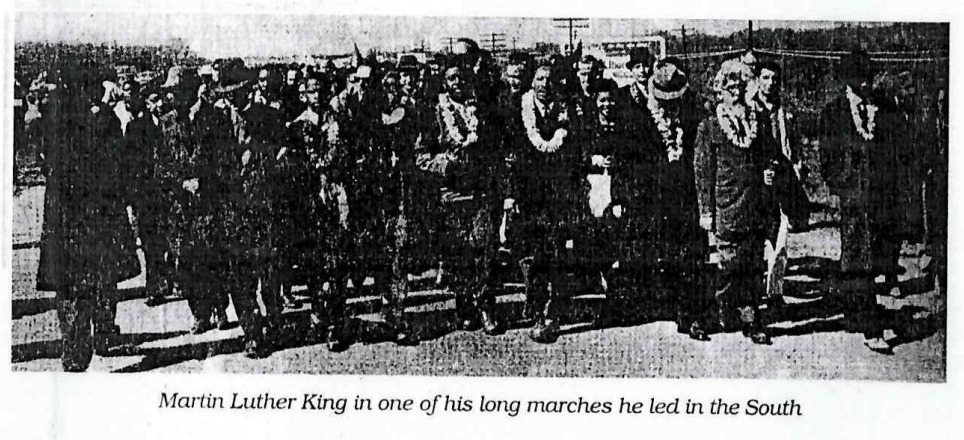
- The People’s Century and Struggles for Rights
- The 20th century is often called the People’s Century due to vast improvements in political, social, and economic conditions.
- The fall of feudalism, empires, and rigid social hierarchies empowered people to shape their nations.
- However, not all communities achieved equality easily:
- Indigenous people in Latin America are still fighting for their basic rights.
- The Kurdish people in Iran, Iraq, Jordan, and Turkey continue to suffer government persecution and resort to violent resistance.
- India’s freedom struggle under Mahatma Gandhi became an inspiration for global movements, including the Black struggle against apartheid.
- Some of these movements remain unfinished and continue to influence and motivate oppressed people worldwide.
- The Civil Rights Movement in the USA
- Segregation and Discrimination
- The abolition of slavery (1863) did not grant equal rights to Black Americans.
- While the Federal Government did not officially differentiate between races, southern states enforced discriminatory laws, such as:
- Denial of voting rights in local elections.
- Segregation, a system forcing Blacks and Whites to live separately, similar to South African apartheid.
- Restricted access to schools, buses, restaurants, and job opportunities.
- Exclusion from trade unions, keeping Black workers economically disadvantaged.
- Despite these injustices, Black Americans served the U.S. in both World Wars with distinction (contrast).
- The Rise of the Civil Rights Movement
- Inspired by India’s independence struggle, Black Americans sought freedom from racial exploitation.
- Martin Luther King Jr., a Baptist minister, emerged as the leader of a non-violent movement.
- The movement was launched in December 1956 when:
- Rosa Parks, a Black woman, was arrested for refusing to give up her bus seat to a White passenger in Montgomery, Alabama.
- Inspired by Gandhi’s methods, King organized a bus boycott, which succeeded in ending segregated seating in Montgomery.
- Expansion of the Movement
- In 1957, King expanded the movement beyond Montgomery:
- Founded the Southern Christian Leadership Council to spread the movement across the southern U.S..
- Used sit-in demonstrations and civil disobedience to challenge segregation.
- Leveraged media to amplify Black grievances, gaining domestic and international support.
- Thousands of White Americans joined, weakening the segregationist movement.
- Violent resistance from White supremacist groups, such as the Ku Klux Klan, resulted in attacks on activists.
- In 1963, King led a historic march of 250,000 people to Washington, D.C., where he delivered his famous “I Have a Dream” speech.
- In 1967, he was awarded the Nobel Peace Prize, but was assassinated in 1968, much like Gandhi.
- Rise of Militant Resistance
- Not all Black activists agreed with King’s non-violent approach:
- Groups like the Black Panthers and Black Power emerged in response to continued White aggression.
- Ku Klux Klan violence and government inaction fueled frustration among Black youth.
- Violent race riots erupted:
- 1964 in Harlem, New York
- 1965 in Los Angeles, where over 35 people were killed
- Some Black Americans rejected Christianity, viewing it as a White man’s religion, and converted to Islam.
- Cassius Clay, the 1960 Olympic Gold Medal-winning boxer, famously converted to Islam and became Muhammad Ali.
- Government Reforms and Legacy
- The Civil Rights Movement found support within the Democratic Party (1961–1968).
- Presidents John F. Kennedy and Lyndon B. Johnson recognized historical injustices and introduced time-bound reforms to integrate Black Americans into mainstream society.
- The movement left an enduring impact, setting a global precedent for non-violent resistance and human rights movements.
- Social Reform Movements in 20th Century India
- Introduction
- India has a history of continuous social reform.
- 19th-century reformers: Raja Rammohun Roy, Ishwarchandra Vidyasagar, Swami Dayananda Saraswati, Swami Vivekananda.
- Their contributions: women’s rights, education, spiritual awakening, scientific temper.
- However, caste-based discrimination remained a major issue.
- The 20th century saw movements aimed at uplifting the downtrodden castes.
-
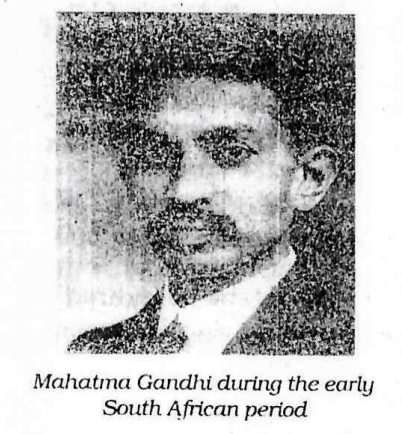
- Shree Narayana Guru (1854–1928)
- Transformed the Ezhava community in Kerala.
- Before his movement, Ezhavas were denied entry into temples and upper-caste homes.
- Established temples with Ezhava Shivalingams and an Ezhava priesthood.
- Promoted education: “Educate to be free, organize to be strong, thrive through industry.”
- Simplified marriage rituals (limited to 10 guests).
- Preached “One caste, one religion, one God for man.”
- Opposed conversion of backward castes to Christianity and Islam.
- His teachings continue through Shree Narayana Dharma Paripalana Yogam (SNDP).
- Dr. Bhim Rao Ambedkar (1891–1956)
-
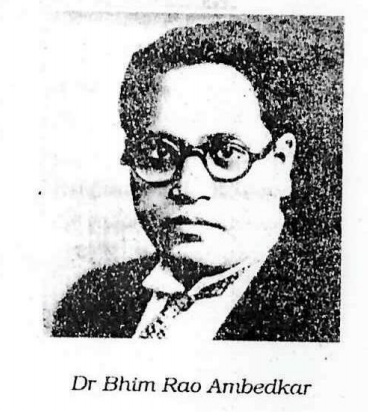
- Led a movement against untouchability.
- Founded Bahishkrit Hitakarini Sabha (1924) to fight for the rights of Dalits.
- Focused on education, women’s rights, and economic upliftment.
- Won a case in Bombay High Court, leading to the ban on untouchability.
- Established the Scheduled Castes Federation for political empowerment.
- Played a key role as Chairman of the Drafting Committee of the Indian Constitution.
- Ensured constitutional safeguards for the backward castes.
- Conclusion
- These movements reshaped Indian society.
- Focused on education, self-awareness, and legal rights.
- Their legacies continue to inspire social justice movements today.
- Science and technology, literature, art and culture in the contemporary world
- Science, Technology, and Human Development
- Importance of Discoveries and Inventions
- Discoveries and inventions have shaped human progress since ancient times.
- The 19th and 20th centuries witnessed rapid advancements.
- Inventions like electricity, antibiotics, telephone, satellites, atomic energy revolutionized life.
- These innovations benefited all of humanity, not just specific nations.
- Some regions lagged due to economic and political limitations.
- Even today, some areas lack basic infrastructure and communication systems.
- Scientific and technological progress reflects a nation’s advancement.
- Technology and economic growth are interconnected.
- Role of Technology in Daily Life
- Technology applies scientific principles to everyday activities.
- Technological progress is driven by scientific discoveries.
- In earlier times, scientific advancements were localized.
- In the last 200 years, discoveries spread worldwide much faster.
- Energy Sources and Technological Growth
- Scientific progress depends on available energy sources.
- Early energy sources: firewood, wind, water.
- Coal became dominant, powering engines.
- Later, petroleum and natural gas improved engine efficiency.
- Electricity and magnetism led to new technologies.
- Electronics and atomic energy reshaped the 20th century.
- Science and Technology: A Two-Way Relationship
- Technology advances due to scientific discoveries.
- Scientific knowledge also grows through technological innovations.
- Examples:
- Steam engine by James Watt.
-
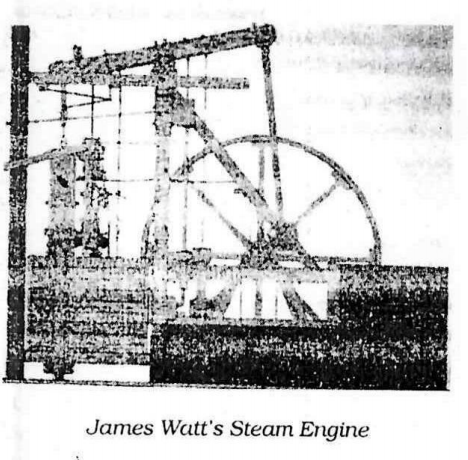
- Telescope by Galileo.
- Science and Technology in the 19th Century
- The 19th century strengthened the link between science and technology.
- Scientific principles were applied to technological inventions.
- Examples:
- Davy’s Miners Safety Lamp used heat conduction, smoke escapement, and light transmission.
- Electric generator and bulb applied principles of electricity, mechanical engineering, and heat conduction.
- Conclusion
- Science and technology drive global progress.
- Their interdependence continues to shape modern advancements.
- Technology and the Scientific Revolution
- The First Scientific Revolution (19th Century)
- Science and technology led to the first scientific revolution in the 19th century.
- New materials, energy sources, and technologies transformed industries.
- Mass production became possible, leading to industrial growth.
- Key industries:
- Steel production
- Railways
- Textiles
- Automobiles
- Electrical equipment and gadgets
- Industrial expansion occurred primarily in Europe and America.
- The Second Scientific Revolution (20th Century Onwards)
1900-1910
- Plastic synthesized (Bakelite by Bakeland, 1906).
- Chemotherapy introduced (Ehrlich, 1907).
- Mass production of motor cars (Ford Model T, 1908).
1910-1920
- Vacuum tube for radio communication (Fleming, 1904, 1912).
- Mass production of track vehicles.
- Construction of the Panama Canal (50 miles long, 1914).
1920-1930
- Radio broadcasting network established (1922).
- Empire State Building constructed (New York, 102 stories, 1930).
- First liquid-fuel rocket developed (Goddard, 1926).
1930-1940
- Television invented (Baird, 1936).
- Hydroelectric power generation (Boulder Dam, 1 million kW, 1936).
- Gas turbine engine developed (Whittle and Chain, 1937).
1940-1950
- Antibiotic drugs introduced (Penicillin, Fleming & Florey, 1942).
- First atomic chain reaction (Fermi and others, 1942).
- First atomic bomb developed (USA, 1945).
- First electronic computer built (1946).
- Supersonic aircraft introduced (1947).
- Transistors invented (1948).
1950-Present
- Atomic power plants for peaceful use (1952).
- Space exploration begins (Sputnik, USSR, 1957).
- Satellite communication develops (1970s).
- Biotechnology emerges (1975).
- Personal computers introduced (1980s).
- Computer-based communication systems revolutionize technology.
- Key Scientific Advances in the 20th Century
- Discovery of the electron.
- Understanding atomic structure.
- Development of vacuum tubes.
- Electromagnetic waves and their use in communication.
- Harnessing atomic energy for electricity generation.
- Advancements in rocketry and communication satellites.
- These developments marked the second scientific revolution, transforming the world with unprecedented technological progress.
- New Sources of Energy
- Non-Renewable Energy Sources
- Commercial and domestic energy mainly comes from coal, oil, and natural gas.
- These fuels take millions of years to regenerate, making them non-renewable.
- Their reserves are depleting, raising global concerns.
- There is a growing effort to find renewable and clean energy sources.
- Solar Energy
-
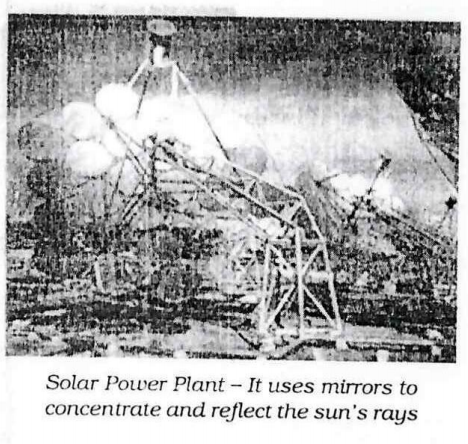
- The sun radiates energy at 10²⁸ watts, but only a small fraction reaches Earth.
- Solar energy can be harnessed in two ways:
- As heat (Solar cookers, water heaters, solar furnaces).
- Converted into electricity (Solar cells).
- Solar Cells:
- Discovered about 100 years ago with selenium, but it was inefficient.
- First practical solar cell (1954) had 1% efficiency.
- Modern solar cells (using silicon) now reach 25% efficiency.
- They provide clean, self-generating electricity.
- Used in artificial satellites and remote areas.
- India is a pioneer (one who is first to do something) in solar energy adoption.
- Wind Energy
-
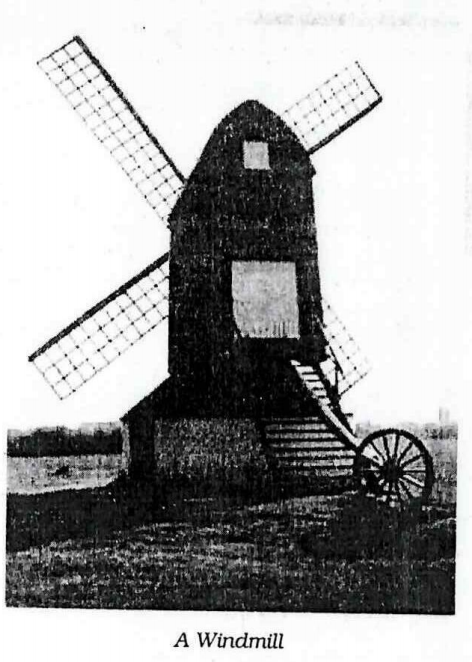
- Used for thousands of years, but efficient technology is still developing.
- Faces technological constraints in modern applications.
- Hydrogen Energy
- Hydrogen is a potential future energy source, but it is highly explosive.
- Scientists are developing safe technologies for its use.
- Jules Verne (1874) predicted that hydrogen would be a major energy source.
- Alcohol as Fuel
- Alcohol reacts with oxygen to produce heat.
- Some countries use alcohol-petrol mixtures as automobile fuel.
- Research continues to improve alcohol-based energy technology.
- Atomic Energy
-
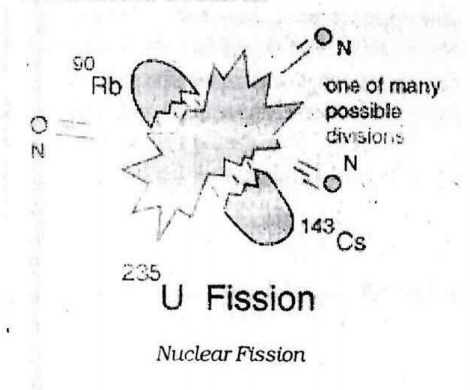
- Nuclear fission and fusion revealed the immense energy potential of atoms.
- Nuclear reactors generate electricity using fission reactions.
- Countries like France, Germany, Japan, Sweden, and others generate over 30% of their power from nuclear energy.
- In India, nuclear power contributes only 3% to total electricity generation.
- Transport and Communication
- Development of Transport
- Science and technology led to efficient transport.
- New energy sources and engines revolutionized (changed radically) travel.
- Types of Transport
(i) Land Transport
- Road: Developed with roads and wheeled vehicles.
- Rail: Steam engines started the railway era.
(ii) Water Transport
- Crucial for economic growth.
- India has 5,760 miles of navigable waterways.
(iii) Air Transport
- Fastest-growing mode of transport.
- Reduced travel time, connecting the world.
- Pipelines
- Transport liquids and gases over long distances.
- Used for crude oil, gas, water, and petroleum products.
- Essential for urban water and gas supply.
- Development of Communication
- Printing technology improved in the 15th century.
- Major breakthrough with Faraday’s electromagnetic induction.
- Key Inventions
- Telegraph (Morse): Enabled long-distance communication.
- Telephone (Bell, 1876): Allowed speech communication.
-
- Wireless Communication (Marconi, 1901): Used electromagnetic waves.
- Radio & TV (1920s-30s): Transformed mass communication.
- Satellite Communication (1962): Relayed press, radio, and TV globally.
- Technology as a Means of Destruction
- Advancement and Misuse
- Science and technology have improved human life.
- However, greed and power struggles have led to destructive applications.
- The 20th century saw rapid development in weapons of mass destruction.
- Weapons of Mass Destruction
(i) Military Research and Missiles
- Many scientists are engaged in military R&D.
- Technological advancements have enhanced weapons like:
- Tanks, combat aircraft, missiles, and warships.
- Cruise missiles: Surface-to-surface, surface-to-air, and air-to-surface.
- Ballistic missiles:
- Intermediate Range Ballistic Missiles (IRBM).
- Inter-Continental Ballistic Missiles (ICBM).
- IT developments have enabled guided missile systems.
- Changing warheads from conventional to nuclear increases destruction potential.
(ii) Nuclear Weapons
- Development of nuclear weapons followed discoveries in radioactivity.
- World War II ended with the dropping of atomic bombs:
- Hiroshima (6 August 1945).
- Nagasaki (9 August 1945).
- Today, nuclear warheads can:
- Carry 200 kilotons (compared to 12 kilotons in Hiroshima/Nagasaki bombs).
- Cover distances of 1600 km.
- Chemical and Biological Weapons
(i) Chemical Weapons
- Used in World War I:
- Chlorine, phosgene, mustard gas.
- Used in later conflicts:
- Italy (Ethiopia, 1935-36).
- Japan (China, 1937-45).
- Hitler’s concentration camps (World War II).
(ii) Biological Weapons
- Long history of use in warfare.
- Geneva Protocol (1925): Banned gases and bacteria in war.
- Biological Weapons Convention (1975): Prohibited development and stockpiling.
- Despite bans, covert research continues.
(iii) Advanced Biological and Chemical Threats
- Binary nerve agents are the most advanced chemical weapons.
- Biological warfare agents include:
- Viruses (Yellow fever).
- Bacteria (Typhoid, plague).
- Fungi (Coccidioidomycosis).
- Even less advanced nations can produce chemical/biological weapons.
- Role of Genetic Engineering
- Provides new materials for military applications.
- Can lead to dangerous developments.
- Needs strong international treaties to prevent misuse.
- Development in Biological Science
- Early Discoveries and Beginnings
- Man’s quest to understand life and fight diseases led to advancements in biological sciences.
- 1897: E. Bucher, a German chemist, discovered that a cell-free yeast extract can convert sugar into alcohol, marking the start of biochemistry.
- Before this, it was believed that life processes only occurred within living cells.
- Virus discovery: Researchers identified viruses as the cause of diseases in plants and animals (e.g., yellow fever, polio, mumps, smallpox, influenza, common cold).
- The search for medicines to cure these diseases took many decades.
- Growth in Microbiology and Biochemistry (20th Century)
(i) Key Discoveries
- Vitamins were discovered.
- The term “gene” was coined to describe the carrier of heredity.
- Insulin was isolated.
- Penicillin was discovered, offering strong anti-bacterial properties.
- Development of sulpha drugs.
- Antibiotics were further developed, reducing mortality from infectious diseases.
- Intensive work in genetics and heredity also took place during this period.
(ii) Breakthroughs in Microbiology
- Electron microscopy and X-ray crystallography helped in understanding fundamental building blocks of living organisms.
- Proteins, DNA, and RNA were identified as the essence of living beings.
- These discoveries gave birth to molecular biology (a blend of biochemistry and physics).
- DNA was found to be essential for detecting hereditary characteristics, carrying the genetic code.
- In the early 1950s, Crick and Watson discovered the double-helix structure of DNA.
- Advances in Genetics and Genetic Engineering
-
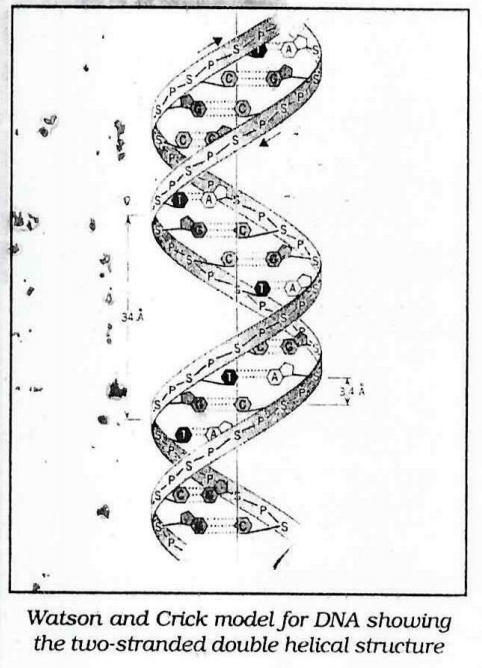
(i) Synthesis and Engineering
- 1970: Har Gobind Khurana and his team synthesized a gene for the first time by assembling it from its component chemicals.
-
- Cohen and Boyer: In the following years, they established genetic engineering by demonstrating that DNA molecules could be:
- Cut with restriction enzymes,
- Joined with other enzymes,
- Reproduced by inserting them into Escherichia Coli chromosomes.
(ii) Identification of Diseases
- 1980s: Identification of AIDS and isolation of the AIDS virus.
- 1990s: Identification of genes related to colon cancer.
(iii) Impact of Genetic Engineering
- 1980s-1990s: Genetic engineering led to the development of several new proteins, including:
- Human insulin.
- Interleukin 2.
- Blood clot dissolver.
- Hepatitis B vaccine.
- Significance of Genetic Engineering
- Genetic engineering is regarded as one of the most important discoveries of the 20th century.
- It offers powerful tools for managing health and life.
- Information Technology
- Overview of Information Technology
- Information Technology (IT) is the science of collecting, storing, processing, and transmitting information.
- It is the convergence of computer technology and telecommunications.
- IT has revolutionized the way information is handled and disseminated (spread).
- Developments in Computer and Telecommunications Technology
(i) Advancements in Computer Technology
- Mini and microcomputers have been developed for information handling.
- These computers are efficient, reliable, and capable of processing information at high speeds.
(ii) Advancements in Telecommunications
- Developments have led to devices like telex, fax, artificial satellites, and optical fibers for near-instantaneous information transmission.
- The first electronic digital computer was built in the USA in 1946; it weighed 30 tons and filled two car garages.
- Modern microelectronics and semiconductors now contain the same computing power in a pea-sized silicon chip.
(iii) Convergence of Technologies
- Telecommunication networks now use digital signals (like in computing), facilitating the convergence of electronics, computing, and telecommunications.
- This convergence is revolutionizing Information Technology and has brought dramatic changes in how we live, work, and even think.
- IT in Everyday Life
(i) Household Applications
- Microchips are used in home appliances like washing machines, food processors, and VCRs.
- Personal computers are increasingly used in homes for various purposes.
(ii) Educational Use
- Computers are used for educational purposes in schools.
- Students are also learning hardware and software technologies to build professional careers.
- Applications of Information Technology
- IT is replacing paperwork and improving productivity and customer service.
- It is extensively used in industries like transport, banking, architecture, publishing, and healthcare.
- It aids scientists in weather forecasting and many other fields.
- Global Impact
- The applications of IT are vast and have impacted human societies globally in numerous ways.
- Culture in the Contemporary World
- Advancements in Art and Culture
- The pace of progress in art and culture has accelerated over the last two centuries.
- Earlier, intellectual expression was limited to the courts and religious institutions, relying on their patronage.
- The majority practiced simpler, unsophisticated forms of expression, known as folk art, especially in India.
- Technological advancements in print and electronic media have made mass reproduction of artistic creations possible, making literature (poetry, drama, novels) and various arts accessible to the public.
- The rise of satellite television and the Internet has added new dimensions to culture, making it a multi-dimensional concept that reflects broader societal changes.
- Defining Culture
- According to Robert Redfield, culture is “an organised body of conventional understanding manifest in art and artefacts, which persists through tradition and characterizes a human group.”
- Culture involves acquired behaviors that are shared and transmitted among members of society.
- Mathew Arnold defines culture as “the acquainting of ourselves with the best that has been known and said in the world.”
- In the era of globalisation, culture is no longer confined to local features or elite groups but encompasses broader, interconnected global trends.
- Dual Cultural Tradition
- People today experience dual cultural traditions:
- One tradition focuses on local features, often not sanctioned by scriptures and widely accepted by the community.
- The other, embodied in literature and refinement of thought, is typically followed by an elite group.
- Examples include Stalin’s illness, where the Russian Church was asked to pray for him, and Mao Zedong presiding over Buddhist celebrations during the Cultural Revolution.
- Culture’s role is crucial in the evolution of societies.
- Globalisation and Cultural Uniformity
- Globalisation has impacted all cultures, promoting a form of cultural uniformity worldwide.
- Some view globalisation as a subtle form of neo-colonialism, where the economic flow to developed countries continues even after their political independence, replacing political or military control with economic domination.
- While this aspect of globalisation persists, newly independent states have responded with self-assertion, promoting democratic processes and global cooperation.
- New Trends in the Post-1945 World
- The contemporary period, especially since 1945, has seen five major trends:
- An increase in the number of independent states.
- The acquisition and development of nuclear weapons by various nations.
- Increased exposure of states to external and internal subversions.
- The influence exerted by superpowers.
- A rise in the influence of non-state actors.
- The ‘South’ countries face challenges such as aggressive nationalism, population growth, economic backwardness, and political instability.
- The ‘North-South’ divide has widened, with the North growing more developed and the South becoming increasingly dependent on foreign aid.
- The New International Economic Order (NIEO)
- The UN Declaration on NIEO (May 1974) marked a significant milestone, calling for a global partnership based on equity and mutual benefit.
- The Brandt Commission Report (1980) emphasized that a New Order of international relations benefits all nations.
- Mass media and public opinion now play a critical role in accountability in international diplomacy.
- The Global Village and the Impact of Globalisation
- With advancements in mass media and computing, the concept of a global village is no longer distant.
- Globalisation is pervasive (penetrating / prevalent), as seen in the global popularity of films, sports events, and human-interest stories.
- Figures like Nelson Mandela and Mother Teresa are revered globally, embodying a universal humanism that transcends specific cultural or philosophical boundaries.
- This new cultural ethos blends Eastern universalism with Western individualism to form a global humanistic perspective.
- Contemporary World Literature
- European Literature
- Social Background
- The 50 years before WWI saw remarkable economic growth and scientific discoveries.
- This created material wealth and shifted society from an aristocratic, semi-feudal, humanistic, agrarian order to a middle-class, democratic, mechanistic, and urban one.
- By 1900, there were 11 metropolises with populations over a million. London, Berlin, and Paris were at the center of a global economic network.
- This led to the rise of modern, individualistic thinking, with modernism emerging as an urban art. The city became the cultural hub.
- Global Impact and Reaction
- Due to imperialism and colonialism, these changes affected distant regions of the world.
- World literature began to react to industrialization and material advancement, with Western powers suffering in WWI, WWII, and the Great Depression.
- Russia and China underwent revolutions, while nationalism and independence movements rose in Asia, Africa, and America.
- Marxism, socialism, and the discovery of a Godless world emerged as significant consequences.
- The world grappled with the paradox of material affluence and emotional sterility, as the West’s industrial awakening ironically led to the decline of its colonial aspirations.
- The Writer’s Response
- The writer, particularly in the West, faced confusion, spiritual bankruptcy, and the disintegration of traditional values.
- This search for meaning led to new forms of expression in response to a society in flux.
- Poetry
- Modern poetry began with Baudelaire’s “unreal city,” where crowds symbolized loneliness.
- German expressionist poets like Rilke and George saw the city as a place of madness and disinheritance.
- Rimbaud’s language and imagery made him the first true modern poet.
- Poets like Yeats, Eliot, Mallarmé, Montale, and Lorca struggled with the tension between tradition and innovation.
- Free verse, with uneven lines and no rhyme, emerged as a popular form, starting with Whitman and Ezra Pound and mastered by T.S. Eliot in “The Waste Land.”
- Eliot’s “The Four Quartets” exemplified the poem-as-play form.
- Novel
- The 19th century established the novel as a literary medium of great variety and depth.
- Henry James first used the novel as an “art form” in works like “The Americans,” where form and content were inseparable.
- Modern novelists, like Joseph Conrad and James Joyce, expanded this fusion of form and content.
- Sigmund Freud’s “The Interpretation of Dreams” influenced many, with Joyce using the stream of consciousness method in “Ulysses.”
-
- Virginia Woolf followed Joyce’s lead, while Proust’s “Remembrance of Things Past” explored consciousness and the past.
- Many modern novels portrayed the artist as a character, as seen in the works of Thomas Mann and André Gide.
- Novels by Malraux, Sartre, Camus, and Kafka presented symbolic representations of life.
- Even traditional novelists like D.H. Lawrence and E.M. Forster employed symbolism in works like “The Rainbow” and “A Passage to India.”
-
- Drama
- Modern drama, shaped by technical and linguistic diversity, was best represented by Henrik Ibsen.
- Ibsen’s “The Doll’s House” projected contemporary themes using symbols, alongside Strindberg’s expressionistic dream-plays and Chekhov’s surface dialogue pointing to hidden realities.
- Maeterlinck, the Belgian playwright, became the first modernist by using silence extensively through pauses, gestures, and external sound patterns.
- Chekhov followed suit with indirect dialogue in “The Cherry Orchard.”
- Wedekind, the German playwright, discovered that real-life communication often lacked dialogue altogether.
- The 20th century saw a break with traditional language in drama, pushing the boundaries of expression.
- Modern Forms of Drama
- Surrealism: Apollinaire introduced surrealism, while Antonin Artaud’s Theatre of Cruelty aimed to affect the audience deeply.
- Dadaism: Dadaists emphasized nonsensical and shocking representations.
- Bertolt Brecht: Brecht introduced the “alienation effect” in plays like Mother Courage, treating the stage as a stage rather than reality.
- Absurd Drama: Playwrights like Beckett, Ionesco, Adamov, and Genet formed the Absurd Drama school. Their plays lacked real-life characters, presenting symbolic representations of emotions like lovelessness, loneliness, and hopelessness.
- Language was often nonsensical, with monologues, pauses, gestures, and exclamations replacing dialogue.
- Plays like Beckett’s Endgame were nihilistic, leaving no comforting resolution for the audience.
- While Camus and Sartre portrayed rootless existence with logical dialogues, Beckett took a more imagistic, symbolic approach.
- Conclusion
- The 20th century literature marked a significant shift, with experimentation across genres.
- Some works departed entirely from tradition, while others blended traditional techniques with new forms.
- The variety and experimentation ensured a prominent place in literary history.
- English Literature
- Turn of the 19th Century
- The late 19th century marked a period of complex change for Britain.
- Rudyard Kipling’s short stories often critiqued the country’s failure to live up to its imperial ideals, rather than the imperial idea itself.
-
- Thomas Hardy explored the realities of empire-building and war, particularly their effects on ordinary people.
- During this time, a tradition of verse emerged that focused on everyday life and used everyday language, finding its quintessential expression in the works of various poets.
- Continental Influence (By 1900)
- By 1900, the influence of mainland Europe was pervasive in British literature.
- This influence can be seen in works such as:
- Ford Madox Ford’s The Good Soldier (1915)
- Somerset Maugham’s Of Human Bondage (1915)
- John Galsworthy’s Villa Rubein (1900)
- Continental Influence on Novelists
- The aesthetic movement of the 1890s influenced James Joyce, especially in A Portrait of an Artist as a Young Man, which also showed a connection with French Naturalism.
- Henrik Ibsen’s realism was another major continental influence, shaping many British novelists and playwrights.
- Early 20th Century Political Liberalism
- The early 20th century saw a resurgence of political liberalism, reflected in the country’s intellectual life.
- Liberalism was associated with human emancipation and the pursuit of higher, finer values of life.
- This intellectual movement appeared in works such as:
- E. M. Forster’s Where Angels Fear to Tread (1905)
- Virginia Woolf’s Mrs Dalloway (1925) and To The Lighthouse (1927)
- Aldous Huxley’s Crome Yellow (1921) marked a new stage of liberal intellectual anxieties in response to the modern world.
Industrialism and Rediscovery of Human Values
- The shift from rural life to industrialism led to a focus on rediscovering human values:
- D.H. Lawrence, in works such as Sons and Lovers (1913) and The Rainbow (1915), explored this theme.
-

- W.B. Yeats also reconsidered local and traditional culture in response to the perceived threat of modernity.
- Poetry in the 1930s
- The poets of the 1930s, influenced by Ezra Pound and T.S. Eliot, focused on satire and terse colloquialism, moving away from the symbolist side of their work.
- The political poets of the 1930s, such as William Empson, George Barker, and Dylan Thomas, were known for their lucid, visionary, and apocalyptic themes.
- Development of English Drama
- Early 20th-century English drama reflected a complex interaction of indigenous forces and continental influence.
- Henrik Ibsen’s social dramas strongly influenced:
- George Bernard Shaw’s early plays, like Man and Superman (1905) and Major Barbara (1905)
- John Galsworthy’s plays, such as Silver Box (1906), Strife (1909), and Justice (1910)
- The most significant development in drama during this period was poetic drama, with a notable contribution from Ireland.
- Post-World War II ‘New Poetry’
- After World War II, a new form of poetry emerged, characterized by common sense, a disciplined tone, craftsmanship, and sharp intelligence.
- W.H. Auden’s poetry, such as About the House (1965) and City without Walls (1969), showcased interest in historical learning and linguistic virtuosity.
- American Literature
- Influences from 1900 to 1941
- Three major developments shaped American literature during this period:
- Social Realism: Writers began addressing the pressing social issues brought about by the Industrial Revolution.
- World War I and the Economic Depression: These events led many authors to become critical of the American way of life.
- Psychoanalysis: Sigmund Freud’s theories opened new areas of the personality for writers to explore.
- Notable Authors and Works
- Ernest Hemingway: A major figure in 20th-century literature, Hemingway won admiration with works such as:
- The Sun Also Rises (1926)
- A Farewell to Arms (1929)
- For Whom the Bell Tolls (1940)
- The Old Man and the Sea (1952)
- William Faulkner: Known for his stories set in the fictional Mississippi county of Yoknapatawpha, Faulkner utilized a stream of consciousness technique in novels like:
-
- The Sound and the Fury (1929)
- His style and intricate narratives create a compelling, magical atmosphere that captivates readers.
- Pearl S. Buck and William Saroyan: Both authors were associated with regionalism, capturing vivid regional details in their works.
- Pearl S. Buck became famous for The Good Earth (1931), which dealt with life in China.
- William Saroyan wrote about the Armenian-American community, with works like:
- The Time of Your Life (1939)
- The Human Comedy (1943)
- American Poetry
- After the death of Walt Whitman in 1892, American poetry declined sharply for about 20 years. However, A Magazine of Verse (published in Chicago by Harriet Monroe in 1912) revived interest in poetry and became a significant outlet for some of the greatest poets of the early 20th century.
- Edwin Arlington Robinson and Robert Frost gained recognition through the resurgence in poetry. Frost, in particular, delved deeply into human psychology with works such as:
- Mending Wall (1914)
- Stopping by Woods on a Snowy Evening (1923)
- Ezra Pound and Amy Lowell were radical poets who led The Imagists, focusing on clear, sharp imagery, everyday speech, and new rhythms. Notable works include:
- Amy Lowell’s Patterns (1916) and Lilacs (1925)
- Drama
- Eugene O’Neill revolutionized American theatre with his exploration of realistic themes and daring stage techniques. His works include:
- Beyond the Horizon (1920), a brutally realistic play.
- Later works such as The Hairy Ape (1922) and Mourning Becomes Electra (1931) blend symbolism and psychological drama.
- Jewish-American Literature
- The conflict between traditional Jewish life and modern American society was explored, particularly by Saul Bellow, who examined this theme in works such as:
- Herzog (1964)
- Humboldt’s Gift (1975)
- Black Literature
- Harlem Renaissance (1920s): This era saw a flourishing of Black literature, with writers exploring Black American culture for the first time in depth.
- Post-World War II Era: In the 1950s, Black writers gained prominence. Key works include:
- Ralph Ellison’s Invisible Man (1952), considered a major post-war novel about Black life in America.
- James Baldwin’s Go Tell it on the Mountain (1953).
- Alex Haley’s Roots (1976), which traced 200 years of his family history from Africa to the United States, sparking popular interest in genealogy across many ethnic groups.
- Latin American Literature
- Colonial Influence:
- During the late 1400s, settlers from southern Europe, particularly Spain and Portugal, began arriving in Latin America.
- They brought their languages, religious beliefs, and customs, which had a substantial impact on the region over time.
- Modernism and Poetry:
- Ruben Dario (1867-1916), a Nicaraguan poet, is credited with giving modernism its form.
- Latin American poets searched for the unusual, turning to exotic sources like Greek, Oriental, and Nordic mythology.
- In the early 1900s, a group of women poets rose to prominence, with Gabriela Mistral from Chile winning the Nobel Prize for Literature in 1945.
- Themes in Literature:
- In the mid-1900s, Eduardo Mallea of Argentina expressed themes of isolation and lack of human communication in novels such as Bay of Silence (1940) and All Green Shall Perish (1941).
- Early Latin American writers often explored exotic themes, such as the ancient past, distant lands, and childhood fantasies, with a focus on beauty and “art for art’s sake.”
- Magical Realism:
- In the 1950s, Latin American writers began experimenting with language and structure, incorporating fantasy and fragmented time and space into their works.
- This style, known as Magical Realism, blended dreams and magic with everyday reality.
- Gabriel García Márquez’s One Hundred Years of Solitude is a famous example of magical realism.
- Russian Literature
- Early 20th Century:
- Soviet literature in the early 20th century was influenced by the attempts of writers and politicians to align with new ideological movements.
- Early writers, raised in 19th-century literary traditions, clashed with those promoting new social and political ideas.
- Tolstoy and Social Criticism:
- Leo Tolstoy (1828-1910) critiqued modern society in works like Resurrection and hinted at the emergence of a new system and human order.
- The Rise of Social Realism:
- In the 1930s, the Union of Soviet Writers was established, endorsing the theory of social realism, which became prominent in historical literature.
- One of the finest works on the Revolution and civil war during this time was Mikhail Sholokhov’s Quiet Flows the Don (1928-1940).
- Famous Writers:
- Anna Akhmatova and Boris Pasternak were influential writers of this era.
- Pasternak’s Doctor Zhivago was first published in the Soviet Union in 1986.
- Literary Movements and Political Expression:
- With the installation of the Communist Party, literature began to support communist ideologies.
- In the 1960s, a group of liberal writers emerged, advocating for freedom and creativity in Soviet life, though this led to increased anxiety about freedom of expression.
- Soviet leader Mikhail Gorbachev’s glasnost policy in the late 1980s allowed for freer expression of ideas.
- African Literature
- Post-World War II and Nationalism:
- After World War II, African literature gained prominence with the rise of nationalist movements across the continent.
- Kwame Nkrumah, the foremost leader of the nationalist movement in Ghana, called for ‘Freedom Now.’
- Nationalism and anti-colonialism became the primary themes in African literature, with writers composing works in European languages such as English, French, and Portuguese.
- Notable Writers:
- Léopold Sédar Senghor and Sembène Ousmane brought Africa to the international literary stage.
- Ousmane’s novels Xala and Le Mandat gained global recognition, introducing dynamic realism into African novels.
- Apartheid and its Impact:
- The policy of apartheid in South Africa hindered writers, but they used literature as a means of resistance.
- Denis Brutus reflected the harsh conditions of apartheid in his poems, which described imprisonment and exile.
- Alex La Guma also gained fame for his poignant stories published in Black Orpheus.
- Nigeria’s Literary Contribution:
- Nigeria emerged as a leading force in African literature, with writers like Wole Soyinka, Chinua Achebe, Gabriel Okara, and Christopher Okara making significant contributions.
- Gabriel Okara, poet and novelist, received the Commonwealth Poetry Award for his collection The Fisherman’s Invocation. He experimented with language by blending English with his local dialect.
- Chinua Achebe:
- Chinua Achebe played a pivotal role in popularizing African literature globally.
- His important works include Things Fall Apart, A Man of the People, Girls at War and Other Stories (1972), and the famous poetry collection Beware Soul and Brothers.
- Other African Writers:
- Ngũgĩ wa Thiong’o, a revolutionary writer from Kenya, made his mark with his novel Weep Not Child (1964).
- Meja Mwangi focused on the struggles of the poor and downtrodden in his works.
- Post-Independence Shift:
- After the independence of African nations, there was a thematic shift in African literature.
- The focus moved from colonial experiences and cultural conflicts to exploring human discontent and aspirations.
- Australian Literature
- Late 19th Century and Early 20th Century:
- The last 20 years of the 19th century saw a rise in nationalism and a move towards the federation of separate states.
- In the first 30 years of the 20th century, literary works focused on the plight of ordinary people and the need for social reform.
- Prominent writers like Katherine Susannah Prichard, Louis Stone, and Edward Dyson wrote about city life and the struggles of workers.
- The life of the Aboriginal people and their relationship with the white man was also portrayed by writers like Aeneas Gunn, Xavier Herbert, and Katherine Susannah Prichard.
- Poetry in the Early 20th Century:
- The success of poets was limited, but their works showed a diversity of aims and styles.
- Jotun Shaw Neilson wrote fine, delicate lyrics, while Victor Daley created romantic poems and sharp satires.
- Post-World War II Literature:
- After World War II, literary magazines proliferated, and the number of readers grew.
- From the 1950s onward, Australian writers became increasingly speculative and introspective.
- The most influential mid-20th-century novelist was Patrick White, whose major novels were distinctly Australian, but whose treatment of themes transcended nationalistic boundaries.
- Short stories continued to be popular, though they maintained a strong rural bias.
- Autobiographical Writing and Poetry:
- Of particular interest were the autobiographical writings of Hal Porter, who explored the changes in Australian society from the 1930s to the 1960s.
- A tradition of descriptive poetry remained, but mid-20th-century poets dominated the literary scene.
- Indian Literature
- 20th Century Preoccupations
- The two major concerns for Indian writers in the 20th century were national awakening and Western cultural achievements.
- Western civilization, though associated with colonialism, influenced Indian writers with its ideals of humanism, freedom, and individualism.
- Continuity of Tradition
- Literature reflected changing societal moods, while also showing a remarkable unity despite India’s racial, religious, and linguistic diversity.
- Regional traditions had local peculiarities, but remained integral to the national literary culture.
- Language Influences
- Persian had a significant influence on Indian literature in the past.
- English continues to be an influential language in Indian literature, even after the colonial era.
- Major Writers
- Writers like Sri Aurobindo, Rabindranath Tagore, Premchand, Subramania Bharati, and others presented a life view rooted in Indian ethos, with some showing secular humanism influenced by the West.
- Tagore, the first Asian Nobel laureate, was a major figure, contributing extensively to literature with his works like Gitanjali and Gora.
- Notable Poets
- Three influential poets of the early 20th century: Manmohan Ghose, Aurobindo Ghose, and Sarojini Naidu.
-
- Their works focused on social, religious, and political themes, making a significant societal impact.
- Rabindranath Tagore
-

- Tagore, the first Asian Nobel laureate (1913), broke new ground in literature, especially in meter, diction, and thought.
- His works, written in Bengali, reflect both national awakening and international humanism.
- Notable works include Galpa Guchchha (short stories), Gora, and Ghare Baire (novels).
- Subramania Bharati
- A great Tamil patriot poet, Bharati revolutionized the poetic tradition in Tamil.
- His poetry was deeply influenced by his political activism.
- Indian Fiction
- The late 19th and early 20th century saw the rise of the Indian novel, influenced by Indo-European contact.
- Notable early novelists included Bankim Chandra Chatterjee, Mirza Qalich Beg, and Hari Narayan Apte.
- Novels in several regional languages emerged during this period, such as Malayalam, Oriya, Sindhi, and Kannada.
- Notable Novelists
- Bankim Chandra Chatterjee: Known for his historical novels Anand Math and Debi Chaudhurani, which included nationalistic themes.
- Icharam Suryaram Desai: Wrote Hind ane Britania, one of the earliest Indian novels with political overtones.
- Vaikom Muhammad Basheer: Known for Balyakala Sakhi, a tragic tale of love.
- Premchand: A significant Hindi-Urdu novelist whose works like Godan and Sevasadan reflected social issues.
-
- Modern Novels and Rural Life
- Phanishwarnath Renu’s Maila Anchal (Hindi) and Bibhuti Bhushan Bandhyopadhyay’s Pather Panchali (Bengali) are key novels about rural life.
- Sarat Chandra Chatterjee focused on middle-class conflicts in his works.
- Yashpal’s Jhootha Such and Khushwant Singh’s Train to Pakistan explored the partition of India.
- Mahasweta Devi and Mulk Raj Anand depicted tribal life and social-political upheavals.
-
- Short Story Genre
- The 20th century saw the short story as a distinct genre, with major contributors like Rabindranath Tagore and Premchand.
- Tagore’s short stories, such as Post-Master and Kabuliwala, explored rural life and human emotions.
- Writers like Mulk Raj Anand, Saadat Hasan Manto, and Rajendra Singh Bedi brought realism to the short story form.
- Ismat Chughtai’s Terhi Lakir explored social codes through the story of a Muslim girl.
- Poetry
- Indian poetry has a powerful and ancient tradition. In the 20th century, it adapted to nationalism, the independence struggle, and the communication revolution.
- The two main phases of transition in Indian poetry were:
- Romanticism in the early 20th century.
- Nationalism, marked by patriotism.
- Romanticism was exemplified by Tagore, whose poems had mysticism and romantic subjectivity, representing the entire culture.
- Key poets included:
- Toru Dutt, Manmohan Ghose, Sri Aurobindo, Sarojini Naidu, Rabindranath Tagore, Swami Vivekananda
- Others: Mohammad Iqbal, Jai Shankar Prasad, Sumitra Nandan Pant, Mahadevi Verma, Ramdhari Singh Dinkar, Nirala, Subramania Bharati, and others.
-
- The Progressive Writers’ Movement in 1936 shifted towards realism, maintaining social protest themes.
- New poets included Nagarjun, Shiv Mangal Singh Suman, Majaaz, Faiz, and others.
- The modern movement became more personal and subjective, with poets like Kamala Das, Amrita Pritam, Raghubir Sahay, and Nissim Ezekiel.
-
- Theatre
- In the 19th century, Indian theatre evolved by blending Western drama with classical folk traditions.
- The national movement influenced theatre, focusing on historical and mythological themes and the middle class’s issues.
- Key dramatists: Sachindranath Sengupta, Manmatha Ray, Parvati Prasad Barua, Laxminarayan Mishra.
- The Indian People’s Theatre Association (IPTA) was formed in 1943 to promote New Drama and folk theatre.
- One-act plays gained popularity in the mid-20th century, with writers like Bivendra Krishna Bhadra, Shaukat Thanvi, and Saadat Hasan Manto.
- Modern experimentation in theatre, like in poetry, reached wider audiences. Key dramatists include Badal Sarkar, Vijay Tendulkar, Girish Karnad, Mohan Rakesh, and others.
- Literature in China
- The Chinese literary revolution began after the establishment of the republic in 1911, marking the end of a monarchical institution that had lasted for more than three millennia.
- Ai Qing (Revolutionary Poet):
- In 1936, Ai Qing, at the age of 26, revolutionized Chinese poetry.
- He continued writing until 1957 when he was exiled for twenty years.
- After political changes, he was rehabilitated and resumed writing poetry.
- Lu Hsun (Writer):
- Lu Hsun (1881-1936) was another significant figure who introduced a new trend in realistic fiction.
- His notable works include Madman’s Diary and The Story of Ai Q.
- His short satirical essays also played a crucial role in public awakening.
- National Struggle (1937-1945):
- During the period of Japanese aggression, all writers—whether leftist, rightist, or nonpartisan—participated in the national struggle.
- Literature was seen as an effective tool to boost the morale of the people and help win the war against Japan.
- Leftist writers played the dominant role in literary theory and production.
- Ideological Remoulding (1950s):
- In the 1950s, China underwent a series of ideological changes that deeply impacted the literary circles.
- Some authors were creating new works, while others focused on revising traditional masterpieces.
- The entire literary heritage of China was re-evaluated and reinterpreted to align with communist ideologies.
- Cultural Revolution (1966-69):
- During the Cultural Revolution, creative activities in literature came to a halt.
- Revitalization (Early 1970s):
- In the early 1970s, signs of renewed literary productivity emerged.
- Japanese Literature
- Western Influence on Japanese Literature:
- The influence of Western ideas has significantly transformed Japanese literature, with the most notable outcome being the development of the modern novel.
- Mori Ogai (1862-1922) and Natsume Soseki (1846-1916):
- Both writers are key figures in imparting artistic maturity to Japanese fiction.
- Soseki’s novels focused on the absurdities of life and the hollowness of middle-class society.
- Influence on Poetry and Drama (1900s):
- Western literature also influenced Japanese poetry and drama during this period.
- Some poets continued to write in traditional forms like Tanka and Haiku, with Masaoka Shiki (1867-1902) being a prominent Haiku writer.
- Longer poems and free verse became more prevalent in Japanese poetry.
- Literature in the Showa Period (1926):
- Literature became more associated with the working class.
- Despite the Western influences, the Japanese literary tradition remained robust.
- Revival of Romanticism:
- At the beginning of the 20th century, Romanticism saw a revival in Japanese poetry.
- Post-World War II Writers:
- Prominent writers in the post-World War II era include Kafu Nagai (1879-1959) and Yasunari Kawabata (1899-1972).
- Contemporary World Art
- Post-Renaissance Art (17th-18th Century Europe):
- Art during this period was dominated by Baroque and classical artists.
- The themes of their works primarily focused on Christianity and the depiction of nature.
- Impact of the French Revolution:
- The French Revolution led to significant changes in socio-cultural activities.
- France became the center of modern art, with Paris emerging as the focal point for most of its cultural activities, which dominated the world of art in the 19th and 20th centuries.
- Artistic Movements Before Modernism:
- The world saw various artistic expressions, including Classicism, Romanticism, Idealism, and Naturalism.
- Modernism emerged in the 1860s, primarily through the works of Édouard Manet.
- Advancement in Science and Technology:
- The rapid progress in science and technology added new dimensions to art during this period.
- Intellectual Churning in Europe (Late 19th Century):
- Intellectuals such as philosophers, scientists, poets, psychologists, politicians, and economists became engrossed in evolving new theories across various subjects.
- Henri Bergson, a French philosopher, reinforced Nietzsche’s theory by asserting that man was the master of his own destiny. This emphasized the superiority of intuition over intelligence, gaining support from scientists.
- Influence of Freudian Theory:
- Sigmund Freud’s theory of the subconscious influenced 19th-century artists.
- The new generation of intellectuals began to believe that reality could not be depicted accurately, leading to a focus on feelings and perceptions instead of apparent truth and nature.
- Modern Art in Europe
- Birth of Modern Art and Impressionism:
- A new artistic movement emerged in Europe, giving birth to Impressionism and its subsequent movements at the turn of the 19th century.
- The term ‘modern art’ typically refers to the period from the 1860s to the 1960s, which is considered the era of modernism.
- Characteristics of Modern Art:
- The period in modern art describes the dominant styles and ideologies of art produced in that era, with modernism as its guiding philosophy.
- Artists such as Monet, Degas, Picasso, Sisley, and Renoir led the new movement of post-impressionism, followed by Cézanne, Rodin, Kandinsky, and others.
- Subsequent Art Movements:
- Movements like Expressionism, Fauvism, Cubism, Futurism, Abstractionism, Dadaism, and Surrealism followed in search of forms and expressions that replaced the aesthetic sensibility of European Classicism.
- This period marked a rejection of previous theories and embraced experimentation not only with formal expression but also with materials and techniques of art.
- Post-Modernism and the Second Half of the 20th Century:
- Experimentation continued into the second half of the 20th century, leading to the post-modernism movement in art.
- Modernism reached the American continent between the two World Wars and infiltrated post-Revolutionary Russia, though it eventually succumbed to communism there.
- The period between the two World Wars, marked by the German Holocaust and the formation of the USSR, somewhat shattered the European art scene.
- Revival and Transformation Post-1950s:
- By the 1950s-60s, European art regained its creative expression with a changed perception.
- The anti-establishment sentiment continued to influence art, and progressive modernism took center stage, with New York becoming the epicenter for the art community.
- Art during this period focused on defining the future and challenging present values, leading to the emergence of conceptual art.
- Major Art Movements (1900-2000):
- Several significant art movements took place during this period, shaping the trajectory of modern and post-modern art.
- Cubism
- Origins and Development:
- Cubism was developed by Pablo Picasso and Georges Braque around 1908.
- Though the movement was short-lived, it had a significant influence on later movements such as Orphism, Purism, Precisionism, Futurism, Constructivism, and Expressionism.
- Synthetic Cubism:
- The second phase of Cubism, starting after 1912, was known as Synthetic Cubism.
- This phase emphasized the combination or synthesis of forms in the artwork.
- Artists often incorporated materials like newspapers and tobacco wrappers, merging them with painted areas, a technique known as collage.
- Fauvism
- Introduction to Fauvism:
- Henri Matisse (1869-1954), a fiercely independent painter, led the Fauvist movement.
- The movement, which also included Maurice de Vilaminck (1876-1895) and Andre Derain (1880-1954), focused on the expressive use of color.
- Artistic Philosophy:
- Fauvist artists used color not only to describe subjects but to enhance their luminosity, breaking traditional color boundaries.
- Surrealism
- Origins and Ideology:
- Surrealism is closely linked to some forms of abstract art, sharing similar origins but differing in interpretation.
- Led by Andre Breton, Surrealism emerged after World War I, when artists, disillusioned by war, sought to destroy traditional art concepts.
- Breton, however, aimed to give art a new meaning through abstraction.
- Divisions Within Surrealism:
- Two main groups emerged among surrealists, based on interpretations of the works of Sigmund Freud and Carl Jung:
- Automation Group: Focused on subconscious expression.
- Veristic Surrealists: Led by Salvador Dalí and Pablo Picasso, with a focus on realistic and symbolic elements.
- Post-Modernism
- Definition and Scope:
- Post-Modernism is a broad term encompassing various disciplines, including art, architecture, music, film, literature, sociology, communication, fashion, and technology.
- It emerged as a concept in academic circles around the mid-1980s, though its exact beginning remains unclear.
- Philosophy and Characteristics:
- Post-modernism rejects the boundaries between high and low forms of art, emphasizing parody and irony.
- While Modernism believed art could provide unity and meaning in society, Post-modernism denies this notion, viewing the world as inherently meaningless and embracing experimentation with absurdity.
- Theoretical Perspectives:
- According to art historian Fredric Jameson, both Modernism and Post-Modernism are cultural formations that correspond to different stages of capitalism.
- Modernism emerged during the market capitalism phase (mid-18th century), aligning with technological advances and realism in art.
- Post-modernism reflects the era of consumer capitalism and multinational corporations, associated with advanced technologies like microprocessors.
- Paradox of Post-Modernism:
- Post-modernism is paradoxical in nature. Some view it as anti-modern, while others see it as a revision of modernism.
- It rejects the supremacy of reason, the notion of truth, and the belief in the perfection of man.
- Modern Indian Art
- Bengal School and Renaissance
- Bengal School’s significance in modern Indian art.
- Rise of nationalism in the 19th century influenced art and literature.
- Contribution of three Tagores: Gaganendra Nath, Rabindra Nath, and Abanindra Nath.
- Establishment of Vishwa Bharti University by Rabindra Nath Tagore.
- Art Schools and Institutions
- Art schools in Madras (Chennai), Calcutta (Kolkata), and Bombay (Mumbai) established around 1850.
- Bombay School became J.J. School of Art.
- New universities and fine arts departments in Vishwa Bharati, M.S. University of Baroda, Benaras Hindu University, Ravindra Bharati, Chandigarh, and Delhi.
- Notable Artists of the 20th Century
- Nanda Lal Bose, Jamini Roy, Ramkinker Baij (Bengal).
- Amrita Sher-Gill and Raja Ravi Verma contributed with Indian themes and Western techniques.
- Progressive Artists Group
- Post-independence, a group of artists formed the Progressive Artists Group: F. N. Souza, M.F. Hussain, J.H. Raza, and K.H. Ara.
- Movement against the Bengal School and traditional values.
- Delhi’s Contribution to Art
- Establishment of institutions like All India Fine Arts and Crafts Society, Delhi College of Arts, Lalit Kala Academy, National Museum, and National Gallery of Arts.
- Artists like B.C. Sanyal, Krishan Khanna, Dhanraj Bhagat, and Manjeet Bawa contributed to the art scene in Delhi.
- Artists of the 1980s Onwards
- A new group of artists emerged in the 1980s with J. Swaminathan as their leader.
- Notable artists: Anjoli Ela Menon, Manjeet Bawa, Satish Gujaral, Meera Mukherjee, Dhiraj Choudhary.
- Handicrafts and Handlooms Revival
- Post-independence focus on India’s handicrafts and handlooms.
- Figures like Kamladevi Chattopadhyay and Neelima Barua revived Indian handicrafts.
- Government agencies and festivals promoted handicraft products.
- State-Specific Art Forms
- Handloom products: Naga shawls, Assam silk, Madhubani painting, Zari work, Chikan embroidery, and more.
- Metal crafts: Brass works (U.P.), Bell metal work (M.P. and Orissa), Filigree (Orissa), and Bidri (Hyderabad).
- Tribal arts: Terracotta and pottery.
- Contemporary Art of America
- Post-1960s Art Evolution
- After the 1960s, American art shifted its identity, moving away from European influences.
- New vernacular imagery emerged, drawn from popular sources and nostalgia, contrasting with the previous idealism of Action Painting.
- Migration of artists, scientists, and intellectuals enriched American culture, contributing to both its economy and intellectual growth, helping the U.S. become a superpower by the late 20th century.
- Major Artists
- Key artists in the American art scene include Roy Lichtenstein, Jim Dine, Tom Wesselmann, and Richard Estes.
- Op Art Movement
- Briefly dominated the art scene with imagery based on the scientific theory of optics.
- Post-Op Art Movements
- Following Op Art, Perceptual, Minimalist, and Post-Minimalist painters took over the American art scene.
- Folk Art Movement
- The American Primitives, artists embracing a non-academic, freer style, contributed to the diversity of American art.
- Their regeneration of traditional art forms added color and life to the pluralist landscape of American art.
- Mass Communication
- Cinema
- Cinema began in the late 19th century with the Lumière Brothers’ moving picture in Paris, December 1895.
- Commercial cinema started in Europe and America, and in India in 1913 with Raja Harish Chandra by Dada Saheb Phalke.
- The silent film era ended in 1931 with Alam Ara, India’s first talkie.
- Cinema became a major global medium of expression and is considered an art form with various national and international festivals.
- It evolved from printing technology, quickly growing into a large business.
- France dominated early cinema, later spreading to England and America.
- Prominent directors: Sergei Eisenstein, Charles Chaplin, Akira Kurosawa, Satyajit Ray, Ingmar Bergman, Fellini, Hitchcock, Spielberg.
- Newspapers
- Despite technological advances, newspapers remain widely popular.
- Categories include dailies (morning, afternoon, evening) and weeklies. India has national and regional editions.
- Print media shapes social, political, and economic views.
- Investigative journalism influences public opinion, such as the Watergate scandal.
- Major international agencies: Associated Press, Reuters, AFP, Kyodo, Tass, Xinhua.
- In India: United News of India, Press Trust of India.
- English journalism grew with increased literacy, while regional editions serve semi-urban and rural areas.
- Magazines provide extensive coverage and promote consumer awareness.
- Radio and Television
- Radio became a key medium in the 1920s, with the invention of the transistor making it affordable.
- BBC and Voice of America were key broadcasters; All India Radio became the national agency.
- In the 1990s, FM radio became popular.
- Television, invented in the 20th century, saw advancements with satellite technology in the 1980s, enabling global broadcasts.
- Television became both an entertainment and information source.
- Cable TV offered multiple channels with global content like CNN, Discovery, and National Geographic.
- Doordarshan remained India’s sole channel until the 1980s, after which private channels emerged.
- The last century’s advancements in mass communication brought nations closer, yet created challenges in their use.
- The 21st century brings new global challenges, emphasizing peace and coexistence.
- Glossary
- Ancien Regime:
- The political and social system in France before the Revolution of 1789.
- Anglican:
- A member of the Church of England or of any Church in communion with it.
- Apartheid:
- Racial segregation; A policy practised by law for the complete separation of the whites, the coloured and the blacks in the Union of South Africa until February 1991.
- Appeasement:
- A policy formulated to pacify or satisfy a potentially troublesome adversary.
- Archipelago:
- A group or chain of islands.
- Aristocrats:
- The upper class persons of the European society.
- Astrolabe:
- An astronomical instrument used for measuring the altitude of the sun or stars to determine a ship’s latitude.
- Atom bomb:
- Bomb which derives its destructive power from the rapid release of nuclear energy by fission of heavy atomic nuclei, causing damage through heat, blast and radioactivity.
- Authoritarianism:
- Favouring or enforcing strict obedience to authority, especially that of the State at the expense of personal freedom.
- Axis Powers:
- The military alliance formed by Germany, Italy and Japan during the World War II.
- Balance of Power:
- A condition in which competing groups or nations have approximately equal strength. This condition is supposed to keep any one group or nation from dominating the other. It is also supposed to keep the competing groups or nations from going to war.
- Bilateral:
- The process of acting or reaching a decision or espousing a principle by two sides on the basis of mutual understanding or agreement.
- Bipolar World:
- Two superpowers dominating world politics.
- Blitzkrieg:
- A German word meaning lightning warfare in which there is an overwhelming all-out attack, especially a swift ground attack using armoured units and air support.
- Blood and Iron policy:
- Bismarck's policy for the unification of Germany adopted by the Prussian monarchy ignoring the Prussian Parliament.
- Bolsheviks :
- Members of the Russian revolutionary Marxist Party headed by Lenin.
- Bourgeoisie:
- The middle class. The word comes from a French word meaning ‘city dwellers’.
- Buffer State:
- A smal] country located between two or more larger countries. The existence of a buffer state is supposed to prevent the larger countries from fighting one another.
- Capitalism:
- An economic system in which individuals use wealth other than land to make a profit which they then invest to make more profit. Under capitalism the means of production are owned by individuals or corporations, and there is little government control over business.
- Cartel:
- A cooperative arrangement between countries intended to protect and promote mutual economic interest.
- Cease-fire:
- A temporary suspension of fighting.
- Central Powers:
- The name given to Germany, Australia, Turkey and Bulgaria, who fought as allies during the World War II.
- Coalition Government:
- A temporary alliance of political parties forming a government for combined action on a mutually agreed prograrnme.
- Cold War:
- The contest for power between the communist block headed by the erstwhile Soviet Union (Warsaw Pact) and the capitalist block headed by the United States (NATO) that began after the World War II.
- Colonialism:
- The policy or practice of acquiring full or partial political and territorial control over one country by another.
- Comintern:
- The Third International; a communist organisation.
- Commercial Revolution:
- Changes in the business life of Europe, brought about by increased trade with colonies overseas. It resulted in the introduction of new business methods, an increase in prices, and the growth of modern capitalism.
- Communism:
- A form of socialism, which in theory calls for the withering away of the state but in practice has resulted in the dictatorship of the communist party.
- Compass:
Instrument for showing directions, consisting of a needle or compass cord that points to the North Magnetic Pole.
- Conscription:
- Compulsory enlistment by governments for service in the armed forces.
- Conservative Party:
- A political party promoting free enterprise and private ownership; a major British party.
- Convention:
- An agreement between or among states covering particular matters, especially one less formal than a treaty.
- Counter Reformation:
- The efforts in the mid-16th century by the Roman Catholic Church to reform the abuses of the Catholic Church from within. The process was stimulated by the Protestant movements.
- Coup:
- A sudden, decisive act in politics, usually bringing about a change of government unlawfully or by force.
- Covenant:
- An agreement which brings about a relationship of commtitment between God and his people.
- Cultural Revolution:
- A political upheaval in China from 1966 to 1968, intended to bring about a return to revolutionary Maoist principles.
- Decolonisation:
- Withdrawal by a colonial power from its colony leaving it independent.
- Democracy:
- A form of government in which the power to rule rests with the people.
- Depression:
- The financial and industrial slump of 1929 and subsequent years which began in the USA and then affected the world economy.
- Developed Countries:
- Countries sufficiently advanced economically and socially.
- Developing Countries:
- Poor agricultural countries trying to become more advanced economically and socially.
- Dictatorship:
- Government by a ruler with total power over a country.
- Diplomacy:
- Skill of managing international relations.
- Dominion:
- Self-governing territories of the British Commonwealth.
- Dyarchy:
- Government by two independent authorities.
- EEC:
- European Economic Community, an economic association of Western European Countries set up by the Treaty of Rome (1957).
- Enlightenment:
- A European intellectual movement of the late 17th and 18th centuries emphasising on reason and individualism rather than on tradition.
- Entente:
- A friendly understanding or informal alliance between states or factions.
- Factionalism:
- Relating to political dissent by a small organised group within a larger one.
- Fascism:
- The principles or methods of a government or a political party favouring rule by a dictator, with strong control of industry and labour by the central government, great restrictions upon freedom of individuals, and extreme nationalism and militarism.
- Federation:
- The action of forming States into a single group with some kind of central organisation.
- Feudal System:
- The dominant social system in mediaeval Europe, in which the nobility held lands from the crown in exchange for military service, and vassals were in turn tenants of the nobles, while the peasants (serfs) were obliged to live on their lord's land and give him homage, labour and a share of the produce, notionally in exchange for military protection.
- The Feudal system was common in Western Europe from about A.D. 900 to 1400.
- Free enterprise:
- An economic system based on the belief that businesses will thrive when they are allowed to operate with minimum of government interference or assistance.
- GATT:
- General Agreement on Trade and Tariff, an international treaty to promote trade and economic development by reducing tariffs and other restrictions.
- Generation:
- People born and living at about the same time.
- Genocide:
- The systematic extermination by a government of a racial, religious or national group living within the country.
- Geocentric:
- Pre-Copernican astronomical view, representing the earth as the centre of the universe.
- Geopolitics:
- Politics, especially international relations, as influenced by geographical factors.
- Girondist:
- A member of the moderate Republican Party in France. The Party was in power during 1791-93.
- Glasnost:
- A bold policy of openness instituted by Mikhail Gorbachev, leader of the Soviet Union in the 1980s, to promote economic growth and simulate discussion.
- Globalisation:
Integration of the world into a world village in all matters and for all practical purposes.
- Hegemonism:
- Dominance, especially by one state or social group over others.
- Heliocentric:
- Astronomical view of Copernicus that the sun is the centre of the solar system.
- Historiography:
- The art of writing history.
- Holocaust:
- A great destruction of life. It is a word used by the Jews to refer to Hitler's extermination of about 6 million European Jews in concentration camps during the World War II.
- Humanism:
- A Renaissance cultural movement which turned away from mediaeval scholasticism and revived interest in ancient Greek and Roman thought.
- Humanitarianism:
- Concerned with or seeking to promote human welfare.
- Imperialism:
- Policy of extending the rule or authority of one country over other countries, especially colonies. The term also connotes domination over another country’s economic, political and military structures without taking governmental control.
- Iron-curtain:
- An expression, first used by Winston Churchill in 1946. It refers to the difficulties imposed by the Soviet Union on the movement of ideas. goods and the people between the communist and the non- communist nations in Europe.
- Liberalism:
- The 19th century European doctrine of the middle class encouraging greater political participation and economic opportunity for members of their class.
- Mandate:
- A commission from the League of Nations to a‘member state to administer a territory.
- Manor:
- A unit of land, originally a feudal lordship, consisting of a lord’s demeshe and lands rented to tenants.
- Marshall Plan:
- A programme of financial aid and other initiatives, sponsored by the US after the World War II.
- Massacre:
Indiscriminate and brutal killing of people.
- Menshevik:
- Members of the Russian Revolutionary Marxist party. The name means the minority party.
- Militarism:
- The belief or desire of a government or people that a country should maintain a strong military capability and be prepared to use it aggressively to defend or promote national interests.
- Missile:
- A weapon that is self-propelled or directed at a target by remote control.
- Modernisation:
- Adapting to modern needs or habits, typically by installing modern equipment or adopting modern ideas or methods.
- Monopoly:
- The company or group having exclusive control over a commodity or service.
- Movement:
- A group of people working together to advance their shared political or social ideas.
- Mujahideen:
- Guerilla fighters in Islamic countries, especially those who are reéligiously motivated.
- Multilateral:
- Decision or policy agreed upon or participated in by three or more parties, especially the governments of different countries.
- Multi-national companies:
- Business firms of the industrial countries which operate in a number of other countries.
- Multiracial State:
- A State made up of people of many races.
- Nationalism:
- The sense of unity felt by people who share a common history, language and culture.
- NATO:
- North Atlantic Treaty Organistion. A military alliance formed in 1949, composed of the United States, Canada and the nations of Western Europe.
- Nazis:
- The National Socialist German Workers Party.
- Neo-colonialism:
- The use of economic, political, cultural or other pressures to control or influence other countries, especially former dependencies.
- No-fly Zone:
- An area over which aircraft are forbidden to fly, especially during a conflict.
- OPEC:
- Organisation of Petroleum Exporting Countries, primarily in the Middle East and North Africa, which jointly formulate oil- related policies.
- Pact:
- A formal agreement between individuals or parties.
- Pagan:
- A person holding religious beliefs other than those of the main world religions.
- Pan-Arabism:
- Belief that if the Arabs would unite, they could overcome the political domination of Britain and France and the cultural and economic domination of the West.
- Peaceful co-existence:
- A policy of economic competition rather than military confrontation between the Soviet Union and the United States.
- Perestroika:
- Restructuring policy developed along with Glasnost by the Soviet leader Mikhail Gorbachev in the middle of 1980s.
- Pharmacology:
- The branch of medicine concerned with the uses, effects and modes of action of drugs.
- PLO:
- Palestinian Liberation Organisation, an umbrella organisation for various Palestinian and Arab guerrilla groups.
- Policy of Containment:
- The action or policy of preventing the expansion of a hostile country or its influence.
- Policy of Encirclement:
- Policy of forming a cordon of allies around a country, pursued in international politics.
- Proletariat:
- The lowest class in economic and social status, including all agricultural, industrial and unskilled workers.
- Protectorate:
- A weak country under the protection and partial control of a strong country.
- Protocol:
- The original draft of a diplomatic document, especially the terms of a treaty agreed to in conference and signed by the parties.
- Puritan:
- A member of a group of English protestants of the late 16th and 17th centuries, who regarded the reformation of the English church under Queen Elizabeth I as incomplete and sought to simplify and regulate forms of worship.
- Red Army:
- The army of the Soviet Union, formed after the Revolution of 1917. The name was officially dropped in 1946.
- Referendum:
- A general vote by the electorate on a single political question which has been referred to them for a direct decision.
- Refugees:
- Persons who have been forced to leave their country for another in order to escape war, persecution or natural disasters.
- Reich:
- The former German state. The term is most often used to refer to the Third Reich.
- Renaissance:
- The revival of art and literature in Europe under the influence of classical models during 14th to 16th centuries.
- Reparation:
- Payments made by a defeated nation for the devastation caused in the territory of a victorious power during a war.
- Republic:
- A state in which the supreme power is held by the people and their elected representatives; and which has an elected or nominated president rather than a monarch.
- Romanesque:
- The style of architecture that was prevalent in Rome during the Renaissance period.
- Sans Culottes:
- A lower class Parisian republican during the French Revolution.
- Satellite States:
- Country nominally independent but actually controlled by a more powerful country, especially a country under the control of the Soviet Union.
- Self-determination:
- The right of people with a common background to form their own nation and to elect their own government.
- Socialism:
- An economic system in which the government owns the means of production.
- Spheres of Influence:
- Regions marked out by foreign powers, where their econornic and strategic interests are involved.
- Spiritualism:
- Spiritual practice, which believes in the existence of a supreme spirit as distinct from matter and aspires to have communion with it.
- Statistics:
- A fact sheet of data, obtained from the study of large quantity of numerical data.
- Status quo:
- Easting state of affairs; especially regarding equation of power in international relations.
- Superpower:
- A very powerful and influential nation.
- Tank:
- A heavy armoured fighting vehicle carrying guns and moving on a continuous articulated metal track.
- Terrorist:
- A person, who uses violence and tactics of intimidation in the pursuit of political goals. Developing countries of Asia, Africa and Latin America.
- Third World:
- A form of government in which the state claims absolute authority over the people.
- Totalitarianism:
- A form of government in which the state claims absolute authority over the poeple.
- Triple Alliance:
- Military alliance of Germany, Austria and Italy before the World War I.
- Truman Doctrine:
- The Principle that the US should give support to countries or p]eoples threatened by the Soviet forces OF communist insurrection. First expressed in 1947 by the US President H. Truman.
- U-boat
- A German submarine first used in the World War I.
- Underdeveloped countries:
- Economically and socially backward countries.
- Unilateral:
- The process of acting or reaching a decision or espousing a principle all by oneself.
- Westernization:
- The process of adopting or being influenced by the systerns of the West.
- Whigs:
- Members of the British pro-reform constitutional party that sought the supremacy of Parliament. They were eventually succeeded in the 19th century by the Liberal Party.
- WTO:
- World Trade Organisation, An inter-national organisation founded in 1995 to promote international trade and economic development by reducing tariffs and other restrictions.
- Yalta Conference:
- The meeting held in Russia in February 1945 at which F. D. Roosevelt, W. Churchill and J. Stalin committed the US, Great Britain and the Soviet Union to help European nations after the World War II.
- Zionism:
- A movement for the re-establishment and development and the protection of a Jewish nation.
- Add the marks for each main's PYQ in the bracket alongside before practicing
- Remove this line after adding
- Contemporary world mains PYQs
- 2025
- The French Revolution has enduring relevance to the contemporary world. Explain. (Answer in 250 words)
- 2024
- How far is it correct to say that the First World War was fought essentially for the preservation of balance of power?
- How far was the Industrial Revolution in England responsible for the decline of handicrafts and cottage industries in India?
- 2023
- Bring out the socio-economic effects of the introduction of railways in different countries of the world.
- 2021
- “There arose a serious challenge to the Democratic State System between the two World Wars.” Evaluate the statement.
- 2018, 2019, 2020
- Add the left out questions
- 2017
- What problems were germane to the decolonization process in the Malay Peninsula?
- 2016
- The anti-colonial struggles in West Africa were led by the new elite of Western educated Africans. Examine.
- 2015
- Why did the industrial revolution first occur in England? Discuss the quality of life of the people there during the industrialization. How does it compare with that in India at present?
- To what extent can Germany be held responsible for causing the two World Wars? Discuss critically.
- 2014
- What were the events that led to the Suez Crisis in 1956? How did it deal a final blow to Britain’s self-image as a world power?
- The New Economic Policy – 1921 of Lenin had influenced the policies adopted by India soon after independence. Evaluate.
- 2013
- “‘Latecomer’ Industrial Revolution in Japan involved certain factors that were markedly different from what West had experienced.” Analyze.
- “Africa was chopped into States artificially created by accidents of European competition.” Analyze.
- “American Revolution was an economic revolt against mercantilism.” Substantiate.
- What policy instruments were deployed to contain the Great Economic Depression?