- CSAT basic info
- There would be 80 questions and permitted time of 2 hours
- Go through paper and mark easy questions to attempt in priority
- Try to attempt minimum 50 questions and leave hard questions to maintain a good proportion
- Very important to solve PYQs of last 5 years
- Eat Haldiram's salted peanuts for food, no high sugar food
- Comprehension
- Reading comprehension
- Method
1. Read the question first and options
2. Make a priority queue of all the options on a balance scale (like b > c > d > a) based on below techniques using general knowledge and logic (if question allows)
-
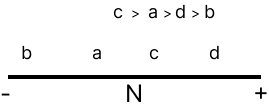
- Traits of mostly correct statements
- Progressive and balanced
- Logically correct
- Possibility words - May, Might, Can, Could, Likely, Possibly, Generally, Tends to, Some, Often, Sometimes, Usually
- Focus on broad perspective, wholesome statement, summarized and generalization
- Traits of mostly wrong statements
- Extreme statements - Always, Never, Must, Completely, Totally, Absolutely, Only, None, All, Every, No one, Everyone, Heavily, Entirely, Too much
- Absurd statement + criticize government
- Not relevant to passage
- Very narrow statement - pointing very narrow technique or scenario or missing out additional info from passage
3. Do a speed reading of passage to validate the right choice in the priority queue
- Other information
- Mostly these portions are redundant and can be given less focus:
- Mathematical figures
- Elaborations
- Examples
- Some questions are very tricky and there is a high chance of getting them wrong, so leave them
- Use hindi language if confused
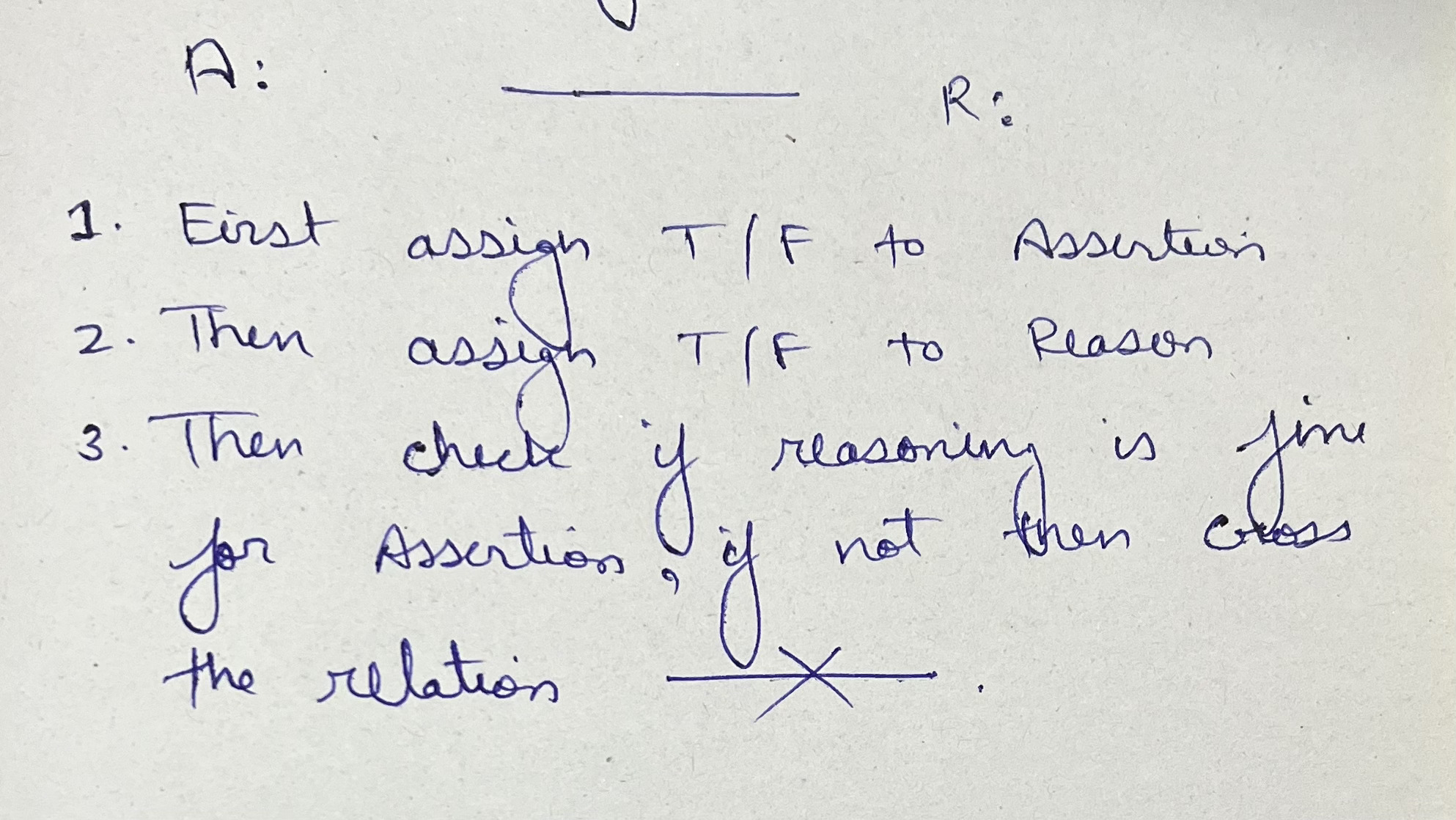
- Assertion based questions
-
- Mathematics
- Number System
- Definitions
- Digits:
- These are the basic symbols used to represent numbers in the Indo-Arabic numeral system, which include 0, 1, 2, 3, 4, 5, 6, 7, 8, and 9.
- Significant Digits:
- These are the digits from 1 to 9, which contribute to the value of a number.
- Insignificant Digit:
- The digit 0, when it does not contribute to the value of a number (e.g., leading zeros in 007 are insignificant, but 0 in 205 is significant).
- Notation:
- This refers to the representation of a number using digits (e.g., the number six hundred forty is written as 640).
- Numeration:
- This is the representation of a number in words (e.g., the number 640 is written as "six hundred forty").
- Face Value:
- The inherent value of a digit regardless of its position in a number (e.g., in the number 3452, the face value of 4 is simply 4).
- Place Value (Local Value):
- The value of a digit based on its position in a number, calculated by multiplying the digit’s face value by the corresponding power of 10.
- Indian Number System:
- The places are organized as follows:
- Ten Crore (\(10^8\)), Crore (\(10^7\)), Ten Lakh (\(10^6\)), Lakh (\(10^5\)), Ten Thousand (\(10^4\)), Thousand (\(10^3\)), Hundred (\(10^2\)), Ten (\(10^1\)), One (\(10^0\)).
- Example:
- In 1,23,45,678 (first comma after 3 digits, then every 2 digits from left)
- International Number System:
- The places are organized as:
- Hundred Million (\(10^8\)), Ten Million (\(10^7\)), Million (\(10^6\)), Hundred Thousand (\(10^5\)), Ten Thousand (\(10^4\)), Thousand (\(10^3\)), Hundred (\(10^2\)), Ten (\(10^1\)), One (\(10^0\)).
- Example:
- In 12,345,678 (comma after every 3 digits from left)
- Types of Numbers:
- Natural Numbers (N):
- These are the counting numbers starting from 1: \(\{1, 2, 3, \ldots\}\).
- The smallest natural number is 1, and there is no largest natural number.
- Whole Numbers (W):
- These include all natural numbers plus zero: \(\{0, 1, 2, \ldots\}\).
- Integers (I):
- These include negative numbers, zero, and positive numbers: \(\{\ldots, -3, -2, -1, 0, 1, 2, \ldots\}\).
- Zero is neither positive nor negative.
- Rational Numbers:
- Numbers that can be expressed as a fraction \(\frac{p}{q}\), where \(p\) and \(q\) are integers and \(q \neq 0\).
- Examples:
- \(\frac{1}{2}\), 5 (as \(\frac{5}{1}\)), \(-\frac{3}{4}\).
- Irrational Numbers:
- Numbers that cannot be expressed as a fraction \(\frac{p}{q}\), typically non-repeating, non-terminating decimals.
- Examples:
- \(\sqrt{2}\), \(\pi\), \(e\).
- Real Numbers:
- All numbers on the number line, encompassing both rational and irrational numbers.
- Complex Numbers:
- A complex number is a number that has two parts, a real part and an imaginary part, it is written as
- a + bi, where
- a = real part (normal number)
- b = coefficient of imaginary part
- i = imaginary unit, defined as i² = −1
- Why do complex numbers exist?
- Because some equations cannot be solved using only real numbers.
- Example:
- x² + 1 = 0 → x² = −1
- No real number squared gives −1, so mathematicians defined “i” to handle such cases.
- Even Numbers:
- Numbers divisible by 2, including zero (e.g., 0, 2, 4, 6, …).
- Odd Numbers:
- Numbers not divisible by 2 (e.g., 1, 3, 5, 7, …).
- Prime Numbers:
- Numbers greater than 1 that are divisible only by 1 and themselves (e.g., 2, 3, 5, 7, 11, …).
- Properties:
- All prime numbers are positive.
- 0 is not a prime number.
- 1 is not a prime number (it has only one factor).
- 2 is the only even prime number.
- The smallest odd prime number is 3.
- Prime Number Test:
- To determine if a number \(P\) is prime:
- 1. Find a whole number \(x\) such that \(x > \sqrt{P}\).
- 2. List all prime numbers less than or equal to \(x\).
- 3. If none of these primes divide \(P\) exactly (remainder 0), then \(P\) is prime; otherwise, it is not.
- Example:
- For \(P = 29\), \(\sqrt{29} \approx 5.39\), so \(x = 6\).
- Primes \(\leq 6\):
- 2, 3, 5.
- Check:
- 29 is not divisible by 2, 3, or 5, so 29 is prime.
- Twin Primes:
- A pair of prime numbers that differ by 2.
- Relevance of twin prime:
- They test how primes are distributed (prime distribution)
- There is a major open problem called the Twin Prime Conjecture which states that there are infinitely many twin primes, which is still unproven
- Links to advanced number theory
- Examples:
- (3, 5), (5, 7), (11, 13), (17, 19), (29, 31)
- Composite Numbers:
- Numbers greater than 1 that have more than two factors (e.g., 4, 6, 8, 9, …).
- Co-prime Numbers:
- Two numbers whose highest common factor (HCF) is 1 (e.g., 4 and 9, since their factors are 4: {1, 2, 4} and 9: {1, 3, 9}, HCF = 1).
- Perfect Squares:
- Numbers that are squares of integers (e.g., 1 = \(1^2\), 4 = \(2^2\), 9 = \(3^2\), 16 = \(4^2\), …).
- Perfect Cubes:
- Numbers that are cubes of integers (e.g., 1 = \(1^3\), 8 = \(2^3\), 27 = \(3^3\), …).
- Operations on Numbers:
- 1. Addition:
- Combining two or more numbers.
- Symbol:
- +
- Example:
- 24 + 25 + 30 = 79
- 2. Subtraction:
- Taking one or more numbers out of a larger number.
- Symbol:
- -
- Example:
- 400 - 223 = 177
- 3. Division:
- Four components:
- (i) Dividend:
- The number being divided
- (ii) Divisor:
- The number dividing the dividend
- (iii) Quotient:
- The result of the division
- (iv) Remainder:
- The leftover part
- Formula:
- Dividend = (Divisor × Quotient) + Remainder
- Symbol:
- ÷ or /
- Example:
- 225 ÷ 25 = 9
- 4. Multiplication:
- One number added repeatedly the number of times indicated by another.
- Symbol:
- × or *
- Example:
- 2 × 4 = 8 or (2 + 2 + 2 + 2) = 8 or (4 + 4) = 8
- Modular Arithmetic:
- Some basics
- What is mod?
- Mod just means - “What is left over after division?”
- What is triple-bar sign (≡):
- It means congruence or identity
- Addition rule:
- Rule:
- \(
(a + b) \bmod n = \left[(a \bmod n) + (b \bmod n)\right] \bmod n
\)
- Code reference
- We can't use "%" to replace "mod" in real maths, but reference is just to get clarity
- In coding the above expression can be written as:
- (a + b) % n = ((a % n) + (b % n)) % n
- CSAT Usage:
- Combine multiple numbers under modulo without full sum.
- Find remainder when 12345 + 6789 is divided by 7
- \(
12345 \bmod 7 = 4, \quad 6789 \bmod 7 = 0
\)
- \(
(12345 + 6789) \bmod 7 = (4 + 0) \bmod 7 = 4
\)
- Multiplication rule:
- Rule:
- \(
(a \cdot b) \bmod n = \left[(a \bmod n)(b \bmod n)\right] \bmod n
\)
- Code reference
- We can't use "%" to replace "mod" in real maths, but reference is just to get clarity
- In coding the above expression can be written as:
- (a.b) % n = ((a % n) . (b % n)) % n
- The first three terms are multiples of \(n\), so modulo-\(n\) they vanish.
- Only the product of remainders \(r_a r_b\) affects the final remainder.
- CSAT usage:
- Simplify multiplication under modulo.
- Find remainder when 234 × 567 is divided by 9
- \(
234 \bmod 9 = 0, \quad 567 \bmod 9 = 0
\)
- \(
(234 \cdot 567) \bmod 9 = (0 \cdot 0) \bmod 9 = 0
\)
- Division rule:
- Any division statement follows:
- \(
\text{Dividend} = (\text{Divisor} \times \text{Quotient}) + \text{Remainder}
\)
- Example:
- \(
17 = 5 \cdot 3 + 2
\)
- CSAT usage:
- Find largest or smallest number satisfying divisibility condition.
- Find the largest 4-digit number divisible by 7
- Step 1 – Identify the largest 4-digit number:
- 9999
- Step 2 – Divide by 7 and find remainder:
- 9999 ÷ 7 = 1428 remainder 3
- Step 3 – Subtract remainder to get nearest divisible number:
- 9999 - 3 = 9996
- Step 4 – Conclude:
- Largest 4-digit number divisible by 7 = 9996
- Find the smallest 3-digit number divisible by 13
- Step 1 – Identify the smallest 3-digit number:
- 100
- Step 2 – Divide by 13 and find remainder:
- 100 ÷ 13 = 7 remainder 9
- Step 3 – Add difference to get divisible number:
- 100 + (13 - 9) = 104
- Step 4 – Conclude:
- Smallest 3-digit number divisible by 13 = 104
- Congruence rule
- For integers \(a, b, n\) with \(n > 0\):
- \( a \equiv b \pmod{n} \quad \text{iff} \quad n \mid (a - b) \)
- Simple meaning of this expression:
- On divide both numbers a and b by n, they leave the same remainder
- Equivalently, (a − b) is divisible by n
- Read it as:
- "a is congruent to b modulo n"
- Converting negative remainder to positive (general rule):
- In modulo arithmetic, two numbers are congruent if their difference is divisible by the modulus:
- \(a \equiv b \pmod{n} \iff n \mid (a-b)\)
- Since:
- \((-1) - (n-1) = -n\)
- Which is divisible by \(n\) and can be represented as:
- \( -1 \equiv n-1 \pmod{n} \)
- CSAT usage:
- Quickly find remainder of large numbers without full division.
- Find remainder when \(10^6 + 37\) is divided by \(13\)
- Step 1: Find smallest dividend using division rule:
- We want a dividend that gives same remainder as given when 10 is divided by 13 to replace the original dividend and simplify the computation
- Original equation:
- \( 10 \bmod 13 = 10 \)
- Let the new dividend be x, then:
- \( x \bmod 13 = 10 \)
- Find smallest value of x using division rule
- \(
\text{Dividend} = (\text{Divisor} \times \text{Quotient}) + \text{Remainder}, \text{where } 0 \le r < n
\)
- Here, divisor and remainder are already fixed
- Divisor = 13
- Remainder = 10
- Test different values of Quotient to find dividend smaller than existing dividend (10):
- For \( q = 0 \)
- Dividend becomes 10, which is already the case
- For \( q = -1 \)
- Dividend becomes -3, which is less than 10
- Note:
- Using a smaller (positive or negative) congruent value often makes powers and products easier to compute.
- Therefore:
- \( (-3) \bmod 13 = 10 \)
- Step 2: Use congruence and replace original dividend:
- \(10 \equiv -3 \pmod{13}\)
- Raise to power:
- \(10^6 \equiv (-3)^6 \pmod{13}\)
- \( (-3)^6 = 729 \)
- Step 3: Reduce modulo:
- Reduce first term:
- \( 729 \equiv 1 \pmod{13} \)
- Reduce second term:
- \(37 \equiv 11 \pmod{13}\)
- Step 4: Combine using addition rule:
- \( 10^6 + 37 \equiv 1 + 11 \pmod{13} \)
- \( (10^6 + 37) \) gives the same remainder as \( (1 + 11) \) when divided by 13
- \( 1 + 11 \pmod{13} = 12 \pmod{13}\)
- Therefore
- Remainder 12
- Number decomposition trick:
- A number can be decomposed like this:
- 9876 = 9800 + 76
- Computation can be done separately on each number and then combined
- Fermat’s Little Theorem:
- If \(p\) is prime and \(a\) is not divisible by \(p\), then:
- \(
a^{p-1} \equiv 1 \pmod p
\)
- Formula explanation:
- \( a^{p-1} \) and \( 1 \) leave the same remainder when divided by \(p\)
- CSAT usage:
- Quickly find remainder of large exponents with prime divisor using Fermat’s Little Theorem.
- Find remainder when \(7^{222}\) is divided by 13
- Step 1 – Identify values:
- \(a = 7\), \(p = 13\)
- Step 2 – Apply Fermat’s Little Theorem:
- Since \(p\) is prime and \(7 \not\equiv 0 \pmod{13}\):
- \(7^{12} \equiv 1 \pmod{13}\)
- Step 3 – Express exponent in multiples of \(p-1\):
- \(222 = 12 \cdot 18 + 6\)
- Using division rule
- \(7^{222} = (7^{12})^{18} \cdot 7^6\)
- Step 4 – Replace using Fermat (expanded):
- From Fermat’s Little Theorem:
- \(7^{12} \equiv 1 \pmod{13}\)
- Multiply:
- \(7^{222} \equiv 1^{18} \cdot 7^6 \equiv 7^6 \pmod{13}\)
- Step 5 – Reduce smaller power modulo 13:
- Simplify
- \(7^6 \equiv 7^2 \cdot 7^4 \pmod{13}\)
- First compute square:
- \(7^2 = 49 = 13 \cdot 3 + 10\)
- Using division rule
- \(7^2 \equiv 10 \pmod{13}\)
- Then fourth power:
- \(7^4 = (7^2)^2\)
- \(7^4 \equiv 10^2 = 100\)
- \(100 = 13 \cdot 7 + 9\)
- Using division rule
- \(7^4 \equiv 9 \pmod{13}\)
- Then sixth power:
- \(7^6 = 7^4 \cdot 7^2\)
- \(7^6 \equiv 9 \cdot 10 = 90\)
- \(90 = 13 \cdot 6 + 12\)
- Using division rule
- \(7^6 \equiv 12 \pmod{13}\)
- Step 6 – Conclude:
- Remainder = \(12\)
- Wilson’s Theorem:
- For any prime \(p\):
- \(
(p-1)! \equiv -1 \pmod p
\)
- Formula explanation
- \((p-1)!\) and \(-1\) leave the same remainder when divided by \(p\).
- CSAT usage:
- Quickly find remainder of (p-1)! when divided by a prime p using Wilson’s Theorem.
- Find remainder of 10! when divided by 11
- Step 1 – Identify values:
- \(p = 11\) (prime divisor)
- Compute \((p-1)! = 10!\)
- Step 2 – Apply Wilson’s Theorem:
- For a prime p:
- \((p-1)! \equiv -1 \pmod p\)
- Hence:
- \(10! \equiv -1 \pmod{11}\)
- Step 3 – Convert negative remainder to positive:
- Converting negative remainder using congruence rule
- \(-1 \equiv p-1 \pmod p\)
- Therefore
- \(-1 \equiv 10 \pmod{11}\)
- Step 4 – Conclude:
- Remainder = 10
- VBODMAS Rule:
- Order of Operations:
1. Vinculum (Bar):
- Solve expressions under a bar first.
2. Brackets:
- Solve in order of (), {}, [].
3. Order/Exponential form:
- Interpret as multiplication (e.g., 2 of 3 = \(2 \times 3\)).
4. Division:
- Perform division operations.
5. Multiplication:
- Perform multiplication operations.
6. Addition:
- Perform addition operations.
7. Subtraction:
- Perform subtraction operations.
- Simplification Tip:
- Break complex expressions into smaller parts, solve brackets first, and use modular arithmetic for large numbers to simplify calculations.
- Example:
- Simplify \(2 + 3 \times (4 - 1)^2\): First, \(4 - 1 = 3\), then \(3^2 = 9\), then \(3 \times 9 = 27\), finally \(2 + 27 = 29\).
- Divisibility Rules:
- Note
- From below shortcut tricks, few of them save time while half of them are a waste of time
- By 2:
- Last digit is 0, 2, 4, 6, or 8.
- Example:
- 246 is divisible by 2 (last digit is 6).
- By 3:
- Sum of digits is divisible by 3.
- Example:
- 123, sum = \(1 + 2 + 3 = 6\), which is divisible by 3.
- By 4:
- Number formed by the last two digits is divisible by 4.
- Example:
- 1232, last two digits 32, \(32 \div 4 = 8\), so divisible.
- By 5:
- Last digit is 0 or 5.
- Example:
- 125 is divisible by 5 (last digit is 5).
- By 6:
- Number is divisible by both 2 and 3.
- Example:
- 18 is divisible by 2 (even) and 3 (\(1 + 8 = 9\)), so divisible by 6.
- By 7:
- Difference between twice the unit digit and the number formed by other digits is 0 or a multiple of 7.
- Example:
- 658, unit digit = 8, twice unit digit = \(2 \times 8 = 16\), other digits = 65, difference = \(65 - 16 = 49\), which is divisible by 7.
- By 8:
- Number formed by the last three digits is divisible by 8.
- Example:
- 1232, last three digits 232, \(232 \div 8 = 29\), so divisible.
- By 9:
- Sum of digits is divisible by 9.
- Example:
- 234, sum = \(2 + 3 + 4 = 9\), divisible by 9.
- By 10:
- Last digit is 0.
- Example:
- 120 is divisible by 10.
- By 11:
- Difference between the sum of digits in odd positions and even positions is 0 or a multiple of 11.
- Example:
- 30426, odd positions (1st, 3rd, 5th): \(3 + 4 + 6 = 13\), even positions (2nd, 4th): \(0 + 2 = 2\), difference = \(13 - 2 = 11\), divisible by 11.
- By 12:
- Number is divisible by both 3 and 4.
- Example:
- 24 is divisible by 3 (\(2 + 4 = 6\)) and 4 (\(24 \div 4 = 6\)), so divisible by 12.
- By 13 (Useless):
- Multiply the last digit by 4, add it to the rest of the number.
- If the result is divisible by 13, so is the original number.
- Repeat the process if needed.
- Example:
- 273 → last digit 3 → (3 × 4 = 12); add to 27 → (27 + 12 = 39); 39 ÷ 13 = 3 → divisible.
- 274 → last digit 4 → (4 × 4 = 16); add to 27 → (27 + 16 = 43); 43 ÷ 13 = 3 remainder 4 → not divisible.
- By 14:
- Number divisible by both 2 and 7.
- Example:
- 686 → even (divisible by 2), also passes 7-rule (\(68 - 2×6 = 56\) → divisible by 7).
- By 15:
- Number divisible by both 3 and 5.
- Example:
- 90 → ends with 0 (divisible by 5) and \(9 + 0 = 9\) divisible by 3.
- By 16:
- Last 4 digits form a number divisible by 16.
- Example:
- 8512 → last 4 digits 8512 → \(8512 ÷ 16 = 532\).
- By 17 (Useless):
- Subtract 5 times the last digit from the remaining number.
- If result divisible by 17, so is the number.
- Example:
- 595 → last digit 5 → \(5×5=25\); \(59 - 25 = 34\); \(34 ÷ 17 = 2\).
- By 18:
- Number is divisible by 2 and 9.
- Example:
- 18 is divisible by 2 and divisible by 9 (\(1 + 8 = 9\)), so divisible by 18.
- By 19 (Useless):
- Add twice the last digit to the rest of the number.
- If the result is divisible by 19, so is the number.
- Example:
- 133 → last digit 3 → \(3×2=6\); add to 13 → \(13 + 6 = 19\).
- By 20:
- Last two digits form a number divisible by 20 (i.e., end with 00, 20, 40, 60, or 80).
- Example:
- 840 → ends with 40 → divisible by 20.
- By 25:
- Last two digits form a number divisible by 25 or are 00.
- Example:
- 125, last two digits 25, divisible by 25.
- By 88 (useless):
- Number is divisible by both 11 and 8.
- Example:
- 352, divisible by 8 (\(352 \div 8 = 44\)) and 11 (odd sum: \(3 + 2 = 5\), even sum: 5, difference: \(5 - 5 = 0\)).
- By 99 (useless):
- Number is divisible by both 9 and 11.
- Example:
- 198, divisible by 9 (\(1 + 9 + 8 = 18\)) and 11 (odd sum: \(1 + 8 = 9\), even sum: 9, difference: \(9 - 9 = 0\)).
- By 125:
- Last three digits form a number divisible by 125 or are 000.
- Example:
- 1125, last three digits 125, divisible by 125.
- Useful Properties of Numbers:
- Even/Odd properties:
- Odd ± Odd = Even
- Whenever confused take take example of 3 to deduce
- Even ± Even = Even
- Whenever confused take take example of 2 to deduce
- Odd ± Even = Odd
- Whenever confused take take example of 2 and 3 to deduce
- Odd × Odd = Odd
- Conclusion:
- \( \text{Odd}^n = \text{Odd} \)
- Even × Anything = Even
- Conclusion:
- \( \text{Even}^n = \text{Even} \)
- Factor to identify Even/Odd instantly:
- For \( (a^n - b^n) \):
- \( a^n - b^n = (a - b)(a^{n-1} + a^{n-2}b + \dots + ab^{n-2} + b^{n-1}) \)
- \( a^n - b^n \) always contains \( (a - b) \) as a factor to quickly deduce fundamental conclusions like value will be even or odd
- Can also be used to deduce that \( a^n - b^n \) is always divisible \( (a - b) \)
- Can also be used to deduce that \( a^n - b^n \) is always divisible \( (a + b) \) for all even values of n
- For \( (a^n + b^n) \):
- If \( n \) is odd:
- \( a^n + b^n = (a + b)\left(a^{n-1} - a^{n-2}b + a^{n-3}b^2 - \dots - ab^{n-2} + b^{n-1}\right) \)
- \( a^n + b^n \) always contains \( (a + b) \) as a factor to quickly deduce fundamental conclusions like value will be even or odd
- Can also be used to deduce that \( a^n + b^n \) is always divisible \( (a + b) \)
- If \( n \) is even:
- No general equation exist when n is even.
- No guaranteed factors \( (a + b) \text{or} (a - b) \) to deduce a conclusion confidently
- Some consecutive integer properties:
- Product of any 2 consecutive integers divisible by 2
- Example:
- \( 4 \times 5 = 20 \)
- One of any two consecutive integers is even, therefore product always divisible by \( 2 \)
- Product of any 3 consecutive integers divisible by 2, 3 and 6
- Or, in other words \( n^3 - n \text{ is divisible by } 2, 3 \text{ and } 6 \)
- Since \( n^3 - n = n(n-1)(n+1) \), it is another way of representing product of three consecutive integers
- Example:
- \(1 \times 2 \times 3 = 6\)
- Any such product always divisible by both 2 and 3 → hence divisible by 6
- Sum of any 2 consecutive numbers is equal to the difference of their squares
- Example:
- \(3 + 4 = 7 = 4^2 - 3^2\)
- \(6 + 7 = 13 = 7^2 - 6^2\)
- Sum of the cubes of any 3 consecutive numbers is divisible by the sum of the numbers themselves
- Example:
- \(2^3 + 3^3 + 4^3 = 8 + 27 + 64 = 99\)
- Sum = \(2 + 3 + 4 = 9\), and \(99 = 9 \times 11\)
- Some division properties:
- If a number is divisible by another number, then it must also be divisible by each factor of that number
- Example:
- 48 is divisible by 12
- Factors of 12: 1, 2, 3, 4, 6, 12
- So 48 is divisible by 2, 3, 4, 6
- If \(p\) divides both \(q\) and \(r\), then \(p\) also divides their sum or difference
- Example:
- 4 divides 12 and 20
- \(12 + 20 = 32\), divisible by 4
- \(20 - 12 = 8\), also divisible by 4
- Other properties:
- Difference of the squares of any 2 odd numbers is always divisible by 2, 4 and 8
- Example:
- \(11^2 - 3^2 = 121 - 9 = 112 = 8 \times 14\)
- Number of Digits and Unit Digits:
- Number of Digits in \(N = b^k\):
- \(
\text{Number of digits} = \lfloor k \cdot \log_{10} b \rfloor + 1
\)
- Example:
- For \(2^{10}\), \(\log_{10} 2 \approx 0.3010\), so \(\lfloor 10 \times 0.3010 \rfloor + 1 = \lfloor 3.01 \rfloor + 1 = 4\) digits.
- Unit Digit of Large Powers:
- Concept:
- The unit digit of powers of any number depends only on the unit digit of its base.
- This is because the higher digits of the base don’t affect the multiplication pattern of the last digit.
- As powers increase, the unit digits repeat in a cyclic pattern, forming what’s called a *cycle of unit digits*.
- Why Cycles Form:
- Since there are only 10 possible unit digits (0–9), repetition must occur.
- Once the same unit digit reappears, the cycle restarts.
- Hence, powers of any number repeat their last digits periodically.
- Step-by-Step Method to Find the Unit Digit of \( a^n \):
- Step 1:
- Determine the last digit of base \( a \).
- Step 2:
- Write down the sequence of unit digits for successive powers of that digit until the pattern repeats.
- This sequence is the cycle.
- Step 3:
- Compute \( n \mod \text{(cycle length)} \) to find the position of the required term within the cycle.
- Step 4:
- If remainder = 0, use the last element of the cycle.
- Otherwise, use the element at the remainder’s position.
- Step 5:
- The corresponding element gives the unit digit of \( a^n \).
- Cycles of Unit Digits (for bases ending in 0–9):
- 0:
- Powers:
- 0¹ = 0, 0² = 0, 0³ = 0, ...
- Cycle = {0} → Cycle length = 1
- Unit digit always remains 0
- 1:
- Powers:
- 1¹ = 1, 1² = 1, 1³ = 1, ...
- Cycle = {1} → Cycle length = 1
- Unit digit always remains 1
- 2:
- Powers:
- 2¹ = 2, 2² = 4, 2³ = 8, 2⁴ = 16, 2⁵ = 32, ...
- Unit digits = {2, 4, 8, 6}
- Cycle = {2, 4, 8, 6} → Cycle length = 4
- 3:
- Powers:
- 3¹ = 3, 3² = 9, 3³ = 27, 3⁴ = 81, 3⁵ = 243, ...
- Unit digits = {3, 9, 7, 1}
- Cycle = {3, 9, 7, 1} → Cycle length = 4
- 4:
- Powers:
- 4¹ = 4, 4² = 16, 4³ = 64, 4⁴ = 256, ...
- Unit digits = {4, 6}
- If unit digit odd, then 4, or else 6
- Cycle = {4, 6} → Cycle length = 2
- 5:
- Powers:
- 5¹ = 5, 5² = 25, 5³ = 125, ...
- Unit digits: {5}
- Cycle = {5} → Cycle length = 1
- Unit digit always remains 5
- 6:
- Powers:
- 6¹ = 6, 6² = 36, 6³ = 216, ...
- Unit digits = {6}
- Cycle = {6} → Cycle length = 1
- Unit digit always remains 6
- 7:
- Powers:
- 7¹ = 7, 7² = 49, 7³ = 343, 7⁴ = 2401, ...
- Unit digits = {7, 9, 3, 1}
- Cycle = {7, 9, 3, 1} → Cycle length = 4
- 8:
- Powers:
- 8¹ = 8, 8² = 64, 8³ = 512, 8⁴ = 4096, ...
- Unit digits = {8, 4, 2, 6}
- Cycle = {8, 4, 2, 6} → Cycle length = 4
- 9:
- Powers:
- 9¹ = 9, 9² = 81, 9³ = 729, 9⁴ = 6561, ...
- Unit digits = {9, 1}
- If unit digit odd, then 9, or else 1
- Cycle = {9, 1} → Cycle length = 2
- 10:
- Powers:
- 10¹ = 10, 10² = 100, 10³ = 1000, ...
- Unit digits = {0}
- Cycle = {0} → Cycle length = 1
- Unit digit always remains 0
- Complex Cases of Unit Digits (Large Bases and Exponents):
- Rule 1:
- Only the unit digit of the base matters, not the entire number.
- Reason:
- The higher digits do not affect the product’s last digit.
- Example:
- \(2137^{2138}\) → base ends with 7 → same as \(7^{2138}\)
- \(674^{209}\) → base ends with 4 → same as \(4^{209}\)
- \(99^{120}\) → base ends with 9 → same as \(9^{120}\)
- Rule 2:
- Find the unit digit cycle for the base’s last digit (from the 0–9 pattern list).
- Example:
- For 7 → cycle = {7, 9, 3, 1} → cycle length = 4
- For 8 → cycle = {8, 4, 2, 6} → cycle length = 4
- For 9 → cycle = {9, 1} → cycle length = 2
- Thus:
- \(2137^{2138}\) → 7-cycle (length 4)
- \(2138^{2139}\) → 8-cycle (length 4)
- \(2139^{2137}\) → 9-cycle (length 2)
- Rule 3 (Key Shortcut for Bases Ending with 4 or 9):
- These digits have cycles of length 2:
- 4 → {4, 6}
- 9 → {9, 1}
- So:
- If the exponent is odd, unit digit = first element of the cycle.
- If the exponent is even, unit digit = second element.
- Shortcut:
- Base ends with 4 → odd → 4, even → 6
- Base ends with 9 → odd → 9, even → 1
- Examples:
- \(2134^{2137}\) → base ends with 4, exponent odd → unit digit = 4
- \(2134^{2138}\) → base ends with 4, exponent even → unit digit = 6
- \(2139^{2137}\) → base ends with 9, exponent odd → unit digit = 9
- \(2139^{2138}\) → base ends with 9, exponent even → unit digit = 1
- Rule 4 (For Bases Ending in 2, 3, 7, or 8):
- These digits have cycles of length 4.
- Use \( n \mod 4 \) to find the position in the cycle:
- If remainder = 0 → take 4th element.
- Else → take element at remainder’s position.
- Example cases 1:
- \(2137^{2138}\)
- Base ends with 7 → cycle {7, 9, 3, 1}
- \(2138 \mod 4 = 2\) → 2nd element = 9 → unit digit = 9
- \(2138^{2139}\)
- Base ends with 8 → cycle {8, 4, 2, 6}
- \(2139 \mod 4 = 3\) → 3rd element = 2 → unit digit = 2
- \(2232^{109}\)
- Base ends with 2 → cycle {2, 4, 8, 6}
- \(109 \mod 4 = 1\) → 1st element = 2 → unit digit = 2
- \(9233^{210}\)
- Base ends with 3 → cycle {3, 9, 7, 1}
- \(210 \mod 4 = 2\) → 2nd element = 9 → unit digit = 9
- Example cases 2:
- \(6789^{4567^{8910}}\)
- Step 1:
- Base ends with 9 → cycle = {9, 1} → length = 2
- Step 2:
- Exponent = \(4567^{8910}\)
- Since 4567 is odd and any odd number raised to any power remains odd, exponent is odd → exponent mod 2 = 1
- Step 3:
- For base 9: odd exponent → 1st term of cycle = 9
- Therefore:
- Unit digit = 9
- \(217^{219^{220}}\)
- Step 1:
- Only the unit digit of the base matters.
- Base = 217 → ends with 7.
- So we focus on \(7^{219^{220}}\).
- Step 2:
- The unit digit cycle for 7 is:
- 7¹ → 7
- 7² → 9
- 7³ → 3
- 7⁴ → 1
- Hence, cycle = {7, 9, 3, 1}, and cycle length = 4.
- Step 3:
- We need to know which element of the cycle applies.
- For that, we find:
- Exponent = \(219^{220}\)
- We only need \(219^{220} \mod 4\).
- Step 4:
- Since 219 ÷ 4 gives remainder 3 (because 4×54=216, remainder 3)
- Using modular congruency rule
- \( 219^{220} \equiv 3^{220} \pmod{4} \)
- \(3^{220} \mod 4\) and \(219^{220}\) gives same remainder using modular congruence rule.
- Now find pattern formed by \(3^{220} \mod 4\):
- Pattern of 3ⁿ mod 4 → {3, 1, 3, 1} → repeats every 2.
- Since exponent 220 is even → remainder = 1.
- Hence \(219^{220} \mod 4 = 1\).
- Step 5:
- Remainder 1 → means 1st element of the cycle {7, 9, 3, 1}.
- Therefore:
- Unit digit = 7
- Rule 5 (For Bases Ending in 0, 1, 5, 6):
- These always yield the same unit digit, regardless of power.
- 0 → always 0
- 1 → always 1
- 5 → always 5
- 6 → always 6
- Examples:
- \(350^{2138}\) → last digit = 0 → unit digit = 0
- \(251^{999}\) → last digit = 1 → unit digit = 1
- \(125^{500}\) → last digit = 5 → unit digit = 5
- \(216^{84}\) → last digit = 6 → unit digit = 6
- Additional Concepts:
- Recurring Decimals:
- For a fraction \(\frac{p}{q}\), if \(q\) is coprime with 10 (i.e., not divisible by 2 or 5), the decimal expansion is recurring.
- This simply means the denominator should not be divisible by 2, 5 and 10 to be recurring
- The period is the smallest \(k\) such that \(10^k \equiv 1 \mod q\).
- Example:
- \(\frac{1}{7} = 0.\overline{142857}\), period = 6 (since \(10^6 \equiv 1 \mod 7\)).
- Surds:
- Definition:
- \(
\text{A surd is an irrational number of the form } \sqrt[n]{x}, \text{where } x \in \mathbb{Q},\; n \in \mathbb{N},\; n > 1,\; \text{and } \sqrt[n]{x} \notin \mathbb{Q}.
\)
- Meaning:
- Where the result of \( \sqrt[n]{x} \) is irrational and it cannot be written as a fraction.
- Simplification rules:
- \(
\sqrt{a} \cdot \sqrt{b} = \sqrt{ab}, \quad \frac{\sqrt{a}}{\sqrt{b}} = \sqrt{\frac{a}{b}}
\)
- Rationalizing the denominator:
- \(
\frac{1}{\sqrt{a}} = \frac{\sqrt{a}}{a}
\)
- Example:
- \(\frac{1}{\sqrt{2}} = \frac{\sqrt{2}}{2}\).
- Highest Common Factor (HCF) and Least Common Multiple (LCM):
- HCF (Greatest Common Divisor):
- The HCF of two or more numbers is the largest number that divides each of them exactly, leaving no remainder.
- It represents the highest measure of common divisibility among numbers.
- Methods to find HCF:
- Prime Factorization Method:
- Express each number as a product of primes.
- Multiply the common primes raised to their smallest powers.
- Example 1:
- HCF(36,60)
- \(36 = 2^2 \times 3^2\)
- \(60 = 2^2 \times 3 \times 5\)
- \(\text{HCF} = 2^2 \times 3 = 12\)
- Example 2:
- HCF(3, 42)
- \(3 = 3^1\)
- \(42 = 2 \times 3 \times 7\)
- \(\text{HCF} = 3^1 = 3\)
- Division (or Euclidean) Method:
- Found using: \(\text{HCF}(a, b) = \text{HCF}(b, a \bmod b)\)
- Continue until the remainder becomes 0.
- Example 1:
- HCF(48, 18)
- \(48 = 18 \times 2 + 12\)
- \(18 = 12 \times 1 + 6\)
- \(12 = 6 \times 2 + 0\)
- \(\text{HCF} = 6\)
- For multiple numbers:
- Compute stepwise: \(\text{HCF}(a, b, c) = \text{HCF}(\text{HCF}(a, b), c)\)
- LCM (Least Common Multiple):
- The LCM of two or more numbers is the smallest number that is exactly divisible by each of them.
- It represents the lowest shared multiple among the numbers.
- Prime Factorization Method:
- Express each number as a product of prime factors.
- Multiply all primes raised to their highest powers.
- Example 1:
- LCM(12, 18)
- \(12 = 2^2 \times 3\)
- \(18 = 2 \times 3^2\)
- \(\text{LCM} = 2^2 \times 3^2 = 36\)
- Example 2:
- LCM(3, 42)
- \(3 = 3^1\)
- \(42 = 2^1 \times 3^1 \times 7^1\)
- \(\text{LCM} = 2^1 \times 3^1 \times 7^1 = 42\)
- For multiple numbers:
- Compute sequentially: \(\text{LCM}(a, b, c) = \text{LCM}(\text{LCM}(a, b), c)\)
- Relationship between HCF and LCM:
- \(\text{HCF}(a, b) \times \text{LCM}(a, b) = a \times b\)
- \(\text{LCM}(48, 18) = \frac{48 \times 18}{6} = 144\)
- This relation helps verify the correctness of computed values.
- Number of Divisors:
- For a number \(N = p_1^{a} \cdot p_2^{b} \cdot \ldots \cdot p_k^{m}\), the number of divisors is:
- \(
(a+1)(b+1)\ldots(m+1)
\)
- Example 1:
- Number:
- \(
18 = 2^1 \cdot 3^2
\)
- Number of divisors:
- \(
(1+1)(2+1) = 2 \times 3 = 6
\)
- Divisors:
- \(
1, 2, 3, 6, 9, 18
\)
- Example 2:
- Number:
- \(
24 = 2^3 \cdot 3^1
\)
- Number of divisors:
- \(
(3+1)(1+1) = 4 \times 2 = 8
\)
- Example 3:
- Number:
- \(
36 = 2^2 \cdot 3^2
\)
- Number of divisors:
- \(
(2+1)(2+1) = 3 \times 3 = 9
\)
- Sum of Divisors (not useful):
- For \(N = p_1^{a} \cdot p_2^{b} \cdot \ldots \cdot p_k^{m}\):
- \(
\sigma(N) = \frac{p_1^{a+1}-1}{p_1-1} \cdot \frac{p_2^{b+1}-1}{p_2-1} \cdot \ldots \cdot \frac{p_k^{m+1}-1}{p_k-1}
\)
- Example:
- For 12 = \(2^2 \cdot 3^1\), sum = \(\frac{2^3-1}{2-1} \cdot \frac{3^2-1}{3-1} = \frac{7}{1} \cdot \frac{8}{2} = 7 \times 4 = 28\).
- Fractions
- Definition:
- A fraction represents a part of a whole, whether it’s an object, quantity, or region.
- It is a rational number of the form \(\frac{p}{q}\), where:
- \(p\) (numerator):
- An integer representing the part.
- \(q\) (denominator):
- A non-zero integer representing the whole, and \(p\) is not a multiple of \(q\).
- Example:
- If a stick is divided into 2 equal parts and you have 1 part, this is represented as \(\frac{1}{2}\), meaning 1 out of 2 equal parts.
- Types of Fractions:
- Proper Fractions:
- Fractions where the absolute value is less than 1, i.e., the numerator is less than the denominator (\(| \frac{p}{q} | < 1\)).
- Example:
- \(\frac{1}{2}\), \(\frac{6}{11}\), \(\frac{3}{7}\).
- Improper Fractions:
- Fractions where the denominator is less than or equal to the numerator (\(\frac{p}{q} \geq 1\)).
- Example:
- \(\frac{16}{11}\), \(\frac{21}{16}\), \(\frac{5}{5}\).
- Complex Fractions:
- Fractions where the numerator, denominator, or both are fractions themselves.
- Example:
- \(\frac{\frac{5}{7}}{\frac{11}{3}}\), \(\frac{4}{\frac{2}{9}}\).
- Simplification:
- Multiply numerator and denominator by the LCM of the denominators of the inner fractions.
- Example:
- For \(\frac{\frac{5}{7}}{\frac{11}{3}}\), multiply by LCM(7, 3) = 21: \(\frac{\frac{5}{7} \times 21}{\frac{11}{3} \times 21} = \frac{5 \times 3}{11 \times 7} = \frac{15}{77}\).
- Compound Fractions:
- Fractions involving the operation “of” (interpreted as multiplication) between fractions.
- Example:
- \(\frac{3}{5} \text{ of } \frac{15}{18} = \frac{3}{5} \times \frac{15}{18} = \frac{3 \times 15}{5 \times 18} = \frac{45}{90} = \frac{1}{2}\).
- Inverse Fractions:
- The reciprocal of a given fraction, obtained by swapping the numerator and denominator.
- Example:
- For \(\frac{7}{13}\), the inverse is \(\frac{13}{7}\).
- Application:
- Used in division of fractions (multiply by the inverse).
- Mixed Fractions:
- A combination of a whole number and a proper fraction.
- Example:
- \(3 \frac{4}{5} = 3 + \frac{4}{5} = \frac{15 + 4}{5} = \frac{19}{5}\).
- Conversion to improper:
- Multiply the whole number by the denominator, add the numerator, and place over the denominator.
- Continued Fractions:
- Fractions with an additional fractional part in the numerator or denominator, often nested.
- Example:
- \(3 + \frac{1}{1 + \frac{4}{9}}\), \(6 + \frac{7 + \frac{1}{8}}{5}\).
- Simplification:
- Start from the innermost fraction and work upward.
- Example:
- For \(3 + \frac{1}{1 + \frac{4}{9}}\):
- Inner fraction:
- \(1 + \frac{4}{9} = \frac{9 + 4}{9} = \frac{13}{9}\).
- Then:
- \(\frac{1}{\frac{13}{9}} = \frac{9}{13}\).
- Finally:
- \(3 + \frac{9}{13} = \frac{39 + 9}{13} = \frac{48}{13}\).
- Equivalent Fractions:
- Fractions that represent the same value but have different numerators and denominators.
- Obtained by multiplying or dividing numerator and denominator by the same non-zero number.
- Example:
- \(\frac{2}{3} = \frac{2 \times 2}{3 \times 2} = \frac{4}{6} = \frac{4 \div 2}{6 \div 2} = \frac{2}{3}\).
- Use:
- Simplifying fractions or finding common denominators.
- Operations on Fractions:
- Addition and Subtraction:
- Case 1 - Same Denominator:
- Add or subtract the numerators and keep the denominator.
- Example:
- \(\frac{2}{7} + \frac{3}{7} = \frac{2 + 3}{7} = \frac{5}{7}\), \(\frac{9}{13} - \frac{6}{13} = \frac{9 - 6}{13} = \frac{3}{13}\).
- Case 2 - Different Denominators:
- Find the LCM of the denominators to get a common denominator.
- Convert each fraction to an equivalent fraction with the common denominator, then add or subtract.
- Example:
- \(\frac{1}{6} + \frac{3}{8}\):
- LCM(6, 8) = 24.
- Convert:
- \(\frac{1}{6} = \frac{1 \times 4}{6 \times 4} = \frac{4}{24}\), \(\frac{3}{8} = \frac{3 \times 3}{8 \times 3} = \frac{9}{24}\).
- Add:
- \(\frac{4}{24} + \frac{9}{24} = \frac{4 + 9}{24} = \frac{13}{24}\).
- Example:
- \(\frac{3}{5} - \frac{2}{7}\):
- LCM(5, 7) = 35.
- Convert:
- \(\frac{3}{5} = \frac{3 \times 7}{5 \times 7} = \frac{21}{35}\), \(\frac{2}{7} = \frac{2 \times 5}{7 \times 5} = \frac{10}{35}\).
- Subtract:
- \(\frac{21}{35} - \frac{10}{35} = \frac{21 - 10}{35} = \frac{11}{35}\).
- Multiplication:
- Multiply the numerators together and the denominators together, then simplify.
- Example:
- \(\frac{2}{3} \times \frac{5}{7} = \frac{2 \times 5}{3 \times 7} = \frac{10}{21}\).
- Tip:
- Simplify before multiplying by canceling common factors.
- Example:
- \(\frac{4}{5} \times \frac{15}{8} = \frac{4 \times 15}{5 \times 8} = \frac{1 \times 3}{1 \times 2} = \frac{3}{2} = 1.5\) (cancel 5 and 15, 4 and 8).
- Division:
- Multiply the first fraction by the inverse (reciprocal) of the second fraction.
- Example:
- \(\frac{3}{4} \div \frac{2}{5} = \frac{3}{4} \times \frac{5}{2} = \frac{3 \times 5}{4 \times 2} = \frac{15}{8}\).
- Tip:
- Simplify before multiplying to reduce calculations.
- Comparison of Fractions:
- Rule 1 - Same Denominator:
- The fraction with the larger numerator is greater.
- Example:
- \(\frac{5}{12} > \frac{3}{12}\), since \(5 > 3\).
- Rule 2 - Same Numerator:
- The fraction with the smaller denominator is greater.
- Example:
- \(\frac{8}{15} > \frac{8}{17}\), since \(15 < 17\).
- Rule 3 - Different Numerators and Denominators:
- Method 1 - Cross-Multiplication:
- For \(\frac{a}{b}\) and \(\frac{c}{d}\), compare \(a \times d\) and \(b \times c\).
- If \(a \times d > b \times c\), then \(\frac{a}{b} > \frac{c}{d}\).
- Example:
- Compare \(\frac{3}{5}\) and \(\frac{4}{7}\):
- Cross-multiply:
- \(3 \times 7 = 21\), \(5 \times 4 = 20\).
- Since \(21 > 20\), \(\frac{3}{5} > \frac{4}{7}\).
- Method 2 - Common Denominator:
- Convert fractions to a common denominator (LCM) and compare numerators.
- Example:
- Compare \(\frac{11}{18}\), \(\frac{113}{173}\), \(\frac{303}{486}\), \(\frac{144}{231}\):
- LCM(18, 173, 486, 231) is complex, so use cross-multiplication or decimal approximation for CSAT.
- Decimal method:
- \(\frac{11}{18} \approx 0.611\), \(\frac{113}{173} \approx 0.653\), \(\frac{303}{486} \approx 0.623\), \(\frac{144}{231} \approx 0.623\).
- Compare:
- \(0.653 > 0.623 \approx 0.623 > 0.611\), so \(\frac{113}{173} > \frac{303}{486} \approx \frac{144}{231} > \frac{11}{18}\).
- CSAT Tip:
- For quick comparison, convert to decimals or use cross-multiplication to save time.
- Decimal Fractions:
- Definition:
- Fractions with denominators that are powers of 10, expressed as decimals.
- Example:
- \(0.25 = \frac{25}{100} = \frac{1}{4}\), \(0.1 = \frac{1}{10}\).
- Parts of a Decimal:
- Example:
- In 13.489, 13 is the integer part, and 0.489 is the decimal part.
- Converting Decimals to Fractions:
- Steps:
1. Write the decimal without the decimal point as the numerator.
2. Place 1 followed by as many zeros as there are decimal places in the denominator.
3. Simplify the fraction.
- Example:
- Convert 11.987 to a fraction:
- Numerator:
- 11987 (remove decimal).
- Denominator:
- \(10^3 = 1000\) (3 decimal places).
- Fraction:
- \(\frac{11987}{1000}\).
- Terminating vs. Non-Terminating Decimals:
- Terminating:
- Denominator has only factors 2 and 5.
- Example:
- \(\frac{1}{4} = 0.25\), \(\frac{3}{8} = 0.375\) (denominators \(2^2\), \(2^3\)).
- Non-Terminating (Recurring):
- Denominator has factors other than 2 and 5.
- Example:
- \(\frac{1}{3} = 0.\overline{3}\), \(\frac{1}{7} = 0.\overline{142857}\).
- Recurring Decimals:
- Definition:
- Decimals where a digit or set of digits repeats infinitely, denoted with a bar or dot over the repeating part.
- Example:
- \(0.\overline{2} = 0.222\ldots\), \(0.\overline{142857} = 0.142857142857\ldots\).
- Converting Recurring Decimals into Fractions
- CASE 1 - Pure Recurring Decimal
- All digits after decimal repeat from the start.
- Method:
- Multiply by \(10^r\) (where \(r\) = length of repeating block), then subtract original.
- Example 1:
- \(0.\overline{3}\)
- Let \(x = 0.\overline{3}\)
- Multiply by 10 (\(r=1\)):
- \(10x = 3.\overline{3}\)
- Subtract:
- \(10x - x = 3\) → \(9x = 3\)
- \(x = \frac{3}{9} = \frac{1}{3}\)
- Hence, \(0.\overline{3} = \frac{1}{3}\)
- Example 2:
- \(0.\overline{142857}\)
- Let \(x = 0.\overline{142857}\)
- Multiply by \(10^6\):
- \(1{,}000{,}000x = 142857.\overline{142857}\)
- Subtract:
- \(999{,}999x = 142857\)
- \(x = \frac{142857}{999999} = \frac{1}{7}\)
- Hence, \(0.\overline{142857} = \frac{1}{7}\)
- CASE 2 - Mixed Recurring Decimal
- Non-repeating digits followed by a repeating block.
- Case 2 involves 1 extra step of creating equation 2
- Method:
- Let \(n\) = number of non-repeating digits
- Let \(r\) = length of repeating block
- Multiply once by \(10^n\) to shift non-repeating part
- Multiply again by \(10^{n+r}\) to shift one full cycle
- Subtract the two equations
- Example 1:
- \(0.12\overline{34}\)
- \(n=2\), \(r=2\)
- Let \(x = 0.12\overline{34}\)
- ×100:
- First multiply the original number with this to get equation 1
- \(100x = 12.\overline{34}\)
- ×10,000:
- Now multiply the original number with this to get equation 2
- \(10{,}000x = 1234.\overline{34}\)
- Subtract:
- Subtract equation 1 from 2
- \(9{,}900x = 1222\)
- \(x = \frac{1222}{9900} = \frac{611}{4950}\)
- Hence, \(0.12\overline{34} = \frac{611}{4950}\)
- Example 2:
- \(2.4\overline{56}\)
- \(n=1\), \(r=2\)
- Let \(x = 2.4\overline{56}\)
- ×10:
- First multiply the original number with this to get equation 1
- \(10x = 24.\overline{56}\)
- ×1,000:
- Now multiply the original number with this to get equation 2
- \(1{,}000x = 2456.\overline{56}\)
- Subtract:
- Subtract equation 1 from 2
- \(990x = 2432\)
- \(x = \frac{2432}{990} = \frac{1216}{495}\)
- Hence, \(2.4\overline{56} = \frac{1216}{495}\)
- Elementary Algebra
- Polynomials:
- Definition:
- An expression of the form \( f(x) = a_0 + a_1 x + a_2 x^2 + \cdots + a_n x^n \), where:
- \( a_0, a_1, a_2, \ldots, a_n \): Constants (coefficients), real numbers, with \( a_n \neq 0 \).
- \( n \): A non-negative integer (degree of the polynomial).
- Example:
- \( 4x^2 + 7x - 9 \) (over integers), \( 7x^3 + \frac{2}{3}x^2 - \frac{7}{5}x + 5 \) (over rationals), \( \sqrt{2}x^2 - \frac{3}{x} + 5 \) (over reals, but not a polynomial due to negative exponent).
- Types of Polynomials by Terms:
- Monomial:
- One term (e.g., \( 7 \), \( 2x \), \( 8x^3 \)).
- Binomial:
- Two terms (e.g., \( 3x + 4 \), \( 8x^2 - 3x \)).
- Trinomial:
- Three terms (e.g., \( 7x^2 - 3x + 8 \)).
- Degree of a Polynomial:
- The highest exponent of \( x \) with a non-zero coefficient.
- Example:
- \( 5x^3 + 2x^2 - x + 4 \) has degree 3, \( 8 \) (constant) has degree 0.
- Types of Polynomials by Degree:
- Zero Polynomial:
- Degree 0 (e.g., \( f(x) = 8 \)).
- Linear Polynomial:
- Degree 1 (e.g., \( 3x + 5 \)).
- Quadratic Polynomial:
- Degree 2 (e.g., \( 4x^2 - 2x + 1 \)).
- Cubic Polynomial:
- Degree 3 (e.g., \( 2x^3 + x^2 - 3 \)).
- Higher-Degree Polynomials:
- Degree \( \geq 4 \) (e.g., \( x^4 + 2x \)).
- Operations on Polynomials:
- Addition/Subtraction:
- Combine like terms.
- Example:
- \( (3x^2 + 2x - 1) + (x^2 - 4x + 5) = 4x^2 - 2x + 4 \).
- Multiplication:
- Distribute each term and combine like terms.
- Example:
- \( (2x + 3)(x - 1) = 2x^2 - 2x + 3x - 3 = 2x^2 + x - 3 \).
- Division:
- Use polynomial long division or synthetic division for linear divisors.
- Example:
- Divide \( x^2 - 5x + 6 \) by \( x - 2 \):
- Synthetic division:
- Coefficients \( [1, -5, 6] \), divisor root \( 2 \).
- Result:
- \( [1, -3, 0] \), quotient \( x - 3 \), remainder 0.
- Thus, \( \frac{x^2 - 5x + 6}{x - 2} = x - 3 \).
- Zero of a Polynomial (Root of a polynomial):
- A real number 'a' is called a zero (or root) of a polynomial f(x) if:
- f(a) = 0
- A root of a polynomial is simply a value that makes the polynomial equal zero.
- Example:
- If x = 1 is a root of polynomial f(x) = 3x³ - 2x² + x - 2, then f(1) = 3(1)³ - 2(1)² + 1 - 2 = 3 - 2 + 1 - 2 = 0 ⇒ x = 1 is a root of f(x)
- Properties:
- A polynomial of degree 'n' has at most 'n' real roots.
- For example:
- Degree 1 → at most 1 real root
- Degree 2 → at most 2 real roots
- Degree 3 → at most 3 real roots
- A linear polynomial f(x) = ax + b (where a ≠ 0) has one unique root: x = -b/a
- A linear polynomial is degree 1 (highest power of x is 1). Solving ax + b = 0 gives x = -b/a.
- Only one solution is possible because the graph of a line cuts the x-axis at exactly one point.
- Example:
- f(x) = 2x − 6
- Root = 6/2 = 3.
- Every real number is a root of the zero polynomial.
- The zero polynomial is f(x) = 0.
- No matter what x you substitute:
- f(x) = 0 for all x
- So:
- f(a) = 0 for every real number a.
- Therefore, every real number is a root.
- This is the only polynomial which has infinitely many real roots.
- A non-zero constant polynomial has no root.
- A constant polynomial looks like -> f(x) = c, where c ≠ 0
- No matter what x you put, f(x) can never become zero.
- f(x) = c, and c ≠ 0
- Hence, it has no root.
- Example:
- f(x) = 5 → never becomes 0 → no root.
- Classification by Degree (Illustration):
- Polynomial:
- 3x² + 4x + 5
- Degree = 2 ⇒ Quadratic polynomial
- Polynomial:
- 3x⁴ + 3x² + 4x + 4
- Degree = 4 ⇒ Biquadratic polynomial
- Remainder Theorem:
- Let f(x) be a polynomial of degree ≥ 1 and let 'a' be any real number. If f(x) is divided by (x - a), the remainder = f(a)
- Meaning:
- Normally, dividing polynomials is long and time-consuming. The Remainder Theorem gives a shortcut:
- Instead of dividing, just substitute x = a in the polynomial.
- The value f(a) = the remainder.
- Example:
- f(x) = 2x³ - 13x² + 17x + 10
- Dividing by (x - 2), remainder = f(2) ⇒ f(2) = 2(8) - 13(4) + 17(2) + 10 = 16 - 52 + 34 + 10 = 8 ⇒ Remainder = 8
- Factor Theorem:
- Let f(x) be a polynomial of degree ≥ 1.
- If f(a) = 0, then (x - a) is a factor of f(x). Conversely, if (x - a) is a factor of f(x), then f(a) = 0
- Example:
- Show that (x + 2) is a factor of f(x) = x² + 4x + 4
- f(-2) = (-2)² + 4(-2) + 4 = 4 - 8 + 4 = 0 ⇒ (x + 2) is a factor of f(x)
- Important Algebraic Identities:
- x² − y² = (x + y)(x − y)
- (x + y)² = x² + 2xy + y²
- (x - y)² = x² - 2xy + y²
- (x + y)³ = x³ + y³ + 3x²y + 3xy²
- (x - y)³ = x³ - y³ - 3x²y + 3xy²
- x³ + y³ = (x + y)(x²+ y² - xy)
- x³ - y³ = (x - y)(x² + y² + xy)
- (x + y + z)² = x² + y² + z² + 2(xy + yz + zx)
- Linear Equations:
- Definition:
- Equations of the form \( a_1 x + b_1 y = c_1 \), where \( a_1, b_1, c_1 \) are constants, and the highest degree is 1.
- A system of linear equations involves multiple such equations.
- Solving Systems of Linear Equations:
- Method 1 - Substitution:
- Solve one equation for one variable and substitute into the other.
- Example:
- Solve \( x + 2y = 7 \), \( x - y = 1 \):
- From (2):
- \( x = y + 1 \).
- Substitute into (1):
- \( (y + 1) + 2y = 7 \Rightarrow 3y + 1 = 7 \Rightarrow 3y = 6 \Rightarrow y = 2 \).
- Substitute \( y = 2 \) into \( x = y + 1 \):
- \( x = 2 + 1 = 3 \).
- Solution:
- \( x = 3 \), \( y = 2 \).
- Method 2 - Elimination:
- Make coefficients of one variable equal, then add or subtract equations.
- Example:
- Solve \( 3x - 2y = 11 \), \( 5x + y = 7 \):
- Multiply (2) by 2:
- \( 10x + 2y = 14 \).
- Add to (1):
- \( (3x - 2y) + (10x + 2y) = 11 + 14 \Rightarrow 13x = 25 \Rightarrow x = \frac{25}{13} \approx 1.92 \).
- Substitute \( x = \frac{25}{13} \) into (2):
- \( 5 \cdot \frac{25}{13} + y = 7 \Rightarrow y = 7 - \frac{125}{13} = \frac{91 - 125}{13} = -\frac{34}{13} \approx -2.62 \).
- Method 3 - Cross-Multiplication (for two variables):
- For \( a_1 x + b_1 y = c_1 \), \( a_2 x + b_2 y = c_2 \):
- \( \frac{x}{b_1 c_2 - b_2 c_1} = \frac{y}{c_1 a_2 - c_2 a_1} = \frac{-1}{a_1 b_2 - a_2 b_1} \).
- Example:
- Solve \( x + 2y = 7 \), \( x - y = 1 \):
- Coefficients:
- \( a_1 = 1, b_1 = 2, c_1 = 7 \), \( a_2 = 1, b_2 = -1, c_2 = 1 \).
- Denominator:
- \( a_1 b_2 - a_2 b_1 = 1 \cdot (-1) - 1 \cdot 2 = -1 - 2 = -3 \).
- \( x = -\frac{b_1 c_2 - b_2 c_1}{a_1 b_2 - a_2 b_1} = -\frac{2 \cdot 1 - (-1) \cdot 7}{-3} = -\frac{2 + 7}{-3} = \frac{9}{3} = 3 \).
- \( y = -\frac{c_1 a_2 - c_2 a_1}{a_1 b_2 - a_2 b_1} = -\frac{7 \cdot 1 - 1 \cdot 1}{-3} = -\frac{7 - 1}{-3} = \frac{6}{3} = 2 \).
- Solution:
- \( x = 3 \), \( y = 2 \).
- Consistency of Systems:
- For \( a_1 x + b_1 y + c_1 = 0 \), \( a_2 x + b_2 y + c_2 = 0 \):
- Unique solution:
- \( \frac{a_1}{a_2} \neq \frac{b_1}{b_2} \).
- Infinite solutions:
- \( \frac{a_1}{a_2} = \frac{b_1}{b_2} = \frac{c_1}{c_2} \).
- No solution:
- \( \frac{a_1}{a_2} = \frac{b_1}{b_2} \neq \frac{c_1}{c_2} \).
- Example:
- Check consistency of \( 2x + 3y = 6 \), \( 4x + 6y = 12 \):
- Ratios:
- \( \frac{a_1}{a_2} = \frac{2}{4} = \frac{1}{2} \), \( \frac{b_1}{b_2} = \frac{3}{6} = \frac{1}{2} \), \( \frac{c_1}{c_2} = \frac{6}{12} = \frac{1}{2} \).
- Since \( \frac{1}{2} = \frac{1}{2} = \frac{1}{2} \), infinite solutions.
- Applications:
- Time and Work:
- If A completes a job in 6 days (\( \frac{1}{6} \) per day) and B in 8 days (\( \frac{1}{8} \) per day), solve for combined time using rates.
- Mixtures:
- Solve for quantities in mixtures using equations based on fractions or percentages.
- Quadratic Equations:
- Definition:
- Equations of the form \( ax^2 + bx + c = 0 \), where \( a, b, c \in \mathbb{R} \), \( a \neq 0 \), and the highest degree is 2.
- Roots:
- Two values of \( x \) (real or imaginary) that satisfy the equation.
- Solving Quadratic Equations:
- Method 1 - Factorization:
- Express as \( (x - \alpha)(x - \beta) = 0 \), so roots are \( \alpha, \beta \).
- Example:
- Solve \( x^2 - 10x + 24 = 0 \):
- Factor:
- \( x^2 - 6x - 4x + 24 = (x - 6)(x - 4) = 0 \).
- Roots:
- \( x = 6, 4 \).
- Method 2 - Quadratic Formula:
- Roots:
- \( x = \frac{-b \pm \sqrt{b^2 - 4ac}}{2a} \), where \( D = b^2 - 4ac \) is the discriminant.
- Derivation:
- Start:
- \( ax^2 + bx + c = 0 \).
- Divide by \( a \):
- \( x^2 + \frac{b}{a}x + \frac{c}{a} = 0 \).
- Complete the square:
- \( x^2 + \frac{b}{a}x = -\frac{c}{a} \).
- Add \( \left(\frac{b}{2a}\right)^2 \):
- \( x^2 + \frac{b}{a}x + \left(\frac{b}{2a}\right)^2 = \left(\frac{b}{2a}\right)^2 - \frac{c}{a} \).
- Simplify:
- \( \left(x + \frac{b}{2a}\right)^2 = \frac{b^2 - 4ac}{4a^2} \).
- Solve:
- \( x + \frac{b}{2a} = \pm \frac{\sqrt{b^2 - 4ac}}{2a} \), so \( x = \frac{-b \pm \sqrt{b^2 - 4ac}}{2a} \).
- Example:
- Solve \( 9x^2 - 3x - 2 = 0 \):
- \( a = 9, b = -3, c = -2 \).
- Discriminant:
- \( D = (-3)^2 - 4 \cdot 9 \cdot (-2) = 9 + 72 = 81 \).
- Roots:
- \( x = \frac{3 \pm \sqrt{81}}{18} = \frac{3 \pm 9}{18} \).
- \( x_1 = \frac{3 + 9}{18} = \frac{12}{18} = \frac{2}{3} \), \( x_2 = \frac{3 - 9}{18} = -\frac{6}{18} = -\frac{1}{3} \).
- Nature of Roots:
- Discriminant \( D = b^2 - 4ac \):
- \( D > 0 \):
- Real and distinct roots (lies on number line).
- \( D = 0 \):
- Real and equal roots (both solutions are the same number).
- \( D < 0 \):
- Imaginary roots (not typically tested in CSAT).
- If \( D \) is a perfect square, roots are rational; otherwise, irrational.
- Example:
- For \( x^2 - 10x + 25 = 0 \):
- \( D = (-10)^2 - 4 \cdot 1 \cdot 25 = 100 - 100 = 0 \).
- Roots are real and equal:
- \( x = \frac{10}{2} = 5 \).
- Sum and Product of Roots:
- For \( ax^2 + bx + c = 0 \), roots \( \alpha, \beta \):
- Sum:
- \( \alpha + \beta = -\frac{b}{a} \).
- Product:
- \( \alpha \beta = \frac{c}{a} \).
- Example:
- For \( x^2 - 10x + 24 = 0 \):
- Sum:
- \( -\frac{-10}{1} = 10 \).
- Product:
- \( \frac{24}{1} = 24 \).
- Roots satisfy:
- \( x_1 + x_2 = 10 \), \( x_1 x_2 = 24 \) (e.g., 6 and 4).
- LCM and HCF
- Factors:
- Definition:
- A number \( n \) is a factor of \( N \) if \( N \div n \) is an integer.
- Example:
- Factors of 12 are 1, 2, 3, 4, 6, 12.
- Prime Factors:
- Factors that are prime numbers.
- Example:
- For \( 729 = 9 \times 9 \times 9 = 3^6 \), prime factors are \( 3 \times 3 \times 3 \times 3 \times 3 \times 3 \).
- Total Number of Factors:
- For a number \( N = p_1^{a} \times p_2^{b} \times p_3^{c} \), where \( p_1, p_2, p_3 \) are distinct primes:
- Number of factors = \( (a + 1)(b + 1)(c + 1) \).
- Example:
- For \( 120 = 2^3 \times 3^1 \times 5^1 \), number of factors = \( (3+1)(1+1)(1+1) = 4 \times 2 \times 2 = 16 \).
- Application:
- Simplifying fractions by dividing numerator and denominator by their HCF.
- Example:
- Simplify \( \frac{24}{36} \). HCF of 24 and 36 is 12, so \( \frac{24 \div 12}{36 \div 12} = \frac{2}{3} \).
- Multiples:
- Definition:
- A number \( X \) is a multiple of \( N \) if \( X = k \times N \), where \( k \) is an integer.
- Example:
- Multiples of 5 are 5, 10, 15, 20, etc.
- Common Multiple:
- A number divisible by each of a given set of numbers.
- Example:
- 30 is a common multiple of 2, 3, 5, and 6.
- Least Common Multiple (LCM):
- Definition:
- The smallest number divisible by each of a given set of numbers.
- Example:
- LCM of 2, 3, 7 is 42.
- Methods to Find LCM:
- Method 1 - Prime Factorization:
- Step 1:
- Write each number in prime-factorized form.
- Step 2:
- List all prime factors appearing in any number.
- Step 3:
- Take each prime to the highest power present in any number.
- Step 4:
- Multiply to get LCM.
- Example:
- Find LCM of 8, 12, 15:
- \( 8 = 2^3 \), \( 12 = 2^2 \times 3^1 \), \( 15 = 3^1 \times 5^1 \).
- Primes:
- 2, 3, 5.
- Highest powers:
- \( 2^3, 3^1, 5^1 \).
- LCM = \( 2^3 \times 3^1 \times 5^1 = 8 \times 3 \times 5 = 120 \).
- Method 2 - Division Method:
- Step 1:
- Write numbers separated by commas.
- Step 2:
- Divide by the smallest prime that divides at least one number.
- Step 3:
- Repeat until all quotients are 1.
- Step 4:
- Multiply all divisors to get LCM.
- Example:
- Find LCM of 36, 48, 64, 72:
-
| 2 | 36 | 48 | 64 | 72 |
| 2 | 18 | 24 | 32 | 36 |
| 2 | 9 | 12 | 16 | 18 |
| 2 | 9 | 6 | 8 | 9 |
| 2 | 9 | 3 | 4 | 9 |
| 2 | 9 | 3 | 2 | 9 |
| 3 | 9 | 3 | 1 | 9 |
| 3 | 3 | 1 | 1 | 3 |
| 1 | 1 | 1 | 1 |
- LCM = \( 2^6 \times 3^2 = 64 \times 9 = 576 \).
- Applications:
- Simultaneous Events:
- LCM gives the time when events (e.g., bells ringing) occur together.
- Example:
- Bells ring every 9, 12, 15 minutes starting at 8:00 AM. When do they ring together?
- LCM of 9, 12, 15 = \( 2^2 \times 3^2 \times 5 = 180 \) minutes = 3 hours.
- Next time:
- 8:00 AM + 3 hours = 11:00 AM.
- Meeting Points:
- LCM determines when objects (e.g., runners) meet at a starting point.
- Example:
- Runners complete a lap in 2, 4, 5.5 hours. LCM = 44 hours.
- Equal Steps:
- LCM gives the minimum distance covered in complete steps.
- Example:
- Steps of 40 cm, 42 cm, 45 cm. LCM = 2520 cm = 25.2 m.
- Highest Common Factor (HCF):
- Definition:
- The largest number that divides each of a given set of numbers exactly.
- Also called Greatest Common Divisor (GCD).
- Example:
- HCF of 18, 24 is 6.
- Methods to Find HCF:
- Method 1 - Prime Factorization:
- Step 1:
- Write each number in prime-factorized form.
- Step 2:
- Take common primes with the lowest power.
- Step 3:
- Multiply to get HCF.
- Example:
- Find HCF of 63, 81:
- \( 63 = 3^2 \times 7 \), \( 81 = 3^4 \).
- Common prime:
- 3, lowest power: \( 3^2 \).
- HCF = \( 3^2 = 9 \).
- Method 2 - Long Division (Euclidean Algorithm):
- Step 1:
- Divide the larger number by the smaller.
- Step 2:
- Divide the divisor by the remainder.
- Step 3:
- Repeat until the remainder is 0.
- Step 4:
- The last non-zero remainder is the HCF.
- Example:
- Find HCF of 284, 320:
- \( 320 \div 284 = 1 \), remainder 36.
- \( 284 \div 36 = 7 \), remainder 32.
- \( 36 \div 32 = 1 \), remainder 4.
- \( 32 \div 4 = 8 \), remainder 0.
- HCF = 4.
- Method 3 - Euclidean Algorithm for Multiple Numbers:
- Find HCF of two numbers, then find HCF of that result with the next number, and so on.
- Example:
- HCF of 4059, 4182, 4223:
- HCF(4059, 4182) = 41 (via long division).
- HCF(41, 4223) = 41.
- HCF = 41.
- HCF and LCM of Polynomials:
- HCF (Highest Common Factor):
- The polynomial of highest degree that exactly divides each of the given polynomials.
- It contains only the common factors among the polynomials.
- LCM (Least Common Multiple):
- The polynomial of lowest degree that is divisible by each of the given polynomials.
- It includes all factors from each polynomial, but without repetition of common factors.
- Special Formula for Rational Expressions:
- For two algebraic fractions \( \frac{a(x)}{b(x)} \) and \( \frac{c(x)}{d(x)} \), the rule is:
- \(
\text{HCF} \left( \frac{a(x)}{b(x)}, \frac{c(x)}{d(x)} \right) = \frac{\text{HCF}(a(x), c(x))}{\text{LCM}(b(x), d(x))}
\)
- \(
\text{LCM} \left( \frac{a(x)}{b(x)}, \frac{c(x)}{d(x)} \right) = \frac{\text{LCM}(a(x), c(x))}{\text{HCF}(b(x), d(x))}
\)
- Relationship Between LCM and HCF:
- For two numbers \( a, b \):
- \( \text{LCM}(a, b) \times \text{HCF}(a, b) = a \times b \).
- Example:
- For 72, 52, LCM = 936, HCF = 4:
- \( 936 \times 4 = 72 \times 52 = 3744 \).
- For fractions \( \frac{a}{b} \) and \( \frac{c}{d} \), HCF = \( \frac{\text{HCF of } a, c}{\text{LCM of } b, d} \).
- Example:
- Find HCF of \( \frac{7}{2} \), \( \frac{35}{4} \):
- HCF of numerators: 7, 35 = 7.
- LCM of denominators: 2, 4 = 4.
- = \( \frac{7}{4} = 1 \frac{3}{4} \) m.
- Application:
- Find the other number when one number, LCM, and HCF are given.
- Example:
- LCM = 936, HCF = 4, one number = 72. Other number = \( \frac{936 \times 4}{72} = 52 \).
- Advanced Applications:
- Remainder Problems:
- Greatest number dividing \( x, y, z \) with remainders \( a, b, c \):
- HCF of \( (x - a), (y - b), (z - c) \).
- Example:
- Greatest number dividing 4061, 4185, 4227 with remainders 2, 3, 4:
- Compute HCF of \( 4061 - 2 = 4059 \), \( 4185 - 3 = 4182 \), \( 4227 - 4 = 4223 \).
- HCF = 41.
- Greatest number dividing \( x, y, z \) with the same remainder:
- HCF of \( |x - y|, |y - z|, |z - x| \).
- Example:
- Find greatest number dividing 76, 151, 226 with same remainder:
- Differences:
- \( 151 - 76 = 75 \), \( 226 - 151 = 75 \), \( 226 - 76 = 150 \).
- HCF of 75, 75, 150 = 75.
- Common remainder:
- Check \( 76 \div 75 \), remainder = 1.
- Least number divided by \( x, y, z \) leaving remainders \( a, b, c \):
- \( \text{LCM}(x, y, z) - k \), where \( k = x - a = y - b = z - c \).
- Example:
- Least number divided by 10, 11, 15, 22 leaving 3, 4, 8, 15:
- LCM = 330, \( k = 10 - 3 = 7 \).
- Number = \( 330 - 7 = 323 \).
- Least number divided by \( x, y, z \) leaving same remainder \( k \):
- \( \text{LCM}(x, y, z) + k \).
- Number of Groups:
- To divide quantities into equal groups, use HCF.
- Example:
- Divide 400 boys and 320 girls into equal sections:
- HCF of 400, 320 = 80.
- Boys:
- \( 400 \div 80 = 5 \), girls: \( 320 \div 80 = 4 \).
- Total sections = \( 5 + 4 = 9 \).
- Maximum Pieces:
- To cut rods into equal parts of maximum length, use HCF.
- Example:
- Rods of 78, 104, 117, 169 cm:
- HCF = 13.
- Pieces:
- \( 78 \div 13 = 6 \), \( 104 \div 13 = 8 \), \( 117 \div 13 = 9 \), \( 169 \div 13 = 13 \).
- Total = \( 6 + 8 + 9 + 13 = 36 \).
- Average
- Concept:
- Average (arithmetic mean) is a measure of central tendency, representing the sum of observations divided by their count.
- Formula:
- For \( n \) observations \( x_1, x_2, \ldots, x_n \), average = \( \frac{x_1 + x_2 + \cdots + x_n}{n} \).
- Example:
- Average of 5, 10, 15 = \( \frac{5 + 10 + 15}{3} = \frac{30}{3} = 10 \).
- Properties:
- If each observation is multiplied by a constant \( p \), the average is multiplied by \( p \).
- Example:
- If 2, 4, 6 (average = 4) are multiplied by 3, new numbers are 6, 12, 18, new average = \( 4 \times 3 = 12 \).
- If a constant \( k \) is added to each observation, the average increases by \( k \).
- Example:
- If 2, 4, 6 (average = 4) have 5 added, new numbers are 7, 9, 11, new average = \( 4 + 5 = 9 \).
- Weighted Average:
- Definition:
- When observations have different weights, the average is the sum of (observation × weight) divided by the sum of weights.
- Formula:
- For observations \( x_1, x_2, \ldots, x_n \) with weights \( w_1, w_2, \ldots, w_n \), weighted average = \( \frac{w_1 x_1 + w_2 x_2 + \cdots + w_n x_n}{w_1 + w_2 + \cdots + w_n} \).
- Example:
- Marks 80 (weight 2), 90 (weight 3), weighted average = \( \frac{2 \times 80 + 3 \times 90}{2 + 3} = \frac{160 + 270}{5} = 86 \).
- Application:
- Used in CSAT for problems like combining averages of two groups or calculating overall performance (e.g., in exams or sports).
- Arithmetic Sequence:
- Definition:
- A sequence where the difference between consecutive terms is constant (e.g., 2, 4, 6, 8).
- Average:
- For an odd number of terms, the average is the middle term.
- Example:
- For 3, 5, 7, 9, 11 (5 terms), middle term = 7, average = 7.
- For an even number of terms, the average is the mean of the two middle terms.
- Example:
- For 2, 4, 6, 8 (4 terms), middle terms = 4, 6, average = \( \frac{4 + 6}{2} = 5 \).
- Applications:
- Average Age:
- Type 1 - Replacement (One person leaves, another joins):
- If average increases by \( \Delta \), age of newcomer = age of person left + \( n \times \Delta \), where \( n \) is the number of persons.
- Derivation:
- We know that, it can be represented as:
- New total − Old total = Age of Newcomer − Age of Leaver
- Where,
- \(
Total = \text{Average} \times n
\)
- Now, equating mathematically:
- Step 1:
- \(
A_2 \times n - A_1 \times n = \text{Age of newcomer} - \text{Age of person left}
\)
or
- \(
(A_2 - A_1) \times n = \text{Age of newcomer} - \text{Age of person left}
\)
or
- \(
\Delta \times n = \text{Age of newcomer} - \text{Age of person left}
\)
- Step 2:
- \(
\text{Age of newcomer} = \text{Age of person left} + n \times \Delta
\)
- If average decreases by \( \Delta \), age of newcomer = age of person left - \( n \times \Delta \).
- Derivation:
- We know that, it can be represented as:
- Old total - New total = Age of Leaver - Age of Newcomer
- Where,
- \(
Total = \text{Average} \times n
\)
- Now, equating mathematically:
- Step 1:
- \(
A_1 \times n - A_2 \times n = \text{Age of person left} - \text{Age of newcomer}
\)
or
- \(
(A_1 - A_2) \times n = \text{Age of person left} - \text{Age of newcomer}
\)
or
- \(
\Delta \times n = \text{Age of person left} - \text{Age of newcomer}
\)
- Step 2:
- \(
\text{Age of newcomer} = \text{Age of person left} - n \times \Delta
\)
- Example:
- Group of 10 friends, average age 10 years. One leaves, another (age 22) joins, new average 8 years. Find age of person who left:
- Decrease in average = \( 10 - 8 = 2 \).
- Age of person left = \( 22 + 10 \times 2 = 22 + 20 = 42 \) years.
- Type 2 - Addition (Person joins, no one leaves):
- If average increases by \( \Delta \), age of newcomer = previous average + \( (n + 1) \times \Delta \).
- Derivation:
- We know that, it can be represented as:
- New total - Old total = Age of newcomer
- Now, equating mathematically:
- Step 1:
- \(
(n+1)A_2 - nA_1 = \text{Age of newcomer}
\)
- Step 2:
- We know that, \( A_2 = A_1 + \Delta \), so
- \(
(n+1)(A_1 + \Delta) - nA_1 = \text{Age of newcomer}
\)
- Step 3:
- \(
(n+1)A_1 + (n+1)\Delta - nA_1 = \text{Age of newcomer}
\)
- Step 4:
- \(
\text{Age of newcomer} = A_1 + (n+1) \times \Delta
\)
- If average decreases by \( \Delta \), age of newcomer = previous average - \( (n + 1) \times \Delta \).
- Derivation:
- We know that, it can be represented as:
- Old total - New total = Age of newcomer
- Now, equating mathematically:
- Step 1:
- \(
nA_1 - (n-1)A_2 = \text{Age of newcomer}
\)
- Step 2:
- We know that, \( A_2 = A_1 - \Delta \), so
- \(
nA_1 - (n-1)(A_1 - \Delta \ ) = \text{Age of newcomer}
\)
- Step 3:
- \(
nA_1 - (n-1)A_1 + (n-1) \Delta \ = \text{Age of newcomer}
\)
- Step 4:
- \(
\text{Age of newcomer} = A_1 + (n+1) \times \Delta
\)
- Example:
- 20 students, average age 5 years. Teacher joins, new average 8 years. Find teacher’s age:
- Increase in average = \( 8 - 5 = 3 \).
- Teacher’s age = \( 5 + (20 + 1) \times 3 = 5 + 21 \times 3 = 5 + 63 = 68 \) years.
- Type 3 - Removal (Person leaves, no one joins):
- If average increases by \( \Delta \), age of person left = previous average - \( (n - 1) \times \Delta \).
- Derivation:
- We know that, it can be represented as:
- Old total - New total = Age of leaver
- Now, equating mathematically:
- Step 1:
- \(
nA_1 - (n-1)A_2 - = \text{Age of leaver}
\)
- Step 2:
- We know that, \( A_2 = A_1 + \Delta \), so
- \(
nA_1 - (n-1)(A_1 + \Delta) = \text{Age of leaver}
\)
- Step 3:
- \(
nA_1 - (n-1)A_1 - (n-1)\Delta= \text{Age of leaver}
\)
- Step 4:
- \(
\text{Age of leaver} = A_1 - (n-1) \times \Delta
\)
- If average decreases by \( \Delta \), age of person left = previous average + \( (n - 1) \times \Delta \).
- Derivation:
- We know that, it can be represented as:
- Old total - New total = Age of leaver
- Now, equating mathematically:
- Step 1:
- \(
nA_1 - (n-1)A_2 = \text{Age of leaver}
\)
- Step 2:
- We know that, \( A_2 = A_1 - \Delta \), so
- \(
nA_1 - (n-1)(A_1 - \Delta \ ) = \text{Age of leaver}
\)
- Step 3:
- \(
nA_1 - (n-1)A_1 + (n-1) \Delta \ = \text{Age of leaver}
\)
- Step 4:
- \(
\text{Age of leaver} = A_1 + (n-1) \times \Delta
\)
- Example:
- 10 friends, average age 15 years. One leaves, new average 16 years. Find age of person who left:
- Increase in average = \( 16 - 15 = 1 \).
- Age of person left = \( 15 - (10 - 1) \times 1 = 15 - 9 = 6 \) years.
- Average of Numbers:
- Natural Numbers:
- Average of first \( n \) natural numbers = \( \frac{n + 1}{2} \).
- Example:
- First 5 natural numbers (1, 2, 3, 4, 5), average = \( \frac{5 + 1}{2} = 3 \).
- Average of squares of first \( n \) natural numbers = \( \frac{n (n + 1) (2n + 1)}{6n} = \frac{(n + 1)(2n + 1)}{6} \).
- Example:
- Squares of 1, 2, 3, 4, 5 = 1, 4, 9, 16, 25. Average = \( \frac{(5 + 1)(2 \times 5 + 1)}{6} = \frac{6 \times 11}{6} = 11 \).
- Average of cubes of first \( n \) natural numbers = \( \frac{n^2 (n + 1)^2}{4n} = \frac{n (n + 1)^2}{4} \).
- Example:
- Cubes of 1, 2, 3 = 1, 8, 27. Average = \( \frac{3 \times 4^2}{4} = \frac{3 \times 16}{4} = 12 \).
- Even Numbers:
- Average of first \( n \) even numbers (2, 4, ..., \( 2n \)) = \( n + 1 \).
- Example:
- First 5 even numbers (2, 4, 6, 8, 10), average = \( 5 + 1 = 6 \).
- Average of squares of first \( n \) even numbers = \( \frac{2 n (n + 1) (2n + 1)}{3n} = \frac{2 (n + 1) (2n + 1)}{3} \).
- Example:
- Squares of 2, 4, 6, 8, 10 = 4, 16, 36, 64, 100. Average = \( \frac{2 \times (5 + 1) \times (2 \times 5 + 1)}{3} = \frac{2 \times 6 \times 11}{3} = 44 \).
- Odd Numbers:
- Average of first \( n \) odd numbers (1, 3, ..., \( 2n - 1 \)) = \( n \).
- Example:
- First 5 odd numbers (1, 3, 5, 7, 9), average = 5.
- Average of squares of first \( n \) odd numbers = \( \frac{n (2n + 1) (2n - 1)}{3} \).
- Example:
- Squares of 1, 3, 5 = 1, 9, 25. Average = \( \frac{3 \times (2 \times 3 + 1) \times (2 \times 3 - 1)}{3} = \frac{3 \times 7 \times 5}{3} = 35 \).
- Average Speed:
- Definition:
- Average speed = \( \frac{\text{Total distance}}{\text{Total time}} \).
- For distances \( d_1, d_2, \ldots \) at speeds \( s_1, s_2, \ldots \), total time = \( \frac{d_1}{s_1} + \frac{d_2}{s_2} + \cdots \).
- Example:
- A person covers 9 km at 3 km/h, 25 km at 5 km/h, 30 km at 10 km/h. Find average speed:
- Total distance = \( 9 + 25 + 30 = 64 \) km.
- Total time = \( \frac{9}{3} + \frac{25}{5} + \frac{30}{10} = 3 + 5 + 3 = 11 \) hours.
- Average speed = \( \frac{64}{11} \approx 5.818 \) km/h.
- Percentage
- Definition:
- Concept:
- Percentage is a way to express a number or ratio as a fraction of 100, denoted by the symbol \( \% \).
- Derived from the Latin "per centum," meaning "per hundred."
- Example:
- \( 25\% = \frac{25}{100} = \frac{1}{4} \), meaning 25 parts out of 100.
- Formula:
- \( x\% \text{ of } y = \frac{x}{100} \times y \).
- Conversions:
- To convert a percentage to a fraction: Divide by 100 and simplify.
- Example:
- \( 40\% = \frac{40}{100} = \frac{2}{5} \).
- To convert a fraction to a percentage: Multiply by 100.
- Example:
- \( \frac{3}{4} = \frac{3}{4} \times 100 = 75\% \).
- To convert a percentage to a decimal: Divide by 100 (move decimal point two places left).
- Example:
- \( 75\% = \frac{75}{100} = 0.75 \).
- To convert a decimal to a percentage: Multiply by 100 (move decimal point two places right).
- Example:
- \( 0.6 = 0.6 \times 100 = 60\% \).
- Common Relationships:
- \( 10\% = \frac{1}{10} \), \( 12.5\% = \frac{1}{8} \), \( 20\% = \frac{1}{5} \), \( 25\% = \frac{1}{4} \), \( 33.33\% = \frac{1}{3} \), \( 50\% = \frac{1}{2} \), \( 100\% = 1 \).
- Percentage Points:
- Definition:
- The absolute difference between two percentages.
- Example:
- If a rate increases from \( 10\% \) to \( 15\% \), the increase is \( 15\% - 10\% = 5 \) percentage points, not \( 5\% \).
- Percentage Change:
- Formula:
- In case of increase:
- \( \text{Percentage change} = \frac{\text{New value} - \text{Old value}}{\text{Old value}} \times 100\% \).
- In case of decrease:
- \( \text{Percentage change} = \frac{\text{Old value} - \text{New value}}{\text{Old value}} \times 100\% \).
- Even if increase formula is used to calculate decrease, answer will be same, the first formula will output negative value to represent decrease
- Derivation
- \( P' = P + P \times \frac{r}{100} \)
- \( P' = P \left( 1 + \frac{r}{100} \right) \)
- \( \frac{P'}{P} = 1 + \frac{r}{100} \)
- \( \frac{P'}{P} - 1 = \frac{r}{100} \)
- \( \frac{P' - P}{P} = \frac{r}{100} \)
- \( r = \frac{P' - P}{P} \times 100 \)
- Example:
- Price increases from 100 to 120.
- Percentage increase = \( \frac{120 - 100}{100} \times 100\% = 20\% \).
- Successive Percentage Changes:
- For successive changes \( a\%, b\%, c\%, ... \):
- Step 1: Calculate net multiplier:
- Net multiplier = \( \left( 1 + \frac{a}{100} \right)\left( 1 + \frac{b}{100} \right)\left( 1 + \frac{c}{100} \right) \)
- Take \( a, b, c \) with signs (+ for increase, − for decrease)
- Step 2: Calculate net percentage change:
- Net percentage change = \( (\text{Net multiplier} - 1) \times 100\% \)
- Derivation
- Let:
- Initial value = \( P \)
- Successive percentage changes = \( a\%, b\%, c\%, \ldots \)
- Take \( a, b, c \) with signs (+ for increase, − for decrease)
- Step 1: Apply first change
- \( P_1 = P \left( 1 + \frac{a}{100} \right) \)
- Step 2: Apply second change on \( P_1 \)
- \( P_2 = P_1 \left( 1 + \frac{b}{100} \right) \)
- Step 3: Apply third change on \( P_2 \)
- \( P_3 = P_2 \left( 1 + \frac{c}{100} \right) \)
- Step 4: Substitute step by step
- \( P_3 = P \left( 1 + \frac{a}{100} \right)
\left( 1 + \frac{b}{100} \right)
\left( 1 + \frac{c}{100} \right) \)
- Step 5: Generalize for \( n \) successive changes
- \( P_n = P \times \text{Net multiplier} \)
- Where
- \( \text{Net multiplier} = \left( 1 + \frac{a}{100} \right) \left( 1 + \frac{b}{100} \right) \left( 1 + \frac{c}{100} \right)\ldots \)
- Step 6: Express ratio of final to initial value
- \( \frac{P_n}{P} = \text{Net multiplier} \)
- Step 7: Use definition of percentage change
- \( \text{Percentage change}
= \frac{P_n - P}{P} \times 100 \)
- Step 8: Substitute ratio form
- \( \text{Percentage change}
= \left( \frac{P_n}{P} - 1 \right) \times 100 \)
- Step 9: Replace \( \frac{P_n}{P} \) by net multiplier
- \( \text{Percentage change}
= (\text{Net multiplier} - 1) \times 100\% \)
- Example:
- For changes +10%, +20% and -15%:
- \( \text{Net multiplier} = \left( 1 + \frac{10}{100} \right)\left( 1 + \frac{20}{100} \right)\left( 1 + \frac{-15}{100} \right) = 1.1 \times 1.2 \times 0.85 = 1.122 \)
- Conversion to net percentage change
- \( \text{Net % change} = (1.122 - 1) \times 100\% = 12.2\% \)
- Applications:
- Consumption Adjustment for Price Change:
- Goal:
- Maintain constant expenditure despite change in price.
- Let:
- Original price per unit = \( P \)
- Original quantity consumed = \( Q \)
- Original expenditure = \( E = P \times Q \)
- Case 1 - Price increases by \( r\% \)
- New price:
- \( P' = P + P \times \frac{r}{100} \)
- \( P' = P \left(1 + \frac{r}{100} \right) \)
- Let new quantity = \( Q' \), and total expenditure must remain same:
- \( E = P \times Q = P' \times Q' \)
- \( P \times Q = P \left(1 + \frac{r}{100} \right) \times Q' \)
- \( Q = \left(1 + \frac{r}{100} \right) \times Q' \)
- \( Q' = \frac{Q}{1 + \frac{r}{100}} = Q \left(\frac{100}{100 + r}\right) \)
- So, percentage reduction in consumption:
- \( \frac{Q - Q'}{Q} \times 100\% \)
- \( \left(1 - \frac{Q'}{Q} \right) \times 100\% = \left(1 - \frac{100}{100 + r} \right) \times 100\% \)
- Final formula:
- \( \frac{r}{100 + r} \times 100\% \)
- Example:
- Price increases by \( 10\% \)
- \( \frac{10}{110} \times 100\% \approx 9.09\% \) reduction in consumption
- Case 2 - Price decreases by \( r\% \)
- New price:
- \( P' = P - P \times \frac{r}{100} \)
- \( P' = P \left(1 - \frac{r}{100} \right) \)
- Again, let new quantity = \( Q' \), and total expenditure must remain same:
- \( P \times Q = P' \times Q' = P \left(1 - \frac{r}{100} \right) \times Q' \)
- \( Q = \left(1 - \frac{r}{100} \right) \times Q' \)
- \( Q' = \frac{Q}{1 - \frac{r}{100}} = Q \left(\frac{100}{100 - r}\right) \)
- So, percentage increase in consumption:
- \( \left( \frac{Q'}{Q} - 1 \right) \times 100\% = \left( \frac{100}{100 - r} - 1 \right) \times 100\% \)
- Final formula:
- \( \frac{r}{100 - r} \times 100\% \)
- Example:
- Price decreases by \( 20\% \)
- \( \frac{20}{80} \times 100\% = 25\% \) increase in consumption
- Profit and Loss:
- Profit percentage = \( \frac{\text{Selling price} - \text{Cost price}}{\text{Cost price}} \times 100\% \).
- Example:
- Cost price = 200, selling price = 250. Profit % = \( \frac{250 - 200}{200} \times 100\% = 25\% \).
- Discounts:
- Discount percentage = \( \frac{\text{Marked price} - \text{Selling price}}{\text{Marked price}} \times 100\% \).
- Example:
- Marked price = 500, selling price = 400. Discount % = \( \frac{500 - 400}{500} \times 100\% = 20\% \).
- Population Growth/Depreciation:
- Formula:
- \( \text{Final Value} = P \left(1 + \frac{r}{100} \right)^n \)
- Take \( r \) with sign (+ for increase, − for decrease)
- Derivation:
- After 1 year: \( P_1 = P \left(1 + \frac{r}{100} \right) \)
- After 2 years: \( P_2 = P_1 \left(1 + \frac{r}{100} \right) = P \left(1 + \frac{r}{100} \right)^2 \)
- ...
- After \( n \) years: \( P_n = P \left(1 + \frac{r}{100} \right)^n \)
- Example:
- Population 1000 grows at \( 10\% \) per year for 2 years:
- Final population = \( 1000 \times \left(1 + \frac{10}{100}\right)^2 = 1000 \times 1.1^2 = 1000 \times 1.21 = 1210 \).
- Aggregate percetage marks:
- Formula:
- \( \text{Aggregate Percentage} = \frac{\text{Total Obtained Marks}}{\text{Total Maximum Marks}} \times 100 \)
- Why aggregate percentage is used (and not average of percentages):
- Average of percentages gives a misleading result when subjects have unequal maximum marks, aggregate percentage reflects true overall performance
- Example:
- Let:
- Subject A:
- Marks = \( 50/50 \)
- Percentage = \( 100\% \)
- Subject B:
- Marks = \( 50/100 \)
- Percentage = \( 50\% \)
- Average of individual percentages:
- \( \frac{100 + 50}{2} = 75\% \)
- Actual overall performance:
- Total obtained marks = \( 50 + 50 = 100 \)
- Total maximum marks = \( 50 + 100 = 150 \)
- Aggregate percentage
- \( = \frac{100}{150} \times 100 = 66.67\% \)
- Important properties
- \( x\% \text{ of } y = y\% \text{ of } x \)
- Example:
- \( 25\% \text{ of } 48 \)
- \( = \frac{25}{100} \times 48 \)
- \( = 12 \)
- \( 48\% \text{ of } 25 \)
- \( = \frac{48}{100} \times 25 \)
- \( = 12 \)
- Order of Magnitude
- Definition:
- Concept:
- Order of magnitude refers to the scale or size of a quantity, expressed as a power of 10.
- If a number is written as \( a \times 10^x \), where \( 1 \leq a < 10 \), then \( x \) is the order of magnitude.
- Example:
- For \( 100000 = 10^5 \), the order of magnitude is 5. For \( 2500 = 2.5 \times 10^3 \), it is 3.
- Applications:
- Used for approximate comparisons in CSAT (e.g., comparing large quantities like population or budget).
- Simplifies calculations in scientific notation for data interpretation questions.
- Squares:
- Definition:
- The square of a number is the result of multiplying it by itself:
- \(
n^2 = n \times n
\)
- Example:
- \(
8^2 = 8 \times 8 = 64
\)
- Properties:
- Always non-negative:
- \(
n^2 \geq 0
\)
- Parity:
- Square of an even number is even.
- Square of an odd number is odd.
- Last digit:
- A perfect square can only end in:
- 0, 1, 4, 5, 6, or 9.
- Hence, it cannot end with:
- 2, 3, 7, or 8.
- Zeros at the end:
- A perfect square cannot have an odd number of zeros at the end.
- (Because zeros come from pairs of 10 = 2 × 5)
- Square of numbers ending in 5:
- Rule:
- If a number ends in 5, then it's square is:
- \(
a(a+1)\,25
\)
- Steps:
1. Ignore the last digit 5.
2. Multiply the remaining part by its next integer.
3. Append 25 at the end.
- Examples:
- Example 1:
- \(
5^2
\)
- \(a = 0\)
- \(
0 \times 1 = 0
\)
- Append 25:
- \(
5^2 = 25
\)
- Example 2:
- \(
35^2
\)
- \(a = 3\)
- \(
3 \times 4 = 12
\)
- Append 25:
- \(
35^2 = 1225
\)
- Example 3:
- \(
205^2
\)
- \(a = 20\)
- \(
20 \times 21 = 420
\)
- Append 25:
- \(
205^2 = 42025
\)
- Remainders (mod properties):
- Modulo 3:
- A perfect square is either:
- A multiple of 3, or 1 more than a multiple of 3.
- i.e.,
- \(
n^2 \equiv 0 \text{ or } 1 \pmod{3}
\)
- Reason:
- Any integer n when divided by 3 leaves remainder:
- 0, 1, or 2.
- Hence, since perfect squares cannot end with:
- 2, 3, 7, or 8.
- We are only left with:
- 0 and 1
- Examples:
- \(5^2 = 25\):
- \(25 \div 3 = 8\) remainder 1.
- \(6^2 = 36\):
- \(36 \div 3 = 12\) remainder 0.
- \(7^2 = 49\):
- \(49 \div 3 = 16\) remainder 1.
- Hence:
- No perfect square gives remainder 2 when divided by 3.
- Modulo 4:
- A perfect square is either:
- A multiple of 4, or 1 more than a multiple of 4.
- i.e.,
- \(
n^2 \equiv 0 \text{ or } 1 \pmod{4}
\)
- Reason:
- Any integer n when divided by 4 leaves remainder:
- 0, 1, 2, or 3.
- Hence, since perfect squares cannot end with:
- 2, 3, 7, or 8.
- We are only left with:
- 0 and 1
- Examples:
- \(8^2 = 64\):
- \(64 \div 4 = 16\) remainder 0.
- \(9^2 = 81\):
- \(81 \div 4 = 20\) remainder 1.
- \(10^2 = 100\):
- \(100 \div 4 = 25\) remainder 0.
- \(11^2 = 121\):
- \(121 \div 4 = 30\) remainder 1.
- Hence:
- No perfect square gives remainder 2 or 3 when divided by 4.
- Digital root:
- Definition:
- The digital root of a number is obtained by repeatedly adding its digits until a single digit remains.
- Examples (digital root):
- \(987\):
- \(9 + 8 + 7 = 24\)
- \(2 + 4 = 6\)
- Digital root = 6
- \(1234\):
- \(1 + 2 + 3 + 4 = 10\)
- \(1 + 0 = 1\)
- Digital root = 1
- Property for perfect squares:
- The digital root of a perfect square is always:
- 1, 4, 7, or 9.
- (Except the trivial case \(0^2 = 0\))
- The digital root of a perfect square number cannot be:
- 2, 3, 5, 6, or 8,
- Method:
- Keep summing digits until one digit is left.
- Verification with examples:
- \(4 = 2^2\):
- Digital root = 4
- \(9 = 3^2\):
- Digital root = 9
- \(16 = 4^2\):
- \(1 + 6 = 7\)
- Digital root = 7
- \(25 = 5^2\):
- \(2 + 5 = 7\)
- Digital root = 7
- \(36 = 6^2\):
- \(3 + 6 = 9\)
- Digital root = 9
- \(49 = 7^2\):
- \(4 + 9 = 13\)
- \(1 + 3 = 4\)
- Digital root = 4
- \(64 = 8^2\):
- \(6 + 4 = 10\)
- \(1 + 0 = 1\)
- Digital root = 1
- \(81 = 9^2\):
- \(8 + 1 = 9\)
- Digital root = 9
- CSAT application:
- Used to eliminate options quickly in perfect square questions without actual squaring.
- CSAT Application:
- Used in problems involving:
- Square grids.
- Perfect square checks.
- Area problems.
- Pattern recognition in number series.
- Square Roots:
- Definition:
- The square root of a number \( x \) is a number \( y \) such that \( y^2 = x \), denoted \( \sqrt{x} \).
- Example:
- \( \sqrt{400} = 20 \), since \( 20^2 = 400 \).
- Properties:
- If a square ends with 1, its square root ends with 1 or 9 (e.g., \( \sqrt{81} = 9 \), \( \sqrt{121} = 11 \)).
- If a square ends with 4, its square root ends with 2 or 8 (e.g., \( \sqrt{64} = 8 \), \( \sqrt{144} = 12 \)).
- If a square ends with 5 or 00, its square root ends with 5 or 0 (e.g., \( \sqrt{625} = 25 \), \( \sqrt{100} = 10 \)).
- If a square ends with 9, its square root ends with 3 or 7 (e.g., \( \sqrt{169} = 13 \), \( \sqrt{729} = 27 \)).
- If a square ends with 6, its square root ends with 4 or 6 (e.g., \( \sqrt{16} = 4 \), \( \sqrt{36} = 6 \)).
- For a number with \( n \) digits, the square root has \( \lfloor n/2 \rfloor \) digits (even \( n \)) or \( \lfloor (n+1)/2 \rfloor \) digits (odd \( n \)).
- Methods to Find Square Root:
- Prime Factorization (only perfect square):
- Factorize the number into prime factors, pair them, and take one factor from each pair.
- Note
- Before applying this method, use digital root to identify if this number is a perfect square or not
- Example:
- Find \( \sqrt{4356} \):
- \( 4356 = 2^2 \times 3^2 \times 11^2 \).
- \( \sqrt{4356} = 2 \times 3 \times 11 = 66 \).
- Successive approximation (Linear interpolation) method:
- Idea:
- If:
- \( a^2 < N < b^2 \)
- Then:
- \( a < \sqrt{N} < b \)
- Approximate using:
- \(
\sqrt{N} \approx a + \frac{N - a^2}{b^2 - a^2}
\)
- Example:
- Find \( \sqrt{266} \):
- Step 1:
- Find nearest perfect squares:
- \(16^2 = 256\)
- \(17^2 = 289\)
- Step 2:
- Since:
- \(256 < 266 < 289\)
- Therefore:
- \(16 < \sqrt{266} < 17\)
- Step 3:
- Apply formula:
- \(
\sqrt{266} \approx 16 + \frac{266 - 256}{289 - 256}
\)
- Step 4:
- Simplify:
- \(
\sqrt{266} \approx 16 + \frac{10}{33}
\)
- Step 5:
- Approximate:
- \(
\frac{10}{33} \approx 0.30
\)
- Final answer:
- \(
\sqrt{266} \approx 16.30
\)
- How to even choose the numbers for close approximation
- Step 1: Check based on memorized squares
| n |
n² |
| 11 | 121 |
| 12 | 144 |
| 13 | 169 |
| 14 | 196 |
| 15 | 225 |
| 16 | 256 |
| 17 | 289 |
| 18 | 324 |
| 19 | 361 |
- Step 2: Rough magnitude (using number of digits)
- \(266\) is a 3-digit number.
- Known squares:
- \(10^2 = 100\)
- \(20^2 = 400\)
- Since:
- \(100 < 266 < 400\)
- Therefore:
- \(10 < \sqrt{266} < 20\)
- Step 3: Narrow inside the range
- Check mid values:
- \(15^2 = 225\)
- \(16^2 = 256\)
- \(17^2 = 289\)
- Compare with 266:
- \(256 < 266 < 289\)
- Conclusion:
- \(16 < \sqrt{266} < 17\)
- Hence, the closest integers are:
- \(a = 16\), \(b = 17\)
- Long Division Method:
- Method
-
- Examples:
-
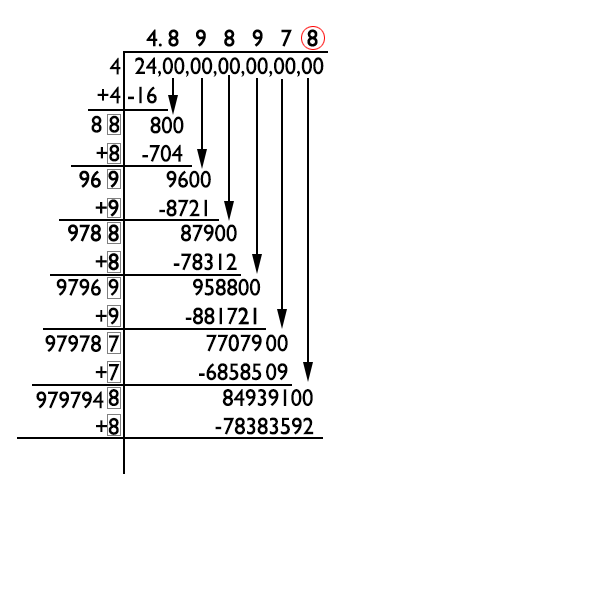
-
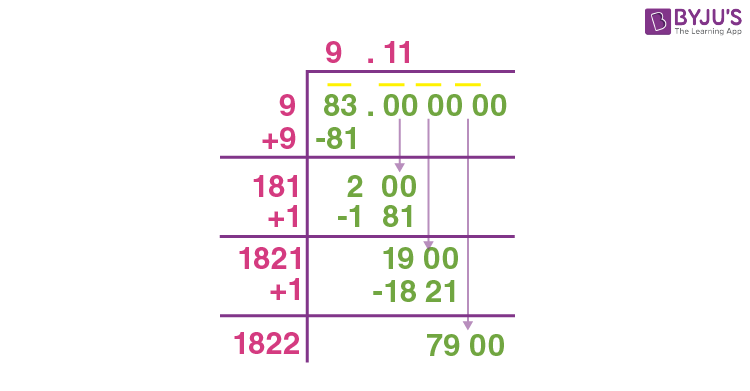
- Cubes:
- Definition:
- The cube of a number is the result of multiplying it by itself thrice: \( n^3 = n \times n \times n \).
- Example:
- \( 5^3 = 5 \times 5 \times 5 = 125 \).
- Properties:
- A perfect cube’s prime factorization has powers that are multiples of 3.
- Cubes of numbers > 1 are greater than the number; cubes of numbers between 0 and 1 are less than the number.
- Cube of a negative number is negative: \( (-n)^3 = -n^3 \).
- Cube root of a cube ending with 1, 4, 5, 6, 9, 0, 2, 3, 7, 8 ends with 1, 4, 5, 6, 9, 0, 8, 7, 3, 2, respectively.
- Cube Roots:
- Definition:
- The cube root of a number \( x \) is a number \( y \) such that \( y^3 = x \), denoted \( \sqrt[3]{x} \).
- Example:
- \( \sqrt[3]{125} = 5 \), since \( 5^3 = 125 \).
- Methods to Find Cube Root:
- Prime Factorization (only for perfect cubes):
- Factorize the number, divide the exponents by 3, and take the product.
- Example:
- Find \( \sqrt[3]{614125} \):
- \( 614125 = 5^3 \times 7^3 \).
- \( \sqrt[3]{614125} = 5 \times 7 = 35 \).
- Approximation for Large Numbers:
- Group digits in sets of three from the right.
- Use the first group for the tens digit and the last digit for the units digit.
- Example:
- Find \( \sqrt[3]{614125} \):
- 614 lies between \( 8^3 = 512 \) and \( 9^3 = 729 \), so tens digit is 8.
- Last digit 5 implies units digit is 5 (since \( 5^3 = 125 \)).
- Answer is: 85.
- Properties related to roots
- \( \sqrt{ab} = \sqrt{a} \times \sqrt{b} \)
- Example:
- \( \sqrt{36 \times 4} = \sqrt{36} \times \sqrt{4} = 6 \times 2 = 12 \)
- \( \frac{\sqrt{a}}{\sqrt{b}} = \sqrt{\frac{a}{b}} \) (when \( b \neq 0 \))
- Example:
- \( \frac{\sqrt{9}}{\sqrt{4}} = \sqrt{\frac{9}{4}} = \frac{3}{2} \)
- \( \sqrt{a^2} = |a| \)
- Example:
- \( \sqrt{(-5)^2} = \sqrt{25} = 5 \)
- \( \sqrt{a + b} \neq \sqrt{a} + \sqrt{b} \)
- Example:
- \( \sqrt{9 + 16} = \sqrt{25} = 5 \), but \( \sqrt{9} + \sqrt{16} = 3 + 4 = 7 \)
- Rationalizing the denominator:
- Example:
- Rationalize \( \frac{1}{\sqrt{2}} \):
- Multiply by \( \frac{\sqrt{2}}{\sqrt{2}} \):
- \( \frac{1}{\sqrt{2}} \times \frac{\sqrt{2}}{\sqrt{2}} = \frac{\sqrt{2}}{2} \)
- Surds:
- Definition:
- A surd is an irrational number expressed as \( \sqrt[n]{a} \), where \( a \) is rational and \( \sqrt[n]{a} \) is irrational.
- The word comes from the Latin word surdus, which means "deaf" or "mute" (silent). early mathematicians literally thought of these numbers as "mute" or "voiceless" because they couldn't be expressed as a simple ratio of integers.
- Example:
- \( \sqrt{2} \), \( \sqrt[3]{5} \).
- Types:
- Simple Surd:
- Single term, e.g., \( \sqrt{3} \), \( 4\sqrt{2} \).
- Mixed Surd:
- Rational + surd, e.g., \( 2 + \sqrt{3} \).
- Compound Surd:
- Sum or difference of surds, e.g., \( \sqrt{3} + \sqrt{7} \).
- Similar Surds:
- Multiples of the same surd, e.g., \( 2\sqrt{3} \), \( 5\sqrt{3} \).
- Dissimilar Surds:
- Different surds, e.g., \( \sqrt{2} \), \( \sqrt{3} \).
- Rationalization:
- Multiply a surd by its conjugate to make it rational. While the denominator becomes rational, the entire number usually remains irrational.
- Example:
- Rationalize \( \frac{1}{\sqrt{3}} \):
- Multiply by \( \frac{\sqrt{3}}{\sqrt{3}} \): \( \frac{1}{\sqrt{3}} \times \frac{\sqrt{3}}{\sqrt{3}} = \frac{\sqrt{3}}{3} \).
- For \( a + \sqrt{b} \), conjugate is \( a - \sqrt{b} \).
- Example:
- Rationalize \( \frac{1}{2 + \sqrt{3}} \):
- Multiply by \( \frac{2 - \sqrt{3}}{2 - \sqrt{3}} \): \( \frac{1}{2 + \sqrt{3}} \times \frac{2 - \sqrt{3}}{2 - \sqrt{3}} = \frac{2 - \sqrt{3}}{4 - 3} = 2 - \sqrt{3} \).
- Comparison of Surds:
- Surds must be of the same order. Convert to the same order using LCM of indices.
- Example:
- Compare \( \sqrt{5} \) and \( \sqrt[3]{4} \):
- Convert to order 6: \( \sqrt{5} = 5^{1/2} = 5^{3/6} = \sqrt[6]{5^3} = \sqrt[6]{125} \), \( \sqrt[3]{4} = 4^{1/3} = 4^{2/6} = \sqrt[6]{4^2} = \sqrt[6]{16} \).
- Since \( 125 > 16 \), \( \sqrt{5} > \sqrt[3]{4} \).
- Laws of Surds (Roots):
- \( \sqrt{ab} = \sqrt{a} \cdot \sqrt{b} \)
- Example: \( \sqrt{9 \cdot 4} = \sqrt{9} \cdot \sqrt{4} = 3 \cdot 2 = 6 \)
- \( \sqrt{\frac{a}{b}} = \frac{\sqrt{a}}{\sqrt{b}} \) (where \( b \neq 0 \))
- Example: \( \sqrt{\frac{25}{4}} = \frac{\sqrt{25}}{\sqrt{4}} = \frac{5}{2} \)
- \( \sqrt[n]{a^m} = (a^m)^{\frac{1}{n}} = a^{\frac{m}{n}} \)
- Example: \( \sqrt[3]{8^2} = (8^2)^{1/3} = 64^{1/3} = 4 \)
- \( a^{\frac{m}{n}} = \sqrt[n]{a^m} \) = \( (\sqrt[n]{a})^m \)
- Example: \( 27^{2/3} = (\sqrt[3]{27})^2 = 3^2 = 9 \)
- \( \sqrt[n]{a} = a^{\frac{1}{n}} \)
- Example: \( \sqrt[4]{16} = 16^{1/4} = 2 \)
- Rationalizing:
- Example:
- Rationalize \( \frac{1}{\sqrt{5}} \):
- Multiply by \( \frac{\sqrt{5}}{\sqrt{5}} \):
- \( \frac{1}{\sqrt{5}} \times \frac{\sqrt{5}}{\sqrt{5}} = \frac{\sqrt{5}}{5} \)
- Indices (Exponents):
- Definition:
- An index (or exponent) represents how many times a number (base) is multiplied by itself.
- If \( x^n \), then:
- \( x \) is the base.
- \( n \) is the exponent/index.
- It means \( x \) is multiplied by itself \( n \) times.
- Example:
- \( 2^4 = 2 \times 2 \times 2 \times 2 = 16 \)
- Laws of Indices (Exponents):
- \( a^m \times a^n = a^{m+n} \)
- Example:
- \( 2^3 \times 2^4 = 2^{3+4} = 2^7 = 128 \)
- \( \frac{a^m}{a^n} = a^{m-n} \) (where \( a \neq 0 \))
- Example:
- \( \frac{5^6}{5^2} = 5^{6-2} = 5^4 \)
- \( (a^m)^n = a^{mn} \)
- Example:
- \( (3^2)^4 = 3^{2 \times 4} = 3^8 \)
- \( a^0 = 1 \) (where \( a \neq 0 \))
- Example:
- \( 7^0 = 1 \)
- \( a^{-n} = \frac{1}{a^n} \) (where \( a \neq 0 \))
- Example:
- \( 2^{-3} = \frac{1}{2^3} = \frac{1}{8} \)
- \( (ab)^m = a^m \times b^m \)
- Example:
- \( (2 \cdot 3)^4 = 2^4 \cdot 3^4 = 16 \cdot 81 = 1296 \)
- \( \left(\frac{a}{b}\right)^m = \frac{a^m}{b^m} \) (where \( b \neq 0 \))
- Example:
- \( \left(\frac{2}{3}\right)^2 = \frac{2^2}{3^2} = \frac{4}{9} \)
- Profit, Loss and Discount
- Cost Price (CP):
- Definition:
- The price at which an article is purchased, including any overhead expenses (e.g., transportation, repairs, labor, commission).
- Actual CP = Purchase Price + Overhead Expenses.
- Note:
- Overhead expenses are included only when explicitly mentioned in the question.
- Example:
- A shopkeeper buys a chair for ₹500 and spends ₹50 on transportation. Actual CP = ₹500 + ₹50 = ₹550.
- Selling Price (SP):
- Definition:
- The price at which an article is sold.
- Example:
- If the chair (CP = ₹550) is sold for ₹700, then SP = ₹700.
- Marked Price (MP):
- Definition:
- The price listed on an article, before any discounts.
- Relationship:
- MP is typically higher than CP to allow for profit after discounts.
- Example:
- A pen has MP = ₹15, sold after 20% discount.
- SP = ₹\( 15 \times \frac{100 - 20}{100} = 12 \).
- Profit:
- Definition:
- Profit is earned when SP > CP.
- Profit = SP - CP.
- Profit percentage formula:
- \( \text{Profit Percentage} = \frac{\text{SP} - \text{CP}}{\text{CP}} \times 100 \)
or
- \( \text{Profit Percentage} = \frac{\text{Profit}}{\text{CP}} \times 100 \)
- Example:
- For CP = ₹550, SP = ₹700:
- Profit = ₹700 - ₹550 = ₹150.
- Profit % = \( \frac{150}{550} \times 100 \approx 27.27\% \).
- Loss:
- Definition:
- Loss is incurred when CP > SP.
- Loss = CP - SP.
- Loss percentage formula:
- \( \text{Loss Percentage} = \frac{\text{CP} - \text{SP}}{\text{CP}} \times 100 \)
or
- \( \text{Loss Percentage} = \frac{\text{Loss}}{\text{CP}} \times 100 \)
- Example:
- For CP = ₹550, SP = ₹500:
- Loss = ₹550 - ₹500 = ₹50.
- Loss % = \( \frac{50}{550} \times 100 \approx 9.09\% \).
- Discount:
- Definition:
- The reduction allowed on the marked price of an article is called a discount.
- Discount is always calculated on the marked price (MP).
- Discount percentage formula:
- \( \text{Discount Percentage} = \frac{\text{MP} - \text{SP}}{\text{MP}} \times 100 \)
or
- \( \text{Discount Percentage} = \frac{\text{Discount}}{\text{MP}} \times 100 \)
- Doubt resolution
- Whenever in doubt weather profit/loss/discount had MP or SP in denominator, just use the percentage change formula to figure out the denominator
- Key Formulas:
- Selling Price (SP) = Marked Price (MP) - Discount
- Discount = Marked Price - Selling Price
- Example:
- Marked Price = ₹1000, Discount = 10%
- Selling Price = ₹\( \frac{(100 - 10)}{100} \times 1000 = 0.9 \times 1000 = 900 \)
- Discount = ₹1000 - ₹900 = ₹100
- Successive Discounts:
- Definition:
- Multiple discounts applied sequentially on the reduced price after each discount.
- For successive discounts a%, b%, c%, ...:
- Step 1: Calculate net multiplier:
- Net multiplier = \( \left( 1 + \frac{a}{100} \right)\left( 1 + \frac{b}{100} \right)\left( 1 + \frac{c}{100} \right) \)
- Take \( a, b, c \) with signs (+ for increase, − for decrease)
- Step 2: Calculate net percentage change:
- Net percentage change = \( (\text{Net multiplier} - 1) \times 100\% \)
- Example:
- For successive discounts of 10% and 20%:
- \( \text{Net multiplier} = \left( 1 + \frac{10}{100} \right)\left( 1 + \frac{20}{100} \right) = 1.1 \times 1.2 = 1.32 \)
- Net percentage change:
- \( \text{Net % change} = (1.32 - 1) \times 100\% = 32\% \)
- Advanced Concepts:
- Always loss scenario:
- Definition:
- If a single article undergoes two successive percentage changes, first an increase of x% and then a decrease of x%, and this always results in a net loss.
- This also hold true for:
- Two articles with same SP, one sold at x% profit, other at x% loss, always results in a net loss.
- Formula
- Net Loss % = \( \frac{x^2}{100} \).
- Derivation
- Base assumption:
- Let the initial price = 100
- We know that, new percentage formula is:
- \( \text{New Value} = \text{Original Value} \times \left(1 + \frac{x}{100}\right) \)
- Sign changes based on weather x is positive or negative.
- After +x%:
- New value = \( 100 \times \left(1 + \frac{x}{100}\right) = 100 + x \)
- After −x%:
- New value = \( (100 + x)\left(1 - \frac{x}{100}\right) \)
- Expanding:
- \( (100 + x)\left(1 - \frac{x}{100}\right) = (100 + x)\frac{100 - x}{100} \)
- \( = \frac{10000 - x^2}{100} \)
- Final value:
- \( = 100 - \frac{x^2}{100} \)
- Final value is less than initial base price of 100.
- Net loss:
- \( = 100 - \left(100 - \frac{x^2}{100}\right) = \frac{x^2}{100} \)
- If the base price had been 200, then this would have turned out to be \( \frac{2x^2}{100} \)
- Net Loss %:
- \( \text{Net Loss %} = \frac{x^2}{100} \)
- Example:
- Two articles sold at SP = ₹100 each, one with 20% profit, other with 20% loss:
- Loss % = \( \frac{20^2}{100} = 4\% \).
- Dishonest Dealer:
- A dealer uses faulty weights or measures to cheat customers.
- Example:
- A dealer uses a 900g weight instead of 1kg, sells at CP per kg, claims no profit/loss:
- True CP = ₹100 for 1kg, but sells 900g for ₹100.
- Effective CP
- CP per gram:
- \( \text{CP per gram} = \frac{100}{1000} = 0.1 \)
- CP for 900 g:
- \( \text{Effective CP of 900 g} = 900 \times 0.1 = 90 \)
- Profit % = \( \frac{100 - 90}{90} \times 100 \approx 11.11\% \).
- Successive Profit and Loss:
- Example:
- A product is sold at 20% profit, then the buyer sells it at 25% profit:
- If CP = ₹100, first SP = ₹\( 100 \times 1.2 = 120 \).
- Second SP = ₹\( 120 \times 1.25 = 150 \).
- Net profit % = \( \frac{150 - 100}{100} \times 100 = 50\% \).
- Break-Even Point:
- When CP = SP, no profit or loss.
- Example:
- CP = ₹100, discount = 20% on MP. Find MP for no profit/loss:
- SP = CP = ₹100 = \( \text{MP} \times \frac{100 - 20}{100} \)
- MP = ₹\( \frac{100 \times 100}{80} = 125 \)
- Ratio, Proportion, Partnership and Mixture
- Ratio:
- Definition:
- A ratio is a comparison of two or more quantities of the same kind by division.
- In any ratio, multiplying or dividing all terms by the same non-zero number does not change the ratio.
- For two quantities:
- \( a : b \) represents the fraction \( \frac{a}{b} \).
- Here, \(a\) is called the antecedent and \(b\) the consequent.
- For three or more quantities:
- \( a : b : c \) or \( a : b : c : d \) does not represent a single fraction.
- Instead, it is represented by a system of proportional fractions:
- For a : b : c:
- First pair:
- \( \frac{a}{b} \)
- Second pair:
- \( \frac{b}{c} \)
- All must be equal:
- \( \frac{a}{b} = \frac{b}{c} \)
- For a : b : c : d:
- First pair:
- \( \frac{a}{b} \)
- Second pair:
- \( \frac{b}{c} \)
- Third pair:
- \( \frac{c}{d} \)
- All must be equal:
- \( \frac{a}{b} = \frac{b}{c} = \frac{c}{d} \)
- Classification of Ratios:
- Simple Ratio:
- Comparison of two quantities (e.g., \( 3:5 \)).
- Compound Ratio:
- Product of two or more ratios (e.g., for \( a:b \), \( c:d \), compound ratio = \( a \times c : b \times d \)).
- Example:
- Compound ratio of \( 2:3 \) and \( 4:5 \) = \( 2 \times 4 : 3 \times 5 = 8:15 \).
- Duplicate Ratio:
- Square of a ratio (e.g., for \( a:b \), duplicate = \( a^2:b^2 \)).
- Reciprocal Ratio:
- Inverse of a ratio (e.g., for \( a:b \), reciprocal = \( b:a \)).
- Relation Among Two Quantities:
- Direct Relation:
- If one quantity increases, the other increases (e.g., more workers, more work).
- Inverse Relation:
- If one quantity increases, the other decreases (e.g., more speed, less time).
- Dividing a Quantity in a Given Ratio:
- Statement:
- If a total quantity \( A \) is to be divided among two or more parts in a given ratio, then each part can be found by multiplying the total \( A \) by its share in the ratio and dividing by the sum of all ratio terms.
- Formula:
- For ratio \( a_1:a_2 \), sum \( A \):
- Quantities = \( \frac{a_1 A}{a_1 + a_2} \), \( \frac{a_2 A}{a_1 + a_2} \).
- For three quantities in \( a_1:a_2:a_3 \), sum \( A \):
- Quantities = \( \frac{a_1 A}{a_1 + a_2 + a_3} \), \( \frac{a_2 A}{a_1 + a_2 + a_3} \), \( \frac{a_3 A}{a_1 + a_2 + a_3} \).
- Derivation:
- Step 1: Represent quantities using a common multiplier
- \( a_1 x \)
- \( a_2 x \)
- Step 2: Use the given sum
- \( a_1 x + a_2 x = A \)
- \( x (a_1 + a_2) = A \)
- \( x = \frac{A}{a_1 + a_2} \)
- Step 3: Substitute for x
- First quantity:
- \( a_1 x = \frac{a_1 A}{a_1 + a_2} \)
- Second quantity:
- \( a_2 x = \frac{a_2 A}{a_1 + a_2} \)
- Example:
- Ratio 20:39, sum 295. Find numbers:
- First = \( \frac{20}{20 + 39} \times 295 = \frac{20}{59} \times 295 = 100 \).
- Second = \( \frac{39}{59} \times 295 = 195 \).
- Answer is: 100, 195.
- Ratio Transformation by Equal Addition:
- Statement:
- If two numbers are in the ratio \( a:b \), and after adding the same number to both they become \( c:d \), then the added number can be determined using a fixed algebraic formula.
- Formula:
- \( k = \frac{ad - bc}{\,c - d\,} \)
- Derivation:
- Step 1: Represent the two numbers
- \( ax \)
- \( bx \)
- Step 2: Add the same number k to both
- \( ax + k \)
- \( bx + k \)
- Step 3: Form the new ratio
- \( \frac{ax + k}{bx + k} = \frac{c}{d} \)
- \( d(ax + k) = c(bx + k) \)
- \( adx + dk = bcx + ck \)
- \( adx - bcx = ck - dk \)
- \( x(ad - bc) = k(c - d) \)
- \( k = \frac{x(ad - bc)}{c - d} \)
- Step 4: Take x = 1
- It's common for both numerator and denominator and cancels out
- \( k = \frac{ad - bc}{c - d} \)
- Example:
- Two numbers are in ratio 5:7, find the number to add to both to make the ratio 3:4.
- a = 5, b = 7, c = 3, d = 4
- Apply formula:
- \( \frac{(5 \times 4) - (7 \times 3)}{3 - 4} = \frac{20 - 21}{-1} = \frac{-1}{-1} = 1 \)
- Answer is:
- Add 1 to both numbers.
- Ratio Transformation by Equal Subtraction:
- Statement:
- If two numbers are in the ratio \( a:b \), and after subtracting the same number from both they become \( c:d \), then the subtracted number can be determined using a fixed algebraic formula.
- Formula
- \( \frac{ad - bc}{d - c} \)
- Derivation:
- Step 1: Represent the two numbers
- \( ax \)
- \( bx \)
- Step 2: Subtract the same number k from both
- \( ax - k \)
- \( bx - k \)
- Step 3: Form the new ratio
- \( \frac{ax - k}{bx - k} = \frac{c}{d} \)
- \( d(ax - k) = c(bx - k) \)
- \( adx - dk = bcx - ck \)
- \( adx - bcx = dk - ck \)
- \( x(ad - bc) = k(d - c) \)
- \( k = \frac{x(ad - bc)}{d - c} \)
- Step 4: Take x = 1
- It's common for both numerator and denominator and cancels out
- \( k = \frac{ad - bc}{d - c} \)
- Example:
- Two numbers are in ratio 5:7, find the number to subtract from both to make the ratio 3:4.
- a = 5, b = 7, c = 3, d = 4
- Apply formula:
- \( \frac{(5 \times 4) - (7 \times 3)}{3 - 4} = \frac{20 - 21}{-1} = \frac{-1}{-1} = 1 \)
- Answer is:
- Subtract 1 from both numbers.
- Proportion:
- Definition:
- Proportion is just a fancy word for “two ratios are equal.”
- Represented as:
- \( a:b::c:d \)
- or
- \( a:b = c:d \)
- Where \( a \times d = b \times c \)
- Extremes (\( a, d \)), means (\( b, c \)).
- Classification of Proportions:
- Direct Proportion:
- If one quantity increases, the other increases (e.g., \( x \propto y \)).
- More input, more output (e.g., more workers, more work).
- Inverse Proportion:
- If one quantity increases, the other decreases (e.g., \( x \propto \frac{1}{y} \)).
- More input, less output (e.g., more workers, fewer days).
- Continued Proportion:
- \( a:b::b:c \), so \( b^2 = a \times c \).
- Mean Proportion:
- \( a:x::x:b \), so \( x = \sqrt{a b} \).
- Fourth Proportion:
- \( a:b::c:x \), so \( x = \frac{b \times c}{a} \).
- Properties:
- Invertendo:
- \( a:b::c:d \implies b:a::d:c \).
- Alternendo:
- \( a:b::c:d \implies a:c::b:d \).
- Componendo:
- \( a:b::c:d \implies (a+b):b::(c+d):d \).
- Dividendo:
- \( a:b::c:d \implies (a-b):b::(c-d):d \).
- Componendo-Dividendo:
- \( a:b::c:d \implies (a+b):(a-b)::(c+d):(c-d) \).
- Example:
- Find fraction \( x \) such that \( x:\frac{3}{7} = \frac{1}{5}:\frac{7}{15} \):
- \( \frac{x}{\frac{3}{7}} = \frac{\frac{1}{5}}{\frac{7}{15}} \).
- \( x = \frac{3}{7} \times \frac{1}{5} \times \frac{15}{7} = \frac{9}{49} \).
- Answer is:
- \( \frac{9}{49} \).
- Unitary Method:
- Definition:
- Find value of one unit, then scale to required quantity using direct or inverse proportion.
- Example:
- Cost of 15 eggs = ₹75. Find cost of 5 dozen eggs:
- Cost per egg = \( \frac{75}{15} = 5 \).
- 5 dozen = \( 5 \times 12 = 60 \) eggs.
- Cost = ₹\( 60 \times 5 = 300 \).
- Answer is:
- ₹300.
- Partnership:
- Definition:
- Two or more persons invest money to run a business, sharing profits/losses based on investment and time.
- Formulae:
- The ratio of profits \( P_1 : P_2 \) in a partnership is equal to the product of investment and time:
- \( P_1 : P_2 = x_1 \times t_1 : x_2 \times t_2 \)
- Where \( x_i \) = investment, \( t_i \) = time
- Derivation of Partnership Profit Formula:
- Step 1: Find proportionality
- Profit is directly proportional to investment:
- \( P \propto x \)
- Profit is directly proportional to time:
- \( P \propto t \)
- Combining both proportionalities:
- \( P \propto x \times t \)
- \( P = k x t \)
- Step 2: For two partners:
- \( P_1 = k x_1 t_1 \)
- \( P_2 = k x_2 t_2 \)
- Step 3: Take ratio of their profits:
- \( \frac{P_1}{P_2} = \frac{k x_1 t_1}{k x_2 t_2} \)
- \( \frac{P_1}{P_2} = \frac{x_1 t_1}{x_2 t_2} \)
- Step 4: Write in ratio form:
- \( P_1 : P_2 = x_1 t_1 : x_2 t_2 \)
- Types of partnerships:
- Simple Partnership:
- Equal time
- Compound Partnership:
- Different times
- Kinds of Partners:
- This information does not matter at all for calculations, it's just here so that if question tries to confuse then I am aware of this.
- Active Partner:
- Manages business.
- Sleeping Partner:
- Invests money only.
- Examples:
- Example 1:
- Problem statement:
- A and B invest in the ratio \(4:3\).
- Solution:
- A invests for \(1\) year and B invests for \(2\) years.
- We know that:
- \( P_1 : P_2 = x_1 t_1 : x_2 t_2 \)
- Calculate:
- \( P_1 : P_2 = (4 \times 1) : (3 \times 2) = 4 : 6 \)
- Example 2:
- Problem statement:
- Three partners invest a total of \(80{,}000\) in a business.
- Their respective profits at the end of the year are \(18{,}000, 30{,}000,\) and \(48{,}000\).
- Find the investment of the second partner.
- Solution:
- Let the investments of the three partners be \(x_1, x_2, x_3\).
- Since all partners invest for the same duration, let the time be \(t\) for each.
- Using the partnership formula:
- \(P_1 : P_2 : P_3 = x_1 t : x_2 t : x_3 t\)
- Cancelling t:
- \(P_1 : P_2 : P_3 = x_1 : x_2 : x_3\)
- Calculating investment ratio:
- \(18{,}000 : 30{,}000 : 48{,}000 = x_1 : x_2 : x_3\)
- \(3 : 5 : 8 = x_1 : x_2 : x_3\)
- This gives us the ratio of investment, now we just have to translate this ratio into amounts
- Using unitary method
- Total ratio parts:
- \(3 + 5 + 8 = 16\)
- Value of one part:
- \(\frac{80{,}000}{16} = 5{,}000\)
- Calculate decond partner’s investment:
- \(x_2 = 5 \times 5{,}000 = 25{,}000\)
- Allegation:
- Definition:
- Allegation is a method used to find the ratio in which different ingredients must be mixed so that their weighted average (mean) becomes a given value.
- Calculation:
- Given:
- Prices of items = \( p_1, p_2, p_3, \ldots, p_n \)
- Mean (mixture) price = \( m \)
- Let:
- Quantities of items = \( q_1, q_2, q_3, \ldots, q_n \)
- Step 1: Classify each item by price relative to the mean:
- If \( p_i < m \) → Cheaper item (negative deviation)
- If \( p_i > m \) → Dearer item (positive deviation)
- Step 2: Compute deviation from the mean for each item:
- For each cheaper item \( p_i < m \):
- Downward deviation = \( m - p_i \)
- For each dearer item \( p_j > m \):
- Upward deviation = \( p_j - m \)
- Step 3: Compute total deviations on each side:
- Total cheaper deviation:
- \( D_C = \sum (m - p_i) \) for all cheaper items \( p_i < m \)
- Total dearer deviation:
- \( D_D = \sum (p_j - m) \) for all dearer items \( p_j > m \)
- Step 4: Apply mean-balance (cross-allegation) rule:
- Apply as:
- For sample:
- \( q_1, q_2 \) -> cheaper
- \( q_3 \) -> dearer
- \( q_1 : q_2 : q_3 = D_D : D_D : D_C \)
- Derivation
- The arithmetic mean requires:
- Total downward pull from cheaper items = Total upward pull from dearer items
- i.e., \( \sum q_i (m - p_i) = \sum q_j (p_j - m) \)
- This can be represented as:
- For sample:
- \( q_1, q_2 \) -> cheaper
- \( q_3 \) -> dearer
- Balance condition of arithmetic mean for 3 items is:
- \( q_1 d_1 + q_2 d_2 = q_3 d_3 \)
- This equation must hold so that the mixture price is exactly m.
- But this equation has infinitely many solutions as \( q_1, q_2, q_3 \) can take infinite values.
- One of those infinite solution is to:
- Take:
- \( q_1 = q_2 = d_3 \)
- \( q_3 = d_1 + d_2 \)
- Which makes LHS = RHS:
- \( d_3 d_1 + d_3 d_2 = (d_1 + d_2) d_3 \)
- So, the quantities which satisfy the mixture are in ratio:
- \( q_1 : q_2 : q_3 = d_3 : d_3 : (d_1 + d_2) \)
- Or
- \( q_1 : q_2 : q_3 = D_D : D_D : D_C \)
- Step 5: So, the final ratio can be considered:
- \( q_1 : q_2 : q_3 = D_D : D_D : D_C \)
- Examples
- Example 1 (2 quantities):
- Problem:
- Rice at ₹7.50/kg and ₹10/kg is mixed to get a mixture worth ₹8.25/kg.
- Find the ratio in which the two types are mixed.
- Given:
- Prices = 7.50, 10
- Mean price \( m = 8.25 \)
- Step 1: Classify relative to mean:
- 7.50 < 8.25 → Cheaper
- 10 > 8.25 → Dearer
- Step 2: Compute deviations from mean:
- \(10 - 8.25 = 1.75\)
- \(8.25 - 7.50 = 0.75\)
- Step 3: Compute total deviations:
- Total cheaper deviation = \(0.75\)
- Total dearer deviation = \(1.75\)
- Step 4: Apply cross-allegation:
- Quantity of cheaper = dearer deviation = \(1.75\)
- Quantity of dearer = cheaper deviation = \(0.75\)
- Step 5: Write ratio:
- Cheaper rice : Rearer rice = \( 1.75 : 0.75\)
- Step 6: Convert to whole numbers:
- Multiply both by 4:
- \(1.75 \times 4 : 0.75 \times 4 = 7 : 3\)
- Final Answer:
- Cheaper : Dearer = \(7 : 3\)
- Example 2 (3 quantities):
- Problem:
- Milk at ₹20, ₹25 and ₹30 per litre are mixed to get a mixture worth ₹26 per litre.
- Find the ratio in which the three are mixed.
- Given:
- Prices = 20, 25, 30
- Mean price \( m = 26 \)
- Step 1: Classify relative to mean:
- 20 < 26 → Cheaper
- 25 < 26 → Cheaper
- 30 > 26 → Dearer
- Step 2: Compute deviations from mean:
- \(30 - 26 = 4\)
- \(26 - 20 = 6\)
- \(26 - 25 = 1\)
- Step 3: Compute total deviations:
- Total cheaper deviation = \(6 + 1 = 7\)
- Total dearer deviation = \(4\)
- Why they don't cancel out?
- According to fundamentals, total cheaper deviation cancels out total dearer deviation, then why don't it cancel out here?
- This is because we have not yet decided how much of each milk is used. As soon as quantities are pegged to these values, they will cancel out.
- Step 4: Apply cross-allegation:
- Quantity of each cheaper = deviation of dearer side = \(4\)
- Quantity of dearer = sum of deviations of cheaper side = \(7\)
- Step 5: Write ratio:
- \(20 : 25 : 30 = 4 : 4 : 7\)
- Step 6: Verification:
- \( \frac{20 \times 4 + 25 \times 4 + 30 \times 7}{4 + 4 + 7} = \frac{390}{15} = 26 \)
- Replacement (Dilution):
- Definition:
- Replacement refers to the process where a certain quantity of liquid is removed from a container and replaced with another liquid.
- With each replacement, the proportion of the original liquid decreases.
- Formula:
- Amount of original liquid left after \( n \) replacements = \( x \left(1 - \frac{y}{x}\right)^n \)
- Derivation:
- Given:
- Capacity of container = original liquid = \( x \)
- Quantity removed and replaced each time = \( y \)
- Number of replacements = \( n \)
- Step 1: First replacement:
- Fraction removed = \( \frac{y}{x} \)
- Fraction remaining = \( 1 - \frac{y}{x} \)
- Original liquid quality left:
- Original quantity * Remaining fraction
- Or
- \( x \left(1 - \frac{y}{x}\right) \)
- Step 2: Second replacement:
- The same fraction \( \frac{y}{x} \) of the remaining liquid is removed.
- Original liquid left:
- \( x \left(1 - \frac{y}{x}\right)\left(1 - \frac{y}{x}\right) = x \left(1 - \frac{y}{x}\right)^2 \)
- Step 3: After \( n \) replacements:
- Original liquid left:
- \( x \left(1 - \frac{y}{x}\right)^n \)
- Example:
- A vessel contains 100 litres of milk.
- 10 litres is removed and replaced with water each time.
- This is done 3 times.
- Given:
- \( x = 100 \)
- \( y = 10 \)
- \( n = 3 \)
- Calculate:
- \( 100 \left(1 - \frac{10}{100}\right)^3 \)
- \( = 100 (0.9)^3 \)
- \( = 100 \times 0.729 \)
- \( = 72.9 \) litres
- So, after 3 replacements, 72.9 litres of milk remains.
- Time and Work
- Basic Concept:
- Definition:
- Work is considered 1 unit (e.g., digging a trench, filling a tank).
- If a person completes a work in \( n \) days, work done per day = \( \frac{1}{n} \).
- Number of days = \( \frac{1}{\text{Work done in one day}} \).
- Core Proportionality Concepts:
- People \( \propto \) Work
- More people → more work done.
- Fewer people → less work done.
- People \( \propto \frac{1}{\text{Time}} \)
- More people → less time needed to complete work.
- Fewer people → more time required.
- Time \( \propto \) Work
- More time → more work done.
- Less time → less work done.
- Work Rate Formulae:
- Individual Work Rate:
- Definition:
- Work rate = \( \frac{1}{\text{Time taken}} \).
- Example:
- A man completes a job in 15 days. Find work done per day:
- Work rate = \( \frac{1}{15} \).
- Answer is:
- \( \frac{1}{15} \) of the work per day.
- Combined Work Rate:
- Definition:
- Multiple workers combine their work rates to complete a job.
- Total work rate = Sum of individual rates.
- Example:
- A, B, C take 12, 15, 20 days respectively. Find time taken together:
- Combined rate = \( \frac{1}{12} + \frac{1}{15} + \frac{1}{20} = \frac{5 + 4 + 3}{60} = \frac{12}{60} = \frac{1}{5} \).
- Time = \( \frac{1}{\frac{1}{5}} = 5 \) days.
- Answer is:
- 5 days.
- Man-Days Concept:
- Definition:
- Total work = (Number of men) × (Days) × (Hours per day).
- If \( M_1 \) men work \( D_1 \) days for \( H_1 \) hours to complete work \( W_1 \), and \( M_2 \) men work \( D_2 \) days for \( H_2 \) hours for work \( W_2 \), then:
- \( W \propto M \times D \times H \)
- \( \frac{W_1}{W_2} = \frac{M_1 D_1 H_1}{M_2 D_2 H_2} \)
- \( M_1 D_1 H_1 W_2 = M_2 D_2 H_2 W_1 \)
- Example:
- 12 men complete a job in 10 days, working 8 hours/day. Find days for 15 men working 6 hours/day:
- Man-days = \( 12 \times 10 \times 8 = 960 \).
- Days = \( \frac{960}{15 \times 6} = \frac{960}{90} \approx 10.67 \).
- Answer is:
- Approximately 10.67 days.
- Efficiency of Workers:
- Definition:
- Efficiency is proportional to work rate (e.g., if A takes 10 days, B takes 20 days, A is twice as efficient).
- Efficiency ratio = Inverse of time ratio.
- Example:
- A is 25% more efficient than B. B takes 20 days. Find A’s time:
- Efficiency ratio = 125:100 = 5:4.
- Time ratio = 4:5.
- A’s time = \( \frac{4}{5} \times 20 = 16 \) days.
- Answer is:
- 16 days.
- Additional Manpower:
- Definition:
- Adjust workforce to meet a deadline, accounting for hours/day or remaining work.
- Use man-days formula to balance work.
- Example:
- 20 men work 8 hours/day for 10 days and complete \( \frac{2}{5} \) of a job. Find the additional men needed to finish the remaining work in 5 more days working 10 hours/day:
- Given:
- \( M_1 = 20,\; D_1 = 10,\; H_1 = 8,\; W_1 = \frac{2}{5} \)
- Remaining work \( = \frac{3}{5} \)
- \( D_2 = 5,\; H_2 = 10,\; M_2 = ? \)
- Let the additional men required be \( x \):
- Total men in the second phase = \( M_2 = M_1 + x \)
Or
- \( M_2 = 20 + x \)
- Since work is proportional to men, days and hours:
- \( W \propto M \times D \times H \)
- Form the ratio:
- \(
\frac{\text{Remaining Work}}{\text{Work Done}}
=
\frac{M_2 D_2 H_2}{M_1 D_1 H_1}
\)
- Substitute values:
- \(
\frac{\frac{3}{5}}{\frac{2}{5}}
=
\frac{(20+x)\times 5 \times 10}{20 \times 10 \times 8}
\)
- Simplify:
- \(
\frac{3}{2}
=
\frac{20 + x}{32}
\)
- \(
48 - 20 = 28
\)
- Final answer is:
- \( 28 \) men
- Pipes and Cisterns:
- Definition:
- Inlet pipe fills a tank; outlet pipe empties it.
- If inlet fills in \( a \) hours, rate = \( \frac{1}{a} \).
- If outlet empties in \( b \) hours, rate = \( -\frac{1}{b} \).
- Net rate = \( \frac{1}{a} - \frac{1}{b} \).
- Net rate = \( \frac{1}{\text{Time to fill/empty}} \).
- Example:
- Pipe A fills a tank in 10 hours, Pipe B empties it in 15 hours. Find time to fill an empty tank if both are open:
- Net rate = \( \frac{1}{10} - \frac{1}{15} = \frac{3 - 2}{30} = \frac{1}{30} \).
- Time = \( \frac{1}{\frac{1}{30}} = 30 \) hours.
- Answer is:
- 30 hours.
- Pipes and Cisterns with Partial Tank:
- Definition:
- Tank starts partially full/empty; calculate time to fill/empty with inlet/outlet pipes.
- Adjust initial work and use net rate.
- Example:
- Tank is \( \frac{1}{3} \) full. Pipe A fills in 9 hours, Pipe B empties in 6 hours. Find time to empty:
- Net rate = \( \frac{1}{9} - \frac{1}{6} = \frac{2 - 3}{18} = -\frac{1}{18} \).
- Work to empty = \( \frac{1}{3} \).
- Time = \( \frac{\frac{1}{3}}{\frac{1}{18}} = \frac{1}{3} \times 18 = 6 \) hours.
- Answer is:
- 6 hours.
- Speed, Time and Distance
- Basic Concepts:
- Definition:
- Speed = \( \frac{\text{Distance}}{\text{Time}} \).
- Unit conversions:
- km/h to m/s:
- Multiply by \( \frac{5}{18} \).
- m/s to km/h:
- Multiply by \( \frac{18}{5} \).
- Example:
- A car travels 240 km at 60 km/h. Find time taken:
- Time = \( \frac{240}{60} = 4 \) hours.
- Answer is:
- 4 hours.
- Average Speed:
- Definition:
- Average speed = \( \frac{\text{Total distance}}{\text{Total time}} \).
- Applies to varying speeds or distances.
- Formula
- \( \text{Average speed} = \frac{d_1 + d_2 + \cdots + d_n}{\frac{d_1}{v_1} + \frac{d_2}{v_2} + \cdots + \frac{d_n}{v_n}} \)
- Example:
- A cyclist travels 30 km at 15 km/h and 40 km at 20 km/h. Find average speed:
- Time for 30 km = \( \frac{30}{15} = 2 \) hours.
- Time for 40 km = \( \frac{40}{20} = 2 \) hours.
- Average speed = \( \frac{30 + 40}{2 + 2} = \frac{70}{4} = 17.5 \) km/h.
- Answer is:
- 17.5 km/h.
- Train-Based Problems:
- Core Formula:
- Speed = \( \frac{\text{Distance}}{\text{Time}} \)
- Distance = Train Length + Object/Bridge Length (when applicable)
- Case 1 - Train vs Stationary Object (Pole, Man etc.):
- Formula:
- Time = \( \frac{\text{Length of Train}}{\text{Speed}} \)
- Example:
- A 400 m train crosses a pole in 20 seconds.
- Speed = \( \frac{400}{20} = 20 \) m/s = \( 20 \times \frac{18}{5} = 72 \) km/h
- Case 2 - Train vs Stationary Object with Length (Platform, Bridge):
- Formula:
- Time = \( \frac{\text{Train Length} + \text{Object Length}}{\text{Speed}} \)
- Example:
- Train = 300 m, Platform = 200 m, Speed = 60 km/h
- Speed in m/s = \( \frac{60 \times 1000}{3600} = 16.67 \) m/s
- Time = \( \frac{300 + 200}{16.67} ≈ 30 \) seconds
- Case 3 - Train vs Moving Person (Negligible Length):
- Time when both move in:
- Same direction:
- \( \frac{\text{Train Length}}{\text{Train Speed} - \text{Person Speed}} \)
- Opposite direction:
- \( \frac{\text{Train Length}}{\text{Train Speed} + \text{Person Speed}} \)
- Example:
- Train = 240 m, Speed = 54 km/h, Man = 6 km/h, same direction
- Relative Speed = \( 54 - 6 = 48 \) km/h = \( \frac{48 \times 1000}{3600} = 13.33 \) m/s
- Time = \( \frac{240}{13.33} ≈ 18 \) seconds
- Case 4 - Train vs Train (Both Have Length):
- Time when both move in:
- Same direction:
- \( \frac{\text{Length}_1 + \text{Length}_2}{| \text{Speed}_1 - \text{Speed}_2 |} \)
- Opposite direction:
- \( \frac{\text{Length}_1 + \text{Length}_2}{\text{Speed}_1 + \text{Speed}_2} \)
- Example:
- Train A = 400 m at 72 km/h, Train B = 600 m at 54 km/h, opposite direction
- Relative speed = \( 72 + 54 = 126 \) km/h = \( \frac{126 \times 1000}{3600} = 35 \) m/s
- Time = \( \frac{400 + 600}{35} = \frac{1000}{35} ≈ 28.57 \) seconds
- Boats and Streams:
- Where:
- B = Boat speed
- S = Stream speed
- U = Boat's upstream speed (against stream)
- D = Boat's downstream speed (along stream)
- Downstream speed:
- \( (B + S) \) km/h
- Upstream speed:
- \( (B - S) \) km/h
- Boat speed in still water
- \( \frac{\text{Boat's Downstream speed} + \text{Boat's Upstream speed}}{2} \)
- Derivation:
- We know:
- \( D = B + S \)
- \( U = B - S \)
- Calculate for B:
- \( D + U = (B+S) + (B-S) \)
- \( D + U = 2B \)
- \( B = \frac{D + U}{2} \)
- Stream speed:
- \( \frac{\text{Boat's Downstream speed} - \text{Boat's Upstream speed}}{2} \)
- Derivation:
- We know:
- \( D = B + S \)
- \( U = B - S \)
- Calculate for S:
- \( D - U = (B+S) - (B-S) \)
- \( D - U = 2S \)
- \( S = \frac{D - U}{2} \)
- Example:
- A boat’s downstream speed is 15 km/h, upstream speed is 9 km/h. Find boat and stream speeds:
- Boat speed = \( \frac{15 + 9}{2} = 12 \) km/h.
- Stream speed = \( \frac{15 - 9}{2} = 3 \) km/h.
- Answer is:
- Boat speed = 12 km/h, Stream speed = 3 km/h.
- Speed Change Affecting Arrival Time:
- Formula:
- Usual time = \( \frac{a}{1 - \frac{y}{x}} \)
- Where:
- \( a \) = time saved
- \( \frac{x}{y} \) = new speed as a fraction of old speed
- It inverses in the final formula to \( \frac{y}{x} \)
- Derivation:
- Let:
- \( T = \text{usual time} \)
- \( v = \text{usual speed} \)
- \( a = \text{time saved} \)
- Change in speed:
- \( \text{New speed} = v \times \ \frac{x}{y} \)
- Change in time:
- \( T_{\text{new}} = \frac{D}{\frac{x}{y}v} \)
- \( T_{\text{new}} = \frac{y}{x} \cdot \frac{D}{v} \)
- \( \text{New time} = \frac{y}{x} \, T \)
- Time saved:
- \( a = T - \frac{y}{x}T \)
- \( a = T \left( 1 - \frac{y}{x} \right) \)
- Usual time:
- \( T = \frac{a}{1 - \frac{y}{x}} \)
- Example:
- A bus at 3/5 of its usual speed arrives 20 min early. Find usual time:
- Usual time = \( \frac{20}{1 - \frac{3}{5}} = \frac{20}{\frac{2}{5}} = 20 \times \frac{5}{2} = 50 \) min.
- Answer is:
- 50 minutes.
- Simple and Compound Interest
- Basic Concepts:
- Definitions:
- Principal (P):
- Sum of money lent or borrowed (e.g., capital).
- Amount (A):
- Sum of principal and interest (A = P + SI or A = P + CI).
- Time (T or n):
- Duration for which money is lent or borrowed (in years).
- Rate of Interest (R or r):
- Percentage rate charged on principal per annum.
- Simple Interest (SI):
- Interest calculated only on original principal.
- Compound Interest (CI):
- Interest added to principal periodically, becoming new principal.
- Example:
- A loan of ₹5000 is taken. Identify principal and define amount:
- Principal (P) = ₹5000.
- Amount = ₹5000 + Interest (SI or CI, depending on type).
- Answer is:
- Principal = ₹5000, Amount depends on interest calculated.
- Simple Interest:
- Formulae for Amount:
- Amount = \( P\left(1 + \frac{R \times T}{100}\right) \)
- Derivation:
- Given:
- Principal = \( P \)
- Rate = \( R\% \) per year
- Time = \( T \) years
- Amount in 1'st year:
- \( P + P \times \frac{R}{100} \)
- Total amount on ₹P for 2 year:
- \( P + P \times \frac{R}{100} + P \times \frac{R}{100} \)
- \( P + 2 \times P \times \frac{R}{100} \)
- Total amount for T year:
- \( P + T \times P \times \frac{R}{100} \)
or
- \( P\left(1 + \frac{R \times T}{100}\right) \)
- Formulae for SI:
- SI = \( \frac{P \times R \times T}{100} \)
- Derivation:
- Given:
- Principal = \( P \)
- Rate of interest per year = \( R\% \)
- Time in years = \( T \)
- Interest on ₹P in 1'st year:
- We know that:
- \( \text{given} = \frac{\text{Percentage} \times \text{total}}{100} \)
- So, interest:
- \( P \times \frac{R}{100} \)
- Total interest on ₹P for 2 year:
- \( P \times \frac{R}{100} + P \times \frac{R}{100} \)
- \( 2 \times P \times \frac{R}{100} \)
- Total interest for T year:
- \( T \times P \times \frac{R}{100} \)
or
- \( \frac{P \times R \times T}{100} \)
- Example:
- Find SI and Amount for ₹4000 at 5% per annum for 3 years:
- SI = \( \frac{4000 \times 5 \times 3}{100} = 600 \) ₹.
- Amount = \( 4000 + 600 = 4600 \) ₹.
- Answer is:
- SI = ₹600, Amount = ₹4600.
- Compound Interest:
- Formulae for amount:
- Amount = \( P \left(1 + \frac{R}{100}\right)^T \)
- Derivation:
- Given:
- Principal = \( P \)
- Rate = \( R\% \) per year
- Number of years = \( T \)
- Amount after 1st year:
- \( P + P \times \frac{R}{100} \)
- \( P\left(1 + \frac{R}{100}\right) \)
- Amount after 2nd year:
- \( P\left(1 + \frac{R}{100}\right) + P\left(1 + \frac{R}{100}\right) \times \frac{R}{100} \)
- \( P\left(1 + \frac{R}{100}\right)\left(1 + \frac{R}{100}\right) \)
- \( P\left(1 + \frac{R}{100}\right)^2 \)
- Amount after 3rd year:
- \( P\left(1 + \frac{R}{100}\right)^2 + P\left(1 + \frac{R}{100}\right)^2 \times \frac{R}{100} \)
- \( P\left(1 + \frac{R}{100}\right)^3 \)
- Continuing this pattern, after T years:
- \( P\left(1 + \frac{R}{100}\right)^T \)
- Formulae for CI:
- CI = \( P \left[ \left(1 + \frac{R}{100}\right)^T - 1 \right] \)
- Derivation:
- Given:
- Principal = \( P \)
- Rate of interest per year = \( R\% \)
- Time in years = \( T \)
- Interest in 1st year:
- We know that:
- \( \text{given} = \frac{\text{Percentage} \times \text{total}}{100} \)
- So, interest:
- \( P \times \frac{R}{100} \)
- Interest in 2nd year:
- Current base = \( \left(P + P\frac{R}{100}\right) \)
- Interest on current base = \( \left(P + P\frac{R}{100}\right)\frac{R}{100} = P\left(1+\frac{R}{100}\right)\frac{R}{100} \)
- Interest in 3rd year:
- Current base = \( P + P\frac{R}{100} + P\left(1+\frac{R}{100}\right)\frac{R}{100} \)
- Interest on current base = \( \left[ P + P\frac{R}{100} + P\left(1+\frac{R}{100}\right)\frac{R}{100} \right] \frac{R}{100} = P\left(1+\frac{R}{100}\right)^2 \frac{R}{100} \)
- Total interest after T years:
- \( P\frac{R}{100}\left[1 + \left(1+\frac{R}{100}\right) + \left(1+\frac{R}{100}\right)^2 + \cdots + \left(1+\frac{R}{100}\right)^{T-1}\right] \)
- This is a geometric series, whose sum is:
- \( P\left[\left(1 + \frac{R}{100}\right)^T - 1\right] \)
- Note:
- For fractional years (e.g., 2 years 4 months), convert to decimal (e.g., \( n = 2 + \frac{4}{12} = \frac{7}{3} \))
- Example:
- Find CI on ₹5000 at 10% per annum for 2 years, compounded annually:
- Amount = \( 5000 \left(1 + \frac{10}{100}\right)^2 = 5000 \times 1.1^2 = 5000 \times 1.21 = 6050 \) ₹
- CI = \( 6050 - 5000 = 1050 \) ₹
- Answer is:
- CI = ₹1050
- Difference between SI and CI:
- Formula:
- CI - SI = \( P\left[\left(1+\frac{R}{100}\right)^T - 1 - \frac{TR}{100}\right] \)
- Derivation:
- Just put the actual formulas of CI and SI in "CI - SI"
- Example:
- Find difference between CI and SI on ₹10000 at 10% per annum for 2 years:
- SI:
- \( \frac{10000 \times 10 \times 2}{100} = 2000 \)
- CI:
- \( 10000 \left(\left(1 + \frac{10}{100}\right)^2 - 1\right) \)
- \( 10000 \times (1.21 - 1) = 2100 \)
- Difference:
- \( 2100 - 2000 = 100 \)
- Using shortcut formula:
- \( 10000\left[\left(1+\frac{10}{100}\right)^2 - 1 - \frac{2 \times 10}{100}\right] \)
- \( 10000(1.21 - 1 - 0.20) \)
- \( 10000 \times 0.01 = 100 \)
- Simple interest annual payment for debt:
- Definition:
- How much you must pay every year (same amount each year) to fully repay a loan when interest is charged at simple interest on the unpaid balance.
- Background
- All the formulas until now were just calculating the amount and interest and there was no concept of returning the amount with interest or loan payment.
- Formula:
- Annual payment = \( \frac{P \times 100}{T \times \left(100 + \frac{R \times (T - 1)}{2}\right)} \)
- Derivation:
- Given:
- Annual payment = \( A \)
- Rate per year = \( R\% \)
- Time = \( T \) years
- Final accumulated amount = \( P \)
- Value of each payment at the end:
- 1st payment:
- Earns SI for \( (T-1) \) years
- Amount = \( A\left(1 + \frac{R(T-1)}{100}\right) \)
- 2nd payment:
- Earns SI for \( (T-2) \) years
- Amount = \( A\left(1 + \frac{R(T-2)}{100}\right) \)
- 3rd payment:
- Earns SI for \( (T-3) \) years
- Amount = \( A\left(1 + \frac{R(T-3)}{100}\right) \)
- ...
- Last payment:
- Earns SI for \( 0 \) years
- Amount = \( A \)
- Total amount at end:
- \( P = A\Big[ 1 + \frac{R(T-1)}{100}
+ 1 + \frac{R(T-2)}{100}
+ \cdots
+ 1 \Big] \)
- Group terms:
- Number of 1’s = \( T \)
- Sum of time terms = \( (T-1)+(T-2)+\cdots+1+0 \)
- \( P = A \left[ T + \frac{R}{100}\{(T-1)+(T-2)+\cdots+1+0\} \right] \)
- Use series sum:
- \( (T-1)+(T-2)+\cdots+1+0 = \frac{T(T-1)}{2} \)
- Substitute:
- \( P = A \left[ T + \frac{R}{100} \cdot \frac{T(T-1)}{2} \right] \)
- \( P = AT \left( 1 + \frac{R(T-1)}{200} \right) \)
- Solve for A:
- \( A = \frac{P}{T\left(1 + \frac{R(T-1)}{200}\right)} \)
- \( A = \frac{P \times 200}{T\left(200 + R(T-1)\right)} \)
- \( A = \frac{P \times 100}{T\left(100 + \frac{R(T-1)}{2}\right)} \)
- Example:
- Find annual payment to discharge ₹500 debt in 5 years at 5% per annum SI:
- Solution:
- Annual payment = \( \frac{500 \times 100}{5 \times \left(100 + \frac{5 \times (5 - 1)}{2}\right)} = \frac{50000}{5 \times (100 + 10)} = \frac{50000}{550} \approx 90.91 \) ₹.
- Answer is:
- Approximately ₹90.91 per year.
- Compound interest annual payment for debt:
- Definition:
- How much you must pay every year (same amount each year) to fully repay a loan when interest is charged at compound interest on the unpaid balance.
- Helpful hint:
- Leave this type of questions in main exam, solving this will take a lot of time
- Context:
- Interest is compounded each year on the outstanding principal.
- Each year interest is added first, then the fixed annual payment is made.
- Unlike simple interest repayment, this follows a geometric progression.
- Formula:
- \( = P \cdot \frac{\left(\frac{R}{100}\right)\left(1+\frac{R}{100}\right)^T}{\left(1+\frac{R}{100}\right)^T - 1} \)
- Where:
- \( P \) = principal
- \( R \) = rate % per year
- \( T \) = number of years
- Example:
- Find annual payment to discharge ₹500 debt in 5 years at 5% per annum compound interest (yearly compounding):
- Solution:
- Given:
- \( P = 500 \)
- \( R = 5 \)
- \( T = 5 \)
- Substitute:
- \( = 500 \cdot \frac{\left(\frac{5}{100}\right)\left(1+\frac{5}{100}\right)^5}{\left(1+\frac{5}{100}\right)^5 - 1} \)
- \( = 500 \cdot \frac{0.05 \cdot (1.05)^5}{(1.05)^5 - 1} \)
- Compute:
- \( = 500 \cdot \frac{0.05 \cdot 1.27628}{1.27628 - 1} \)
- \( = 500 \cdot \frac{0.063814}{0.27628} \)
- \( \approx 500 \cdot 0.2309 \)
- \( \approx 115.45 \)
- Permutation and Combination
- Basic Concepts:
- Permutation:
- Arrangement of objects where order matters.
- Combination:
- Selection of objects where order does not matter.
- Example:
- For letters A, B, C, find permutations and combinations of 2 letters:
- Permutations:
- AB, BA, AC, CA, BC, CB (\( ^3P_2 = 6 \)).
- Combinations:
- AB, AC, BC (\( ^3C_2 = 3 \)).
- Answer is:
- 6 permutations, 3 combinations.
- Linear Permutation:
- Definition:
- Number of ways to arrange n dissimilar things taken r at a time
- Formula:
- \( ^nP_r = \frac{n!}{(n-r)!} \)
- Derivation:
- Given:
- Total distinct objects = \( n \)
- Objects to be arranged = \( r \)
- Order matters
- Choices for first position:
- Any of the \( n \) objects can be chosen
- Ways = \( n \)
- Choices for second position:
- One object already used
- Remaining ways = \( n - 1 \)
- Choices for third position:
- Two objects already used
- Remaining ways = \( n - 2 \)
- ...
- Choice for the last position:
- Objects already used = \( r-1 \)
- Remaining ways = \( n-(r-1) \) = \( n-r+1 \)
- Don't get confused with +1, it is obtained mathematically, what matters is that at this point only (r-1) choices were left that led to this expression
- Total arrangements:
- \( n (n-1) (n-2) \cdots (n-r+1) \)
- Write product using factorial form:
- We know that full factorial of n will be:
- \( n! = n (n-1) (n-2) \cdots (n-r+1)(n-r)(n-r-1)\cdots 1 \)
- Grouping into two parts:
- \( n! = [n (n-1) (n-2) \cdots (n-r+1)] \times [(n-r)(n-r-1)\cdots 1] \)
- Where first r terms:
- \( n (n-1) (n-2) \cdots (n-r+1) = ^nP_r \)
- And second terms:
- \( (n-r)(n-r-1)\cdots 1 = (n-r)! \)
- So it becomes:
- \( n! = ^nP_r \times (n-r)! \)
- Final rearrangement:
- \( ^nP_r = \frac{n!}{(n-r)!} \)
- Example:
- In how many ways can 3 books be arranged on a shelf from 5 different books?
- \( ^5P_3 = \frac{5!}{(5-3)!} = \frac{5 \times 4 \times 3!}{2!} = 5 \times 4 \times 3 = 60 \).
- Answer is:
- 60 ways.
- Circular Permutation:
- Formula:
- Number of ways to arrange \( n \) different things in a circle: \( (n-1)! \).
- Reason:
- In linear permutation, changing position of all elements gives a new arrangement.
- In circular permutation, all rotations are considered the same.
- So we fix one position (e.g., 1st person) to avoid counting identical circular rotations multiple times.
- Hence, \( n \) linear arrangements become \( (n-1)! \) unique circular arrangements.
- Example:
- In how many ways can 4 students sit around a circular table?
- Number of ways = \( (4-1)! = 3! = 6 \).
- Answer is:
- 6 ways.
- Circular Permutation Around a Thread:
- Formula:
- Number of ways to arrange \( n \) different things on a thread (e.g., necklace): \( \frac{(n-1)!}{2} \).
- Reason:
- In circular permutation, \( (n-1)! \) accounts for rotational symmetry.
- In thread-based arrangements (like necklaces), both clockwise and anticlockwise arrangements are considered identical.
- So each circular arrangement has a mirror image that is not unique.
- Therefore, total arrangements = \( \frac{(n-1)!}{2} \).
- Example:
- In how many ways can 5 different beads be strung to form a necklace?
- Number of ways = \( \frac{(5-1)!}{2} = \frac{4!}{2} = \frac{24}{2} = 12 \).
- Answer is:
- 12 ways.
- Permutation with Constraints:
- Concept:
- Handle specific conditions (e.g., certain objects fixed or grouped).
- Example:
- In how many ways can 3 men and 2 women sit in a row if the women must sit together?
- Treat 2 women as 1 unit:
- Total units = \( 3 \text{ men} + 1 \text{ (women group)} = 4 \).
- Arrange 4 units:
- \( 4! = 24 \).
- Arrange 2 women within the group:
- \( 2! = 2 \).
- Total ways = \( 24 \times 2 = 48 \).
- Answer is:
- 48 ways.
- Combination:
- Formula:
- Number of ways to select \( r \) items from \( n \): \( ^nC_r = \frac{n!}{r!(n-r)!} \).
- Derivation:
- We know that selecting item in sequence is done using:
- \( ^nP_r = \frac{n!}{(n-r)!} \)
- Adjusting for repeated combinations:
- Since, we know that the order does not matter for combinations, and r items can have r! arrangements in themselves, so removing duplicates by dividing with r!
- \( ^nC_r = \frac{n!}{r! \times (n-r)!} \)
- Why divide instead of subtracting?
- We are removing duplicate counting of the same item, and duplicates are multiplicative, not additive. So we divide, not subtract.
- In permutations, every chosen set of r items is counted r! times due to different internal orders.
- Example:
- In how many ways can 2 students be selected from 6 students?
- \( ^6C_2 = \frac{6!}{2!(6-2)!} = \frac{6 \times 5}{2 \times 1} = 15 \).
- Answer is:
- 15 ways.
- Key Combination Formulas:
- Property 1:
- \( ^nC_r = ^nC_{n-r} \)
- Reason:
- Total objects = n
- Choosing r objects automatically determines which (n−r) objects are NOT chosen
- Each selection of r items ↔ exactly one selection of (n−r) items left out
- One-to-one pairing exists
- Therefore:
- Number of ways to choose r = Number of ways to choose n−r
- Practical application:
- For quick solution:
- Find \( ^{20}C_{17} \)
- Using property:
- \( ^{20}C_{17} = ^{20}C_3 \)
- Formula:
- \( ^{20}C_{3} = \dfrac{20!}{3!\,17!} \)
- Cancel factorials:
- \( = \dfrac{20 \times 19 \times 18}{3 \times 2 \times 1} \)
- 1140
- Property 2:
- \( ^nC_0 = 1 \)
- Reason:
- Choosing nothing = Only one way
- \( ^nC_n = 1 \)
- Reason:
- Choosing all n objects = Only one way
- \( ^nC_1 = n \)
- Reason:
- Choosing 1 object from n = Any one of n objects
- Property 3
- If \( ^nC_x = ^nC_y \), then \( x = y \) or \( x + y = n \)
- Reason:
- We already know:
- \( ^nC_r = ^nC_{n-r} \)
- Combination values increase as r goes from 0 -> middle then decrease symmetrically
- Example:
| C0 |
C1 |
C2 |
C3 |
C4 |
C5 |
C6 |
| 1 |
6 |
15 |
20 |
15 |
6 |
1 |
- So equal values occur only:
- At same index -> x = y
- Or symmetric positions -> y = n−x
- Practical application:
- If \( ^{12}C_k = {}^{12}C_8 \), find k
- Using property:
- If \( ^nC_x = {}^nC_y \), then
- \( x = y \) or \( x + y = n \)
- Apply:
- \( k = 8 \)
- or \( k + 8 = 12 \)
- Solve:
- \( k = 8 \)
- \( k = 4 \)
- Property 4:
- \( ^nC_0 + ^nC_1 + \cdots + ^nC_n = 2^n \)
- Reason:
- Each object has 2 choices:
- Included
- Not included
- For n objects:
- Total subsets = \( 2^n \)
- Subsets grouped by size:
- Size 0 -> \( ^nC_0 \)
- Size 1 -> \( ^nC_1 \)
- …
- Size n -> \( ^nC_n \)
- Adding all subset counts:
- Total subsets = sum of all combinations = \( 2^n \)
- Practical application:
- Total selection:
- A box contains 10 distinct balls. Each ball can be selected or not selected. Find total number of possible selections.
- Combination view:
- Select 0 balls:
- \( ^{10}C_0 \)
- Select 1 ball:
- \( ^{10}C_1 \)
- …
- Select 10 balls:
- \( ^{10}C_{10} \)
- Using property:
- \( ^{10}C_0 + ^{10}C_1 + \cdots + ^{10}C_{10} = 2^{10} \)
- Value:
- \( 2^{10} = 1024 \)
- Instant subset / yes-no choice counts:
- An organization is reviewing 7 policies. For each policy, it can either be accepted or rejected. In how many different decision patterns can the final choices be made?
- Same logic as previous question, either a policy is included or it's not
- Each policy has 2 independent choices:
- accept / reject
- Total patterns:
- \( 2^7 \)
- Value:
- \( 128 \)
- Property 5:
- Sum of even-indexed combinations = Sum of odd-indexed combinations = \( 2^{n-1} \)
- What it means in practice:
- All subsets:
- Size 0 -> {} -> even
- Size 1 -> {A},{B},{C} -> odd
- Size 2 -> {AB},{AC},{BC} -> even
- Size 3 -> {ABC} -> odd
- Counts
- Even-size subsets = 1 + 3 = 4
- Odd-size subsets = 3 + 1 = 4
- Total = 8 = \( 2^3 \)
- Each side = 4 = \( 2^(3-1) \)
- Practical application:
- Count of even-size vs odd-size selections instantly
- From a group of 8 people, how many different committees of EVEN size can be formed?
- Sum of even-indexed combinations
- \( = 2^{\,n-1} \)
- Apply:
- \( n = 8 \)
- Even-size committees
- \( = 2^{8-1} = 2^7 \)
- Value:
- \( = 128 \)
- Property 6:
- Maximum \( ^nC_r \):
- If \( n \) is even, max at \( r = \frac{n}{2} \); if \( n \) is odd, max at \( r = \frac{n+1}{2} \) or \( \frac{n-1}{2} \)
- Reason:
- Most probable number of successes = middle term
- Practical application:
- Most probable case in binomial probability without computing all terms.
- A fair coin is tossed 12 times. Which number of heads is most likely?
- Method:
- In a binomial distribution, most likely outcome occurs at the middle term
- Maximum value of \( ^nC_r \) occurs at
- \( r = \dfrac{n}{2} \) (when n is even)
- Apply:
- \( n = 12 \)
- \( r = \dfrac{12}{2} = 6 \)
- Most likely number of heads:
- \( 6 \)
- Finding largest
- Which is largest - \( ^{15}C_5,\; ^{15}C_6,\; ^{15}C_7,\; ^{15}C_8 \) ?
- Method:
- Maximum \( ^nC_r \) occurs at the middle index
- Middle ≈ \( \dfrac{n}{2} \)
- Apply:
- \( \dfrac{15}{2} = 7.5 \)
- Nearest indices → \( r = 7 \) and \( r = 8 \)
- By symmetry:
- \( ^{15}C_7 = {}^{15}C_8 \)
- Conclusion:
- Largest values:
- \( ^{15}C_7 \) and \( ^{15}C_8 \)
- Eliminate the rest instantly
- Probability
- Definitions:
- Probability:
- Measure of the likelihood an event occurs, expressed as a number between 0 (impossible) and 1 (certain). It quantifies uncertainty in random experiments.
- Experiment:
- A repeatable process with well-defined outcomes (e.g., rolling a die, drawing a card).
- Random Experiment:
- An experiment where the outcome cannot be predicted with certainty, though all possible outcomes are known (e.g., tossing a coin).
- Sample Space (S):
- The set of all possible outcomes of a random experiment, denoted by \( S \) (e.g., for a die, \( S = \{1, 2, 3, 4, 5, 6\} \)).
- Event:
- A specific outcome or set of outcomes from an experiment (e.g., getting a 3 on a die roll).
- Example:
- A die is thrown. Define sample space, mutually exclusive events, and complement of getting an even number:
- Sample space:
- \( S = \{1, 2, 3, 4, 5, 6\} \).
- Mutually exclusive events:
- Getting 1, 2, ..., 6 (only one face appears per roll).
- Event (even number):
- \( E = \{2, 4, 6\} \), \( P(E) = \frac{3}{6} = \frac{1}{2} \).
- Complement:
- \( E' = \{1, 3, 5\} \), \( P(E') = 1 - \frac{1}{2} = \frac{1}{2} \).
- Answer is:
- Sample space = \( 1, 2, 3, 4, 5, 6 \), events 1-6 are mutually exclusive, complement probability = \( \frac{1}{2} \).
- Different events:
- Definitions:
- Simple Event:
- A single outcome in the sample space (e.g., drawing a specific card).
- Complement of an Event:
- The event that includes all outcomes not in the given event \( E \), denoted \( E' \), with \( P(E') = 1 - P(E) \).
- Compound Event:
- An event involving multiple outcomes, often using union or intersection (e.g., drawing a red card or a king).
- Equally Likely Events:
- Events with the same probability of occurrence (e.g., each face of a fair die has a \( \frac{1}{6} \) chance).
- Exhaustive Events:
- A set of events that covers all possible outcomes of an experiment (e.g., getting 1, 2, 3, 4, 5, or 6 on a die roll).
- Mutually Exclusive Events:
- Events that cannot occur simultaneously (e.g., getting a 1 and a 2 on a single die roll).
- Independent Events:
- Events where the occurrence of one does not affect the probability of the other, \( P(E_1 \cap E_2) = P(E_1) \times P(E_2) \).
- Dependent Events:
- Events where the occurrence of one affects the probability of the other.
- Conditional Event:
- An event whose probability depends on the occurrence of another event, denoted \( P(E_2 | E_1) \), the probability of \( E_2 \) given \( E_1 \).
- Examples:
- Example 1:
- In a single coin toss, identify a simple, compound, and conditional event:
- Simple event:
- Getting heads, \( P(\text{heads}) = \frac{1}{2} \).
- Compound event:
- Getting heads or tails, \( P(\text{heads or tails}) = \frac{2}{2} = 1 \).
- Conditional event:
- In two tosses, probability of second toss being heads given first is heads = \( \frac{1}{2} \) (independent events).
- Answer is:
- Simple = heads, Compound = heads or tails, Conditional = \( \frac{1}{2} \).
- Example 2:
- Find probability of at least one tail in three coin tosses:
- Total outcomes:
- \( 2^3 = 8 \) (HHH, HHT, HTH, HTT, THH, THT, TTH, TTT).
- Using complement (no tails = all heads):
- \( P(\text{HHH}) = \frac{1}{8} \).
- \( P(\text{at least one tail}) = 1 - \frac{1}{8} = \frac{7}{8} \).
- Answer is:
- \( \frac{7}{8} \).
- Fundamentals:
- Total ways
- If a process is completed in stages:
- Stage 1 can be done in \( m \) ways
- For each choice of stage 1, stage 2 can be done in \( n \) ways
- Then total ways to complete the full process is \( m \times n \)
- Formula:
- Total ways = \( m \times n \)
- Example:
- Two cards are drawn from a deck with replacement. Find probability both are kings:
- \( P(\text{king}) = \frac{4}{52} = \frac{1}{13} \)
- \( P(\text{both kings}) = \frac{1}{13} \times \frac{1}{13} \)
- Answer is:
- \( \frac{1}{169} \)
- Union (OR):
- Formula:
- \( P(E_1 \cup E_2) = P(E_1) + P(E_2) - P(E_1 \cap E_2) \)
- Meaning:
- Outcomes where E1 happens OR E2 happens OR both
- Example:
- A die is rolled once, what is the probability that the number is even or a multiple of 3?
- Let:
- \( E_1 \) = even
- \( E_2 \) = multiple of 3
- Compute:
- \( E_1 \) = {2,4,6} → \( P(E_1)=\frac{3}{6} \)
- \( E_2 \) = {3,6} → \( P(E_2)=\frac{2}{6} \)
- \( E_1 \cap E_2 = \{6\} \) → \( \frac{1}{6} \)
- \( P(E_1 \cup E_2) = P(E_1)+P(E_2)-P(E_1 \cap E_2) \)
- \( \frac{3}{6}+\frac{2}{6}-\frac{1}{6}=\frac{4}{6}=\frac{2}{3} \)
- Intersection (AND):
- Formula:
- \( P(E_1 \cap E_2) = P(E_1) + P(E_2) - P(E_1 \cup E_2) \)
Or
- \( P(E_1 \cap E_2) = P(E_1)\ \times P(E_2 \mid E_1) = P(E_2)\ \times P(E_1 \mid E_2) \)
- Derivation:
- First one is derived from union and second formula is derived from the definition of conditional probability
- \( P(E_2 \mid E_1)=\dfrac{P(E_1 \cap E_2)}{P(E_1)} \)
- Meaning:
- Outcomes where both E1 and E2 happen together
- Used in:
- Joint probability
- Conditional probability formulas
- Complement (NOT):
- Formula:
- \( P(E_1') = 1 - P(E_1) \)
- Meaning:
- Event E1 does not happen
- Difference:
- Formula:
- \( P(E_1 - E_2) = P(E_1) - P(E_1 \cap E_2) \)
- Derivation:
- Event \( E_1 \) can be divided into two non-overlapping parts:
- Part A:
- Outcomes in \( E_1 \cap E_2 \) (both happen)
- Part B:
- Outcomes in \( E_1 - E_2 \) (only E1 happens)
- This can be represented as:
- \( E_1 = (E_1 - E_2) \cup (E_1 \cap E_2) \)
- In terms of probability:
- \( P(E_1) = P(E_1 - E_2) + P(E_1 \cap E_2) \)
Or
- \( P(E_1 - E_2) = P(E_1) - P(E_1 \cap E_2) \)
- Meaning:
- E1 happens but E2 does not
- Classical Probability:
- Formula:
- \( P(E) = \frac{\text{Number of favorable outcomes}}{\text{Total number of outcomes}} \)
- Explanation:
- Assumes all outcomes are equally likely and mutually exclusive.
- Used for simple experiments like coin tosses or card draws.
- Example:
- What is the probability of drawing a spade from a standard deck of 52 cards?
- Total outcomes:
- \( n = 52 \) cards.
- Favorable outcomes:
- \( m = 13 \) spades.
- \( P(\text{spade}) = \frac{13}{52} = \frac{1}{4} \).
- Answer is:
- \( \frac{1}{4} \).
- Conditional Probability:
- Formula:
- \( P\left(\frac{E_2}{E_1}\right) = \frac{P(E_1 \cap E_2)}{P(E_1)} \), where \( P(E_1) \neq 0 \)
- Derivation:
- Step 1: Define the Sample Space
- Let \( S \) be the total sample space with \( n(S) \) equally likely outcomes.
- Example:
- A standard deck of 52 cards, where \( n(S) = 52 \).
- Step 2: Restrict the Sample Space
- Since we are given that \( E_1 \) has occurred, the outcomes outside of \( E_1 \) are no longer possible. Our "new" sample space is \( E_1 \).
- Example:
- We are told the card is "Red" (\( E_1 \)). Our possible outcomes are now only the 26 red cards. \( n(E_1) = 26 \).
- Step 3: Identify Favorable Outcomes
- Within this restricted space \( E_1 \), event \( E_2 \) can only occur where it overlaps with \( E_1 \). This is the intersection \( E_1 \cap E_2 \).
- Example:
- How many "Kings" (\( E_2 \)) are in our "Red" (\( E_1 \)) set? There are 2 red kings. \( n(E_1 \cap E_2) = 2 \).
- Step 4: Apply the Classical Probability Definition
- \( P\left(\frac{E_2}{E_1}\right) = \frac{\text{Number of outcomes in } (E_1 \cap E_2)}{\text{Number of outcomes in } E_1} = \frac{n(E_1 \cap E_2)}{n(E_1)} \)
- Example:
- The probability is \( \frac{2}{26} \).
- Step 5: Normalize by the Original Sample Space
- Divide both numerator and denominator by \( n(S) \) to transition to probability notation:
- \( P\left(\frac{E_2}{E_1}\right) = \frac{\frac{n(E_1 \cap E_2)}{n(S)}}{\frac{n(E_1)}{n(S)}} \)
- Step 6: Final Formula
- Using the definition \( P(A) = \frac{n(A)}{n(S)} \) to convert the above terms into probability
- \( P\left(\frac{E_2}{E_1}\right) = \frac{P(E_1 \cap E_2)}{P(E_1)} \), where \( P(E_1) \neq 0 \)
- Explanation:
- Representing the probability of \( E_2 \) occurring given \( E_1 \) has occurred.
- Used for dependent events where the sample space is reduced by the condition.
- Example:
- Two cards are drawn without replacement. Find probability the second is a king given the first is a king:
- Define events:
- \( E_1 \) = first card is king
- \( E_2 \) = second card is king
- Step 1: Compute \( P(E_1) \)
- \( P(E_1) = \dfrac{4}{52} = \dfrac{1}{13} \)
- Step 2: Compute \( P(E_1 \cap E_2) \)
- \( = \dfrac{4}{52} \times \dfrac{3}{51} \)
- Step 3: Apply formula
- \( P(E_2 \mid E_1) =
\dfrac{\frac{4}{52}\times\frac{3}{51}}{\frac{4}{52}} \)
- Step 4: Simplify
- \( P(E_2 \mid E_1) = \dfrac{3}{51} = \dfrac{1}{17} \)
- Odds of an Event:
- Definition:
- It is the ratio of favorable outcomes to unfavorable outcomes
- Formula:
- Count form:
- Odds = \( n(E) : n(E') \)
- Number of favorable outcomes : Number of unfavorable outcomes
- Probability form:
- \( \text{Odds}(E) = \frac{P(E)}{P(E')} = \frac{P(E)}{1 - P(E)} \).
- Probability that event occurs : Probability that it does not occur
- Example:
- Find the odds of drawing an ace from a deck of 52 cards:
- \( P(\text{ace}) = \frac{4}{52} = \frac{1}{13} \).
- \( P(\text{not ace}) = 1 - \frac{1}{13} = \frac{12}{13} \).
- Odds = \( \frac{\frac{1}{13}}{\frac{12}{13}} = \frac{1}{12} \).
- Answer is:
- 1:12.
- Most used sets in probability
- Coins (Fair):
-
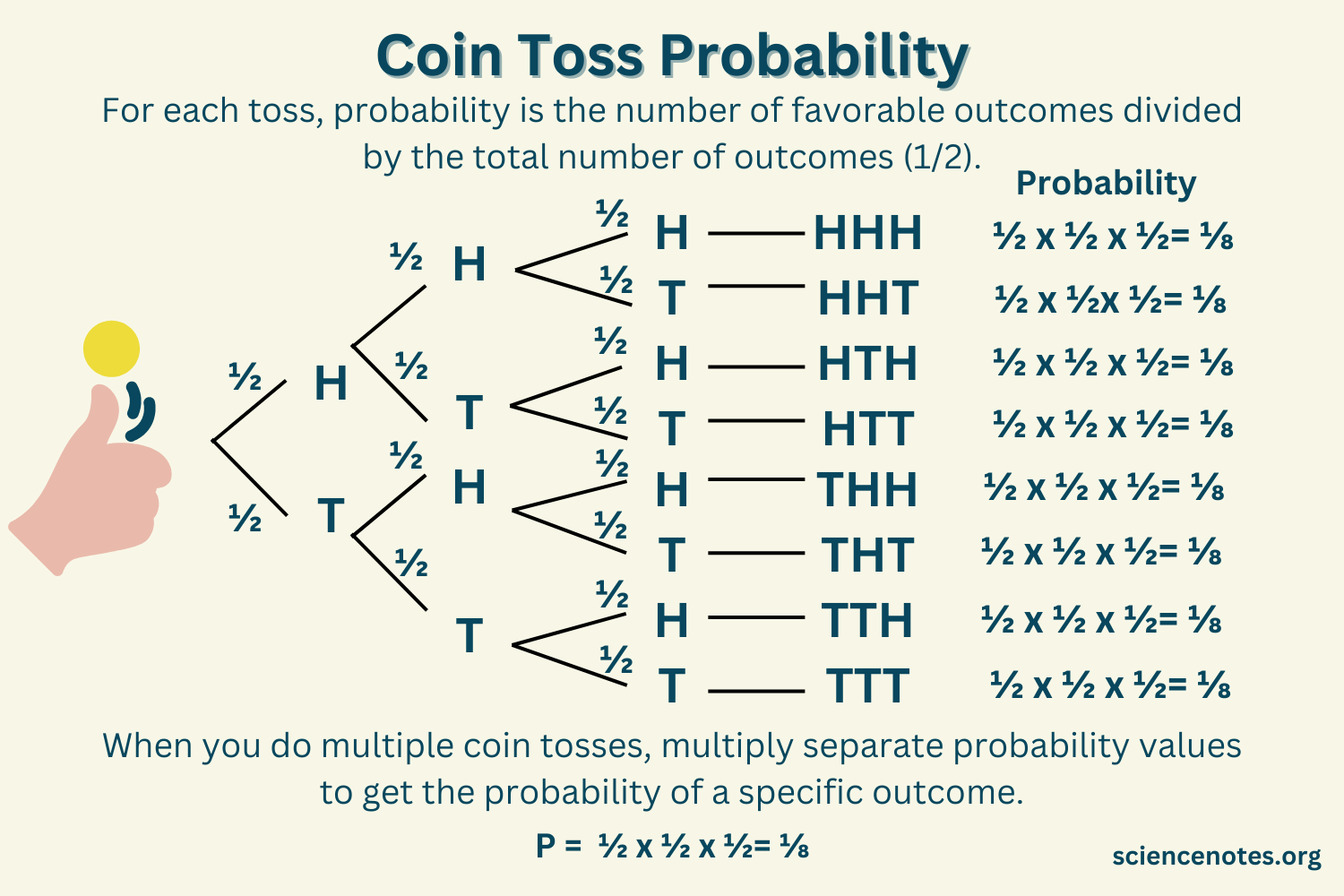
- Outcomes (1 toss):
- \(\{H, T\}\)
- Total outcomes = \(2\)
- Probability (fair coin):
- \(P(H) = \frac{1}{2}\)
- \(P(T) = \frac{1}{2}\)
- Dice (Standard fair die):
-
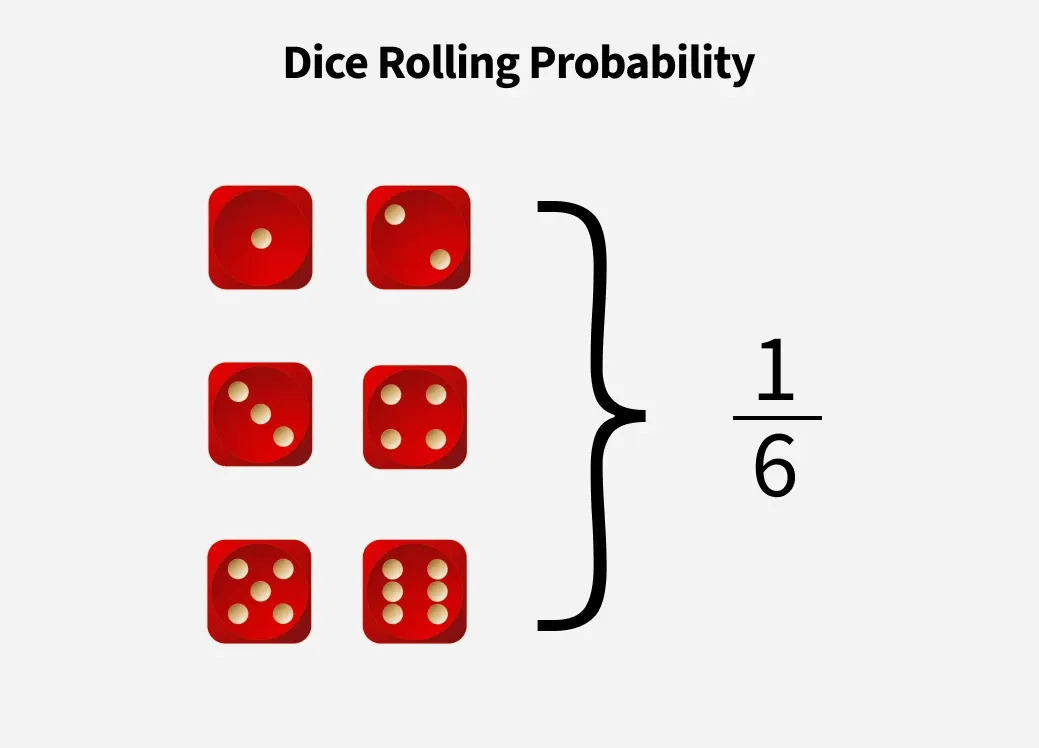
- Faces:
- \(\{1,2,3,4,5,6\}\)
- Total outcomes = \(6\)
- Single die:
- \(P(\text{any specific number}) = \frac{1}{6}\)
- \(P(\text{even}) = \frac{3}{6}\)
- \(P(\text{odd}) = \frac{3}{6}\)
- Playing Cards (Standard deck)
-
- Total cards:
- \(52\)
- Suits:
- Hearts, Diamonds, Clubs, Spades
- \(13\) cards each
- Colors:
- Red = \(26\) (Hearts + Diamonds)
- Black = \(26\) (Clubs + Spades)
- Ranks per suit:
- A
- 2-10
- J, Q, K
- Lowest to Highest:
- A, 2, 3, 4, 5, 6, 7, 8, 9, 10, J, Q, K
- Ace hsa special rule it can be lowest (A = 1) and highest (above King) depends on the game
- Face cards:
- \(J, Q, K\)
- Total = \(12\)
- Aces:
- Not face cards
- Total = 4
- Treated as separate category
- Can be lowest (A=1) or highest (A=14) depending on game
- Number cards:
- \(2\text{–}10\)
- Total = \(36\)
- Special counts:
- Kings = \(4\)
- Queens = \(4\)
- Aces = \(4\)
- Typical probabilities:
- \(P(\text{heart}) = \frac{13}{52} = \frac{1}{4}\)
- \(P(\text{face card}) = \frac{12}{52} = \frac{3}{13}\)
- \(P(\text{ace}) = \frac{4}{52} = \frac{1}{13}\)
- Sets and Functions
- Set Theory Basic Concepts
- Definition:
- A set is a well-defined collection of distinct objects, represented using curly braces \( \{ \} \).
- Example:
- \( \{1, 2, 3\} \)
- Types of Sets:
- Universal Set \( (U) \):
- Contains all possible elements in a given context.
- Example:
- \( U = \{1, 2, 3, 4, 5\} \)
- Empty Set / Null Set:
- A set with no elements.
- Denoted by \( \phi \) or \( \{\} \)
- Example:
- \( \{x \mid x > 10, x < 5\} = \phi \)
- Singleton Set:
- A set with exactly one element.
- Example:
- \( \{5\} \)
- Finite Set:
- A set with a countable number of elements.
- Example:
- \( \{1, 2, 3\} \)
- Infinite Set:
- A set with uncountably many elements.
- Example:
- Set of all integers \( \mathbb{Z} \)
- Equal Sets:
- Two sets are equal if they contain exactly the same elements.
- Denoted:
- \( A = B \)
- Equivalent Sets:
- Two sets with the same number of elements.
- Denoted:
- \( n(A) = n(B) \)
- Subset:
- \( A \) is a subset of \( B \) if every element of \( A \) is also in \( B \).
- Denoted:
- \( A \subseteq B \)
- Power Set:
- The set of all subsets of \( A \).
- Denoted:
- \( P(A) \)
- Total number of subsets:
- \( n(P(A)) = 2^{n(A)} \)
- Example:
- Given:
- \( U = \{1, 2, 3, 4, 5\}, A = \{1, 2\}, B = \{1, 2\} \)
- Empty set:
- \( A \cap \{3, 4\} = \phi \)
- Singleton:
- \( \{1\} \)
- Finite:
- \( A, \quad n(A) = 2 \)
- Equal:
- \( A = B \)
- Subset:
- \( A \subseteq U \)
- Power set of \( A \):
- \( P(A) = \{\phi, \{1\}, \{2\}, \{1, 2\}\} \),
- \( n(P(A)) = 2^2 = 4 \)
- Final Answers:
- Empty = \( \phi \)
- Singleton = \( \{1\} \)
- Finite = \( A \)
- Equal = \( A = B \)
- Subset = \( A \subseteq U \)
- Power set = 4 subsets
- Set Representation:
- Definitions:
- Roster Form:
- Lists all elements of a set within curly braces, separated by commas.
- Example:
- \( \{1, 3, 5\} \)
- Set-Builder Form:
- Describes a set using a property that its elements satisfy.
- Format:
- \( \{x \mid \text{x satisfies a condition}\} \)
- Example:
- \( \{x \mid x \text{ is an odd integer, } x < 6\} \)
- Example:
- Represent the set of even numbers less than 10 in both forms:
- Roster form:
- \( \{2, 4, 6, 8\} \)
- Set-builder form:
- \( \{x \mid x \text{ is an even integer, } 0 < x < 10\} \)
- Answer is:
- Roster = \( \{2, 4, 6, 8\} \), Set-builder = \( \{x \mid x \text{ is an even integer, } 0 < x < 10\} \)
- Set Operations:
- Definitions:
- Intersection (\( A \cap B \)):
- Elements common to both \( A \) and \( B \).
- Union (\( A \cup B \)):
- Elements in \( A \), \( B \), or both.
- Difference (\( A - B \)):
- Elements in \( A \) but not in \( B \).
- Symmetric Difference (\( A \triangle B \)):
- Elements in exactly one of \( A \) or \( B \), i.e., \( (A - B) \cup (B - A) \).
- Complement (\( A' \)):
- Elements in universal set \( U \) not in \( A \), i.e., \( U - A \).
- De Morgan’s Laws:
- \( (A \cup B)' = A' \cap B' \).
- \( (A \cap B)' = A' \cup B' \).
- Example:
- Let \( A = \{1, 2, 3\} \), \( B = \{2, 3, 4\} \), \( U = \{1, 2, 3, 4, 5\} \). Find operations and verify De Morgan’s law:
- \( A \cap B = \{2, 3\} \).
- \( A \cup B = \{1, 2, 3, 4\} \).
- \( A - B = \{1\} \).
- \( A \triangle B = \{1, 4\} \).
- \( A' = \{4, 5\} \).
- Verify:
- \( (A \cup B)' = \{5\} \), \( A' \cap B' = \{4, 5\} \cap \{1, 5\} = \{5\} \).
- Answer is:
- All operations computed, De Morgan’s law verified.
- Important Properties of Sets:
- Properties:
- Idempotent:
- \( A \cup A = A \), \( A \cap A = A \).
- Commutative:
- \( A \cup B = B \cup A \), \( A \cap B = B \cap A \).
- Associative:
- \( (A \cup B) \cup C = A \cup (B \cup C) \), \( (A \cap B) \cap C = A \cap (B \cap C) \).
- Distributive:
- \( A \cup (B \cap C) = (A \cup B) \cap (A \cup C) \), \( A \cap (B \cup C) = (A \cap B) \cup (A \cap C) \).
- Identity:
- \( A \cup \phi = A \), \( A \cap U = A \).
- Complement:
- \( A \cup A' = U \), \( A \cap A' = \phi \).
- Universal Set:
- \( A \cup U = U \), \( A \cap \phi = \phi \).
- Double Complement:
- \( (A')' = A \).
- De Morgan’s Laws:
- As above.
- Example:
- Verify distributive property for \( A = \{1, 2\} \), \( B = \{2, 3\} \), \( C = \{3, 4\} \):
- Left:
- \( A \cup (B \cap C) = \{1, 2\} \cup \{3\} = \{1, 2, 3\} \).
- Right:
- \( (A \cup B) \cap (A \cup C) = \{1, 2, 3\} \cap \{1, 2, 3, 4\} = \{1, 2, 3\} \).
- Answer is:
- Property verified.
- Inclusion-Exclusion Principle:
- Formulas:
- Two sets:
- \( n(A \cup B) = n(A) + n(B) - n(A \cap B) \).
- Three sets:
- \( n(A \cup B \cup C) = n(A) + n(B) + n(C) - n(A \cap B) - n(B \cap C) - n(A \cap C) + n(A \cap B \cap C) \).
- Example:
- In a survey, 70% like tea, 40% like coffee, 20% like both. Find percentage liking at least one:
- \( n(T) = 70 \), \( n(C) = 40 \), \( n(T \cap C) = 20 \).
- \( n(T \cup C) = 70 + 40 - 20 = 90 \).
- Answer is:
- 90%.
- Venn Diagrams:
- Definition:
- Diagrammatic representation of sets using circles, with overlaps for intersections and universal set as background.
-
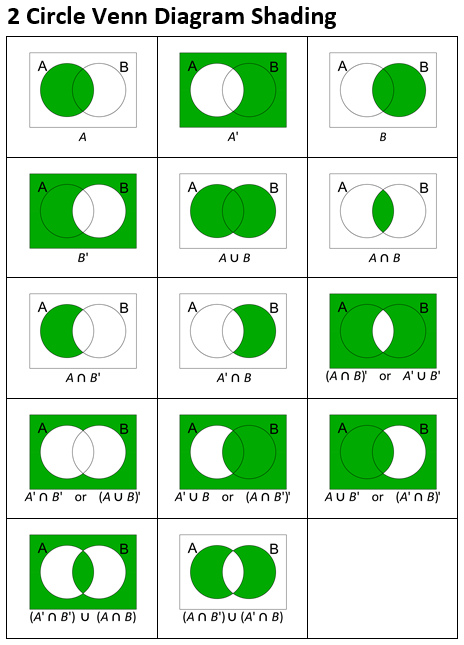
- Solving Problems:
- Identify regions for unions, intersections, differences, and specific areas (e.g., only one set, exactly two sets).
- Functions:
- Definitions:
- Function:
- A relation from set \( A \) to set \( B \) where each element in \( A \) maps to exactly one element in \( B \).
- In other words:
- A function is a rule that assigns exactly one output to each input.
- Mathematical Definition:
- A function \( f: A \to B \) assigns each \( x \in A \) to a unique \( y \in B \), denoted \( y = f(x) \).
-
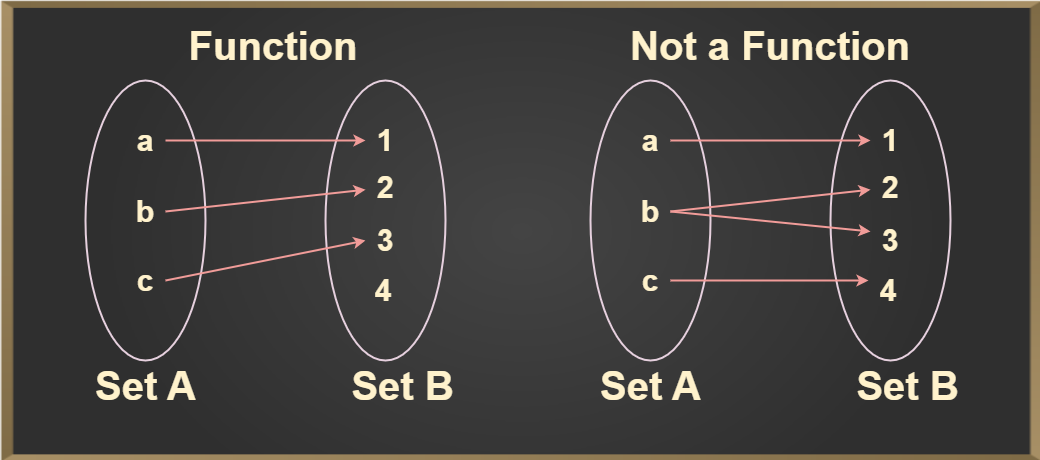
- Purpose of a function?
- In mathematics function is just a rule that says:
- Input → Apply rule → Output
- Why this is useful?
- To describe relationships
- Functions describe how one thing depends on another.
- Example:
- \(
\text{Area of circle} = \pi r^2
\)
- Prediction
- Functions let you predict unknown values.
- Simplifies complex problems
- Instead of writing long expressions repeatedly, you wrap them in a function.
- Example:
- Expression without function:
- \( (2x+3)^2 + 5(2x+3) \)
- Define function:
- \( f(x) = 2x+3 \)
- Expression using function
- \( f(x)^2 + 5f(x) \)
- Everything in advanced math is built on functions
- For simplicity and comprehensiveness
- Graphing relationships visually
- Example:
- Parabola equation
- \( y = x^2 \)
- Operations on Functions:
- Addition:
- \( (f + g)(x) = f(x) + g(x) \).
- Subtraction:
- \( (f - g)(x) = f(x) - g(x) \).
- Multiplication:
- \( (f \cdot g)(x) = f(x) \cdot g(x) \).
- Division:
- \( (f / g)(x) = \frac{f(x)}{g(x)} \), where \( g(x) \neq 0 \).
- Composition:
- \( (f \circ g)(x) = f(g(x)) \).
- Types of Functions:
-
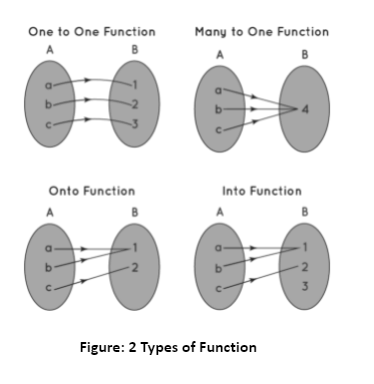
- One-One (Injective):
- Each element in \( A \) maps to a unique element in \( B \), i.e., if \( f(x_1) = f(x_2) \), then \( x_1 = x_2 \).
- Onto (Surjective):
- Every element in \( B \) is mapped to by at least one element in \( A \).
- Many-One:
- Multiple elements in \( A \) map to the same element in \( B \).
- Into:
- Not all elements in \( B \) are mapped to.
- Bijective:
- Both one-one and onto.
- Total Functions:
- If \( A \) has \( n \) elements and \( B \) has \( m \) elements, total functions from \( A \) to \( B \) is \( m^n \).
- Example:
- Let \( A = \{1, 2\} \), \( B = \{3, 4, 5\} \), \( f(x) = x + 2 \), \( g(x) = x^2 \). Find operations and check if \( f \) is one-one:
- \( (f + g)(1) = f(1) + g(1) = 3 + 1 = 4 \).
- \( (f \circ g)(1) = f(g(1)) = f(1) = 3 \).
- One-one:
- \( f(1) = 3 \), \( f(2) = 4 \), distinct outputs, so injective.
- Total functions:
- \( 3^2 = 9 \).
- Answer is:
- \( (f + g)(1) = 4 \), \( (f \circ g)(1) = 3 \), \( f \) is one-one, 9 total functions.
- Clock and Calendar:
- Basic Concepts:
- Clock Structure:
- A clock’s circular dial is divided into 60 equal parts, known as minute spaces, which together form a complete 360° circle. The dial is marked with 12 hour positions, meaning each hour occupies 5 minute spaces, since \( 60 \div 12 = 5 \).
- The clock features two hands, the shorter hour hand indicates the hour, and the longer minute hand indicates the minutes.
- Example:
- Question:
- Describe the positions of the clock hands at 9:00 and explain the significance of the minute spaces.
- Solution:
- At 9:00, the hour hand points at the 9 mark on the clock. Since each hour mark corresponds to 30° (\( 360^\circ \div 12 = 30^\circ \)), the hour hand is positioned at \( 9 \times 30 = 270^\circ \).
- The minute hand points at the 12 mark, representing 0 minutes, which corresponds to \( 0^\circ \).
- The significance of minute spaces is that the dial is divided into 60 equal parts, with each hour mark spanning 5 minute spaces. This structure is crucial for calculating angles and relative positions of the hands.
- Answer is:
- At 9:00, the hour hand is at \( 270^\circ \), the minute hand is at \( 0^\circ \), and each hour mark represents 5 minute spaces.
- Hand Movements:
- The minute hand moves at a speed of \( 6^\circ \) per minute, as it completes a full 360° revolution in 60 minutes (\( 360^\circ \div 60 = 6^\circ \)).
- The hour hand moves more slowly, at \( 0.5^\circ \) per minute, since it completes a 360° revolution in 12 hours, or 720 minutes (\( 360^\circ \div (12 \times 60) = 0.5^\circ \)).
- Relative to the hour hand, the minute hand gains \( 6^\circ - 0.5^\circ = 5.5^\circ \) per minute.
- The minute hand moves 12 times faster than the hour hand, as \( 6^\circ \div 0.5^\circ = 12 \).
- Example:
- Question:
- How far does the minute hand move in 10 minutes, and how much does it gain over the hour hand in that time?
- Solution:
- The minute hand moves \( 6^\circ \) per minute. In 10 minutes, it covers \( 10 \times 6 = 60^\circ \).
- The hour hand moves \( 0.5^\circ \) per minute, so in 10 minutes, it covers \( 10 \times 0.5 = 5^\circ \).
- The minute hand’s gain over the hour hand is \( 5.5^\circ \) per minute, so in 10 minutes, it gains \( 10 \times 5.5 = 55^\circ \).
- Alternatively, compute the gain directly:
- \( 60^\circ - 5^\circ = 55^\circ \).
- Answer is:
- In 10 minutes, the minute hand moves \( 60^\circ \), and it gains \( 55^\circ \) over the hour hand.
- Key Clock Facts:
- The hour and minute hands coincide (form a 0° angle) once every hour, resulting in 11 coincidences in 12 hours (approximately every 65.45 minutes).
- The hands are straight, forming a 180° angle (pointing in opposite directions), once per hour, when they are 30 minute spaces apart.
- The hands are perpendicular, forming a 90° angle, twice per hour, when they are 15 minute spaces apart.
- In 60 minutes, the minute hand gains 55 minute spaces on the hour hand, since it moves 12 times faster and each minute space equals 1 minute on the clock.
- Example:
- Question:
- How many times do the clock hands form a 90° angle between 3:00 and 4:00?
- Solution:
- The hands form a 90° angle (are perpendicular) twice per hour, as they are 15 minute spaces apart in two positions within each hour.
- Between 3:00 and 4:00, this occurs twice: once when the minute hand is 15 minute spaces behind the hour hand, and once when it is 15 minute spaces ahead.
- Answer is:
- The clock hands form a 90° angle twice between 3:00 and 4:00.
- Calendar Structure:
- Ordinary year:
- An ordinary year consists of 365 days, which equates to 52 complete weeks (52 × 7 = 364 days) plus 1 extra day, known as an odd day.
- Leap year:
- A leap year consists of 366 days, which equates to 52 weeks plus 2 odd days, with the extra day being February 29.
- A year is a leap year if it is divisible by 4. However, century years (e.g., 2100, 2200) must also be divisible by 400 to be leap years.
- Odd days:
- Odd days are the extra days beyond complete weeks in a given period, and they are essential for determining the day of the week for a specific date.
- The calendar we use today started on January 1st, Year 1, which was a Monday. Therefore, 1 odd day always represents Monday. By logic, 0 odd days (or 7) completes the week cycle back to Sunday.
- Standard Day Codes (Universal for Odd Days Method):
- Logic:
- The Gregorian calendar considers the first day (01-01-0001) as a Monday.
- Codes:
- 1 = Monday
- 2 = Tuesday
- 3 = Wednesday
- 4 = Thursday
- 5 = Friday
- 6 = Saturday
- 0 or 7 = Sunday
- Monthly odd days in an ordinary year (and leap year for February):
- January:
- 3 odd days (31 days = 4 weeks + 3 days).
- February:
- 0 odd days (28 days = 4 weeks) in an ordinary year; 1 odd day (29 days = 4 weeks + 1 day) in a leap year.
- March:
- 3 odd days (31 days = 4 weeks + 3 days).
- April:
- 2 odd days (30 days = 4 weeks + 2 days).
- May:
- 3 odd days (31 days = 4 weeks + 3 days).
- June:
- 2 odd days (30 days = 4 weeks + 2 days).
- July:
- 3 odd days (31 days = 4 weeks + 3 days).
- August:
- 3 odd days (31 days = 4 weeks + 3 days).
- September:
- 2 odd days (30 days = 4 weeks + 2 days).
- October:
- 3 odd days (31 days = 4 weeks + 3 days).
- November:
- 2 odd days (30 days = 4 weeks + 2 days).
- December:
- 3 odd days (31 days = 4 weeks + 3 days).
- Mathematical Simplification (Modulo 7):
- Concept:
- Since the day of the week repeats every 7 days, any number of total days can be reduced to "odd days" by finding the remainder when divided by 7.
- Rule:
- \( \text{Odd Days} = \text{Total Days} \pmod 7 \).
- Example:
- In your calculation:
- \( 31 \div 7 = 4 \) weeks and \( 3 \) days remainder.
- \( 31 \pmod 7 = 3 \).
- Therefore, 31 days contribute 3 odd days to the final tally.
- Examples:
- Example 1:
- Question:
- Is 2048 a leap year, and how many odd days does February have in that year?
- Solution:
- To determine if 2048 is a leap year, check divisibility by 4: \( 2048 \div 4 = 512 \), which is an integer. Since 2048 is not a century year, it is a leap year.
- In a leap year, February has 29 days, which is 4 weeks (28 days) plus 1 day, so February has 1 odd day.
- Answer is:
- 2048 is a leap year, and February has 1 odd day.
- Example 2:
- Question:
- Is 1900 a leap year, and how many odd days does February have in that year?
- Solution:
- To determine if 1900 is a leap year:
- First check divisibility by 4:
- \( 1900 \div 4 = 475 \) (integer, so seems leap at first glance).
- Since 1900 is a century year (divisible by 100), apply the century rule:
- A century year must be divisible by 400 to be a leap year.
- Check divisibility by 400:
- \( 1900 \div 400 = 4.75 \) (not an integer).
- Therefore, 1900 is NOT a leap year.
- In a non-leap year, February has 28 days.
- 28 days = 4 weeks exactly.
- So February has 0 odd days.
- Answer is:
- 1900 is not a leap year, and February has 0 odd days.
- Clock Calculations:
- Angle Between Hands:
- To calculate the angle between the hour and minute hands at a given time \( H \) hours and \( M \) minutes:
- If the minute hand is behind the hour hand:
- Formula:
- \( |(30H + 0.5M) - 6M| \)
- Derivation:
- Let:
- \( H \) = hour (0 to 11)
- \( M \) = minutes past the hour.
- Minute hand speed:
- \( 360^\circ \) in 60 minutes.
- \( \frac{360}{60} = 6^\circ \) per minute.
- Position of minute hand after M minutes:
- \( 6M \).
- Hour hand speed:
- \( 360^\circ \) in 12 hours.
- \( 12 \text{ hours} = 720 \text{ minutes} \).
- \( \frac{360}{720} = 0.5^\circ \) per minute.
- Position of hour hand at H hours:
- \( 30H \) (since \( 360/12 = 30^\circ \) per hour).
- Additional movement of hour hand in M minutes:
- \( 0.5M \).
- Total position of hour hand:
- \( 30H + 0.5M \).
- Angle between hour and minute hands:
- \( |(30H + 0.5M) - 6M| \).
- Simplify:
- \( |30H + 0.5M - 6M| \).
- \( |30H - 5.5M| \).
- Since \( 5.5 = \frac{11}{2} \):
- \( \left| 30H - \frac{11M}{2} \right|^\circ \).
- Therefore:
- \( \left| 30H - \frac{11M}{2} \right|^\circ \).
- If the minute hand is ahead of the hour hand:
- Formula:
- \( |6M - (30H + 0.5M)| \)
- Derivation:
- Same as above, the only minor difference is that minute hand is ahead, so difference will be:
- \( |6M - (30H + 0.5M)| \)
- This will lead to:
- \( \left| 30 \left( \frac{M}{5} - H \right) - \frac{M}{2} \right|^\circ \)
- Example:
- Question:
- What is the angle between the hour and minute hands at 7:30?
- Solution:
- Given time is 7:30, so \( H = 7 \), \( M = 30 \).
- Hour hand position:
- In 7 hours, it moves \( 7 \times 30 = 210^\circ \). In 30 minutes, it moves an additional \( 30 \times 0.5 = 15^\circ \). Total: \( 210 + 15 = 225^\circ \).
- Minute hand position:
- In 30 minutes, it moves \( 30 \times 6 = 180^\circ \).
- Since the minute hand (\( 180^\circ \)) is behind the hour hand (\( 225^\circ \)), use:
- \( \left| 30H - \frac{11M}{2} \right| \).
- Compute:
- \( 30 \times 7 = 210 \), \( \frac{11 \times 30}{2} = 165 \), so \( \left| 210 - 165 \right| = 45^\circ \).
- Check the complement:
- \( 360 - 45 = 315^\circ \). The smaller angle is \( 45^\circ \).
- Answer is:
- The angle between the hands at 7:30 is \( 45^\circ \).
- Coincidence of Hands:
- The hour and minute hands coincide (form a 0° angle) between \( H \) and \( H+1 \) o’clock at \( \frac{60H}{11} \) minutes past \( H \).
- This happens 11 times in 12 hours, approximately every 65.45 minutes, because the minute hand catches up to the hour hand at a relative speed of \( 5.5^\circ \) per minute.
- Derivation:
- Let:
- \( H \) = hour (0 to 11)
- \( M \) = minutes past \( H \) o'clock when hands coincide.
- Minute hand speed:
- \( 360^\circ \) in 60 minutes.
- \( 6^\circ \) per minute.
- Position after \( M \) minutes:
- \( 6M \).
- Hour hand speed:
- \( 360^\circ \) in 12 hours.
- \( 30^\circ \) per hour.
- \( 0.5^\circ \) per minute.
- Position at \( H \) o'clock:
- \( 30H \).
- Additional movement in \( M \) minutes:
- \( 0.5M \).
- Total position:
- \( 30H + 0.5M \).
- When hands coincide:
- Positions are equal.
- \( 6M = 30H + 0.5M \).
- Rearranging:
- \( 6M - 0.5M = 30H \).
- \( 5.5M = 30H \).
- \( M = \frac{30H}{5.5} \).
- Since \( 5.5 = \frac{11}{2} \):
- \( M = \frac{30H}{11/2} \).
- \( M = \frac{30H \times 2}{11} \).
- Therefore:
- \( M = \frac{60H}{11} \) minutes.
- Example:
- Question:
- At what time between 8 and 9 o’clock do the hands of a clock coincide?
- Solution:
- Use the formula:
- \( \frac{60H}{11} \) minutes past \( H \), where \( H = 8 \).
- Compute:
- \( \frac{60 \times 8}{11} = \frac{480}{11} \approx 43.6363 \).
- Convert the decimal to seconds:
- \( 0.6363 \times 60 \approx 38 \) seconds.
- Thus, the hands coincide at approximately 43 minutes and 38 seconds past 8.
- Answer is:
- The hands coincide at approximately 8:43:38.
- T Minutes Apart:
- The hands are \( T \) minute spaces apart at \( \left( 5H \pm T \right) \frac{12}{11} \) minutes past \( H \), with the positive sign when the hour hand is ahead and the negative sign when the minute hand is ahead.
- Formula:
- \( \left( 5H \pm T \right) \frac{12}{11} \)
- Derivation:
- Let:
- \( H \) = hour (0 to 11)
- \( M \) = minutes past \( H \)
- \( T \) = required minute-spaces between the hands
- Minute hand speed:
- \( 360^\circ \) in 60 minutes
- \( 6^\circ \) per minute
- Position after \( M \) minutes:
- \( 6M \)
- Hour hand speed:
- \( 360^\circ \) in 12 hours
- \( 0.5^\circ \) per minute
- Position at \( H \) o'clock:
- \( 30H \)
- Additional movement in \( M \) minutes:
- \( 0.5M \)
- Total position:
- \( 30H + 0.5M \)
- Angle between hands:
- \( |6M - (30H + 0.5M)| \)
- Simplify:
- \( |6M - 30H - 0.5M| \)
- \( |5.5M - 30H| \)
- One minute-space equals:
- \( 6^\circ \)
- If hands are \( T \) minute-spaces apart:
- Required angle = \( 6T \)
- Therefore:
- \( |5.5M - 30H| = 6T \)
- Case 1:
- \( 5.5M - 30H = 6T \)
- \( 5.5M = 30H + 6T \)
- Case 2:
- \( 5.5M - 30H = -6T \)
- \( 5.5M = 30H - 6T \)
- Combine:
- \( 5.5M = 30H \pm 6T \)
- \( M = \frac{30H \pm 6T}{5.5} \)
- Since \( 5.5 = \frac{11}{2} \):
- \( M = \frac{30H \pm 6T}{11/2} \)
- \( M = \frac{2(30H \pm 6T)}{11} \)
- \( M = \frac{60H \pm 12T}{11} \)
- \( M = \frac{12(5H \pm T)}{11} \)
- Therefore:
- \( M = (5H \pm T)\frac{12}{11} \)
- Example:
- Question:
- At what times between 3 and 4 o’clock are the hands 10 minute spaces apart?
- Solution:
- Use the formula:
- \( \left( 5H \pm T \right) \frac{12}{11} \) minutes past \( H \), where \( H = 3 \), \( T = 10 \).
- Compute:
- \( 5 \times 3 = 15 \), so \( 15 \pm 10 = 25 \) or \( 5 \).
- First case (hour hand ahead):
- \( 25 \times \frac{12}{11} = \frac{300}{11} \approx 27.2727 \). Convert: \( 0.2727 \times 60 \approx 16 \) seconds, so approximately 27 minutes and 16 seconds past 3.
- Second case (minute hand ahead):
- \( 5 \times \frac{12}{11} = \frac{60}{11} \approx 5.4545 \). Convert: \( 0.4545 \times 60 \approx 27 \) seconds, so approximately 5 minutes and 27 seconds past 3.
- Answer is:
- The hands are 10 minute spaces apart at approximately 3:05:27 and 3:27:16.
- Right Angles:
- The hands form a 90° angle (are perpendicular) twice per hour, when they are 15 minute spaces apart, at times given by \( \left( 5H \pm 15 \right) \frac{12}{11} \) minutes past \( H \).
- Formula:
- \( \left( 5H \pm 15 \right) \frac{12}{11} \)
- Derivation:
- Use the above generic formula with difference as 15 minutes
- Example:
- Question:
- At what times between 6 and 7 o’clock are the hands at a right angle?
- Solution:
- Use the formula: \( \left( 5H \pm 15 \right) \frac{12}{11} \) minutes past \( H \), where \( H = 6 \).
- Compute:
- \( 5 \times 6 = 30 \), so \( 30 \pm 15 = 45 \) or \( 15 \).
- First time:
- \( 45 \times \frac{12}{11} = \frac{540}{11} \approx 49.0909 \). Convert: \( 0.0909 \times 60 \approx 5 \) seconds, so approximately 49 minutes and 5 seconds past 6.
- Second time:
- \( 15 \times \frac{12}{11} = \frac{180}{11} \approx 16.3636 \). Convert: \( 0.3636 \times 60 \approx 22 \) seconds, so approximately 16 minutes and 22 seconds past 6.
- Answer is:
- The hands are at a right angle at approximately 6:16:22 and 6:49:05.
- Straight Line (Opposite Directions):
- The hands are 180° apart (point in opposite directions) once per hour, when they are 30 minute spaces apart
- Formula:
- \( \left( 5H \pm 30 \right) \frac{12}{11} \) minutes past \( H \)
- Choose the value of M such that 0 < M < 60
- Derivation:
- Use the above generic formula with difference as 30 minutes
- Example:
- Question:
- At what time between 5 and 6 o’clock are the hands opposite each other?
- Solution:
- Use:
- \( \left( 5H \pm 30 \right) \frac{12}{11} \) minutes past \( H \).
- Compute:
- \( 5 \times 5 + 30 = 55 \), so \( 55 \times \frac{12}{11} = \frac{660}{11} = 60 \).
- This result (60 minutes) indicates the boundary at 6:00, which is typically not included in the interval.
- Recalculate using the minute space approach for clarity:
- At 5:00, the hands are 25 minute spaces apart. To be opposite (30 minute spaces apart), the minute hand must gain \( 30 - 25 = 5 \) minute spaces or \( 30 + 25 = 55 \) minute spaces.
- Minute hand gains 55 minute spaces in 60 minutes, so 5 minute spaces in \( \frac{60 \times 5}{55} = \frac{60}{11} \approx 5.4545 \). Convert: \( 0.4545 \times 60 \approx 27 \) seconds, so approximately 5 minutes and 27 seconds past 5.
- Answer is:
- The hands are opposite at approximately 5:05:27.
- Faulty Clocks:
- A clock is considered “too fast” if it shows a time ahead of the correct time (e.g., showing 6:15 when it’s actually 6:00) and “too slow” if it shows a time behind (e.g., showing 6:45 when it’s actually 7:00).
- If the minute hand overtakes the hour hand every \( M \) minutes, then the gain or loss per day is:
- \( \frac{1440}{11} \left( \frac{720}{M} - 11 \right) \text{ minutes} \)
- A positive result indicates the clock gains time.
- A negative result indicates the clock loses time.
- Derivation:
- For a correct clock:
- In 12 hours = 720 minutes
- Hands coincide 11 times
- Time between coincidences:
- \( \frac{720}{11} \) minutes
- Correct relative angular speed:
- \( 5.5^\circ \) per minute
- If faulty clock shows coincidence every \( M \) minutes:
- Relative angular speed:
- \( \frac{360}{M} \) degrees per minute
- Ratio of faulty speed to correct speed:
- \( \frac{\frac{360}{M}}{5.5} \)
- Gain or loss per minute:
- \( \frac{\frac{360}{M} - 5.5}{5.5} \)
- Gain or loss per day (1440 minutes):
- \( \frac{\frac{360}{M} - 5.5}{5.5} \times 1440 \)
- Simplifying:
- \( \frac{1440}{11} \left( \frac{720}{M} - 11 \right) \)
- Example:
- Question:
- A clock’s minute hand overtakes the hour hand every 63 minutes. How much time does the clock gain or lose per day?
- Solution:
- Substitute \( M = 63 \):
- \( \frac{720}{63} \approx 11.4286 \)
- \( 11.4286 - 11 = 0.4286 \)
- Gain per day:
- \( \frac{1440}{11} \times 0.4286 \approx 130.9091 \times 0.4286 \approx 56 \)
- Therefore:
- The clock gains approximately 56 minutes per day.
- Time Conversion (Decimal to Sexagesimal):
- Concept:
- Competitive exam results often produce decimal or fractional values (e.g., while using the relative speed formula). These must be converted back into the Hours:Minutes:Seconds format to match exam options.
- General Formula:
- \( \text{Total Time} = H \text{ hours} + (D_1 \times 60) \text{ minutes} + (D_2 \times 60) \text{ seconds} \)
- Where \( D_1 \) is the decimal part of the hour, and \( D_2 \) is the decimal part of the minute.
- Example 1: Decimal Hours
- Question:
- Convert \( 2.72 \text{ hours} \) into hours, minutes, and seconds.
- Solution:
- Step 1 (Extract Hours):
- The whole number is \( 2 \).
- Step 2 (Calculate Minutes):
- Take the decimal part: \( 0.72 \).
- \( 0.72 \times 60 = 43.2 \text{ minutes} \).
- The whole number \( 43 \) is your minutes.
- Step 3 (Calculate Seconds):
- Take the remaining decimal \( 0.2 \).
- \( 0.2 \times 60 = 12 \text{ seconds} \).
- Final Result:
- \( 2.72 \text{ hours} = 2 \text{ hours, } 43 \text{ minutes, and } 12 \text{ seconds} \).
- Example 2: Fractional Minutes (Common in CSAT)
- Question:
- Convert \( 10 \frac{10}{11} \text{ minutes} \) to minutes and seconds.
- Solution:
- Convert fraction to seconds:
- \( \frac{10}{11} \times 60 = \frac{600}{11} \approx 54.54 \text{ seconds} \).
- Final Result:
- Approximately \( 10 \text{ minutes and } 55 \text{ seconds} \).
- Calendar Calculations:
- Leap Year Identification:
- A year is a leap year if it is divisible by 4. Century years (e.g., 2000, 2100) must also be divisible by 400 to qualify as leap years.
- Example:
- Question:
- Is 2052 a leap year?
- Solution:
- Check divisibility by 4:
- \( 2052 \div 4 = 513 \), which is an integer.
- Since 2052 is not a century year, no further check is required.
- Answer is:
- 2052 is a leap year.
- Odd Days:
- An ordinary year (365 days) has 1 odd day, as \( 365 = 52 \times 7 + 1 \).
- A leap year (366 days) has 2 odd days, as (\( 366 = 52 \times 7 + 2 \)).
- For longer periods (speed shortcut):
- 100 years:
- 5 odd days.
- 200 years:
- 3 odd days.
- 300 years:
- 1 odd day.
- 400 years:
- 0 odd days
- Gregorian calendar repeats every 400 years. So, any century multiple of 400 (400, 800, 1200, 1600, 2000, 2400) has 0 odd days.
- Example 1:
- Question:
- Find the day of the week for August 15, 1947.
- Solution:
- Step 1: Breakdown the years into segments:
- 1600 years (multiple of 400) = 0 odd days.
- 300 years = 1 odd day.
- Step 2: Calculate odd days in the 46 completed years (1901 to 1946):
- Leap years in 46 years:
- \( 46 \div 4 = 11 \) leap years.
- Ordinary years:
- \( 46 - 11 = 35 \) ordinary years.
- Odd days:
- \( (11 \times 2) + (35 \times 1) = 22 + 35 = 57 \) days.
- Simplify:
- \( 57 \div 7 = 1 \) odd day (remainder).
- Step 3: Calculate days in the current year (1947) up to August 15:
- Jan(3) + Feb(0) + Mar(3) + Apr(2) + May(3) + Jun(2) + Jul(3) + Aug(15)
- Total days = \( 3+0+3+2+3+2+3+15 = 31 \) days.
- Simplify:
- \( 31 \div 7 = 3 \) odd days (remainder).
- Step 4: Total odd days:
- \( 0 \text{ (1600y)} + 1 \text{ (300y)} + 1 \text{ (46y)} + 3 \text{ (1947)} = 5 \) odd days.
- Step 5: Match the code:
- 0=Sun, 1=Mon, 2=Tue, 3=Wed, 4=Thu, 5=Fri, 6=Sat.
- Final Result:
- August 15, 1947 was a Friday.
- Example 2:
- Question:
- How many odd days are there from 2015 to 2018 (inclusive)?
- Solution:
- 2015:
- Ordinary year, 1 odd day.
- 2016:
- Leap year, 2 odd days (assuming post-February 29).
- 2017:
- Ordinary year, 1 odd day.
- 2018:
- Ordinary year, 1 odd day.
- Total:
- \( 1 + 2 + 1 + 1 = 5 \) odd days.
- Answer is:
- There are 5 odd days from 2015 to 2018.
- Day Gain or Loss:
- Moving forward by 1 ordinary year adds 1 day (e.g., Monday becomes Tuesday).
- Moving backward by 1 ordinary year subtracts 1 day (e.g., Tuesday becomes Monday).
- Moving forward by 1 leap year adds 2 days if the date is after February 29 (e.g., Monday becomes Wednesday); otherwise, adds 1 day.
- Moving backward by 1 leap year subtracts 2 days if after February 29 (e.g., Wednesday becomes Monday); otherwise, subtracts 1 day.
- Example:
- Question:
- If April 20, 2023, was a Thursday, what day was it on April 20, 2024?
- Solution:
- 2024 is a leap year (\( 2024 \div 4 = 506 \)), and April is after February 29.
- Moving forward in a leap year adds 2 days.
- Thursday + 2 days = Saturday.
- Answer is:
- April 20, 2024, was a Saturday.
- Day of the Week (With Reference):
- To find the day of the week, calculate the number of odd days between the given reference date and the target date. Adjust the reference day forward (if the target is later) or backward (if earlier) by the number of odd days.
- Example:
- Question:
- If October 10, 2024, was a Thursday, what day was it on October 10, 2023?
- Solution:
- 2024 is a leap year, and October is after February 29, so moving backward subtracts 2 days.
- Thursday - 2 days = Tuesday.
- Answer is:
- October 10, 2023, was a Tuesday.
- Day of the Week (Without Reference):
- Sum the odd days from a base year (e.g., 2000, which has 0 odd days due to the 400-year cycle) to the target year, including centuries, years, and days in the target year.
- Map the total odd days to:
- 0 = Sunday, 1 = Monday, 2 = Tuesday, 3 = Wednesday, 4 = Thursday, 5 = Friday, 6 = Saturday.
- Example:
- Question:
- What day of the week was July 4, 2023?
- Solution:
- Base year:
- 2000 (0 odd days, as it’s a 400-year cycle).
- Years 2001–2022:
- 16 ordinary years (\( 16 \times 1 = 16 \)) + 5 leap years (2004, 2008, 2012, 2016, 2020; \( 5 \times 2 = 10 \)) = 26 odd days = \( 26 \mod 7 = 5 \).
- 2023 (up to July):
- Ordinary year, January to June = \( 3 + 0 + 3 + 2 + 3 + 2 = 13 \mod 7 = 6 \).
- July 1–4:
- 4 days = \( 4 \mod 7 = 4 \).
- Total odd days:
- \( 5 + 6 + 4 = 15 \mod 7 = 1 \).
- 1 odd day = Monday.
- Answer is:
- July 4, 2023, was a Monday.
- Century Constraints:
- The first day of a century (e.g., January 1, 2000) can only be a Tuesday, Thursday, or Saturday.
- The last day of a century (e.g., December 31, 2000) cannot be a Tuesday, Thursday, or Saturday.
- Area and Perimeter:
- Basic Concepts:
- Area:
- The area of a 2-dimensional figure represents the region enclosed within its boundaries. It quantifies the surface covered by the shape and is always expressed in square units, such as square meters (\( \text{m}^2 \)) or square centimeters (\( \text{cm}^2 \)).
- Perimeter:
- The perimeter is the total length of the sides or boundary enclosing a 2-dimensional figure. It is measured in linear units, such as meters (m) or centimeters (cm), and represents the distance around the shape.
- Example:
- Question:
- Define the area and perimeter of a rectangle with a length of 12 cm and a breadth of 5 cm.
- Solution:
- Area is the region enclosed by the rectangle’s boundaries. For a rectangle, area = length × breadth. Here, length = 12 cm, breadth = 5 cm, so area = \( 12 \times 5 = 60 \, \text{cm}^2 \).
- Perimeter is the total length of the rectangle’s sides. For a rectangle, perimeter = \( 2(\text{length} + \text{breadth}) \). Here, perimeter = \( 2(12 + 5) = 2 \times 17 = 34 \, \text{cm} \).
- Answer is:
- The area is \( 60 \, \text{cm}^2 \), and the perimeter is \( 34 \, \text{cm} \).
- Triangle:
- A triangle is a polygon with three sides, three vertices, and three angles, making it one of the fundamental shapes in geometry. It is denoted as \( \triangle ABC \), with sides \( AB \), \( BC \), and \( CA \).
- Types of triangles:
- Scalene:
- All sides and angles are unequal. A right-angled triangle is scalene unless it is isosceles.
- Right-Angled:
- One angle is 90°, with the side opposite the right angle called the hypotenuse.
- Isosceles:
- Two sides are equal, and the angles opposite them are equal.
- Equilateral:
- All sides are equal, and each angle measures 60°.
- General formulas:
- Area = \( \frac{1}{2} \times \text{base} \times \text{height} \).
- Area (Heron’s formula) = \( \sqrt{s(s-a)(s-b)(s-c)} \), where \( s = \frac{a+b+c}{2} \) (semi-perimeter).
- Perimeter = \( a + b + c \).
- Incircle radius = \( \frac{\text{Area}}{s} \).
- Example:
- Question:
- Find the area of a scalene triangle with sides 13 cm, 14 cm, and 15 cm.
- Solution:
- Use Heron’s formula:
- Area = \( \sqrt{s(s-a)(s-b)(s-c)} \).
- Semi-perimeter:
- \( s = \frac{13 + 14 + 15}{2} = \frac{42}{2} = 21 \, \text{cm} \).
- Compute:
- \( s - a = 21 - 13 = 8 \), \( s - b = 21 - 14 = 7 \), \( s - c = 21 - 15 = 6 \).
- Area = \( \sqrt{21 \times 8 \times 7 \times 6} = \sqrt{7056} \).
- Factorize:
- \( 7056 = 2^4 \times 3^2 \times 7^2 \), so \( \sqrt{7056} = \sqrt{16 \times 9 \times 49} = 4 \times 3 \times 7 = 84 \, \text{cm}^2 \).
- Answer is:
- The area is \( 84 \, \text{cm}^2 \).
- Different triangles:
- Right-Angled Triangle:
- A triangle with one 90° angle, where the side opposite the right angle is the hypotenuse.
- Formulas:
- Area = \( \frac{1}{2} \times \text{base} \times \text{height} \).
- Hypotenuse = \( \sqrt{\text{base}^2 + \text{height}^2} \) (Pythagoras’ theorem).
- Perimeter = \( \text{base} + \text{height} + \text{hypotenuse} \).
- Example:
- Question:
- A right-angled triangle has a base of 8 m and a height of 6 m. Find its area and perimeter.
- Solution:
- Area = \( \frac{1}{2} \times \text{base} \times \text{height} = \frac{1}{2} \times 8 \times 6 = 24 \, \text{m}^2 \).
- Hypotenuse = \( \sqrt{8^2 + 6^2} = \sqrt{64 + 36} = \sqrt{100} = 10 \, \text{m} \).
- Perimeter = \( 8 + 6 + 10 = 24 \, \text{m} \).
- Answer is:
- The area is \( 24 \, \text{m}^2 \), and the perimeter is \( 24 \, \text{m} \).
- Isosceles Triangle:
- A triangle with two equal sides and equal angles opposite those sides.
- Formulas:
- Area = \( \frac{\text{base}}{4} \sqrt{4 \times \text{side}^2 - \text{base}^2} \).
- Height = \( \sqrt{\text{side}^2 - \frac{\text{base}^2}{4}} \).
- Perimeter = \( 2 \times \text{side} + \text{base} \).
- Example:
- Question:
- An isosceles triangle has a base of 10 cm and equal sides of 13 cm. Find its area.
- Solution:
- Area = \( \frac{\text{base}}{4} \sqrt{4 \times \text{side}^2 - \text{base}^2} \).
- Here, base = 10 cm, side = 13 cm.
- Compute:
- \( 4 \times 13^2 = 4 \times 169 = 676 \), \( 10^2 = 100 \), so \( 676 - 100 = 576 \).
- \( \sqrt{576} = 24 \).
- Area = \( \frac{10}{4} \times 24 = 2.5 \times 24 = 60 \, \text{cm}^2 \).
- Answer is:
- The area is \( 60 \, \text{cm}^2 \).
- Equilateral Triangle:
- A triangle with all sides equal and all angles 60°.
- Formulas:
- Area = \( \frac{\sqrt{3}}{4} \times \text{side}^2 \).
- Height = \( \frac{\sqrt{3}}{2} \times \text{side} \).
- Perimeter = \( 3 \times \text{side} \).
- Incircle radius = \( \frac{\text{side}}{2\sqrt{3}} \).
- Circumcircle radius = \( \frac{\text{side}}{\sqrt{3}} \).
- Example:
- Question:
- Find the area and perimeter of an equilateral triangle with a side of 6 cm.
- Solution:
- Area = \( \frac{\sqrt{3}}{4} \times 6^2 = \frac{\sqrt{3}}{4} \times 36 = 9\sqrt{3} \approx 9 \times 1.732 = 15.588 \, \text{cm}^2 \).
- Perimeter = \( 3 \times 6 = 18 \, \text{cm} \).
- Answer is:
- The area is approximately \( 15.59 \, \text{cm}^2 \), and the perimeter is \( 18 \, \text{cm} \).
- Quadrilateral:
- A closed figure with four sides and four angles, where the sum of angles is \( 360^\circ \).
- Area = \( \frac{1}{2} \times \text{diagonal} \times (\text{sum of offsets}) \), or sum of areas of two triangles formed by a diagonal.
- Example:
- Question:
- A quadrilateral has a diagonal of 12 cm, with offsets of 8 cm and 10 cm. Find its area.
- Solution:
- Area = \( \frac{1}{2} \times \text{diagonal} \times (\text{sum of offsets}) \).
- Here, diagonal = 12 cm, offsets = 8 cm and 10 cm.
- Sum of offsets = \( 8 + 10 = 18 \, \text{cm} \).
- Area = \( \frac{1}{2} \times 12 \times 18 = 6 \times 18 = 108 \, \text{cm}^2 \).
- Answer is:
- The area is \( 108 \, \text{cm}^2 \).
- Different quadrilaterals:
- Square:
- A quadrilateral with all sides equal and all angles 90°.
- Formulas:
- Area = \( \text{side}^2 \).
- Diagonal = \( \sqrt{2} \times \text{side} \).
- Perimeter = \( 4 \times \text{side} \).
- Number of square tiles for a floor of \( l \times b \) = \( \frac{l \times b}{\text{HCF}(l, b)^2} \).
- Example:
- Question:
- A square has a side of 9 m. Find its area and perimeter.
- Solution:
- Area = \( 9^2 = 81 \, \text{m}^2 \).
- Perimeter = \( 4 \times 9 = 36 \, \text{m} \).
- Answer is:
- The area is \( 81 \, \text{m}^2 \), and the perimeter is \( 36 \, \text{m} \).
- Rectangle:
- A quadrilateral with opposite sides equal and all angles 90°.
- Formulas:
- Area = \( \text{length} \times \text{breadth} \).
- Diagonal = \( \sqrt{\text{length}^2 + \text{breadth}^2} \).
- Perimeter = \( 2(\text{length} + \text{breadth}) \).
- Area of four walls = \( 2(\text{length} + \text{breadth}) \times \text{height} \).
- Example:
- Question:
- A rectangle has a length of 15 m and a breadth of 8 m. Find its area and diagonal.
- Solution:
- Area = \( 15 \times 8 = 120 \, \text{m}^2 \).
- Diagonal = \( \sqrt{15^2 + 8^2} = \sqrt{225 + 64} = \sqrt{289} = 17 \, \text{m} \).
- Answer is:
- The area is \( 120 \, \text{m}^2 \), and the diagonal is \( 17 \, \text{m} \).
- Parallelogram:
- A quadrilateral with opposite sides parallel and equal, and opposite angles equal.
- Formulas:
- Area = \( \text{base} \times \text{height} \), or \( 2 \sqrt{s(s-a)(s-b)(s-d)} \), where \( s = \frac{a+b+d}{2} \).
- Example:
- Question:
- A parallelogram has a base of 14 m and a height of 9 m. Find its area.
- Solution:
- Area = \( \text{base} \times \text{height} = 14 \times 9 = 126 \, \text{m}^2 \).
- Answer is:
- The area is \( 126 \, \text{m}^2 \).
- Rhombus:
- A quadrilateral with all sides equal, opposite sides parallel, and diagonals bisecting at 90°.
- Formulas:
- Area = \( \frac{1}{2} \times \text{diagonal}_1 \times \text{diagonal}_2 \).
- Side = \( \frac{1}{2}\sqrt{\text{diagonal}_1^2 + \text{diagonal}_2^2} \).
- Perimeter = \( 4 \times \text{side} \).
- Example:
- Question:
- A rhombus has diagonals of 16 cm and 12 cm. Find its area and perimeter.
- Solution:
- Area = \( \frac{1}{2} \times 16 \times 12 = 96 \, \text{cm}^2 \).
- Side = \( \sqrt{\frac{16^2 + 12^2}{4}} = \sqrt{\frac{256 + 144}{4}} = \sqrt{\frac{400}{4}} = \sqrt{100} = 10 \, \text{cm} \).
- Perimeter = \( 4 \times 10 = 40 \, \text{cm} \).
- Answer is:
- The area is \( 96 \, \text{cm}^2 \), and the perimeter is \( 40 \, \text{cm} \).
- Trapezium:
- A quadrilateral with one pair of parallel sides.
- Formula:
- Area = \( \frac{1}{2} \times (\text{sum of parallel sides}) \times \text{height} \).
- Example:
- Question:
- A trapezium has parallel sides of 20 m and 30 m, with a height of 8 m. Find its area.
- Solution:
- Area = \( \frac{1}{2} \times (20 + 30) \times 8 = \frac{1}{2} \times 50 \times 8 = 25 \times 8 = 200 \, \text{m}^2 \).
- Answer is:
- The area is \( 200 \, \text{m}^2 \).
- Kite:
- A quadrilateral with two pairs of equal adjacent sides, and diagonals intersecting at 90°.
- Formula:
- Area = \( \frac{1}{2} \times \text{diagonal}_1 \times \text{diagonal}_2 \).
- Example:
- Question:
- A kite has diagonals of 10 m and 14 m. Find its area.
- Solution:
- Area = \( \frac{1}{2} \times 10 \times 14 = 5 \times 14 = 70 \, \text{m}^2 \).
- Answer is:
- The area is \( 70 \, \text{m}^2 \).
- Circle:
- A shape where every point on the boundary is equidistant from a fixed center, with radius \( r \) and diameter \( 2r \).
- Formulas:
- Area = \( \pi r^2 \).
- Circumference = \( 2\pi r \).
- Area of a circle with the same perimeter as a square of area \( a \): \( \frac{a}{4\pi} \).
- Largest square inscribed in a circle: Area = \( 2r^2 \).
- Example:
- Question:
- A circle has a radius of 5 m. Find its area and circumference.
- Solution:
- Area = \( \pi \times 5^2 = \pi \times 25 = 25\pi \approx 25 \times 3.1416 = 78.54 \, \text{m}^2 \).
- Circumference = \( 2 \times \pi \times 5 = 10\pi \approx 10 \times 3.1416 = 31.416 \, \text{m} \).
- Answer is:
- The area is approximately \( 78.54 \, \text{m}^2 \), and the circumference is approximately \( 31.42 \, \text{m} \).
- Circle related:
- Semi-Circle:
- Half of a circle enclosed by its diameter.
- Formulas:
- Area = \( \frac{\pi r^2}{2} \).
- Circumference = \( \pi r \) (arc only).
- Example:
- Question:
- A semi-circle has a radius of 4 cm. Find its area.
- Solution:
- Area = \( \frac{\pi \times 4^2}{2} = \frac{\pi \times 16}{2} = 8\pi \approx 8 \times 3.1416 = 25.133 \, \text{cm}^2 \).
- Answer is:
- The area is approximately \( 25.13 \, \text{cm}^2 \).
- Sector:
- A region enclosed by two radii and an arc, with central angle \( \theta \).
- Formulas:
- Area = \( \frac{\pi r^2}{360} \times \theta \)
- Arc length = \( \frac{2\pi r}{360^\circ} \times \theta \).
- Example:
- Question:
- A sector has a radius of 12 cm and an arc length of 18 cm. Find its area.
- Solution:
- Area = \( \frac{1}{2} \times \text{radius} \times \text{arc length} = \frac{1}{2} \times 12 \times 18 = 6 \times 18 = 108 \, \text{cm}^2 \).
- Answer is:
- The area is \( 108 \, \text{cm}^2 \).
- Segment:
- A region enclosed by a chord and the arc it cuts off.
- Formula:
- Area = area of sector – area of triangle formed by the radii and chord.
- Example:
- Question:
- A segment of a circle with radius 10 cm has a chord subtending a 60° angle at the center. Find its area.
- Solution:
- Sector area = \( \frac{\theta}{360^\circ} \times \pi r^2 = \frac{60}{360} \times \pi \times 10^2 = \frac{1}{6} \times 100\pi = \frac{100\pi}{6} \approx \frac{314.16}{6} \approx 52.36 \, \text{cm}^2 \).
- Triangle area (equilateral, since 60°): \( \frac{\sqrt{3}}{4} \times 10^2 = 25\sqrt{3} \approx 25 \times 1.732 = 43.3 \, \text{cm}^2 \).
- Segment area = \( 52.36 - 43.3 \approx 9.06 \, \text{cm}^2 \).
- Answer is:
- The area is approximately \( 9.06 \, \text{cm}^2 \).
- Polygons:
- A closed figure with four or more straight sides. A regular polygon has equal sides and angles.
- Formulas:
- Area = \( \frac{1}{2} \times n \times \text{side} \times \text{apothem} \).
- Perimeter = \( n \times \text{side} \).
- Sum of interior angles = \( (2n - 4) \times 90^\circ \).
- Sum of exterior angles = \( 360^\circ \).
- Number of diagonals = \( \frac{n(n-3)}{2} \).
- Hexagon area = \( \frac{3\sqrt{3}}{2} \times \text{side}^2 \).
- Octagon area = \( 2(\sqrt{2} + 1) \times \text{side}^2 \).
- Example:
- Question:
- Find the area of a regular hexagon with a side of 4 cm.
- Solution:
- Area = \( \frac{3\sqrt{3}}{2} \times 4^2 = \frac{3\sqrt{3}}{2} \times 16 = 24\sqrt{3} \approx 24 \times 1.732 = 41.568 \, \text{cm}^2 \).
- Answer is:
- The area is approximately \( 41.57 \, \text{cm}^2 \).
- Some Properties of Plane Figures:
- Dimension Changes:
- 1. If side or radius changes by \( a\% \), area changes by \( \left(2a + \frac{a^2}{100}\right)\% \).
- Why?
- Area of square:
- \( A = s^2 \)
- Area of circle:
- \( A = \pi r^2 \)
- If:
- \( s \rightarrow s\left(1 + \frac{a}{100}\right) \)
- Then:
- \( A' = s^2\left(1 + \frac{a}{100}\right)^2 \)
- That is why:
- \( (1+x)^2 = 1 + 2x + x^2 \)
- 2. If all dimensions of a 2D figure change by \( a\% \), perimeter changes by \( a\% \).
- Why?
- Perimeter is linear combination:
- Example:
- \( P = 2(l+b) \)
- If each dimension increases by \( a\% \), every term is multiplied by the same factor.
- So:
- \( P' = P\left(1 + \frac{a}{100}\right) \)
- 3. Rectangle:
- If length changes by \( a\% \) and breadth by \( b\% \), area changes by \( \left(a + b + \frac{ab}{100}\right)\% \).
- Why?
- Area:
- \( A = lb \)
- If:
- \( l \rightarrow l\left(1 + \frac{a}{100}\right) \)
- \( b \rightarrow b\left(1 + \frac{b}{100}\right) \)
- Then:
- \( A' = lb\left(1 + \frac{a}{100}\right)\left(1 + \frac{b}{100}\right) \)
- Now subtract original 1 (since we want increase only):
- Increase factor:
- \( x + y + xy \)
- Replace back:
- \( \frac{a}{100} + \frac{b}{100} + \frac{ab}{10000} \)
- This is not yet percentage, it is a fractional increase.
- Converting to percentage:
- Since, this formula already represents percentage change \( \frac{\text{New} - \text{Old}}{\text{Old}} \)
- Therefore, Percentage = Fraction * 100
- We get:
- \( a + b + \frac{ab}{100} \% \)
- Example:
- Question:
- A rectangle’s length increases by 10% and its breadth decreases by 5%. Find the net change in area.
- Solution:
- Use the formula: Net change = \( a + b + \frac{ab}{100} \), where \( a = 10 \), \( b = -5 \).
- Compute:
- \( 10 + (-5) + \frac{10 \times (-5)}{100} = 10 - 5 - \frac{50}{100} = 5 - 0.5 = 4.5\% \).
- Answer is:
- The area increases by \( 4.5\% \).
- Volume and Surface Area of Solid Figures:
- Basic Concepts:
- Solid Figures:
- Solid figures are 3-dimensional shapes with length, breadth, and height (or depth), bounded by one or more plane surfaces called faces. Examples include cuboids, cubes, cylinders, spheres, cones, and frustums.
- Surface Area:
- The surface area is the total area of all faces of a solid figure, measured in square units (e.g., \( \text{m}^2 \), \( \text{cm}^2 \)). It can be divided into lateral (curved) surface area (excluding bases) and total surface area (including all faces).
- Volume:
- The volume is the amount of space enclosed within the solid figure, measured in cubic units (e.g., \( \text{m}^3 \), \( \text{cm}^3 \)).
- Example:
- Question:
- Define the surface area and volume of a cube with an edge of 4 cm.
- Solution:
- Surface area is the total area of the cube’s six square faces. For a cube, total surface area = \( 6 \times \text{edge}^2 \). Here, edge = 4 cm, so surface area = \( 6 \times 4^2 = 6 \times 16 = 96 \, \text{cm}^2 \).
- Volume is the space enclosed within the cube. Volume = \( \text{edge}^3 = 4^3 = 64 \, \text{cm}^3 \).
- Answer is:
- The surface area is \( 96 \, \text{cm}^2 \), and the volume is \( 64 \, \text{cm}^3 \).
- Cuboid:
- A cuboid is a 3D shape with six rectangular faces, also called a rectangular parallelepiped. It has length (\( l \)), breadth (\( b \)), and height (\( h \)).
- Formulas:
- Lateral surface area = \( 2(l + b)h \).
- Total surface area = \( 2(lb + bh + lh) \).
- Volume = \( lbh \).
- Diagonal = \( \sqrt{l^2 + b^2 + h^2} \).
- Example:
- Question:
- A cuboid has dimensions 10 cm (length), 6 cm (breadth), and 8 cm (height). Find its total surface area and volume.
- Solution:
- Total surface area = \( 2(lb + bh + lh) \).
- Compute:
- \( lb = 10 \times 6 = 60 \), \( bh = 6 \times 8 = 48 \), \( lh = 10 \times 8 = 80 \).
- Total surface area = \( 2(60 + 48 + 80) = 2 \times 188 = 376 \, \text{cm}^2 \).
- Volume = \( lbh = 10 \times 6 \times 8 = 480 \, \text{cm}^3 \).
- Answer is:
- The total surface area is \( 376 \, \text{cm}^2 \), and the volume is \( 480 \, \text{cm}^3 \).
- Cube:
- A cube is a special cuboid with six equal square faces, where length = breadth = height = edge (\( x \)).
- Formulas:
- Lateral surface area = \( 4x^2 \).
- Total surface area = \( 6x^2 \).
- Volume = \( x^3 \).
- Diagonal = \( \sqrt{3}x \).
- Example:
- Question:
- A cube has an edge of 7 cm. Find its volume and diagonal.
- Solution:
- Volume = \( x^3 = 7^3 = 343 \, \text{cm}^3 \).
- Diagonal = \( \sqrt{3} \times 7 \approx 1.732 \times 7 \approx 12.124 \, \text{cm} \).
- Answer is:
- The volume is \( 343 \, \text{cm}^3 \), and the diagonal is approximately \( 12.12 \, \text{cm} \).
- Cylinder:
- A right circular cylinder has two equal circular bases, with the axis (line joining the centers) perpendicular to the bases. It has radius (\( r \)) and height (\( h \)).
- Formulas:
- Curved surface area = \( 2\pi rh \).
- Total surface area = \( 2\pi r(r + h) \).
- Volume = \( \pi r^2 h \).
- Liquid level change:
- \( \text{Height change} = \frac{\text{Volume of object}}{\pi r^2} \).
- Example:
- Question:
- A cylinder has a radius of 5 m and a height of 12 m. Find its curved surface area and volume.
- Solution:
- Curved surface area = \( 2\pi rh = 2 \times \pi \times 5 \times 12 = 120\pi \approx 120 \times 3.1416 \approx 376.99 \, \text{m}^2 \).
- Volume = \( \pi r^2 h = \pi \times 5^2 \times 12 = \pi \times 25 \times 12 = 300\pi \approx 300 \times 3.1416 \approx 942.48 \, \text{m}^3 \).
- Answer is:
- The curved surface area is approximately \( 376.99 \, \text{m}^2 \), and the volume is approximately \( 942.48 \, \text{m}^3 \).
- Sphere:
- A sphere is a 3D shape formed by revolving a semi-circle around its diameter, with all points equidistant from the center (radius \( r \)).
- Formulas:
- Surface area = \( 4\pi r^2 \).
- Volume = \( \frac{4}{3} \pi r^3 \).
- Example:
- Question:
- A sphere has a radius of 6 cm. Find its surface area and volume.
- Solution:
- Surface area = \( 4\pi r^2 = 4 \times \pi \times 6^2 = 4 \times \pi \times 36 = 144\pi \approx 144 \times 3.1416 \approx 452.39 \, \text{cm}^2 \).
- Volume = \( \frac{4}{3} \pi r^3 = \frac{4}{3} \times \pi \times 6^3 = \frac{4}{3} \times \pi \times 216 = 288\pi \approx 288 \times 3.1416 \approx 904.78 \, \text{cm}^3 \).
- Answer is:
- The surface area is approximately \( 452.39 \, \text{cm}^2 \), and the volume is approximately \( 904.78 \, \text{cm}^3 \).
- Hemisphere:
- A hemisphere is half a sphere, with a circular base.
- Formulas:
- Curved surface area = \( 2\pi r^2 \).
- Total surface area = \( 3\pi r^2 \).
- Volume = \( \frac{2}{3} \pi r^3 \).
- Example:
- Question:
- A hemisphere has a radius of 3 cm. Find its total surface area and volume.
- Solution:
- Total surface area = \( 3\pi r^2 = 3 \times \pi \times 3^2 = 3 \times \pi \times 9 = 27\pi \approx 27 \times 3.1416 \approx 84.82 \, \text{cm}^2 \).
- Volume = \( \frac{2}{3} \pi r^3 = \frac{2}{3} \times \pi \times 3^3 = \frac{2}{3} \times \pi \times 27 = 18\pi \approx 18 \times 3.1416 \approx 56.55 \, \text{cm}^3 \).
- Answer is:
- The total surface area is approximately \( 84.82 \, \text{cm}^2 \), and the volume is approximately \( 56.55 \, \text{cm}^3 \).
- Cone:
- A right circular cone is formed by rotating a right-angled triangle around its height, with a circular base (radius \( r \)), height (\( h \)), and slant height (\( l \)).
- Formulas:
- Slant height = \( \sqrt{h^2 + r^2} \).
- Curved surface area = \( \pi rl \).
- Total surface area = \( \pi r(l + r) \).
- Volume = \( \frac{1}{3} \pi r^2 h \).
- Example:
- Question:
- A cone has a base radius of 4 m and a height of 3 m. Find its curved surface area and volume.
- Solution:
- Slant height = \( \sqrt{h^2 + r^2} = \sqrt{3^2 + 4^2} = \sqrt{9 + 16} = \sqrt{25} = 5 \, \text{m} \).
- Curved surface area = \( \pi rl = \pi \times 4 \times 5 = 20\pi \approx 20 \times 3.1416 \approx 62.83 \, \text{m}^2 \).
- Volume = \( \frac{1}{3} \pi r^2 h = \frac{1}{3} \times \pi \times 4^2 \times 3 = \frac{1}{3} \times \pi \times 16 \times 3 = 16\pi \approx 16 \times 3.1416 \approx 50.27 \, \text{m}^3 \).
- Answer is:
- The curved surface area is approximately \( 62.83 \, \text{m}^2 \), and the volume is approximately \( 50.27 \, \text{m}^3 \).
- Frustum of a Cone:
- A frustum is the portion of a cone between two parallel planes cutting it, with top radius \( r \), bottom radius \( R \), height \( h \), and slant height \( l \).
- Formulas:
- Slant height = \( \sqrt{h^2 + (R - r)^2} \).
- Curved surface area = \( \pi (R + r) l \).
- Total surface area = \( \pi (R^2 + r^2 + l(R + r)) \).
- Volume = \( \frac{1}{3} \pi h (R^2 + r^2 + Rr) \).
- Derived by subtracting the volume of smaller cone from the bigger cone
- Example:
- Question:
- A frustum of a cone has a top radius of 3 m, a bottom radius of 5 m, and a height of 4 m. Find its total surface area.
- Solution:
- Slant height = \( \sqrt{h^2 + (R - r)^2} = \sqrt{4^2 + (5 - 3)^2} = \sqrt{16 + 4} = \sqrt{20} \approx 4.472 \, \text{m} \).
- Total surface area = \( \pi (R^2 + r^2 + l(R + r)) \).
- Compute:
- \( R^2 = 5^2 = 25 \), \( r^2 = 3^2 = 9 \), \( R + r = 5 + 3 = 8 \), \( l(R + r) = 4.472 \times 8 \approx 35.776 \).
- Total surface area = \( \pi (25 + 9 + 35.776) = \pi \times 69.776 \approx 3.1416 \times 69.776 \approx 219.11 \, \text{m}^2 \).
- Answer is:
- The total surface area is approximately \( 219.11 \, \text{m}^2 \).
- Some Rules Related to Solid Figures:
- Volume Change:
- Formula:
- \( x + y + z + \frac{xy + yz + zx}{100} + \frac{xyz}{10000} \%\)
- Derivation:
- New Dimensions:
- \( l \rightarrow l\left(1 + \frac{x}{100}\right) \)
- \( b \rightarrow b\left(1 + \frac{y}{100}\right) \)
- \( h \rightarrow h\left(1 + \frac{z}{100}\right) \)
- Original Volume:
- \( V = lbh \)
- New Volume:
- \( V' = V\left(1 + \frac{x}{100}\right)\left(1 + \frac{y}{100}\right)\left(1 + \frac{z}{100}\right) \)
- Expansion:
- \( (1+a)(1+b)(1+c) \)
- \( = 1 + a + b + c + ab + bc + ca + abc \)
- where:
- \( a = \frac{x}{100} \)
- \( b = \frac{y}{100} \)
- \( c = \frac{z}{100} \)
- Example:
- Question:
- A cuboid’s length, breadth, and height increase by 10%, 15%, and 20%, respectively. Find the percentage increase in volume.
- Solution:
- Use the formula: \( x + y + z + \frac{xy + yz + zx}{100} + \frac{xyz}{10000} \), where \( x = 10 \), \( y = 15 \), \( z = 20 \).
- Compute:
- \( xy = 10 \times 15 = 150 \), \( yz = 15 \times 20 = 300 \), \( zx = 20 \times 10 = 200 \), \( xyz = 10 \times 15 \times 20 = 3000 \).
- Increase = \( 10 + 15 + 20 + \frac{150 + 300 + 200}{100} + \frac{3000}{10000} = 45 + \frac{650}{100} + \frac{3000}{10000} = 45 + 6.5 + 0.3 = 51.8\% \).
- Answer is:
- The volume increases by \( 51.8\% \).
- Surface Area Change (Product of Two Changing Quantities):
- Applicable When:
- Surface area formula is of the form:
- \( \text{Area} = kAB \)
- Where:
- \( k \) = constant
- \( A, B \) are the only changing dimensions
- Formula:
- \( x + y + \frac{xy}{100} \% \)
- Derivation:
- If:
- \( A \rightarrow A\left(1 + \frac{x}{100}\right) \)
- \( B \rightarrow B\left(1 + \frac{y}{100}\right) \)
- Original Area:
- \( S = kAB \)
- New Area:
- \( S' = kAB\left(1 + \frac{x}{100}\right)\left(1 + \frac{y}{100}\right) \)
- Expansion:
- \( (1+a)(1+b) \)
- \( = 1 + a + b + ab \)
- where:
- \( a = \frac{x}{100} \)
- \( b = \frac{y}{100} \)
- Percentage Increase:
- \( x + y + \frac{xy}{100} \% \)
- Works For:
- Rectangle area \( lb \)
- Triangle area \( \frac{1}{2}bh \)
- Cylinder CSA \( 2\pi rh \)
- Any formula that is simple product of two changing variables
- Does NOT Work Directly For:
- \( \pi r^2 \) (circle area)
- \( 4\pi r^2 \) (sphere surface area)
- Any expression containing squares or higher powers
- Any formula containing sums like \( 2\pi r(h+r) \)
- Change for squared values:
- For Squared Case (Important):
- If:
- \( r \rightarrow r\left(1 + \frac{x}{100}\right) \)
- Then:
- \( r^2 \rightarrow r^2\left(1 + \frac{x}{100}\right)^2 \)
- Expansion:
- \( (1+a)^2 = 1 + 2a + a^2 \)
- Percentage Change:
- \( 2x + \frac{x^2}{100} \% \)
- For Cubed Case (Volume type single variable):
- \( (1+a)^3 = 1 + 3a + 3a^2 + a^3 \)
- Percentage Change:
- \( 3x + \frac{3x^2}{100} + \frac{x^3}{10000} \% \)
- Example:
- Question:
- A cylinder’s radius and height increase by 5% and 10%, respectively. Find the percentage increase in curved surface area.
- Solution:
- Curved surface area = \( 2\pi rh \), so use \( x = 5 \), \( y = 10 \).
- Increase = \( x + y + \frac{xy}{100} = 5 + 10 + \frac{5 \times 10}{100} = 15 + 0.5 = 15.5\% \).
- Answer is:
- The curved surface area increases by \( 15.5\% \).
- Melting Sphere to Cone:
- If a sphere of radius \( r \) is melted into a cone of height \( h \), the cone’s radius is \( \sqrt[3]{\frac{4r^3}{h}} \).
- Example:
- Question:
- A sphere of radius 8 cm is melted into a cone of height 16 cm. Find the radius of the cone.
- Solution:
- Cone radius = \( \sqrt[3]{\frac{4r^3}{h}} = \sqrt[3]{\frac{4 \times 8^3}{16}} = \sqrt[3]{\frac{4 \times 512}{16}} = \sqrt[3]{\frac{2048}{16}} = \sqrt[3]{128} \).
- Compute:
- \( 128 = 2^7 \), so \( \sqrt[3]{128} = 2^{7/3} \approx 5.039 \, \text{cm} \).
- Answer is:
- The cone’s radius is approximately \( 5.04 \, \text{cm} \).
- Inscribed Shapes:
- Largest cube in a sphere of radius \( r \):
- Edge = \( \frac{2r}{\sqrt{3}} \).
- Largest sphere in a cone (slant height = diameter):
- Radius = \( \frac{r}{2} \).
- Largest cube in a hemisphere:
- Edge = \( \frac{2r}{\sqrt{3}} \).
- Example:
- Question:
- Find the edge of the largest cube inscribed in a sphere of radius 9 cm.
- Solution:
- Edge = \( \frac{2r}{\sqrt{3}} = \frac{2 \times 9}{\sqrt{3}} = \frac{18}{\sqrt{3}} \approx \frac{18}{1.732} \approx 10.39 \, \text{cm} \).
- Answer is:
- The edge of the cube is approximately \( 10.39 \, \text{cm} \).
- Plane Geometry:
- Basic Concepts:
- Geometry:
- Geometry, derived from Greek words "Geo" (Earth) and "metry" (measurement), studies the shape, size, and relationships of figures. Plane geometry deals with 2D shapes (e.g., lines, triangles, circles), while solid geometry covers 3D shapes (e.g., cubes, spheres).
- Point:
- A point is a location in a plane with no length, width, or thickness, defined only by its position (e.g., point A).
- Line and Line Segment:
- A line is a set of points extending infinitely in both directions. A line segment is a part of a line between two points, with a defined length (e.g., segment AB).
- Key properties:
- The shortest distance between two points is a straight line segment; only one line passes through two distinct points; three or more points are collinear if they lie on the same line; lines are concurrent if they intersect at a single point.
- Parallel Lines and Transversals:
- Parallel lines never meet, maintaining a constant distance (denoted \( AB \parallel CD \)). A transversal is a line intersecting two parallel lines, forming angles with specific properties.
-
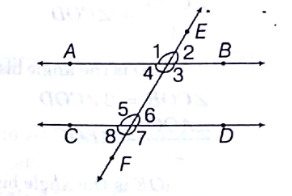
- Properties:
- Corresponding angles are equal (e.g., \( \angle 1 = \angle 5 \)).
- Alternate interior angles are equal (e.g., \( \angle 3 = \angle 5 \)).
- Interior angles on the same side of the transversal are supplementary (e.g., \( \angle 3 + \angle 6 = 180^\circ \)).
- Exterior angles on the same side are supplementary (e.g., \( \angle 1 + \angle 8 = 180^\circ \)).
- Intercepts by two transversals on three or more parallel lines are proportional.
- Example:
- Question:
- Imagine two parallel lines PQ and RS intersected by a transversal TU at points V and W, respectively. If \( \angle PVW = 40^\circ \), find the measure of the alternate interior angle to \( \angle PVW \).
- Solution:
- Visualize:
- Line PQ is parallel to RS, and transversal TU intersects PQ at V and RS at W, forming angles at V and W. \( \angle PVW \) is an interior angle at V.
- Since PQ \(\parallel\) RS, alternate interior angles are equal. The angle at W opposite to \( \angle PVW \) on the other side of the transversal (e.g., \( \angle RWT \)) is the alternate interior angle.
- Thus, \( \angle RWT = \angle PVW = 40^\circ \).
- Answer is:
- The alternate interior angle is \( 40^\circ \).
- Angles:
- Definition:
- An angle is formed when two lines meet at a point, measured in degrees. A full circle is \( 360^\circ \), a straight line is \( 180^\circ \).
- Types of Angles:
- Acute:
- \( 0^\circ < \theta < 90^\circ \).
- Right:
- \( \theta = 90^\circ \).
- Obtuse:
- \( 90^\circ < \theta < 180^\circ \).
- Straight:
- \( \theta = 180^\circ \).
- Reflex:
- \( 180^\circ < \theta < 360^\circ \).
- Complex:
- \( \theta = 360^\circ \).
- Complementary and Supplementary Angles:
- Complementary:
-
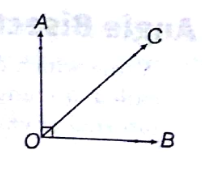
- Sum is \( 90^\circ \) (e.g., complement of \( \theta \) is \( 90^\circ - \theta \)).
- Supplementary:
-
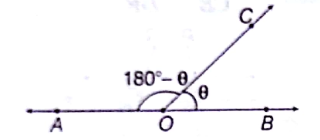
- Sum is \( 180^\circ \) (e.g., supplement of \( \theta \) is \( 180^\circ - \theta \)).
- Angle Bisector:
-
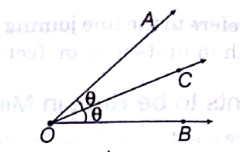
- A line dividing an angle into two equal angles, either internal or external.
- Adjacent Angles:
-
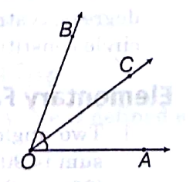
- Angles sharing a common vertex and side, lying on either side of the common side.
- Example:
- Question:
- The supplement of an angle is three times the angle itself. Find the angle.
- Solution:
- Let the angle be \( x \).
- Supplementary angle:
- \( 180^\circ - x \).
- Given:
- \( 180^\circ - x = 3x \).
- Solve:
- \( 180^\circ = 3x + x \Rightarrow 180^\circ = 4x \Rightarrow x = 45^\circ \).
- Answer is:
- The angle is \( 45^\circ \).
- Triangles:
- Definition:
- A triangle is a figure formed by three non-collinear points connected by three straight lines, with three sides (e.g., AB, BC, CA) and three angles (e.g., \( \angle A, \angle B, \angle C \)).
- Classification:
- By sides:
- Equilateral:
- All sides equal, all angles \( 60^\circ \).
- Isosceles:
- Two sides equal, angles opposite equal sides equal.
- Scalene:
- All sides and angles unequal.
- By angles:
- Acute:
- All angles \( < 90^\circ \).
- Right:
- One angle \( = 90^\circ \).
- Obtuse:
- One angle \( > 90^\circ, < 180^\circ \).
- Properties:
- Sum of interior angles:
- \( 180^\circ \).
- Exterior angle equals sum of opposite interior angles.
- Sum of two sides > third side; difference of two sides < third side.
- Largest angle opposite longest side; smallest angle opposite shortest side.
- Pythagoras theorem (right triangle):
- \( a^2 + b^2 = c^2 \), where \( c \) is the hypotenuse.
- Congruence of Triangles:
- Definition:
- Two triangles are said to be congruent if all corresponding sides and angles are exactly equal in measure.
- Symbolically written as:
- \( \triangle ABC \cong \triangle PQR \)
- Conditions for Triangle Congruence (Postulates):
- SSS (Side-Side-Side):
- All three sides of one triangle are equal to all three sides of another triangle.
- Example:
- If \( AB = PQ \), \( BC = QR \), \( CA = RP \), then \( \triangle ABC \cong \triangle PQR \).
- SAS (Side-Angle-Side):
- Two sides and the included angle (angle between those two sides) of one triangle are equal to the corresponding parts of another triangle.
- Example:
- \( AB = PQ \), \( \angle B = \angle Q \), \( BC = QR \) implies congruence.
- ASA (Angle-Side-Angle):
- Two angles and the included side of one triangle are equal to those of another triangle.
- Example:
- \( \angle A = \angle P \), \( AB = PQ \), \( \angle B = \angle Q \).
- AAS (Angle-Angle-Side):
- Two angles and a non-included side of one triangle are equal to those of another triangle.
- RHS (Right angle-Hypotenuse-Side):
- Used only for right-angled triangles.
- If the hypotenuse and one side are equal in two right-angled triangles, they are congruent.
- Notes:
- Congruent triangles are exact copies in size and shape.
- When triangles are congruent, all corresponding angles and sides are equal.
- Congruence does not depend on orientation or position — the triangle can be flipped or rotated.
- Similarity:
- Two triangles are similar if corresponding angles are equal and sides proportional.
- Ratios:
- Area ratio = square of side ratio; perimeter ratio = side ratio; altitude/median ratio = side ratio.
- Altitudes, Medians, and Bisectors:
- Altitude:
-
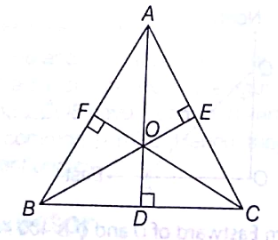
- Perpendicular from a vertex to the opposite side, meeting at the orthocentre.
- Median:
-
- Line from a vertex to the midpoint of the opposite side, meeting at the centroid (divides median in 2:1 ratio).
- Angle Bisector:
-
- Divides an angle into two equal angles, meeting at the incentre.
- Perpendicular Bisector:
-
- Line through the midpoint of a side, perpendicular to it, meeting at the circumcentre.
- Example:
- Question:
- In triangle ABC, \( \angle B = 90^\circ \), AB = 3 cm, BC = 4 cm. Find the length of hypotenuse AC and the area of the triangle.
- Solution:
- Visualize:
- Triangle ABC with \( \angle B = 90^\circ \), AB (perpendicular) = 3 cm, BC (base) = 4 cm, AC (hypotenuse).
- Pythagoras theorem:
- \( AC^2 = AB^2 + BC^2 = 3^2 + 4^2 = 9 + 16 = 25 \Rightarrow AC = \sqrt{25} = 5 \, \text{cm} \).
- Area = \( \frac{1}{2} \times \text{base} \times \text{height} = \frac{1}{2} \times BC \times AB = \frac{1}{2} \times 4 \times 3 = 6 \, \text{cm}^2 \).
- Answer is:
- Hypotenuse AC is 5 cm, and the area is 6 cm².
- Quadrilaterals:
- Definition:
- A quadrilateral is a plane figure bounded by four straight lines, with four sides, vertices, and angles.
- Types and Properties:
- Parallelogram:
- Opposite sides equal and parallel, opposite angles equal, adjacent angles supplementary (\( 180^\circ \)), diagonals bisect each other.
- Rectangle:
- Parallelogram with adjacent sides perpendicular (\( 90^\circ \)), opposite sides equal, diagonals equal and bisect.
- Rhombus:
- Parallelogram with all sides equal, diagonals bisect at right angles, opposite angles equal, adjacent angles supplementary.
- Square:
- Rectangle with all sides equal, diagonals equal and bisect at right angles, all angles \( 90^\circ \).
- Trapezium:
-
- One pair of opposite sides parallel, line joining midpoints of non-parallel sides equals half the sum of parallel sides.
- Example:
- Question:
- In parallelogram ABCD, AB = 10 cm, AD = 6 cm, and diagonal AC = 12 cm. Find the length of diagonal BD.
- Solution:
- Visualize:
- Quadrilateral ABCD with AB \(\parallel\) CD, AD \(\parallel\) BC, AB = CD = 10 cm, AD = BC = 6 cm, diagonal AC = 12 cm.
- In triangle ABC, apply Apollonius theorem: \( AB^2 + BC^2 = 2(BO^2 + AO^2) \), where O is the midpoint of diagonal AC (so AO = OC = \( \frac{12}{2} = 6 \, \text{cm} \)).
- Compute:
- \( AB^2 = 10^2 = 100 \), \( BC^2 = 6^2 = 36 \), so \( 100 + 36 = 136 = 2(BO^2 + 6^2) = 2(BO^2 + 36) \).
- Solve:
- \( 136 = 2(BO^2 + 36) \Rightarrow 68 = BO^2 + 36 \Rightarrow BO^2 = 32 \Rightarrow BO = \sqrt{32} = 4\sqrt{2} \).
- Diagonal BD = \( 2 \times BO = 2 \times 4\sqrt{2} = 8\sqrt{2} \approx 11.31 \, \text{cm} \).
- Answer is:
- The length of diagonal BD is approximately 11.31 cm.
- Circles:
- Definition:
- A circle is the locus of points equidistant from a fixed point (centre), with the distance called the radius.
- Properties:
- Arc:
-
- Portion of the circle’s circumference; equal arcs subtend equal central angles.
- Chord:
-
- Line segment joining two points on the circle; equal chords are equidistant from the centre.
- Chords in a Circle:
- Perpendicular from Centre:
- A line drawn from the centre of the circle to a chord bisects the chord if it is perpendicular to it.
- Example:
- Let chord PQ be in a circle with centre O.
- Draw line OM from O perpendicular to PQ such that M is the midpoint of PQ.
- Then, OM ⟂ PQ and PM = MQ.
- Equal Chords and Distance:
- Equal chords are equidistant from the centre of the circle.
- Conversely, chords that are equidistant from the centre are equal in length.
- Example:
- Let chords AB and CD be such that distance from O to AB and O to CD are equal.
- Then AB = CD.
- Intersecting Chords Theorem:
- If two chords AB and CD intersect at point E (internally or externally), then:
- \( AE \times EB = DE \times EC \)
- Example:
- Chords AB and CD intersect at E inside the circle.
- AE = 4 cm, EB = 3 cm, then AE × EB = 12.
- If DE = 2 cm, then EC = 6 cm since \( 2 \times 6 = 12 \).
- Central Angle:
-
- Angle subtended by an arc at the centre, twice the angle subtended at any point on the remaining circumference.
- Tangent:
-
- Line touching the circle at one point, perpendicular to the radius at the point of contact.
- Tangent and its Properties:
- Tangent-Radius Perpendicularity:
- The tangent at any point of a circle is perpendicular to the radius through the point of contact.
- Mathematically:
- If O is the centre and T is the point of contact, then OT ⊥ PT.
- Lengths of Tangents from an External Point:
-
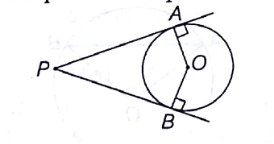
- If two tangents are drawn to a circle from an external point, the lengths of tangents are equal.
- Mathematically:
- PA = PB, where P is the external point and A, B are points of contact.
- Geometrically:
- Triangle ΔPAO ≅ ΔPBO by RHS congruency.
- Tangent-Secant Theorem (also called the Power of a Point Theorem):
-
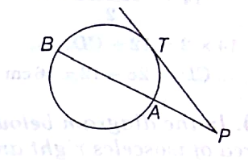
- If PT is a tangent and PAB is a secant, with P being external and A, B being points on the circle, then:
- \( PT^2 = PA \times PB \)
- Useful to solve questions involving unknown segment lengths.
- Angle Between Tangent and Chord:
-
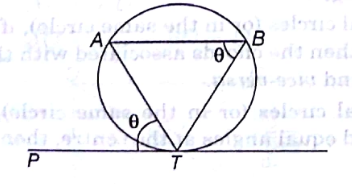
- The angle which a chord makes with a tangent at its point of contact is equal to the angle in the alternate segment.
- Mathematically:
- ∠PTA = ∠BAT, where AT is the chord and PT is the tangent.
- This is known as the Alternate Segment Theorem.
- Tangents Between Two Circles:
-
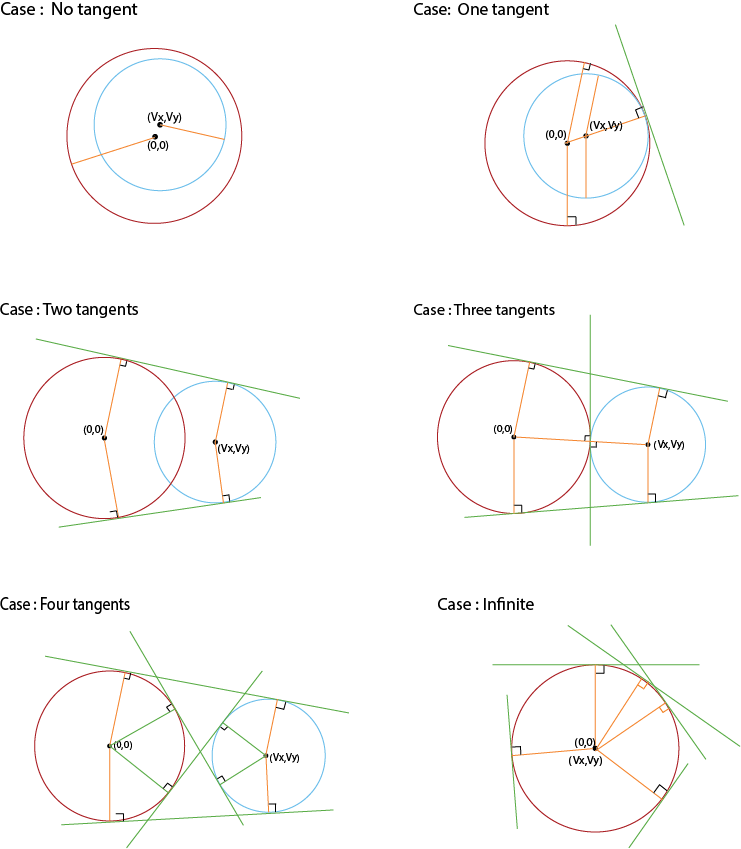
-
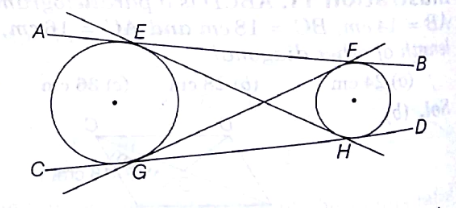
- There are two types of tangents between two circles:
- Direct tangents:
- do not intersect the line joining centres (e.g., AB and CD).
- Transverse (cross) tangents:
- intersect the line joining centres (e.g., EH and GF).
- Collinearity in Touching Circles:
- If two circles touch each other (externally or internally), then the point of contact lies on the straight line joining their centres.
- Mathematically:
- Points A, C, and B are collinear.
- Length of Direct Common Tangent Between Two Circles:
- Let the radii of two circles be \( r_1 \) and \( r_2 \), and the distance between centres be \( d \).
- Then the length of the direct common tangent:
- \( L = \sqrt{d^2 - (r_1 - r_2)^2} \)
- Length of Transverse Common Tangent Between Two Circles:
- If two circles touch each other externally, and the distance between centres is \( d = r_1 + r_2 \), then:
- Length of transverse tangent:
- \( L = \sqrt{d^2 - (r_1 + r_2)^2} \)
- Secant:
-
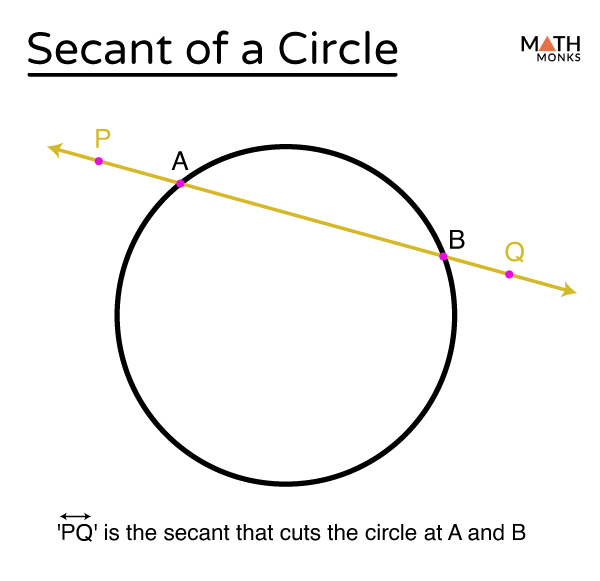
- A secant is a line that intersects a circle at two distinct points. It passes through the interior of the circle, unlike a tangent which touches at only one point.
- Cyclic Quadrilateral:
-
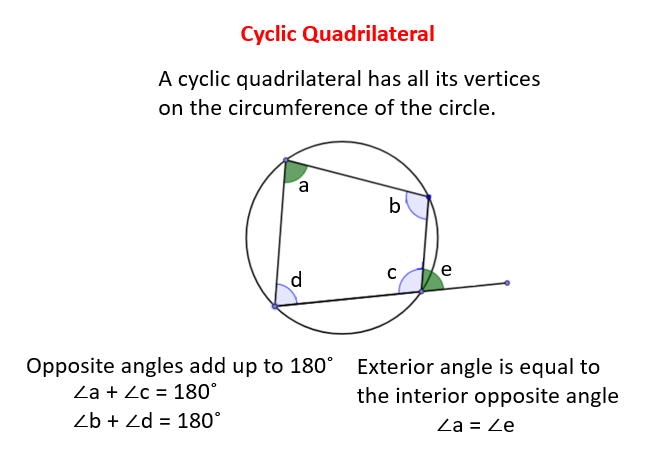
-
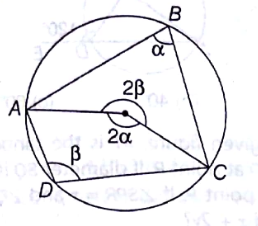
- Quadrilateral with vertices on a circle’s circumference, opposite angles supplementary (\( 180^\circ \)).
- Advanced properties are there but not value for money.
- Example:
- Question:
- In a circle with centre O, chord AB subtends \( \angle AOB = 60^\circ \). If the radius is 5 cm, find the length of chord AB.
- Solution:
- Visualize:
- Circle with centre O, radius 5 cm, chord AB forming \( \angle AOB = 60^\circ \).
- Triangle AOB is isosceles (OA = OB = 5 cm). Drop perpendicular OM from O to AB, bisecting AB (AM = MB) and \( \angle AOB \) (\( \angle AOM = \angle BOM = 30^\circ \)).
- In right triangle AOM:
- \( \sin 30^\circ = \frac{AM}{OA} = \frac{AM}{5} \Rightarrow \frac{1}{2} = \frac{AM}{5} \Rightarrow AM = 2.5 \, \text{cm} \).
- Chord AB = \( 2 \times AM = 2 \times 2.5 = 5 \, \text{cm} \).
- Answer is:
- The length of chord AB is 5 cm.
- Polygons:
- Definition:
- A polygon is a closed plane figure bounded by straight lines. Convex polygons have all interior angles \( \leq 180^\circ \); concave polygons have at least one angle \( > 180^\circ \).
- Regular Polygon:
- All sides and angles equal.
- Exterior angle:
- \( \frac{360^\circ}{n} \), where \( n \) is the number of sides.
- Interior angle:
- \( 180^\circ - \text{exterior angle} \).
- Sum of interior angles:
- \( (2n-4) \times 90^\circ \).
- Sum of exterior angles:
- \( 360^\circ \).
- Number of diagonals:
- \( \frac{n(n-3)}{2} \).
- Example:
- Question:
- A regular polygon has an exterior angle of \( 40^\circ \). Find the number of sides and the sum of its interior angles.
- Solution:
- Exterior angle = \( \frac{360^\circ}{n} \Rightarrow 40^\circ = \frac{360^\circ}{n} \Rightarrow n = \frac{360}{40} = 9 \).
- Sum of interior angles = \( (2n-4) \times 90^\circ = (2 \times 9 - 4) \times 90^\circ = 14 \times 90^\circ = 1260^\circ \).
- Answer is:
- The polygon has 9 sides, and the sum of its interior angles is \( 1260^\circ \).
- Sequences and Series:
- Basic Concepts:
- Sequence:
- A sequence is an ordered list of numbers (terms) following a specific pattern, denoted as \( T_1, T_2, T_3, \ldots, T_n \). For example, 1, 4, 7, 10 is a sequence where terms increase by a constant difference.
- Series:
- A series is the sum of the terms of a sequence. For example, the series for the sequence 1, 4, 7, 10 is \( 1 + 4 + 7 + 10 \).
- Progression:
- A progression is a sequence with a defined mathematical relationship between consecutive terms, such as Arithmetic Progression (AP), Geometric Progression (GP), or Harmonic Progression (HP).
- Example:
- Question:
- Identify whether the sequence 5, 8, 11, 14 is a progression and find its next term.
- Solution:
- Check for AP:
- Common difference = \( 8 - 5 = 3 \), \( 11 - 8 = 3 \), \( 14 - 11 = 3 \). Since the difference is constant, it’s an AP with first term \( a = 5 \) and common difference \( d = 3 \).
- Next term (n = 5):
- \( T_5 = a + (n-1)d = 5 + (5-1) \times 3 = 5 + 12 = 17 \).
- Answer is:
- The sequence is an AP, and the next term is 17.
- Arithmetic Progression (AP):
- Definition:
- An AP is a sequence where each term increases or decreases by a constant difference, called the common difference (\( d \)).
- General form:
- \( a, a+d, a+2d, \ldots, a+(n-1)d \).
- \( n \)-th term:
- \( T_n = a + (n-1)d \).
- Sum of \( n \) terms:
- \( S_n = \frac{n}{2} [2a + (n-1)d] = \frac{n}{2} (a + l) \), where \( l = a + (n-1)d \) is the last term.
- Arithmetic Mean (AM):
- For a series, \( AM = \frac{\text{first term} + \text{last term}}{2} \).
- Properties:
- Adding or multiplying each term by a constant preserves the AP.
- Three terms:
- \( a-d, a, a+d \).
- Four terms:
- \( a-3d, a-d, a+d, a+3d \).
- Five terms:
- \( a-2d, a-d, a, a+d, a+2d \).
- Example:
- Question:
- Find the 10th term and sum of the first 10 terms of the AP: 4, 7, 10, 13, ...
- Solution:
- First term \( a = 4 \), common difference \( d = 7 - 4 = 3 \).
- 10th term:
- \( T_{10} = a + (n-1)d = 4 + (10-1) \times 3 = 4 + 27 = 31 \).
- Sum of 10 terms:
- \( S_{10} = \frac{n}{2} [2a + (n-1)d] = \frac{10}{2} [2 \times 4 + (10-1) \times 3] = 5 \times (8 + 27) = 5 \times 35 = 175 \).
- Answer is:
- The 10th term is 31, and the sum of the first 10 terms is 175.
- Geometric Progression (GP):
- Definition:
- A GP is a sequence where each term is obtained by multiplying the previous term by a constant ratio, called the common ratio (\( r \)).
- General form:
- \( a, ar, ar^2, \ldots, ar^{n-1} \).
- \( n \)-th term:
- \( T_n = ar^{n-1} \).
- Sum of \( n \) terms:
- If \( r \neq 1, r < 1 \):
- \( S_n = \frac{a(1-r^n)}{1-r} \).
- If \( r > 1 \):
- \( S_n = \frac{a(r^n-1)}{r-1} \).
- Sum of infinite GP (\( |r| < 1 \)):
- \( S_\infty = \frac{a}{1-r} \).
- Geometric Mean (GM):
- For \( n \) terms, \( GM = \sqrt[n]{a_1 \cdot a_2 \cdot \ldots \cdot a_n} \).
- Properties:
- Multiplying terms by a constant or raising to a power preserves the GP.
- Reciprocals of a GP form a GP.
- Three terms:
- \( \frac{a}{r}, a, ar \).
- Four terms:
- \( \frac{a}{r^3}, \frac{a}{r}, ar, ar^3 \).
- Five terms:
- \( \frac{a}{r^2}, \frac{a}{r}, a, ar, ar^2 \).
- Example:
- Question:
- Find the 7th term and sum of the first 7 terms of the GP: 2, 6, 18, 54, ...
- Solution:
- First term \( a = 2 \), common ratio \( r = \frac{6}{2} = 3 \).
- 7th term:
- \( T_7 = ar^{7-1} = 2 \times 3^6 = 2 \times 729 = 1458 \).
- Sum of 7 terms (\( r > 1 \)):
- \( S_7 = \frac{a(r^7-1)}{r-1} = \frac{2(3^7-1)}{3-1} = \frac{2(2187-1)}{2} = 2186 \).
- Answer is:
- The 7th term is 1458, and the sum of the first 7 terms is 2186.
- Harmonic Progression (HP):
- Definition:
- An HP is a sequence where the reciprocals of the terms form an AP.
- General form:
- \( \frac{1}{a}, \frac{1}{a+d}, \frac{1}{a+2d}, \ldots \).
- \( n \)-th term:
- \( T_n = \frac{1}{a + (n-1)d} \).
- Harmonic Mean (HM):
- For \( n \) numbers, \( HM = \frac{n}{\frac{1}{a_1} + \frac{1}{a_2} + \ldots + \frac{1}{a_n}} \); for two numbers \( a, c \): \( HM = \frac{2ac}{a+c} \).
- Example:
- Question:
- The 4th term of an HP is \( \frac{1}{8} \), and the 7th term is \( \frac{1}{14} \). Find the 10th term.
- Solution:
- For the HP, the reciprocals form an AP. So, 4th term \( \frac{1}{8} \) means the 4th term of the AP is 8; 7th term \( \frac{1}{14} \) means the 7th term of the AP is 14.
- AP terms:
- \( a + 3d = 8 \), \( a + 6d = 14 \).
- Subtract:
- \( (a + 6d) - (a + 3d) = 14 - 8 \Rightarrow 3d = 6 \Rightarrow d = 2 \).
- Substitute:
- \( a + 3 \times 2 = 8 \Rightarrow a + 6 = 8 \Rightarrow a = 2 \).
- 10th term of AP:
- \( a + (10-1)d = 2 + 9 \times 2 = 2 + 18 = 20 \).
- 10th term of HP:
- \( \frac{1}{20} \).
- Answer is:
- The 10th term is \( \frac{1}{20} \).
- Series of Natural Numbers:
- Sum of first \( n \) natural numbers:
- \( \frac{n(n+1)}{2} \).
- Sum of squares of first \( n \) natural numbers:
- \( \frac{n(n+1)(2n+1)}{6} \).
- Sum of cubes of first \( n \) natural numbers:
- \( \left( \frac{n(n+1)}{2} \right)^2 \).
- Sum of first \( n \) even numbers:
- \( n(n+1) \).
- Sum of first \( n \) odd numbers:
- \( n^2 \).
- Example:
- Question:
- Find the sum of the squares of the first 10 natural numbers.
- Solution:
- Use the formula:
- \( S_n = \frac{n(n+1)(2n+1)}{6} \).
- For \( n = 10 \):
- \( S_{10} = \frac{10 \times 11 \times (2 \times 10 + 1)}{6} = \frac{10 \times 11 \times 21}{6} = \frac{2310}{6} = 385 \).
- Answer is:
- The sum of the squares is 385.
- Statistics:
- Basic Concepts:
- Definition:
- Statistics is the study of collecting, analyzing, interpreting, presenting, and organizing data. It involves designing surveys and experiments to gather data systematically.
- Measures of Central Tendency:
- Mean, median, and mode summarize a dataset by identifying its central value, providing insights into typical or representative values.
- Example:
- For marks 10, 20, 30, the mean is \( \frac{10 + 20 + 30}{3} = 20 \), indicating the average performance.
- Mean:
- Arithmetic Mean (AM):
- The sum of all values divided by the number of values.
- Ungrouped data:
- \( \text{Mean} = \frac{\sum x_i}{n} \), where \( x_i \) are the values and \( n \) is the number of values.
- Grouped data:
- \( \text{Mean} = \frac{\sum f_i x_i}{\sum f_i} \), where \( f_i \) is the frequency of value \( x_i \).
- Assumed Mean Method:
- \( \text{Mean} = a + \frac{\sum f_i d_i}{\sum f_i} \), where \( a \) is the assumed mean, \( d_i = x_i - a \).
- Property:
- \( \sum (x_i - \text{Mean}) = 0 \).
- For two numbers \( a, b \):
- \( AM = \frac{a + b}{2} \).
- Deviation from Mean:
- Deviation from the mean is the difference between a value and the arithmetic mean.
- For any value \(x\),
- Deviation = \(x - \text{Mean}\)
- If \(x > \text{Mean}\), deviation is positive (pulls average upward).
- If \(x < \text{Mean}\), deviation is negative (pulls average downward).
- Additional Property (Balance Property of Mean):
- The mean is the balancing point of the data. All the positive deviations (values above the mean) exactly cancel all the negative deviations (values below the mean).
- The sum of weighted deviations from the mean is zero:
- \( \sum f_i (x_i - \text{Mean}) = 0 \)
- Geometric Mean (GM):
- For two numbers \( a, b \):
- \( GM = \sqrt{ab} \).
- For \( n \) numbers:
- \( GM = \sqrt[n]{a_1 \cdot a_2 \cdot \ldots \cdot a_n} \).
- Harmonic Mean (HM):
- For two numbers \( a, b \):
- \( HM = \frac{2ab}{a + b} \).
- For \( n \) numbers:
- \( HM = \frac{n}{\frac{1}{a_1} + \frac{1}{a_2} + \ldots + \frac{1}{a_n}} \).
- Relationship:
- \( AM \geq GM \geq HM \).
- Example:
- Question:
- The marks of 5 students are 50, 60, 70, 80, 90. Find the arithmetic, geometric, and harmonic means.
- Solution:
- Arithmetic Mean:
- \( AM = \frac{50 + 60 + 70 + 80 + 90}{5} = \frac{350}{5} = 70 \).
- Geometric Mean:
- \( GM = \sqrt[5]{50 \times 60 \times 70 \times 80 \times 90} \). Compute product: \( 50 \times 60 = 3000 \), \( 3000 \times 70 = 210000 \), \( 210000 \times 80 = 16800000 \), \( 16800000 \times 90 = 1512000000 \). Then, \( GM = (1512000000)^{1/5} \approx 68.97 \) (using approximation for CSAT).
- Harmonic Mean:
- \( HM = \frac{5}{\frac{1}{50} + \frac{1}{60} + \frac{1}{70} + \frac{1}{80} + \frac{1}{90}} \). Compute: \( \frac{1}{50} = 0.02 \), \( \frac{1}{60} \approx 0.01667 \), \( \frac{1}{70} \approx 0.01429 \), \( \frac{1}{80} = 0.0125 \), \( \frac{1}{90} \approx 0.01111 \). Sum: \( 0.02 + 0.01667 + 0.01429 + 0.0125 + 0.01111 \approx 0.07457 \). Then, \( HM = \frac{5}{0.07457} \approx 67.05 \).
- Verify:
- \( AM (70) \geq GM (68.97) \geq HM (67.05) \).
- Answer is:
- AM = 70, GM ≈ 68.97, HM ≈ 67.05.
- Median:
- Definition:
- The median is the middle value when data is arranged in ascending or descending order, dividing the dataset into two equal parts.
- Ungrouped Data:
- Odd \( n \):
- Median = value of the \( \frac{n+1}{2} \)-th term.
- Even \( n \):
- Median = average of the \( \frac{n}{2} \)-th and \( \frac{n+1}{2} \)-th terms.
- Grouped Data:
- Median = \( l + \frac{\frac{n}{2} - cf}{f} \times h \), where \( l \) is the lower limit of the median class, \( cf \) is the cumulative frequency of the class preceding the median class, \( f \) is the frequency of the median class, and \( h \) is the class size.
- Example:
- Question:
- Find the median of the data: 12, 15, 18, 20, 22, 25, 30.
- Solution:
- Number of terms \( n = 7 \) (odd).
- Median = value of \( \frac{n+1}{2} \)-th term = \( \frac{7+1}{2} = 4 \)-th term.
- Ordered data:
- 12, 15, 18, 20, 22, 25, 30. The 4th term is 20.
- Answer is:
- The median is 20.
- Mode:
- Definition:
- The mode is the value with the highest frequency in the dataset. For ungrouped data, it’s the most frequent value; for grouped data, it’s calculated using the modal class.
- Ungrouped Data:
- Mode is the value that appears most often. It’s ill-defined if multiple values share the highest frequency or if no value repeats.
- Grouped Data:
- Mode = \( l + \frac{f_1 - f_0}{2f_1 - f_0 - f_2} \times h \), where \( l \) is the lower limit of the modal class, \( f_1 \) is its frequency, \( f_0 \) is the frequency of the preceding class, \( f_2 \) is the frequency of the succeeding class, and \( h \) is the class size.
- Example:
- Question:
- Find the mode of the following frequency distribution of test scores:
-
| Class Interval |
Frequency |
| 0-10 |
5 |
| 10-20 |
12 |
| 20-30 |
8 |
| 30-40 |
3 |
- Solution:
- Modal class:
- 10-20 (highest frequency = 12).
- Parameters:
- \( l = 10 \), \( f_1 = 12 \), \( f_0 = 5 \), \( f_2 = 8 \), \( h = 10 \).
- Mode = \( 10 + \frac{12 - 5}{2 \times 12 - 5 - 8} \times 10 = 10 + \frac{7}{24 - 13} \times 10 = 10 + \frac{7}{11} \times 10 \approx 10 + 6.36 = 16.36 \).
- Answer is:
- The mode is approximately 16.36.
- Empirical Relationship:
- Definition:
- For moderately skewed distributions, \( \text{Mode} = 3 \text{Median} - 2 \text{Mean} \). This relationship helps estimate one measure when the other two are known.
- Example:
- Question:
- The mean of a dataset is 50, and the median is 48. Estimate the mode using the empirical relationship.
- Solution:
- Use the formula:
- \( \text{Mode} = 3 \text{Median} - 2 \text{Mean} \).
- Substitute:
- \( \text{Mode} = 3 \times 48 - 2 \times 50 = 144 - 100 = 44 \).
- Answer is:
- The mode is 44.
- Reasoning
- Analogy
- Number analogy
- Common Cases & Approaches
1. Basic Arithmetic Operations
- Identify if the second number is obtained by adding, subtracting, multiplying, or dividing the first number.
- Example:
- 6 : 12 :: 9 : 18 (Multiply by 2)
2. Square and Cube Relationships
- One number might be the square or cube of another.
- Example:
- 4 : 16 :: 5 : 25 (Square relationship)
3. Square/Cube Roots
- Reverse of above: one number is the square root or cube root of the other.
- Example:
- 81 : 9 :: 64 : 8
4. Prime Numbers
- Look for consecutive prime numbers or operations involving primes.
- Example:
- 2 : 3 :: 5 : 7 (Next prime number)
5. Even-Odd Patterns
- Relationship based on parity (even/odd nature).
- Example:
- 8 : 7 :: 10 : 9 (Subtract 1 from even numbers)
6. Sum or Product of Digits
- Apply digit sum/product and see the relation.
- Example:
- 59 : 14 :: 68 : 14 (Sum of digits: 5+9=14, 6+8=14)
7. Mixed Operations
- Combination of two or more arithmetic steps.
- Example:
- 7 : 50 :: 5 : 26 (7² + 1 = 50, 5² + 1 = 26)
8. Multiplication/Division with Addition/Subtraction
- Example:
- 4 : 18 :: 6 : 38 (4×5 - 2 = 18, 6×7 - 4 = 38)
9. Positional Value (Place Value)
- Using place value in digits (tens, units).
- Example:
- 23 : 6 :: 45 : 9 (Sum of digits: 2+3=5, then +1)
10. Factorials
- Relation through factorial values.
- Example:
- 3 : 6 :: 4 : 24 (3! = 6, 4! = 24)
11. Differences between Numbers
- Observe constant or progressive differences.
- Example:
- 11 : 14 :: 17 : 20 (Add 3)
12. Ratio/Proportion
- Numbers maintain a constant ratio.
- Example:
- 2 : 8 :: 3 : 12 (Ratio 1:4)
13. Fibonacci/Series Based
- Relation from a known number series.
- Example:
- 5 : 8 :: 8 : 13 (Fibonacci sequence)
14. Reverse of Digits
- Example:
- 12 : 21 :: 34 : 43
15. Difference of Squares/Cubes
- Example:
- 5 : 16 :: 7 : 48 (5² - 9 = 16, 7² - 1 = 48)
- Strategy to find the best case quickly
- Step 1: Observe the options
- If numbers are small (≤ 50), suspect:
- Addition/Subtraction of a fixed number
- Multiplication/Division by a small number
- Simple mixed operation (e.g., ×2 + 3)
- If numbers are large (≥ 1000), suspect:
- Squares, cubes, or higher powers
- Multiplication by large constants
- Factorial or exponential patterns
- Step 2: Check ratio between first pair
- If ratio is whole number → likely multiplication/division
- If ratio is fractional → likely division or root
- If difference is constant → likely addition/subtraction
- Step 3: Check if numbers are special types
- Prime numbers
- Perfect squares/cubes
- Fibonacci series
- Powers of 2, 3, etc.
- Step 4: Consider positional digit logic
- Reverse of digits (e.g., 12 → 21)
- Sum/product of digits
- Increasing/decreasing digits
- Step 5: If no direct relation, try compound operations
- Multiply + Add
- Square then add/subtract
- Add then divide
- Step 6: Always cross-verify with second pair
- Apply suspected rule to both pairs to confirm
- Step 7: Use elimination
- If the pattern fails for even one pair, discard it immediately
- Focus on only remaining possible patterns
- Letter analogy
- Common Cases & Approaches
1. Position in Alphabet
- Letters are related based on their numerical positions (A=1, B=2, ..., Z=26).
- Example:
- A : B :: C : D (Consecutive positions: +1)
2. Forward/Backward Shifts
- One letter is obtained by adding or subtracting a fixed number of positions from the other.
- Example:
- C : F :: G : J (Forward shift by +3)
3. Opposite Letters
- Letters that are mirrors or opposites in the alphabet (A-Z=1-26, B-Y=2-25, etc.).
- Example:
- A : Z :: B : Y (Opposite pairs: 27 minus position)
4. Vowel/Consonant Patterns
- Relationships based on vowels (A,E,I,O,U) or consonants.
- Example:
- A : E :: I : O (Consecutive vowels)
5. Skip Letters
- Skipping a fixed number of letters in between.
- Example:
- A : C :: D : F (Skip one letter: +2)
6. Reverse Order
- Letters in reverse sequence or mirrored.
- Example:
- Z : Y :: X : W (Backward consecutive: -1)
7. Sum of Positions
- The sum of positions of letters in a pair is constant.
- Example:
- A : Z :: B : Y (Sum: 1+26=27, 2+25=27)
8. Mixed Shifts
- Combination of forward and backward shifts or other operations.
- Example:
- B : D :: H : J (Skip one consonant: +2 in consonants)
9. Positional Value (Place Value in Words)
- Treating letters as part of words where positions matter, like first/last letters.
- Example:
- CAT : C :: DOG : D (First letter of the word)
10. Alphabetical Order
- Letters in sequence or sorted order.
- Example:
- A : B :: X : Y (Next in alphabet)
11. Differences between Positions
- Constant or progressive differences in positions.
- Example:
- D : G :: H : K (Difference of 3 positions)
12. Ratio/Proportion in Positions
- Positions maintain a constant ratio (less common, but possible with multiples).
- Example:
- B : D :: E : J (Position 2:4 :: 5:10, multiply by 2)
13. Series Based (e.g., Every nth Letter)
- Relation from a known letter series, like every second letter.
- Example:
- A : C :: E : G (Every alternate letter)
14. Reverse of Letters
- Reversing the order of letters in pairs.
- Example:
- AB : BA :: CD : DC
15. Vowel to Consonant or Vice Versa
- Transforming vowels to next consonant or similar.
- Example:
- A : B :: E : F (Next consonant after vowel)
- Strategy to find the best case quickly
- Step 1: Observe the options
- If letters are close in alphabet (e.g., A to F), suspect:
- Forward/Backward shifts
- Skip letters
- Consecutive or vowel patterns
- If letters are far apart (e.g., A to Z), suspect:
- Opposite letters
- Sum of positions
- Reverse order
- Step 2: Check difference in positions between first pair
- If difference is whole number → likely shift or skip
- If sum is constant (e.g., 27) → opposite or sum-based
- If no direct difference → check vowel/consonant
- Step 3: Check if letters are special types
- Vowels only
- Consonants only
- Starting/ending letters of words
- Part of a series (alphabetical, reverse)
- Step 4: Consider positional logic
- Alphabet positions (numerical)
- Reverse letters
- Sum/product of positions
- Step 5: If no direct relation, try compound operations
- Shift + Skip
- Position then add/subtract
- Vowel to next consonant
- Step 6: Always cross-verify with second pair
- Apply suspected rule to both pairs to confirm
- Step 7: Use elimination
- If the pattern fails for even one pair, discard it immediately
- Focus on only remaining possible patterns
- Blood relations
- Symbols
-
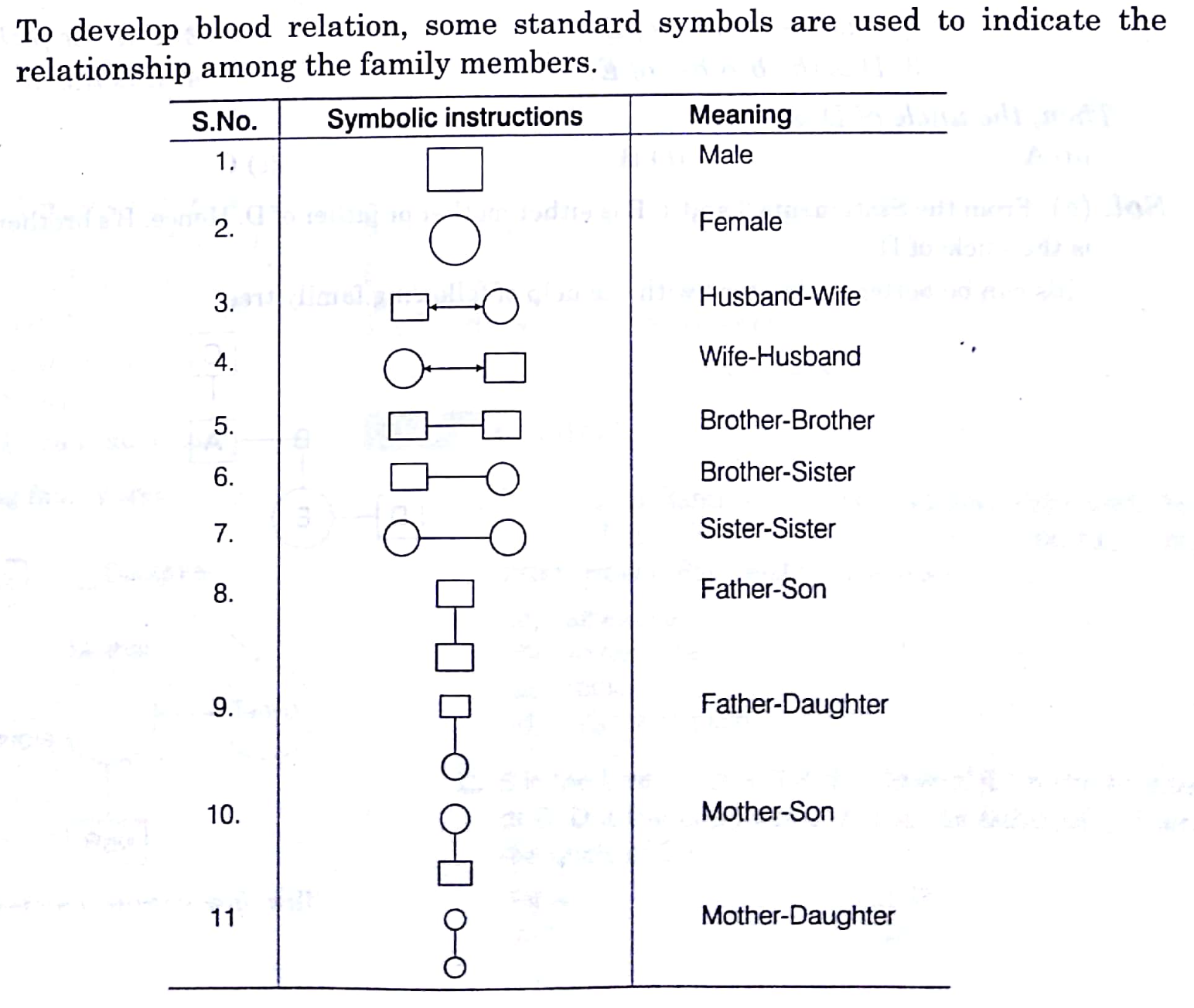
- Relations
-
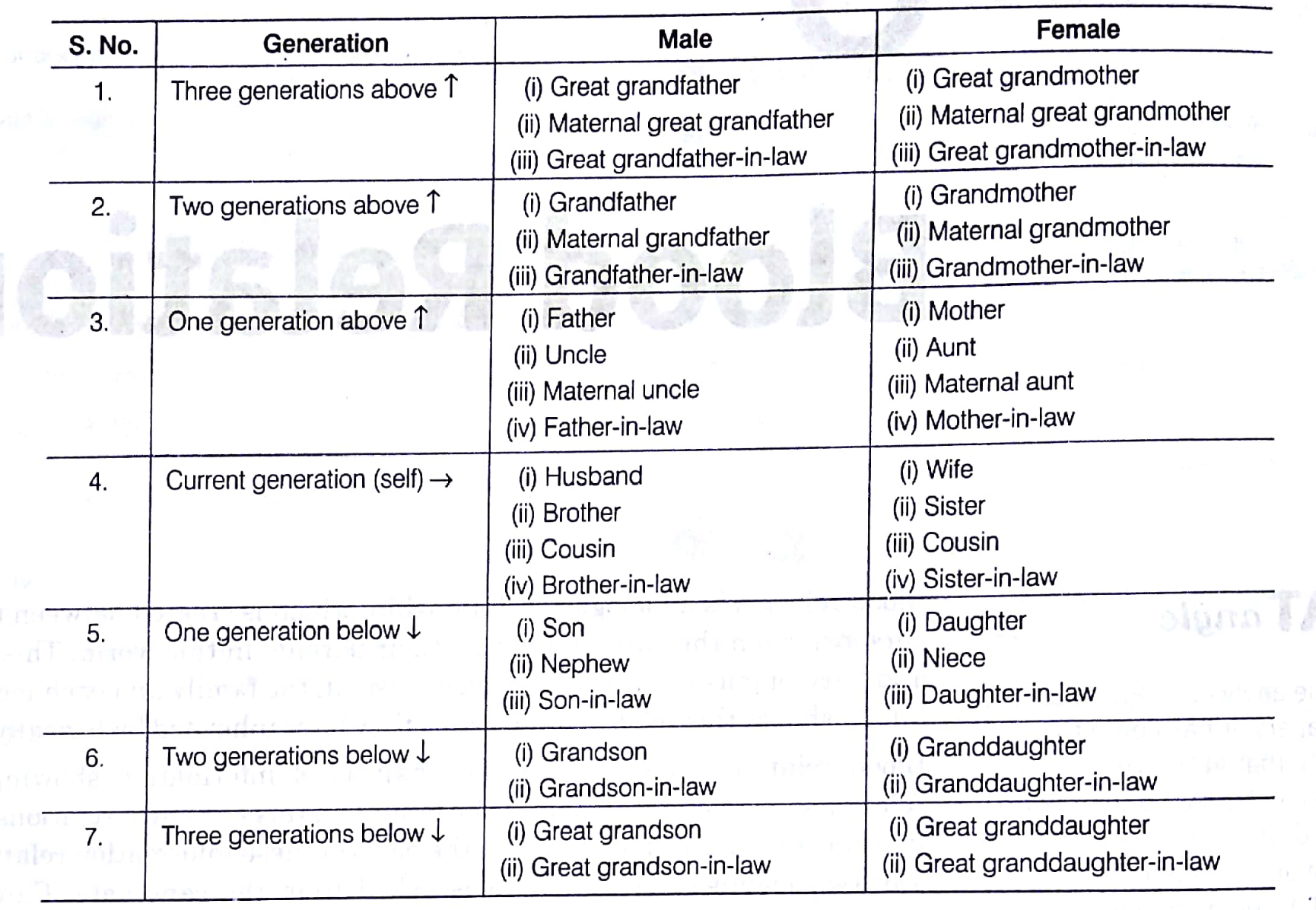
- Dice
- Single number is common
- Rotate clockwise and write in sequence from common number, the aligning numbers are opposite to each other, while the missing number is opposite to the common number.
-
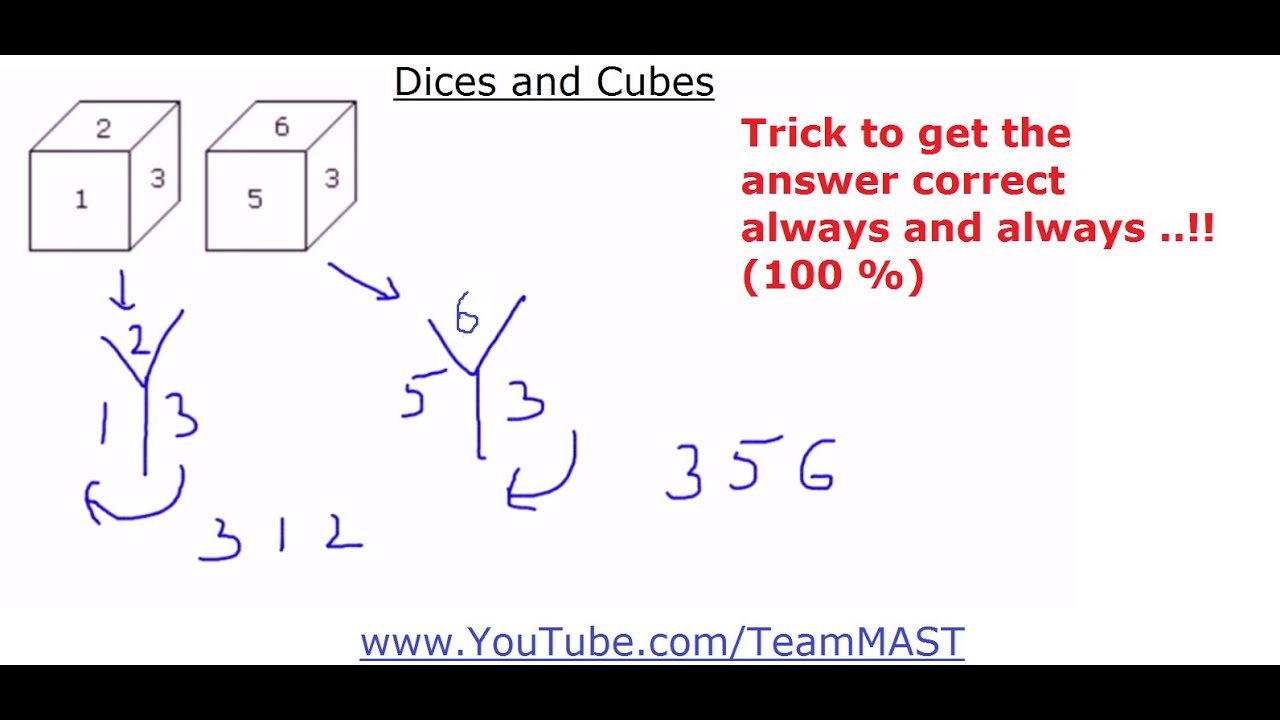
- Two numbers are common
- For only two cases
- The numbers which are not common between the dice are opposite to each other. In below case 1 and 5 are not common, so 1 is opposite to 5.
-
- For more than cases
- Need to validate multiple cases among each other on 1 to 1 basis before concluding.
-
- Open dice
- Alternative positions are opposite to each other if they are in straight line
-
- Ranking
- Need to diagrammatically solve these questions in a careful way. Below is an example.
-
- Missing character
- It uses overall logic of analogy with numbers and alphabets.
- Pattern/shape recognition
- Counting triangles
- First count singles, then by combining 2, then combining 3, and so on
- Tracing paths
- First go by minimum elevation, then keep on raising the state with each iteration
- Syllogism
- Solve with arrow diagrams, very easy to solve.
- Data Interpretation
- Involves reading graphs, charts and tables, easy to understand and attempt, uses basic numeracy skills like average, ration, percetage, etc.
- Decision making
- Involves most balanced and ethical approach to answer the questions. This skill enhances with grasp on ethics and essay writing.